Comprehensive Reflections to Aid in Governance
By Sima Guang
Translated By Yiming Yang
Annals of Han Book 10 Scroll 18
Duration of 9 years
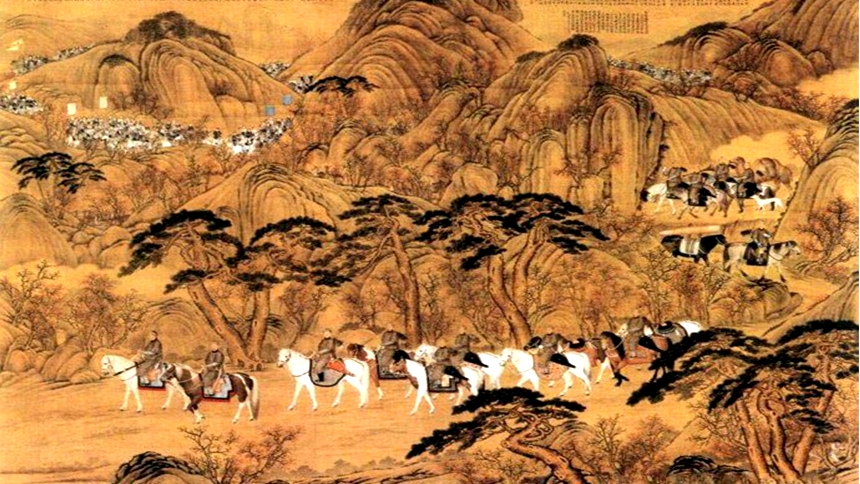
The 2nd year of Emperor Wu’s Yuan’guang Era (133 B.C.)
In October of winter, the Emperor traveled to Yong county and offered sacrifices at the Altars for Five Deities.
An occultist known as Li Shaojun was granted an audience with the Emperor, for being able to reverse aging by worshiping the kitchen god. The Emperor highly respected him. Li Shaojun, formerly an attendant of the Marquis of Shenze, Zhao Xiu, concealed his age and upbringing. He traveled widely among the feudal lords without revealing any information about his life, He seemed to have no spouse and child. He was known for his ability to influence material goods, longevity, and claimed to possess knowledge of beings who won’t die. People donated food and money to him, so he had a surplus of wealth. People believed him even more when they witnessed that he didn’t engage in regular occupations yet lived in abundance. They vied to serve him and provided him with offerings, including money, clothing, and food.
Li Shaojun was good at making surprising predictions that later were proved to be true. Once, Li Shaojun joined a gathering with Marquis Wu’an(Tian Fen) for a drink. Being present at the gathering, there was an old man who was more than ninety years old. Li Shaojun spoke about a place where he used to go hunting with the old man’s grandfather. To everyone’s astonishment, the elderly man recognized that place, having accompanied his grandfather there during his childhood.
Li Shaojun told the Emperor: “When one makes offerings to the kitchen deity, it attracts spiritual beings. By connecting with these spiritual beings, one can transform cinnabar into gold, extend his life, and even encounter the Immortals of Penglai. If one meets these Immortals and performs the Feng-Shan ceremony[worship of Heaven and Earth at Mount Tai], one will attain immortality. This is what happened to the Yellow Emperor.”
“Once, I traveled to the sea and encountered Anqi Sheng, an Immortal. He shared jujubes with me, each as big as a melon. Anqi Sheng is a being of great enlightenment, capable of traveling through the realm of Penglai. When one is in harmony with him, one can see him. When one is not, he remains hidden.”
As a result, the Emperor began to personally perform sacrifices to the kitchen god, and he sent occultists to search the sea for islands like Penglai and demigods like Anqi Sheng. They also embarked on efforts to transmute cinnabar sand into gold. After some time, Li Shaojun became seriously ill and passed away. The Emperor believed that he had undergone a transformation and not actually died. However, many occultists(necromancers and alchemists, etc.) along the coasts of Yan and Qi came to the Emperor and talked about gods and spirits.
Miu Ji of Bo raised awareness about the offering to Taiyi(North Star). He said, “The most revered heavenly deity is Taiyi, and Taiyi is assisted by the Five Deities.” Following this, the Emperor established the altar to Taiyi at the southeast outskirts of Chang’an.
Nie Yi, a wealthy man from Ma’yi County of Yanmen Commandery, suggested a plan, through the Grand Herald Wang Hui, to lure the Xiongnu through the strategy of feigned friendship and then launch a surprise attack. The Emperor consulted with his ministers, and Wang Hui said, “I’ve heard that the state of Dai, when it was a sovereign state, had a formidable enemy in the north, and yet maintained vigilance against internal warfare of the middle kingdoms. At that time, their elderly and the young were still well taken care of, trees were planted at the right time, and the granaries were always full. This made the Xiongnu hesitant to invade. Now, Your Majesty’s power unifies the entire nation. However, the incessant Xiongnu incursions are because they no longer fear us. I believe that we should launch an attack.”
Han Anguo disagreed, stating, “I’ve heard that Emperor Gaozu once was besieged in Pingcheng and ran out of food for seven days. After lifting the siege, he showed no sign of hatred and revenge. A wise ruler measures the entire world, not harboring personal resentment that harms the interests of the people. That’s why he sent Liu Jing to negotiate peace with the marriage agreement, and to this day, we’ve enjoyed five generations of benefits. I believe that we shouldn’t attack.”
Wang Hui argued, “That’s not the case. Emperor Gaozu, wearing armor and wielding sharp weapons, had gone through wars for decades. He didn’t seek vengeance for the grudge at Pingcheng not because he didn’t have the strength, But he aimed at calming the hearts of the people and giving people a respite from incessant wars. Nowadays, frequent border alarms, injured soldiers, and the sight of hearses come one after another. A benevolent person should be sad about this. That’s why I say we should attack.”
Han Anguo said, “I disagree. I’ve heard that in military affairs, you should keep our forces with satiety versus an enemy who is hungry, to maintain order versus an enemy who is in chaos, and to keep our forces well rested versus an enemy who is exhausted. By keeping our forces well-provisioned and disciplined, we can conquer enemy armies, destroy their countries, and capture their cities. This is the way of warfare advocated by wise leaders. Currently, the plan to swiftly deploy is unwise, and the depth of our invasion is difficult to execute. Rushing in a long column would lead to side ambushes, while marching in parallel would lead to less reinforcement. Moving too fast leads to supply shortage. Procrastinating leads to missed opportunities. In less than a thousand miles, we would run out of food. The horses and men would be starved, and the ancient law says, ‘Sending troops far away, and you let them be captured.’ That’s why I say we shouldn’t attack.”
Wang Hui countered, “That’s not the case. When I suggest attacking, it doesn’t mean an all-out invasion. We will go along with the greed of the Chanyu and lure him to our borders. Then, we’ll select elite cavalry and strong warriors to lay in ambush. We’ll examine the difficult terrains and use them as strategic positions for attacking the enemy. We’ll have our forces established and stationed to encircle him. Once ready, we’ll block him from the left, the right, the front, and the back. We can capture the Chanyu, and a complete victory is inevitable.”
The Emperor agreed with Wang Hui‘s plan.
In June of summer, The Emperor appointed Han Anguo, the Grand Master of Censerate, as the General Guards the Army, Commandant of the Court Guard–Li Guang, as the General of Agile Cavalry, the Grand Coachman, Gongsun He, as the General of Light Chariots, the Grand Usher Wang Hui as the General of Stationed Troops, and Grandee of Palace Li Xi as the General of Infantry. These generals were tasked with leading over 300,000 cavalry, chariots and infantry to hide in the valley near Ma’yi, preparing to ambush the Xiongnu. They secretly made a plan to launch an attack as soon as the Xiongnu entered Ma’yi.
They also sent Nie Yi as a double agent to the Xiongnu, promising to deliver the surrender of Ma’yi and the capture of its officials. Nie Yi executed criminals and placed their heads under the walls of Ma’yi. Nie Yi sent a message to the Xiongnu emissary: “The officials of Ma’yi were dead. Come soon!” Xiongnu Chanyu led his forces and crossed the border into the Wuzhou Pass. However, as they advanced, they encountered empty pastures without anyone herding livestock. They continued to advance and reached a garrison where they captured a staff of Commandant of Yanmen. The captive told the Chanyu where the Han forces were positioned as they were about to execute him.
Surprised by this revelation, Xiongnu Chanyu exclaimed, “I had my suspicions!” and decided to retreat. He considered the capture of the Han staff officer as divine revelation, and named him “the king of heaven”.
News of the Xiongnu‘s retreat reached the Han forces, who stopped their pursuit. Wang Hui led a separate unit to attack the Xiongnu‘s baggage train but also retreated when they heard that the chieftain had returned and its force was strong.
The Emperor was furious with Wang Hui. Wang Hui argued: “Initially, the plan was to lure the Xiongnu into Ma’yi and engage them in a battle. Simultaneously, I was to attack their supply train, hoping to gain an advantage. However, when the Xiongnu chieftain did not arrive and instead retreated, my 30,000 soldiers were no-match to Chanyu’s large forces and an attack would add insult to injury. I decided to return to Ma’yi and face beheading. At least I preserved the lives of 30,000 soldiers for Your Majesty.” Nevertheless, Wang Hui‘s case was brought before the Minister of Justice. The Justice Minister ruled that Wang Hui wavered and missed the opportunity, and sentenced him to death.
Wang Hui bribed the Chancellor Tian Fen with a thousand caddies of gold. Tian Fen didn’t dare to speak to The Emperor directly. Instead, he shared his opinion with the Empress Dowager, his elder sister. The Empress Dowager, in turn, informed the Emperor of Tian Fen‘s concerns: “Wang Hui was the proponent of the battle of Ma’yi. If we kill Wang Hui for failure to capture Chanyu, we are doing the bidding of the Xiongnu.”
The Emperor responded: “Wang Hui had been the one who initiated the campaign, and his actions had led to the mobilization of a large army. Even though their main objective was not achieved, Wang Hui‘s attack on the Xiongnu‘s baggage train would have helped to soothe the discontent among the soldiers and the gentry. Without punishing Wang Hui, I would not be able to appease the rest of the empire.” Wang Hui heard the verdict and committed suicide.
Thereafter, the Xiongnu broke off the marriage alliance, assailed the frontier passes, and made frequent incursions into the Han territory, their raids beyond number. Yet they remained covetous of the border markets, delighting in trade and craving the Han goods. The Han people, too, kept the markets open, thereby meeting their needs.

 Reflection by Rio Grande
Leave a reply to Yiming Yang Cancel reply