Comprehensive Reflections to Aid in Governance
By Sima Guang
Translated By Yiming Yang
Annals of Han Book 11 Scroll 19 (continued)
The 2nd year of Emperor Wu’s Yuan’shou Era (121 B.C. continued)
The Prince of Jiangdu, Liu Jian, engaged in numerous heinous acts, including an affair with Consort Nao, the favored concubine of his father, Prince Yi, and an incestuous relationship with his younger sister, Liu Zhengchen. On one occasion, during a tremendous storm, Liu Jian went boating on Leibei Lake. He ordered two attendants to board a small boat despite the perilous conditions. The boat capsized, and the attendants struggled helplessly in the water, unable to save themselves. Liu Jian, standing by, laughed heartily and ordered no rescue, leading to their tragic deaths. He indulged in lewd and cruel activities, wantonly taking the lives of thirty-five innocent people.
Realizing the extent of his crimes and fearing retribution, Liu Jian conspired with his consort, Cheng Guang, to invoke witchcraft. They employed a maid from Yue to pray for divine intervention, cursing the Emperor. Furthermore, upon hearing of the plots in Huainan and Hengshan, Liu Jian began manufacturing weapons and forging the imperial seal in preparation for rebellion. When these treasonous acts were discovered, the authorities demanded his arrest and execution. In the face of inevitable punishment, Liu Jian chose to take his own life, while Cheng Guang and the others involved were executed publicly. The principality of Jiangdu was thus brought to ruin.
In the same year, Prince Kang of Jiaodong, Liu Ji, passed away.
In the autumn, the Hunye King of the Xiongnu surrendered. At that time, the Chanyu, enraged, sought to exact vengeance upon the Hunye King and the Xiutu King in the western regions, whose forces had suffered great losses at the hands of the Han—tens of thousands slain or taken captive. The Chanyu, in his fury, intended to summon and execute these two kings. Fearing for their lives, the Hunye King and the Xiutu King secretly conspired to surrender to the Han. They first sent envoys to the border, where they were intercepted by Han forces, who relayed their intentions to the Emperor.
At this time, the Grand Usher, Li Xi, was constructing a fortress along the Yellow River. He intercepted the Hunye King’s messengers and swiftly reported the matter to the Emperor. Suspecting that this surrender might be a ruse to launch a surprise attack, the Emperor commanded the General of Agile Cavalry, Huo Qubing, to lead his troops and meet with the Hunye King’s emissaries. The Xiutu King, regretting his decision to surrender, was killed by the Hunye King, who then assumed control over his followers.
When General Huo Qubing crossed the Yellow River, he encountered the Hunye King’s forces. Some of the Hunye King’s subordinate commanders, seeing the Han army, hesitated to surrender and attempted to flee. Without delay, Huo Qubing struck swiftly, capturing and executing eight thousand of those who sought to escape. The Hunye King was then placed in a government carriage and sent alone to the Emperor, while the rest of the surrendered forces were escorted across the Yellow River.
More than forty thousand surrendered, though their numbers were exaggerated to a hundred thousand. Upon reaching Chang’an, the Emperor rewarded the surrendering forces with numerous grants, enfeoffing the Hunye King with ten thousand households and bestowing upon him the title of Marquis of Luoyin. Four of his subordinate kings, including Hudu Ni, were likewise ennobled as marquises. In addition, the General of Agile Cavalry, Huo Qubing, was granted an increase of 1,700 households in his fief.
When the Hunye King surrendered, the Han court summoned twenty thousand carriages to welcome them. However, the county officials lacked the necessary funds and were forced to borrow horses from the people. Some citizens, unwilling to part with their horses, hid them, and there were not enough horses to meet the demand. The Emperor, enraged, ordered the execution of the magistrate of Chang’an. But the Right Interior Minister, Ji An, interjected, saying, “The magistrate of Chang’an is innocent. If anyone is to be punished, let it be me. Only then will the people be willing to bring forth their horses. Moreover, the Xiongnu have abandoned their ruler and come to surrender to Han. We should gradually assimilate these migrants, county by county. How could we cause turmoil throughout the country, exhausting the resources of the Middle Kingdom to serve these outsiders and barbarians?” The Emperor fell silent.
When the Hunye King and his followers arrived, more than five hundred merchants and traders were sentenced to death for violating the laws prohibiting trade with foreigners. Ji An requested an audience at the Gaomen Hall of Weiyang Palace and spoke: “The Xiongnu have invaded our borders, shattered our marriage alliances, and caused countless casualties when the Middle Kingdom mobilized troops to suppress them. The expenses for this campaign have been enormous. I, foolishly, suggest that Your Majesty consider taking the surrendered Xiongnu people and distributing them as slaves and servants to the families of those who died serving in the army. The spoils of war could be distributed among the people as compensation for their losses, alleviating their suffering. But now, even though tens of thousands of the Hunye have surrendered, the treasury is drained to reward them, and good citizens are levied to serve the foreigners. This is akin to pampering spoiled children. How could the common folk in Chang’an, who buy and sell, understand that the bureaucratic officials have interpreted their actions as smuggling wealth and goods across the borders and punished them for it? Your Majesty, if you cannot gain benefits from the Xiongnu to compensate the nation and, instead, wrongfully execute more than five hundred innocent people, you are protecting the leaves but damaging the branches. I humbly advise against it.”
The Emperor, displeased, remained quiet and then remarked, “I have not heard Ji An speak for some time, and now he speaks foolishly once again.”
In a short time, the surrendered Xiongnu were relocated and distributed across the borders of five commanderies(Longxi, Beidi, Shangjun, Shuofang, Yunzhong). These commanderies, originally situated outside the old passes but within the territory of Henan, were transformed into five satellite states, each adhering to their former customs. In the region west of Jincheng and beyond, extending from the Hexi Corridor and southern mountains to the Salt Marsh(Lop Nur), there were no Xiongnu to be found. Occasionally, there were rare visits from Xiongnu scouts, but these visits were infrequent.
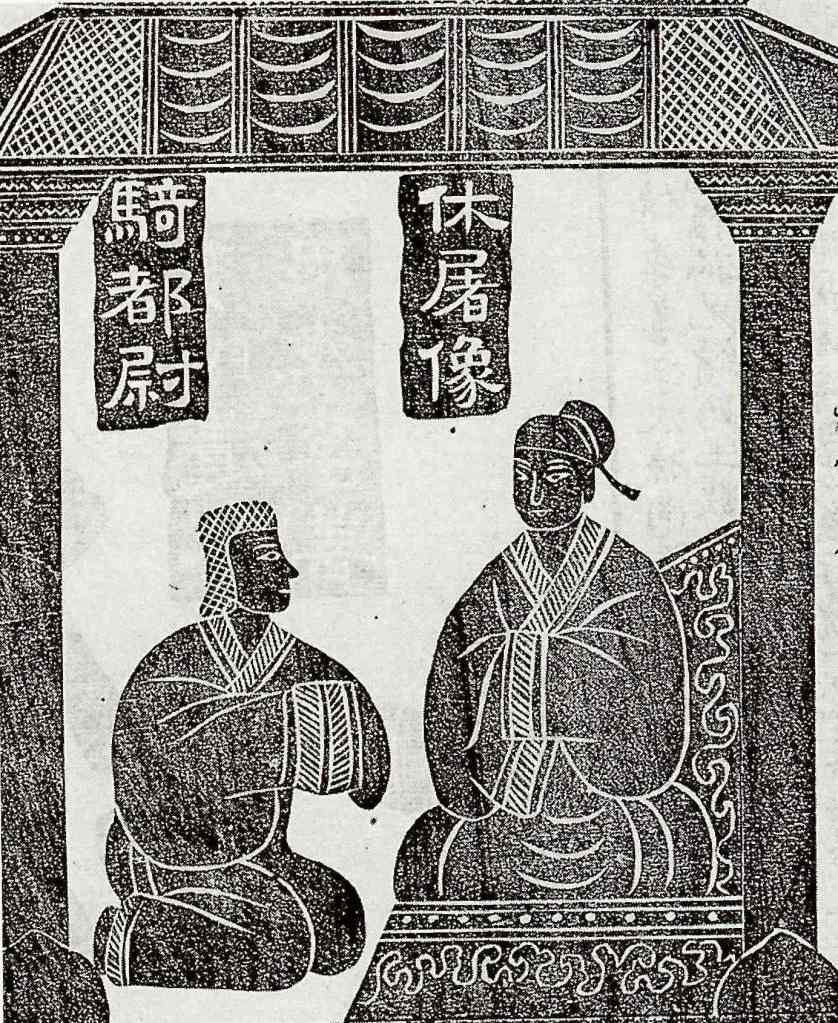
The son of the Xiutu King, Midi(sinicized form of Dimitri), along with his mother, Yanzhi (Madame/Queen), and his younger brother, Lun(sinicized form of Leo), entered imperial service. They were assigned to care for the imperial horses under the supervision of the Privy Treasurer. One day, during the Emperor’s leisure activities, when he was inspecting the horses, he was surrounded by his harem. Midi, along with several dozen others, led the horses past the hall, and while every servant man stole glances at the beauties, Midi alone dared not look. Midi, standing eight (Chinese)feet and two (Chinese)inches tall, had a stern countenance, and the horses he led were exceptionally healthy and well-groomed. The Emperor, intrigued by this, inquired about Midi‘s background. Midi spoke honestly, and the Emperor, amazed by his appearance and character, immediately ordered a bath for him, along with proper attire. He was appointed as the horse stable supervisor, later promoted to an attendant-in-waiting, then to the Commandant of Cavalry, and finally elevated to the rank of Grandee of the Chamberlain.
As Midi grew closer to the Emperor, he made no mistakes in his service. The Emperor trusted him deeply and showered him with rewards, giving him gifts worth thousands of gold. Midi would drive for the Emperor when he went out and closely attend to him when indoors. Many among the nobility secretly complained, “Your Majesty has unwittingly elevated this boy from the barbarians and now treasures him as one of your own.” Yet, when the Emperor heard these murmurs, his esteem for Midi only grew. Because the Xiutu King had made a golden statue as an offering to the heavenly lord, the Emperor bestowed upon Midi the surname Jin, meaning “gold.”
 Reflection by Rio Grande
Leave a comment