Comprehensive Reflections to Aid in Governance
By Sima Guang
Translated By Yiming Yang
Annals of Han Book 11 Scroll 19 (continued)
The 5th year of Emperor Wu’s Yuan’shuo Era (124 B.C. continued)
In the summer month of June, an edict was issued, declaring, “It is known that guiding the people through rituals and nurturing them with music are essential. Yet now, with rituals in decline and music absent, We are deeply concerned. Let the officials responsible for rituals promote the study and revive the rites, thereby leading the entire nation!”
In response, Chancellor Gongsun Hong and others suggested, “We request the establishment of fifty students for the Erudite, exempting them from public taxes and duties, to be assessed for their abilities and appointed to positions such as Attendant-in-waiting, Literary, and Office Clerks. Those who display exceptional talent will be honored and recommended for higher positions. Conversely, those who show no dedication to learning and possess lesser abilities shall be dismissed. Furthermore, officials who are proficient in at least one of the Five Confucian Classics shall be selected as candidates for roles with a salary of 2,000 picul.”
The Emperor gave his approval. From that time forth, more scholars appeared among the ministers, grandees, gentry, and local officials.
In autumn, ten thousand riders from the Xiongnu invaded the territory of Dai, killing Commandant Zhu Ying and capturing over a thousand people.
The Prince of Huainan, Liu An, was greatly fond of reading and literature. He took pleasure in gaining fame and attracted thousands of guests and scholars versed in various teachings. Among his courtiers and guests were many frivolous individuals from the Yangtze and Huai River basins, who bore longstanding resentment towards the Prince Li of Huainan, Liu Chang, due to his banishment to Qiong and eventual death. These men often brought up the matter to provoke Liu An.
In the sixth year of the Emperor Wen‘s Early Era, a comet appeared. Some lobbied the Prince of Huainan, saying, “In the time when the Prince of Wu(Liu Pi) raised his army, a comet appeared, stretching several feet, and it led to bloodshed across a thousand miles. Now, with a comet filling the entire sky, it may signal a large-scale uprising of armies across the realm.” The prince believed these words to be true and thus increased preparations for siege weapons, while also amassing gold and wealth.
Guard Lei Bei, in an accident during fencing practice, had wounded the Crown Prince of Huainan, Liu Qian. An edict was issued proclaiming that anyone willing to join the campaign against the Xiongnu should report to Chang’an. Lei Bei expressed his eagerness to fight against the Xiongnu. However, the Crown Prince Liu Qian disparaged Lei Bei in front of Liu An. The Prince of Huainan scolded and dismissed him to set an example for others.
In the same year, Lei Bei fled to Chang’an and submitted a petition to clear his name. The matter was sent to the magistrate for investigation, and Lei Bei’s complaint was linked to the Prince of Huainan. The court officials requested the arrest and trial of the Prince of Huainan. The Crown Prince of Huainan then devised a plan to dress someone as a palace guard, who would hold a halberd by the prince’s side. If any envoy from the Han was found to be suspicious, the guard would kill the person, triggering a rebellion. The Emperor dispatched the Capital Guard commandant Duan Hong to interrogate the prince. However, upon observing Duan Hong‘s composed demeanor, the prince refrained from carrying out the plan.
The court officials reported, “Liu An, who obstructed a warrior willing to fight the Xiongnu, defied the clear decree and must be punished by execution.” A decree was issued, stripping him of two counties. Deeply ashamed, Prince Huainan lamented, “Even when I act with benevolence and righteousness, I am met with territorial losses.” Out of this shame and humiliation, his plot to rebel grew more intense.
Liu An‘s relationship with the Prince of Hengshan, Liu Ci, had long been strained and grew more distant with time. When the Prince of Hengshan heard of a potential rebellion by Liu An, he feared being annexed by his brother and began preparing countermeasures by gathering retainers and weapons for rebellion. He believed that if the Prince of Huainan were to conquer the west, he would raise an army to seize control of the Yangtze River and Huai River basins.
The Queen of the Princedom of Hengshan, Xu Lai, accused the heir-apparent of Prince Hengshan, Liu Shuang of wrongdoing, hoping to depose him and install his younger brother, Prince Liu Xiao, in his place. The Prince of Hengshan detained his heir Liu Shuang and bestowed the royal seal upon Prince Liu Xiao, commanding him to gather retainers. When these retainers arrived, they, from illusive signs, understood the rebellious intentions of both the Princes of Huainan and Hengshan, and clandestinely aided and abetted them day and night.
The Prince of Hengshan then instructed Mei He and Chen Xi of Jiangdu, retainers of Liu Xiao, to manufacture chariots, forge arrows, and carve imperial seals and insignias for generals and military officers. In the autumn, when the Prince of Hengshan was due to attend court, he planned to pass through Huainan. At this moment, the two brothers, reconciled as siblings, resolved their previous differences and agreed to unite in their rebellion.
Upon their reconciliation, Prince Liu Ci sent a letter pleading illness, thereby securing exemption from the Emperor’s summons and avoiding his visit to the capital.
The 6th year of Emperor Wu’s Yuan’shuo Era (123 B.C.)
In February of spring, the Grand General Wei Qing set forth from Dingxiang to confront the Xiongnu. The Emperor appointed Gongsun Ao, the Marquis Heqi, as General of the Center; Grand Coachman Gongsun He as General of the Left; Zhao Xin, the Marquis Xi, as General of the Front; Capital Guard Commander Su Jian as General of the Right; Chamberlain Li Guang as General of the Rear; and Li Zu, the Left Interior Minister, as the Mighty Crossbow General, all under the command of the Grand General. They returned after slaying several thousand enemies, resting their soldiers and horses in Dingxiang, Yunzhong, and Yanmen.
A general amnesty was proclaimed throughout the empire.
In April of summer, Wei Qing once more led the six generals from Dingxiang to engage the Xiongnu, resulting in the slaying and capturing of more than ten thousand enemies. The General of the Right, Su Jian, and the General of the Front, Zhao Xin, leading over three thousand cavalry, encountered the Chanyu’s forces alone. After battling for more than a day, the Han forces were nearly exhausted. Zhao Xin, once a minor king among the Nomad tribes who had surrendered to the Han and been granted the title of Marquis Xi, was lured by the Xiongnu after being defeated. He led the remaining eight hundred riders to defect to the Xiongnu. Su Jian, having lost his entire army, managed to escape and returned to the Grand General’s camp.
Gentleman Consultant Zhou Ba proposed, “Since the Grand General has assumed command, no general has been executed. Now that Su Jian has abandoned his army, he must be executed to uphold the authority of the Grand General.”
The military judge Hong and Chief of Staff An countered, “Not so. According to the ‘Art of War,’ even the toughest small forces may fall before much larger ones. Su Jian faced tens of thousands of enemies with only a few thousand troops, fought fiercely for over a day, exhausted his soldiers, yet did not entertain thoughts of defection and willingly returned. Executing him would suggest that failure is intolerable in all circumstances, which is inappropriate.”
The Grand General responded, “I, Wei Qing, am fortunate enough to have the Emperor’s trust and command a great army. I am not concerned with lacking authority. Zhou Ba advises me to behead a general to assert my power; however, this does not suit my station as a subject of the court. Even if I have the authority to execute a general, with all the favor and privilege I possess, I cannot unilaterally pass judgment without first reporting to the Emperor. I will send Su Jian to the imperial court, and the Emperor shall determine his fate. This demonstrates that as a servant, I do not dare wield arbitrary power. Is this not the proper course?”
The military officers all agreed, saying, “Well said!” They then imprisoned Su Jian and sent him to the Emperor for trial.
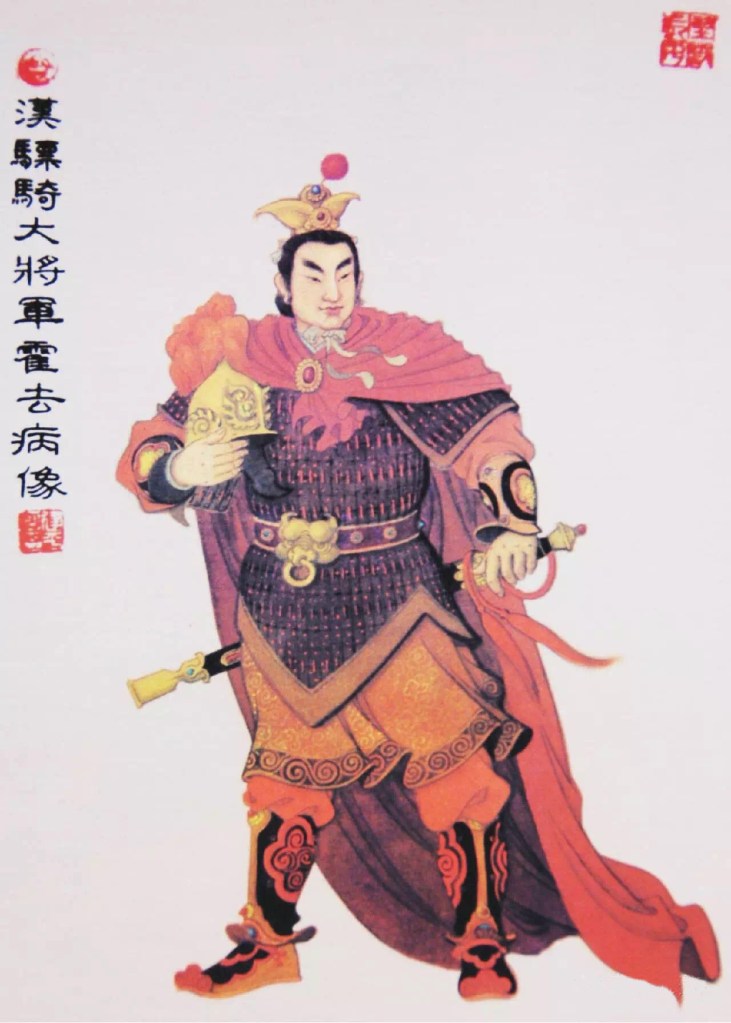
An official in Pingyang County, named Huo Zhongru, served in the household of the Marquis of Pingyang[the husband of Princess Pingyang]. He had an affair with Wei Qing’s elder sister, Wei Shao’er, a maid, resulting in the birth of Huo Qubing. At the age of eighteen, Huo Qubing became an attendant to the Emperor. He excelled in horse riding and archery. He accompanied the Grand General twice in wars against the Xiongnu, serving as Colonel of Piaoyao [Soaring Hawk]. Displaying immense bravery, he led 800 light cavalry troops, charging ahead of the main army, capturing or killing numerous enemies, far surpassing expectations.
The Emperor issued a decree, saying: “Colonel Piaoyao Huo Qubing has slain over 2,000 enemy soldiers, captured the prime minister and chieftains of the Xiongnu, beheaded the Chanyu’s Grand Uncle, Chan, Marquis of Jiruo, and seized Chanyu’s uncle, Luobi. His feats surpass all others in the army. He shall be honored as Marquis of Guanjun [Champion]. The Prefect of Shanggu, Hao Xian, has followed the Grand General in four campaigns against the Xiongnu, capturing and beheading over 2,000 enemies. For his contributions, Hao Xian shall be bestowed with the title of Marquis Zhongli.”
That year, due to the loss of two generals, the defection of Marquis Xi, and lesser military accomplishments, the Grand General was not granted an increase in noble rank but was instead given a thousand gold coins. General of the Right, Su Jian, upon his return, was not executed but was demoted to commoner status and redeemed by paying a fine.
At that time, the Chanyu, having Marquis Xi, Zhao Xin, surrendered, promoted him to Under King, second only to the Chanyu. He married his sister to Zhao Xin and plotted against the Han. Zhao Xin counseled the Chanyu to move further north to a distant location, making it appear as though the Xiongnu were withdrawing, intending to lure and exhaust the Han forces for a future attack at a remote location, far from the border. The Chanyu followed Zhao Xin‘s plan.
During those years, the Han Household annually dispatched over a million soldiers to fight against the nomadic tribes. The soldiers who captured or killed enemies were rewarded with more than two hundred thousand catties of gold, yet over a hundred thousand Han soldiers and horses perished. The expenses for the military campaigns and supplies drained the treasury, resulting in insufficient provisions for the soldiers.
In June, a decree was issued allowing civilians to purchase noble titles and amnesty for past crimes by paying a fine. A system of rewarding military achievements was also established, called “Military Merit Lordship,” with seventeen ranks and over three hundred thousand gold coins allocated. Those who purchased these titles and attained the rank of “chiliarch” were granted priority for official appointments. The system of governance became muddled and riddled with various loopholes, leading to a decline in administrative efficacy.
 Reflection by Rio Grande
Leave a comment