Comprehensive Reflections to Aid in Governance
By Sima Guang
Translated By Yiming Yang
Annals of Han Book 11 Scroll 19
Duration of 6 years
The 5th year of Emperor Wu’s Yuan’shuo Era (124 B.C.)
In winter, on November 5, Xue Ze was relieved of his office. In his place, Gongsun Hong was appointed Chancellor and ennobled as the Marquis of Pingjin. From that time forth, the custom of conferring noble titles upon those who held the chancellorship began with Gongsun Hong.
The Son of Heaven set his heart upon vast enterprises and the glory of national achievement. Gongsun Hong, opening the Eastern Gate of the Chancellor’s Office, summoned worthies and men of counsel, discoursing with them on state affairs. Whenever he entered court to present matters for deliberation, he would bring up proposals aimed at the benefit of the realm. The Emperor, esteeming his words, would summon scholars of the court to contend in debate with him.
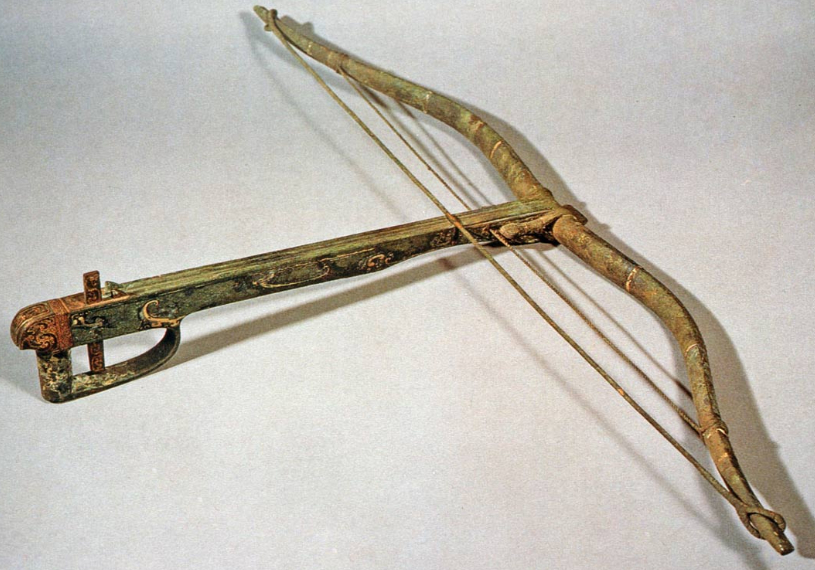
On one occasion, Gongsun Hong memorialized, saying: “Let it be forbidden for the people to bear bows and crossbows. For the sake of public safety, such arms must be restrained. Ten brigands with crossbows may cause a hundred officials to shrink in fear and not step forward.”
The Emperor commanded the court to deliberate upon this proposal.
Thereupon Yuqiu Shouwang, an Attendant-in-waiting, stepped forth and replied: “I have heard that the Five Arms—spear, halberd, bow, sword, and dagger-axe—were not devised to bring harm, but to subdue evil and restrain violence. In the time of Qin, when the empire was first united, weapons were cast into molten cauldrons and swords were blunted. Thereafter, the people fought each other with hoes, riding crops, and clubs. Crimes multiplied, banditry spread, and rebellion ensued. In the end, the state fell to ruin.
“Thus, the sage kings of old taught the people by virtue and governed by rites, knowing that prohibitions alone could not suffice. The Book of Rites records: ‘When a male child is born, raise the mulberry-wood bow, and shoot arrows of reed to Heaven, to Earth, and to the four directions’—signifying that the man is destined to serve in arms throughout his life. The Grand Archery Rite, practiced from the Son of Heaven to the commoner, has been a ceremony passed down since the Three Dynasties.
“I have heard of kings instructing the people through archery rites, but never of those who banned bows and arrows. What is forbidden is intended to prevent theft and assault; yet though death is decreed as punishment, still such crimes do not cease. This shows that even the severest law does not check the greatest of transgressions. If evil men conceal arms in secret while honest men are stripped of means to defend themselves, the law serves not justice but misfortune. I humbly submit: this measure is ill-advised.”
This memorial was entered into the official record and submitted for imperial consideration. The Sovereign summoned Gongsun Hong and inquired of him regarding the matter, but Gongsun Hong could offer no rebuttal.
Gongsun Hong was by nature suspicious and inwardly vindictive. All who had once opposed him, whether near or distant, though they might appear on cordial terms, would in time meet with his concealed vengeance.
Dong Zhongshu, a man of upright character and moral resolve, regarded Gongsun Hong as sycophantic and insincere. Gongsun Hong, harboring envy, bore ill will toward him. The Prince of Jiaoxi, Liu Duan, indulged in lawlessness and brought about many deaths, including the demise of several officials of the 2,000-picul rank. Gongsun Hong, seeking to distance Dong Zhongshu from the Emperor, recommended him to serve as prime minister of the Principality of Jiaoxi. Yet Dong Zhongshu, pleading illness, did not assume the post.
Ji An, who often voiced criticisms of Confucian doctrine, had long held differences with Gongsun Hong. Desiring to entrap him, Gongsun Hong seized upon an opportunity to destroy him. He memorialized the Emperor, saying: “The jurisdiction of the Right Interior Minister(intendant of Right Fufeng) is replete with nobles and high ministers. It is a post fraught with difficulty, and only one of great stature may govern it. I propose the transfer of Ji An to serve as Right Interior Minister.” The Emperor approved this request.
In January of spring, a great drought afflicted the land.
At that time, the Right Tuqi King of the Xiongnu made repeated incursions into Shuofang Commandery, harassing the border regions. The Sovereign dispatched the General of Chariots and Cavalry, Wei Qing, with thirty thousand cavalrymen departing from Gaoque Pass. Su Jian, Commandant of the Palace Guard, was appointed as Guerrilla General; Li Zu, the Left Interior Minister, was made Strong Crossbow General; Gongsun He, Grand Coachman, was named Cavalry General; and Li Cai, Prime Minister of Dai, was appointed Light Chariot General. All were placed under the overall command of Wei Qing. They departed from Shuofang to strike the enemy.
In addition, the Grand Usher Li Xi and the Marquis of Antou, Zhang Cigong, were each appointed as generals and marched from Youbeiping. Altogether, the expeditionary force exceeded one hundred thousand men, advancing in concert against the Xiongnu.
The Right Tuqi King, believing the Han troops too distant to pose a threat, indulged in wine and became inebriated. But Wei Qing led his men swiftly by night, advancing six to seven hundred li without pause, and fell upon the Right Tuqi King’s encampment. Caught unawares, the Right Tuqi King was seized with panic. In the dead of night, he broke through the encirclement and fled northward with but a few hundred elite riders.
The Han forces captured more than ten subordinate kings under the Right Tuqi King, and seized over fifteen thousand men and women. Livestock taken numbered in the hundreds of thousands. With their objectives achieved, the army withdrew in good order and returned in triumph.
When the army reached the border pass, the Son of Heaven dispatched an envoy bearing the seal of the Grand General, and in the field conferred upon Wei Qing the title of Grand General. All other generals were henceforth subordinated to his command.
In April of summer, Wei Qing was further rewarded with an increase of fief comprising 8,700 households. His three sons—Wei Kang, Wei Buyi, and Wei Deng—though yet in infancy, were each ennobled as marquises.
Wei Qing respectfully declined, memorializing thus: “By the grace of Heaven and the favor of Your Majesty, I have received fortune beyond measure. The great victory of the army was due to the valor and exertions of all the colonels and officers. The generous increase of my fief, and the enfeoffment of my sons with marquisates, though they are yet swaddled in cloth, is not the example I had hoped to set for those soldiers who risked their lives in the field.”
The Emperor replied, “I have not forgotten the meritorious deeds of all the colonels.”
Thereafter, the Emperor granted titles and honors to the various officers of distinction:
Gongsun Ao, Colonel of Army Protectors, was made Marquis of Heqi;
Han Yue, Commandant, was made Marquis of Long’e;
Gongsun He, Commandant, was made Marquis of Nanjiao;
Li Cha, Commandant, was made Marquis of Le’an;
Li Shuo, Colonel, was made Marquis of Shezhi;
Zhao Buyu, Colonel, was made Marquis of Suicheng;
Gongsun Rongnu, Colonel, was made Marquis of Congping.
In addition, Li Zu, Li Xi, and Colonel Dou Ruyi were each granted the title of Marquis Within the Passes.
At this time, Wei Qing stood in highest favor among all court officials and ministers; none within the realm equaled his prestige. From the Three Excellencies down through the Nine Ministers, all bore themselves with deference before him. Only Ji An alone treated Wei Qing as an equal, neither yielding nor posturing.
Some among the court cautioned Ji An, saying, “Now that the Son of Heaven commands all officials to bow before the Grand General, and the Grand General’s rank is exalted beyond compare, how can you refrain from bowing?”
Ji An replied, “When the Grand General salutes his peer, does his status thereby lessen?”
When these words reached the ears of the Grand General, he held Ji An in even greater esteem. Thereafter, Wei Qing often consulted Ji An concerning affairs of state and matters of court, treating him with a respect greater than he accorded others.Though Wei Qing’s position was lofty, when he came into an audience, the Emperor would recline upon his couch and receive him with ease. When Chancellor Gongsun Hong was summoned for informal audiences, the Son of Heaven at times dispensed with donning his imperial crown. Yet on one occasion, when Ji An came to request an audience, the Emperor, seated in the armory tent without his crown, glimpsed Ji An’s approach, and at once withdrew to the rear tent. He dispatched an attendant to grant Ji An’s petition in full, without requiring his presence. Thus was the reverence accorded to Ji An.
 Reflection by Rio Grande
Leave a comment