Comprehensive Reflections to Aid in Governance
By Sima Guang
Translated By Yiming Yang
Annals of Han Book 7 Scroll 15 (continued)
The 15th year of the Emperor Wen of Early Era (165 B.C.)
In the spring, the appearance of yellow dragons was reported in Chengji County. The Emperor summoned Gongsun Chen and appointed him as erudite, instructing him to clarify the essence of earth alongside other scholars and draft revisions to the calendar and the colors of official attire. As a result, Zhang Cang became despondent and resigned.
In April of summer, the Emperor made his first visit to Yong County, where he performed the imperial sacrifice to the Five Color Emperors in the suburban area. He also granted a general amnesty to the entire nation.
In September, a decree was issued instructing princes, ministers, and prefects to recommend virtuous and outspoken individuals who could offer strong remonstrances. The Emperor personally reviewed their recommendations. Chao Cuo, the Majordomo of the Crown Prince, presented a top-ranked proposal and was promoted to Grandee of the Palace. Additionally, Chao Cuo submitted a memorial proposing the reduction of the powers of the vassal kings and the revision of certain liege laws, totaling thirty articles. Although the Emperor did not fully implement all of his suggestions, he admired Chao Cuo‘s talent and abilities.
That same year, both Prince Wen of Qi, Liu Ze, and Prince Ai of Hejian, Liu Fu, passed away without leaving heirs, leading to the dissolution of their respective princedoms.
A man named Xinyuan Ping from Zhao, skilled in divination and feng shui, obtained an audience with the emperor. He informed the emperor of a divine aura with five vibrant colors in the northeast of Chang’an. In response, the Emperor ordered the construction of the Temple of the Five Emperors on the north bank of the Wei River.
The 16th year of the Emperor Wen’s Early Era (164 B.C.)
In April of that year, during the summer, the Emperor performed the suburban sacrifice to the Supreme Deity at the Temple of the Five Emperors, north of the Wei River. At the time, Xinyuan Ping was highly honored and appointed as a senior Grandee, receiving generous rewards, including a thousand catties of gold. The Emperor also instructed erudites and their students to examine the Six Classics, compile them into the book Imperial System, and deliberate on matters concerning imperial hunting tours and Fengshan (sacrificial ceremonies worshiping heaven and earth). Additionally, an Altar of the Five Emperors was erected north of Changmen Pavilion.
The Prince of Huainan, Liu Xi, was relocated and reinstated as the Prince of Chengyang. Furthermore, the kingdom of Qi was divided into six separate principalities. On April 17, six sons of the late Prince Dǎohuì of Qi, who were alive, were enfeoffed as follows: Liu Jianglü, Marquis of Yangxu, became the Prince of Qi; Liu Zhi, Marquis of Andu, became the Prince of Jibei; Liu Xian, Marquis of Wucheng, became the Prince of Zichuan; Liu Xiongqu, Marquis of Baishi, became the Prince of Jiaodong; Liu Ang, Marquis of Pingchang, became the Prince of Jiaoxi; and Liu Piguang, Marquis of Le, became the Prince of Jinan.
As for the three surviving sons of the late Prince Li of Huainan: Liu An, Marquis of Fuling, became the Prince of Huainan; Liu Bo, Marquis of Anyang, became the Prince of Hengshan; and Liu Ci, Marquis of Yangzhou, became the Prince of Lujiang.
In September of autumn, Xinyuan Ping sent someone to present a jade cup and a written memorial to the Emperor at the palace entrance. Xinyuan Ping then told the Emperor, “There is a precious jade aura approaching beneath the throne.” Upon inspection, the cup was indeed made of jade, engraved with the words “Longevity to the Lord.” Xinyuan Ping further remarked, “Your Majesty, I anticipated that the sun would reach high noon twice.” Shortly after, the Sun reversed its course and returned to the high noon position. Consequently, the Emperor proclaimed the beginning of a new era, marking the seventeenth year of his reign as the first year of the new era, and ordered a grand celebration throughout the empire.
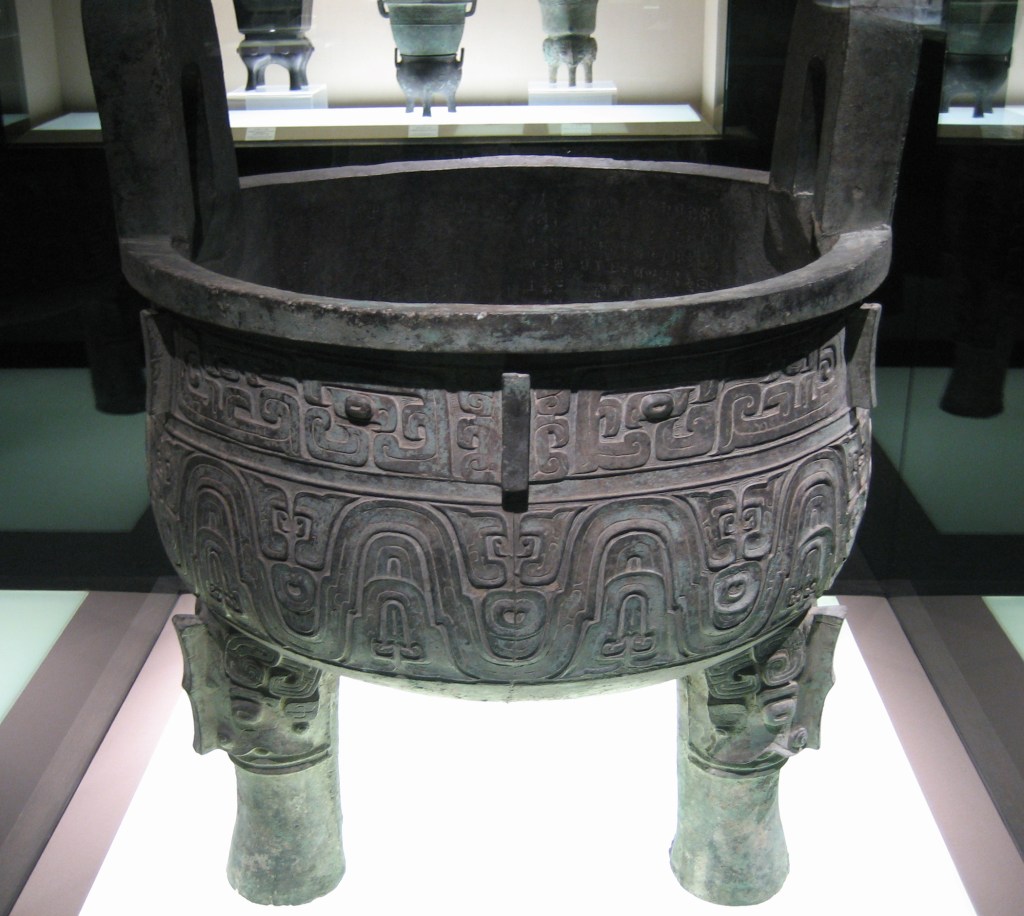
Xinyuan Ping foretold, “The Zhou tripod was lost in the waters of the Si River. Now that the Yellow River has breached its banks and connected with the Si River, I suspect there may be precious metal treasures in northeastern Fenyin County. It is possible that the Zhou tripod cauldrons has emerged there! Signs are visible, but if not welcomed, they will not arrive.” Subsequently, the Emperor dispatched officials to build a temple in the south of Fenyin, near the Yellow River, with the intent of honoring the emergence of the Zhou tripod cauldrons.
The 1st year of the Emperor Wen’s Later Era (163 B.C.)
In October of winter, someone submitted a letter accusing Xinyuan Ping of deceit, claiming that “all his statements were lies and fraud.” Upon investigation, Xinyuan Ping was executed along with his clan. After this incident, the Emperor was less enthusiastic about matters such as calendar rectification, the official color of court attire, and the worship of various deities. The Temple of the Five Emperors north of the Wei River and the Altar of the Five Emperors at Changmen Pavilion were placed under the supervision of the official responsible for sacrificial ceremonies, and the Emperor no longer visited them personally.
In March of spring, Empress Dowager Zhang, the widow of Emperor Hui, passed away.
An imperial decree stated: “In recent years, the harvests have not been abundant. Moreover, there have been calamities such as floods, droughts, and epidemics, which deeply concern me. We, being ignorant and lacking understanding, have yet to grasp the reasons behind these misfortunes. Is it due to faults in my governance and actions? Or is it that the heavenly principles are not in harmony, the earthly advantages are not obtained, human affairs are in disarray, and the neglect of ancestral and divine worship rites has caused this? What has led to this situation? Perhaps officials are not sufficiently compensated, and unnecessary projects abound? Is this the reason for the scarcity or poor quality of the people’s food? It is not that the amount of cultivated land has decreased, and the census has not shown significant population growth. When measuring the land in proportion to the population, there should still be a surplus as in ancient times, yet why is there such a severe shortage of food? Where does the fault lie? Is it because many people engage in non-agricultural activities that harm farming, or because alcohol production wastes grain, and a multitude of livestock consume too much food meant for humans? We have not fully grasped the intricacies of this matter.
“Therefore, We request that the Chancellor, the marquises, the officials of two thousand piculs rank, and the erudites discuss this matter. If there are any measures that can assist the people, we implore you to think deeply and not withhold any opinion!”
 Reflection by Rio Grande
Leave a comment