Comprehensive Reflections to Aid in Governance
By Sima Guang
Translated By Yiming Yang
Annals of Han Book 7 Scroll 15 (continued)
The 13th year of the Emperor Wen of Early Era (167 B.C.)
In Spring, on February 16, an imperial edict was issued: “We personally lead the farming activities throughout the country to ensure an abundant harvest, and the Empress personally tends the mulberry trees and cultivates silkworms to provide sacrificial attire. Study and work out the proper rituals.”
During the Qin dynasty, there existed a secret office of diviners who had secret prayer. Whenever there were signs of disaster or auspicious events, they would attribute to officials in lower positions, shifting away from the emperor. In the summer, an imperial edict was issued, stating: “It is widely known that the heavenly mandate brings calamity through grievances and prosperity through virtue. If there are any shortcomings among the various officials, it should be attributed to mine personally. Now, the office of secret prayer, which shifts blame to others, highlights my lack of virtue, and I strongly reject it. Eliminate it!”
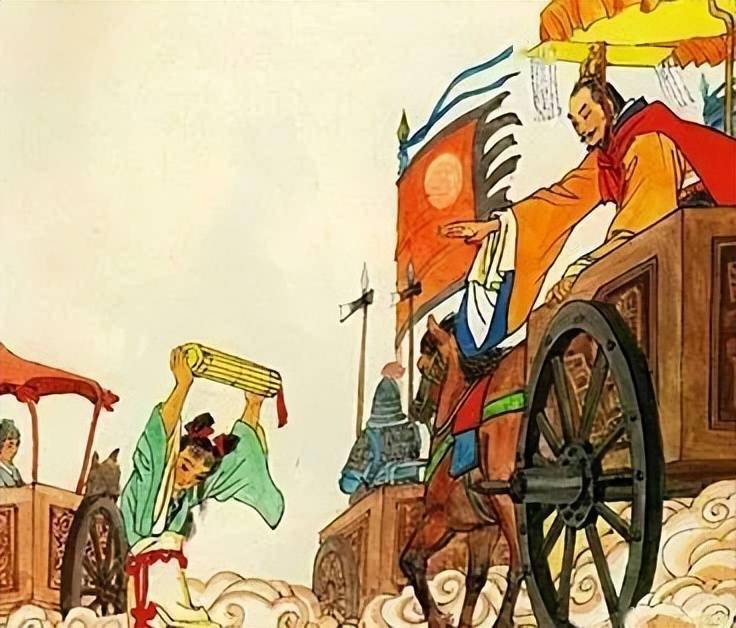
The Magistrate of the Taicang (Grand Granary) in the principality of Qi, Chunyu Yi, was found guilty of a crime and was to be punished. An imperial edict ordered his arrest and detention in Chang’an. His young daughter, Chunyu Tiying, wrote a memorial: “My father served as an official, and his integrity and fairness were acclaimed throughout Qi. Now he is being subjected to the punishment of the law. I am deeply saddened by the fact that the deceased cannot be revived, and those subjected to punishment cannot be restored. Even if he were to desire to reform and start anew, there would be no way to do so. I am willing to offer myself as a maidservant to the government, in order to redeem my father’s criminal punishment and allow him the chance to be reinvigorated.”
The Emperor, moved by her plea, showed compassion. An imperial edict was issued in May: “The Book of Songs states: ‘O my amical and warmhearted lord, you are the people’s father and mother.’ Currently, when people commit wrongdoings, punishment is imposed before education has been given. Some may desire to change their ways and do good, but they have no opportunity to do so. We deeply sympathize with them! Physical punishment inflicts severe harm on the body, carving into the flesh and leaving lifelong scars or even being infertile. Such painful punishment is immoral. Is this in line with the intentions of being a parent to the people? Let us abolish corporal punishment and find alternative methods. Also, let it be known that offenders will be punished with prison terms according to the severity of their crimes, and after a certain number of years, they will be released as long as they have not fled. Draft the necessary laws!”
Chancellor Zhang Cang and Grand Master of the Censorate Feng Jing submitted a proposal to amend the laws as follows: “For those sentenced to have their heads and faces shaved, men shall be punished with hard labor, such as building city walls, while women shall be assigned to pound or husk rice. For those sentenced to face-branding, they shall be shaved, shackled, and subjected to hard labor. For those sentenced to have their noses cut off, they shall be flogged three hundred times. For those sentenced to the amputation of their left toe, they shall be flogged five hundred times. For those sentenced to the amputation of their right toe, including murderers who turned them in, officials who accept bribes, distort justice, embezzle government assets, or steal entrusted property, who, after being punished, commit another offense deserving flogging, they shall all be sentenced to public beheading. For those whose criminal cases have been adjudicated, and for those already subjected to hard labor, there shall be a designated number of years of imprisonment, after which they shall be freed.”
The Emperor approved the proposal.
At that time, the Emperor personally practiced Daoism’s Politics of non-intervention, while the ministers and generals were mostly veteran figures of merit, with fewer literary talents and more practical experience. To correct the excesses and eradicate the governance style of the Qin dynasty, discussions focused on leniency and forgiveness, avoiding the humiliation of exposing people’s faults, and sought to transform the national atmosphere. The prevailing culture of accusation and denunciation was gradually fading. Officials were content in their roles, and the people found joy in their occupations. Wealth and resources accumulated year after year, and the population steadily grew. People treated each other with respect and kindness, with far fewer prohibitions. Suspects were treated fairly, leading to a significant reduction in punishments. Only four hundred convictions occurred across the empire each year. It became increasingly common to resort to criminal laws less frequently.
In June, an imperial edict was issued, stating: “Agriculture is the foundation of the nation, and no task is greater than its cultivation. At present, the people diligently engage in agriculture, yet they are burdened with taxes and levies. This blurs the distinction between the essential (agriculture) and the superficial (commerce). The promotion of agricultural endeavors has not been fully realized. Therefore, we should abolish taxes on farmland.”
 Reflection by Rio Grande
Leave a comment