Comprehensive Reflections to Aid in Governance
By Sima Guang
Translated By Yiming Yang
Annals of Han Book 7 Scroll 15
Duration of 15 years

The 11th year of the Emperor Wen of Early Era (169 B.C.)
In November of winter, the Emperor traveled to the principality of Dai, returning to the capital in January of spring.
In June, during the summer, Prince Huai of Liang, Liu Yi, died without an heir. Jia Yi once again presented a memorial to the Emperor:
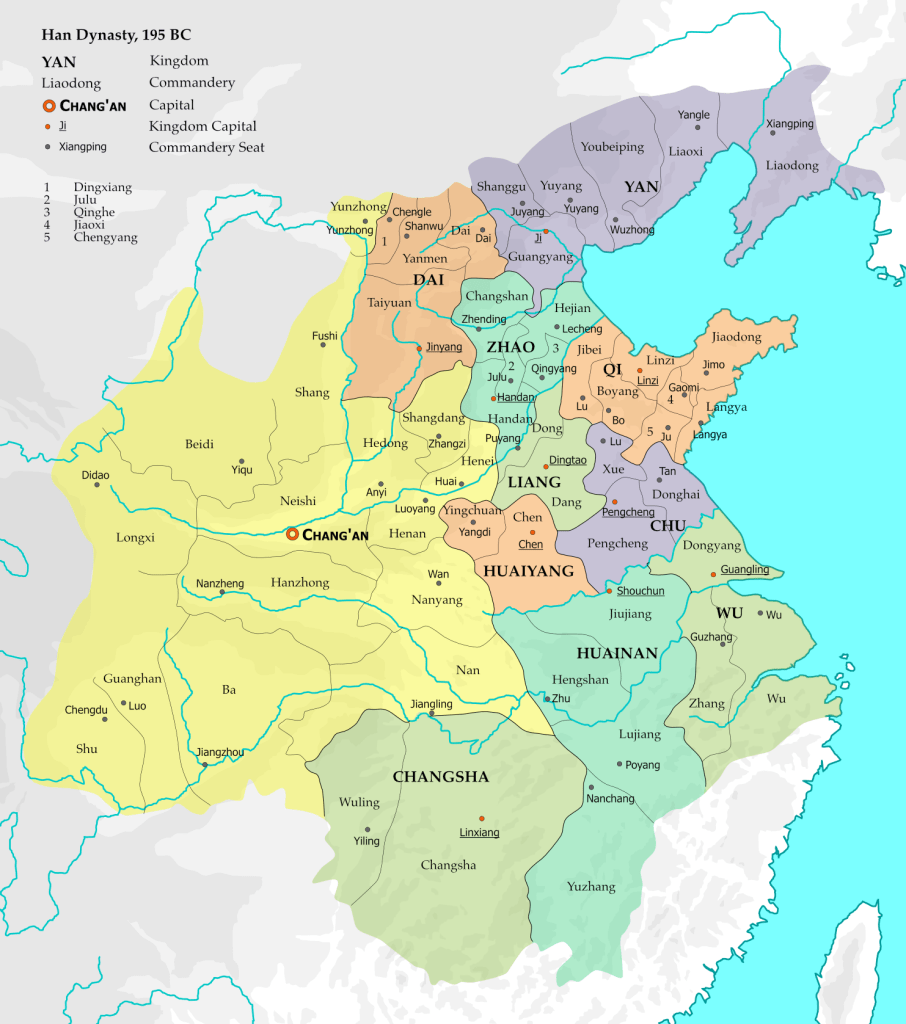
“If your Majesty does not establish a clear policy on the vassal states now, the situation will continue to worsen. The principalities, with only one or two generations of succession, act independently and are not constrained by the central court. As they grow stronger and more assertive, the laws of Han will no longer be enforced. Your Majesty’s barriers and the Crown Prince’s foundation rest with two key principalities: Huaiyang (Liu Wu) and Dai (Liu Can).
“Dai borders the powerful Xiongnu in the north, and would have done more than its due if it could defend itself. However, compared to the other powerful princedoms, Huaiyang is like a mole on the face—significant enough to tempt larger states but not strong enough to resist their advances. Your Majesty holds all the power, yet you allow your son’s fief to serve as bait for these larger princedoms. This is not a sound strategy.
“I humbly propose this: Take land from the princedom of Huainan to strengthen the princedom Huaiyang and establish a successor for the Prince of Liang. You could grant two or three cities in northern Huaiyang, along with the Dongjun Commandery, to the Princedom of Liang, thereby enlarging it. Alternatively, you could relocate the Prince of Dai to Suiyang as the new capital of Liang. The Principality of Liang would then stretch from Xinqi county to the Yellow River in the north, while Huaiyang would encompass the old Chen kingdom, reaching the Yangtze River in the south.
“If this plan is implemented, the other princes will be too intimidated to rebel against the empire. The principality of Liang will be able to defend against the principalities of Qi and Zhao, and Huaiyang will be able to shield the empire from the principalities of Wu and Chu. This strategy will ensure Your Majesty can rest easy, free from worries in the east, and will provide stability for at least two generations.
“Your Majesty currently enjoys a time of peace while the princes are still young, but in a few years, the threat they pose will become evident. Qin worked tirelessly to eliminate the problems posed by the six states, and now, Your Majesty directs the empire to your satisfaction with your fingers or facial expression, holding all the power to act. But if you idly allow the princedoms to grow into six powerful states once again, it would be difficult to say that your Majesty was a wise ruler.
“Even if nothing happens in Your Majesty’s lifetime, the troubles are simmering beneath the surface, and by doing nothing, you will leave them for your elderly mother and young children to grapple with after your passing. This is not the act of a benevolent ruler.”
The Emperor followed Jia Yi‘s advice and relocated the Prince of Huaiyang to become the Prince of Liang. He was granted over forty large counties, including Mount Tai in the north and Gaoyang County in the west. Jia Yi passed away a year later at the age of 33.
The Emperor also relocated the Prince of Chengyang, Liu Xi, appointing him as the new Prince of Huainan.
Meanwhile, the Xiongnu have begun invading Didao county.
At this time, the Xiongnu posed a frequent threat to the border. The Crown Prince’s majordomo, Chao Cuo, submitted a military proposal:
“The Art of War says, ‘There are commanders who are certain to win, but there is no such nation which is sure to win.’ From this, we understand that to defend the border and achieve military success, it is essential to select capable commanders.
“I have also heard that three factors are crucial in winning a battle: the terrain, the training of the troops, and the quality of their armory. The Art of War teaches that different terrains require different strategies for infantry, cavalry, archery, pikes, spears, swords, and shields. Ten soldiers using the wrong tactics are no match for one soldier using the right tactics.
“If officers are not selected from the best, and soldiers do not willingly practice; if they are careless in their daily routines and lack proper training; if they cannot move swiftly to seize opportunities or retreat in an organized manner when necessary; if the front engages in battle while the rear is in disarray; if they fail to respond to the signals of drums and trumpets from their commanders, then it is a failure of discipline and training. A hundred such untrained soldiers are no match for ten well-trained ones.”
“If the weapons are not of good quality, they are as useless as empty hands. If the armor is not strong and secure, it is as ineffective as wearing no protection at all. If bows and arrows cannot hit their targets, they are no better than daggers, and if arrows cannot penetrate the enemy’s armor, they are as ineffective as arrows with no heads. This is the greatest danger for commanders who neglect the upkeep of their weaponry and equipment. Five ill-equipped soldiers are no match for one well-equipped soldier.
“Moreover, the Art of War states: ‘If the equipment is inadequate, the soldiers are lost to the enemy; if the troops are not well-trained, the general is lost to the enemy; if the general is ignorant of military affairs, the ruler is lost to the enemy; and if the ruler fails to select capable generals, the state is lost to the enemy.’ These four factors are the most critical in warfare.
“I have also heard that states of different sizes adopt different styles, states with varying strengths and weaknesses take different positions, and defending regions with different geographical features requires different preparations. Humbly serving a larger state is a self-preserving strategy for smaller states. Defending against a stronger enemy with a coalition of weaker forces is the position of a state of equal strength. Driving barbarians to attack other barbarians is a strategy of the Middle Kingdom, like Han.
“The Xiongnu‘s terrain and tactics differ greatly from those of the Middle Kingdom. They excel in navigating mountains and hills, crossing streams and gorges, and their horses are faster than ours. On difficult terrain, whether riding or shooting, the Han cavalry cannot compare to the Xiongnu. When facing fatigue from wind and rain, or enduring hunger and thirst, the people of the Middle Kingdom are no match for the Xiongnu.
“These are Xiongnu‘s strengths. However, they are vulnerable on open plains to sudden attacks by chariots and cavalry ambushes. They cannot withstand strong bows or long spears used for long-range attacks, nor can they resist the disciplined formations of the Middle Kingdom’s troops—organized into groups of five soldiers and teams of ten, moving in unison, equipped with a mix of long and short weapons and wearing metal armor. The detachments of crossbowmen and archers can easily overpower their leather outfits and wooden shields as our skilled artisans produce powerful bows and precise arrows; The Xiongnu are no match for the Middle Kingdom’s foot soldiers in close combat or the cavalry’s charge. These are the strengths of the Middle Kingdom.
“Considering all of this, the Xiongnu possess three key strengths, while the Middle Kingdom has five. Your Majesty plans to deploy hundreds of thousands of troops to defeat the Xiongnu, who number only in the tens of thousands. This is a strategy of overwhelming force.
“However, war is a dangerous and unpredictable endeavor. Sometimes, what is large becomes small, and what is strong turns weak in an instant. The risk of losing lives in battle is great, and once they are lost, there is no chance of recovery. The way of an emperor and a king is to take every precaution and ensure full preparation.
“Currently, there are thousands of people from the Nomads, Yiqu, and other barbarian tribes who have surrendered to us. They share the lifestyle and skills as the Xiongnu. We should equip them with sturdy armor, warm clothing, strong bows, and sharp arrows, reinforcing them with the elite cavalry from the border regions. Experienced generals who understand their customs and can unite their hearts should be appointed by Your Majesty.
“In treacherous terrain, these forces should bear the brunt of the fighting. On flat terrain, the empire’s chariots and skilled archers should be deployed. Both armies should use their respective strengths, complementing each other with reinforcements. This is a fail-safe strategy.”
The Emperor appreciated Chao Cuo‘s advice and wrote back to him as encouragement.


 Reflection by Rio Grande