Comprehensive Reflections to Aid in Governance
By Sima Guang
Translated By Yiming Yang
Annals of Qin Book 2 Scroll 7(continued)
The 34th year of the First Emperor(213 B.C.)
Officials who abused the criminal justice system by releasing criminals or wrongfully imprisoning the innocent were punished. They were either sent to build the Great Wall in the north or exiled to the state of Southern Yue.
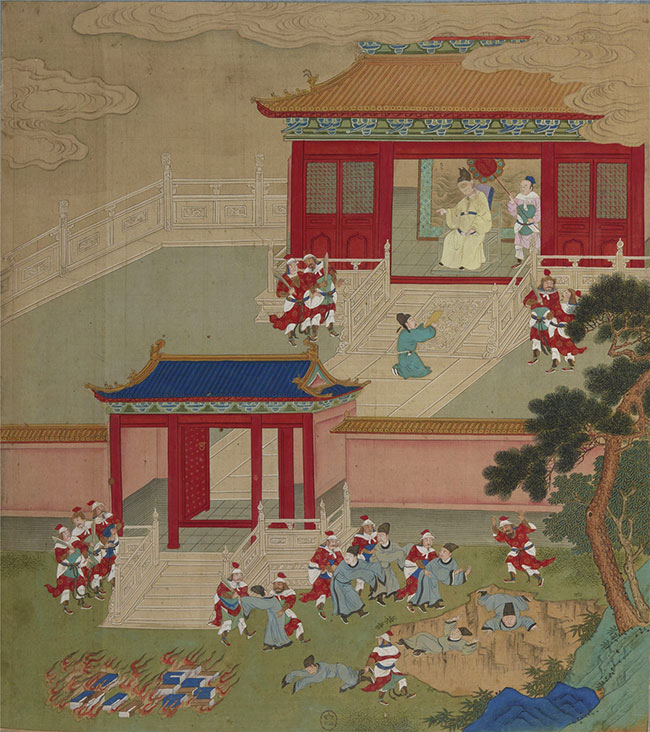
The chancellor Li Si submitted a memorandum: “The kingdoms once recruited migrant scholars to their courts with opulent perks when they were jostling for power. Now, the country is in peacetime, and all laws and orders come from a single place. Ordinary households should work hard on farming and crafting, while intellectuals should study law and order. Today, there are Confucianists who do not study current laws and policies but reference the archaic texts to criticize the new. They baffle the public with their speeches and teach fallacies in their private schools. Whenever a new law is promulgated, they make remarks based on their own theories. They hold their dissent silently in court yet spread discord on the street. They praise the lord to elevate their own fame, dispute to show their superiority, and mislead the masses to denigrate policies. If these activities are not prohibited, it will diminish the authority of the court from above and form dissident parties from below. A ban is in the best interest of the country! I plead that the court historians burn all the history books except those from the kingdom of Qin. Unless they are court scholars who need the books for their duty, all people must turn in books in their possession—such as the ‘Book of Songs,’ the ‘Book of Documents,’ and other works authored by scholars and philosophers before our time—to the governors and military officers to be burned together. Those who speak of these books should be executed publicly. Those who disparage current policy by referencing ancient books should be punished by executing their entire clans. Government officials who do not prosecute these crimes will be treated as accomplices. After thirty days of this decree taking effect, those who do not burn their books will be branded on their faces and sent to labor on the Great Wall. Only books about medicine, divination, and horticulture can remain. Those who wish to study the law and policies can learn from government officials.”
The First Emperor issued an edict: “Approved.”
Chen Yu, who was from Wei, spoke to Kong Fu (a direct descendant of Confucius), “The emperor of Qin wants to destroy the classic works of your ancestor. You are the owner of these books. You are in trouble.” Zi Yu (the courtesy name of Kong Fu) replied: “My study is about useless theory. Only my friends know me. I am no friend of Qin. Why am I in trouble? I stock up my books, waiting for someone to solicit them. Once there is a demand for them, I won’t have any worries.”
The 35th year of the First Emperor(212 B.C.)
The First Emperor directed Meng Tian to widen and straighten an expressway from the town of Jiuyuan to Yunyang county. The road, which was a thousand and eight hundred miles long, cut through mountains and leveled canyons along the way, taking years to complete.
The First Emperor thought the city of Xianyang was too crowded and the palaces from his predecessors were too small. He built new palaces in Shanglin Park, south of the Wei River. The first palace under construction was the front palace called E’fang. It extended five hundred paces from east to west and five hundred feet from south to north. The top level could seat ten thousand people, and the bottom level could hoist banners as high as fifty feet. Around the palace, there was a causeway that led from the palace to the South Mountain. A gateway was erected on top of the South Mountain as the entrance to the palace. An overpass was built across the Wei River, connecting E’fang Palace to downtown Xianyang, symbolizing the North Star and Cassiopeia crossing over the Milky Way to Encampment.
Seven hundred thousand criminals, punished by castration or sentenced to servitude, were poured into laboring in E’fang Palace or the Emperor’s Mausoleum at Lishan. Stone was quarried from the North Mountain, and timbers were shipped from the states of Shu and Jing (Chu). The building materials all arrived at the site. The total number of palaces within the four passes of the Qin kingdom was three hundred, with more than four hundred palaces outside the four passes. A monument had been installed within the Qu County of Donghai Commandery, serving as the east portal of the Qin Empire.
The First Emperor ordered thirty thousand families to settle in Liyi County and fifty thousand families in Yunyang County. These families were exempted from taxation and conscription for ten years.
Scholar Lu spoke to the First Emperor: “In an unholy world, Your Majesty should often travel secretly to avoid evil spirits. In the absence of evil spirits, the holy man will appear. I hope the palace where Your Majesty stays will be kept a secret, so we can obtain the immortal panaceas we have sought.” The First Emperor replied, “I wish to be the holy man.” He referred to himself as “this holy man” instead of “we.”
He ordered the two hundred palaces within two hundred miles around the city of Xianyang to be connected via causeways or porticos, with draperies, percussion instruments, and beautiful ladies furnished at designated places. The settings were to be on record and not moved. The revelation of his itinerary was punishable by death. When the First Emperor toured Liangshan palace, he was displeased by the lavish entourage of the Chancellor seen from the hilltop. One of the eunuchs informed the Chancellor, who then reduced his retinue. The First Emperor became furious, saying, “Someone divulged what I said.” He ordered a formal investigation, but nobody confessed. He arrested everyone present at the time and executed them all. From then on, no one knew where the emperor was. All ministers who needed the emperor’s approval had to wait at the palace in Xianyang.
Court scholars Lu and Hou satirized the Emperor’s behaviors and fled from the court. When the First Emperor heard this, he was livid, “This holy man gave scholars like Lu high respect and paid them well, and they turned around and disparaged this holy man! This holy man sent investigators to look into those scholars at Xianyang, and some reported that they spread heresy to instigate the people.” He directed law officers to prosecute the scholars.
The scholars snitched on each other to exonerate themselves. The emperor sentenced four hundred sixty perpetrators to be buried alive at Xianyang. The burials were widely publicized to admonish posterity. More scholars were banished to the remote frontiers. The eldest son of the emperor, Fusu, beseeched for leniency: “These scholars are the leading Confucianists of the country. Your Majesty is applying severe punishment to all of them. I am afraid it would lead to unrest in the empire.”
The First Emperor was roiled by Fusu’s plea. He sent Fusu away to Shangjun commandery to monitor General Meng Tian.
 Reflection by Rio Grande
Leave a comment