Comprehensive Reflections to Aid in Governance
By Sima Guang
Translated By Yiming Yang
Annals of Qin Book 2 Scroll 7 (continued)
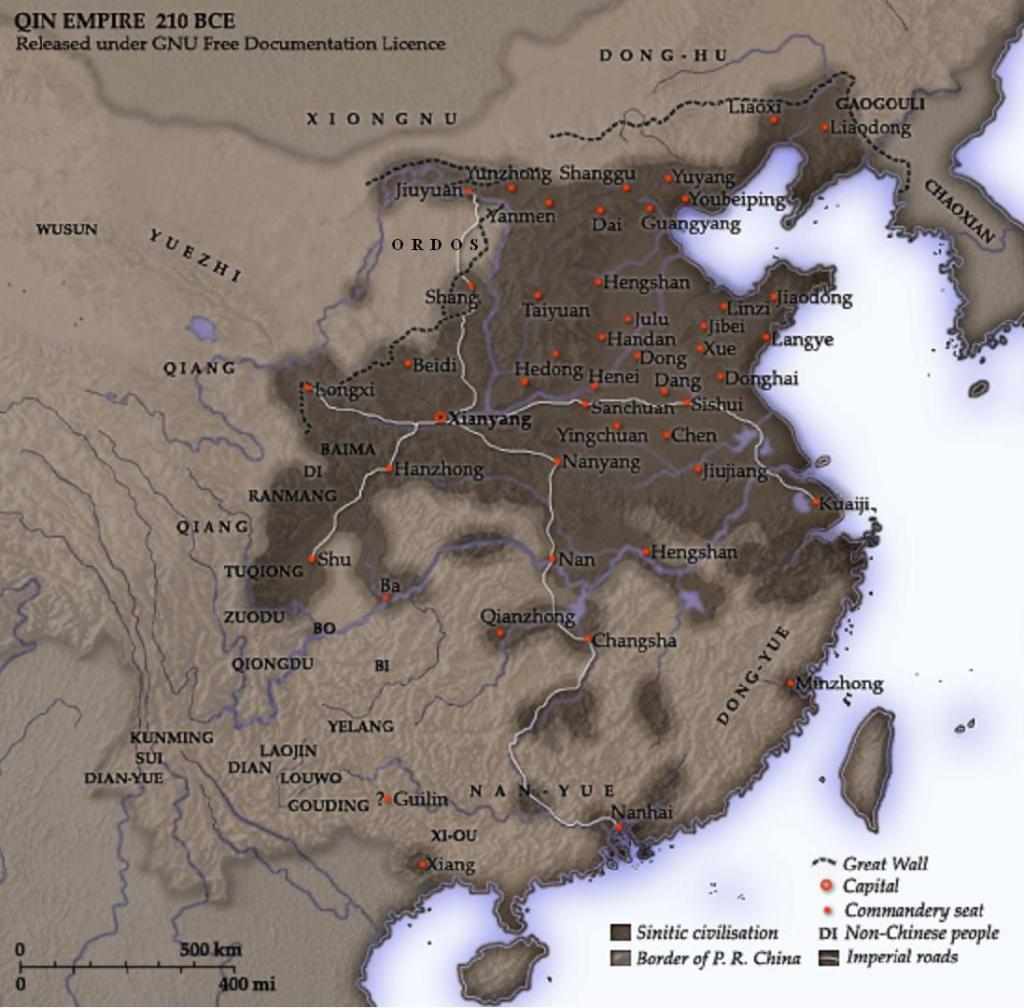
The 25th year of the First Emperor(222 B.C.)
The king of Qin mobilized more troops, led by General Wang Ben, to invade Liaodong, the remnant of the kingdom of Yan. They captured the king of Yan, Ji Xi.
Sima Guang’s comments: Crown Prince Ji Dan of Yan could not contain his resentment and riled up the king of Qin, who was as wicked and violent as tigers and wolves. He instigated more ill will and hastened the calamity with his reckless and poorly devised assassination plots. As a result, the temple of Duke Zhao of Yan was suddenly destroyed, and there were no more worshipers. There wasn’t a greater sin than this. Was it beyond the pale when some commentators said that he was a refined man?
A statesman should appoint masterminds to the right posts, promulgate policies according to propriety, oversee the people with benevolence, and interact with neighbors with honesty. Had he done that, the officials would have followed him, the government would have been regulated by him, the people would have been grateful for his kindness, and the neighbors would have formed close ties with him because of his uprightness. Such a state would be as solid as granite and as bright as a blaze. Whoever struck it would be crushed. Whoever infringed upon it would be burned. Such a state would not fear anyone, even the presence of violent states. Crown Prince Ji Dan did not do that. He gambled with his large kingdom, with ten thousand chariots, to vent his anger and carry out a plot of assassination like raiders. As a result, he was killed, his reputation ruined, and his kingdom reduced to rubble. Isn’t it tragic?
Ji Dan’s walking on his knees and prostrating did not signify respect; his doing what he said and adhering to his promises did not signify integrity; his free spending of gold and dispensing jades did not signify charity; his suicide and self-disemboweling did not signify bravery. In summary, his plan was short-sighted, and his motivation was not righteous. He degraded himself to the class of the Duke of Bai, Xiong Sheng of Chu!
Jing Ke repaid his personal benefits from the prince’s indulgence, disregarding the lives of the seven clans of kinfolk. He intended to strengthen the feeble Yan kingdom and weaken the powerful Qin with a dagger of a foot and eight inches. Isn’t it foolish! That’s why Yang Xiong commented: Yao Li’s death was the death of a bug; Nie Zheng’s death was the death of a strongman; Jing Ke’s death was the death of an assassin. None of these deaths are honorable. Yang Xiong also said, “Jing Ke was just a burglar in the view of a refined man.” Those are apt comments!
General Wang Ben attacked the state of Dai and captured its king, Zhao Jia.
General Wang Jian secured the regions south of the Yangtze River, overcame the resistance of the Lord of Baiyue, and established the commandery of Kuai’ji.
In May, during the summer, a national drinking banquet was held everywhere in Qin to celebrate these military victories.
The queen dowager of Qi was a wise monarch. The kingdom of Qi prudently cooperated with the kingdom of Qin and maintained cordial relationships with other monarchs. With a coastline in the east, Qi was strategically positioned. Meanwhile, the kingdom of Qin had been constantly attacking the three kingdoms derived from the kingdom of Jin—Han, Wei, and Zhao—as well as the kingdoms of Yan and Chu. The five kingdoms were in survival mode. Therefore, Tian Jian, the king of Qi, had not engaged in any warfare for the forty years since his inauguration.
When the queen dowager was dying, she advised King Tian Jian, “Someone among all the ministers should be in charge.” King Tian Jian said, “Please write his name down.” The queen dowager replied, “Fine.” King Tian Jian fetched the brush pen and the tablet and prepared to write. The queen dowager then said, “This old lady has forgotten it.”
After the queen dowager died, Hou Sheng became the prime minister of Qi. He accepted many bribes from Qin. When migrant consultants of Qi went to Qin, they were bribed with gold and became agents of Qin when they returned. They all persuaded the king of Qi to go on a pilgrimage to the king of Qin, instead of building up defense capability against invasion or aiding the other five kingdoms under attack by Qin. Consequently, the five kingdoms were annihilated by Qin.
The king of Qi was about to embark on his pilgrimage journey to Qin. However, the guard at the Yong Gate stood in front of his horses, holding a halberd, and asked, “Is the throne of a king for the state or for the king himself?” The king replied, “It is for the state.” The guard retorted, “If the throne is for the state, why does Your Majesty go to serve the kingdom of Qin while leaving our state behind?” The king turned his carriage around and went back.
The grand master of Jimo heard about the king’s decision and came to speak to him: “The kingdom of Qi has land spanning thousands of miles and millions of armored soldiers. The officers of the three kingdoms derived from Jin—namely, Han, Wei, and Zhao—do not wish to benefit the kingdom of Qin. More than a hundred of them are settled in Dong’e county and Zhencheng. If Your Majesty acquires their allegiance and gives them a million soldiers to lead, allowing them to recoup the territories of Han, Wei, and Zhao, we may someday reach the Linjin Pass of Qin. The officers from Yanying of Chu, do not wish to work for Qin either. Hundreds of them are displaced in the south of Nancheng. If Your Majesty secures their loyalty and lets them lead a million soldiers to reclaim the land of Chu, we will break through the Wu Pass of Qin. Thus, the fame of Qi would rise, and the kingdom of Qin would be demolished. Why should we merely seek the survival of our state?”
The king of Qi, however, did not heed his advice.
The 26th year of the First Emperor(221 B.C.)
General Wang Ben led an attack on the Kingdom of Qi from the south of Yan. They broke into the capital, Linzi, and none of the people of Qi dared to fight back. The King of Qin enticed the King of Qi with a fiefdom of five hundred miles. The King of Qi finally surrendered to Qin. He was moved to Gong county, and left in a wooded area with pine and cypress trees, where he was starved to death. The people of Qi blamed King Tian Jian for not joining the vertical alliance. They faulted him for taking advice from migrant counselors who acted as agents of Qin, which led to the perishing of the state. They sang a rhyme about Tian Jian’s folly of listening to the wrong counselors: “Was it pine tree or cypress, guests made Jian at Gong helpless.”
Sima Guang’s comment: Although the talk about vertical and horizontal alliances was shifting and confusing, the gist was that the vertical alliance was in the best interest of the six kingdoms. The primogenitor king awarded feudal states to his family and friends to enhance social exchange, visit, wine and dine at each other’s places, and develop friendship and alliances. There was no other agenda for them than to bind together with prepossession to safeguard the country. Had the six kingdoms treated each other with trust and fairness, even in the face of the mighty and violent Qin kingdom, they would not have been annihilated. The kingdoms of Han, Wei, and Zhao served as the fences and shelters for the kingdoms of Qi and Chu, whereas the kingdoms of Qi and Chu were the roots and bases of the other three kingdoms. Their relationship should be founded on interdependence of interior and exterior and coordinated actions. When the kingdoms of Han, Wei, and Zhao attacked the kingdoms of Qi and Chu, they dug up their own roots. When the kingdoms of Qi and Chu attacked the other three kingdoms, they pulled out their fences and shelters. How could one uproot his fortress to appease the raiders, then say, “The raiders will love me and won’t hurt me”? How absurd was that!
The King of Qin unified the realm for the first time. He believed his virtue matched that of the three legendary sovereigns and that his achievements surpassed those of the five historical emperors. He changed his title to “August Sovereign” (The Emperor). His orders were called decrees, his proclamations were called edicts, and he referred to himself as “We.” He bestowed the title Emperor Emeritus on his father, King Zhuangxiang. His decree stated: “The tradition of giving a deceased king a posthumous title based on his behavior is nonsensical. It allows a son to assess his father and a subject to appraise his lord. From now on, the ritual of giving posthumous titles will be abolished. We are the First Emperor, and my successors will be named numerically, from the Second Emperor, the Third Emperor, to the Ten-Thousandth Emperor, and so on to infinity.”
During the era of King Wei of Qi and King Xuan of Qi, Zou Yan developed a theory of five virtues based on the five elements, where each element nourishes one element while overcoming another in a continuous cycle. When the emperor unified the country, the people of Qi submitted a proposal based on this theory. The emperor adopted it, believing that the virtue of the Zhou dynasty was fire. Since the Qin dynasty replaced the Zhou dynasty, the virtue of the Qin dynasty must be water, as the element fire could never overcome the element water. He also changed the official calendar, making the annual obeisance to the emperor and celebration of the new year on October 1 each year. He promoted black as the color of official gowns, flags, and tallies. Additionally, he selected a senary numeral system with a base of six.
The prime minister, Wang Wan, and others proposed: “The states of Yan, Qi, and Chu are remote. It is difficult to control them without rulers. Please install Your Majesty’s sons as rulers of these places.” The emperor sent the proposal to all the ministers for discussion. Li Si, the Minister of Justice, disputed: “King Wen and King Wu of Zhou assigned titles to their numerous sons and brothers. Over the years, their descendants grew apart, attacking each other like enemies, and the emperor could not stop their fights. Thanks to Your Majesty’s divine power, the whole country has been unified and subdivided into commanderies and counties. The princes and heroes have been highly compensated with state taxes. When they are satisfied and conform, there will be no dissension in the country. That’s the art of achieving peace and tranquility. It is not a good idea to set up monarchs.”
The emperor approved, stating: “The country has long suffered from incessant wars due to the existence of monarchs and kings. Thanks to our ancestors’ temples, we have finally unified the country. It would be a daunting task to maintain peace once we split into states, which will reignite conflicts. The Minister of Justice’s remark is right on target.”
The country was divided into thirty-six commanderies. A governor, a military minister, and a prefect were appointed for each commandery.
All the weapons in the country were confiscated and transported to the capital, Xianyang. These weapons were melted and cast into bells and carillons. Twelve golden statues were made to decorate the court, each weighing more than a hundred thousand kilograms. Measures for length, volume, and weight were standardized. Additionally, a hundred and twenty thousand wealthy and highborn families from all over the country were forced to move to Xianyang.
The royal temples, Zhangtai Palace, and Shanglin Park were all located on the south bank of the Wei River. Whenever a kingdom was conquered, a replica of its palace was built on the north slope of the Wei River at Xianyang. A roadway aligned with palaces, bridges, overpasses, towers, and pavilions extended from the Gate Yong to the east, reaching as far as the confluence of Jing River and Wei River. The beautiful women from the surrendered kingdoms, along with their musical instruments, filled the edifices with fanfare.
 Reflection by Rio Grande
Leave a comment