Comprehensive Reflections to Aid in Governance
By Sima Guang
Translated By Yiming Yang
Annals of Zhou Book 5 Scroll 5 (continued)
The 55th year of King Nan(260 B.C.)
The army of Qin, under the leadership of Deputy Prime Minister Wang He, launched an attack on Shang’dang, successfully capturing it.
Fleeing from the turmoil, the people of Shang’dang sought refuge in the kingdom of Zhao. Responding to their plight, the army of Zhao, commanded by General Lian Po, entered the city of Chang’ping to assist the displaced inhabitants, aiding them in resettling within the kingdom of Zhao.
In the months of April and early summer, Wang He initiated multiple assaults on the kingdom of Zhao. The army of Zhao fought back with limited success, resulting in the loss of one lieutenant general and four middle-level officers. Concerned about the escalating conflict, the king of Zhao consulted with his advisors, Lou Chang and Yu Qing, regarding potential strategies for peace.
Lou Chang proposed initiating peace talks with a distinguished envoy to the kingdom of Qin. However, Yu Qing disagreed, “The kingdom of Qin holds complete control over the lever of peace. Their relentless determination is to obliterate Your Majesty’s army, and they would not entertain peace negotiations even if one were to seek them. A more strategic approach would be to dispatch distinguished envoys to the kingdoms of Chu and Wei. If these kingdoms respond favorably to our gestures of goodwill, it could sow seeds of suspicion within the kingdom of Qin regarding a potential alliance forming among other kingdoms against them. This strategic maneuver might prompt Qin to reconsider and accept our plea for peace.”
Despite Yu Qing‘s objections, the king of Zhao ultimately decided to send Zheng Zhu as the envoy to Qin in pursuit of peace. Upon his arrival, Zheng Zhu was warmly received by the kingdom of Qin. The king of Zhao remarked to Yu Qing, “Zheng Zhu seemed to be well received by Qin.” Yu Qing remained skeptical, “It’s unlikely that your majesty will secure a peace treaty, and your army may face defeat. Currently, envoys from all kingdoms are in Qin, extending congratulations for their victory in Shang’dang. Zheng Zhu, being of elite stature, will undoubtedly receive an extravagant welcome from the king of Qin and Marquis Ying, designed to impress and entertain. Consequently, other kingdoms may hesitate to come to Your Majesty’s aid, as they perceive a peace treaty between Qin and Zhao. With no external support forthcoming, the king of Qin may see no need to negotiate a peace treaty with Zhao.”
As predicted by Yu Qing, despite the grand reception, no peace treaty was established between Zhao and Qin.
The army of Qin inflicted several defeats upon the army of Zhao, prompting General Lian Po to withdraw his troops behind a fortified barricade, ceasing engagements with Qin. This decision led to frustration and anger from the king of Zhao, who perceived Lian Po‘s actions as cowardice resulting from previous heavy losses. Despite repeated reprimands from the king, Lian Po remained steadfast in his defensive strategy.
In response to the perceived discord, Marquis Ying dispatched spies bearing thousands of caddies of gold to the kingdom of Zhao, delivering counter-intelligence that suggested the kingdom of Qin harbored fears, particularly regarding the potential ascension of General Zhao Kuo, the son of Lord Ma-Fu, as commander-in-chief of the army of Zhao. The intelligence further insinuated that Lian Po was on the verge of surrender. Prompted by this information, the king of Zhao relieved Lian Po of his duties and appointed Zhao Kuo as the new commander-in-chief of the army.
Lin Xiangru voiced opposition to this decision, “Your Majesty’s decision to choose Zhao Kuo over Lian Po was based on Zhao Kuo‘s reputation alone. It’s akin to attempting to tune string instruments by tightening the tuning pegs when the strings are already glued in place. Zhao Kuo‘s reliance solely on his father’s military textbooks without the ability to adapt tactics from the books to rapidly changing battlefield conditions makes him ill-prepared for the complexities of warfare.” Despite Lin Xiangru‘s counsel, the king of Zhao remained stubborn in his decision to appoint Zhao Kuo.
Zhao Kuo had immersed himself in the study of warfare since childhood, believing himself to be unparalleled in the theory of war. He frequently engaged in discussions on the subject with his father, Zhao She. Despite his eloquence in discourse on military strategy, Zhao She remained unimpressed by his son’s understanding of warfare. When questioned about this by Zhao Kuo‘s mother, Zhao She expressed concern, stating that war is a matter of life and death, and Zhao Kuo‘s casual attitude towards it could lead to disastrous consequences if he were to assume a leadership role in the army of Zhao.
As Zhao Kuo prepared to depart for the frontlines, his mother, troubled by his appointment, wrote to the king opposing it. Summoned by the king, she explained her concerns, “This humble woman served her husband, Zhao She, faithfully in the past. During Zhao She‘s tenure as commander-in-chief, his generosity was renowned—he provided for tens of individuals with his earnings and counted hundreds as his friends. He willingly shared the rewards bestowed upon him by the king and other royalties with his comrades and intellectuals. However, as he prepared for war, he distanced himself from family matters.”
“In contrast, when Zhao Kuo assumed the role of commander-in-chief, he received homage from his subordinates while sitting facing east. His underlings hesitated to meet his gaze, intimidated by his presence. Unlike his father, Zhao Kuo retained all the gold and silk granted by the king, and in the last few days, he indulged in purchasing houses and land for personal gain. The king believed that Zhao Kuo would naturally succeed his father’s position, but they are different persons. I wish your majesty would not have chosen him to be the commander!” The king of Zhao declined her plea:”Stop right here, Mom! I have made up my mind.”
In her final request, Zhao Kuo‘s mother implored the king to spare her family from any repercussions should Zhao Kuo‘s leadership prove unsuccessful. The king approved of her demand.
Upon learning that Zhao Kuo had assumed the position of commander-in-chief, the king of Qin took covert action, sending Lord Wu’an as the top general of the Qin army, with Wang He as his lieutenant. Strict orders were given to maintain secrecy, with severe consequences for any leaks of the appointment.
As Zhao Kuo arrived at the frontline, he implemented new strategies and replaced officers. The Zhao army emerged from their bunkers to confront the Qin troops. Lord Wu’an pretended to be defeated, leading the Qin troops away while leaving detachments behind to ambush the Zhao army.
Seeing what appeared to be a sign of victory, Zhao Kuo pursued the retreating Qin troops to the camp’s bulwarks, only to find them impenetrable. Simultaneously, Qin detachments of twenty five thousand infantry maneuvered to cut off Zhao Kuo‘s retreat and another five thousand cavalry to slice through between the front and the camp. The Zhao army was severed into two isolated groups and their food supply line was broken.
Lord Wu’an then unleashed his light infantry to attack the vulnerable Zhao troops, who struggled to fend off the relentless assault. With their situation growing dire, the Zhao forces dug up barriers and erected bastions, awaiting reinforcements.
Upon learning that the food supply line to the Zhao army had been severed, the king of Qin took decisive action. He traveled to the commandery of Henei in person, and mobilized all men above fifteen years old to march towards Chang’ping, aiming to overwhelm any attempts at rescue or supply for the Zhao army.
Despite the willingness of the people in the kingdoms of Qi and Chu to aid Zhao, the soldiers of Zhao found themselves lacking in food. When they requested grains from the kingdom of Qi, the king refused. His adviser, Zhou Zi, implored him to reconsider,
“The kingdom of Zhao serves as a protective barrier for the kingdoms of Qi and Chu. Their relationship is akin to that of lips and teeth: if the lips are lost, the teeth are left vulnerable to the chill. If Zhao falls today, it foreshadows impending disasters for Qi and Chu tomorrow. Therefore, the urgency to rescue Zhao is as crucial as using leftover water in a cracked urn to cool a burned pot. Providing aid to Zhao is not just a moral duty but also a righteous act. Additionally, defeating the Qin troops would bring glory to Qi.”
“It is our responsibility to assist a country in distress, uphold justice, and confront the formidable Qin forces to earn a heroic reputation. Neglecting this vital issue by prioritizing grains over aiding Zhao would be detrimental to our country and its values.” Despite Zhou Zi’s impassioned plea, the king of Qi refused to listen.
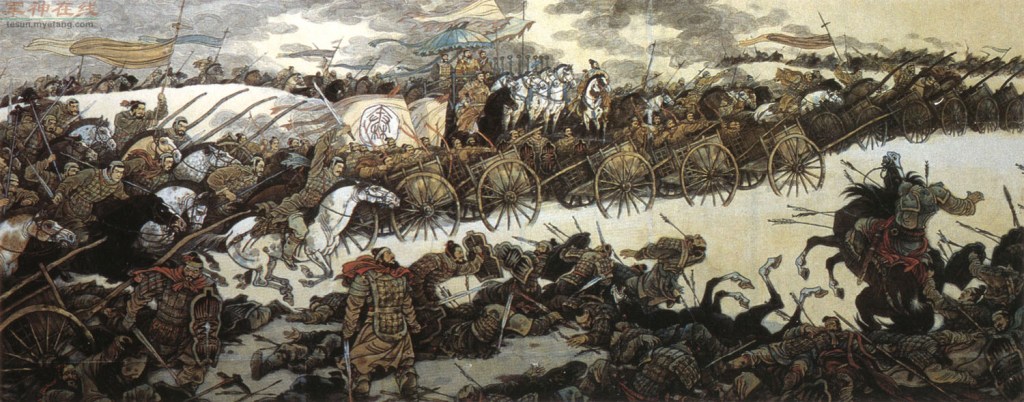
In the autumn and early September, the soldiers of Zhao endured forty-six days without food. Desperation led to quiet acts of cannibalism within the camp. Despite their efforts to break the barricade, rotating attack squads proved ineffective. As the fifth squad prepared to begin, they remained trapped. Zhao Kuo, the chief commander, leading his elite guards, ventured into a skirmish and tragically met his demise, struck down by arrows, plunging the army into chaos. Without leadership, four hundred thousand Zhao soldiers surrendered.
Lord Wu’an saw the potential danger posed by these soldiers, “The people of Shang’dang, discontented under Qin‘s rule, allied themselves with Zhao after Qin‘s conquest of Shang’dang. The enormous number of Zhao captives posed a serious threat of mutiny if left alive.” Fearing mutiny, he ordered the execution and burial of all prisoners of war, sparing only two hundred forty youths to return to Zhao. In total, four hundred fifty thousand prisoners were beheaded, shocking the people of Zhao to their core.
 Reflection by Rio Grande
Leave a comment