Comprehensive Reflections to Aid in Governance
By Sima Guang
Translated By Yiming Yang
Annals of Zhou Book 2 Scroll 2 (continued)
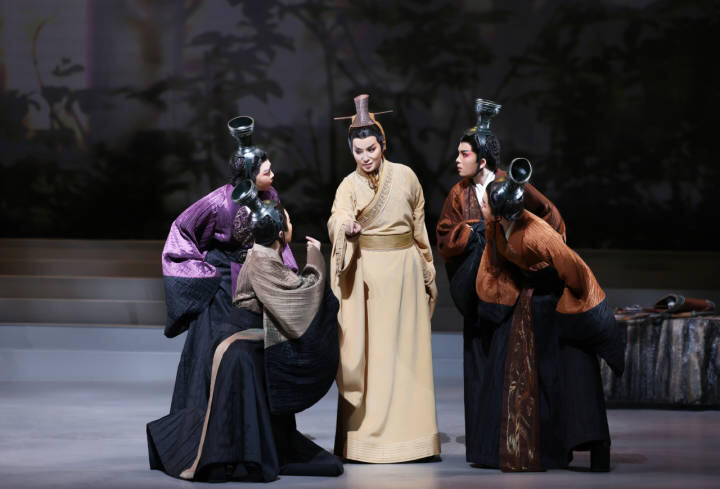
The 36th year of King Xian (333 B.C. continued)
Su Qin continued his persuasive efforts with King Xuanhui of Han: “The kingdom of Han boasts a large expanse of land, spanning nine hundred miles, and possesses hundreds of thousands of well-armed soldiers. The world’s finest bows, crossbows, and swords are all crafted right here in the state of Han. Han‘s archers are so skilled that they can leap into the air and unleash a continuous barrage of a hundred arrows. It is beyond doubt that the valor of a single Han soldier, armed with the best weaponry, can withstand the assault of a hundred adversaries.”
“Your grace, if you yield to Qin‘s demands, they will not stop at just taking Yiyang and Chenggao as they did this year. Next year, they will seek even more territory. In the end, you will have nothing left to give. Any concession made now will only nullify the goodwill you have shown before, inviting calamity upon us. Your land is limited, while the kingdom of Qin‘s appetite is boundless. Attempting to satiate an insatiable hunger with limited resources is akin to trading grievances for misfortune. We are losing territory without putting up a fight. As the saying goes, ‘I would rather be a chick’s beak than the behind of a cow.’ It is regrettable that your wisdom, your grace, and the valor of Han‘s army are earning a reputation as the backend of a cow!” King Xuanhui of Han heeded Su Qin‘s counsel and decided not to concede to Qin‘s demands
Su Qin continued his diplomatic efforts, this time directing his persuasive skills toward the King of Wei: “Your grace, your kingdom, although not extensive in terms of land, spans a thousand miles. It is a densely populated region filled with countless farms and residences, leaving little room for pastures. The population is so dense, and the traffic so bustling, that one might think it’s perpetually hosting armies on the move. In my humble opinion, your kingdom rivals the vastness of the kingdom of Chu.”
“I have also come to understand the might of your armed forces: you command two hundred thousand heavily armed soldiers, two hundred thousand black-cap servicemen, two hundred thousand gladiators, and one hundred thousand auxiliary supporters. In addition, you possess six hundred chariots and five thousand cavalry.”
“Yet, it troubles me to see that you are currently heeding advisors who advocate servility towards the Kingdom of Qin. I implore you to reconsider this stance and examine the charter of alliance provided by my lord, the King of Zhao. The charter is unequivocal: your commands are to be executed by the alliance!” King of Wei, after consideration, agreed to Su Qin‘s proposal.
Su Qin‘s persuasive efforts extended to the King of Qi: “Your grace, the Kingdom of Qi boasts fortresses on all four borders, with territory spanning two thousand miles. It commands hundreds of thousands of well-armed soldiers and vast grain reserves. Your standing armies are well-disciplined, and five independent military forces are at your disposal in five cities. Your warriors move as swiftly as arrows, fight fiercely like thunderstorms, and retreat like showers. Even if a military conflict were to arise, the aggressors would have to clear Mount Tai, cross the Qing River, and navigate Bohai Bay.”
“The city of Linzi alone houses seventy thousand families, and a rough estimate of three able-bodied men per family gives you two hundred and ten thousand potential fighters in Linzi alone, without counting neighboring counties. Linzi‘s people are prosperous and affluent, indulging in activities like cockfighting, dog racing, chess, and football. On Linzi‘s streets, cartwheels clash, pedestrians rub shoulders, and their sleeves brushing together could form a backdrop curtain, while wiping sweat from their brows could create a downpour.”
“However, certain ministers who fear Qin‘s proximity dominate the strategic decisions of the states of Han and Wei because they share borders with Qin. The survival or downfall of these states can be decided within ten days of mobilizing their troops. Even if they win, they might lose half their forces and face border incursions. If they lose, their state may face defeat and collapse. This is why the states of Han and Wei tend to appease Qin and hesitate to engage in combat. Qi‘s security against a Qin invasion is entirely different. Qin invaders must traverse the lands of Han and Wei, navigate the narrow road at Yanjin (in Wei), and break through the strategic Kangfu Pass. Qin‘s chariots cannot move in combat formations, and cavalry cannot advance side by side through these passages. A hundred defenders on these bastions can thwart thousands of attackers. Qin‘s army may want to advance deep into Qi, but they must also be cautious, wary of attacks from Han and Wei from behind.”
“It is evident that Qin does not pose an immediate threat to Qi. They resort to trickery, threats, and bluster rather than moving into combat. Those ministers who advocate submission to Qin do not fully grasp the situation, Your grace. You possess the means to safeguard your state and need not be labeled as subservient to Qin. Please consider our strategy carefully.” The King of Qi approved of Su Qin‘s counsel.
Su Qin continued his diplomatic efforts in the southwest, addressing the King of Chu: “The Kingdom of Chu stands as a world superpower, spanning a vast territory of six thousand miles. Its army numbers one million strong, equipped with thousands of chariots and tens of thousands of horses. Its granaries hold enough grain to sustain the state for a decade, a resource that signifies dominance. To the Kingdom of Qin, Chu represents a greater threat than any other state. The strength of Chu corresponds to the weakness of Qin, and vice versa. Qin and Chu cannot coexist peacefully.”
“To your advantage, the Kingdom of Chu should join the vertical alliance to isolate the Kingdom of Qin. I will ensure that other states east of Xiao Mountain pay tribute to you with seasonal produce, obey your orders, entrust their state affairs and heritage to you, and train their soldiers to follow your lead. Joining the vertical alliance implies that all states cede their lands and are subject to Chu, while joining the horizontal alliance implies that the Kingdom of Chu surrenders its land and is subject to Qin. The consequences of these two options are vastly different. Which one do you choose?” The King of Chu concurred with Su Qin‘s proposal.
With Su Qin‘s successful diplomacy, he assumed the role of chief commander and prime minister for all six states of the vertical alliance. He traveled north to report to the Marquis of Zhao, accompanied by an impressive entourage equipped with chariots and well-armed guards, rivaling that of a king.
King Wei of Qi passed away, and his son, Piqiang, ascended to the throne as King Xuan of Qi. King Xuan of Qi recognized that Marquis Cheng (Zou Ji) had wrongfully accused Tian Ji and reinstated Tian Ji to his former position.
Duke Wen of Yan also passed away, and his son succeeded him as King Yi of Yan.
Marquis Cheng of Wey passed away, and his son took over as Marquis Ping of Wey.
The 37th year of King Xian (332 B.C.)
The king Hui of Qin, in an attempt to disrupt the vertical alliance, sent Xi Shou to deceive the Kingdoms of Qi and Wei into forming a coalition against the state of Zhao. This move aimed to thwart the alliance that Su Qin had been working on. When Marquis Su of Zhao discovered this plot, he held Su Qin responsible, and Su Qin became fearful.
To make amends, Su Qin offered to lobby the state of Yan to seek revenge for Qi‘s actions. As Su Qin left the state of Zhao, the vertical alliance fell apart. The people of Zhao breached a dam to flood the armies of Qi and Wei, forcing them to withdraw.
In a gesture of reconciliation, the Kingdom of Wei ceded the city of Yinjin to the Kingdom of Qin. This city is now known as Huayin.
Subsequently, the King of Qi launched a campaign against the state of Yan, capturing ten cities. However, they later returned these cities to their original owner Yan.
 Reflection by Rio Grande
Leave a comment