The 1st year of Emperor Yuan’s Jingning Era (33 B.C. continued)
The Chanyu rejoiced greatly and submitted a letter, saying: “I am willing to guard the frontier from Shanggu to Dunhuang and transmit this charge to my descendants without end. I beg that the border defenses and garrisons be withdrawn, so that the people of the Son of Heaven may have rest.”
The Emperor referred the matter to his ministers for deliberation, and all deemed it advantageous. Only the Court Attendant Hou Ying, well versed in frontier affairs, spoke in opposition.
The Emperor asked for an explanation. Hou Ying replied:
“Since the time of the Zhou and Qin, the Xiongnu have been violent and aggressive, constantly raiding the frontiers. Since the rise of the Han, we have suffered especially from their incursions. I have heard that the northern frontier stretches east to Liaodong and west beyond the Yin Mountains, extending for more than a thousand li, rich in grass, forests, and game. In former times, Modu Chanyu used this land as his hunting ground, fashioning bows and arrows there and launching his raids.
“In the reign of Emperor Wu, when armies were dispatched on campaign, this territory was recovered and the Xiongnu were driven beyond the desert. Fortified barriers were erected, beacon towers and subterranean passes were established, outer walls were constructed, and garrisons were stationed to defend them. Only then did the borderlands attain a measure of peace.
“North of the desert, the land is flat and barren, with little grass or timber and vast stretches of sand; when the Xiongnu come to raid, they have nowhere to conceal themselves. South of the barriers lie deep mountains and ravines, difficult to traverse. The elders of the frontier say: ‘Since the Xiongnu lost the Yin Mountains, they have never crossed them without weeping.’ If now the garrisons are withdrawn and the defenses abandoned, it would be to hand the eastern and northern tribes a single, immense advantage. This is the first reason it must not be done.
“Now, under Your Majesty’s virtuous rule, Heaven shelters the Xiongnu, and they enjoy preservation and peace, bowing their heads in submission. Yet the nature of these tribes is such that when pressed they are humble and compliant, but when strong they grow arrogant and rebellious—such is Heaven’s design. Previously, the outer walls were already dismantled and the watchtowers reduced, leaving only what was needed to observe and signal. The ancients, even in times of peace, never forgot the possibility of danger; such defenses must not again be abolished. This is the second reason.”
“Since antiquity, the Central State has established passes and bridges in order to restrain the feudal lords, thereby cutting off any thought of ambition among the people. The construction of frontier barriers and the stationing of garrisons were not undertaken solely because of the Xiongnu, but also on account of the various dependent states and surrendered peoples who had once belonged to them—lest they recall former ties and flee back. This is the fourth reason.
“Recently, the Western Qiang have dwelt near the frontier posts and come into contact with the Han populace. Officials and commoners, driven by greed, have encroached upon them, seizing their livestock and taking their wives and children. For this they harbored resentment and rose in rebellion. Now, if the mounted frontier posts are abolished, arrogance and contempt will arise, disputes will multiply—this is the fifth reason.
“In former times, many soldiers went to war and never returned; their sons and grandsons were left in poverty. If one day they should flee, they would surely seek refuge among their kin among the Xiongnu—this is the sixth reason.
“Moreover, the bondservants and slaves of the border people live in hardship. Many long to flee, saying, ‘We hear that life among the Xiongnu is easy; only the strict watch and guard restrain us.’ Even now, some slip away beyond the frontier—this is the seventh reason.
“Furthermore, bandits and violent men, when pressed by the law, often flee northward beyond the borders, beyond our ability to pursue or restrain them—this is the eighth reason.
“Since the establishment of the frontier defenses, more than a hundred years have passed. Not all were built of rammed earth alone: some relied upon mountain cliffs, stone and timber, river valleys, and water-gates, which were gradually leveled and joined together. Soldiers and laborers toiled to construct and repair them; the hardship and expense accumulated through generations are beyond reckoning. I fear that those who now deliberate have not examined the matter from beginning to end, and wish to abolish at once all corvée service and garrison duties. Yet within ten years—or within a hundred—should circumstances change, and should the barriers collapse and the watch-posts and subterranean passes disappear, new garrisons would again have to be raised and the works rebuilt. The accumulated labor of generations cannot be restored in a single day. This is the ninth reason.
“If the garrisons are withdrawn and the watch-posts reduced, the Chanyu, relying upon his own frontier defenses, will surely feel deep gratitude toward Han and will make incessant requests. Should we then displease him even slightly, the consequences would be beyond all calculation. To open a breach for the tribes and diminish the strength of the Central State—this is the tenth reason.
“Withdrawing garrisons is not the long-term strategy by which lasting peace is preserved and the hundred tribes are held in awe.”
After hearing this, the Emperor issued a decree: “Let there be no further discussion of dismountling the frontier defenses.”
He then dispatched Xu Jia, General of Chariots and Cavalry, to convey this message to Huhanye Chanyu, saying:
“The Chanyu has written, requesting that the northern frontier officials and garrisons be withdrawn, pledging that his descendants will guard the border for generations to come. The Chanyu’s admiration for propriety and his concern for the welfare of the people reveal a far-sighted intention, which We greatly commend.
“The Central Realm, however, maintains barriers and defenses in all four directions—not solely to guard against external threats, but also to restrain disorder within. Clear laws and firm institutions are the means by which order is preserved. We fully understand and appreciate the Chanyu’s intent and harbor no suspicion. Yet, lest the Chanyu be perplexed by the continued maintenance of these defenses, we have therefore dispatched Xu Jia to explain the matter in person.”
“I did not comprehend this far-reaching design. I am deeply grateful that the Son of Heaven has sent a high minister to instruct me. I receive this with reverence and gratitude.”
The 4th year of Emperor Yuan’s Jianzhao Era (35 B.C.)
In January of spring, the head of Zhizhi Chanyu arrived at the capital. Gan Yanshou and Chen Tang submitted a memorial, saying:
“We have heard that the great principle under Heaven is unity. In antiquity there were the reigns of Yao of Taotang and Shun of Youyu; in the present age there is the mighty Han. The Xiongnu Chanyu Huhanye has already acknowledged himself a northern vassal, yet Zhizhi Chanyu alone remained defiant and had not yet met due punishment. West of Daxia (Bactria), the peoples believed that the mighty Han could not subdue him.
“Zhizhi Chanyu inflicted cruel suffering upon the people and committed great crimes, all witnessed by Heaven. We, your servants Gan Yanshou and Chen Tang, have led righteous troops to carry out Heaven’s punishment. Relying upon Your Majesty’s divine authority, and aided by the harmonious response of yin and yang, the weather was clear, our armies broke through the enemy lines, defeated the foe, and beheaded Zhizhi Chanyu together with his nobles. His head should be displayed among the residences of the barbarian ambassadors in the capital, so that those throughout the myriad lands may know that whoever offends the mighty Han, no matter how distant, will surely be punished.”
The Chancellor Kuang Heng and others remonstrated, saying, “Since it is spring, the season for covering bones and burying the dead, it would be fitting not to display the head of Zhizhi Chanyu.”
The Emperor decreed that it be displayed for ten days and then buried. He further ordered sacrifices to be offered at the suburban altars and proclaimed a general amnesty throughout the empire. The ministers all came forward to offer congratulations, and a banquet was held.
On June 5, Liu Jing, Prince Ai of Zhongshan, passed away. The Prince was the Emperor’s younger brother and had grown up studying together with the Crown Prince. Upon his death, the Crown Prince went to attend the mourning rites. When the Emperor saw him, he was moved by memories of the Prince of Zhongshan and was overcome with grief. The Crown Prince, however, showed no outward sorrow. The Emperor was greatly angered and exclaimed, “How can one who lacks compassion and benevolence serve the ancestral temples and become a parent to the people?”
At that time, Shi Dan, Commandant of the Cavalier Escort, was in charge of protecting the Crown Prince’s household. The Emperor reproached him. Shi Dan removed his cap and apologized, saying, “I indeed saw that Your Majesty mourned deeply for the Prince of Zhongshan, to the point of shedding tears. When the Crown Prince was about to appear, I privately instructed him not to weep, lest he further distress Your Majesty. The fault lies with me alone; I deserve death.” The Emperor found his explanation reasonable and his anger subsided.
In Lantian, an earthquake caused a mountain to collapse, blocking the Ba River. In Anling, a landslide caused the riverbank to give way, obstructing the Jing River, which then flowed backward.
The 5th year of Emperor Yuan’s Jianzhao Era (34 B.C.)
In March of spring, a general amnesty was proclaimed throughout the empire.
In summer, on June 17, the Emperor restored the Li Garden, the tomb of his great-grandfather(Liu Ju).
On June 30, at the close of the moon, a solar eclipse occurred.
In autumn, on July 28, the Emperor restored the ancestral temples and mausoleums of the Emperor Emeritus(Prince Li, great-grandfather of the Emperor, Liu Ju), as well as the temples of the imperial progenitors, and the tombs of Empress Zhaoling (mother of Emperor Gaozu), Prince Wu’ai (brother of Emperor Gaozu), Empress Zhao’ai (sister of Emperor Gaozu), and Empress Weisi (Wei Zifu). At the time, the Emperor had long been afflicted by illness and believed that the ancestral spirits were displeased. Therefore, he ordered these sites to be fully restored. The ancestral temples in the commanderies and princedoms, however, remained abolished.
In that year, Liu Kang, Prince Kang of Jiyang, was transferred to become Prince of Shanyang.
When Huhanye Chanyu of the Xiongnu heard that Zhizhi had been executed, he was both fearful and relieved. He sent a letter expressing his wish to come to court and present himself in the audience.
The 1st year of Emperor Yuan’s Jingning Era (33 B.C.)
In January of spring, Huhanye Chanyu of the Xiongnu came to the Han court and requested to enter into a marriage alliance, wishing thereby to strengthen relations. The Emperor bestowed upon him Wang Qiang of the inner palace, whose courtesy name was Zhaojun and who came from a family of upright repute.
The 3rd year of Emperor Yuan’s Jianzhao Era (36 B.C.)
In the summer, on June 19, Wei Xuancheng, Marquis of Fuyang, passed away.
In July of autumn, Kuang Heng was appointed Chancellor. On July 14, Li Yanshou, Commandant of the Palace Guards, was appointed Grand Master of the Censorate.
In winter, the envoys sent to the Protector-General of the Western Regions—Cavalry Commandant Gan Yanshou of Beidi and Lieutenant Colonel Chen Tang of Shanyang—acted jointly and slew Zhizhi Chanyu of the Xiongnu in Kangju.
Earlier, Zhizhi Chanyu, relying on the strength of his people and boasting of his might, regarded himself as a great power and grew arrogant. Having gained victories, he became increasingly insolent and failed to treat the King of Kangju with due respect. In a rage, he slew the king’s daughter along with several hundred nobles and commoners, some of whom he dismembered and cast into the Dulai River. He compelled the people of Kangju to build a fortified city, forcing five hundred men to labor each day; the work continued for two years before completion. He also sent envoys to demand annual tribute from the kingdoms of Yancai and Dayuan, which dared not refuse.
The Han court dispatched three envoys to Kangju and Zhizhi Chanyu to recover the bodies of Gu Ji and the others who had been killed by them. Zhizhi Chanyu humiliated and tormented the envoys, refused to receive the imperial edict, and instead sent a letter to the Protector-General of the West, feigning submission and claiming that he was in distress and wished to rely upon the mighty Han, even offering to send his son as a hostage. Such was his disdain and duplicity.
Chen Tang was a man of courage and composure, adept at deep calculation and bold in devising quirky stratagems. He delighted in extraordinary achievements. He said to Gan Yanshou:
“The barbarians are by nature awed by great gens. The Western Regions once belonged to the Xiongnu. Now Zhizhi Chanyu’s reputation has spread far and wide; he oppresses Wusun and Dayuan, and frequently conspires with Kangju, intending to subdue them. If he gains control of these two states, within a few years all the cities and kingdoms will be endangered. Moreover, his people are fierce and warlike, often victorious in battle. If they are left unchecked for long, they will surely become a great calamity to the Western Regions.
“Though they dwell in remote lands, they have no strong cities nor effective crossbows. If we draw troops from the agricultural garrisons and combine them with the forces of Wusun, advancing directly upon their camps, they will have nowhere to go if they flee; if they stand and fight, they will not be able to endure. An achievement of a thousand years may be accomplished in a single day.”
Gan Yanshou approved of this reasoning and wished to present it to the court. Chen Tang, however, said, “The Son of Heaven would summon the Three Excellencies and the Nine Ministers to deliberate on such a matter. Our far-reaching design is not something mediocre officials can comprehend, and it will certainly not be approved.” Gan Yanshou still hesitated.
At that time, Gan Yanshou had long been ill and confined to his bed. Chen Tang thereupon took matters into his own hands, mobilizing troops from the commanderies and garrisons under a forged imperial decree. When Gan Yanshou learned of this, he was startled into rising from his bed and attempted to stop him. Chen Tang, enraged, drew his sword and rebuked him, saying, “The army has already been set in motion—would a mere fellow like you dare to obstruct it?” Thereupon Gan Yanshou yielded.
They assembled the host, numbering more than forty thousand men, Han troops together with allied aliens. Gan Yanshou and Chen Tang submitted a memorial acknowledging their unauthorized action, explaining the military situation, and then divided the army into six columns. Three columns advanced by the southern route, crossing the Congling (Pamir) Mountains and proceeding directly toward Dayuan. The other three, led by the Protector-General Gan Yanshou himself, set out from the kingdom of Wensu, entered Chigu(Yshtyk, the capital of Wusun) by the northern route, passed through Wusun territory, crossed into Kangju lands, and advanced westward to the vicinity of Lake Tianchi (Issyk-Kul).
Meanwhile, Baotian, the deputy king of Kangju, led several thousand cavalry eastward to raid near Chigu(Yshtyk). He killed and captured more than a thousand of the people of the Great Kunmi of Wusun and seized large numbers of livestock. He then pursued the Han army from the rear and plundered its supplies. Chen Tang released the auxiliary alien troops to counterattack. They slew four hundred and sixty of the enemy, recaptured four hundred and seventy captives taken from Wusun, and returned them to the Great Kunmi. The horses, cattle, and sheep were taken to provision the army. They also captured a Kangju noble named Inudu.
Upon entering the eastern border of Kangju, Chen Tang ordered that the army should not plunder. He secretly summoned the Kangju noble Tumo and met with him, explaining the authority and trustworthiness of the Han dynasty. They drank together and concluded an alliance, after which Tumo was allowed to depart. The army then advanced and encamped sixty li from the city of Zhizhi Chanyu.
They captured another Kangju noble, Jusezi Nankaimou, and compelled him to serve as guide. Jusezi, being the maternal younger brother of Tumo, harbored resentment toward Zhizhi Chanyu and therefore disclosed all information concerning him. On the following day, the army advanced again and encamped thirty li from the city.
The Chanyu then sent an envoy to Chen Tang, asking, “Why have the Han troops come?”
The answer was: “The Chanyu once wrote, ‘I am in distress and wish to submit to the mighty Han, and to come in person to attend the court.’ The Son of Heaven, taking pity on your abandonment of your former realm and your submission to Kangju, has therefore dispatched the Protector-General to welcome the Chanyu’s wives and children. Fearing to alarm those nearby, he has not yet dared to approach the city walls.”
The envoy went back and forth several times with replies. Thereupon Gan Yanshou and Chen Tang rebuked him:
“We have come from afar on the Chanyu’s behalf, yet to this day not a single noble or chief has come forth to meet the General and receive his commands. Why does the Chanyu neglect this great undertaking, failing in the proper duties between host and guest? Our troops have traveled far; men and cattle alike are exhausted, and our provisions are nearly spent. We fear that we shall have no means of return. We ask the Chanyu to deliberate carefully on this matter with his ministers.”
The following day, they advanced to the banks of the Dulai River near the city of Zhizhi Chanyu and encamped three li away. They saw five-colored banners and pennants raised upon the city walls, with several hundred armored men stationed atop them. More than a hundred cavalry rode back and forth below the walls, while over a hundred infantrymen were drawn up in fish-scale formation at the gates, drilling in martial display.
Those on the walls beckoned toward the Han army, shouting, “Come and fight!” More than a hundred cavalry charged toward the Han camp, but the camp was already prepared, crossbows drawn and aimed. The cavalry withdrew at once. Some officers and soldiers shot at the cavalry and infantry at the gates, forcing them to retreat back within the city.
Gan Yanshou and Chen Tang issued orders to the army, saying: “When the drums are sounded, press forward from all sides, encircle the city, and hold your positions. Dig trenches, block the gates, set large shields in front, and array spearmen and crossbowmen behind to strike those upon the walls.”
The defenders on the towers fled. Outside the earthen walls stood a wooden palisade, from which arrows were shot, inflicting some casualties upon the Han troops. The Han soldiers set fire to the palisade. During the night, several hundred cavalry attempted to break out, but were met by arrows and slain.
Earlier, when the Chanyu heard that the Han army had arrived, he wished to flee, but suspected that Kangju harbored resentment against him and would collude from within. Moreover, hearing that the Wusun and other states had also mobilized their forces, he found no place to escape. At first he departed, but then returned, saying, “It is better to hold our ground. The Han army has come from afar and cannot long sustain itself.”
Thereupon the Chanyu donned armor and ascended the tower. Several dozen of his wives(yanzhi) and concubines also mounted the walls and shot arrows at the attackers. A Han soldier shot Zhizhi Chanyu in the nose, and several of his consorts were killed. The Chanyu then withdrew from the tower.
After midnight, the wooden palisade was breached. The defenders withdrew into the earthen city, climbing the walls and crying out. Kangju then sent more than ten thousand cavalry, divided into over ten detachments, to encircle the city and join with the defenders. Throughout the night they repeatedly assaulted the Han camp, but each attack was repelled.
At dawn, fires rose on all sides. The Han officers and soldiers advanced with loud shouts, drums and gongs resounding and shaking the ground. The Kangju troops withdrew, and the Han forces advanced with large shields, entering the earthen city.
The Chanyu, together with more than one hundred men and women, fled into the inner quarters. The Han soldiers set fires and stormed in, wounding and killing the Chanyu. Deputy Commander Du Xun beheaded Zhizhi Chanyu. They recovered the two Han scepters and the silk documents carried by Gu Ji and the other envoys. The spoils were distributed to those who had captured them.
In total, one thousand five hundred and eighteen heads were taken, including those of wives(yanzhi), crown princes, nobles, and others. One hundred and forty-five persons were captured alive, and more than a thousand surrendered. These captives were distributed among the various city-states and the fifteen kings who had joined the Han coalition forces.
Six Line Divination from Liangqiu He to Wulu Chongzong
The 2nd year of Emperor Yuan’s Jianzhao Era (37 B.C. continued)
Associate Censor Chen Xian frequently criticized Shi Xian. In time, he was accused of maintaining close ties with Zhu Yun, Magistrate of Huaili, and of leaking confidential discussions from within the palace. Shi Xian secretly investigated the matter, discovered the facts, and had both Chen Xian and Zhu Yun arrested, their heads shaved, and sentenced to penal labor.
Shi Xian’s power and influence thereafter grew by the day. From high officials down to minor functionaries, all feared him, treading cautiously and standing in awe on one leg. He formed a clique with Lao Liang, Deputy Director of the Central Secretariat, and Wulu Chongzong, Privy Treasurer. Those who attached themselves to their faction were all favored and advanced. Among the people there arose a song:
“If you are of the Lao clan, Or if you are of the Shi, Or if you are guests of Wulu— Heavy hang your seals, And many are your sashes!”
Shi Xian, fully aware of the authority he wielded, feared that one day the Emperor might heed other voices and turn against him. Therefore, he constantly sought to display his loyalty in order to secure imperial trust. Once, when he dispatched an official to requisition supplies from various offices, he first reported to the Emperor, saying: “I fear that if the gates are closed, the message may not pass through. I therefore request that an edict be issued ordering the guards to open the gates for me.” The Emperor assented.
Shi Xian then deliberately returned late at night, claiming that he bore an edict ordering the gates to be opened. Later, someone submitted a memorial accusing Shi Xian of falsely issuing commands and using a forged decree to open the palace gates. When the Emperor read it, he laughed and showed it to Shi Xian.
Shi Xian wept and said, “Your Majesty has entrusted this humble servant with great responsibility, and thus others envy and seek to harm me. Such incidents occur repeatedly, yet only a wise lord can discern them. I am insignificant and cannot satisfy all men while bearing the resentment of the world. I beg to be relieved of my central secretariat duties and to serve in some lowly post within the inner palace, where I may die without regret. I implore Your Majesty to have mercy and spare my life.”
The Emperor was moved by this and took pity on him, repeatedly comforting and encouraging him, and bestowing upon him lavish gifts amounting to one hundred million in gold and valuables.
Earlier, Shi Xian had feared that rumors of his involvement in the death of the former General Xiao Wangzhi would provoke criticism from scholars. Hearing that the Grandee of Remonstration, Gong Yu, was renowned for his integrity and learning, Shi Xian sent someone to cultivate goodwill with him, forging a close relationship and recommending him to the Emperor. Gong Yu rose rapidly through the ranks, eventually becoming one of the Nine Ministers, and was treated with exceptional honor.
As a result, some praised Shi Xian, believing that he harbored no jealousy or slander toward Xiao Wangzhi. In this way, Shi Xian dispelled suspicion and secured the Emperor’s trust through calculated artifice.
Xun Yue’s commentary:The deception of a ruler by sycophantic ministers is indeed most pernicious. Thus Confucius said, ‘Keep flatterers at a distance.’ This means not merely refraining from employing them, but keeping them far away and cutting off their influence at the root—this is the utmost precaution. Confucius also said, ‘To govern is to be upright.’ The essence of governance lies in uprightness. Those who are upright, honest, and sincere embody this principle.
Therefore, before appointing a man, one must examine the truth of his virtue; before assigning a task, examine the truth of his ability; before granting reward, examine the truth of his merit; before imposing punishment, examine the truth of his guilt; before bestowing honor, examine the truth of his conduct; before trusting words, examine their truthfulness of speech; before employing resources, examine their substance; before managing affairs, examine their reality. When righteousness accumulates above, substance naturally takes root below. Such was the Way of the ancient kings.
On August 3, Kuang Heng, who was serving as Chamberlain, was appointed Grand Master of the Censorate.
In the intercalary August 8, the Grand Empress Dowager Shangguan (Empress Zhao) passed away.
In November of the winter, earthquakes struck the regions of Qi and Chu, accompanied by heavy snow. Trees were broken, and houses collapsed.
The 2nd year of Emperor Yuan’s Jianzhao Era (37 B.C. continued)
Sima Guang’s commentary:When the virtue of the ruler is unsound, even if his ministers wish to devote their utmost loyalty, how can they find a way to do so? Observing how Jing Fang sought to awaken Emperor Yuan, one may say his reasoning was clear and his words earnest, yet in the end he could not get through to him. How lamentable!
The Book of Songs says: ‘If one cannot instruct him face to face, then speak to his ear; if one cannot lead him by the hand, then show him by one’s conduct.’ It also says: ‘You instructed him with care, yet he listened without heed.’ These lines describe Emperor Yuan exactly.
The Emperor then ordered Jing Fang to instruct his disciples in the methods for evaluating officials and their duties, intending to test these principles. Jing Fang recommended that Court Attendants Ren Liang and Yao Ping be appointed provincial inspectors to put the method into practice, and requested permission to remain at court to submit reports, lest obstruction arise.
Shi Xian and Wulu Chongzong, both hostile toward Jing Fang, sought to distance him from the Emperor and proposed instead that he be tested by appointment as a commandery prefect. Accordingly, the Emperor appointed Jing Fang Prefect of Weijun Commandery, instructing him to implement the evaluative methods in governance.
Jing Fang then requested: “At the end of the year, I ask for leave to return by postal relay to report personally to Your Majesty.” The Emperor granted this request.
Jing Fang, however, knew that his frequent remonstrances had incurred the resentment of powerful ministers, and that he was at odds with Shi Xian and others. Fearing that once he left the court he would be obstructed and destroyed before accomplishing his purpose, he submitted a sealed memorial:
“After I depart, I fear that those in power will block my way, and that I shall perish before completing my charge. Therefore, I beg leave to return by post relay at year’s end, as Your Majesty has graciously permitted. On June 20, the obscuring qi of Meng (Hexagram 4) was overtaken by Fu (Hexagram 24), and the sun’s radiance was encroached upon. This signifies that a powerful minister has overshadowed the sovereign light, and that the Sovereign’s mind is clouded. Between June 18 and June 19, there will surely be those who seek to cut off this minister, preventing him from traveling by relay to present reports and manage affairs.”
Before Jing Fang had even departed, the Emperor ordered Wang Feng, Marquis of Yangping, to issue an edict forbidding Jing Fang to return by postal relay. Jing Fang’s apprehension thereby deepened.
In autumn, when Jing Fang reached Xinfeng County, he submitted a sealed memorial from the postal station, saying:
“Earlier, in mid-June, my divination by the Dun hexagram (Hexagram 33) was not yet verified. The text says: ‘When one who has attained the Way departs, surging waters arise as calamity.’ By July, the waters indeed surged forth. My disciple Yao Ping said to me, ‘Jing Fang may be said to have attained the Way, yet cannot be said to believe in the Way. Your predictions of calamity have never failed. Now that the surging waters have appeared, the one who has attained the Way will surely be driven into exile and die—what do you say about that?’
“I replied, ‘His Majesty is supremely benevolent and especially gracious toward me. Even if my words should bring about my death, I will still speak them.’ Yao Ping further said, ‘Jing Fang may be said to be loyal in a small sense, but not yet loyal in the great sense. In Qin, Zhao Gao held power. The first to remonstrate openly against him was Zheng Xian, who was executed, thereby enabling Zhao Gao to seize authority and plunge the Qin into chaos. Zheng Xian in fact hastened that disorder.’
“Now I have been sent out to govern a commandery, vainly hoping to display my ability. I fear that I shall perish before accomplishing anything. I beg Your Majesty not to let me fulfill the omen of the surging waters, nor allow me to become a laughingstock of Yao Ping by meeting the same end as Zheng Xian.”
When Jing Fang reached Shaan County, he again submitted a sealed memorial, saying:
“Previously, I requested that Ren Liang be appointed in order to test the methods of evaluation, while I myself remained at court. Those who opposed me knew that such an arrangement would hinder their designs and prevent them from obstructing my communications with Your Majesty. Thus they said, ‘It is better to test the master than the disciple.’ I was therefore appointed Inspector and required to report on my duties. They then further argued, ‘As an Inspector, he may not be able to control the prefects; it would be better to make him a prefect instead.’ In this way they sought to isolate me.
“Your Majesty did not oppose their words and thus followed their counsel. For this reason, the obscuring influence of the Meng hexagram has lingered, and the sun has appeared without its radiance. As I travel ever farther away, the light of the sun will grow ever more dim. I beg that Your Majesty not make my return difficult, lest you act contrary to Heaven’s intent. Though heretic words may momentarily please the lord, Heaven’s mandate does not waver. Men may be deceived, but Heaven cannot. I earnestly hope that Your Majesty will reflect upon this.”
A month after Jing Fang’s departure, he was ultimately summoned back and imprisoned.
Zhang Bo—maternal uncle of Liu Qin, Prince of Huaiyang—was a deceitful and unscrupulous man who frequently sought gold and wealth from the prince, hoping thereby to secure an entrance into court affairs. Zhang Bo had once studied under Jing Fang and later married his daughter to him. Whenever Jing Fang attended court, he would afterward recount what had been discussed, and Zhang Bo would record these matters in writing. He then had Jing Fang compose memorials on the prince’s behalf, showing these records to the prince as proof of his service and influence.
When Shi Xian learned of this, he accused Jing Fang of conspiring with Zhang Bo, slandering the government, blaming the Emperor, and misleading the feudal princes. Both men were arrested and executed; their bodies were exposed in the marketplace, and their families were banished to the frontier.
The Grand Master of the Censorate, Zheng Hong, because of his friendship with Jing Fang, was demoted and reduced to plebeian status.
Feng Jieyu Stood in front a bear. Painting by Jin Tingbiao(-1767)
The 1st year of Emperor Yuan’s Jianzhao Era (38 B.C.)
In spring, on January 28, a meteor fell in the Principality of Liang.
In March, the Emperor traveled to Yong and offered sacrifice at the Altars of the Five Deities.
In winter, Liu Yuan, Prince of Hejian, was deposed and banished to Fangling for complicity in the killing of an innocent man.
The ancestral temple and garden of Empress Dowager Xiaowen (Madame Bo, mother of Emperor Wen) were abolished.
The Emperor went to the tiger menagerie to watch a beast fight, with all the ladies of the harem seated around him. A bear broke from its enclosure, climbed the railing, and attempted to enter the hall. The attendants, noblewomen, and Consort(Jieyu[Lady of Handsome Fairness]) Fu all fled in fear. But Consort(Jieyu) Feng stepped forth and stood before the bear. The attendants then slew it.
The Emperor asked, “When all were terrified, why did you stand before the bear?”
Consort Feng (Feng Jieyu) replied, “A fierce beast halts advance when it grapples with a person. I feared it would reach Your Majesty’s seat, so I used my body to block it.”
The Emperor sighed and praised her, and his favor toward her deepened. Consort Fu(Fu Jieyu) felt shamed, and thus enmity arose between her and Consort Feng(Feng Jieyu).
The 2nd year of Emperor Yuan’s Jianzhao Era (37 B.C.)
In January of spring, the Emperor journeyed to Ganquan and performed the suburban sacrifice at the Taiyi Altar. In March, he traveled to Hedong and offered sacrifice to Queen Earth.
In April of summer, a general amnesty was proclaimed throughout the empire.
In June, the Emperor established his son Liu Xing (born by Feng Yuan)as Prince of Xindu.
Jing Fang of Dongjun had studied the Book of Changes under Jiao Yanshou of Liang principality. Jiao Yanshou often said, “He who will follow my teachings and lose his life thereby is my disciple Jing Fang.” His method excelled in interpreting disasters and transformations, dividing the sixty hexagrams and employing them daily to foresee events by observing wind, rain, cold, and warmth—each with its own verification.
Jing Fang mastered this method with singular skill. He was recommended to office as a Court Attendant on account of filial piety and incorrupt conduct, and he frequently submitted memorials concerning disasters, which were later confirmed. The Emperor esteemed him and summoned him repeatedly for inquiry.
Jing Fang said, “In ancient times, the Son of Heaven promoted the worthy according to their achievements; thus all transformations were successfully realized and auspicious signs appeared. In later ages, men were selected for their reputations, and achievements were neglected, resulting in calamities. Officials should be examined by their merits, thereby preventing disasters.”
The Emperor ordered Jing Fang to carry out the examination, and Jing Fang submitted a method for evaluating the performance of officials. The Emperor instructed the Three Excellencies and the ministers to deliberate upon it in the Warm Chamber(Heated) Palace. All judged Jing Fang’s proposal to be intricate and cumbersome, its system of mutual supervision between higher and lower ranks difficult to implement, though the Emperor inclined toward adopting it.
At that time, the provincial inspectors were presenting their annual reports in the capital. The Emperor summoned them all and commanded Jing Fang to explain his method of assessment; the inspectors likewise deemed it impracticable. Only the Grand Master of the Censorate, Zheng Hong, and the Grandee of Merit, Zhou Kan, who had at first opposed it, later gave their support.
At that time, the Director of the Palace Secretariat, Shi Xian, held exclusive authority. His friend Wulu Chongzong served as Director of the State Secretariat, and the two managed all court affairs day by day.
Once, during a banquet together, Jing Fang asked the Emperor: “Why did Kings You and Li of Zhou fall into peril? Whom did they employ?”
The Emperor replied, “Those lords lacked wisdom, and the men they employed were cunning sycophants.”
Jing Fang asked, “Did they know these men were sycophants and yet employ them, or did they take them for the virtuous?”
The Emperor said, “They took them for the virtuous.”
Jing Fang continued, “Then how do we now know that they were not virtuous?”
The Emperor replied, “Because their age fell into chaos, and the lords met with calamity.”
Jing Fang said, “If this is so, then employing the worthy certainly brings order, and employing the unworthy certainly brings chaos. This is an unchanging principle. Why, then, did Kings You and Li of Zhou not comprehend this and seek out the worthy? Why did they persist in employing the unworthy and bring peril upon themselves?”
The Emperor replied, “Lords in a time of disorder each believe their ministers to be virtuous. If all could discern the truth as plainly as we do now, how could any ruler lead his state into chaos and ruin?”
Jing Fang said, “Duke Huan of Qi and the Second Emperor of Qin also heard of those rulers and mocked them. Yet they themselves employed eunuch Shu Diao and Zhao Gao, plunging their realms ever deeper into chaos until bandits filled the mountains. Why did they not divine the faults of Kings You and Li of Zhou and awaken to their own misjudgment?”
The Emperor replied, “Only those of superior insight can infer the future from the past.”
Jing Fang then removed his cap, bowed, and said: “The Spring and Autumn Annals record two hundred and forty-two years of disasters to warn the rulers of all ages. Since Your Majesty ascended the throne, there have been eclipses and retrograde stars, landslides and erupting springs, earthquakes and falling stones, frosts in summer, thunder in winter, withering in spring, flourishing in autumn, unseasonable frosts that failed to kill pests, floods, droughts, locusts, famine, pestilence, rampant banditry, and execution grounds filled to excess—every disaster set forth in the Spring and AutumnAnnals has manifested. Does Your Majesty deem the present condition one of order or of chaos?”
The Emperor said, “It is greatly chaotic—what need is there to say more?”
The Emperor replied, “Indeed, I believe we fare better than the old regimes of Qi and Qin, and the fault does not lie with these men.”
Jing Fang said, “The rulers of old thought the same. I fear that future generations will judge the present as we judge the past.”
After a long silence, the Emperor asked, “Who is causing the present disorder?”
Jing Fang replied, “A wise lord should have known this of himself.”
The Emperor said, “I do not know. If I knew, why would I employ them?”
Jing Fang answered, “Those whom Your Majesty trusts most—who deliberate within the inner chambers and determine promotions and demotions—these are the ones.”
Jing Fang’s meaning pointed to Shi Xian. The Emperor understood and said to him, “I have got what you mean.” Jing Fang withdrew, but afterward the Emperor still could not bring himself to dismiss Shi Xian.
Fan Zhongyan’s family precepts. Calligraphy of Ai Xiongheng
The 3rd year of Emperor Yuan’s Yongguang Era (41 B.C.)
In February of spring, Feng Fengshi returned to the capital and was appointed General of the Left, and the title of Marquis Within the Passes was conferred upon him.
In March, the Emperor’s son Liu Kang was made Prince of Jiyang.
In April of summer, Wang Jie, Marquis Kao of Pingchang, passed away.
In July of autumn, Xu Jia, Marquis of Ping’en, was appointed Grand Marshal and General of Chariots and Cavalry.
In winter, on November 8, there was an earthquake accompanied by rainfall.
The offices of Salt and Iron were reinstated; the enrollment of court scholars was limited to one thousand. Because funds were insufficient and many among the people had been exempted from levies, the government lacked the means to sustain both internal and external labor services.
The 4th year of Emperor Yuan’s Yongguang Era (40 B.C.)
In February of spring, a general amnesty was proclaimed throughout the empire.
In March, the Emperor traveled to Yong to offer sacrifice at the Altars of the Five Deities.
In summer, on June 26, a fire broke out at the eastern gate of the Mausoleum of Emperor Xuan.
On June 30, at the new moon, a solar eclipse occurred.
The Emperor then summoned and questioned those who had earlier spoken on the omens of the sun, including Zhou Kan and Zhang Meng. They bowed their heads and apologized. Thereupon the Emperor issued an edict praising Zhou Kan’s virtue, summoned him to the traveling court, appointed him Grandee of Merit with a stipend of two thousand piculs of grain, and placed him in charge of the State Secretariat. Zhang Meng was restored to the office of Grandee of the Palace and Palace Steward.
The Chief of the Palace Secretariat, Shi Xian, controlled the State Secretariat entirely, and all five ministers within it were his clients. Zhou Kan seldom had an opportunity to see the Emperor and was compelled to speak through Shi Xian, with all decisions made according to Shi Xian’s word. Later Zhou Kan fell ill with a throat ailment, lost the power of speech, and died. Shi Xian then falsely accused Zhang Meng, who, in despair, took his own life at the palace concierge.
Gong Yu had submitted a memorial stating: “The temples of Emperors Hui and Jing, having no direct descendants, should be dismantled. Furthermore, the temples maintained in the commanderies and kingdoms do not accord with ancient rites and should be rectified.” The Emperor approved this proposal.
Thus in autumn, on July 10, the temples of Queen Zhaoling (mother of Emperor Gaozu), King Wu’ai (elder brother of Emperor Gaozu), Queen Zhao’ai (elder sister of Emperor Gaozu), Empress Wei Si (Wei Zifu, mother of Crown Prince Liu Ju), Crown Prince Li (Liu Ju), and Empress Dowager Li (consort of Liu Ju and grandmother of Emperor Xuan) were discontinued. None of these were thereafter to receive sacrifices; only a minimal guard of officials and soldiers was assigned.
In winter, on October 19, the ancestral temples located in the commanderies and princedoms were likewise abolished.
The various imperial tombs were assigned to the jurisdiction of the Three Metropolitan Regions. The area of the Shouling Pavilion in Weicheng was designated as the preliminary burial ground of the Emperor. An edict forbade the establishment of counties or towns there, and prohibited forcefully relocating people from the commanderies or kingdoms into that area.
The 5th year of Emperor Yuan’s Yongguang Era (39 B.C.)
In January of spring, the Emperor journeyed to Ganquan and performed the suburban sacrifice at the Taiyi Altar. In March, he traveled to Hedong and offered sacrifice to the Queen of the Earth.
In autumn, great flooding struck Yingchuan, and many people perished.
In winter, the Emperor traveled to Changyang Palace, where the Bear-Shooting Park lay, and held a great hunt.
On December 16, the temples and tombs of the Grand Emperor Emeritus (father of Emperor Gaozu) and of Emperor Hui were destroyed in accordance with the counsel of Wei Xuancheng and others.
The Emperor favored Confucian arts and literary cultivation, thereby greatly altering the policies of Emperor Xuan. Many who offered proposals were granted audience, and all believed themselves to have entered the Emperor’s favor. Moreover, Consort(Zhaoyi[Lady of Bright Deportment]) Fu and her son, the Prince of Jiyang, were cherished above the Empress and the Crown Prince.
The Crown Prince’s tutor, Kuang Heng, submitted a memorial:
“I have heard that the key to order and disorder, safety and peril, and the governance of all under Heaven, lies in discerning where the Sovereign directs his mind. A sovereign who receives the Mandate fixes his thoughts upon founding and perpetuating a dynasty, transmitting it endlessly to future ages. One who inherits the throne seeks to continue the virtues of the former kings and to magnify their achievements. In ancient times, when King Cheng of Zhou succeeded to the throne, he sought to follow the ways of King Wen and King Wu of Zhou to cultivate his heart. All his illustrious deeds and glorious accomplishments he attributed to the two kings, never daring to claim the merit for himself. Thus Heaven took delight in their offerings, and the spirits bestowed their blessings.”
“Your Majesty possesses sacred virtue vast as the heavens and loves the people of the realm as your own children, yet the harmony of yin and yang has not been attained, and treachery and wickedness have not been curbed. This is likely because your advisers have not greatly extolled the achievements of the former emperors, but instead vie with one another to assert that established institutions cannot be used and must be changed. Some reforms prove impractical and are repeatedly altered and reversed, causing subordinates to dispute without end and leaving officials and people alike without trust. I privately lament that the state has cast aside what the people found successful and satisfying, and instead engages in fruitless back-and-forth.”
“I wish that Your Majesty would carefully review the great matter of succession, and devote your mind to upholding established institutions and advancing the past achievements so as to steady the hearts of your subordinates. The Great Odes of the Book of Songs say: ‘Do not forget your ancestors; cultivate their virtue.’ This is the root of utmost virtue. The Commentaries say: ‘By discerning likes and dislikes and regulating emotion and nature, the royal Way is achieved.’ The means of regulating one’s nature is to examine one’s excesses and strengthen one’s deficiencies.
“Those who are bright and perceptive must beware of being overly critical; those who are less informed must beware of being obstructive. The brave and strong must beware of undue violence; the benevolent and gentle must beware of indecision. The tranquil and easygoing must beware of negligence; the broad-minded and magnanimous must beware of forgetfulness. One must scrutinize the cautions appropriate to oneself and temper them with righteousness; then the influence of balanced harmony will respond, and the deceitful and cunning will not dare to scheme for advancement. If Your Majesty heeds this counsel, it will elevate your sacred virtue.”
“I have also heard that when the Way of the household is cultivated, the governance of the realm is thereby achieved. Thus the Book of Songs begins with the ‘Airs of the States,’ and the Book of Rites begins with the ceremonies of capping and marriage. The Airs of the States reveal the origins of emotion and human relationships, thereby illuminating ethical norms. The ceremonies of coming-of-age and marriage set the household in order and lay the foundation for preventing future disorder. Therefore, the sage kings carefully managed the relationships among consorts and queens, distinguished between the heir-apparent and the lesser sons, and observed the rites within the household. The lowly did not overstep the honored, nor the new precede the old, thus harmonizing human sentiments and regulating the yin force.
“By honoring the rightful heir and subordinating the lesser sons, the legitimate son is capped at the Eastern Terrace and receives the sweet-wine rite; the lesser sons do not join the ranks. Thus the legitimate lineage is exalted and doubts and suspicions are dispelled. This is not merely a matter of adding external ritual forms, but of manifesting a true internal distinction. Therefore, ritual inquires into inner emotion and makes it visible outwardly. When the sage’s movements—whether in formal intercourse or in leisurely intimacy—accord with proper order, then everything follows its correct pattern, self-cultivation is achieved, and the people are transformed by his example.
“If those who should be near are pushed afar, and those who should be honored are disgraced, then the treacherous and cunning will seize the chance to disturb the state. Thus the sage vigilantly prevents wrongful beginnings and forbids troubles before they arise, never allowing private affection to injure public righteousness. The Commentaries say: ‘When the household is in order, the realm will be at peace.’”In earlier times, after Emperor Wu had blocked the breach of the Yellow River and built Xuanfang Palace to commemorate the achievement, the river later burst northward again at Guantao, forming the Tunshi River, which flowed northeast into the sea. The Tunshi River grew as broad and as deep as the main course of the Yellow River, and thus it was left unblocked. In this year, the Yellow River broke through at Lingmingdu Estuary in Qinghe Commandery, causing the Tunshi River to dry up.
The 2nd year of Emperor Yuan’s Yongguang Era (42 B.C.)
In February of spring, a general amnesty was proclaimed throughout the realm.
On February 5, Wei Xuancheng, Grand Master of the Censorate, was appointed Chancellor, and Zheng Hong, Intendant of Fufeng, was appointed Grand Master of the Censorate.
On March 1, at the new moon, a solar eclipse occurred.
In June of summer, a general amnesty was again granted to the empire.
The Emperor asked the Palace Steward Kuang Heng about the meaning of the earthquake and the solar eclipse. Kuang Heng submitted a memorial:
“Your Majesty embodies sacred virtue and opens the way to peace, showing compassion even to foolish officials and commoners who violate the law. In recent years Your Majesty has repeatedly granted general amnesties, allowing the people to correct themselves and begin anew—this is a great blessing to the realm.
“However, I observe that after the amnesties, deceit and wickedness have not diminished. One day there is a general amnesty; the next, crimes are committed anew; prisons are continually filled. This reveals that the root of the problem has not been addressed.
“The customs of our age are such that people are greedy, valuing wealth over righteousness; they pursue pleasure and extravagance, belittle the bonds of kinship, seek alliances through marriage, and dare to test the boundaries of the law as they pursue profit by opportunistic means. Without altering these underlying causes, even if amnesties were granted every year, it would be difficult to eliminate crime and make punishments unnecessary. In my humble view, it is essential to profoundly transform the ethos of the land.
“The court is the pillar of the realm. If the court speaks words of discontent, contention will arise below; if those above act for private gain, those below will become unyielding; if those above use unprincipled means to overcome others, those below will harbor harmful intent; if ministers seek profit, the people will turn to theft. The court is the root of society.
“To govern the realm, it is essential that the example be set from above. The transforming influence of instruction does not come from preaching alone, but from virtuous men holding office and capable men fulfilling their duties. When the court reveres propriety, the officials will act with deference; moral conduct will spread outward, beginning with those near at hand. Only then will the people know whom to emulate, gradually improving themselves without being aware of the change.
“As the Book of Songs says: ‘The city of Shang is orderly, the supreme model for the four quarters.’ Today’s Chang’an, seat of the Son of Heaven, should directly inherit the sacred teachings. Yet its customs differ little from those of distant regions. Visitors from commanderies and principalities find no model to follow; at times they witness extravagance and emulate it. This is the root of education and transformation, the pivot of reforming customs; it must be rectified first.
“I have heard that the interaction between Heaven and humanity is such that spiritual omens answer one another, and good and evil move in mutual response. Events below are mirrored above. When Yin stirs and changes, the still is shaken, as in an earthquake; when Yang is obscured, the bright grows dark, as at a solar eclipse; thereafter follow the disasters of flood and drought.
“Your Majesty should, in awe of Heaven’s warnings, take pity upon the people; reduce extravagance, examine institutions, cherish loyalty and integrity, and distance yourself from the cunning and the fawning. By exalting supreme benevolence, correcting corrupt customs, and elevating moral conduct in the capital, virtuous influence will flow beyond the borders, producing great transformation, renewing propriety and deference.”
The Emperor found his words pleasing and promoted Kuang Heng to Grand Master of Merit.
Xun Yue’s commentary: An amnesty is a measure suited to particular times; it is not a constant policy. When the Han first arose, it followed upon the tumult of Qin’s wars, in an age of great confusion when almost every household was liable to punishment. Therefore the simple law of three articles and the general amnesty were instituted to purge corruption and give the people a new beginning—such measures accorded with the times.
Later generations inherited these practices without adapting them to changing circumstances, and thus their appropriateness was lost.
In the reigns of Emperors Hui and Wen, there was no need for an amnesty. But in the time of Emperor Jing, the Seven Kingdoms rebelled; factions arose with divergent aims, and deceit became widespread. By the end of Emperor Wu’s reign, excessive taxes and labor levies gave rise to banditry, and the affair of the Crown Prince together with the witchcraft calamity plunged the people into fear and disorder. Likewise, under Emperor Guangwu, following the restoration after turmoil, conditions made an amnesty fitting.
In July of autumn, the Qiang tribes of Longxi rebelled. An edict summoned Chancellor Wei Xuancheng and others to deliberate. At that time, the year’s harvest was poor, and the court was already anxious; suddenly the Qiang uprising erupted, yet Wei Xuancheng and the others remained silent, none venturing a word.
General of the Right, Feng Fengshi, said: “The Qiang barbarians lie close at hand and have risen against us. If we do not strike quickly, we cannot overawe the tribes afar. I am willing to lead a host to suppress them.”
The Emperor asked how many troops were needed. Feng Fengshi replied: “I have heard that those skilled in war do not repeatedly mobilize troops, nor store provisions for more than three years. Thus their forces are not left long in exposure, and they swiftly enact Heaven’s punishment. The rebels number some thirty thousand; therefore we should employ twice that number—sixty thousand men. Yet the Qiang and Xirong chiefly use bows and spears, weapons not exceptionally keen; forty thousand should suffice. One month will settle the matter.”
The Chancellor, the Grand Master of the Censorate, and the Two Generals (the General of Chariots and Cavalry and the General of the Left) all said: “The people are still recovering; it is unwise to mobilize great numbers. Ten thousand garrison troops will suffice.”
Feng Fengshi objected, saying: “No—it will not suffice. Famine spreads, our soldiers and horses are weak, and our defenses have long been neglected. The barbarians may deem our garrisons feeble and feel no fear. If we fight in the field, our troops may break and suffer wounds; if we cling to our forts, the people will not be rescued. This will reveal our weakness. The Qiang will seize the moment, and the tribes will unite and rise. I fear that the levies of the Central Plain will surpass even forty thousand, and the matter cannot be settled with coins alone. Thus a small force will protract the war, whereas a decisive strike will settle it swiftly. The difference is ten thousandfold.”
Feng Fengshi pressed his argument vigorously but could not prevail. An edict was issued adding only two thousand more troops. Thereafter Feng Fengshi was dispatched with twelve thousand cavalry, ostensibly for garrison duty, with the Minister of Vassal Affairs Ren Li and the Protection Commandant Han Chang as his lieutenants.
Upon reaching Longxi, they established three garrisons. Han Chang first sent two colonels against the Qiang, but the enemy were numerous, overwhelmed them, and the two colonels were slain.
Feng Fengshi then submitted detailed calculations of the terrain and the forces required, requesting an additional thirty-six thousand troops to settle the matter decisively. His memorial persuaded the Emperor, who mobilized more than sixty thousand soldiers.
In August, the Emperor appointed the Minister of Rites and Marquis of Yiyang, Ren Qianqiu, as General of Fervent Resolve to assist in the campaign.
By October of winter, the troops had reached Longxi; in November they advanced in unison. The Qiang suffered a crushing defeat; several thousand heads were taken, and the remainder fled beyond the borders.
While the campaign was still underway, the court again levied ten thousand troops and appointed Han Anguo, Prefect of Dingxiang, as General of Establishing Might. But when news arrived of the Qiang defeat, they returned without advancing.
An edict was issued demobilizing the officers and troops, leaving a portion to remain in garrison-farms and guard the strategic passes.
The 1st year of Emperor Yuan’s Yongguang Era (43 B.C.)
In January of spring, the Emperor traveled to Ganquan to offer sacrifice at the Taiyi Altar. When the rites were completed, he remained there to hunt. Xue Guangde submitted a memorial, saying: “I observe that the lands east of Hangu Pass are in extreme distress, and the people wander in displacement. Yet Your Majesty daily strikes the bell of fallen Qin and listens to the music of Zheng and Wey—this fills me with deep sorrow. Now the soldiers stand exposed to wind and chill, and the officials grow weary. I earnestly request that Your Majesty return swiftly to the palace and share in the joys and sorrows of the common people, that the whole realm may be greatly comforted.” The Emperor returned to the palace on that very day.
In February, an edict was issued: “The Chancellor and the Grand Master of the Censorate shall recommend men who are sincere, upright, modest, and virtuous. Each year the Grand Chamberlain shall examine Secretariat Gentlemen and Palace Attendants according to these standards.”
In March, a general amnesty was proclaimed throughout the empire.
Rains, snows, and frost fell, withering the mulberry trees.
In the autumn, the Emperor performed sacrifices at the ancestral temple. As he was about to depart through the side gate to board the tower-ship, Xue Guangde, the Grand Master of the Censorate, removed his cap and bowed low, saying: “It is fitting to use the bridge.”
The Emperor said, “Put on your cap, Grand Master.”
Xue Guangde replied: “If Your Majesty will not heed me, I shall cut my throat and stain the chariot wheels with blood—then Your Majesty will not be able to enter the temple!” The Emperor was displeased.
The forerunner, Grand Master of Merit Zhang Meng, stepped forward and said, “I have heard that when the lord is wise, his ministers are upright. To ride the tower-ship is perilous; to use the bridge is more secure. A wise lord does not court danger. The words of the Grand Master of the Censorate ought to be heeded.”
The Emperor replied, “Should not an enlightened man explain it thus first?” Therefore he followed their counsel and crossed by the bridge.
In September, frost descended and destroyed the crops, and famine spread throughout the realm. The Chancellor Yu Dingguo, the Grand Marshal and General of Chariots and Cavalry Shi Gao, and the Grand Master of the Censorate Xue Guangde all requested leave to retire, taking the blame for the disaster. They were granted carriages, four horses, and sixty catties of gold, and were dismissed. The Grand Tutor to the Crown Prince, Wei Xuancheng, was appointed Grand Master of the Censorate. When Xue Guangde returned home, he hung his carriage aloft and displayed it to his descendants as a badge of honor.
When the Emperor was Crown Prince, he studied the Book of Documents under Grand Master of the Palace Kong Ba. Upon ascending the throne, he granted Kong Ba the title of Marquis Within the Passes, the honorific Lord Baocheng, and appointed him Palace Liaison. The Emperor wished to elevate Kong Ba to Chancellor, but Kong Ba—modest and yielding, averse to power and influence—often said, “My rank and title are already excessive; how could I be worthy of them?”
Whenever the post of Grand Master of the Censorate fell vacant, the Emperor desired to appoint Kong Ba. But Kong Ba declined each time, explaining his reasons with humble sincerity. The Emperor, perceiving that his modesty was genuine, did not compel him to accept and esteemed him all the more, bestowing upon him many generous rewards.
On September 24, the Privy Counselor and Commander of the Capital Guards, Wang Jie—son of Wang Wugu, the maternal uncle of Emperor Xuan—was appointed Grand Marshal and General of Chariots and Cavalry.
Shi Xian feared Zhou Kan, Zhang Meng, and the others, and incessantly slandered and maligned them. Liu Gengsheng, fearing they were endangered, submitted a sealed memorial:
“I have heard that when Emperor Shun appointed the Nine Ministers, they worked in harmony, achieving perfect concord. When ministers were harmonious at court, all things were harmonious in the countryside, prosperity was attained, the nine movements of the music Xiao–Shao were composed, and phoenixes appeared. Conversely, in the tumultuous reigns of King You and King Li of Zhou, when the court was rife with discord, mutual accusations, and grievances, the sun and moon were eclipsed, springs and wells boiled, mountains collapsed, and frost fell out of season. From this it is evident that harmony brings good fortune, while discord invites calamity. When auspicious signs abound, a state is secure; when anomalies multiply, the state is imperiled. This is the principle of Heaven and the Earth, the shared understanding of all ages.
“Now Your Majesty has revived the traditions of the Three Dynasties(Xia, Shang, Zhou)—gathering scholars, promoting lenience and tolerance, allowing them to advance together. Yet at present, the worthy and unworthy are mixed; black and white are not distinguished; the corrupt and upright are intermingled; loyal and slanderous men advance side by side. Memorials inundate the transmission office; dubious petitioners crowd the prisons of the Northern Army, detained for questioning. Court officials are disordered and discordant, hamstringing one another, thereby confounding and misleading the eyes and ears of the court, clouding the heart and mind.
“They form factions and cliques, often plotting against righteous ministers. When righteous ministers advance, governance is in order; when they are cast aside, occasions of chaos arise. Now, at the very moment when the government must be set right, Your Majesty hesitates over whom to entrust with authority, while disasters and anomalies frequently occur—this fills me with profound apprehension.
“Since the first year of the Chuyuan era(the Emperor’s enthroning year), six years have passed, and never in these six years have disasters been as numerous as recorded in the Spring and Autumn Annals. The reason lies in the advancement of slanderers and the wicked. And the reason they advance lies in the Sovereign’s distrust and suspicion. Even when worthy men are appointed and good policies enacted, if slander arises, the worthy will withdraw and the good policies will cease. When the Sovereign’s heart clings to doubt, slanderous tongues multiply; when his mind is hesitant and irresolute, falsehoods gain entry. When slanderers advance, the worthy retreat; when the wicked flourish, the righteous disappear. Thus the Book of Changespeaks of misfortune and fortune: when misfortune reaches its end, good fortune comes. When the way of the petty prevails, the way of gentlemen declines and chaos ensues; conversely when the way of gentlemen prevails, the way of the petty declines and good governance arises.
“In ancient times, Gun, Gong’gong, and Huan Dou served in Emperor Yao’s court together with Shun and Yu; and the Duke of Zhou served in the Zhou court alongside Uncle Guan and Uncle Cai. In those days they contended fiercely and slandered one another without end. Yet Emperor Yao empowered Shun, Yu, where King Cheng of Zhou empowered the Duke of Zhou, while suppressing Gong’gong, Uncle Guan, and Uncle Cai. Thus governance flourished, and their renown endures to this day. By contrast, Confucius served in Lu beside Jisun and Mengsun; Li Si served in Qin alongside Shusun Tong. Duke Ding of Lu honored Jisun, Mengsun yet dismissed Confucius where the First Emperor(Qin Shihuang) honored Li Si but dismissed Shusun Tong. Hence chaos arose and their disgrace is remembered to the present.
“Therefore, the root of order and disorder, honor and disgrace, lies in whom the Lord trusts. If the Lord entrusts the worthy and his trust remains firm and unmovable, good governance will flourish. The Book of Songs says, ‘My heart is not a stone; it cannot be turned.’ This signifies steadfast adherence to what is good. The Book of Change says, ‘When a great command is issued, it should be as irrevocable as sweat.’ It means commands are like sweat: once sweat has come out, it cannot be rescinded. Yet now good ordinances are often reversed within three months—like attempting to reverse sweat. Worthy men are appointed only to be dismissed within thirty days—like turning a stone. The Analects says, ‘When you see what is wrong, act as though touching hot water.’ But now the Two Offices (Chancellery and Censorate) report that certain flatterers and deceivers should not hold office, and yet they have persisted for years. Thus orders are reversed like sweat, appointing the worthy is like turning stone, and removing flatterers is like moving mountains. Under such circumstances, wouldn’t it be so difficult to hope for harmony between yin and yang?
“Thus the unworthy perceive these openings, adorn their writings with cunning words, and spread slanderous tales among the people. The Book of Songs says, ‘My troubled heart is pained by the many unworthy men’—truly, when petty men abound, it is exasperating. In the past, Confucius, Yan Yuan, and Zigong praised one another without forming factions, and Yu the Great, Hou Ji, and Gao Yao recommended one another without private motive. This was because they were loyal to the state and harbored no ulterior motive.
“But now flatterers and wicked men intermingle with worthy ministers in the inner court, forming factions and plotting together—opposing the good, espousing the evil, frequently setting forth perilous words to sway the Lord. Should he suddenly make use of them, Heaven and Earth must first warn the people; thus calamities occur again and again.
“Since antiquity, no wise Lord has attained good governance without punishing the wicked. Thus Emperor Shun exiled the Four Criminals, and Confucius executed Shaozheng Mao at the Gate of Dual Views; only thereafter could the sage’s transforming influence take effect.
“Now, with Your Majesty’s enlightened understanding, with a mind that comprehends Heaven and Earth, examine the hexagrams of misfortune and fortune; follow the precedents of King Cheng of Zhou and Emperor Yao, and take lessons from the ruin of Qin and the disorder of Lu. Consider the blessings signaled by inauspicious omens and the disasters portended by anomalies, so as to discern the changes of the age.
“Expel the factions of flatterers and dissolve their cliques; close the gates through which falsehood enters and open the paths by which the righteous advance. Decide with firmness, distinguish right from wrong with clarity—then anomalous signs will vanish and manifold blessings will come. This will establish the foundation of enduring peace and bestow benefit upon ten thousand generations.”
Upon reading Liu Gengsheng’s memorial, Shi Xian bound himself still more tightly to the Xu and Shi clans and grew ever more hateful toward Liu Gengsheng and his cohorts.
That year, the summer was cold, and the sun appeared green and without radiance. Shi Xian, Xu Jia, and Shi Gao all claimed that these portents were due to the misgovernment of Zhou Kan and Zhang Meng. The Emperor, though inwardly cherishing Zhou Kan, was troubled by the rising clamor of criticism and found no one in whom he could wholly trust.
At that time, the magistrate of Chang’an, Yang Xing, was in high favor for his talent and ability and was known to praise Zhou Kan. The Emperor wished to seek out Yang Xing’s judgment and asked him, “Why do the court officials ceaselessly complain against the Grand Chamberlain?”
Yang Xing, a cunning and opportunistic man, discerned the Emperor’s doubts concerning Zhou Kan and echoed his thoughts, saying: “Zhou Kan is not only unfit for office at court, he is unfit even in his own native town! I have heard people say that Zhou Kan and Liu Gengsheng conspired to harm their own kin and deserved execution. Thus earlier I wrote that Zhou Kan should not be harmed, and the state might display its grace.”
The Emperor asked, “Then for what crime would execution be fitting? And what should be done now?”
Yang Xing replied: “In my foolish view, he may be granted the title of Marquis Within the Passes with a fief of three hundred households, but he should not be permitted to manage affairs of state. A wise lord does not cast away the grace of his mentors; this would be the best course.”
Colonel of Capital Inspectorate Zhuge Feng of Langya had first gained renown at court for his exceptional uprightness and integrity, often offending the powerful. Many officials spoke of his faults. Later, for imprisoning people during the spring and summer months, he was punished and transferred to serve as City Gate Colonel. Zhuge Feng then submitted a memorial accusing Zhou Kan and Zhang Meng of crimes, but the Emperor did not accept it. Instead, he issued an edict to the Censorate:
“City Gate Colonel Zhuge Feng, in former days when serving together with Grand Chamberlain Zhou Kan and Grandee of Merit Zhang Meng, often praised them in court. When he was Colonel Supervising the Capital, he failed to observe the seasons, altered laws arbitrarily, and acted with excessive severity to seek false renown. I could not bear to send him for judgment, and therefore appointed him City Gate Colonel. Yet rather than reflect upon himself, he harbored resentment toward Zhou Kan and Zhang Meng, seeking vengeance by making unfounded accusations and openly spreading unverifiable charges. His slander and his praise alike follow his whim, disregarding what he formerly said—thus he is gravely untrustworthy. I pity Zhuge Feng for his age and cannot bear to impose further punishment; therefore he is dismissed and made a commoner.”
The Emperor further said: “Zhuge Feng claims that Zhou Kan and Zhang Meng are untrustworthy. Out of pity, and reluctant to prosecute, and because their talents have not yet borne fruit, I demote Zhou Kan to Prefect of Hedong and Zhang Meng to Magistrate of Huaili.”
Sima Guang commentary:Zhuge Feng’s conduct toward Zhou Kan and Zhang Meng—first praising them, then slandering them—was not born of a desire to promote the good and remove the evil for the court; he merely sought advancement for himself. He is of the same kind as Zheng Peng and Yang Xing. How can he be called upright or honest?
For the ruler, to distinguish good from evil, to discern right from wrong, to reward in order to encourage goodness and to punish in order to deter wickedness—these are the essentials of governance. If Zhuge Feng’s accusations were true, then Zhuge Feng ought not to have been dismissed. If they were false, then what fault had Zhou Kan and Zhang Meng have? Now the Emperor blames and discards both sides—how then can good and evil, right and wrong, be distinguished?
Jia Juanzhi was a friend of Yang Xing. Because Jia Juanzhi often spoke ill of Shi Xian, he was prevented from obtaining office and seldom had the opportunity to appear at court. Yang Xing, by contrast, had recently gained favor on account of his talent and ability. Jia Juanzhi said to Yang Xing, “The post of Intendant of Jingzhao is vacant. If I may gain audience with the Emperor and speak on Junlan(Yang Xing’s courtesy name)’s behalf, you could at once obtain the office.”
Yang Xing replied, “Junfang(Jia Juanzhi’s courtesy name)’s writing and eloquence are unmatched under Heaven; if you were made Director of the State Secretariat, you would far surpass Wulu Chongzong.”
Jia Juanzhi said, “If I were to replace Wulu Chongzong, and you were to become Intendant of Jingzhao, Jingzhao being the head of all commanderies and principalities, and the Director of the State Secretariat being the root of all officials—then the realm would truly be well governed, and men of talent would no longer go unrecognized!”
Jia Juanzhi continued speaking ill of Shi Xian. Yang Xing said, “Shi Xian is now in high favor, and the Emperor trusts him deeply. If you wish to advance, follow my plan: first align yourself with him, and then you may enter the inner circle.”
Thus Jia Juanzhi and Yang Xing jointly submitted a memorial recommending Shi Xian, praising his virtues and proposing that he be made Marquis Within the Passes and that his brothers be appointed to various offices. They also submitted a joint memorial recommending Yang Xing, proposing that he be tested as Intendant of Jingzhao.
When Shi Xian learned of this, he reported it to the Emperor, who ordered an investigation of Yang Xing and Jia Juanzhi, placing Shi Xian in charge. Shi Xian reported: “Yang Xing and Jia Juanzhi have harbored deceit and falsehood, praising and recommending each other to secure high office, deceiving the Emperor and acting improperly.”
Jia Juanzhi was executed in the marketplace, and Yang Xing was shaved, shackled, and made a convict laborer.
Sima Guang’s commentary: A noble man uses righteousness to oppose evil, and even then he fears he may not prevail. How much less could Jia Juanzhi, employing evil to combat evil, hope to escape unharmed!
The Prince of Qinghe, Liu Jing, was transferred to the princedom of Zhongshan.The Xiongnu Chanyu Huhanye’s people grew numerous and strong, and the game of the borderlands became exhausted. His strength was now sufficient for self-defense, and he no longer feared Zhizhi Chanyu. Many of his ministers urged him to return north. After some time, Huhanye Chanyu did indeed return to his northern court, and the people gradually followed. Thus his state was made secure.
The 4th year of Emperor Yuan’s Chuyuan Era (45 B.C.)
In January of spring, the Emperor journeyed to Ganquan and offered sacrifice at the Taiyi Altar.
In March, he traveled to Hedong and made offerings to the Mother Earth deity; a pardon was granted to the convicts of Fenyin.
The 5th year of Emperor Yuan’s Chuyuan Era (44 B.C.)
In January of spring, the Lord Zinan of Zhou, was appointed Marquis Chengxiu of Zhou.
In March, the Emperor traveled to Yong and offered sacrifice at the Altar of the Five Deities.
In April of summer, a comet appeared near the constellation Orion.
The Emperor, following the counsel of Confucian scholars such as Gong Yu, issued a decree stating that the Imperial Kitchen should not slaughter animals daily and should reduce its prepared provisions by half. Horses were to be kept only for the imperial carriage and essential official duties. The practices of wrestling; the seldom-used palace maids in the inner gardens; the offices overseeing the Three-Season Garment Works in Qi; the officials of the northern hunting grounds; the salt-and-iron administration; and the Fair-Price Granaries were all to be abolished.
Disciples of the Imperial Academy were no longer limited in number, so that learning might be encouraged. Any commoner proficient in one of the Confucian classics was exempted from corvée. More than seventy categories of punishment were abolished.
The Grand Master of the Censorate, Chen Wannian, passed away.
On June 20, Gong Yu, Treasurer of Changxin Palace, was appointed Grand Master of the Censorate. Gong Yu had long submitted many memorials discussing the successes and failures of state affairs. The Emperor esteemed his honesty and integrity and frequently adopted his proposals.
Zhizhi Chanyu of the Xiongnu, resenting that the Han favored Huhanye and did not aid him, and believing himself far removed from the Middle Kingdom, mistreated the Han envoys Jiang Naishi and others. He sent an envoy with tribute, requesting the return of his hostage son. The court deliberated on sending Court Guard Marshal Gu Ji to escort the prince. Imperial Counselor Gong Yu and the Erudite Kuang Heng of Donghai argued against it, saying: “Zhizhi Chanyu’s acceptance of the ways of the Central States is but superficial, and his territory lies at an extreme distance. It is fitting that the envoy delivers his son only to the frontier and there turn back.”
Gu Ji submitted a memorial, saying: “Between the Central States and the tribes, a bond has long endured without interruption. Now, having raised and nurtured his son for ten years with great kindness, if we abruptly cease and escort him no farther than the frontier border, returning without completing our purpose, it will appear as abandonment—causing him to feel discarded and bereft of allegiance, thereby nullifying past kindness and sowing future resentment. This is unwise.
“Those who advise against this, having seen the humiliations suffered earlier by Jiang Naishi and the others, imagine such dangers beforehand. I, fortunate to uphold the strength of Han and to receive the enlightened command, will proclaim our profound benevolence; they will not dare to rebel. If they harbor a beast-like heart and behave immorally toward me, then the Chanyu will incur a grave crime and must flee far away, not daring to approach our borders. To sacrifice one envoy so that the people may dwell in peace is strategy for the state and the wish of Your servant. I request permission to deliver him to the court.”
The Emperor approved his counsel.
Upon Gu Ji’s arrival, Zhizhi Chanyu flew into rage and in the end slew Gu Ji and his retinue. Knowing that he had wronged the Han, and hearing that Huhanye was growing stronger daily, he feared attack and sought to flee to a distant region.
The King of Kangju(Sogdiana), long harassed by the Wusun, conferred with his chieftains, saying: “The Xiongnu are a great nation, and the Wusun have long been subject to them. Now Zhizhi Chanyu wanders outside his domain. We may invite him to our eastern marches, join forces to conquer the Wusun, and establish him there, thereby eliminating the Xiongnu threat once for all.” They sent an envoy to Jiankun, where Zhizhi Chanyu then resided, to convey this plan.
Zhizhi Chanyu, already fearing and resenting the Wusun, was greatly delighted by Kangju’s proposal. They formed an alliance, and Zhizhi Chanyu led his forces westward. Many among his followers perished from the cold along the way, leaving but three thousand men. When they reached Kangju, the King of Kangju gave his daughter in marriage to Zhizhi Chanyu, and Zhizhi Chanyu likewise gave his daughter to the King of Kangju. The King of Kangju revered Zhizhi Chanyu greatly, intending to use his strength to overawe the neighboring states.
Zhizhi Chanyu repeatedly borrowed troops to strike the Wusun, penetrating deeply into Chigu[Red Valley, near Lake Issyk-Kul] city, killing and capturing many and driving off livestock. The Wusun did not dare to pursue. An area of five thousand square miles of western land lay desolate and uninhabited.
In winter, on December 9, Grand Master of the Censorate Gong Yu died. On December 19, Xue Guangde, Treasurer of Changxin Palace, was appointed Gong Yu’s successor.
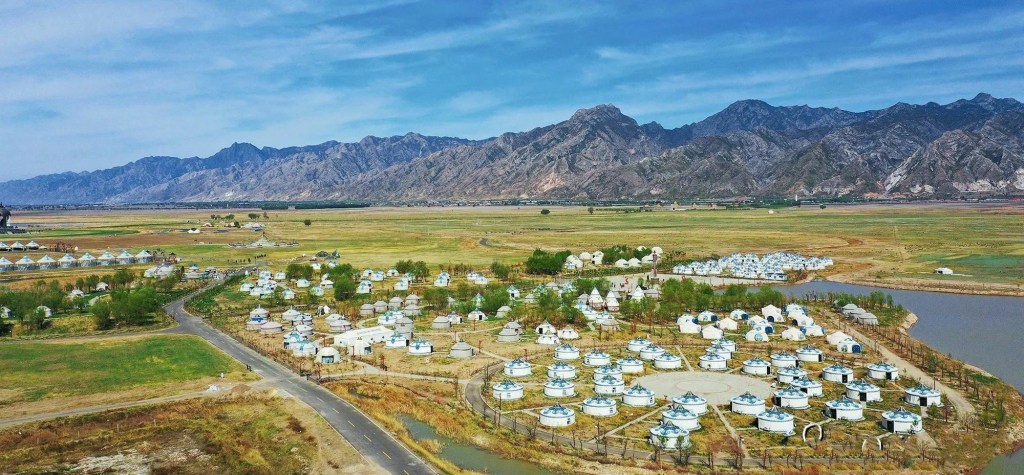
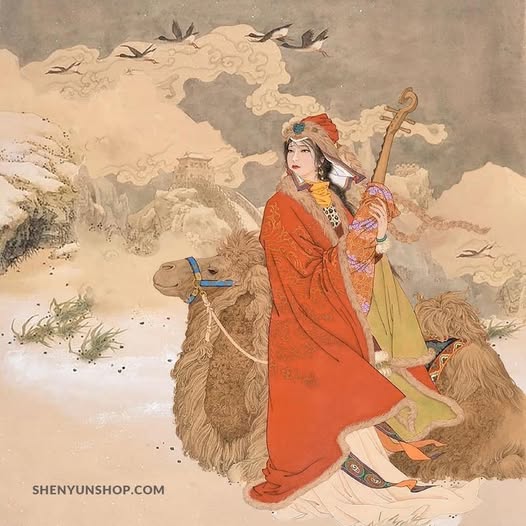

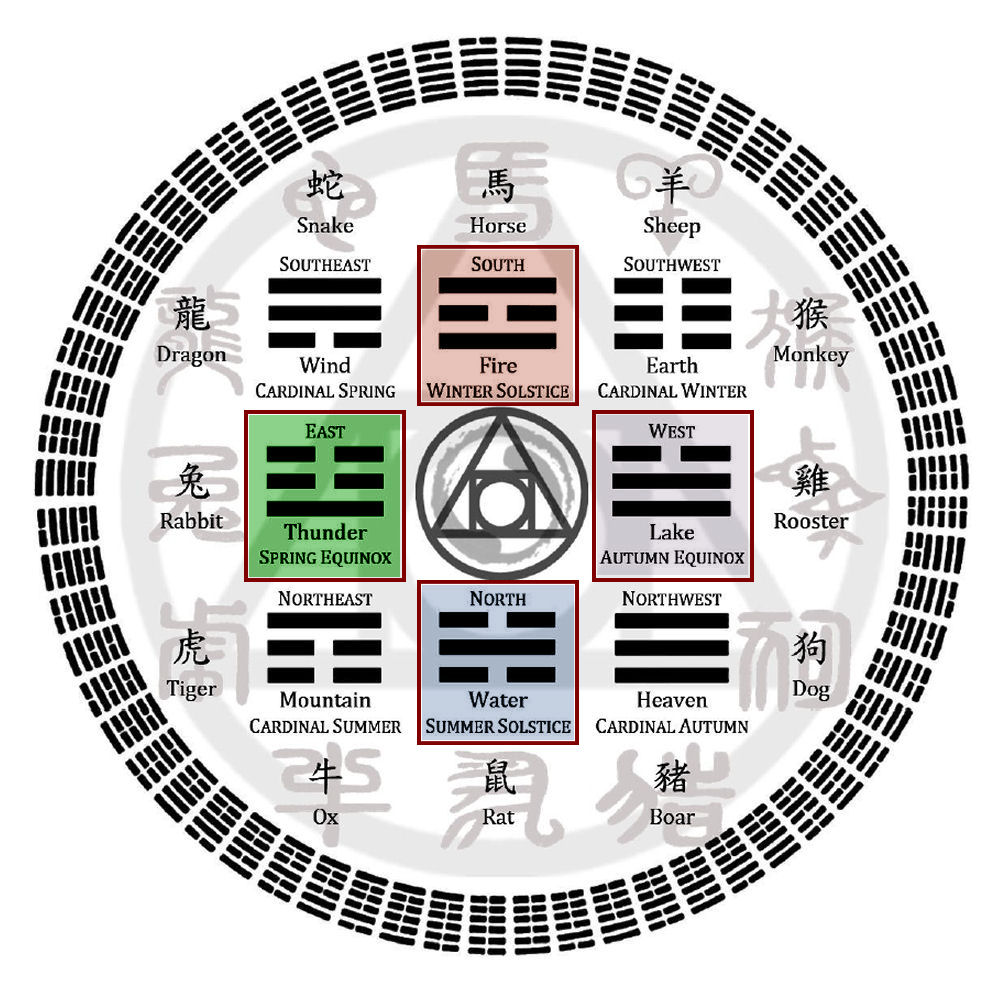
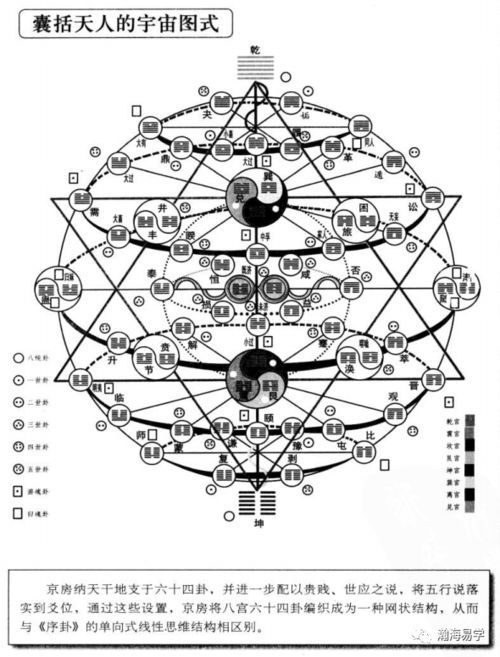
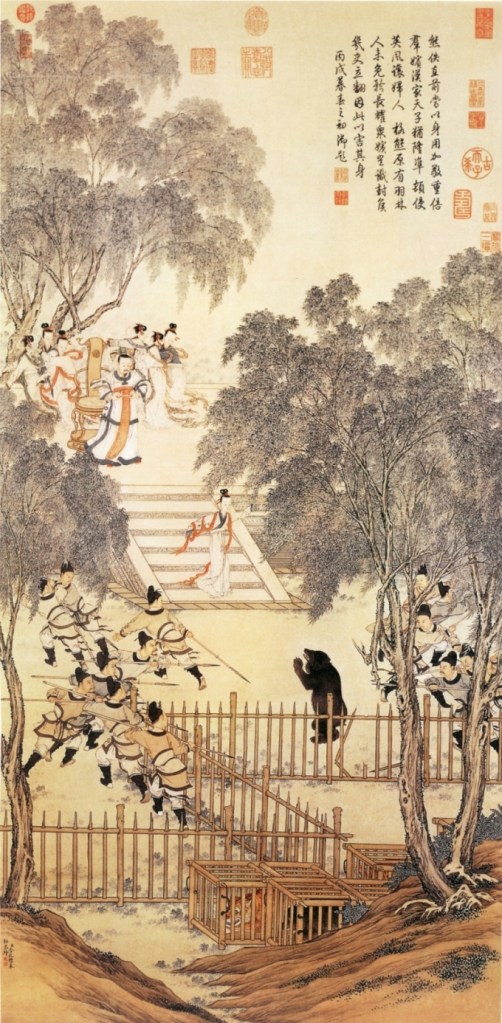
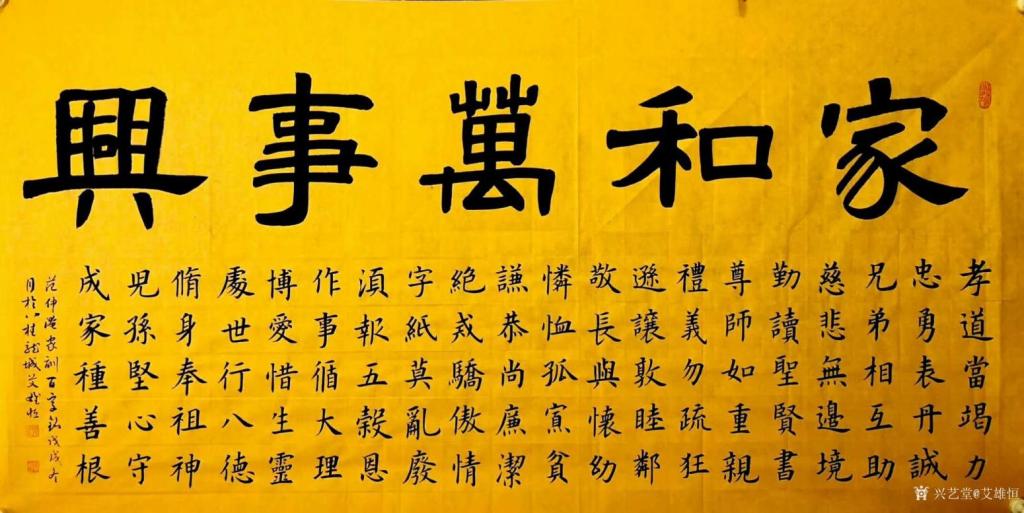
 Reflection by Rio Grande