Tag: Zhang Liang

  • Comprehensive Reflections to Aid in Governance(Part 94): Keeping Kingly Titles within The Liu Family

    Comprehensive Reflections to Aid in Governance

    By Sima Guang

    Translated By Yiming Yang 

    Annals of Han Book 3 Scroll 11 (continued)
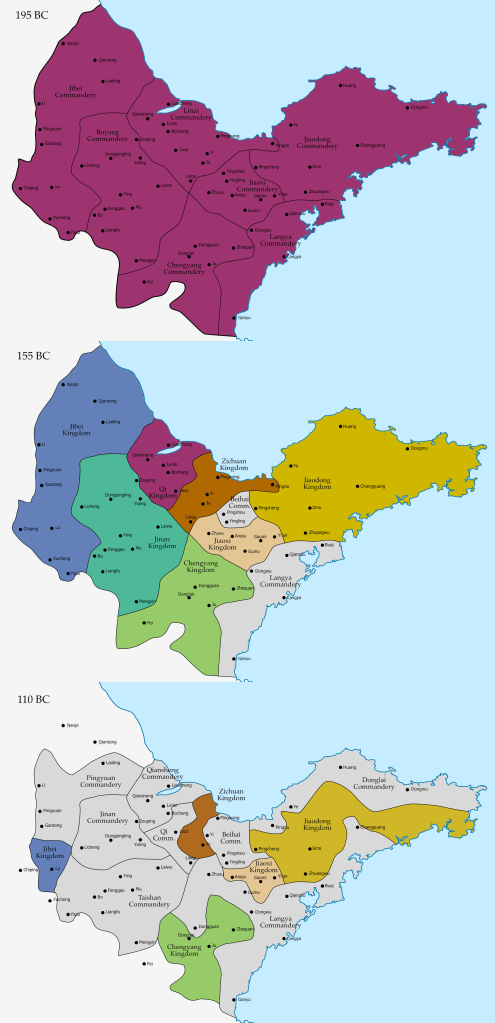
    The Evolution of The Kingdom of Qi

    The 6th year of the Emperor Gaozu(201 B.C. continued)

    The emperor believed the country was finally at peace. His sons were still young, and he had few brothers. Learning from the downfall of the Qin dynasty, which lacked external support, he decided to grant kingly titles to members of his extended family—those who shared the same family name—to safeguard and manage different regions.

    On January 21, in the spring, the emperor divided Han Xin’s territory into two states: 53 counties east of the Huai River were awarded to General Liu Jia, the emperor’s elder cousin, as King of Jing; 36 counties, including the commanderies of Xuejun, Donghai, and Pengcheng, were awarded to his younger brother, Lord Wenxin Liu Jiao, as King of Chu.

    On January 27, the emperor awarded 53 counties under the commanderies of Yunzhong, Yanmen, and Daijun to his elder brother, Marquis Yixin Liu Xi, as King of Dai. He also granted 73 counties, including the commanderies of Jiaodong, Jiaoxi, Linzi, Jibei, Boyang, and Chengyang, to his illegitimate son Liu Fei who was born out of wedlock when the emperor was a commoner, as King of Qi. All people who spoke the Qi dialect became subjects of the kingdom of Qi.

    The emperor thought the king of Hán, Xin, was a military talent. His princedom was bordered with Gong county and Luoyang to the north, Wancheng and Ye county to the south, Huaiyang to the east.  These were all military strongholds.  The emperor set aside 31 counties under commandery Taiyuan to the state of Hán.  He moved the king of Hán to the north of Taiyuan and made Jinyang the capital of the state to defend the borders against the nomads.  Xin wrote to the emperor: “The Xiongnu invaded my state border several times.  Jinyang is too far away from the border.  I request moving the capital to the town of Mayi.” The emperor approved the request.

    The emperor had already awarded more than twenty top achievers, The rest of them bogged down into dispute and the title awarding process ground to a halt.  One day the emperor saw the generals were talking together on the sandy beach of Luo River when he watched them from an overpass in the South Palace of Luoyang.

    “What are they talking about?”  The emperor asked.

    “Does your majesty know this?  They are plotting a mutiny.”  Marquis Liu, Zhang Liang replied.

    “The country just reconciled in peace.  Why do they want to revolt again?”  The emperor was puzzled.  

    “Your majesty was a commoner yourself and relied on these generals to conquer the country. Now your majesty is the son of Heaven.  Those awarded are the family members and old friends of your majesty’s; Those killed are whom your majesty had grudge on.  Now the officials who counted the merits of the generals indicated that there were not enough fief lands in the country to go around for rewarding. These generals feared that they were not going to be all rewarded with fiefs.  They also feared they would be killed if they got the wrong side and offended your majesty in the past.  That’s the reason they got together and plotted mutiny.”

    “What should I do about it?”  The emperor started worrying.

    “Among all your generals, who is the one, that everyone knows, that is hated the most by your majesty?”  Marquis Liu asked.

    Yong Chi is the one.  He and I held a grudge for years.  He humiliated me on many occasions.  I want to kill him.  But he had rendered many meritorious services and I could not bear to do it.”

    “Then you reward Yong Chi first.  Everyone else will feel confident that they will be treated fairly.”

    The emperor held a banquet to honor Yong Chi and awarded him as Marquis Shifang.  He also pushed the prime minister and censor-in-chief to accelerate the award granting process.  The generals were happy after the wine-and-dine.  They said to each other: “We don’t need to worry if even Yong Chi can be a marquis.”

    Sima Guang’s comments: Zhang Liang was the most trusted adviser of the emperor.  He won’t hold back if he has something to say.  How come he only spoke out when the emperor saw something unusual accidentally had he known that the generals were plotting a mutiny?  The reason was that the emperor dealt out rewards or punishments based on whether he liked or hated a person in the early days on the throne.  His judgment was unfair at times.  His ministers felt either bitter or terrorized.  Zhang Liang took the opportunity to rectify the emperor’s behavior, such that the emperor would not harm public interest with personal tastes and subjects would not watch over their shoulders.  The state will be free of distress and benefits the upcoming generations.  Advisors like Zhang Liang are good at remonstration.

    The awarding process of titled classes that were above Marquis had come to a close. The emperor promulgated the names of eighteen first class marquis with their rankings.  Public opinion said: “Marquis Pingyang, Cao Shen, who conquered many cities and land and wounded in seventy places of his body, should rank the first because of his highest merit score.”

    Marquis Within Passes E Qianqiu, an internuncio, disagreed: “The comments you guys made are off the mark.  Cao Shen earned his hundreds of merits in the battlefields, but those were just one time heroic acts.  His majesty had standoffs with the king of Chu for five years.  Many times his majesty had lost his troops and taken a flight for his life.  Xiao He often replenished his majesty’s troops, tens of thousands at times when his majesty had not even requested for;  Many times his majesty ran out of food and other supplies.  It was Xiao He who transported goods from Guanzhong and kept the supply chain of food moving;  Many times his majesty lost footings to the east of Xiao Mountains.  It was Xiao He who maintained a home base for his majesty to return.  These are the achievements impacting thousands of generations.  The kingdom of Han would not have missed a great deal without the service of hundreds of Cao Shen;  Why do we value a heroic achievement of a time over an achievement that impacts thousands of generations!  Xiao He should rank the first;  Cao Shen the second!”  The emperor agreed: “Well said!”  He granted Xiao He the privilege to go to court with his sword and shoes, and exempted him from trotting when coming to meet the emperor.

    The emperor said: “I heard that those who promoted winners should be rewarded amply.  Xiao He’s achievements are the greatest.  Mr. E has made us see more clearly.”  He promoted E Qianqiu to Marquis Anping, increasing his fiefdom.   He also awarded the father, son and brothers of Xiao He, more than ten people with fief.  He increased the fiefdom of Xiao He by two thousand households.

  • Comprehensive Reflections to Aid in Governance(Part 92): Zhang Liang’s Fading Away

    Comprehensive Reflections to Aid in Governance

    By Sima Guang

    Translated By Yiming Yang 

    Annals of Han Book 3 Scroll 11 (continued)

    One of the Temples Worshiping Chisongzi, Hong Kong

    The 5th year of the Emperor Gaozu (202 B.C. continued)

    Lou Jing, from the kingdom of Qi, was sent to a garrison in Longxi Commandery. While passing through Luoyang, he visited his fellow townsman, General Yu of Qi, wearing a sheepskin coat and pulling a cart. He asked General Yu to introduce him to the Emperor. General Yu wanted to provide him with better attire for the meeting, but Lou Jing refused, saying, “If I come in silk, I will meet his majesty in silk. If I come in plain cloth, I will meet his majesty in plain cloth. I dare not dress differently.” General Yu mentioned Lou Jing to the Emperor, who agreed to meet him.

    When the Emperor sought his advice, Lou Jing asked, “Does your majesty intend to compete with the Zhou dynasty in terms of prosperity by choosing Luoyang as the capital?”

    The Emperor replied, “Yes.”

    Lou Jing continued, “Your majesty took over the country in a way very different from the Zhou dynasty. The ancestor of Zhou, Hou Ji, was awarded the fiefdom Tai State. From that time, the family followed a virtuous path, accumulating merit and charity over several generations. Then came King Tai, King Ji, King Wen, and King Wu of Zhou, whom other monarchs admired and supported. King Wu of Zhou overthrew the Shang dynasty and became emperor. When King Cheng of Zhou ascended the throne and the Duke of Zhou served as prime minister, they chose Luoyang as the capital because it was centrally located, making it equally accessible for all the monarchs to pay tributes and report to the Emperor.”

    “A virtuous king easily becomes emperor, while an unethical king is easily destroyed.  During the prime of the Zhou dynasty, the country was at peace and harmony, with all the monarchs and neighboring foreigners compliant and paying tribute. But as the Zhou dynasty declined, no one paid homage anymore, and the emperor lost control over the country. He not only lost his moral authority but was also in a weaker position. Now, your majesty began the uprising in the town of Feng in Pei county, prevailed over Shu and Hanzhong commandery, and then conquered the three kingdoms of Qin. Your majesty fought Xiang Yu between Xingyang and Chenggao, enduring more than seventy major battles and forty minor ones. The people of this country have suffered extreme cruelty. Countless bodies of fathers and sons lie scattered in the fields, the cries of the bereaved have not ceased, and the wounded have not yet risen from their beds. We are not in a position comparable to the time of King Cheng or King Kang of Zhou.”

    “The former kingdom of Qin has mountains at its back and is encircled by rivers. Fortresses have been built at strategic mountain passes on all four sides. In an emergency, a million soldiers could be mobilized instantly. With Qin’s infrastructure and fertile land, it is a god-blessed stronghold. If your majesty chooses to establish the capital within the Hangu Pass, the land of Qin will be secure, even if there are rebellions east of Xiao Mountain. In hand-to-hand combat, it is not a total victory unless you can grab your opponent by the throat and strike from his back. By securing the former kingdom of Qin as the capital, your majesty essentially grabs the country by its throat and slaps its back.”

    The Emperor consulted other ministers, all of whom were from east of the Xiao Mountains. They tripped over each other to offer their opinions: “The Zhou dynasty lasted for centuries, while the Qin dynasty perished within only two generations. Luoyang has Chenggao to the east, Xiao Mountain and Mianchi Lake to the west. It is backed by the Yellow River and faces the Yi River and Luo River, making its defensive position reliable.”

    The Emperor then sought advice from Zhang Liang. Zhang Liang said, “Luoyang is defensible, but its core area is too small, and the farming soil is poor. It is vulnerable to attacks from all directions and not an ideal place to engage in a long battle. Guanzhong, on the other hand, is different. It has Xiao Mountain and Hangu Pass to its east, Long Mountain and the Shu commandery to its west, with thousands of miles of fertile land. It is enriched by the wealth of Ba and Shu commanderies to the south and benefits from the nomads’ pastures to the north. It is protected on three sides, leaving only the eastern monarchs to deal with. If these monarchs are peaceful, the Yellow and Wei rivers can serve as conduits to transport resources westward to the capital. If they rebel, troops can swiftly move downstream, and supply lines won’t be a problem. That is why Guanzhong is known as the ‘Thousand Miles of Metal City’ or ‘God-blessed Home Base.’ Lou Jing knows what he is talking about.”

    The Emperor immediately set out westward and established Chang’an as the capital. He appointed Lou Jing as a court guard and granted him the title of Lord Fengchun. Additionally, he honored Lou Jing by bestowing his own surname, Liu, upon him.

    Zhang Liang had been in poor health and practiced a therapeutic Daoist art since following the Emperor into the west of Hangu Pass. He adopted a strict diet, avoiding grain, and rarely left his house. He declared, “My family served as prime ministers of Hán for generations. I spent ten thousand caddies of gold to avenge the brutal Qin when the kingdom of Hán was annihilated, and I made an impact on the country. I was fortunate enough to become the emperor’s advisor and was granted a fief of ten thousand households just by moving my three-inch tongue and sharing my counsel. This is the highest position a commoner could ever achieve—far beyond what I desired. Now, I wish to follow Chisongzi, a Daoist immortal, to wander freely and leave behind the troubles of the human world.”

    Sima Guang’s commentary: Death after life is as natural as night following day. From ancient times to the present, no one has escaped fate to achieve immortality. Zhang Zifang was a rational man and must have known that immortality was a fantasy. His wisdom was evident in his talk of following Chisongzi’s path. Fame and success are the hardest trials a minister faces. The Emperor praised none more than the three standouts—yet Marquis Huaiyin and his clan were extirpated, and Xiao He was imprisoned. Isn’t it because they did not stop when their lives reached their peaks? Zhang Zifang wisely turned his life over to the gods, discarding wealth and fame, and leaving the secular world. He is an example of someone who saved himself and his philosophy.

    The Emperor announced a nationwide amnesty on June 9th. 

    In July of the fall, Zang Tu, the king of Yan, rebelled, prompting the Emperor to personally lead the campaign to suppress the mutiny. 

    Both King Jing of Zhao, Zhang Er, and King Wen of Changsha, Wu Rui, passed away. 

    Zang Tu was captured in September, and Marquis Chang’an, Lu Wan, who served as the grand commandant, was appointed the king of Yan. Lu Wan had grown up in the same neighborhood as the Emperor and was born on the same day, a bond unmatched by anyone else. His appointment as king was a unique honor. 

    Li Ji, a general under Xiang Yu, also mounted an insurrection, which the emperor personally quelled, bringing Li Ji into custody.

    The construction of Changle Palace began in late September. 

    Zhongli Mo, a general under Xiang Yu, was a close friend of Han Xin, the king of Chu. He joined Han Xin‘s command. The Emperor, harboring a grudge against Zhongli Mo, issued a decree for his arrest upon learning of his escape to the kingdom of Chu.

    When Han Xin traveled to Chu for his inauguration, his large entourage was heavily armed as they passed through the towns and counties of his fiefdom state.

  • Comprehensive Reflections to Aid in Governance(Part 89): Besieged On All Sides in Gaixia

    Comprehensive Reflections to Aid in Governance

    By Sima Guang

    Translated By Yiming Yang 

    Annals of Han Book 3 Scroll 11

    Duration of 3 years

    Xiang Yu and his horse

    The 5th year of the Emperor Gaozu (202 B.C.)

    In October of that winter, the King of Han pursued King Xiang Yu to Guling. He arranged a meeting with Han Xin, the King of Qi, and Peng Yue, the Prime Minister of Wei, to plan an assault on the army of Chu. However, Han Xin and Peng Yue did not attend. King Xiang Yu struck back at the Han forces and dealt them a severe blow. The Han troops retreated to their camps and refused to engage further.

    The King of Han asked Zhang Liang, “What should we do now that our allies haven’t come to our aid?”

    Zhang Liang replied, “The Kingdom of Chu is on the verge of collapse, but these two generals haven’t yet secured their territories. Their absence was to be expected. If Your Majesty is willing to share the land, they will come at once. The enthronement of Han Xin as King of Qi was not your original intent, and he is aware of that and not convinced of your trust. Peng Yue conquered the lands of Wei, yet Your Majesty only appointed him Prime Minister due to the presence of Wei Bao. Now that Wei Bao is dead, Peng Yue expects to be enthroned, but Your Majesty has hesitated.”

    “If Your Majesty grants the land from Suiyang county to the north, up to Gucheng, as Peng Yue‘s kingdom, and makes him king; and if you give the land from ancient State of Chen to the east, all the way to the East Ocean, to Han Xin, the King of Qi, they will join us immediately. Han Xin‘s home is in the Kingdom of Chu, and his intention would be to reclaim it. If Your Majesty cedes these lands and gives them authority to manage their battles, the downfall of Chu will not be difficult.”

    The King of Han followed Zhang Liang’s advice, and Han Xin and Peng Yue soon led their troops to join him, as expected.

    In November, General Liu Jia crossed the Huai River to the south and laid siege to the city of Shouchun. He sent an emissary to persuade King Xiang Yu’s Grand Marshal, Zhou Yin, to defect. Zhou Yin betrayed the Kingdom of Chu and led troops from Shu county in a massacre in Lu county. He then organized the soldiers of Jiujiang to welcome their former king, Qingbu. Afterward, he moved to Chengfu county, where he carried out another massacre before joining forces with General Liu Jia.

    In December, King Xiang Yu reached Gaixia. His army had dwindled, and they were running out of food. All his battles against the Han forces had ended in failure, and they were now trapped in bastions. The Han army, along with allied forces, surrounded his camps in multiple layers. One night, King Xiang Yu heard folk songs of Chu being sung by the Han soldiers from all sides. Astonished, he exclaimed, “Has the Han army taken over all of Chu? Why are so many Chu folks here?” He rose, drank liquor in his tent, and, overcome with emotion, began singing sorrowful songs, tears streaming down his face. Those around him sobbed, not daring to look at him.

    That night, King Xiang Yu mounted his favorite steed, named Zhui, and led 800 elite cavalrymen to break through the encirclement. They rode south at high speed, and it was not until dawn that the Han army realized they had fled. General Guan Ying was ordered to pursue them with 5,000 cavalrymen. King Xiang Yu managed to cross the Huai River, but by then, only about a hundred cavalrymen remained with him. They became lost near Yinling town and asked a farmer for directions. The farmer said, “Turn left.” They followed his advice and were soon trapped in a large swamp, where the Han cavalry caught up with them.

    King Xiang Yu fled east again and reached Dongcheng county with only 28 cavalrymen remaining. Several thousand Han cavalry were in pursuit. Realizing he could not escape, Xiang Yu spoke to his followers: “It has been eight years since I took up arms. I have fought more than seventy battles and never been defeated. That is why I am the hegemon of the land. Yet, now we are besieged. This is the will of Heaven, not my failure as a warrior. In this final duel of life and death, I want to fight for sport and claim at least three victories: breaking the encirclement, beheading an enemy commander, and cutting down their banner. I want to prove to you that it is Heaven’s will, not my own shortcomings, that has doomed us.”

    He divided his riders into four groups, each facing a different direction, as the Han cavalry encircled them in multiple layers. Xiang Yu told his followers, “I will take out one of their commanders for you.” He then ordered them to charge in all four directions and regroup at three points over the mountain to the east. Xiang Yu roared as he charged into the Han formation, causing their soldiers to panic and flee. He beheaded a Han commander in the chaos.

    A Han cavalry court guard named Yang Xi pursued Xiang Yu, but when Xiang Yu turned and stared at him with a thunderous shout, both Yang Xi and his horse were so terrified that they retreated several miles before recovering their nerve.

    Xiang Yu met his followers at the three rendezvous points. The Han pursuers, unsure where he was, split their forces into three groups to surround each location. Xiang Yu charged the Han troops once more, beheading another commander and killing dozens of Han soldiers. When the group regrouped again, only two horsemen were missing.

    Xiang Yu asked his followers, “How was that?”

    His men, filled with admiration, dismounted and said, “Exactly as Your Majesty said!”

    King Xiang Yu planned to cross the Yangtze River at the town of Wujiang, where the post chief of Wujiang ford had prepared a boat for him. The chief urged him, “Jiangdong region may not be large, but it covers thousands of miles and has a population in the hundreds of thousands. It is enough for Your Majesty to reclaim power. Please cross quickly—only I have boats, and the Han soldiers won’t be able to follow.”

    Xiang Yu laughed and reconsidered: “Why should I cross the river if Heaven has already doomed me? I, Xiang Ji, crossed this river with 8,000 sons of Jiangdong and launched my western campaign. Today, not one of them returned with me. Even if the people of Jiangdong still love me and make me their king, I don’t have the heart to face them again! They may not say a word, but how could I not feel ashamed?”

    He gave his horse, Zhui, as a gift to the post chief and ordered his guards to dismount for one final battle. Xiang Yu fought hand-to-hand with a sword, killing hundreds of Han soldiers on his own, though he was wounded in more than ten places.

    During the fight, Xiang Yu saw a cavalry major, Lü Matong, and asked, “Aren’t you an old friend of mine?” Lü Matong dared not face Xiang Yu, turned to calvary court guard Wang Yi, and pointed to the king, “This is King Xiang Yu!”

    Xiang Yu responded, “I’ve heard the Kingdom of Han has offered 1,000 ounces of gold and a fief of 10,000 households for my head. I’ll repay you a favor for your kindness.” With that, he slashed his own throat.

    Wang Yi took Xiang Yu’s head, but chaos erupted as Han cavalrymen trampled each other, each trying to claim a piece of Xiang Yu’s body. In the mayhem, dozens of soldiers died. Ultimately, five men—Yang Xi, Lü Matong, Lü Sheng, Yang Wu, and Wang Yi—each claimed a piece of Xiang Yu. Together, they confirmed the remains and received the reward. Each was given a fief of 2,000 households and the title of marquis.

    All the cities of the Kingdom of Chu had surrendered to Han rule, except for the county of Lu. The King of Han led the army of the entire country to attack the city. As they approached the city walls, they heard chanting and music from within. The King of Han realized that this was Xiang Yu’s fiefdom, and the people of Lu remained defiant because of their loyalty to him and adherence to the rites.

    The King of Han then showed Xiang Yu‘s severed head to the people of Lu, and the city capitulated. He ordered that Xiang Yu‘s funeral be conducted in the name of the Duke of Lu and had him buried in Gucheng county. The King of Han attended the ceremony himself and wept at the altar. He pardoned all members of the Xiang family, granting Xiang Bo and three others the title of marquis and the surname Liu. Additionally, he allowed those who had been forcibly relocated to Chu to return to their original homes.

    The great historian Sima Qian once commented: Xiang Yu rose from obscurity and dismantled the Qin Empire with the help of five allied monarchs in just three years. He divided the land and granted his followers the titles of king and marquis, becoming the de facto ruler of the country. Although his reign ended poorly, his achievements were nonetheless remarkable in history. Yearning for his home state of Chu, he abandoned the strategic region of Guanzhong. He exiled the honorary emperor and usurped power. Given this, it is difficult to fault the kings and marquises he elevated, who later turned against him. Xiang Yu was overly confident in his military prowess and trusted his own judgment, often deviating from established norms. He sought hegemony and ambitious control but relied solely on brute force to govern. He ultimately perished in the east, and his kingdom was destroyed. Even in defeat, he refused to acknowledge his faults, blaming his downfall on fate, claiming, “It was Heaven that doomed me, not my military failure.” How absurd!

    In his Exemplary Sayings, Yang Xiong commented: Someone asked, “The King of Chu failed at Gaixia. Before his death, he claimed it was Heaven’s will. Does that make sense?” The answer was: “The King of Han sought advice from many, and more ideas overcame more brute force. The King of Chu, on the other hand, discouraged counsel and weakened his own position. Victory goes to those who triumph through wisdom. Defeat comes to those who undermine themselves. What does Heaven have to do with it?”

  • Comprehensive Reflections to Aid in Governance(Part 58): A Tour of The Empire

    Comprehensive Reflections to Aid in Governance

    By Sima Guang

    Translated By Yiming Yang

    Annals of Qin Book 2 Scroll 7 (continued)

    South Gate to Heaven, Mount Tai

    The 27th year of the First Emperor(220 B.C.)

    The First Emperor toured the region of Longxi and Beidi commandery, reaching Mount Jitou and then back home passing the Huizhong Palace.

    Changxin Palace was built on the south bank of Wei River.  It was renamed as the Supreme Temple once it was finished construction.  A road was made from the Supreme Temple to the Lishan Mausoleum.  The Front Hall of the Ganquan Palace had been built.  A corridor was built leading it to Xianyang.  Expressways reserved for the emperor were built from Xianyang to the other parts of the country.

    The 28th year of the First Emperor(219 B.C.)

    The First Emperor toured the commanderies and counties of the east. He ascended Mount Yi in Zou county and erected a monument extolling his achievements. At the foot of Mount Tai, he summoned seventy Confucianists from the state of Lu to discuss a sacrificial ceremony for heaven(Feng) and earth(Shan). Some Confucianists suggested: “In the ancient way of ceremony, the wheels of wagons must be wrapped with sedge grass to avoid squashing the dirt, rocks, trees, and grass of the mountain. Sacrificing for the earth involves sweeping the ground, then covering it with mats made of straw and stalks.” Other Confucianists proposed different, equally impractical ideas. From that moment, the First Emperor despised the Confucianists, finding their advice difficult to implement. He ordered the road to be widened for wagons. He reached the top of Mount Tai from the sunny side, erected monuments to laud his virtues, then descended from the shady side and sacrificed for the earth at a small peak named Mount Liangfu. The liturgy of the ceremonies adhered to those used by the worship ministers of Qin when they conducted ceremonies for God in progenitor temples at Yong. These rites were kept secret, and none could be recorded.

    From there, the First Emperor traveled east and cruised the coastal area. He paid homage to numerous temples, famous mountains, and rivers, and honored the eight gods: Heaven, Earth, Soldier, Yin, Yang, Month, Day, and the Four Seasons. The First Emperor then journeyed south and ascended to the top of Langya Terrace. Delighted with the location, he stayed in the commandery for three months. A palace named Langya was built there, and another stone monument was erected to express his satisfaction.

    Song Wuji and Xianmen Zigao from the kingdom of Yan claimed they had learned the way to immortality and sublime into celestial beings. Many gullible and eccentric scholars followed them enthusiastically, propagating their teachings. Kings, from King Wei and King Xuan of Qi to King Zhao of Yan, became believers and sent people to search for three fairy islands—Penglai, Fangzhang, and Yingzhou—in the Bohai Sea. According to myths, these islands were not far from the human world, but magical winds would blow ships away as they approached. A few fortunate people who reached the islands reported that fairies lived there and that they possessed elixirs for immortality.

    When the First Emperor toured the coast, sorcerers from the kingdom of Qi, including one named Xu Fu, vied for his favor by submitting a proposal. Xu Fu petitioned to lead a group of virgin boys and girls to search for the fairy islands after a period of fasting. The First Emperor approved, and Xu Fu selected several thousand boys and girls to seek fairies in the ocean. However, their ships were blown back by inauspicious winds. They reported, “We could not reach them, yet we could see them.”

    The First Emperor was on his way back to Xianyang when he passed through Pengcheng commandery. There, he held a worship ritual in a temple after a period of fasting. He sought to recover a caldron from the Zhou dynasty that had sunk in the Si River, by ordering a thousand people to dive into the river, but they found nothing.

    He then headed southwest, clearing the Huai River, and reached Mount Heng and Nanjun commandery. His entourage sailed downstream on the Yangtze River and arrived at a temple on Mount Xiang. They encountered strong winds that nearly wrecked their ship. The First Emperor asked the scholar accompanying him, “What kind of goddess is Madame Xiang?” The scholar replied, “I heard she was the daughter of Emperor Yao and married Emperor Shun. She was buried here.”

    In a rage, the First Emperor ordered three thousand prisoners to hack down all the trees on Mount Xiang, leaving the mountain bare and exposing its dark red soil. The First Emperor then left Nanjun and returned to Xianyang through the Wu Pass.

    Zhang Liang was from the kingdom of Han. His father and grandfather, up to five generations, had been prime ministers of Han. After the kingdom of Han perished, Zhang Liang devoted all his assets, amounting to a thousand catties of gold, to avenging the fall of Han.

    The 29th year of the First Emperor(218 B.C.)

    The First Emperor toured the eastern regions and passed through Yangwu county. Zhang Liang hired a hitman to ambush him with an iron mallet at a place called Bolangsha. The mallet, thrown at the emperor, struck one of his escorting wagons in the cavalcade. The emperor was frightened and ordered his guards to search for the perpetrators, but they did not catch anyone. He then commanded a nationwide manhunt for ten days.

    The First Emperor ascended Mount Zhifu and inscribed his achievements on the rocks there. He then traveled to Langya Commandery before returning to Xianyang via Shangdang Commandery.

    The 31st year of the First Emperor(216 B.C.)

    The First Emperor decreed that all plebeians in the country report their properties and acreage.

    The 32nd year of the First Emperor(215 B.C.)

    The First Emperor visited Mount Jieshi. He sent a Daoist named Lu to pay a visit to Xianmen Zigao from the kingdom of Yan, a hermit reputed to know the secret of becoming a celestial being. The emperor made an inscription on the gate of Jieshi. He decreed that the walls of castles be broken down, and levees, dikes, and dams be flattened or breached. The First Emperor then surveyed the northern borders and returned via Shangjun commandery.

    Daoist Scholar Lu returned from his visit to Xianmen Zigao overseas and submitted a report to the emperor titled “Record Map Book.” In the book, there was an ominous prophecy: “It is Hu who causes the kingdom of Qin to perish.” Hu was the derogatory name people gave to the Xiongnu in the north. The First Emperor ordered General Meng Tian to lead a 300,000-strong army to conquer Xiongnu in the north.

    The 33rd year of the First Emperor(214 B.C.)

    The First Emperor decreed conscription for men who were former fugitives, son-in-laws living in their wives’ houses, and merchants to join the army. This army conquered the rolling hills of the state of Southern Yue, establishing commanderies such as Guiling, Nanhai, and Xiang. Five hundred thousand disgraced and punished individuals were relocated to the Five Hills region to guard the southern border, where they cohabitated with the local population.

    General Meng Tian chased Xiongnu away and recovered a swath of land south of the Yellow River, establishing forty-four counties in this area. The Great Wall of China was built according to the geographic features, with fortresses constructed to control the strategic passes along the northern borders. Extending tens of thousands of miles from Lintao County to Liaodong Commandery, the Great Wall marked a formidable boundary. Meng Tian led his army across the Yellow River and occupied Mount Yangshan, zigzagging northwards. His troops were deployed on the frontier for more than ten years. For years, General Meng Tian stationed at Shangjun and governed the northern frontier, his fame serving as a deterrent to Xiongnu.