Tag: Xiang Yu

  • Comprehensive Reflections to Aid in Governance(Part 89): Besieged On All Sides in Gaixia

    Comprehensive Reflections to Aid in Governance

    By Sima Guang

    Translated By Yiming Yang 

    Annals of Han Book 3 Scroll 11

    Duration of 3 years

    Xiang Yu and his horse

    The 5th year of the Emperor Gaozu (202 B.C.)

    In October of that winter, the King of Han pursued King Xiang Yu to Guling. He arranged a meeting with Han Xin, the King of Qi, and Peng Yue, the Prime Minister of Wei, to plan an assault on the army of Chu. However, Han Xin and Peng Yue did not attend. King Xiang Yu struck back at the Han forces and dealt them a severe blow. The Han troops retreated to their camps and refused to engage further.

    The King of Han asked Zhang Liang, “What should we do now that our allies haven’t come to our aid?”

    Zhang Liang replied, “The Kingdom of Chu is on the verge of collapse, but these two generals haven’t yet secured their territories. Their absence was to be expected. If Your Majesty is willing to share the land, they will come at once. The enthronement of Han Xin as King of Qi was not your original intent, and he is aware of that and not convinced of your trust. Peng Yue conquered the lands of Wei, yet Your Majesty only appointed him Prime Minister due to the presence of Wei Bao. Now that Wei Bao is dead, Peng Yue expects to be enthroned, but Your Majesty has hesitated.”

    “If Your Majesty grants the land from Suiyang county to the north, up to Gucheng, as Peng Yue‘s kingdom, and makes him king; and if you give the land from ancient State of Chen to the east, all the way to the East Ocean, to Han Xin, the King of Qi, they will join us immediately. Han Xin‘s home is in the Kingdom of Chu, and his intention would be to reclaim it. If Your Majesty cedes these lands and gives them authority to manage their battles, the downfall of Chu will not be difficult.”

    The King of Han followed Zhang Liang’s advice, and Han Xin and Peng Yue soon led their troops to join him, as expected.

    In November, General Liu Jia crossed the Huai River to the south and laid siege to the city of Shouchun. He sent an emissary to persuade King Xiang Yu’s Grand Marshal, Zhou Yin, to defect. Zhou Yin betrayed the Kingdom of Chu and led troops from Shu county in a massacre in Lu county. He then organized the soldiers of Jiujiang to welcome their former king, Qingbu. Afterward, he moved to Chengfu county, where he carried out another massacre before joining forces with General Liu Jia.

    In December, King Xiang Yu reached Gaixia. His army had dwindled, and they were running out of food. All his battles against the Han forces had ended in failure, and they were now trapped in bastions. The Han army, along with allied forces, surrounded his camps in multiple layers. One night, King Xiang Yu heard folk songs of Chu being sung by the Han soldiers from all sides. Astonished, he exclaimed, “Has the Han army taken over all of Chu? Why are so many Chu folks here?” He rose, drank liquor in his tent, and, overcome with emotion, began singing sorrowful songs, tears streaming down his face. Those around him sobbed, not daring to look at him.

    That night, King Xiang Yu mounted his favorite steed, named Zhui, and led 800 elite cavalrymen to break through the encirclement. They rode south at high speed, and it was not until dawn that the Han army realized they had fled. General Guan Ying was ordered to pursue them with 5,000 cavalrymen. King Xiang Yu managed to cross the Huai River, but by then, only about a hundred cavalrymen remained with him. They became lost near Yinling town and asked a farmer for directions. The farmer said, “Turn left.” They followed his advice and were soon trapped in a large swamp, where the Han cavalry caught up with them.

    King Xiang Yu fled east again and reached Dongcheng county with only 28 cavalrymen remaining. Several thousand Han cavalry were in pursuit. Realizing he could not escape, Xiang Yu spoke to his followers: “It has been eight years since I took up arms. I have fought more than seventy battles and never been defeated. That is why I am the hegemon of the land. Yet, now we are besieged. This is the will of Heaven, not my failure as a warrior. In this final duel of life and death, I want to fight for sport and claim at least three victories: breaking the encirclement, beheading an enemy commander, and cutting down their banner. I want to prove to you that it is Heaven’s will, not my own shortcomings, that has doomed us.”

    He divided his riders into four groups, each facing a different direction, as the Han cavalry encircled them in multiple layers. Xiang Yu told his followers, “I will take out one of their commanders for you.” He then ordered them to charge in all four directions and regroup at three points over the mountain to the east. Xiang Yu roared as he charged into the Han formation, causing their soldiers to panic and flee. He beheaded a Han commander in the chaos.

    A Han cavalry court guard named Yang Xi pursued Xiang Yu, but when Xiang Yu turned and stared at him with a thunderous shout, both Yang Xi and his horse were so terrified that they retreated several miles before recovering their nerve.

    Xiang Yu met his followers at the three rendezvous points. The Han pursuers, unsure where he was, split their forces into three groups to surround each location. Xiang Yu charged the Han troops once more, beheading another commander and killing dozens of Han soldiers. When the group regrouped again, only two horsemen were missing.

    Xiang Yu asked his followers, “How was that?”

    His men, filled with admiration, dismounted and said, “Exactly as Your Majesty said!”

    King Xiang Yu planned to cross the Yangtze River at the town of Wujiang, where the post chief of Wujiang ford had prepared a boat for him. The chief urged him, “Jiangdong region may not be large, but it covers thousands of miles and has a population in the hundreds of thousands. It is enough for Your Majesty to reclaim power. Please cross quickly—only I have boats, and the Han soldiers won’t be able to follow.”

    Xiang Yu laughed and reconsidered: “Why should I cross the river if Heaven has already doomed me? I, Xiang Ji, crossed this river with 8,000 sons of Jiangdong and launched my western campaign. Today, not one of them returned with me. Even if the people of Jiangdong still love me and make me their king, I don’t have the heart to face them again! They may not say a word, but how could I not feel ashamed?”

    He gave his horse, Zhui, as a gift to the post chief and ordered his guards to dismount for one final battle. Xiang Yu fought hand-to-hand with a sword, killing hundreds of Han soldiers on his own, though he was wounded in more than ten places.

    During the fight, Xiang Yu saw a cavalry major, Lü Matong, and asked, “Aren’t you an old friend of mine?” Lü Matong dared not face Xiang Yu, turned to calvary court guard Wang Yi, and pointed to the king, “This is King Xiang Yu!”

    Xiang Yu responded, “I’ve heard the Kingdom of Han has offered 1,000 ounces of gold and a fief of 10,000 households for my head. I’ll repay you a favor for your kindness.” With that, he slashed his own throat.

    Wang Yi took Xiang Yu’s head, but chaos erupted as Han cavalrymen trampled each other, each trying to claim a piece of Xiang Yu’s body. In the mayhem, dozens of soldiers died. Ultimately, five men—Yang Xi, Lü Matong, Lü Sheng, Yang Wu, and Wang Yi—each claimed a piece of Xiang Yu. Together, they confirmed the remains and received the reward. Each was given a fief of 2,000 households and the title of marquis.

    All the cities of the Kingdom of Chu had surrendered to Han rule, except for the county of Lu. The King of Han led the army of the entire country to attack the city. As they approached the city walls, they heard chanting and music from within. The King of Han realized that this was Xiang Yu’s fiefdom, and the people of Lu remained defiant because of their loyalty to him and adherence to the rites.

    The King of Han then showed Xiang Yu‘s severed head to the people of Lu, and the city capitulated. He ordered that Xiang Yu‘s funeral be conducted in the name of the Duke of Lu and had him buried in Gucheng county. The King of Han attended the ceremony himself and wept at the altar. He pardoned all members of the Xiang family, granting Xiang Bo and three others the title of marquis and the surname Liu. Additionally, he allowed those who had been forcibly relocated to Chu to return to their original homes.

    The great historian Sima Qian once commented: Xiang Yu rose from obscurity and dismantled the Qin Empire with the help of five allied monarchs in just three years. He divided the land and granted his followers the titles of king and marquis, becoming the de facto ruler of the country. Although his reign ended poorly, his achievements were nonetheless remarkable in history. Yearning for his home state of Chu, he abandoned the strategic region of Guanzhong. He exiled the honorary emperor and usurped power. Given this, it is difficult to fault the kings and marquises he elevated, who later turned against him. Xiang Yu was overly confident in his military prowess and trusted his own judgment, often deviating from established norms. He sought hegemony and ambitious control but relied solely on brute force to govern. He ultimately perished in the east, and his kingdom was destroyed. Even in defeat, he refused to acknowledge his faults, blaming his downfall on fate, claiming, “It was Heaven that doomed me, not my military failure.” How absurd!

    In his Exemplary Sayings, Yang Xiong commented: Someone asked, “The King of Chu failed at Gaixia. Before his death, he claimed it was Heaven’s will. Does that make sense?” The answer was: “The King of Han sought advice from many, and more ideas overcame more brute force. The King of Chu, on the other hand, discouraged counsel and weakened his own position. Victory goes to those who triumph through wisdom. Defeat comes to those who undermine themselves. What does Heaven have to do with it?”

  • Comprehensive Reflections to Aid in Governance(Part 74): A Land of 18 Kingdoms

    Comprehensive Reflections to Aid in Governance

    By Sima Guang

    Translated By Yiming Yang

    Annals of Han Book 1 Scroll 9 (continued)

    A rhesus macaque mother and her child

    The 1st year of Emperor Gaozu(206 B.C. continued)

    A few days later, Xiang Yu led his troops westward and ransacked the city of Xianyang. He ordered the execution of the king of Qin, Ziying, and commanded the burning of all the Qin palaces. The inferno lasted for more than three months. His soldiers looted all the treasures of Qin, abducted the court’s women, and took them to the east. The people of Qin were horrified by Xiang Yu’s actions.

    A scholar, Mr. Han, advised him: “The Guanzhong region (the heartland of Qin) is naturally fortified by mountains and rivers. It is a place secured by fortresses on all sides. The land here is fertile, making it an ideal capital for your empire.” However, as Xiang Yu saw the Qin palaces reduced to wreck, he intended to return to his hometown in the east. He dismissed Mr. Han’s suggestion, saying: “To become rich and famous and not return to one’s homeland is like wearing an embroidered gown in the dark. What is the point?” Disheartened, Mr. Han made the remark: “I’ve heard that the people of Chu were rhesus monkeys dressed-up as humans, with caps and gowns. Now I believe it is true.” Upon learning of this insult, Xiang Yu had Mr. Han executed by boiling.

    Xiang Yu sent messengers to King Huai II of Chu, pleading to annul their agreement that whoever first entered Xianyang would be king. King Huai II replied, “A promise is a promise.” Enraged, Xiang Yu said, “It was my family who put King Huai II on the throne. He didn’t win any battles, so why does he get to dictate promises? When chaos erupted in the land, we installed descendants of the former monarchs to rally the troops against the Qin empire. It was you and I who donned armor and fought in the wilderness for three years until we finally crushed the Qin empire. Even though King Huai II did nothing, we can give him a king’s title but divide his land among ourselves.” His generals all agreed, saying, “Well said!” In January of that spring, Xiang Yu elevated King Huai II to the position of honorary emperor, stating, “The emperors of the past ruled over lands spanning thousands of miles and always lived upstream.” He relocated the honorary emperor to the south of the Yangtze River and designated Chen county as his capital.

    In February, Xiang Yu divided the land into kingdoms and bestowed the title of king upon his generals. He declared himself the Hegemonial King of West Chu, ruling over nine commanderies in the former kingdoms of Liang (also known as Wei) and Chu, with his capital in Pengcheng. Xiang Yu and Fan Zeng were wary of the Duke of Pei but maintained a cordial relationship to avoid the appearance of breaking their pact. In private, they discussed, “The commanderies of Ba and Shu are distant, with treacherous roads, and were places where Qin exiled its convicts.” Publicly, they claimed, “The commanderies of Ba and Shu are part of Guanzhong.” Xiang Yu then conferred the title of “King of Han” upon the Duke of Pei, giving him control over the three commanderies of Ba, Shu, and Hanzhong, with his capital at Nanzheng county.

    Xiang Yu divided the real Guanzhong (the heartland of the Qin kingdom) into three parts, granting them to the three surrendered Qin generals to block access by the king of Han(Liu Bang). General Zhang Han was made the King of Yong, ruling the land west of Xianyang, with his capital in Feiqiu county. Zhang Han’s chief of staff, Sima Xin, who had earlier been a prison warden who did a favor to Xiang Liang, was named the King of Sai, controlling the area from east of Xianyang to the Yellow River, with his capital in Yueyang county. General Dong Yi, who persuaded Zhang Han to surrender, was made the King of Di(Zhai), ruling Shangjun  commandery with his capital at Gaonu county.

    Xiang Yu transferred the King of Wei, Wei Bao, to be the King of West Wei, ruling the region east of the Yellow River with his capital in Pingyang. Shen Yang of Xiaqiu county, a favorite of Zhang Er and the first to conquer the Henan commandery, was named King of Henan with his capital at Luoyang. The King of Hán, Han Cheng, returned to his old capital at Yangdi. General Sima Ang of Zhao, who conquered the Henei commandery, was made King of Yin, ruling from the Zhaoge county.

    Xiang Yu moved the King of Zhao, Zhao Xie, to be King of Dai, while Zhang Er, who had a great reputation and had accompanied Xiang Yu into the Hangu Pass, was awarded the title of King of Changshan, ruling the former land of Zhao from his office in Xiangguo county. Lord Dangyang, Qing Bu, the top general of Chu, was appointed King of Jiujiang, headquartered in Liu county. Lord Po, Wu Rui, who led the Yue tribes to support Xiang Yu, was made King of Hengshan with his government in Zhu county.

    The commander-in-chief of the honorary emperor, Gong Ao, who had achieved multiple military victories, was awarded the title of King of Linjiang, with his capital in Jiangling. Xiang Yu reassigned the King of Yan, Han Guang, to be King of Liaodong, with his office in Wuzhong county. A general of Yan, Zang Tu, who joined the campaign to save Zhao and later followed Xiang Yu into the Hangu Pass, was promoted to King of Yan, ruling from Ji county.

    Xiang Yu reassigned the King of Qi, Tian Shi, to be King of Jiaodong, with his office in Jimo. A general of Qi, Tian Du, who also took part in the rescue of Zhao and the western expedition against Qin, was made King of Qi, ruling from Linzi. Another general of Qi, Tian An, who conquered several cities in the Jibei region and joined the rescue of Zhao, was named King of Jibei, with his capital in Boyang.

    In contrast, General Tian Rong of Qi, who had repeatedly spurned Xiang Liang and refused to join Xiang Yu’s western expedition, received no title. Similarly, Lord Cheng’an, Chen Yu, who relinquished his field marshal seal and did not join Xiang Yu’s campaign, also went unrewarded. Many of Xiang Yu’s supporters pleaded, saying, “Zhang Er and Chen Yu were inseparable and both accomplished much for the kingdom of Zhao. Since you awarded Zhang Er a king’s title, you must also reward Chen Yu.” Reluctantly, Xiang Yu awarded Chen Yu three counties around Nanpi county, upon hearing that he was staying there. Mei Juan, a general under Lord Po with numerous military merits, was granted the title of Marquis and a fief of one hundred thousand households.

    The King of Han was furious and wanted to wage war against Xiang Yu. His generals, Zhou Bo, Guan Ying, and Fan Kuai, all urged him not to proceed. Xiao He cautioned him, saying, “As much as you despise being the King of Han, it is better than being dead.” The King of Han retorted, “Why would we end up dead?” Xiao He replied, “Our forces are vastly outnumbered compared to his. We have lost every time we faced him in battle. What else could the outcome be, except death? King Tang of Shang and King Wu of Zhou were able to defer to one man while commanding an army of ten thousand chariots. I implore Your Majesty to go to Hanzhong and establish your base there. Allow the people to recover from the ravages of war, recruit talent from across the land, and use the resources of the Ba and Shu regions to reclaim the three kingdoms of Qin—Kingdoms of Yong, Sai, and Di. Once we secure Qin, we can then strategize to take over the entire country.” The King of Han agreed, saying, “Well said!” He reported to his position in Hanzhong and appointed Xiao He as the Prime Minister. He also awarded Zhang Liang with twenty-four hundred ounces of gold and two buckets of pearls. Zhang Liang, in turn, redirected all these treasures to Xiang Bo.  

    The King of Han also asked Zhang Liang to thank Xiang Bo with lavish gifts so that Xiang Bo would advocate to Xiang Yu on his behalf to grant him all the land around Hanzhong. Xiang Yu approved the request. 

    In April of that summer, allied forces began to depart from the banner of Xiang Yu to take their positions in their respective kingdoms. Xiang Yu assigned thirty thousand soldiers to accompany the King of Han to Hanzhong, while tens of thousands more followers trailed behind him on their own will, entering Hanzhong through the plank road at Shi Valley in southern Du County.

    Zhang Liang accompanied the King of Han to Baozhong before being ordered to return to his own king (King Han Cheng) by the King of Han. Zhang Liang advised the King of Han to burn all the plank roads they had used to travel from Xianyang to Hanzhong. The first reason was to prevent surprise attacks from the three kingdoms of Qin. The second reason was to demonstrate to Xiang Yu that he had no intention of advancing eastward.

    Tian Rong was enraged when he learned that Xiang Yu had moved the King of Qi, Tian Shi, to Jiaodong and promoted Tian Du to be the King of Qi. In May, he led his troops to attack Tian Du, who fled to the Kingdom of Chu. Tian Rong detained the King of Qi and refused to allow him to go to Jiaodong. Fearing Xiang Yu’s authority, Tian Shi escaped to Jiaodong. Furious, Tian Rong pursued Tian Shi to Jimo and killed him there, proclaiming himself the King of Qi.

    Peng Yue, commanding ten thousand troops in Juye County, remained unresponsive to calls from others. Tian Rong conferred upon Peng Yue the title of general and ordered him to attack Jibei. In July, Peng Yue killed the King of Jibei, Tian An, making Tian Rong the ruler of the three kingdoms of Qi (Jiaodong, Jibei, and Qi). Tian Rong then directed Peng Yue to launch an assault on the Kingdom of Chu. In response, Xiang Yu ordered the Duke of Xiao, Jiao, to lead the defense against Peng Yue. Peng Yue decisively defeated the troops of Chu.

    When Zhang Er arrived in his kingdom, Chen Yu was furious, saying, “Zhang Er has the same achievements as I do, yet he is made a king while I am only a marquis. Xiang Yu is very unfair to me.” He secretly sent Zhang Tong and Xia Yue to lobby Tian Rong, the King of Qi, saying, “Xiang Yu is unjust as the nation’s power broker. He promoted his own generals to be kings of prosperous lands and moved the former kings to poor regions. General Chen Yu believes it was wrong to move the King of Zhao to Dai in the north. Now that Your Majesty has risen against this injustice, we hope you will support General Chen Yu‘s campaign against Changshan to restore the King of Zhao to his rightful place. The Kingdom of Zhao will then become the bulwark of the Kingdom of Qi.” Tian Rong agreed to the plan and sent troops to aid Chen Yu‘s offensive.

    Xiang Yu harbored enmity for the King Han Cheng of State of Hán, due to Zhang Liang‘s support for the King of Han, and because Han Cheng had not significantly contributed to the downfall of the Qin Empire. As a result, Xiang Yu did not allow Han Cheng to return to his kingdom, instead taking him to Pengcheng, where he stripped him of his kingly title and demoted him to Marquis of Rang. Later, Han Cheng was assassinated.

  • Comprehensive Reflections to Aid in Governance(Part 64): The Implosion of Zhang-Chu

    Comprehensive Reflections to Aid in Governance

    By Sima Guang

    Translated By Yiming Yang

    Annals of Qin Book 3 Scroll 8

    Duration of 2 years

    The Rise of Zhang-Chu

    The 2nd year of the Second Emperor(208 B.C.)

    In October of that winter, the inspector general of the Sichuan commandery, named Ping, led an armed force to surround the Duke of Pei in Feng county. The Duke of Pei emerged from the city and defeated Ping’s troops. He then assigned Yong Chi to defend Feng county. In November, the Duke of Pei led his forces toward Xue county. The governor of the Sichuan commandery, named Zhuang, came out to engage the Duke of Pei in a battle but was routed. Zhuang fled to Qi County, where he was captured and killed by the Left Major of the Duke of Pei’s forces.

    General Zhou Wen fled from the Hangu Pass and halted at Caoyang post. About two months later, General Zhang Han pursued him and defeated his troops again. Zhou Wen retreated to Mianchi county, where Zhang Han attacked him again after a dozen days. This time, Zhou Wen’s troops were decisively crushed. Zhou Wen slit his throat, and his troops ceased fighting.

    The Deputy King of Zhang-Chu, Wu Guang, led the siege of Xingyang. Li You, the governor of the Sanchuan commandery, commanded the defense of the city, successfully thwarting Wu Guang’s efforts. A general of Zhang-Chu named Tian Zang conspired with his confidants: “The army of Zhou Wen has collapsed, and the Qin army could arrive any day now. We cannot breach Xingyang, and we will be defeated when the Qin forces come. It would be better to leave a small contingent to continue the siege of Xingyang and concentrate our finest troops to face the incoming Qin army head-on. However, the Deputy King Wu Guang is arrogant and ignorant of military strategy. Discussing this plan with him would be pointless and could make matters worse.” They plotted to forge a decree from Chen Sheng, ordering Wu Guang‘s execution. They beheaded Wu Guang and delivered his head to Chen Sheng. In response, Chen Sheng sent an envoy to Tian Zang, granting him the seal of Prime Minister of Zhang-Chu and appointing him as the top general.

    Tian Zang left General Li Gui and several other generals to maintain the siege of Xingyang. He then led his core forces westward to confront the Qin army at the town of Aocang. In the ensuing battle, Tian Zang was killed, and his troops were slaughtered. General Zhang Han advanced to Xingyang and broke the siege. General Li Gui and the other generals were killed.

    General Deng Shui of Zhang-Chu from Yangcheng County had his troops camped at Jia county, but a lieutenant under Zhang Han routed them. General Wu Feng from Zhi County led his troops to the town Xu, where Zhang Han‘s army crushed them. Both Zhang-Chu forces collapsed, and their commanders fled back to their king. Enraged, Chen Sheng had Deng Shui executed.

    The Second Emperor lampooned Chancellor Li Si several times: “You hold the highest ministerial position in the court; why do you allow bandits and thieves to be so rampant?” Li Si was frightened. He greatly valued his high rank and rewards but did not know how to address the issue. 

    Seeking to please the emperor, he drafted a proposal: “A wise ruler must master the art of surveillance and supervision. When Mr. Shen Buhai said, ‘When one owns the world and does not do whatever he wants, it can be said that he lets the world be a shackle on himself,’ he meant that a ruler who fails to surveil and supervise properly, like Emperors Yao and Yu who served all the people with their own labor, effectively shackles himself. If a ruler does not practice the wise arts developed by Mr. Shen Buhai and Mr. Han Fei, and instead burdens himself with the distress of ordinary people, making himself haggard, he is merely devoting himself to serving the people. This is the labor of a commoner, not the duty of a lord of the world. What is noble about that? Therefore, a wise monarch should enhance the surveillance of his subordinates and make all decisions himself to prevent power from falling into the hands of his subjects. Furthermore, he should stop the practice of benevolence and block all counsel and debate. The lord should do whatever he pleases, and no one would dare to resist. This way, officials and the people will be too busy correcting their own mistakes to plot any insurgency.”

    The Second Emperor was pleased with this proposal. He began scrutinizing officials more strictly, equating the brightest officers with those who taxed the people most severely and the loyalists with those who killed the most. Half of the people on the streets had criminal records, and dead bodies piled up in public squares daily. The people of Qin were terrified and yearned for insurgence.

    General Li Liang of Zhao had just subdued the chaos in Changshan commandery and reported back to the King of Zhao. The king then sent him to capture the city of Taiyuan. However, Li Liang‘s troops were halted at the town of Shiyi when the Qin army blocked the Jingjing Pass. The Qin commander forged a letter from the Second Emperor, attempting to persuade General Li Liang to change his allegiance. After reading the letter, Li Liang was not convinced and returned to Handan to request reinforcements. His request had not yet been answered when the king’s older sister went out on a drinking spree. Seeing her entourage of about a hundred people, Li Liang mistakenly thought it was the king himself and prostrated himself by the roadside to pay homage. The king’s sister, drunk and unaware of who was there, merely sent a cavalier to acknowledge him.

    General Li Liang, from an aristocratic background, felt humiliated in front of his troops. One of his officers stepped forward and said, “The people across the empire are revolting against Qin. Whoever has the might will come out on top. The King of Zhao used to rank below you, General. Yet this woman did not even get off her carriage to greet you. Allow me to catch and kill her.” Having received the letter from Qin, Li Liang was already wavering about his loyalty to the King of Zhao. Infuriated by the insult, he sent his man to catch up with the king’s sister and kill her. Li Liang then led his troops to attack the capital, Handan. The city was caught off guard. Li Liang killed the King of Zhao and Vice Prime Minister Shao Sao. Zhang Er and Chen Yu managed to escape, as they had many informants throughout the state.

    Qin Jia from Ling and Zhu Jishi from Fuli county raised an armed force and surrounded the governor of Donghai commandery in Tan county. When King Chen Sheng heard about it, he sent General Xin, titled Lord Wuping, to oversee the troops besieging Tan. Qin Jia, unwilling to accept Lord Wuping’s authority, declared himself Grand Marshal.  He hated being under General Xin’s command. He told his fellow officers, “Lord Wuping is too young and knows nothing about military matters. Do not listen to him!” Claiming he had received an order from Chen Sheng, Qin Jia then killed Lord Wuping(General Xin).

    The Second Emperor sent the court chief of staff, Sima Xin, and commandant Dong Yi to assist General Zhang Han in suppressing the “bandits and burglars.” Zhang Han had already defeated Wu Feng and proceeded to attack the top general of Zhang-Chu, Lord Fang, killing him. He then moved on to attack the troops of Zhang He, located west of Chen county. Chen Sheng himself came out to oversee the battle, but Zhang He was killed.

    In December, while returning from Ruyin county, Chen Sheng was assassinated by his chauffeur, Zhuang Jia, in a village called Xiachengfu. Zhuang Jia subsequently defected to Qin.

    In the early days when Chen Sheng became king, his fellow countrymen came to visit him, including his father-in-law. Chen Sheng treated him like any other visitor—he saluted him but did not kneel. His father-in-law was furious, saying, “You are a rioter and a title-grabber. You disrespect your elders; you won’t last long!” He turned around and left. Chen Sheng knelt and apologized, but his father-in-law did not look back. Encouraged by this, Chen Sheng‘s childhood friends began recounting old stories from their youth. Someone advised Chen Sheng, “These guests of yours are uneducated and boorish. Their talk is careless and out of control; it will bring dishonor to your name.” In response, Chen Sheng beheaded a few of the loose talkers. His chums deserted him afterward.

    Chen Sheng appointed Zhu Fang as chief examiner and Hu Wu as inquisitor. These two supervised all his officers and generals. When generals returned from conquering cities, they were often punished as criminals if their actions were deemed inappropriate. Zhu Fang and Hu Wu equated harshness with loyalty; if they found any mistakes, they either issued punishments themselves or handed them over to prosecutors. Because of this, the generals distanced themselves from King Chen Sheng. This alienation contributed to Chen Sheng’s downfall.

    General Lü Chen, a former housekeeper of King Chen Sheng, formed an armed force in Xinyang County, known as the Black-Head Army, as all the soldiers wore black headscarves. They broke into Chen county and killed Zhuang Jia, reinstating the Kingdom of Chu there. They buried King Chen Sheng in Dang county and gave him the posthumous title of King Yin of Chu.

    Chen Sheng had sent Song Liu from Zhi county to lead troops to capture the city of Nanyang and breach Wu Pass. Song Liu had already occupied Nanyang when he learned of Chen Sheng’s death. The Qin army retook Nanyang, and Song Liu surrendered. The Second Emperor ordered Song Liu to be quartered in public.

    Zhou Fu of Wei led troops to seize lands in Feng county and Pei county. He sent envoys to persuade Yong Chi to change allegiances. Yong Chi, who had previously been aloof and reluctant to report to the Duke of Pei, surrendered Feng county to the Kingdom of Wei. The Duke of Pei launched an attack on Feng county but was thwarted.

    Zhang Er and Chen Yu of Zhao reassembled an armed force from the remnants of their collapsed troops. They led tens of thousands of soldiers to attack Li Liang, defeating him.  As a result, Li Liang fled to surrender to General Zhang Han of Qin. An attendant of Zhang Er and Chen Yu advised them, “You are not natives of the Kingdom of Zhao, just mere travelers here, so you cannot claim kingship on your own. You need to find a descendant of the King of Zhao and help him become king. Then you may achieve your goals.” Following this advice, Zhang Er and Chen Yu found Zhao Xie. In January, during the spring, they installed Zhao Xie as the new King of Zhao and established Xindu county as its capital.

    The rebels in Dongyang county, led by Ning Jun and Qin Jia, learned that Chen Sheng’s troops had been defeated. They installed Jing Ju as the King of Chu and led their troops to Fangyu county, planning an attack on the Qin army at Dingtao. They sent Gongsun Qing as an envoy to the Kingdom of Qi, requesting that the Qi army join forces with them to confront the Qin army. The King of Qi, Tian Dan, rebuked the envoy: “King Chen Sheng was defeated. We do not know if he is dead or alive. Why did you install a new king without consulting us?” Gongsun Qing retorted, “The Kingdom of Qi installed its king without consulting the Kingdom of Chu. Why should the Kingdom of Chu consult with the Kingdom of Qi before installing its king?” In response, Tian Dan had Gongsun Qing executed.

  • Comprehensive Reflections to Aid in Governance(Part 63): A Commoner and An Aristocrat

    Comprehensive Reflections to Aid in Governance

    By Sima Guang

    Translated By Yiming Yang

    Annals of Qin Book 2 Scroll 7 (continued)

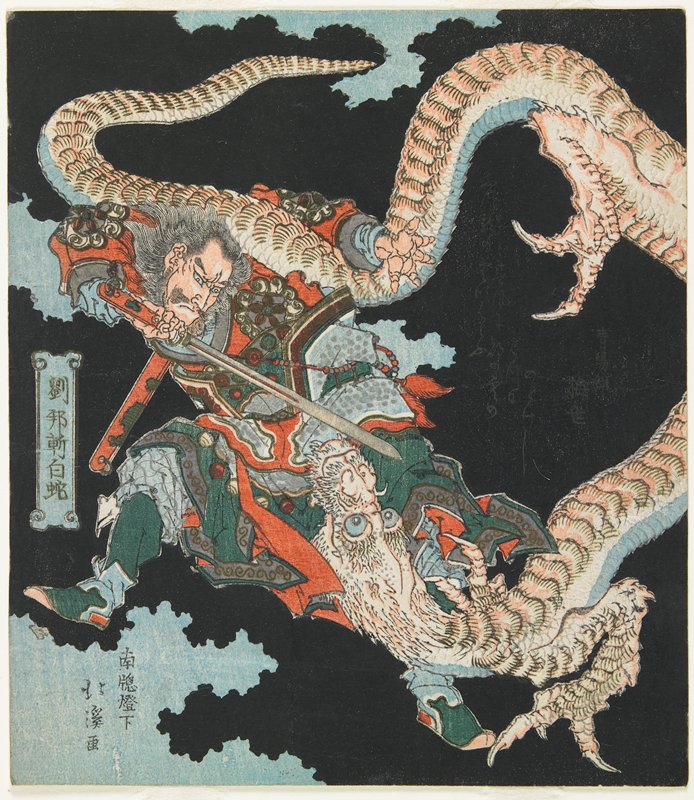
    Liu Ban Beheading A White Snake

    The 1st year of the Second Emperor(209 B.C. continued)

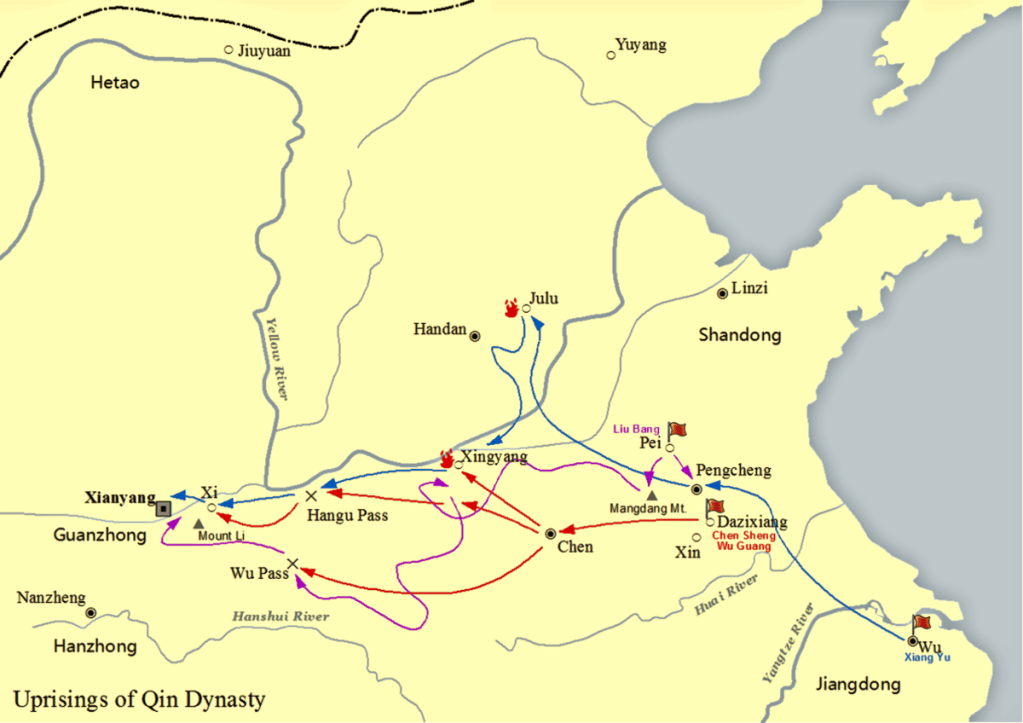
    In September, Liu Bang from Pei county rose in arms, Xiang Liang from Xiaxiang county revolted in the state of Wu, and Tian Dan from Di county did the same in the state of Qi

    Liu Bang, whose courtesy name was Liu Ji, had a prominent nasal bridge and a noble face, with seventy-two ink spots on his left thigh. He was known for his bold personality, generosity, and extroversion, often expressing his feelings openly. Ambitious and disinclined to engage in farming or handicrafts like his family members, he eventually became the head of Sishang Post. Mr. Lü from Shanfu county, a skilled physiognomist, was fascinated by Liu Ji’s extraordinary appearance and married his daughter to him despite Liu Ji’s low rank.

    Liu Ji was once tasked with escorting a group of convicts to Lishan on behalf of the county magistrate. As they traveled, many convicts escaped along the way, and Liu Ji realized that by the time they reached their destination, all would likely have fled. When the group stopped at a post in a swamp in Feng county, Liu Ji drank wine with the convicts. He then released them, saying, “Go your own ways; I am escaping myself.” About a dozen strong men among the convicts volunteered to join him.

    As the legend has it, Liu Ji, in a drunken state, wandered along a trail in the swamp when a large snake rose up in his path. Drawing his sword, Liu Ji swiftly hacked the snake in half. Suddenly, an old woman appeared, wailing: “My son, the son of the White Emperor, transformed into a snake on this trail and was killed by the son of the Red Emperor!” She then vanished. Liu Ji hid in the swamps between Mang County and Dangshan County, where several eerie phenomena were reported, attracting many young men from Pei County who were eager to join his growing band.

    When Chen Sheng’s uprising erupted, the magistrate of Pei County considered joining the rebellion. However, his chief operating officer, Xiao He, and his chief correction officer, Cao Shen, cautioned him: “As an officer of the Qin Empire, the people of Pei may not follow you in betraying your duty. It would be wiser to summon those in exile and gather a mob of a few hundred. With pressure from the mob, no one in Pei would dare oppose you.” The magistrate then sent Fan Kuai to summon Liu Ji, who had already assembled nearly a hundred followers. Fearing a mutiny, the magistrate reconsidered, ordering the city gates shut and defensive positions established. He also intended to execute Xiao He and Cao Shen. Alarmed, they escaped, clearing the city walls and sought refuge with Liu Ji.

    Liu Ji wrote a proclamation on a piece of silk and delivered it to the city elders by tying it to an arrow and shooting it over the ramparts. The message outlined the benefits and consequences of the uprising, urging the elders of Pei to take action. Persuaded, the elders led their sons and brothers to kill the magistrate and opened the gates for Liu Ji. The people gathered around Liu Ji, proclaiming him the Duke of Pei. With the help of Xiao He and Cao Shen, Liu Ji recruited young men from Pei, amassing a force of two to three thousand. They soon joined forces with other rebels from neighboring counties.

    Xiang Liang, the son of General Xiang Yan of the Kingdom of Chu, was hiding with his nephew Xiang Ji in the Wuzhong region due to a murder charge. The scholars and elites of Wuzhong admired Xiang Liang and often sought his friendship and counsel. Xiang Ji, however, struggled with reading and writing as a child and eventually abandoned his studies. He then turned to fencing but did not excel in it either, prompting Xiang Liang‘s disapproval. Xiang Ji retorted, “Reading and writing are only useful for recording names, and fencing is for fighting a single person. These are not worthy of my time. I want to learn how to fight ten thousand people.” Impressed by his ambition, Xiang Liang began teaching him the art of war, which Xiang Ji eagerly learned. However, once he grasped the basics, he lost interest in deeper studies. Xiang Ji grew to over six feet tall, had the strength to lift sacrificial tripods, and was known for his extraordinary talent and character.

    The governor of Kuaiji Commandery, Yin Tong, heard of Chen Sheng’s rebellion and decided to send troops to support the uprising, appointing Xiang Liang and Huan Chu as co-captains. However, Huan Chu was still hiding in the swamps as an outlaw. Xiang Liang told the governor, “Only Xiang Ji knows where Huan Chu is hiding.” Xiang Liang stationed Xiang Ji outside the governor’s residence, sword in hand, while he entered to speak with Yin Tong. He proposed, “Please call Xiang Ji in and have him bring Huan Chu.” The governor agreed. Xiang Liang then brought Xiang Ji inside, and after a few moments, he signaled him with a wink: “It is time to do it!” Xiang Ji drew his sword and decapitated Yin Tong. Xiang Liang held up the governor’s severed head and donned his official seal. The governor’s attendants were thrown into panic, and chaos erupted throughout the residence. Xiang Ji killed dozens, possibly over a hundred people. Terrified, everyone in the residence laid flat on the ground, not daring to move.

    Xiang Liang summoned the local leaders and former officials he knew, announcing his plans to rebel against the Qin Empire. He recruited young men from Wuzhong and dispatched deputies to draft fighters from the counties under Kuaiji Commandery. Xiang Liang assembled an elite force of eight thousand warriors and declared himself the governor of Kuaiji, appointing Xiang Ji as his lieutenant general. Together, they governed all the counties of the commandery. Xiang Ji was only twenty-four years old at the time.

    Tian Dan was a member of the royal clan of Qi, with cousins named Tian Rong and Tian Heng. The Tian brothers were wealthy, influential, and highly regarded. When General Zhou Fu of Zhang-Chu arrived to seize Di County for Chen Sheng, the county magistrate closed the gates and fortified his defenses. To gain access, Tian Dan staged a scene by tying up his house slave and dragging him to the county court, accompanied by a crowd of young men. Pretending to seek permission from the magistrate to execute the slave for wrongdoing, Tian Dan waited until the magistrate appeared in court. Seizing the opportunity, he killed the magistrate on the spot. He then gathered the wealthy and powerful figures of Di County and declared, “All the kingdoms are rising against the Qin Empire and restoring their kings. The Kingdom of Qi has a long history, and as a member of the Tian family, I, Tian Dan, shall be the king of Qi.” Proclaiming himself king, he led his forces against Zhou Fu’s troops, driving them back. Tian Dan then marched east and reclaimed the former lands of the Kingdom of Qi.

    Meanwhile, General Han Guang led an expedition north to the former Kingdom of Yan. The local elites urged him to become the King of Yan, but Han Guang hesitated, saying, “My mother still lives in the Kingdom of Zhao. I cannot be king.” The leaders of Yan persisted, arguing, “Zhao is preoccupied with the Qin Empire to the west and wary of the Zhang-Chu Kingdom to the south. It lacks the strength to challenge us. Even the powerful Zhang-Chu Kingdom does not harm the relatives of the King of Zhao. Why would Zhao target your family, General?” Convinced, Han Guang proclaimed himself King of Yan. A few months later, Zhao handed over Han Guang’s mother and her retinue to the Kingdom of Yan.

    The King of Zhao, accompanied by Zhang Er and Chen Yu, ventured to the northern border with the Kingdom of Yan in pursuit of land. During an excursion, he was captured by Yan soldiers and imprisoned. Yan demanded territorial concessions for his release, and envoys sent to negotiate were executed. A cook of the Zhao army approached the Yan camp and spoke with the commander, asking, “Do you know what Zhang Er and Chen Yu want most right now?” The commander replied, “They probably want their king back.” The cook laughed and said, “You have no idea what those two truly desire. Wu Chen, Zhang Er, and Chen Yu conquered dozens of Zhao cities with little effort. Each of them aspires to be a king, not merely commanders or prime ministers. Initially, they didn’t divide Zhao into three kingdoms because the situation was still unstable, and they supported Wu Chen’s claim to the throne due to seniority while they secured the loyalty of the Zhao people. Now that Zhao is stable under their rule, they’re waiting for the right moment to split the kingdom and crown themselves kings. With your capture of the King of Zhao, Zhang Er and Chen Yu publicly advocate for his release but secretly hope the people of Yan kill him, allowing them to claim their own kingdoms. One Zhao kingdom would tolerate Yan, but two Zhao kingdoms, each led by wise and ambitious leaders, would surely push each other to avenge their fallen king, making Yan’s downfall inevitable.” Alarmed, the Yan commander released the King of Zhao, and the cook safely escorted him back.

    General Zhou Fu, having withdrawn from Di County, marched toward the former Kingdom of Wei with the intention of reinstating a Wei prince named Jiu, titled Lord Ningling, as king. However, Jiu was stranded in Chen County and could not reach Wei. Zhou Fu already controlled the land of Wei, and local dignitaries proposed that he became the king.  Zhou Fu refused, saying, “A loyal servant must prove himself in turbulent times. The world is rebelling against Qin, and we must restore a descendant of the former king.” Despite the people’s insistence, Zhou Fu remained firm in his refusal and sent envoys to Chen County five times before Chen Sheng finally approved Prince Jiu’s return. The people of Wei then installed Jiu as King of Wei, appointing Zhou Fu as prime minister.

    Meanwhile, the Second Emperor stripped Jiao, the Lord of Wey, of his title and banished him to a commoner, effectively ending the lineage of the state of Wey.