Tag: Wei Qing

  • Comprehensive Reflections to Aid in Governance(Part 164): Mistrust And Levirate Marriage

    Comprehensive Reflections to Aid in Governance

    By Sima Guang

    Translated By Yiming Yang  

    Annals of Han Book 13 Scroll 21 (continued)

    Yurt of Kazakhs in the Tianshan, Photo by Matti & Keti

    The 4th year of Emperor Wu’s Yuanfeng Era (107 B.C.)

    In October of winter, the Emperor embarked on a journey to Yong, where he performed rituals at the Five Deity Altars. He traveled along the newly opened Huizhong road, proceeding north and exiting through Xiao Pass. He passed through Mount Dulu and Mingze Marsh, journeying back from Dai and reaching Hedong.

    In January of spring, the Emperor worshiped at the Earth Deity Shrine and granted amnesty to those sentenced to lesser punishments from Fenyin, Xiayang, and Zhongdu.

    During the summer, a severe drought occurred.

    Since Wei Qing and Huo Qubing had roamed across the Gobi Desert, the Xiongnu had rarely engaged in hostilities. They had moved far north, allowing their soldiers and horses to rest while training them in archery and hunting. They frequently sent emissaries to the Han court, using eloquent language and sweet words to seek reconciliation and a marriage alliance.

    The Emperor sent Wang Wu of Beidi and others to reconnoiter the Xiongnu. Wang Wu assimilated into their customs, putting down his ambassador scepter and entering their yurts. The Chanyu liked him, promising with sweet words to send his crown prince to the Han as a hostage.

    The court then dispatched Yang Xin to the Xiongnu. However, Yang Xin refused to comply with their customs. The Chanyu remarked, “We had an agreement with the Han when they sent the Princesses to us, providing silk, fabric, and quality food to establish a marriage connection and peace, ensuring the Xiongnu would not disturb the borders. But now, you seek to revert to old ways, demanding our crown prince as a hostage. What does that leave for us?”

    After Yang Xin returned, the court sent Wang Wu again. The Chanyu once more deceived with sweet promises, aiming to acquire more wealth from the Han. He said to Wang Wu, “I desire to pay visits to the Han and meet the Emperor face-to-face, swearing to be brothers.” Wang Wu returned to report to the Han, and the Emperor subsequently constructed a palace in Chang’an for the Chanyu.

    Xiongnu officials claimed, “We won’t hold sincere talks without a distinguished Han envoy.” They sent a nobleman to the Han, who fell ill. The Han court provided medicine in hopes of his recovery, but unfortunately, he passed away. The Han then sent Lu Chongguo, with the insignia and ribbons of 2,000-piculs official and silk as gifts, and escorting the deceased nobleman back to the Xiongnu, offering lavish burial fees of several thousand catties of gold, claiming, “This was a distinguished Han envoy.” However, the Chanyu believed that the Han had killed their esteemed envoy, and thus detained Lu Chongguo, preventing his return. All the prior discussions the Chanyu had with Wang Wu were merely empty deceptions, with no intention to enter the Han court or send their crown prince as hostage. Subsequently, the Xiongnu frequently sent raiding parties to invade the Han borders.

    Therefore, Guo Chang was appointed as General Bahu[Defeating the Xiongnu], stationed east of Shuofang with the Marquis of Zhuoye, Zhao Ponu, to guard against the Xiongnu.

    The 5th year of Emperor Wu’s Yuanfeng Era (106 B.C.)

    In the winter, the Emperor embarked on a southern inspection and hunting tour. He arrived at Shengtang and paid homage to Emperor Shun at Mount Jiuyi. He ascended Mount Tianzhu in Qian County and sailed the Yangtze River from Xunyang. There, he personally shot and captured a jiao (a mythical creature resembling a crocodile) in the river. His fleet stretched a thousand li, landing at Zongyang before proceeding north to Langya, traveling along the coastline. Along the way, he honored and offered sacrifices at renowned mountains and great rivers.

    In March of spring, the Emperor returned to Mount Tai and expanded the altar for the Heavenly Deity. On March 21, he commenced the worship of the Supreme Deity in the Bright Hall, alongside the worship of Emperor Gaozu, the founder of the Han Dynasty. He also held court for the princes, marquises, and received tax and finance reports from the commanderies and kingdoms.

    In April of summer, a general amnesty was granted to the entire nation. The regions previously visited were exempted from that year’s taxes and levies. Upon his return, the Emperor visited Ganquan and held the suburban sacrifice at the Taiyi Altar.

    The Marquis of Chángpíng, Wèi Qīng, passed away. His tomb was erected, shaped like Mount Lushan, a mountain in Xiongnu‘s territory.

    Having repelled the barbarians and expanded the empire’s territories, the Emperor established the provinces of Jiaozhi and Shuofang, as well as the provinces of Jizhou, Youzhou, Bingzhou, Yanzhou, Xuzhou, Qingzhou, Yangzhou, Jingzhou, Yuzhou, Yizhou, and Liangzhou, totaling thirteen provinces, each overseen by an inspector.

    As outstanding ministers and military figures were passing away, the Emperor issued an edict: “Extraordinary achievements are often accomplished by exceptional individuals. Sometimes unruly horses traverse thousands of miles swiftly, and individuals, despite being non-conformist and unconventional, achieve greatness. The capabilities of these exceptional horses and extraordinary individuals are realized through their utilization under proper guidance. Therefore, all provinces and commanderies are instructed to seek out officials and people of outstanding talent, exceptional abilities, and unique qualities, suitable for positions as generals, ministers, or diplomats for missions to faraway countries.”

    The 6th year of Emperor Wu’s Yuanfeng Era (105 B.C.)

    In winter, the Emperor embarked upon a tour of the Huizhong road.

    In the spring, Shoushan Palace was constructed.

    In March, the Emperor journeyed to Hedong, where he offered sacrifices to the Earth Deity and pardoned those condemned to death in Fenyin.

    After the Han established contact with the southwestern tribes, five commanderies were formed to link the newly acquired lands with the previous routes leading to Daxia. For years, more than ten missions were dispatched from these initial commanderies, all of which were intercepted at Kunming, resulting in the slaughter of the envoys and the plunder of their possessions.

    The Emperor, in his mercy, granted amnesty to the fugitives within the capital, ordering them to enlist in the military. He dispatched General of Bahu[eradicating Xiongnu] Guo Chang to lead them in an assault on the kingdom of Dian, resulting in the decapitation of tens of thousands. Despite the victory, communication through subsequent emissaries still could not be re-established.

    In autumn, a severe drought plagued the land, followed by a locust infestation.

    The envoy from the Wusun tribe, upon witnessing the vastness of the Han Empire, returned and reported its grandeur to his country, raising the esteem in which they held the Han. Upon learning of the Wusun‘s communication with the Han, the Xiongnu were filled with anger and resolved to attack the Wusun. Additionally, the nearby Dayuan and Yuezhi, who also had relations with the Han, further unsettled the Wusun. In response, they sent envoys, seeking to establish kinship through a marriage with a Han princess. After deliberation, the Emperor and his council agreed.

    The Wusun presented a thousand horses as a betrothal gift for the Han princess. In return, the Han court bestowed upon Liu Xijun, daughter of Liu Jian, Prince of Jiangdu, the title of princess and sent her to marry Kunmo, King of the Wusun. She was provided with lavish dowry upon her departure. The Xiongnu, not to be outdone, also sent a woman to Kunmo as his secondary wife. Princess Liu Xijun resided in a palace of her own within the Wusun kingdom, meeting Kunmo periodically for feasts and gatherings. As Kunmo grew old and his health failed, he could no longer communicate well with the princess, who, in her isolation, began to long for her homeland. Upon hearing of her sorrow, the Emperor sympathized and dispatched envoys every other year, bearing embroidered silk curtains as gifts to console her.

    In time, Kunmo, feeling the weight of his age, wished for his grandson, Cenzou(a title name), to marry the princess. However, the princess, distressed, petitioned the Emperor. The Emperor replied, “Live according to their customs; we sought this union to strengthen our ties with the Wusun and to weaken the Xiongnu.” After Kunmo‘s death, Cenzou married the princess and succeeded him as King Kunmi.

    At that time, the envoys of the Han crossed beyond the Onion Ranges (the Pamir Mountains) and arrived in the land of Anxi (Parthia Empire). The Anxi sent emissaries, bearing ostrich eggs and various skilled magic performers from Lixuan (Egypt or Roman Empire) as gifts to the Han. Additionally, smaller kingdoms such as Huanqian(Khorazm), Dayi (Dahae), Jushi (Gushi), Hanmi, and Suxie (Sagdia), among others, followed suit, sending their envoys to present themselves before the Emperor. The Emperor, greatly delighted, welcomed these visitors.

    Envoys from the western regions continued to come and go. When the Emperor embarked on hunting expeditions by the sea, he ensured the inclusion of foreign guests, personally guiding them through the great and bustling cities. He scattered wealth and silk as rewards, generously providing abundant supplies to showcase the vast riches and prosperity of the Han.

    Particular highlights of these events included wrestling matches, exhibitions of marvels and magic, and displays of strange creatures, all watched by vast crowds of spectators. Generous rewards were bestowed, and the fields were filled with pools of wine and forests of meat. Foreign guests were granted the privilege of touring and observing the famous warehouses and treasuries of the Han, where they beheld the Empire’s immense wealth, leaving them in awe and astonishment.

    The Dayuan kingdom, abundant in grapes suitable for wine production, and rich in alfalfa, favored by the Heavenly Horses, became a notable source of tribute. The Han envoys gathered samples of these resources and brought them back to the Empire. The Emperor, in turn, planted them in gardens near his detached palace, in vast fields stretching far beyond the horizon.

    However, the western regions, being in proximity to the Xiongnu, harbored a deep fear of the Xiongnu envoys and thus treated them with greater deference than those from the Han.

    In that year, Xiongnu Chanyu Wuwei passed away, and his young son, Wushilu, succeeded him, taking the title of “Er Chanyu” (Son of Heavenly Son). Subsequently, the new Chanyu moved further northwest, stationing the left-wing troops near Yunzhong and the right-wing troops near the commanderies of Jiuquan and Dunhuang.


  • Comprehensive Reflections to Aid in Governance(Part 154): Favorability Contest

    Comprehensive Reflections to Aid in Governance

    By Sima Guang

    Translated By Yiming Yang  

    Annals of Han Book 11 Scroll 19 (continued)

    Gobi Desert, Mongolia

    The 4th year of Emperor Wu’s Yuanshou Era (119 B.C. continued)

    Another office of Grand Marshal was established. Both the Grand General and the General of Agile Cavalry were appointed as Grand Marshals. A decree was issued, establishing the salary and status of the General of Agile Cavalry equivalent to that of the Grand General. From then on, while Grand General Wei Qing gradually receded in prominence, the General of Agile Cavalry Huo Qubing became increasingly esteemed.

    Many of Grand General Wei Qing‘s former associates and scholars from his circle departed to serve under the General of Agile Cavalry, and they swiftly obtained official ranks and titles, except for Ren An, who refused to do so.

    The General of Agile Cavalry was a man of few words, not revealing much, yet possessing courage and a daring spirit. The Emperor once wanted to instruct him in the military strategies of Sun Wu and Wu Qi, to which he responded, “Wars are more concerned about battle strategies than learning ancient military tactics.”

    When the Emperor was constructing a palace for Huo Qubing, he asked the General of Agile Cavalry to inspect it. The general replied, “As long as the Xiongnu remain unconquered, what is the need of building a home for?” Due to such responses, the Emperor increasingly valued and favored him. 

    However, Huo Qubing rose to high positions when he was young. He didn’t pay much attention to the welfare of his soldiers. During military campaigns, the Emperor would send several tens of carriages loaded with supplies and delicacies from imperial kitchens, but upon their return, the vehicles would still be filled with leftover meat and grains, while some soldiers would suffer from hunger. When they were stationed outside the borders, the troops often lacked provisions, and sometimes they were underfed and displayed low morale, while the General of Agile Cavalry indulged in leisurely sports such as playing a ball game taju [similar to soccer], building a field for the game.  Many instances similar to these occurred.

    On the other hand, the Grand General was known for his benevolence, favoring soldiers who displayed humility and deference, endearing himself to the Emperor with his gentle and accommodating demeanor. Both individuals had such distinctive characters and principles, yet quite different.

    The Han Dynasty had slain around 80,000 to 90,000 Xiongnu, while several tens of thousands of Han soldiers had also perished. Subsequently, the Xiongnu retreated far away, and there were no more royal courts of Xiongnu to the south of the Gobi desert.

    The Han Dynasty crossed the river from the Shuofang region to the west towards Lingju, establishing canals for back and forth communication, setting up military farm offices, and deploying around 50,000 to 60,000 officers and soldiers. They gradually encroached northward into Xiongnu territory. However, due to the scarcity of horses, they ceased large-scale offensives against the Xiongnu.

    The Xiongnu employed Zhao Xin’s strategy and sent envoys to Han, using conciliatory language to request peace and marriage alliance. The Emperor sought counsel on this matter—some advocated for marriage alliance, while others proposed subjugation.

    The Chief staff of the Chancellor, Ren Chang, suggested, “The Xiongnu, having just suffered a defeat and hardship, might be made to become tributaries, visiting the court and seeking audience at the borders.”

    The Emperor dispatched Ren Chang as an envoy to the Chanyu. However, the Chanyu became greatly enraged and detained him.

    Erudite Di Shan proposed that seeking peace would be advantageous. The Emperor discussed the matter with Zhang Tang, the Grand Master of Censorate. Zhang Tang dismissed Di Shan‘s proposal, calling him an ignorant foolish scholar. 

    Di Shan retorted, “I might be foolish, but I am a faithful fool. As for the Grand Master of Censorate Zhang Tang, he is a deceitful loyalist.”

    This made the Emperor furious, and he asked, “If I were to let you be a prefect of a commandery, would you prevent the enemy from invading?” 

    Di Shan replied, “No, I could not.” 

    “How about in a county?” Di Shan replied similarly. 

    Finally, the Emperor asked, “How about in a small fortress?” 

    Di Shan, realizing the futility of arguing further and fearing the consequences of being court-martialed, replied, “I can.”

    Consequently, the Emperor sent Di Shan to a small fortress. After a month’s time, the Xiongnu beheaded Di Shan and departed. From then on, the courtiers were terrified and dared not oppose Zhang Tang.

    During this year, Ji An was dismissed from his position due to violation of laws. Yi Zong, the Prefect of Dingxiang, was appointed as the Right Interior Minister, replacing Ji An, and Wang Wenshu, the Prefect of Henei, was appointed as the Commandant of the Capital Guard.

    Before this, Ning Cheng held the post of Commandant at the Hangu Pass. People said, “One would rather encounter a nursing tiger, than face a raging Ning Cheng.” When Yi Zong became the Prefect of Nanyang, upon arriving at the Pass, Ning Cheng personally welcomed him, showing great respect. When Yi Zong reached the commandery, he put Ning’s family on trial and exterminated Ning Cheng‘s household. The people of Nanyang were terrified, all standing on one foot.

    Later, Yi Zong was transferred to be the Prefect of Dingxiang. Upon his arrival, he immediately took more than 200 people on various charges from the prison. Additionally, he arrested over 200 of relatives and friends who visited the prison, claiming they relieved shackles for prisoners on death row. On that day, more than 400 people were reported killed. This sent shockwaves through the commandery, and fear spread throughout the region.

    Around this time, Zhao Yu and Zhang Tang were known for their severity as the highest ranking Ministers. However, they emphasized legal governance in their administration. Yi Zong, on the other hand, solely focused on using oppressive methods to govern, particularly through punitive strikes like eagles on preys.

    Wang Wenshu, initially serving as the Commandant of Guangping, carefully selected around  a dozen bold and resolute officials from the commandery, using them as his henchmen. He overlooked their serious past offenses, using these crimes as leverage, and allowed them to  hunt thefts and criminals to their desire. As long as these individuals gratified his desires for more captives, they were not prosecuted, even if they had committed numerous crimes. If someone did not do his bidding, he would use their previous offenses against them, even wiping out their families. Due to his methods, the bandits and criminals from the borders of Qi and Zhao dared not approach Guangping. The reputation of Guangping became such a place that no one picks up lost articles in the street.

    Later, when Wang Wenshu was appointed as the Prefect of Henei, he arrived in September. He ordered the commandery to provide fifty privately owned horses as express couriers. He arrested numerous powerful and dishonest figures in the commandery, involving more than a thousand families implicated by association. He submitted memorials to the Emperor requesting punishment: the major offenders were executed together with their whole clans, while the minor ones were put to death, and their families’ assets were confiscated to compensate for the crimes. The edict of approval came down swiftly within two or three days, and the resulting blood flow extended for over ten li (approximately 5 kilometers), causing awe among the people of Henei for his memorial due to their rapid response. 

    By the end of December, the commandery fell silent, and people dared not travel at night. There were no thieves that dared to disturb the peace, and even in the fields, no dogs barked. For the few who managed to escape, they were pursued in neighboring commanderies and princedoms. When spring arrived, Wang Wenshu sighed and said, “Alas! If only the winter months were extended by one more month, I would have enough time for completing my initiative!”

    Upon hearing of Yi Zong, Wang Wenshu‘s actions, the Emperor considered them able administrators and promoted them to senior minister of 2000 picul salary.

    There was a man from Qi called Shaowong, known for his skills in dealing with spirits and ghosts, which attracted the Emperor’s attention. When the Emperor’s favored Madame Wang passed away, Shaowong used his methods to summon the deceased’s spirit, taking on the appearance of the deceased Madame. The Emperor glimpsed this from behind a curtain, watching this shadow play. 

    Shaowong was appointed as General Wencheng and received considerable rewards and honors, being treated with the courtesy reserved for a guest of the Emperor. General Wencheng also advised the Emperor to construct the Ganquan Palace, establishing chambers and halls within, painting images of various spirits and deities of Heaven, Earth, and the North Star, arranging offerings, and inviting celestial beings. After residing there for over a year, The magic of Shaowong‘s methods began to decline, and the spirits ceased to appear. 

    Shaowong fed a piece of silk with writing to a cow, then pretending ignorance, and said, “There’s something unusual in this cow’s belly.” When the cow was slaughtered, the silk was found, containing strange writings. The Emperor recognized the handwriting and interrogated the Shaowong, confirming that it was a forged artifact by him. Subsequently, General Wencheng was executed, but this episode was kept secret.

  • Comprehensive Reflections to Aid in Governance(Part 153): Crash Landing of The Flying General

    Comprehensive Reflections to Aid in Governance

    By Sima Guang

    Translated By Yiming Yang  

    Annals of Han Book 11 Scroll 19 (continued)

    Khentii(Langjuxu) Mountains, Mongolia

    The 4th year of Emperor Wu’s Yuanshou Era (119 B.C. continued)

    The Emperor discussed with his generals, “The Marquis of Xi, Zhao Xin, often plans on behalf of the Xiongnu. He believes that the Han forces cannot cross the desert quickly and will less likely linger. Now, with the massive mobilization of soldiers, we are sure to get what we desire.” Therefore provisions for 100,000 grain-fed horses were prepared. The Grand General, Wei Qing, and the General of Agile Cavalry, Huo Qubing, each led 50,000 cavalry.  Additionally they had 40,000 extra horses for private provisioning. Also, hundreds of thousands of infantry and supply porters followed behind the cavalry, and the daring and skilled warriors were all under the command of the General of Agile Cavalry Huo Qubing.

    The General of Agile Cavalry planned to cross the border from Dingxiang to face the Xiongnu Chanyu. Captured prisoners informed that the Chanyu had moved east. Subsequently, the General of Agile Cavalry was ordered to exit passes in Dai Commandery, while the Grand General Wei Qing went out of Dingxiang. Chamberlain, Li Guang, repeatedly requested to join the expedition. The Emperor initially refused due to his age, but eventually allowed him to be General of the Front. The Grand Coachman, Gongsun He, was appointed as the General of the Left, the Commandant of Title Ranking, Zhao Yi’ji, as the General of the Right, and Marquis Pingyang, Cao Rang, as the General of the Rear, all under the command of the Grand General. Zhao Xin, said to the Chanyu on strategy, “Once the Han forces have crossed the desert and exhausted their men and horses, the Xiongnu can easily take them prisoners.” Therefore, he sent his supply train far north and positioned elite troops to wait for the Han forces to the north of the desert.

    The Grand General Wei Qing, having advanced beyond the borders, captured a prisoner who knew the whereabouts of the Chanyu. Taking his elite troops, he went forth, while instructing the  General of the Front Li Guang to rendezvous with the forces of the General of the Right Zhao Yi’ji and proceed through the eastern route. The eastern path was circuitous, distant and lacked sufficient water and grass. Li Guang pleaded, “I am supposed to be the General of the Front and the vanguard, yet now the Grand General commands me to take the eastern path. I’ve fought the Xiongnu since adolescence, and now that I have the chance to confront the Chanyu, I wish to be in the front, to face the Chanyu first and duel with him.”

    The Grand General, aware of the private warning from the Emperor, “Li Guang is old and unlucky. It’s better not to let him confront the Chanyu because I am afraid that he might not accomplish what we want, the capture of Chanyu.” Additionally, the Grand General wished to send Gongsun Ao, recently demoted from his marquis status, to confront the Chanyu to earn merit credit, hence the transfer of the General of the Front Li Guang to the east. Li Guang, upon learning this, staunchly appealed to the Grand General. The Grand General stuck to his decision, Li Guang, without formal farewell, rose and departed, filled with deep resentment.

    The Grand General marched beyond the borders for over a thousand li, and crossing the Gobi desert, he saw the Chanyu’s forces arrayed and waiting. Thus, the Grand General ordered heavy chariots to encircle and create a camp, and then unleashed five thousand cavalry to confront the Xiongnu. The Xiongnu, in turn, released about ten thousand cavalry. As they were about to engage near sunset, a fierce wind stirred up sand and pebbles, obstructing visibility between the two armies. Taking advantage of this, the Han forces extended their left and right wings to encircle the Chanyu in a pincer maneuver.

    Assessing that the Han forces were numerous and the soldiers and horses were still robust, the Chanyu reckoned that he couldn’t contend with the Han forces in battle. Consequently, the Chanyu, riding on a team of six swift mules, accompanied by a few hundred sturdy riders, broke through the Han encirclement and fled swiftly to the northwest. It was already dusk, and both the Han and Xiongnu forces suffered about equal amounts of casualties and engaged in heavy fighting. A Xiongnu captive caught by the left wing Colonel confessed that the Chanyu had taken cover of the darkness and departed earlier. The Han troops, dispatching light cavalry, pursued the Chanyu through the night. The army of the Grand General followed behind. The Xiongnu forces were in disarray and dispersed. By dawn, having traveled over two hundred li, they failed to capture the Chanyu. Nevertheless, they seized and beheaded nine thousand enemy soldiers and reached the Tianyan Mountains and the City garrisoned by Zhao Xin, where they found the Xiongnu‘s stocked grain and replenished supplies for the Han army. They stayed for a day, burned the remaining grain in the city, and then returned.

    The General of the Front Li Guang, along with the General of the Right Zhao Yi’ji, lost their way due to a lack of local guide, which led to their arrival late for the battle against the Chanyu, missing the rendezvous with Grand General. As the Grand General returned and passed by the southern desert, he encountered the two generals. The Grand General instructed his chief of staff to question Li Guang and Zhao Yi’ji regarding their lost way, summoning Li Guang to the headquarter to file a report.

    Li Guang said, “The ranking colonels and captains are not at fault; it was my own mistake in losing the way. I will present myself to the headquarters before the higher authorities to account for my actions.”

    Li Guang then spoke to his subordinates, saying, “I have engaged in more than seventy battles with the Xiongnu, large and small, since I was sixteen. Today, I was fortunate to follow the Grand General to face the Chanyu’s forces. The Grand General transferred my command to the east route, and I lost my way. Isn’t this the will of heaven? Anyway, I am over sixty years old and do not want to face the scrutiny of bureaucratic officials anymore!” He then drew his sword and took his own life.

    Li Guang was known for his honesty and integrity; he would share rewards and gifts received with his subordinates and shared meals and drinks with his soldiers. He held the position of 2000 picul salary for over forty years, yet his family had no surplus wealth. He had long and strong arms like a gorilla and was skilled in archery; whenever he drew his bow, he wouldn’t shoot if he was not sure to hit the target. In places where there was a shortage of water, Li Guang refrained from drinking until all his soldiers had drunk enough. Similarly, when food was scarce, he abstained from eating until all his soldiers had been fed. His soldiers cherished and respected him for these reasons. Upon his death, the entire army sobbed in mourning.

    When news of his death reached the common people, regardless of whether they knew him personally or not, tears were shed by the old and young alike. However, the General of the Right, Zhao Yi’ji, being held accountable by the authorities, faced death but was pardoned and relegated to a commoner.

    After the Chanyu’s escape, his troops frequently scattered and followed him, causing disorder whenever they encountered the Han forces. For a long time, the Chanyu didn’t reunite with the majority of his forces. The Right Luli King assumed the Chanyu was dead and proclaimed himself as the new Chanyu. However, after around ten days, the real Chanyu emerged to regain his followers, causing the Right Luli King to abandon his claim to the Chanyu’s title.

    The General of the Agile Cavalry, with an equal number of cavalry and heavy chariots, had equivalent military strength to the Grand General’s forces but lacked subordinate generals. Li Gan [a son of Li Guang] and others were appointed as senior colonels, acting as his lieutenants. They traveled over two thousand li, crossing the Dai and Youbeiping, traversing the great Gobi desert, and directly confronted the east division of Xiongnu’s troops. They captured three junior kings including the Prince of Tuntou, the king of Han, and eighty-three military and civil officers, including generals, ministers, chiefs and commandants. They ascended Khentii Mountains (Langjuxu Mountain) to worship the heavens, offered sacrifices at Guyan Mountain to the earth, and reached Lake Baikal (Hanhai). They captured 74443 prisoners. 

    The Emperor increased the fiefdom of the General of the Agile Cavalry by 5,800 households. He also granted titles to four individuals, including the Youbeiping Prefect Lu Bode, and augmented the households of two marquises, including Marquis of Congbiao, Zhao Puonu, and appointed Senior Colonel Li Gan, as the Marquis within Passes with a fief. Many military officers and soldiers received official positions, rewards, and honors. However, the Grand General did not receive an increase in his fiefdom, and none of his military officers or soldiers were granted noble titles.

    When the two armies departed beyond the border passes, the tally of official and privately-owned horses amounted to a total of 140,000 horses. However, upon their return within the borders, the number of horses did not exceed 30,000.

  • Comprehensive Reflections to Aid in Governance(Part 148): A Rising Star

    Comprehensive Reflections to Aid in Governance

    By Sima Guang

    Translated By Yiming Yang  

    Annals of Han Book 11 Scroll 19 (continued)

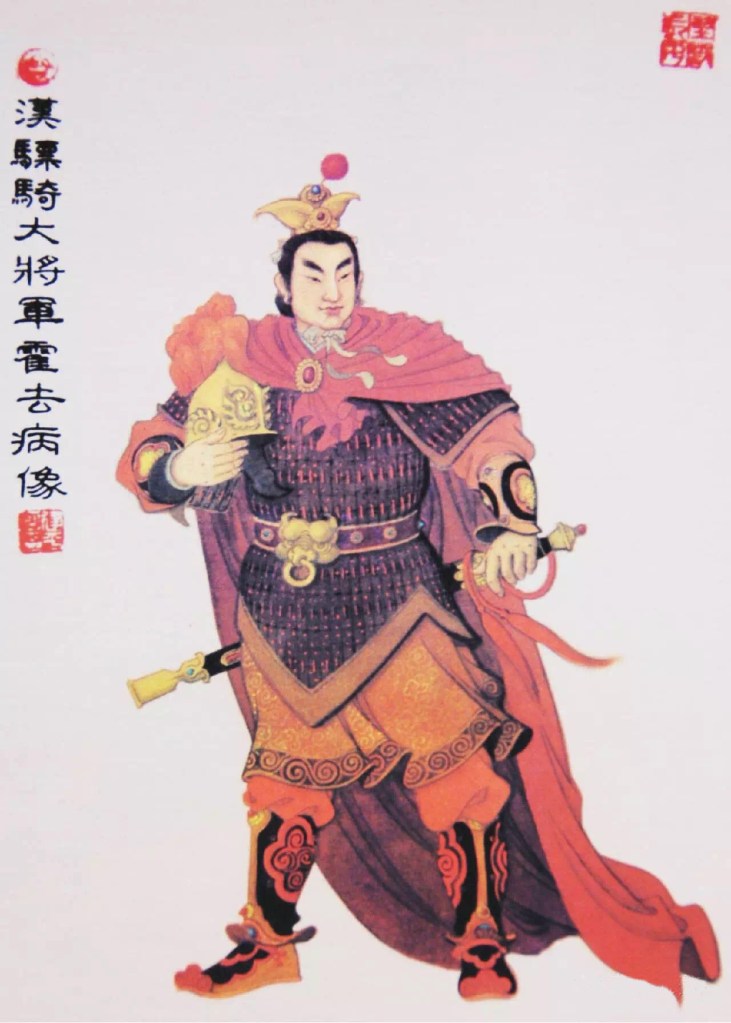
    Portrait of General Huo Qubing

    The 5th year of Emperor Wu’s Yuan’shuo Era (124 B.C. continued)

    In the summer month of June, an edict was issued, declaring, “It is known that guiding the people through rituals and nurturing them with music are essential. Yet now, with rituals in decline and music absent, We are deeply concerned. Let the officials responsible for rituals promote the study and revive the rites, thereby leading the entire nation!”

    In response, Chancellor Gongsun Hong and others suggested, “We request the establishment of fifty students for the Erudite, exempting them from public taxes and duties, to be assessed for their abilities and appointed to positions such as Attendant-in-waiting, Literary, and Office Clerks. Those who display exceptional talent will be honored and recommended for higher positions. Conversely, those who show no dedication to learning and possess lesser abilities shall be dismissed. Furthermore, officials who are proficient in at least one of the Five Confucian Classics shall be selected as candidates for roles with a salary of 2,000 picul.”

    The Emperor gave his approval. From that time forth, more scholars appeared among the ministers, grandees, gentry, and local officials.

    In autumn, ten thousand riders from the Xiongnu invaded the territory of Dai, killing Commandant Zhu Ying and capturing over a thousand people.

    The Prince of Huainan, Liu An, was greatly fond of reading and literature. He took pleasure in gaining fame and attracted thousands of guests and scholars versed in various teachings. Among his courtiers and guests were many frivolous individuals from the Yangtze and Huai River basins, who bore longstanding resentment towards the Prince Li of Huainan, Liu Chang, due to his banishment to Qiong and eventual death. These men often brought up the matter to provoke Liu An.

    In the sixth year of the Emperor Wen‘s Early Era, a comet appeared. Some lobbied the Prince of Huainan, saying, “In the time when the Prince of Wu(Liu Pi) raised his army, a comet appeared, stretching several feet, and it led to bloodshed across a thousand miles. Now, with a comet filling the entire sky, it may signal a large-scale uprising of armies across the realm.” The prince believed these words to be true and thus increased preparations for siege weapons, while also amassing gold and wealth.

    Guard Lei Bei, in an accident during fencing practice, had wounded the Crown Prince of Huainan, Liu Qian. An edict was issued proclaiming that anyone willing to join the campaign against the Xiongnu should report to Chang’an. Lei Bei expressed his eagerness to fight against the Xiongnu. However, the Crown Prince Liu Qian disparaged Lei Bei in front of Liu An. The Prince of Huainan scolded and dismissed him to set an example for others.

    In the same year, Lei Bei fled to Chang’an and submitted a petition to clear his name. The matter was sent to the magistrate for investigation, and Lei Bei’s complaint was linked to the Prince of Huainan. The court officials requested the arrest and trial of the Prince of Huainan. The Crown Prince of Huainan then devised a plan to dress someone as a palace guard, who would hold a halberd by the prince’s side. If any envoy from the Han was found to be suspicious, the guard would kill the person, triggering a rebellion. The Emperor dispatched the Capital Guard commandant Duan Hong to interrogate the prince. However, upon observing Duan Hong‘s composed demeanor, the prince refrained from carrying out the plan.

    The court officials reported, “Liu An, who obstructed a warrior willing to fight the Xiongnu, defied the clear decree and must be punished by execution.” A decree was issued, stripping him of two counties. Deeply ashamed, Prince Huainan lamented, “Even when I act with benevolence and righteousness, I am met with territorial losses.” Out of this shame and humiliation, his plot to rebel grew more intense.

    Liu An‘s relationship with the Prince of Hengshan, Liu Ci, had long been strained and grew more distant with time. When the Prince of Hengshan heard of a potential rebellion by Liu An, he feared being annexed by his brother and began preparing countermeasures by gathering retainers and weapons for rebellion. He believed that if the Prince of Huainan were to conquer the west, he would raise an army to seize control of the Yangtze River and Huai River basins.

    The Queen of the Princedom of Hengshan, Xu Lai, accused the heir-apparent of Prince Hengshan, Liu Shuang of wrongdoing, hoping to depose him and install his younger brother, Prince Liu Xiao, in his place. The Prince of Hengshan detained his heir Liu Shuang and bestowed the royal seal upon Prince Liu Xiao, commanding him to gather retainers. When these retainers arrived, they, from illusive signs, understood the rebellious intentions of both the Princes of Huainan and Hengshan, and clandestinely aided and abetted them day and night.

    The Prince of Hengshan then instructed Mei He and Chen Xi of Jiangdu, retainers of Liu Xiao, to manufacture chariots, forge arrows, and carve imperial seals and insignias for generals and military officers. In the autumn, when the Prince of Hengshan was due to attend court, he planned to pass through Huainan. At this moment, the two brothers, reconciled as siblings, resolved their previous differences and agreed to unite in their rebellion.

    Upon their reconciliation, Prince Liu Ci sent a letter pleading illness, thereby securing exemption from the Emperor’s summons and avoiding his visit to the capital.

    The 6th year of Emperor Wu’s Yuan’shuo Era (123 B.C.)

    In February of spring, the Grand General Wei Qing set forth from Dingxiang to confront the Xiongnu. The Emperor appointed Gongsun Ao, the Marquis Heqi, as General of the Center; Grand Coachman Gongsun He as General of the Left; Zhao Xin, the Marquis Xi, as General of the Front; Capital Guard Commander Su Jian as General of the Right; Chamberlain Li Guang as General of the Rear; and Li Zu, the Left Interior Minister, as the Mighty Crossbow General, all under the command of the Grand General. They returned after slaying several thousand enemies, resting their soldiers and horses in Dingxiang, Yunzhong, and Yanmen.

    A general amnesty was proclaimed throughout the empire.

    In April of summer, Wei Qing once more led the six generals from Dingxiang to engage the Xiongnu, resulting in the slaying and capturing of more than ten thousand enemies. The General of the Right, Su Jian, and the General of the Front, Zhao Xin, leading over three thousand cavalry, encountered the Chanyu’s forces alone. After battling for more than a day, the Han forces were nearly exhausted. Zhao Xin, once a minor king among the Nomad tribes who had surrendered to the Han and been granted the title of Marquis Xi, was lured by the Xiongnu after being defeated. He led the remaining eight hundred riders to defect to the Xiongnu. Su Jian, having lost his entire army, managed to escape and returned to the Grand General’s camp.

    Gentleman Consultant Zhou Ba proposed, “Since the Grand General has assumed command, no general has been executed. Now that Su Jian has abandoned his army, he must be executed to uphold the authority of the Grand General.”

    The military judge Hong and Chief of Staff An countered, “Not so. According to the ‘Art of War,’ even the toughest small forces may fall before much larger ones. Su Jian faced tens of thousands of enemies with only a few thousand troops, fought fiercely for over a day, exhausted his soldiers, yet did not entertain thoughts of defection and willingly returned. Executing him would suggest that failure is intolerable in all circumstances, which is inappropriate.”

    The Grand General responded, “I, Wei Qing, am fortunate enough to have the Emperor’s trust and command a great army. I am not concerned with lacking authority. Zhou Ba advises me to behead a general to assert my power; however, this does not suit my station as a subject of the court. Even if I have the authority to execute a general, with all the favor and privilege I possess, I cannot unilaterally pass judgment without first reporting to the Emperor. I will send Su Jian to the imperial court, and the Emperor shall determine his fate. This demonstrates that as a servant, I do not dare wield arbitrary power. Is this not the proper course?”

    The military officers all agreed, saying, “Well said!” They then imprisoned Su Jian and sent him to the Emperor for trial.

    An official in Pingyang County, named Huo Zhongru, served in the household of the Marquis of Pingyang[the husband of Princess Pingyang]. He had an affair with Wei Qing’s elder sister, Wei Shao’er, a maid, resulting in the birth of Huo Qubing. At the age of eighteen, Huo Qubing became an attendant to the Emperor. He excelled in horse riding and archery. He accompanied the Grand General twice in wars against the Xiongnu, serving as Colonel of Piaoyao [Soaring Hawk]. Displaying immense bravery, he led 800 light cavalry troops, charging ahead of the main army, capturing or killing numerous enemies, far surpassing expectations.

    The Emperor issued a decree, saying: “Colonel Piaoyao Huo Qubing has slain over 2,000 enemy soldiers, captured the prime minister and chieftains of the Xiongnu, beheaded the Chanyu’s Grand Uncle, Chan, Marquis of Jiruo, and seized Chanyu’s uncle, Luobi. His feats surpass all others in the army. He shall be honored as Marquis of Guanjun [Champion]. The Prefect of Shanggu, Hao Xian, has followed the Grand General in four campaigns against the Xiongnu, capturing and beheading over 2,000 enemies. For his contributions, Hao Xian shall be bestowed with the title of Marquis Zhongli.”

    That year, due to the loss of two generals, the defection of Marquis Xi, and lesser military accomplishments, the Grand General was not granted an increase in noble rank but was instead given a thousand gold coins. General of the Right, Su Jian, upon his return, was not executed but was demoted to commoner status and redeemed by paying a fine.

    At that time, the Chanyu, having Marquis Xi, Zhao Xin, surrendered, promoted him to Under King, second only to the Chanyu. He married his sister to Zhao Xin and plotted against the Han. Zhao Xin counseled the Chanyu to move further north to a distant location, making it appear as though the Xiongnu were withdrawing, intending to lure and exhaust the Han forces for a future attack at a remote location, far from the border. The Chanyu followed Zhao Xin‘s plan.

    During those years, the Han Household annually dispatched over a million soldiers to fight against the nomadic tribes. The soldiers who captured or killed enemies were rewarded with more than two hundred thousand catties of gold, yet over a hundred thousand Han soldiers and horses perished. The expenses for the military campaigns and supplies drained the treasury, resulting in insufficient provisions for the soldiers.

    In June, a decree was issued allowing civilians to purchase noble titles and amnesty for past crimes by paying a fine. A system of rewarding military achievements was also established, called “Military Merit Lordship,” with seventeen ranks and over three hundred thousand gold coins allocated. Those who purchased these titles and attained the rank of “chiliarch” were granted priority for official appointments. The system of governance became muddled and riddled with various loopholes, leading to a decline in administrative efficacy.

  • Comprehensive Reflections to Aid in Governance(Part 147): The Right To Bear Arms

    Comprehensive Reflections to Aid in Governance

    By Sima Guang

    Translated By Yiming Yang  

    Annals of Han Book 11 Scroll 19

    Duration of 6 years

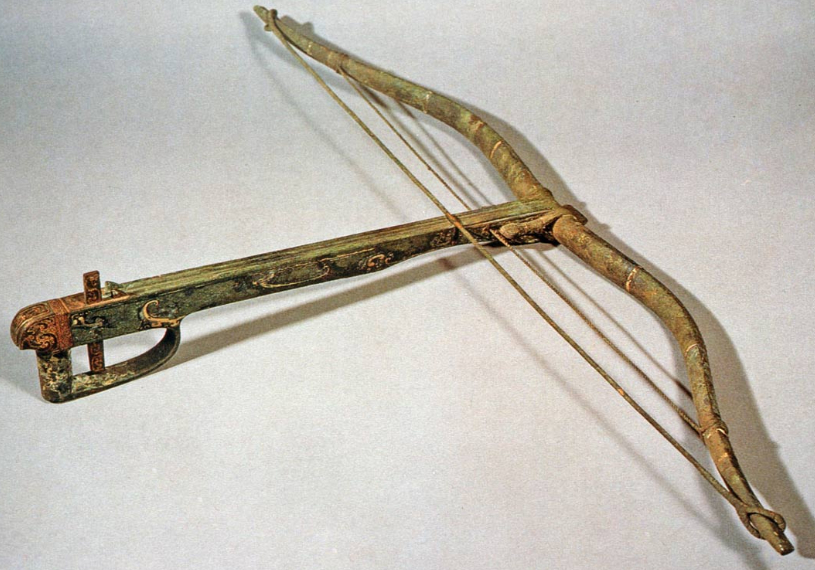
    A Crossbow, Terra Cotta Warrior Museum

    The 5th year of Emperor Wu’s Yuan’shuo Era (124 B.C.)

    In winter, on November 5, Xue Ze was relieved of his office. In his place, Gongsun Hong was appointed Chancellor and ennobled as the Marquis of Pingjin. From that time forth, the custom of conferring noble titles upon those who held the chancellorship began with Gongsun Hong.

    The Son of Heaven set his heart upon vast enterprises and the glory of national achievement. Gongsun Hong, opening the Eastern Gate of the Chancellor’s Office, summoned worthies and men of counsel, discoursing with them on state affairs. Whenever he entered court to present matters for deliberation, he would bring up proposals aimed at the benefit of the realm. The Emperor, esteeming his words, would summon scholars of the court to contend in debate with him.

    On one occasion, Gongsun Hong memorialized, saying: “Let it be forbidden for the people to bear bows and crossbows. For the sake of public safety, such arms must be restrained. Ten brigands with crossbows may cause a hundred officials to shrink in fear and not step forward.”

    The Emperor commanded the court to deliberate upon this proposal.

    Thereupon Yuqiu Shouwang, an Attendant-in-waiting, stepped forth and replied: “I have heard that the Five Arms—spear, halberd, bow, sword, and dagger-axe—were not devised to bring harm, but to subdue evil and restrain violence. In the time of Qin, when the empire was first united, weapons were cast into molten cauldrons and swords were blunted. Thereafter, the people fought each other with hoes, riding crops, and clubs. Crimes multiplied, banditry spread, and rebellion ensued. In the end, the state fell to ruin.

    “Thus, the sage kings of old taught the people by virtue and governed by rites, knowing that prohibitions alone could not suffice. The Book of Rites records: ‘When a male child is born, raise the mulberry-wood bow, and shoot arrows of reed to Heaven, to Earth, and to the four directions’—signifying that the man is destined to serve in arms throughout his life. The Grand Archery Rite, practiced from the Son of Heaven to the commoner, has been a ceremony passed down since the Three Dynasties.

    “I have heard of kings instructing the people through archery rites, but never of those who banned bows and arrows. What is forbidden is intended to prevent theft and assault; yet though death is decreed as punishment, still such crimes do not cease. This shows that even the severest law does not check the greatest of transgressions. If evil men conceal arms in secret while honest men are stripped of means to defend themselves, the law serves not justice but misfortune. I humbly submit: this measure is ill-advised.”

    This memorial was entered into the official record and submitted for imperial consideration. The Sovereign summoned Gongsun Hong and inquired of him regarding the matter, but Gongsun Hong could offer no rebuttal.

    Gongsun Hong was by nature suspicious and inwardly vindictive. All who had once opposed him, whether near or distant, though they might appear on cordial terms, would in time meet with his concealed vengeance.

    Dong Zhongshu, a man of upright character and moral resolve, regarded Gongsun Hong as sycophantic and insincere. Gongsun Hong, harboring envy, bore ill will toward him. The Prince of Jiaoxi, Liu Duan, indulged in lawlessness and brought about many deaths, including the demise of several officials of the 2,000-picul rank. Gongsun Hong, seeking to distance Dong Zhongshu from the Emperor, recommended him to serve as prime minister of the Principality of Jiaoxi. Yet Dong Zhongshu, pleading illness, did not assume the post.

    Ji An, who often voiced criticisms of Confucian doctrine, had long held differences with Gongsun Hong. Desiring to entrap him, Gongsun Hong seized upon an opportunity to destroy him. He memorialized the Emperor, saying: “The jurisdiction of the Right Interior Minister(intendant of Right Fufeng) is replete with nobles and high ministers. It is a post fraught with difficulty, and only one of great stature may govern it. I propose the transfer of Ji An to serve as Right Interior Minister.” The Emperor approved this request.

    In January of spring, a great drought afflicted the land.

    At that time, the Right Tuqi King of the Xiongnu made repeated incursions into Shuofang Commandery, harassing the border regions. The Sovereign dispatched the General of Chariots and Cavalry, Wei Qing, with thirty thousand cavalrymen departing from Gaoque Pass. Su Jian, Commandant of the Palace Guard, was appointed as Guerrilla General; Li Zu, the Left Interior Minister, was made Strong Crossbow General; Gongsun He, Grand Coachman, was named Cavalry General; and Li Cai, Prime Minister of Dai, was appointed Light Chariot General. All were placed under the overall command of Wei Qing. They departed from Shuofang to strike the enemy.

    In addition, the Grand Usher Li Xi and the Marquis of Antou, Zhang Cigong, were each appointed as generals and marched from Youbeiping. Altogether, the expeditionary force exceeded one hundred thousand men, advancing in concert against the Xiongnu.

    The Right Tuqi King, believing the Han troops too distant to pose a threat, indulged in wine and became inebriated. But Wei Qing led his men swiftly by night, advancing six to seven hundred li without pause, and fell upon the Right Tuqi King’s encampment. Caught unawares, the Right Tuqi King was seized with panic. In the dead of night, he broke through the encirclement and fled northward with but a few hundred elite riders.

    The Han forces captured more than ten subordinate kings under the Right Tuqi King, and seized over fifteen thousand men and women. Livestock taken numbered in the hundreds of thousands. With their objectives achieved, the army withdrew in good order and returned in triumph.

    When the army reached the border pass, the Son of Heaven dispatched an envoy bearing the seal of the Grand General, and in the field conferred upon Wei Qing the title of Grand General. All other generals were henceforth subordinated to his command.

    In April of summer, Wei Qing was further rewarded with an increase of fief comprising 8,700 households. His three sons—Wei Kang, Wei Buyi, and Wei Deng—though yet in infancy, were each ennobled as marquises.

    Wei Qing respectfully declined, memorializing thus: “By the grace of Heaven and the favor of Your Majesty, I have received fortune beyond measure. The great victory of the army was due to the valor and exertions of all the colonels and officers. The generous increase of my fief, and the enfeoffment of my sons with marquisates, though they are yet swaddled in cloth, is not the example I had hoped to set for those soldiers who risked their lives in the field.”

    The Emperor replied, “I have not forgotten the meritorious deeds of all the colonels.”

    Thereafter, the Emperor granted titles and honors to the various officers of distinction:
    Gongsun Ao, Colonel of Army Protectors, was made Marquis of Heqi;
    Han Yue, Commandant, was made Marquis of Long’e;
    Gongsun He, Commandant, was made Marquis of Nanjiao;
    Li Cha, Commandant, was made Marquis of Le’an;
    Li Shuo, Colonel, was made Marquis of Shezhi;
    Zhao Buyu, Colonel, was made Marquis of Suicheng;
    Gongsun Rongnu, Colonel, was made Marquis of Congping.

    In addition, Li Zu, Li Xi, and Colonel Dou Ruyi were each granted the title of Marquis Within the Passes.

    At this time, Wei Qing stood in highest favor among all court officials and ministers; none within the realm equaled his prestige. From the Three Excellencies down through the Nine Ministers, all bore themselves with deference before him. Only Ji An alone treated Wei Qing as an equal, neither yielding nor posturing.

    Some among the court cautioned Ji An, saying, “Now that the Son of Heaven commands all officials to bow before the Grand General, and the Grand General’s rank is exalted beyond compare, how can you refrain from bowing?”

    Ji An replied, “When the Grand General salutes his peer, does his status thereby lessen?”

    When these words reached the ears of the Grand General, he held Ji An in even greater esteem. Thereafter, Wei Qing often consulted Ji An concerning affairs of state and matters of court, treating him with a respect greater than he accorded others.Though Wei Qing’s position was lofty, when he came into an audience, the Emperor would recline upon his couch and receive him with ease. When Chancellor Gongsun Hong was summoned for informal audiences, the Son of Heaven at times dispensed with donning his imperial crown. Yet on one occasion, when Ji An came to request an audience, the Emperor, seated in the armory tent without his crown, glimpsed Ji An’s approach, and at once withdrew to the rear tent. He dispatched an attendant to grant Ji An’s petition in full, without requiring his presence. Thus was the reverence accorded to Ji An.

  • Comprehensive Reflections to Aid in Governance(Part 144): Meteor Rise And Spread of Grace

    Comprehensive Reflections to Aid in Governance

    By Sima Guang

    Translated By Yiming Yang  

    Annals of Han Book 10 Scroll 18 (continued)

    Maoling Mausoleum Museum, Shaanxi Province

    The 1st year of Emperor Wu’s Yuan’shuo Era (128 B.C. continued)

    Zhufu Yan, Yan An of Linzi, and Xu Le of Wuzhong each submitted memorials to the court.

    In his early years, Zhufu Yan journeyed through the principalities of Qi, Yan, and Zhao, seeking patronage, yet was met with disdain by the local scholars and found no means of livelihood. Thus he traveled west to the capital and presented a memorial at the palace gates. The memorial set forth nine proposals; of these, eight were later enacted as law. The remaining point, concerning the campaign against the Xiongnu, read as follows:

    The Methods of the Sima(Rangju) states: ‘A state obsessed with warfare, however vast, shall surely perish; a realm at peace, if unmindful of arms, shall fall into peril.’ Fervor stands in opposition to virtue; war is a weapon of destruction; contention is not essential to good governance. Those who pursue nothing but military triumph and are consumed by warfare shall, in the end, rue their endeavors.

    “In the past, the First Emperor of Qin annexed the feudal states and strove endlessly for military conquest. He intended to attack the Xiongnu. Yet Li Si remonstrated with him, saying: ‘This must not be done. The Xiongnu possess no settled cities, no granaries or storehouses. They dwell in constant movement, like migratory birds. To conquer them is no easy task. Should Your Majesty send troops deep into their territory, the supply lines will break. If the soldiers carry their provisions, the weight of the rations will far exceed the gains of the expedition. Their land is of little use to us; their people cannot be governed. To defeat them would necessitate their extermination—this is not the way of a ruler who acts as the parent of his people. The campaign will impoverish the Central States and bring satisfaction only to the Xiongnu. This is no strategy for the long term.’

    “The First Emperor heeded him not, but instead dispatched Meng Tian with a great army against the Xiongnu. The borders were extended by over a thousand li, and the Yellow River was set as the frontier. Yet the new territory was mired in swamps and salt marshes, unfit for the cultivation of the Five Grains. Troops were garrisoned north of the Yellow River for over a decade, exposed to the elements and suffering grievous losses. They could not press further, not for want of men or arms, but because the terrain was ill-suited to their aims. The empire was compelled to transport grain from the eastern coasts of Langya and the heartlands near Bohai Sea. One picul of grain came at the cost of thirty zhong [480 bushel]. Men toiled in the fields without rest, yet it did not suffice to feed the army. Women spun thread without ceasing, yet could not meet the demand for tents. The campaign beggared the realm. The old, the widowed, the orphaned, the frail—all were left to fend for themselves. The roads lay strewn with corpses. It was then that rebellion swept across the land, and the Qin fell.”

    “When Emperor Gaozu of Han rose and unified the realm, he too sought to expand the frontiers. Learning that the Xiongnu had gathered beyond Dai Valley, he resolved to strike them. The Imperial Censor Cheng Jin submitted counsel: ‘This must not be done. The Xiongnu are like wild beasts—when they gather, they disperse again. To contend with them is like grasping at shadows. Your Majesty, though you possess great virtue, would be ill-served by confronting them in open war. I beg you to reconsider.’

    “But Emperor Gaozu did not accept the remonstrance, and marched north to Dai Valley, where he was eventually besieged at Pingcheng. He repented too late. Thereafter, Liu Jing was dispatched to make peace with the Xiongnu, and only then was tranquility restored to the realm.

    “The Xiongnu are not a people to be subdued in one generation. Their customs, rooted in pillage and foray, are innate and enduring. From the time of Yu the Great through dynasties of Xia, Shang, and Zhou, none have ever taxed them or ruled over them. We have regarded them as beasts, not subjects. If now, Your Majesty does not follow the example of the sages of antiquity, but instead repeats the missteps of the recent past, I fear this will be the root of great sorrow for the people.”

    Yan An submitted a memorandum, stating:

    “Today, the people of the realm revel in extravagance. They vie to outdo one another in adorning carriages and steeds, in donning furs and silks, in the construction of opulent mansions. They attune the five musical tones to perfect harmony, blend the five colors to dazzle the eye, and obsess over the five flavors laid upon their tables. Such displays are now held as the ideal throughout the land. When the people behold what is beautiful, they aspire to it; thus, without intent, the state instructs the people in excess.

    “But unchecked luxury is unsustainable. When people abandon their roots in pursuit of the superficial, their foundations are lost. The fleeting adornments of wealth corrupt the heart. Thus, those clad in official robes resort to fraud without shame, and those who bear arms speak proudly of killing, that they might plunder the property of others. The realm grows envious of wrongdoers who escape justice; and so, lawbreakers multiply.

    “I humbly propose the establishment of a systematic order to restrain such tendencies—to prevent indulgence, to temper the ostentatious swaggers by the wealthy, to bring repose to the people’s minds. When the heart is at peace, theft and robbery decline, punishment diminishes, harmony prevails, and all things flourish.

    “In former times, the First Emperor of Qin harbored vast ambitions. Wishing to awe distant lands, he dispatched Meng Tian north to contend with the Xiongnu, and sent  Commandant Tu Sui to lead the navy ships to strike the Yue through the waterway. Thus Qin found itself imperiled on two fronts—north by the Xiongnu, south by the Yue. The armies were stationed in barren lands, compelled to advance without hope of retreat. For more than ten years, men were conscripted without rest, and women were driven to labor in transport, enduring boundless hardship. The roads were lined with the bodies of the hanged; corpses littered every path. Upon the death of the First Emperor, rebellion swept the empire, and the Qin perished—brought low by its own excess of militarism.

    “The Zhou House fell for its weakness; the Qin, for its excess of force. Both succumbed to the same ailment: the failure to adapt.

    “Now, as we pursue the Western Barbarians, lure Yelang to show fealty, subdue the Qiang and Bo tribes, press into Yemaek, raise colonial cities, and march deep into  the Xiongnu and torch its capital, there are those who celebrate such exploits. Yet these are not the strategies of enduring rule, but rather the ambitions of those who serve within the court.”

    Xu Le submitted a memorandum, stating:

    “Your servant has heard it said: the peril of a state lies not in the collapse of its roof, but in the crumbling of its foundations. This principle has held true from ancient times to the present day.

    “What is meant by the crumbling of foundations? Consider the fall of the Qin. Chen Sheng, though neither a lord commanding ten thousand chariots, nor master of a fief, held no noble title, bore no illustrious lineage. He was not famed like Confucius, Zengzi, or Mozi, nor wealthy like Mr. Taozhu[Fan Li] and Yi Dun. Yet, from lowly station, he rose—gathering the impoverished, giving voice to their anguish, and winning the hearts of the people. How did this happen? It was because the plight of the people went unheard by the rulers, the grievances of the lowly went unseen, and the decay of morals went uncorrected. These three ills became Chen Sheng’s strength and Qin’s undoing. Thus it is said: the peril of a nation lies in the collapse of its foundations.

    “And what is meant by the disintegration of the roof? This refers to the insurrection of the principalities of Wu, Chu, Qi, and Zhao. The seven princes rose in concerted rebellion, each a sovereign in his own right, commanding ten thousand chariots and myriad troops, possessing fortified cities, ample wealth, and strong soldiers. Yet none could advance westward; all were crushed in the heartland. Why? Not because their power was less than Chen Sheng’s, nor their military forces were weaker. Rather, the virtue of the reigning emperor had not yet decayed, and the common people remained accustomed to the order he preserved. Thus the monarchs found no support among the people. This is what is called the disintegration of the roof. Therefore, it is said: the peril of a nation lies not in disintegration.

    “These two cases mark the distinction between safety and peril. It is the duty of the enlightened ruler to grasp their essence with clarity and foresight.

    “Now, in recent years, the eastern provinces have suffered poor harvests. The people struggle under growing hardship. Add to this the strain of border campaigns, and by all signs and measures, their burdens grow ever heavier. Where hardship accumulates, unrest follows. Where unrest festers, the foundations begin to crack. This, too, is a sign of the foundation collapsing.

    “Therefore, a wise sovereign must perceive the hidden stirrings of change before they become manifest, discern the fragile threshold between order and disorder, and rectify the upper echelons of governance so as to avert the faintest sign of foundational crumbling.”

    Upon reading their memorials, the Emperor summoned the three men to court. He sighed deeply and said, “Where have you been until now? It is a sorrow that we have not met earlier.” He thereupon appointed them as Gentlemen-in-waiting.

    Of the three, Zhufu Yan soon gained great favor. Within a single year, he was promoted four times and rose to become Grandee of the Palace. Bold in speech and sharp in counsel, he struck fear into the hearts of other ministers. Many, seeking to shield themselves from his censure, sent him bribes worth thousands in gold.

    When someone accused him of audacity and overreach, Zhufu Yan replied, “If I cannot feast on delicacies served from five tripod cauldrons in the rites of state, then I would rather be boiled alive in those same five cauldrons!”

    The 2nd year of Emperor Wu’s Yuan’shuo Era (127 B.C.)

    In the winter season, the Emperor conferred upon the Prince of Huainan a cane and a tea table, and granted him exemption from court attendance.

    Zhufu Yan memorialized the throne, saying:

    “In high antiquity, the feudal lords governed domains no greater than one hundred li in breadth, their power restrained, their authority easily checked. Now, the princes command multiple cities across distances spanning thousands of li. When treated with leniency, they grow haughty and indulgent, giving rise to disorder. Yet when swift and severe action is taken, they may form an alliance in rebellion, threatening the capital itself.

    “To reduce their strength by law invites peril, as was the case with Chao Cuo, who met his end through such means. At present, many of the lords have a dozen sons or more. Yet only the heir-apparent(the eldest legitimate son) receives the fief, while the rest—though of the same blood—are left without land or title. Thus, filial affection and fraternal harmony do not extend far and apparent.

    “I respectfully request that Your Majesty allow the feudal lords to bestow favor around and assign land to their other legatees, granting them titles and territories. This will bring great joy to each individual as they satisfy their desires. By spreading the grace and dividing the land justly, the central authority will be strengthened without taking away from the monarchs, the principalities will be gradually weakened without the appearance of diminution.”

    The Emperor approved this counsel.

    In January of spring, an edict(Spread of Grace) was proclaimed: “Those among the princes who wish to bestow lands upon their non-heir sons shall submit petitions for imperial review. We shall personally confer their titles and determine their ranks.”

    Henceforth began the division of fiefs within the vassal domains, and the younger sons received marquisates by inheritance.

    The Xiongnu invaded Shanggu and Yuyang, killing and capturing more than one thousand officials and commoners. In response, the Sovereign dispatched Generals Wei Qing and Li Xi, who set out from Yunzhong westward to Longxi, and thereupon launched an assault against the Xiongnu chieftains, the King of Loufan and the King of Baiyang, south of the Yellow River. They captured several thousand Xiongnu people, seized over a million head of cattle and sheep, and, driving away the Kings of Loufan and Baiyang, occupied the lands south of the Yellow River.

    For this, the Emperor conferred upon Wei Qing the title of Marquis of Changping. His subordinates, Colonels Su Jian and Zhang Cigong, also rendered distinguished service. Su Jian was ennobled as Marquis of Pingling, and Zhang Cigong as Marquis of Antou.

    Zhufu Yan memorialized the Emperor: “The land south of the Yellow River is fertile and well shielded by the river’s natural barrier. If cities are built there to repel the Xiongnu, and the transport of provisions is maintained steadily within, the Middle Kingdom will expand, and the strongholds of the Xiongnu shall be annihilated.”

    When deliberated upon in court, most officials opposed the measure. Yet the Emperor ultimately accepted Zhufu Yan’s proposal and established Shuofang Commandery. Su Jian was ordered to lead over one hundred thousand men to construct the city of Shuofang, repairing and expanding the old fortifications built by Meng Tian in the Qin era, and reinforcing them along the Yellow River.

    The undertaking strained the realm’s resources. The people to the east of the Xiao Mountains bore the brunt of the burden, and the labor and transport depleted the granaries. The expenses ran into tens and hundreds of millions, draining the imperial treasury. Moreover, the distant and exposed Zaoyang County in Shanggu, protruding into the wilderness like a pan-handle, was relinquished and left to the Xiongnu.

    On March 30, there was an eclipse.

    In the summer, the court relocated one hundred thousand settlers to Shuofang.

    Zhufu Yan again offered counsel: “Now that the mausoleum of Maoling has been established, let the influential households, as well as the unruly and the defiant from all regions, be relocated there. In this way, the capital will be fortified in strength, while disruptive elements are removed without the shedding of blood.”

    The Emperor approved. Those tycoons whose net worth surpassed three million coins from various commanderies and principalities were thereafter resettled in Maoling.

  • Comprehensive Reflections to Aid in Governance(Part 143): Rags to Riches

    Comprehensive Reflections to Aid in Governance

    By Sima Guang

    Translated By Yiming Yang  

    Annals of Han Book 10 Scroll 18 (continued)

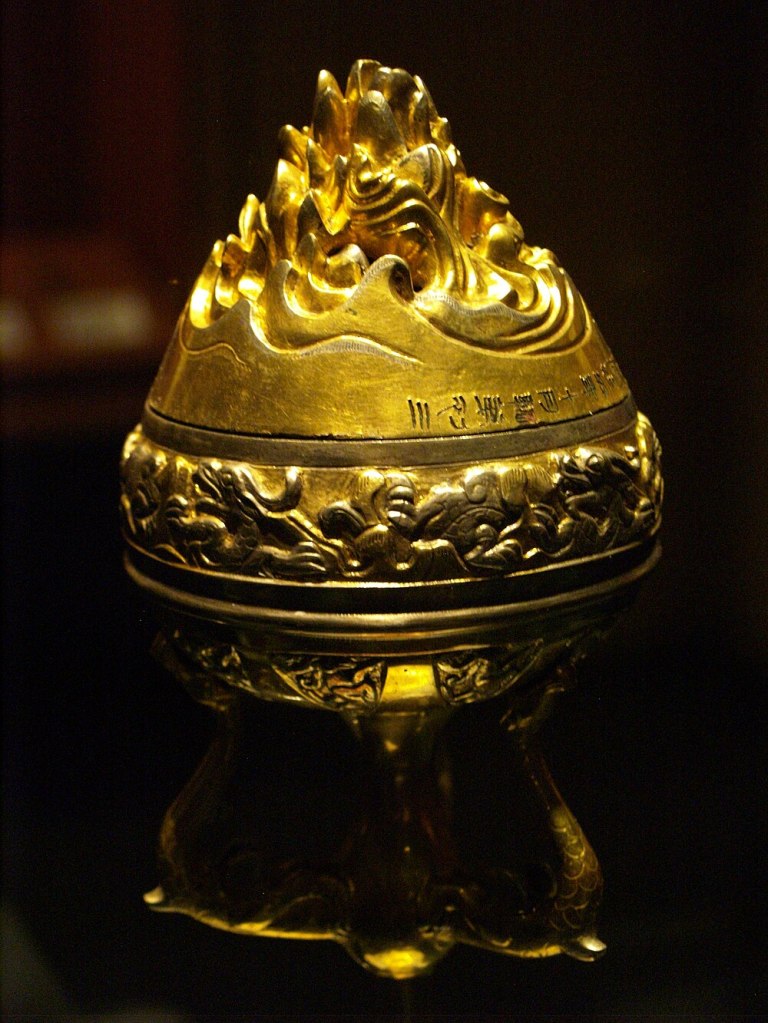
    A Incense Burner, allegedly given to Wei Qing by the Emperor Wu of Han

    The 6th year of Emperor Wu’s Yuan’guang Era (129 B.C.)

    In the winter, the court instituted the registration of merchant carriages throughout the realm, so as to levy taxes upon them.

    The Grand Minister of Agriculture, Zheng Dangshi, memorialized, saying, “If a canal is dug from the Wei River to the Yellow River, it will ease the transport of grain from the eastern provinces and irrigate more than ten thousand acres of arable land.”

    In the spring of the following year, the Emperor issued an edict mobilizing tens of thousands of laborers to undertake the work in accordance with Zheng Dangshi’s plan. After three years, the canal was completed, and it was praised throughout the land as a boon to the people.

    That same year, four armies were dispatched to strike the Xiongnu at the frontier markets. General of Chariots and Cavalry Wei Qing set forth from Shanggu; General of Cavalry Gongsun Ao from Dai; General of Light Chariot Gongsun He from Yunzhong; and General of Gallant Cavalry Li Guang from Yanmen. Each commanded ten thousand horsemen.

    Wei Qing advanced as far as Longcheng and captured seven hundred of the Xiongnu. Gongsun He returned without success. Gongsun Ao suffered defeat and lost seven thousand cavalrymen. Li Guang, too, was defeated and taken captive. The Xiongnu riders bound him, placed him between two horses, and bore him prone for more than ten li. Feigning death, Li Guang suddenly leapt onto a Xiongnu rider’s horse, seized his bow, and spurred the beast southward. Thus did he escape and return alive.

    Gongsun Ao and Li Guang, having suffered defeat in battle, were condemned to death by the Han court. They each redeemed their lives by paying the statutory ransom, and were thereafter stripped of rank and reduced to commoner status. Only Wei Qing, whose campaign deemed success, was enfeoffed with the title of Marquis Within Passes.

    Though born of low station, Wei Qing was skilled in horsemanship and archery, possessed great physical strength, and treated his officers with due respect while showing kindness to the common soldiery. The troops held him in high regard and followed him without hesitation. He had the makings of a competent commander; thus, in every expedition he achieved victory. The empire, observing this, gave credit to the Emperor for his discerning eye in recognizing and raising up the worthy.

    In the summer, the land suffered from severe drought, and locusts swarmed across the fields.

    In June, the Emperor set forth on an inspection tour, journeying to Yong.

    In autumn, the Xiongnu launched frequent incursions along the frontier, with Yuyang Commandery bearing the brunt of the attacks. The court appointed Han Anguo, Commandant of the Court Guard, as Infantry General, and ordered him to garrison his troops in Yuyang for the defense of the realm.

    The 1st year of Emperor Wu’s Yuanshuo Era (128 B.C.)

    In November of winter, an imperial edict was issued, proclaiming:

    “We have long instructed our officials to honor filial piety and uphold integrity, that such virtues might be extolled throughout the realm, establishing a standard for the generations to come and preserving the noble legacy of our forebears. Within every group of ten households, there ought to be one loyal and upright man; among every three, one who is worthy of emulation. Yet there are commanderies in which not a single name has been recommended. Such negligence obstructs the cultivation of virtue and hinders worthy men from receiving due recognition by the Sovereign.

    “In antiquity, those who advanced the worthy were rewarded, while those who concealed talent were punished with death in the marketplace. Thus excellence was encouraged, and the good brought to light. Let it be deliberated: what punishment befits those senior officials whose emoluments exceed 2000-piculs, yet who fail to put forth even one name in recommendation of the filial and upright?”

    The ministers submitted a memorial, stating: “To neglect the promotion of the filial is to disregard the imperial will; such is the crime of defying the sovereign. To be unable to discern the virtuous is to reveal one’s unfitness for office. Such officials ought to be removed.”

    The Emperor assented, and the measure was enacted.

    In December, King Yi of Jiangdu, Liu Fei, passed away.

    Prince Liu Ju was born to Madame Wei. That same day, Madame Wei was elevated to the throne of Empress, and a general amnesty was proclaimed throughout the realm.

    In autumn, twenty thousand Xiongnu cavalry breached the frontier. They slew the Prefect of Liaoxi and carried off more than two thousand captives. Advancing further, they laid siege to the garrison under Han Anguo’s command. Thereafter, they swept through Yuyang and Yanmen, each suffering over a thousand killed or captured. Han Anguo withdrew to Beiping, where he died after several months. The court then reappointed Li Guang as Prefect of Youbeiping. The Xiongnu chieftains, having long feared him, referred to him as the “Flying General of Han” and henceforth did not dare approach the territory under his watch.

    That same season, General Wei Qing led thirty thousand cavalry to strike the Xiongnu in the region of Yanmen, while General Li Xi advanced into Dai Commandery. Wei Qing’s troops slew several thousand of the enemy and returned in triumph.

    At this time, Nam Ryeo, chieftain of the Yemaek, together with his followers—numbering two hundred eighty thousand—submitted in surrender. The court established Canghai Commandery to govern them. The expense of their resettlement matched that incurred in pacifying the southwestern tribes such as Yelang, which led to disturbances between the territories of Yan and Qi.

    In that same year, the Prince of Lu, Liu Yu and the Prince of Changsha, Liu Fa passed away.

  • Comprehensive Reflections to Aid in Governance(Part 135): The Lineage of Wei Qing

    Comprehensive Reflections to Aid in Governance

    By Sima Guang

    Translated By Yiming Yang  

    Annals of Han Book 9 Scroll 17 (continued)

    Empress Chen Jiao And Wei Zifu, by Xiang Li

    The 2nd year of the Emperor Wu’s Jianyuan Era (139 B.C. continued)

    After Dou Ying and Tian Fen were removed from their positions, they retired to their respective homes. Although Tian Fen held no official role, he remained close to Empress Dowager Wang and continued to exert considerable influence. Many scholars and officials who sought power and favor left Dou Ying to assemble under Tian Fen, thereby enhancing his predominance.

    On February 1 of the spring, there was a solar eclipse.

    On March 20, Marquis of Baizhi, Xu Chang, who served as the Minister of Ceremonies, was appointed as the Chancellor.

    Initially, the Marquis of Tangyi, Chen Wu, was married to the Emperor’s paternal aunt, Princess Guantao, Liu Piao. Princess Guantao held considerable influence in the designation of Crown Prince to Liu Che. She arranged for her daughter to marry the Emperor when he became Crown Prince, and later, when he ascended the throne, this daughter became the Empress Chen.

    Princess Guantao, feeling secure in her position due to her merit, sought various privileges and made endless demands, which concerned the Emperor greatly. The Empress Chen was proud and jealous, monopolizing his affections, but she was unable to bear children despite spending an enormous amount of money on medical care, nine hundred million coins, in pursuit of an heir. Unfortunately, her efforts were in vain, and her favor with the Emperor began to wane.

    Empress Dowager Wang, the Emperor’s mother, warned him about the delicate situation: “You have just ascended the throne, and the senior ministers have not yet fully pledged their allegiance. The construction of the Mingtang has already angered Grand Empress Dowager Dou, and now you’ve crossed the Princess Guantao. You risk incurring grave displeasure from powerful women. Women’s feelings are fickle; you must tread carefully!”

    The Emperor, heeding wise counsel, extended more grace to Princess Guantao and Empress Chen.

    In the course of a journey to the Bashang, the Emperor stopped by his eldest sister Princess Pingyang’s house, where he was entertained by a singer named Wei Zifu and liked her. Her mother had once served as a maid to Princess Pingyang. Princess Pingyang then presented her to the palace. Wei Zifu soon found favor in the Emperor’s eyes and was held in high esteem. When Empress Chen became aware of this, she was seized by jealousy and, in her despair, made repeated attempts upon her own life. Her conduct bred resentment in the Emperor’s heart and widened the rift between them.

    Wei Zifu’s younger brother by the same mother was Wei Qing. Wei Qing’s father, Zheng Ji, had formerly held a minor office in Pingyang County, in the service of the Marquis of Pingyang (Princess Pingyang’s husband). Having engaged in illicit relations with a maid in the Marquis of Pingyang’s household, Maid Wei(Wei Zifu’s mother), he begot Wei Qing. In order to conceal this affair, the child was given the surname Wei.

    As he came of age, Wei Qing entered service as a cavalryman serving the Marquis of Pingyang as a slave. In time, however, misfortune befell him: Princess Guantao had him seized and intended to put him to death. His friend, the royal horseman Gongsun Ao, gathered several stout men and broke into the Princess’s quarters, rescued Wei Qing. When this was reported to the Emperor, he summoned Wei Qing to the court, appointed him Director of the Jianzhang Palace, and conferred upon him the title of Palace Attendant. Over the span of several days, Weiqing was bestowed with thousands of gold coins.

    In time, the Emperor elevated Wei Zifu to the rank of Madame, and Wei Qing was promoted to Grandee of the Palace.

    In April of summer, a star appeared, shining as brightly as the sun, visible even in the night.

    At that time, Maoling Township, the site of the Imperial Mausoleum, was first established.

    Many ministers memorialized, contending that Chao Cuo‘s policies had been unjustly criticized as oppressive. Seeking to further diminish the power of the feudal lords, they incessantly reported the faults of the princes, magnified their misdeeds, seized upon minor offenses, and flogged the subordinates to implicate their masters. None among the feudal lords were free from grief and resentment.

    The 3rd year of the Emperor Wu’s Jianyuan Era (138 B.C.)

    In the tenth month of winter, Liu Deng, Prince of Dai; Liu Fa, Prince of Changsha; Liu Sheng, Prince of Zhongshan; and Liu Ming, Prince of Jichuan, came to the capital to pay homage. The Emperor held a banquet in their honor. When Prince Liu Sheng heard the music, he wept. The Emperor inquired of the cause, and Liu Sheng replied, “Those who grieve should not be burdened with moaning, nor those who worry with untimely sighs. Now my heart has long been heavy; when I hear the music of the court, my tears flow unbidden. I have been fortunate to be placed in the eastern vassalage by Your Majesty’s side and honored with the title of imperial brother. Yet many among Your Majesty’s officials, neither bound by kinship nor entrusted with great duties, form factions, promote one another, and exclude the imperial clan. Thus blood ties melt away like ice. I grieve profoundly!” He then enumerated the misdeeds of the ministers.

    Hearing this, the Emperor bestowed greater honors upon the vassal princes, overlooking the memorials submitted by the ministers regarding the princes, and showed the princes renewed familial affection.

    The Yellow River overflowed its banks and flooded the plains.

    There was a great famine; people resorted to cannibalism.

    In July of autumn, a comet appeared in the northwest.

    Prince Liu Ming of Jichuan was accused of murdering his attendant; he was deposed and banished to Fangling.

    When the insurrections of the Seven Principalities were quelled, Liu Ju, a son of the Prince of Wu, fled to Minyue, blaming the Kingdom of Dong’ou for the death of his father. Ever harboring enmity, he urged the King of Minyue to strike at Dong’ou. The King, heeding his counsel, dispatched troops to besiege Dong’ou.

    The King of Dong’ou thereupon sent a swift envoy to the Han court, petitioning for aid. The Emperor consulted Tian Fen. Tian Fen said, “Among the states of the Yue, mutual aggression and betrayal are their constant ways. Since the time of Qin, they have been unruly and disloyal; it is not fitting that the Middle Kingdom troubles itself for their sake.”

    Zhuang Zhu spoke against this, “It is a matter of righteousness to succor the distressed. When aid is within reach, how can one refuse it? In the time when Qin fell, it was not only the Yue who forsook allegiance, but all under Heaven who rose against tyranny. Now a small state, beset by calamity, turns to us for salvation. If Your Majesty declines to assist, whither shall they turn? If such appeals are disregarded, how shall the myriad states hold to their loyalty?”

    The Emperor said, “The Grand Commandant’s counsel is of no merit. I have but newly ascended the throne; I do not wish to issue the tiger tally lightly and summon the troops of the commanderies and principalities.” Nevertheless, he dispatched Zhuang Zhu, granting him a token of authority to levy forces from Kuaiji Commandery.

    The Prefect of Kuaiji disobeyed the order and withheld his troops. Zhuang Zhu executed one of the officers of Kuaiji, a major, to manifest his resolve. Thus, with severity displayed, he raised an army and set forth by sea to relieve Dong’ou. Yet before his forces could arrive, the King of Minyue had already withdrawn his troops.

    The King of Dong’ou then memorialized the throne, requesting to relocate his people and place them under the protection of Han. The Emperor approved. Thus the King gathered his subjects and resettled them between the Yangtze and Huai Rivers.