Comprehensive Reflections to Aid in Governance
By Sima Guang
Translated By Yiming Yang
Annals of Zhou Book 4 Scroll 4 (continued)
The 36th year of King Nan(279 B.C.) (continued)
The King of Zhao conferred the town of Guanjin upon Yue Yi, expressing veneration and affection for him. This move, however, raised alarms in the kingdoms of Yan and Qi. King Hui of Yan promptly dispatched an envoy to Zhao to reprimand Yue Yi: “General Yue, by embracing misguided opinions and harboring doubts about us, you abandoned the kingdom of Yan and sought refuge in Zhao. While this may benefit you personally, how do you reciprocate the grace my father bestowed upon you for recognizing your talent?”
In response, Yue Yi composed a letter to the king, drawing a parallel with the historical account of Wu Zixu, a general in the kingdom of Wu. Wu Zixu, having advised King He Lv to engage in a distant battle at the city of Ying, was disregarded by He Lv‘s son, Fu Chai, who went so far as to dispose of Wu Zixu’s body in a river. Fu Chai, doubting Wu Zixu‘s strategic counsel, expressed no remorse upon sinking his body. Wu Zixu, unable to foresee the contrasting character of the two Wu kings, retained his indignation even in death.
Yue Yi emphasized his commitment: “My primary objective was to accentuate the accomplishments of the late king while deliberately abstaining from claiming any credit for myself. My greatest apprehension was the prospect of being entangled in a smear campaign and facing prosecution that could tarnish the reputation of the deceased king. Confronted with an unspecified indictment, my conscience vehemently opposed exploiting the favor extended by the kingdom of Zhao to the detriment of the kingdom of Yan.”
“I was mindful of the historical wisdom that distinguished individuals, particularly those of ancient times, refrained from denigrating each other, even in the event of severed friendships. Additionally, a devoted subject refrained from exculpating himself when forced into exile from his homeland. I may lack intelligence, but I have been a student of gentlemen. I implore Your Majesty to observe my conduct.”
Upon reading the letter, the King of Yan bestowed upon Yue Yi‘s son, Yue Jian, the title of Lord of Changguo. This gesture marked the restoration of Yue Yi’s relationship with the kingdom of Yan, allowing him to travel between the two kingdoms. Eventually, Yue Yi passed away in the kingdom of Zhao, posthumously honored with the title of Lord of Wangzhu.
Tian Dan, the prime minister of the Kingdom of Qi, once encountered an old man suffering from hypothermia near the Zi River. The elderly man, unable to move after crossing the river, caught Tian Dan’s attention. Without hesitation, Tian Dan removed his fur coat and draped it over the shivering man. Witnessing this act of kindness, King Xiang of Qi became deeply perturbed, suspecting ulterior motives.
He vented his agitation, exclaiming, “Tian Dan bestows favors; is he harboring ambitions to seize the kingdom? I fear that if I don’t address this now, he may attempt such a coup later.” After these words, he took a moment to survey his surroundings and noticed no one in close proximity. His gaze then fell upon a pearl jewel craftsman situated beneath a rock. Acting on impulse, he summoned the craftsman and inquired, “Did you overhear my remarks?” The craftsman affirmed, “Indeed, I did.” Curious, the king pressed, “What are your thoughts on the matter?”
The perl craftsman replied: “It would be more advantageous, Your Grace, to redirect these concerns into a display of your own benevolence. Praise Tian Dan by acknowledging his compassionate actions, stating, ‘We was troubled by the plight of people facing starvation, and Tian Dan graciously opened his home, providing sustenance. We was concerned about an elderly man succumbing to the cold, Tian Dan selflessly removed his fur coat and draped it over him. We worried about the hardships faced by the people, Tian Dan demonstrated genuine empathy. Tian Dan really understands We.’”
Embracing this advice, King Xiang agreed and rewarded Tian Dan with cattle and wine. Later, the pearl craftsman returned with further advice, recommending that the king publicly acknowledge Tian Dan‘s philanthropy during a court assembly. Additionally, he proposed issuing an executive order to identify individuals lacking food and clothing, promptly providing them with grains. The king, receptive to this counsel, implemented the suggestions.
As word spread, the people learned of Tian Dan‘s benevolent acts through discussions among officials and intellectuals. The consensus emerged that Tian Dan‘s love for the people was a manifestation of his adherence to the teachings of the king.
Tian Dan recommended Diao Bo to the king of Qi. However, nine courtiers conspired against Lord Anping, advising the king in a rotating fashion. Their collective suggestion was to express gratitude and goodwill to the kingdom of Chu since their recovery and subsequent peace was aided by Chu‘s general and ten thousand soldiers. The king sought a suitable ambassador, and they unanimously endorsed Diao Bo. Diao Bo embarked on a mission to Chu, where he was graciously received by the king, sharing drinks during an audience. Several months passed without Diao Bo‘s return.
The nine courtiers seized the opportunity to influence the king, asserting that Diao Bo, a mere courier, received extravagant hospitality from a powerful kingdom due to Lord Anping‘s influence. They implied that Lord Anping‘s status rivaled the king’s, creating confusion between ruler and subject. Moreover, they criticized Lord Anping‘s internal governance of benevolence, accusing him of fostering alliances with northern barbarians, attracting talents from around the world, and harboring limitless ambitions. They urged the king to investigate these matters.
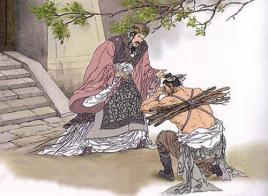
The following day, the king issued a command: “Fetch Prime Minister Dan!” Unadorned, barefoot, and bare-backed, Tian Dan entered, acknowledging his alleged crimes. After five days of reflection, the king declared Tian Dan innocent, acknowledging no wrongdoing. He instructed Tian Dan to show the appropriate respect as a subject, while reaffirming the king’s duty to treat him as such.
Diao Bo returned from the kingdom of Chu, and the king of Qi hosted a lavish feast in his honor. As the king became increasingly intoxicated, he suddenly exclaimed, “Summon Prime Minister Dan!” Diao Bo promptly stood up, left the table, and knelt before the king. He inquired, “Is Your Majesty comparable to esteemed figures like King Wen of Zhou?”
The king admitted, “I am not as accomplished.” Diao Bo pressed on, “Indeed, I knew Your Majesty might not be. How about someone of lower standing, like Duke Huan of Qi?” Reluctantly, the king confessed, “I am not as accomplished.” Diao Bo concurred, “I knew Your Majesty was not. However, King Wen of Zhou addressed Lv Shang as ‘Honorable Father’ when appointing him as prime minister, and Duke Huan of Qi referred to Guan Zhong as ‘Great Uncle.’ Today, with Lord Anping‘s support, Your Majesty addresses him simply as ‘Dan.’ Such language is detrimental to our kingdom.”
Diao Bo then recounted the achievement of Tian Dan: “Throughout the entirety of the universe’s existence and human history, none have achieved as much as Lord Anping in his ministerial role. When the previous king’s realms were under threat, and the people of Yan launched an attack, Your Majesty, unable to defend, sought refuge in the mountains near Chengyang. In these dire circumstances, Lord Anping led a meager force of seven thousand beleaguered soldiers to defend the small city of Jimo, encompassing three miles of inner city and five miles of outer city.”
“Lord Anping‘s strategic brilliance reversed the tides of battle, resulting in the capture of Yan’s general and a remarkable comeback that reclaimed thousands of miles of the Land of Qi. During this critical juncture, Lord Anping possessed the opportunity to ascend as king, bypassing the exiled king in Chengyang, with none capable of opposing him. However, Lord Anping, guided by moral principles, rejected the notion of self-anointment.”
“Demonstrating not only military prowess but also compassion, Lord Anping constructed plank roads and wooden houses connecting Chengyang and ensured the safe return of the king and queen to their people. Presently, with the kingdom in a state of tranquility and order, Your Majesty’s summoning of Lord Anping with a simple ‘Dan’ is deemed infantile behavior.” Diao Bo implores the king to rectify the situation by eliminating the nine conspirators and extending a genuine apology to Lord Anping, emphasizing that failure to do so jeopardizes the stability of the kingdom.The king, swayed by Diao Bo‘s counsel, executed the nine courtiers and exiled their families. Additionally, he granted Lord Anping further fiefs, comprising ten thousand households in the town of Ye.



 Reflection by Rio Grande