Tag: translation

  • Comprehensive Reflections to Aid in Governance(Part 105): The Reign of The First Empress

    Comprehensive Reflections to Aid in Governance

    By Sima Guang

    Translated By Yiming Yang  

    Annals of Han Book 5 Scroll 13

    Anling, the Mausoleum of Emperor and Empress Hui, Shaanxi Province. Photo by Brücke-Osteuropa

    The 1st year of the Empress Gao (187 B.C.)

    In winter, the Empress Dowager proposed appointing members of the Lü family as kings and sought the opinion of Right Chancellor Wang Ling. Wang Ling replied, “When Emperor Gaozu swore an oath over the sacrificed white horse, he said, ‘If anyone outside the Liu family becomes king, the whole world will rise against them.’ If we make the Lü family kings now, we would be breaking that oath.” The Empress Dowager was displeased with this response, so she asked for the opinion of Left Chancellor Chen Ping and Grand Commandant Zhou Bo. They replied, “Emperor Gaozu established the rule that only the sons of kings may become kings. Now that the Empress Dowager holds power, making the Lü family kings is acceptable.” The Empress Dowager was delighted and ended the court session.

    Afterwards, Wang Ling reprimanded Chen Ping and the Marquis of Jiang, reminding them of the oath they had sworn with Emperor Gaozu. He asked, “Were you not present? Now that Emperor Gaozu has passed, and the Empress Dowager wants to make the Lü family kings, if you yield and break the oath, how will you face Emperor Gaozu in the afterlife?” Chen Ping and the Marquis of Jiang replied, “When it comes to standing your ground and directly opposing the Empress Dowager, we do not have your courage. However, in safeguarding the empire and the Liu family’s lineage, you are not as prudent as we are.” Wang Ling was unable to argue with them.

    On December 5, the Empress Dowager appointed Wang Ling as Grand Tutor to the Emperor, but in reality, she stripped him of his authority as chancellor. Wang Ling, citing poor health, resigned and retired to home.

    The Empress Dowager then promoted Left Chancellor Chen Ping to Right Chancellor and appointed the Marquis of Biyang, Shen Yiji, as Left Chancellor. However, Shen Yiji was not assigned any functions of a chancellor; he was simply tasked with overseeing the palace, as if he were the Minister of the Imperial Household. Shen Yiji, favored by the Empress Dowager, became influential, and court officials began following his lead in decision-making.

    The Empress Dowager harbored resentment toward Grand Master of Censorate Zhao Yao for his efforts to protect Prince Yin of Zhao (Liu Ruyi), and she accused him of a crime and removed him from office.

    Ren Ao, formerly a jailer in Pei County and now Prefect of Shangdang Commandery, earned the Empress Dowager‘s favor through his virtuous service to her in the past and was appointed Grand Master of the Censerate.

    The Empress Dowager posthumously honored her father, the Marquis of Linsi, Mr. Lü as King of Xuan, and her brother, the Marquis Lingwu of Zhoulü, Lü Ze, as King of Daowu, thereby paving the way for the Lü family to gradually ascend to kingship.

    In January, the laws enforcing the execution of three clans for heinous crimes and the laws punishing heresy-mongering were abolished.

    In April, Princess Yuan of Lu passed away. Her son, Zhang Yan, was named Prince of Lu, and Princess Yuan was posthumously honored as Empress Dowager Yuan of Lu.

    On April 28, the so-called sons of Emperor Hui were given noble titles: Liu Shan was granted the title of Marquis of Xiangcheng, Liu Chao was named Marquis of Zhi, and Liu Wu was made Marquis of Huguan.

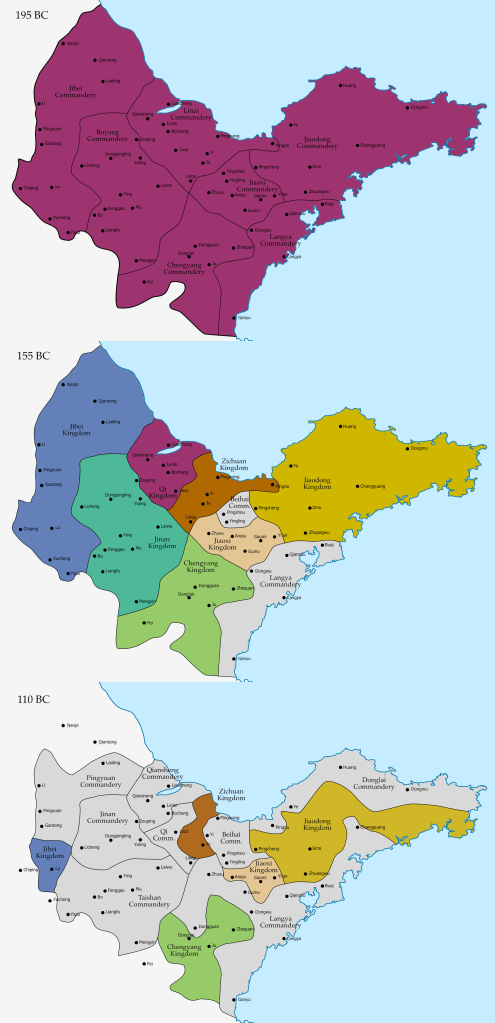
    The Empress Dowager sought to establish members of the Lü family as kings. She began by naming Emperor Hui‘s so-called sons, Liu Qiang as Prince of Huaiyang and Liu Buyi as Prince of Hengshan. She then dispatched the Director of Internuncio Zhang Shi to subtly promote the idea of nominating Lü family members as kings among the ministers. The ministers subsequently proposed that Marquis of Li, Lü Tai, the eldest son of King of Daowu (Lü Ze), be made Prince of Lü, and that Jinan Commandery in Qi be ceded to the principality of Lü as its territory.

    On May 4, a fire broke out on the Cong terrace in the King of Zhao’s palace.

    In autumn, peach and plum blossoms bloomed unexpectedly.

    The 2nd year of the Empress Gao(186 B.C.)

    In November, during the winter, Prince Su of Lü, Lü Tai, passed away.

    On January 27, an earthquake struck, causing mountains to collapse between Qiangdao County and Wudu County.

    On May 9, Liu Yingke, the son of Prince Yuan of Chu, was granted the title of Marquis of Shangpi, and Liu Zhang, the son of Prince Daohui of Qi, was appointed Marquis of Zhuxu. Both were assigned to serve in the imperial guard. Additionally, the Empress Dowager married the daughter of Lü Lu to Liu Zhang.

    On June 30, the last day of the month, a solar eclipse occurred.

    In July, during autumn, Prince Ai of Hengshan, Liu Buyi, passed away.

    The currency denomination of eight zhu was reintroduced into circulation.

    On July 27, Emperor Hui‘s so-called son, the Marquis of Xiangcheng, Liu Shan, was established as Prince of Hengshan, and his name was changed to Liu Yi.

    The 3rd year of the Empress Gao(185 B.C.)

    In the summer, the Yangtze River and the Han River overflowed, causing flooding that affected over 4,000 households.

    In the autumn, stars were visible in the daytime.

    The Yi River and the Luo River also overflowed, causing flooding that affected over 1,600 households. The Ru River also overflowed, causing flooding that affected over 800 households.

    The 4th year of the Empress Gao(184 B.C.)

    On February 7, Emperor Hui’s alleged son, Liu Tai, was established as the Marquis of Changping.

    On April 21, the Empress Dowager granted her younger sister, Lü Xu, the title of Marquess of Lin’guang.

    As the Young Emperor grew older, he became aware that he was not Emperor Hui’s son and said, “How could the Empress Dowager kill my mother and make me emperor? When I am grown, I will do something about it!”

    The Empress Dowager heard of this and confined him to a narrow alley (Yong Lane), where harem women were incarcerated, claiming that he was ill and could not be seen by anyone. She told her ministers, “The emperor has been mentally ill for a long time and is unable to govern the country. We must choose a successor.” All the ministers knelt and said, “The Empress Dowager is wise and benevolent and has always been deeply concerned with the welfare of the country and the ancestors’ temples. We humbly obey the imperial edict.”

    Thus, the young emperor was deposed and killed in secret. On May 11, the Prince of Hengshan, Liu Yi, was installed as the new emperor and took the name Liu Hong. His reign was not counted as the first year of an era, as the Empress Dowager ruled as regent. The Marquis of Zhi, Liu Chao, was granted the title of Prince of Hengshan.

    In the same year, Cao Zhu was appointed grand master of the censorate.

    The officials in charge requested that the Empress Dowager ban the trade of goods and ironware at the border markets with the Nanyue kingdom. In response, the King of Nanyue, Zhao Tuo, dismissed the idea, saying, “Emperor Gaozu founded our kingdom and permitted us to trade with the Middle Kingdom and exchange emissaries. Now, Empress Gao has listened to the slanders of her advisors and seeks to isolate us and cut off our trade. This is surely the plot of the Prince of Changsha, who wants to use the Middle Kingdom’s power to attack and conquer Nanyue, annexing it as his own and taking it as his trophy.”

    The 5th year of the Empress Gao(183 B.C.)

    In the spring, King Zhao Tuo proclaimed himself Emperor Wu of Nanyue and launched an attack on Changsha. He defeated the defenses in several counties before retreating.

    In August, during the autumn, the Prince Huai of Huaiyang, Liu Qiang, passed away and was succeeded by the Marquis of Huguan, Liu Wu, who became the new Prince of Huaiyang.

    In September, cavalry from Hedong and Shangdang were dispatched to camp in Beidi commandery.

    The 6th year of the Empress Gao(182 B.C.)

    In October, during the winter, the Empress Dowager deposed the Prince of Lü, Lü Jia, for his arrogance and unruliness. In November, she appointed Lü Chan, the younger brother of Prince Su, as the new Prince of Lü.

    In the spring, stars were visible during the daytime.

    In the summer, on April 3, a general amnesty was declared across the empire.

    The emperor granted Liu Xingju, the younger brother of the Marquis of Zhuxu, Liu Zhang, the title of Marquis of Dongmou and ordered him to join the imperial guard.

    The Xiongnu invaded the counties of Didao and Ayang.

    A five-fen currency was issued.

    In the winter, the Marquis of Xuanping, Zhang Ao, passed away and was posthumously honored with the title “Prince Yuan of Lu.”

    The 7th year of the Empress Gao(181 B.C.)

    In December, during the winter, the Xiongnu invaded Didao County and captured over two thousand people.

    In the spring, during the first month, the Empress Dowager summoned Liu You, Prince You of Zhao. Liu You had married a woman from the Lü clan but did not love her, preferring another concubine. The Lü woman, angered, left him and slandered him to the Empress Dowager, claiming he had said, “How could the Lü clan have a prince? After the Empress Dowager passes away at the age of 100, I will surely attack them.” Upon hearing this, the Empress Dowager summoned Liu You to the capital, placed him under house arrest, and forbade him from seeing anyone or receiving food. Some of his officials secretly provided him food, but they were caught and punished. On January 18, Liu You died of starvation, and his body was buried in a commoner’s grave in Chang’an.

    On January 30, there was a solar eclipse. The Empress Dowager, displeased, said to those around her, “This is because of me!”

    In February, the Prince of Liang, Liu Hui, was transferred to become the Prince of Zhao, and Lü Chan, the Prince of Lü, was appointed as the new Prince of Liang. However, the new Prince of Liang did not go to his principality but instead served as the Grand Tutor to the Emperor.

    In the autumn, on June 30, the Marquis of Pingchang, Liu Tai, was installed as the Prince of Jichuan.

    The daughter of the Empress Dowager‘s sister, Lü Xu, was married to General Liu Ze, the Marquis of Yingling, who was a cousin of Emperor Gaozu. Tian Sheng from the state of Qi persuaded the Director of Internuncio, Zhang Shi, “The Lü clan has become kings, but the ministers have not yet fully accepted them. Now, the Marquis of Yingling, Liu Ze, is the eldest of the Liu clan. If you suggest to the Empress Dowager to make him a prince, the power of the Lü clan will be further strengthened.” Zhang Shi reported this to the Empress Dowager, who agreed with the idea, and thus she separated Langya commandery from the Qi state and made Liu Ze the Prince of Langya.

    When Liu Hui, the Prince of Zhao, was relocated to the territory of Liang, he was unhappy. The Empress Dowager appointed a daughter of Lü Chan as his queen, and the queen’s attendants, all members of the Lü clan, abused their power and kept a close watch on the prince. The prince’s beloved concubine was poisoned and killed on the queen’s orders. In June, overwhelmed by grief and anger, the prince committed suicide. The Empress Dowager blamed his death on his lack of respect for his royal duties and lineage, attributing it to his preference for women over his responsibilities for ancestral temples. As a result, the prince was posthumously stripped of his title, and his descendants were disinherited.

    At that time, members of the Lü clan held power and were in control. Marquis Zhuxu, Liu Zhang, though only twenty years old, was physically strong and resentful that the Liu clan was not given important positions. At one banquet with the Empress Dowager, Liu Zhang was appointed to serve wine. He requested to serve it according to military rules, and the Empress Dowager agreed. As they drank, Liu Zhang asked to sing the “Plowing and Weeding Song,” and the Empress Dowager consented. Liu Zhang sang, “Deeply plow and sow the seed, seedlings dislike being crowded. For seedlings not of the same kind, wield the hoe to weed them out!” The Empress Dowager remained silent.

    Later, a member of the Lü clan became drunk and left the banquet early. Liu Zhang pursued him, drew his sword, and killed him. Upon his return, he reported, “Someone tried to escape, and I punished him according to military law.” The Empress Dowager and her attendants were greatly shocked, but since she had agreed to his use of military law, there was no way to chastise him. The banquet ended on a sour note. After this incident, the Lü clan members feared Marquis Zhuxu, Liu Zhang, and even high officials began to side with him, strengthening the Liu clan’s power.

  • Comprehensive Reflections to Aid in Governance(Part 104): Laissez-faire Administration

    Comprehensive Reflections to Aid in Governance

    By Sima Guang

    Translated By Yiming Yang

    Annals of Han Book 4 Scroll 12 (continued)

    Xiao He, as portrayed by Peking Opera Artist Zhou Xinfang

    The 2nd year of the Emperor Hui (193 B.C.)

    In October of that winter, Prince Daohui of Qi, Liu Fei, came to court and drank in the presence of the Empress Dowager. The emperor gave his elder half brother, the Prince of Qi, the seat of honor. Infuriated, the Empress Dowager poured a cup of poisoned wine and presented it to the Prince of Qi as a blessing for longevity. As the Prince of Qi stood, the emperor stood up and took the cup instead. Horrified, the Empress Dowager quickly rose and knocked over the cup from the hand of the emperor. The Prince of Qi, surprised, dared not drink and pretended to be drunk and left.

    Upon learning that the wine had been poisoned, the Prince of Qi was terrified. The Minister of Internal Affairs for Qi, named Shi, advised the Prince of Qi to offer Chengyang Commandery as a fiefdom for Princess Yuan of Lu, the Empress Dowager‘s daughter. Pleased with this offer, the Empress Dowager let the Prince of Qi return home.

    In the spring, on January 4, two dragons were seen in a well by a household in Lanling.

    There was an earthquake in Longxi.

    There was a drought in the summer.

    The Marquis of Heyang, Liu Zhong(Emperor Gaozu’s elder brother), passed away.

    During the illness of the Marquis of Zan, Chancellor Xiao He, the emperor visited him and asked, “After you reach the age of one hundred, who could replace you?” Xiao He replied, “Your Majesty knows me the best.” The emperor then asked, “How about Cao Shen?” Xiao He immediately kowtowed, “Your Majesty has found the right man. I will die without worries.”

    In the autumn of that year, on July 5, Xiao He passed away. He always chose to live in modest and remote areas, and his home lacked elaborate walls or fancy structures. He once said, “Future generations should learn from my frugality. If they are wise, they will follow my example; if they are not, their homes won’t be taken away by powerful families.”

    Cao Shen was appointed Chancellor on July 27. Upon hearing of Xiao He‘s death, he told his attendant, “Pack up my luggage, I will become the Chancellor.” Shortly after, a messenger arrived to summon him. Cao Shen and Xiao He had been good friends as commoners. Although some tension arose between them when they held high offices, Xiao He always regarded Cao Shen highly and only recommended Cao Shen as an excellent leader in his waning hours.

    After assuming the role of Chancellor, Cao Shen made no changes and followed Xiao He‘s principles. He selected his assistants from commanderies and princedoms, based on their reputation for modesty and respectfulness, rather than their eloquence or literary talent. Those who were good at talking but lacked substance and practicality were dismissed.

    Cao Shen enjoyed drinking wine day and night. When officials or guests came to discuss important matters, he would simply drink with them until they were drunk and then send them away. It became a common occurrence that these officials had not spoken about what they came for before they were drunk. He overlooked minor mistakes of his subordinates, maintained order, and ensured that the government ran smoothly without trouble.

    One day, the Emperor asked Cao Shen‘s son, Cao Zhu, who was Grandee of Palace, why the Chancellor wasn’t doing his job properly. He remarked, “Does he take advantage of my young age?” Cao Zhu privately asked his father about this, which enraged Cao Shen. He whipped his son two hundred strokes and scolded him, “Hurry back to wait on the emperor! You don’t talk about state affairs with me!”

    When Cao Shen went to court, the Emperor reprimanded him, “The other day it was We who asked Cao Zhu to remonstrate with you.” Cao Shen removed his cap and apologized, asking, “Does Your Majesty consider yourself as wise as the Emperor Gaozu?”

    The Emperor replied, “How could I compare to Emperor Gaozu?”

    Cao Shen then asked, “Does Your Majesty think I am as capable as Xiao He?”

    The Emperor said, “You don’t seem to be.”

    Cao Shen responded, “Your Majesty speaks the truth. Emperor Gaozu and Xiao He established order and justice in the empire. Now, Your Majesty sits on the throne, and we, your ministers, make sure that the rules are properly followed. What more could you ask for?”

    The Emperor praised him, “Well said!”

    Cao Shen served as Chancellor for three years. During his tenure, the people praised him and sang, “Xiao He established laws, being clear and straightforward; Cao Shen succeeded him, kept compliance without error; The people lived in peace, when no one interferes.”

    The 3rd year of the Emperor Hui(192 B.C.)

    In the spring, 146,000 men and women were conscripted within a 600-li radius of Chang’an to  build its defenses. The work was completed in 30 days.

    A girl from the imperial family was given in marriage to Xiongnu‘s Modu Chanyu, in the name of the emperor’s daughter. At that time, Modu was very powerful and sent a letter to Empress Dowager Gao, using highly disrespectful and insulting language. Furious, Empress Dowager Gao summoned her generals and ministers to discuss beheading the messenger and launching an attack on the Xiongnu. Fan Kui declared, “I want an army of 100,000 to roam through the Xiongnu!”

    However, Ji Bu, General of the Palace, responded, “Fan Kui should be executed! When the Xiongnu besieged Emperor Gaozu at Pingcheng, there were 320,000 Han troops, and Fan Kui was the top general, yet he failed to break the siege. Now, families of the soldiers have only just begun singing their laments, and the wounded have barely recovered, yet Fan Kui talks recklessly of leading 100,000 men. This is nothing but lying to our faces! Moreover, barbarians are like wild beasts—if we receive their kind words, there is no need to rejoice; if we receive their insults, there is no need to be outraged.”

    Empress Dowager Gao replied, “Well said!” and ordered Grand Internuncio Zhang Shi to send a letter of apology, humbling herself deeply. She also sent two carriages and two pairs of horses as gifts. Modu Chanyu, in turn, sent an envoy to express his apologies, “I have never learned Middle Kingdom etiquette and righteousness. Your Majesty was kind enough to pardon me.” He also presented horses to the Han court as a gesture of goodwill, leading to the establishment of peace.

    In May of that summer, the lord of Minyue, Yao, was established as the King of Donghai. Yao and Wuzhu were both descendants of the King of Yue, Goujian. They had aided the other feudal lords in overthrowing the Qin dynasty and achieved many accomplishments, earning the people’s loyalty. As a result, they were established as kings. Yao’s capital was located in Dong’ou, and he was known as the King of Dong’ou.

    In June, 20,000 prisoners from principalities and marquises were sent to build the city wall of Chang’an.

    In the autumn of July, there was a fire at the imperial stables.

    This year, the people of Jiandi County in Shu rebelled, but the rebellion was suppressed.

    The 4th year of the Emperor Hui(191 B.C.)

    In October of that winter, the Emperor anointed Lady Zhang as Empress. Empress Zhang was the daughter of Princess Yuan of Lu, the Emperor’s elder sister. The Empress Dowager sought to establish a dual kinship bond with the Emperor, so she arranged the marriage.

    In the spring of January, individuals who demonstrated filial piety, sibling respect, or excellence in farming were exempted from corvée labor.

    On March 7, the Emperor was crowned in a coronation ceremony, and he declared a general amnesty throughout the country.

    The Emperor issued an edict abolishing laws and regulations that hindered officials from serving the people and caused harm. He also eliminated Qin dynasty laws that punished the carrying and preservation of books.

    In January of that spring, the Emperor frequently visited the Empress Dowager at Changle Palace, disrupting public traffic due to road clearances. To address this, he ordered the construction of a double-deck road south of the imperial arsenal. However, the Minister of Ceremony Shusun Tong remonstrated, saying: “This is the route where Emperor Gaozu‘s ceremonial dress and hat are paraded to the ancestral temple each month. How can his descendants ride on a road that passes above this sacred path?”

    The Emperor, alarmed, ordered the road to be demolished. But Shusun Tong advised, “A ruler’s actions cannot go unnoticed. Since Your Majesty has already begun, and the people are aware, I suggest building another ancestral temple north of the Wei River. The monthly processions for the dress and hat can go to the new temple. A newer and larger ancestral temple would better reflect the foundation of great filial piety.”

    The Emperor agreed and ordered the relevant authorities to construct the new ancestral temple.

    Sima Guang’s commentary: Everyone makes mistakes, but only the wise can recognize and correct them. The ancient sages feared failing to recognize their mistakes, so they established the wooden post of defamation and daring-you-remonstrating drum. How could they fear the people hearing of their errors? Zhong Hui praised King Tang of Shang for his ability to correct his mistakes: “Never hesitate to correct your mistakes.” Fu Yue admonished King Wu-Ding of Shang: “Never be ashamed of errors, thus preventing more mistakes.” From this, we understand that a monarch is not considered wise for being faultless but for being willing to correct his faults.

    However, when Shusun Tong admonished Emperor Hui, he claimed, “The Ruler is infallible.” suggesting that he taught the monarch to use sophistry to justify his errors. Wasn’t this itself a mistake?

    There was a disaster at Hong Terrace in Changle Palace.

    In the autumn of July, two fires occurred in the imperial palaces. On July 20, the Ice Storage Room in Weiyang Palace caught fire, and on July 21, the Weaving Room also burned.

    The 5th year of the Emperor Hui(190 B.C.)

    In the winter, thunder was heard, and peaches and plums blossomed. Dates ripened early.

    In the spring of January, the Emperor once again conscripted 145,000 men and women from within a 600-li radius around Chang’an to work on the city walls. The project was completed in 30 days.

    In the summer, there was a severe drought. The Yangtze River and Yellow River had very little water, while the streams and creeks were completely dry.

    In the autumn, on September 11, Cao Shen, the Marquis Yi of Pingyang, passed away.

    The 6th year of the Emperor Hui(189 B.C.)

    In the winter of October, Wang Ling was appointed as the Right Chancellor, and Chen Ping was appointed as the Left Chancellor.

    Prince Hui of Qi, Liu Fei, passed away.

    In the summer, the Marquis of Wencheng, Zhang Liang, passed away.

    Zhou Bo was appointed as Grand Commandant.

    The 7th year of the Emperor Hui(188 B.C.)

    In the winter, chariots, cavalry veterans were dispatched to Xingyang, led by Grand Commandant Guan Ying.

    In the spring, on January 1, there was a solar eclipse. Another solar eclipse occurred on May 29.

    In the autumn, on August 12, Emperor Hui passed away in Weiyang Palace. A general amnesty was declared throughout the empire. On September 5, the Emperor was buried in the Anling Mausoleum.

    Previously, Empress Dowager Lü had ordered Empress Zhang to adopt someone else’s son and kill his mother to make him the crown prince. After the burial, the crown prince ascended the throne, but as he was still young, Empress Dowager Lü served as the regent.

  • Comprehensive Reflections to Aid in Governance(Part 103): A Human Pig

    Comprehensive Reflections to Aid in Governance

    By Sima Guang

    Translated By Yiming Yang

    Annals of Han Book 4 Scroll 12 (continued)

    The tomb of Emperor Gaozu, Changling, Shaanxi Province, Photo by Sohan Dsouza

    The 12th year of the Emperor Gaozu (195 B.C. continued)

    During the campaign against Ying Bu, the emperor was struck by a stray arrow and became gravely ill while on the road. Empress Lü brought a skilled doctor to treat him, but the emperor refused medical care, “I rose from nobody to power by my own hands—was this not fate? Fate lies in Heaven; what benefit will a doctor bring, even if Bian Que[a legendary doctor] was here?” He dismissed the doctor, rewarding him with fifty catties of gold.

    Empress Lü then asked him who should succeed Xiao He as Chancellor after his passing. The emperor responded that Cao Shen would be a good choice, followed by Wang Ling, “Although Wang Ling is somewhat slow-witted and would require Chen Ping’s assistance. Chen Ping, whose wits are plenty, is not suitable for the role on his own. Zhou Bo, though not very educated or eloquent, is honest and straightforward, and he would be the one to secure the Liu family’s safety, so he should be appointed Grand Commandant.”  When asked who should succeed after that, the emperor replied, “That is beyond what you need to worry about.”

    In the summer, on April 25, the Emperor passed away at Changle Palace, and a grand mourning ceremony was held. A general amnesty was proclaimed throughout the empire.

    Lu Wan, along with several thousand men, was stationed at the frontier, awaiting the Emperor’s recovery. He had hoped to admit his mistakes and solicit a pardon when the Emperor regained his health. However, upon learning of the Emperor’s death, Lu Wan fled to Xiongnu.

    On May 17, Emperor Gaozu was buried at the Changling mausoleum.

    Although Emperor Gaozu was not a scholar, he had a sharp mind and a magnanimous nature. He was skilled in strategy and willing to listen to advice. He treated his former gatekeepers and soldiers like family. To address the people’s needs, he established the Law of Three Articles. After unifying the country, he appointed Xiao He to organize laws and regulations, Han Xin to codify military strategy and discipline, Zhang Cang to establish the legal code, and Shusun Tong to set the ceremonial system. He also rewarded his meritorious subjects by inscribing oaths of immunity and storing them in ancestral temples in the form of red books, iron tablets, golden boxes, and stone chambers. Despite his demanding schedule that had not enough hours in a day, he successfully established a comprehensive administrative system with a lasting impact.

    On May 20, the crown prince ascended the throne and became emperor, bestowing upon the Empress the title of Empress Dowager.

    When Emperor Gaozu was gravely ill, someone accused Fan Kuai of conspiring with the clan, alleging that they planned to order soldiers to execute the King of Zhao, Liu Ruyi, and his followers once the emperor died. Enraged, Emperor Gaozu sought the counsel of Chen Ping. He then ordered the Marquis of Jiang, Zhou Bo, to retrieve an imperial edict from his bedside: “Chen Ping, as my representative, is to go immediately to Fan Kuai‘s camp and replace him with Zhou Bo as commander. Once there, Chen Ping is to have Fan Kuai beheaded.”

    Zhou Bo and Chen Ping deliberated: “Fan Kuai has been with the emperor since childhood. He has accomplished so much and is married to the empress’s sister. He is both a noble and a member of the imperial family. The emperor, in his fury, ordered his execution, but what if he later regrets it? Let’s arrest him and take him to the emperor. Let the emperor decide his fate personally.”

    They set up a platform and summoned Fan Kuai using the emperor’s insignia. Fan Kuai, upon receiving the imperial edict, complied and was taken to Chang’an in a cage cart. Zhou Bo replaced Fan Kuai as the general in charge of pacifying the Yan rebellion.

    On his way back to the capital, Chen Ping heard of Emperor Gaozu‘s death and feared that Empress Lü‘s sister, Lü Xu, might denigrate him. He hurried back to Chang’an, but along the way, he encountered an imperial messenger ordering him and Guan Ying to station at Xingyang. Chen Ping accepted the order but quickly returned to the palace to mourn the emperor’s passing, weeping sorrowfully. He requested to stay in the imperial palace as a guard, and the Empress Dowager appointed him minister of imperial household to teach and assist the young emperor. As a result, Lü Xu‘s libels against Chen Ping were ineffective, and when Fan Kuai arrived in Chang’an, he was pardoned and restored to his former position and privilege.

    The Empress Dowager ordered to lock Consort Qi in the palace prison. She was shaved, shackled, dressed in a coarse red robe, and made to do manual labor such as pounding grain. The Empress Dowager also sent envoys to summon the Prince of Zhao, Liu Ruyi. After three attempts, Zhao‘s Prime Minister, Zhou Chang, refused to let Liu Ruyi accompany the envoys to the capital. He told them, “Emperor Gaozu entrusted the Prince of Zhao to me. The prince is still young, and I have heard that the Empress Dowager hates Consort Qi and intends to execute both her and the prince. I cannot send the Prince of Zhao as he is ill and unable to follow the imperial order.”

    The Empress Dowager, enraged, summoned Zhou Chang to Chang’an. After his arrival, she sent for the Prince of Zhao once more. The king was en route, but when the Emperor learned of the Empress Dowager’s animosity, he personally welcomed the Prince of Zhao at Bashang, brought him into the palace, and engaged him in daily activities. Although the Empress Dowager wished to kill Liu Ruyi, she could not find an opportunity.

    The 1st year of the Emperor Hui(194 B.C.)

    In December of that winter, the emperor went hunting in the early morning. The young Prince of Zhao could not rise as early, and the Empress Dowager sent someone to give him a cup of poisoned wine. When the emperor returned at dawn, he discovered that the King of Zhao had already died. The Empress Dowager then ordered Consort Qi’s hands and feet to be cut off, her eyes gouged out, her ears burned, and a potion administered to render her mute. She was kept in the outhouse and referred to as a “human pig.”

    A few days later, the emperor was summoned by the Empress Dowager to see this “human swine.” He recognized her and cried bitterly. His grief made him ill, and he remained bedridden for over a year. He passed messages to the Empress Dowager, “This is not something a human being should do. I am the son of the Empress Dowager, but I will never be able to govern the realm.” After this, the emperor indulged in drinking and pleasures, neglecting state affairs.

    Sima Guang’s commentary: As a son, one should remonstrate with his parents if they do something wrong. If the remonstration is ignored, one should weep and continue to persuade. How can one abandon the country and its governance, indulging in alcohol and carnal pleasure, because they cannot bear their mother’s cruelty, especially when entrusted with the legacy of the founding emperor and rulership of the realm? Emperor Hui can be seen as someone devoted to small acts of kindness but ignorant of great principles.

    The Prince of Huaiyang, Liu You, was removed from his position and made Prince of Zhao.

    In January, during the spring, construction of the city walls began in the northwest of Chang’an.

  • Comprehensive Reflections to Aid in Governance(Part 102): Kings with A Different Surname

    Comprehensive Reflections to Aid in Governance

    By Sima Guang

    Translated By Yiming Yang

    Annals of Han Book 4 Scroll 12 (continued)

    Depiction of the Four Silver-haired Sages of Mount Shang, photo by Kanō Naonobu

    The 11th year of the Emperor Gaozu (196 B.C. continued)

    In July of the autumn, the King of Huainan, Ying Bu, rebelled.

    After the death of the Marquis of Huaiyin, Ying Bu had already become fearful. Later, when Peng Yue was executed and his flesh was minced and distributed as a warning to other feudal lords. When the Han court’s envoy arrived in Huainan, the king was out hunting and then saw Peng Yue‘s preserved flesh delivered. Horrified and filled with dread, he secretly ordered his men to gather troops and stay alert for any signs of danger from neighboring commanderies.

    At the same time, one of Ying Bu‘s favored concubines fell ill and was receiving medical treatment. The doctor and the Grandee of the Palace, Ben He, lived across the street from each other. Ben He prepared expensive gifts and drank with the concubine in the doctor’s home while she came for doctor visits. Ying Bu grew suspicious and believed Ben He might be having an affair with his favorite concubine, so he considered arresting him.

    Ben He quickly rode to Chang’an in a post carriage and reported to the court that the King of Huainan was planning a rebellion, claiming it was already in motion and should be preemptively suppressed. The emperor read Ben He‘s report and consulted Chancellor Xiao He, who advised caution, “I don’t believe Ying Bu is planning a revolt. He may have been falsely accused due to personal animosity. Hold Ben He for now and send someone to investigate the situation first.”

    When Ying Bu learned that Ben He had reported him to the Han court, he became even more anxious. When court officials arrived to investigate, they found some evidence of rebellion. Feeling he had no other choice, Ying Bu exterminated Ben He‘s clan and openly launched his insurrection.

    After the mutiny began, the emperor pardoned Ben He and appointed him as a general.

    The emperor asked his generals for advice, and they all suggested, “Send troops to attack them, bury the brat, what can they possibly do?” The Marquis of Ruyin, Duke of Teng, Xiahou Ying, summoned the former Chancellor of Chu, Mr. Xue, for his opinion. 

    Mr. Xue said, “He will certainly rebel.” 

    The Duke of Teng asked, “But the emperor has given him land and a title. Why would he rebel?”

    Mr. Xue replied, “Last year, Peng Yue was killed, and the year before that, Han Xin was killed. These three men achieved the same level of merit and status. Now, they fear for their safety and that is why they rebel.”

    The Duke of Teng reported this to the emperor, who summoned Mr. Xue and sought his advice. Mr. Xue said, “Ying Bu‘s rebellion is unsurprising. If he follows the best strategy, the land east of Xiao Mountain would no longer belong to the Han Empire. If he follows the medium strategy, the outcome is uncertain. If he follows the worst strategy, Your Majesty could sleep soundly.”

    The emperor asked, “What is the best strategy?”

    Mr. Xue answered, “He would take State Wu to the east, State Chu to the west, annex State Qi and State Lu, rally State Yan and State Zhao, and defend his territories. The land east of Xiao Mountain would no longer belong to the Han Empire.”

    The emperor then asked, “What is the medium strategy?”

    Mr. Xue replied, “He would take State Wu to the east, State Chu to the west, annex State Hán and State Wei, control the granaries at Ao’cang, and block the pass at Chenggao. The outcome would be uncertain.”

    The emperor asked, “What is the worst strategy?”

    Mr. Xue responded, “He would take State Wu to the east, Xiacai County to the west, pivot to State Yue, and retreat to Changsha. Your Majesty could sleep soundly, and the Han Empire would have no more problems.”

    The emperor then asked, “Which strategy will he choose?”

    Mr. Xue replied, “He will take the worst strategy.”

    The emperor asked, “Why do you think he will drop the top and middle strategies and choose the worst?”

    Mr. Xue said, “Ying Bu was a prisoner laborer from Lishan who rose to become the king of a powerful kingdom by his own efforts. He only considers his pressing concerns and does not think beyond his current predicament or about future generations. That is why I believe he will take the worst strategy.”

    The emperor was pleased with Mr. Xue’s advice and rewarded him with a fief of a thousand households. He then appointed his son, Prince Liu Chang, as the new King of Huainan.

    At that time, the emperor was ill and wanted to send the crown prince to lead the campaign against Ying Bu. The crown prince’s advisors—Four Silver-Haired Sages of Mount Shang, Mr. East Garden, Qili Ji, Mr. Xiahuang, and Professor Luli—persuaded Lü Shizhi, the Marquis of Jiancheng, “The crown prince has already reached the highest position. If he leads the troops, there is nothing more for him to gain if he succeeds, but much to lose if he fails. Why not ask Empress Lü to plead with the emperor immediately, saying, ‘Ying Bu is a fierce general skilled in military tactics. All the generals now were once the emperor’s peers, and sending the crown prince to lead them is like sending a sheep to lead wolves. No one will listen to him. If Ying Bu hears of this, he will surely attack immediately! Although the emperor is ill, he should be carried in a cart and guide the army himself. The generals will then have no choice but to do their best. The emperor must stand strong for his family, even in his suffering condition!’”

    That night, Lü Shizhi approached his sister, Empress Lü and conveyed the advisors’ plea. Empress Lü wept and presented the plea to the emperor as suggested. The emperor responded, “I know the boy is not fit to lead the troops, so your old man will go himself.”

    The emperor then led his troops eastward, while his courtiers stayed behind to guard the capital. They accompanied him as far as Bashang. Despite being ill, Marquis Liu, Zhang Liang, forced himself to meet the emperor at Quyou village. He said, “I should have accompanied Your Majesty, but I am too unwell. The Chu people are quick-witted and fierce fighters. I urge Your Majesty not to engage them in a head-on clash.” He also advised the emperor to appoint the crown prince as the general in charge of the army in Guanzhong. The emperor responded, “Even though Zifang is sick, you still teach the crown prince while lying down.”

    At that time, Shusun Tong served as the Grand Tutor, and Marquis Liu, Zhang Liang, as the Minor Tutor. The emperor levied chariots and cavalry from Shangjun, Beidi, and Longxi commanderies, as well as military officers from Ba and Shu, and capital guards. This force, totaling about 30,000 soldiers, was commanded by the crown prince and stationed in Bashang.

    When Ying Bu first rebelled, he told his generals, “The emperor is old and weary of war. He won’t come to fight. He will send his generals. Of the generals, I only feared Marquis Huaiyin and Peng Yue. They are both dead now, so there is no one left to flinch from.” Confident in this, Ying Bu marched eastward toward the kingdom of Jing, just as Mr. Xue had assumed. The King of Jing, Liu Jia, fled and died in Fuling county. Ying Bu took command of all the soldiers of Jing and crossed the Huai River to attack the kingdom of Chu.

    The King of Chu, Liu Jiao, sent his troops to fight Ying Bu between Xu County and Tong County. He divided his forces into three, intending for them to support each other in case of emergency. However, some advisors warned Chu‘s generals, saying, “Ying Bu is skilled in warfare, and the people naturally fear him. Furthermore, according to military tactics, ‘when soldiers fight on their home land, it is considered a land of dispersion.’ If we split our forces into three, and one is defeated, the others will flee. How can they then come to each other’s aid?”

    But the King of Chu ignored the advice. As predicted, Ying Bu defeated one of the armies, causing the other two to flee. He then led his troops westward.

    The 12th year of the Emperor Gaozu (195 B.C.)

    In October, during the winter, the emperor encountered Ying Bu‘s army in west Qi County. Ying Bu‘s troops were well-equipped and well trained. The emperor camped at Yongcheng and, upon seeing Ying Bu‘s army formation—which resembled Xiang Yu‘s—he was in a sour mood. From a distance, the emperor called out to Ying Bu, “Why do you rebel?” Ying Bu responded, “I want to become the emperor.” This enraged the emperor, who cursed him, and the two sides went to battle.

    Ying Bu‘s army was defeated and retreated across the Huai River. They stopped and engaged in several more battles but remained unsuccessful. With only a few hundred followers left, Ying Bu fled south. The emperor ordered his generals to pursue him.

    On his way back to the capital, the emperor stopped in Pei County and held a banquet at Pei Palace. He invited old friends, male and female elders, and young people to drink and reminisce. After drinking, the emperor sang, danced, expressed his emotions, and shedded tears. He said to the elders of Pei, “A wanderer always misses his hometown. I overthrew the tyrant in the name of the Duke of Pei and finally unified the world. I will make Pei county my estate. From generation to generation, the people here will be exempt from taxes and compulsory service.” The celebration lasted for more than ten days before he departed.

    Meanwhile, a Han general attacked Ying Bu‘s forces at the south and north of the Tao River, defeating them soundly. Wu Chen, the King of Changsha, whose father Lord Po (Wu Rui) was connected to Ying Bu through marriage, deceived him with false promises of escape to Yue. Trusting him, Ying Bu followed Wu Chen’s envoy, but the people of Poyang killed Ying Bu in a farmer’s house in Zi township.

    Zhou Bo completely pacified the commanderies of Dai, Yanmen, and Yunchong, and beheaded Chen Xi at Dangcheng county.

    The Emperor changed the kingdom name from Jing to Wu, as the former Prince of Jing, Liu Jia, had no heir. On October 25, he appointed the son of his elder brother Liu Zhong, whose name was Liu Pi, as the Prince of Wu and granted him three commanderies and fifty-three towns.

    In November, the emperor passed through the State of Lu and held a grand ceremony to offer sacrifices to Confucius.

    After returning from the campaign against Ying Bu, the emperor fell seriously ill and considered changing his heir. Zhang Liang advised him against it, but was not listened to.  Zhang Liang ceased attending to state affairs on pretense of poor health.

    Shusun Tong also remonstrated with the emperor, “In the past, Duke Xian of Jin abolished the crown prince and made Xiqi his heir due to Concubine Li‘s influence. This caused turmoil in Jin and made the state a laughing stock. The empire of Qin also failed to designate Fusu as crown prince, allowing Zhao Gao to install Huhai with a forged decree. Your Majesty witnessed this firsthand. The crown prince is known throughout the empire for his virtue and filial piety. Your Majesty and Empress Lü endured wars and hardships together—how could you betray her? If Your Majesty insists on changing the heir, I am willing to be beheaded before you. Let my blood stain the ground here!”

    The emperor stopped him, “Don’t do that, Mr. Shusun. I was only joking.”

    Shusun Tong replied, “The crown prince is the foundation of the empire. If the foundation is shaken, the entire empire will flutter. How can we treat the country as a joke?”

    At that time, many ministers strongly opposed the idea, and the emperor, realizing they did not support the King of Zhao, abandoned the idea to change his heir.

    The Chancellor, Xiao He, complained that the city of Chang’an was becoming overcrowded, while the land in the Imperial Park (Shanglin Park) lay uncultivated. He proposed that the people be allowed to farm the land, which would also reduce the burden on officials who had to pluck weeds to feed the animals. The emperor flew into a rage: “The Chancellor must have accepted bribes from merchants, allowing them to covet my garden!” As a result, Xiao He was arrested by the justice minister and shackled with manacles.

    A few days later, Captain Wang of the Imperial Guard, while on duty with the emperor, asked, “What heinous crime has the Chancellor committed to deserve such cruel treatment with chains?” The emperor responded, “I heard that Chancellor Li Si of Qin attributed all good deeds to his lord and took all the blame upon himself when he served the Qin emperor. Now, the Chancellor has accepted bribes from merchants and sought to use my park to win public favor. That’s why I punished him with shackles.”

    Captain Wang argued, “If a minister’s request benefits the people, it is truly the duty of the Chancellor. On what ground does Your Majesty accuse the Chancellor of taking money from merchants? Moreover, when Your Majesty was away for years fighting with Chu, and later when Chen Xi and Ying Bu rebelled, you went to confront them personally. During those times, the Chancellor guarded Guanzhong. If Guanzhong had fallen, the lands west of the pass would not have belonged to Your Majesty. The Chancellor sought no personal advantage then, so why would he seek it now from merchants? Furthermore, Qin lost its empire because it refused to hear criticism. What is the point of repeating the mistake in blaming everything bad on Li Si? Why does Your Majesty doubt the depth of the Chancellor’s loyalty?”

    The emperor, feeling regretful, sent a messenger with his insignia to the prison to release Xiao He. When freed, Xiao He, showing signs of age, remained humble and discreet. He arrived barefoot with the messenger to see the emperor and admit his guilt. The emperor interrupted him, saying, “That’s enough, Chancellor! When you requested the use of the park for the people, I refused. I am worse than the tyrant kings like Jie of Xia and King Zhou of Shang, while you are a wise Chancellor. I put you in shackles so the people would know that I make mistakes too.”

    During Chen Xi’s rebellion, Lu Wan, King of Yan, sent troops to attack him from the northeast. At that time, Chen Xi asked Wang Huang to seek help from Xiongnu. Lu Wan also sent his minister, Zhang Sheng, to the Xiongnu to report that Chen Xi’s army had been defeated. When Zhang Sheng arrived, he encountered Zang Yan, the son of the former King of Yan, Zang Tu, who had fled to live among the Xiongnu.

    Zang Yan said to Zhang Sheng, “You are valuable to Yan because of your familiarity with the Xiongnu way of life. Yan has survived so long because, despite repeated rebellions by various vassals, the conflicts never reached a decisive ending. If you now attempt to destroy Chen Xi and his followers, once they are gone, the emperor will come for Yan, and you and your people will also become captives. Instead, why not make peace with the Xiongnu and instruct Yan’s army to go easy on Chen Xi? If things go well, you will continue ruling Yan, and if the Han empire ever threatens you, you can rely on the Xiongnu’s support to protect your kingdom.”

    Zhang Sheng thought this plan made sense, so he secretly asked the Xiongnu to aid Chen Xi against Yan’s army.

    Lu Wan, suspecting that Zhang Sheng had betrayed him by colluding with the Xiongnu, sent a letter to the emperor requesting Zhang Sheng’s clan to be executed. However, when Zhang Sheng returned, he explained his actions, and Lu Wan, accusing someone else for Zhang Sheng’s crime, spared Zhang Sheng’s family. He then directed Zhang Sheng as an agent working in the Xiongnu and instructed Fan Qi to visit Chen Xi secretly, advising him to remain in exile and avoid direct confrontation with Yan’s forces.

    When Han attacked Ying Bu, Chen Xi was stationed with his troops in Dai. After Chen Xi was killed, one of his subordinate generals surrendered and informed the Han court that the King of Yan, Lu Wan, had conspired with Fan Qi at Chen Xi‘s camp. The emperor then sent messengers to summon Lu Wan, but he claimed to be ill. In response, the emperor dispatched Marquis of Piyang, Shen Yiji, and Grand Master of Censorate, Zhao Yao to bring back Lu Wan and investigate those around him.

    Frightened, Lu Wan went into hiding and said to his favored ministers, “Besides the Liu family, only the King of Changsha and I hold kingships. Last year, Han eliminated the Marquis of Huaiyin and executed Peng Yue, all due to the schemes of the Lü family. The emperor is ill and has entrusted power to Empress Lü. She is determined to kill kings of different surnames and great meritorious ministers.” Lu Wan continued to claim illness and refused to meet the officials. His attendants fled and leaked what he said.

    Upon hearing this, the Marquis of Piyang, Shen Yiji, returned to report to the emperor, who grew even angrier. Soon after, they received word that Zhang Sheng had fled to Xiongnu as an envoy from Yan. The emperor then declared, “Lu Wan has indeed rebelled!”

    In February of the following spring, Fan Kuai, in the name of the Chancellor, led troops to attack Yan and established Prince Liu Jian as the new King of Yan.

    The imperial edict declared: “The Marquis of Nanwu, Zhi, is also of the lineage of Yue and shall be appointed as the King of Nanhai.”

  • Comprehensive Reflections to Aid in Governance(Part 101): Meeting with Triệu Đà

    Comprehensive Reflections to Aid in Governance

    By Sima Guang

    Translated By Yiming Yang

    Annals of Han Book 4 Scroll 12 (continued)

    Zhao Tuo (Triệu Đà in Vietnamese), photograph by Zhang zhugang

    The 10th year of the Emperor Gaozu (197 B.C. continued)

    In May, the emperor appointed Zhao Tuo, the Nanhai commandant of Qin, as King of Nanyue. He immediately sent Lu Jia as an envoy to grant Zhao Tuo the king’s seal, ribbon, and tally, and to establish communication with the court through emissaries. The emperor wanted Zhao Tuo to govern all the Yue tribes and bring peace to the south.

    Earlier, during the reign of the second emperor of the Qin dynasty, Ren Xiao, the commandant of Nanhai, fell gravely ill. He summoned Zhao Tuo, the magistrate of Longchuan county, and said, “The Qin dynasty is tyrannical, and the people are suffering. I’ve heard of the rebellion led by Chen Sheng and others, and the world is uncertain. Nanhai is remote, and I fear bandits may invade this land. I want to raise an army, block the New Expressway, and defend ourselves while we wait for the turmoil among the monarchs to subside. Fanyu County is protected by mountains, and the South Sea forms a natural barrier to the south. It stretches east to west for thousands of miles, and many Middle Kingdom settlers here can support us. This place could serve as the capital of a state. The county officials are incapable of discussing this matter, so I have summoned you to consult.”

    Ren Xiao put his delegation of duties in writing and handed it to Zhao Tuo, who then assumed the role of Commandant of Nanhai, entrusted by Ren Xiao. Upon Ren Xiao’s death, Zhao Tuo immediately sent orders to Hengpu Pass, Yangshan Pass, and Huangxi Pass, declaring, “Bandits are about to arrive. We must cut off the roads and gather our troops for defense!” He also gradually eliminated the Qin-appointed officials through legal enforcement and replaced them with his own confidants as acting prefects. After the fall of the Qin dynasty, Zhao Tuo attacked Guilin and Xiangjun, declaring himself King Wu of Nanyue.

    When Lu Jia arrived, Zhao Tuo received him disrespectfully, wearing a conical hairdo like a local aboriginal and sitting with his legs wide apart. Lu Jia addressed Zhao Tuo: “You are a Han subject, and your relatives, brothers, and ancestral tombs are in Zhending. Now, you have forsaken your heritage, abandoned your titles and attire, and seek to defy the Emperor of Han with a mere petty state. This will only bring ruin upon you. Moreover, when the Qin dynasty lost its way, many tribes and nobles rose up, but only the King of Han entered the pass and occupied Xianyang. Xiang Yu, after breaking his word, proclaimed himself Hegemon King of Western Chu, and all the lords submitted to him. Yet, the King of Han rose from Ba and Shu, wielded force across the land, and eventually defeated and destroyed Xiang Yu, bringing peace to the empire within five years. This was not due to human strength but was ordained by the will of heaven.

    The Emperor has heard that the King of Nanyue has rebelled and failed to help eliminate injustice and tyranny. The Emperor and his ministers are considering sending troops to punish you. However, since the people have just endured hardship, the Emperor has chosen to wait and instead sends an envoy with the imperial seal, tally, and formal means of communication. You should welcome the envoy before he reaches the outskirts, bow to him, and declare your submission while facing north. Why would you wish to build a fledgling state and remain so unyielding? If the Han court heard of this, they would have dug up and burned your ancestors’ graves, exterminated your clan, and sent a general with 100,000 soldiers to Nanyue. The people of Nanyue would have killed you and surrendered to the Han empire like the flip of a hand.”

    Upon hearing this, Zhao Tuo suddenly stood up and apologized to Lu Jia, saying, “I have been living among the barbarians for too long and have forgotten my sense of propriety.” 

    He then asked the scholar, “Am I as wise as Xiao He, Cao Shen, and Han Xin?” 

    Lu Jia replied, “You are as wise as they are.” 

    Zhao Tuo then asked, “Am I as wise as the Emperor?”

    Lu Jia responded, “The Emperor inherits the legacies of the Five Emperors and Three Sovereigns, ruling over the Middle Kingdom. The people of the Middle Kingdom number in the hundreds of millions, and the land is vast and prosperous. The government is centralized, a system unprecedented since the formation of the universe. Now, your army has no more than 100,000 men, all of them barbarians living among rugged mountains and seas. It is equivalent to a single commandery of the Han empire. How can you compare your kingdom to the Han empire?”

    Zhao Tuo laughed heartily and said, “I do not seek to rise up in the Middle Kingdom; that is why I am a king here. But if I did it in the Middle Kingdom, how do you know my kingdom wouldn’t have been as great as the Han?” He then entertained Lu Jia for several months. Zhao Tuo said to him, “I have no one to converse with here. Since you arrived, I have learned so much every day.” He presented Lu Jia with a pack of pearls and other treasures worth thousands of catties of gold, along with other valuable gifts.

    Lu Jia conferred upon Zhao Tuo the title of King of Nanyue, asking him to become a vassal and abide by a treaty with the Han empire. Upon his return, Lu Jia reported to the emperor, who was greatly pleased and appointed him Grandee of the Palace.

    During his time at court, Lu Jia often mentioned and praised the Book of Songs and the Book of Documents. Once, the Emperor rebuked him, saying, “Your old man got his empire on horseback. What do ‘Songs’ and ‘Documents’ have to do with that?”

    Lu Jia replied, “Although your Majesty conquered the country on horseback, would you prefer to govern it on horseback as well? Moreover, King Tang of Shang and King Wu of Zhou gained power through conquest but sustained their rule through virtue. Combining military strength with civil virtues is the way to ensure long-lasting stability. In the past, the King of WuFuchai, Zhi Bo, and the Emperor of Qin all fell because they relied too heavily on military might. If the Qin had conquered the realm and then ruled with the virtues of benevolence and justice, following the wise laws of our sages, how could your Majesty have wrested the country from them?”

    The Emperor, ashamed of his words, asked Lu Jia to write a book explaining why the Qin lost their empire and how the Han dynasty gained it, as well as the successes and failures of other kingdoms throughout history. Lu Jia composed twelve chapters in total, summarizing the rise and fall of dynasties. After each chapter was submitted, the Emperor praised it, and the entire court cheered, “Long live the lord!” The book was titled New Speak.

    The Emperor was ill and refused to see anyone. He remained in his chambers for more than ten days, issuing an order that no one, not even court officials like Zhou Bo and Guan Ying, was allowed to enter. They dared not disobey. One day, the Marquis of Wuyang, Fan Kuai, forcefully pushed his way through the gate and entered, followed by the other officials. The Emperor was lying on an eunuch as a pillow.

    Seeing him, Fan Kuai and the others wept and said, “Your Majesty and we started together in Feng and Pei, and built this grand empire, you were so invigorating! Now that the empire has been established, why are you so exhausted? Your Majesty, you are gravely ill, and the ministers are deeply concerned. Why do you not see us to discuss state affairs, instead remain alone with a single eunuch? Have you not seen what happened with Zhao Gao?”

    The Emperor laughed and got up.

  • Comprehensive Reflections to Aid in Governance(Part 100): General’s Last Words

    Comprehensive Reflections to Aid in Governance

    By Sima Guang

    Translated By Yiming Yang

    Annals of Han Book 4 Scroll 12 (continued)

    Han Xin

    The 11th year of the Emperor Gaozu (196 B.C.)

    In the winter, the Emperor was in Handan. Chen Xi‘s general, Hou Chang, led more than ten thousand soldiers around Handan, while Wang Huang commanded over a thousand cavalry to attack from Quni county. Zhang Chun led over ten thousand soldiers across the river to assault Liaocheng county. Han’s generals, including Guo Meng and generals from the state of Qi, attacked and defeated them. Grand Commandant Zhou Bo marched from Taiyuan to the Dai territory, reached Mayi, but failed to capture it, and a subsequent violent assault destroyed it. Zhao Li defended Dongyuan, but the Emperor attacked, captured this county, and renamed it Zhending. The Emperor offered a thousand gold coins for the heads of Wang Huang and Wanqiu Chen, leading to their subordinates capturing both alive and surrendering to Han. As a result, Chen Xi‘s army collapsed.

    Marquis Huaiyin feigned illness and did not participate in the attack against Chen Xi. He secretly sent someone to Chen Xi’s residence to conspire with him. Han Xin plotted with his subordinates to issue a fake imperial decree pardoning all criminals and slaves, intending to use them to overthrow Empress Lü and the crown prince. The plan was set, awaiting news from Chen Xi. However, one of Han Xin‘s attendants offended him and was imprisoned, with the intention of being executed. In January, the attendant’s younger brother betrayed Han Xin by telling on his sedition to Empress Lü

    She wanted to summon Han Xin but feared he refused to come. Therefore, she conspired with Chancellor Xiao He to fabricate a report that the mutiny had already been suppressed and Chen Xi had died. The royalties and officials all congratulated the Emperor. Chancellor Xiao He deceived Han Xin, “Although you are ill, do the best you can to come and congratulate the Emperor.” Han Xin went to court, where the Empress Lü ordered warriors to bind and behead him in the Changle Bell Chamber. Just before his execution, Han Xin said, “I regret not following Kuai Che‘s advice. I was deceived by a woman and her son—was this not heaven’s will?” Han Xin‘s entire family, including the clans of his father, mother, and wife, was also executed.

    Sima Guang’s commentary: Some credit Han Xin as the one who first proposed the grand strategy and partnered with Emperor Gaozu to start from Hanzhong, establish control over the Three Qins, and then led separate forces north to capture the state of Wei, seize control of Dai, dominate Zhao, secure the allegiance of Yan, attack Qi in the east, and finally conquer Chu at the Battle of Gaixia in the south. In short, the establishment of the Han dynasty owes much to Han Xin’s achievements. Reflecting on his actions, did Han Xin really intend to rebel when he earlierly rejected Kuai Che’s advice and welcomed Emperor Gaozu in Chen County? It seems he was merely disappointed by a lack of recognition, which led him into conspiracy. Even Lu Wan became the King of Yan due to his old friendship with Emperor Gaozu, while Han Xin, had to meet with the Emperor as a marquise. Has the Emperor also shortchanged Han Xin?

    In my view, Emperor Gaozu used deceit to capture Han Xin in Chen County, so there was indeed some betrayal on the Emperor’s part. That being said, Han Xin deserved his misfortune as well. Initially, when the Han army was facing off against Chu at Xingyang, Han Xin had already conquered Qi and declared himself king without informing the Emperor. Later, when the Han army pursued Chu to Guling, Han Xin did not join forces with Emperor Gaozu as agreed upon. At that point, the Emperor had already intended to seize Han Xin but lacked the means. When the empire was finally unified, what did Han Xin have left to bargain with? Seeking opportunities for personal gain is the desire of ordinary people, while reciprocating for merits and repaying kindness is the heart of a gentleman. Han Xin pursued personal interests like an ordinary person but expected the recognition and respect of a gentleman—wasn’t that unrealistic?

    Thus, Sima Qian commented in his historical records: If Han Xin had learned humility, refrained from boasting of his achievements, and avoided exaggerating his abilities, wouldn’t that have been fortunate! Had he acted nobly and his merit to the Han dynasty could have been compared to the likes of the Duke of Zhou, the Duke of Shao, and Grand Duke Jiang, and would have been remembered for generations. But instead, he plotted rebellion after the world was already unified, leading to his downfall and the destruction of his entire clan. Wasn’t that fitting?

    General Chai Wu beheaded the King of Hán, Xin, in Canhe County. 

    Upon returning to Luoyang, the Emperor learned of the death of the Marquis of Huaiyin and had mixed feelings, torn between relief and grief. He asked Empress Lü, “What did Han Xin say before he died?” Empress Lü replied, “Han Xin regretted not heeding the advice of Kuai Che.” The Emperor said, “He must have meant Kuai Che, the strategist from Qi,” and ordered that Kuai Che be arrested and brought from Qi.

    When Kuai Che arrived, the Emperor asked, “Did you teach the Marquis of Huaiyin to rebel?” Kuai Che replied, “Yes, I did. But the brat did not follow my plan, and that is why he met his end here. Had he followed my plan, how could Your Majesty have executed him?” The Emperor, enraged, ordered Kuai Che to be boiled to death. Kuai Che exclaimed, “Oh, what an injustice to boil me!” The Emperor asked, “You taught Han Xin to rebel—how is this an injustice?” Kuai Che explained, “When the state of Qin let its deer loose, everyone in the world chased after it, and those who were swift and sharp-minded were the first to catch it. When the dog barked at Emperor Yao, it wasn’t because Emperor Yao was not benevolent but because the dog didn’t recognize its master. At that time, I only knew Han Xin, not Your Majesty. Besides, many sharp and skilled people in the world desire to do what Your Majesty is doing—they just haven’t yet gathered enough strength. Is it really necessary to execute them all?”

    The Emperor then said, “Pardon him.”

    The Emperor gave his son, Liu Heng, the title of King of Dai, with Jinyang as his capital. 

    He announced an amnesty for the country.

    When attacking Chen Xi, the Emperor called up troops from the kingdom of Liang. The King of Liang, Peng Yue, took sick leave and sent one of his generals with troops to Handan. The Emperor, furious, sent someone to reprimand him. Fearing punishment, Peng Yue wished to apologize in person. However, his general, Hu Zhe, advised, “If Your Excellency didn’t go before and only goes now after being reprimanded, you will be arrested. It’s better to take this opportunity to rebel with our troops.” Peng Yue ignored him.

    The Grand Coachman of Liang, who had fled to the Han court after being prosecuted for a crime in Liang, accused Peng Yue and Hu Zhe of plotting rebellion. As a result, the Emperor sent someone to ambush Peng Yue, who was caught off guard and captured in Luoyang. The judicial officers concluded, “There is evidence of rebellion. Please issue punishment according to the law.” However, the Emperor pardoned Peng Yue, reduced him to a commoner, and exiled him to Qingyi Dao(a county) in Shu commandery.

    On his way west, Peng Yue encountered Empress Lü at Zheng County, who was coming from Chang’an. Peng Yue wept, proclaimed his innocence, and requested to be resettled in his ancestral home of Changyi County. Empress Lü promised to grant his request and took him back east. Upon arriving in Luoyang, she reported to the Emperor, “Peng Yue is a great talent. If he is exiled to Shu, he will become a future threat. It’s better to execute him now. I took the liberty of bringing him back.” Empress Lü then ordered her attendant to accuse Peng Yue of plotting rebellion again. The Minister of Justice, Wang Tian, petitioned to punish him by exterminating his family, and the Emperor approved. In March, Peng Yue and his three clans were executed, and his head was displayed in Luoyang. A decree was issued: “Anyone who harbors or protects Peng Yue’s body will be arrested.”

    Luan Bu, a Grandee from the kingdom of Liang, was sent on a diplomatic mission to the kingdom of Qi. On his return to Luoyang, he passed by the public display of Peng Yue‘s severed head. Luan Bu went to the temple to pay his respects to the deceased and wept bitterly. Local officials arrested him and reported the incident to the emperor, who was enraged. Summoning Luan Bu, the emperor insulted him and ordered him to be boiled to death.

    As Luan Bu was being led to the boiling water pot, he asked to speak. The emperor granted him the chance, and Luan Bu said: “When Your Majesty was in trouble at Pengcheng and defeated between Xingyang and Chenggao, the reason King Xiang Yu did not advance further west was that the King of Liang, your ally, troubling the army of Chu in coordination with your troops. At that time, King Peng Yue held the balance of power. Had he joined forces with Chu, Han would have been destroyed; had he joined forces with Han, Chu would have been demolished. At the Battle of Gaixia, without King Peng Yue, King Xiang Yu would not have been annihilated. Now that Your Majesty has unified the empire, the King of Liang accepted the tally and title from Your Majesty, and also would like to pass it to his descendants for generations. But when you summoned him to raise troops from the kingdom of Liang, he could not comply due to illness. Your Majesty suspected him of rebellion without proof and executed him over a trivial matter. I fear this will make loyal officials feel insecure. Now that the King of Liang is dead, I am ready to die as well. Go ahead and boil me.”

    The emperor was moved by his words and decided to spare Luan Bu‘s life. Instead, he appointed him as a commandant.

    On February 20, Prince Liu Hui was established as the King of Liang. On March 11, Prince Liu You was established as the King of Huaiyang. The Dongjun commandery was abolished and annexed by the Liang kingdom, while the Commandery of Yingchuan was abolished and annexed by the Huaiyang kingdom.

    In April, during the summer, the emperor returned to the capital from Luoyang.

  • Comprehensive Reflections to Aid in Governance(Part 99): Protecting The Heir Apparent

    Comprehensive Reflections to Aid in Governance

    By Sima Guang

    Translated By Yiming Yang

    Annals of Han Book 4 Scroll 12 (continued)

    General Chen Xi

    The 10th year of the Emperor Gaozu (197 B.C.)

    The Emperor Emeritus(the emperor’s father) passed away at the Yueyang Palace in May of the summer. He was buried at Wannian tomb on July 14 in the autumn. The kings of Chu and Liang both attended the funeral. The prisoners of Yueyang county were granted amnesty.

    Consort Qi of Dingtao was favored by the emperor and gave birth to Prince Ruyi, the King of Zhao. The emperor regarded the crown prince as weak and believed Liu Ruyi looked more like himself. Although Prince Ruyi held the title of King of Zhao, he was always kept in Chang’an. When the emperor traveled east of the Huangu Pass, Consort Qi often accompanied him, weeping day and night, hoping to make her son the heir. Empress Lü, who was aging, often stayed behind and grew distant from the emperor. The emperor wanted to depose the crown prince and make Prince Ruyi the heir, but officials opposed it, and no one could change his mind. The Grand Master of Censorate, Zhou Chang, vehemently opposed the decision in the court. When the emperor asked for his reasoning, Zhou Chang, who was a stutter, infuriated and stuttered, “I have trouble speaking, but I know it is just…just not right! Your Majesty wants to depose the crown prince, but I… I cannot obey the order!” The emperor was amused and laughed. Empress Lü, listening from the east side room, thanked Zhou Chang on her knees after the meeting, “Were it not for you, the crown prince would have been deposed!”

    Prince Ruyi of Zhao was ten years old at the time, and the emperor feared he would be unable to protect his son after his death. The Censor of Imperial Seal and Insignia, Zhao Yao, suggested appointing a powerful and respected figure as Prince Ruyi‘s advisor—someone held in high regard by Empress Lü, the crown prince, and the court officials. The emperor asked, “Who would be a suitable candidate?” Zhao Yao replied, “The Grand Master of Censorate, Zhou Chang, is the right person.” The emperor then appointed Zhou Chang as Prime Minister to Prince Ruyi of Zhao and replaced Zhou Chang with Zhao Yao as the Grand Master of Censorate.

    The emperor also appointed Marquis Yangxia, Chen Xi, as Prime Minister of the kingdom of Dai and tasked him with overseeing the border troops of kingdom Zhao and Dai. Before Chen Xi left, he met with the Marquis of Huaiyin, Han Xin, to bid farewell. The Marquis took his hand, dismissed his attendants, and walked with him in the courtyard. Gazing up at the sky, he sighed and said, “May I speak with you?” Chen Xi replied, “Please give me instructions, General.” The Marquis of Huaiyin said, “Where you are going to stations the best soldiers in the world, and you are a trusted servant of the emperor. If people accuse you of rebellion, the emperor will not believe it the first time. The second time, he will begin to doubt. By the third time, he will be mad and lead the army himself. I can support you from within, and together we can take over the country.” Knowing the Marquis’s abilities, Chen Xi trusted him and said, “I will follow your advice carefully.”

    Chen Xi had long admired Wei Wuji (Lord Xinling) for his practice of cultivating talented individuals. While serving as Prime Minister guarding the border, he reported back to the capital and passed through the principality of Zhao, accompanied by more than a thousand carriages filled with his retainers. The official residences in Handan were packed with them. The Prime Minister of Zhao, Zhou Chang, requested an audience with the emperor and reported that Chen Xi had a large number of clients and had commanded troops near the border for several years, raising concerns about possible unrest.

    The emperor ordered an investigation into the unlawful activities of Chen Xi’s retainers in Dai, many of which implicated Chen Xi himself. Fearing for his safety, Chen Xi was persuaded by the King of Hán, Xin, to defect, with the assistance of Wang Huang, Wanqiu Chen, and others.

    When the Emperor Emeritus passed away, the emperor summoned Chen Xi, but Chen Xi claimed illness and did not come. In September, Chen Xi rebelled with the help of Wang Huang and others, declaring himself the King of Dai and plundering the principalities of Zhao and Dai. The emperor led troops from the east to attack him. Upon arriving in Handan, the emperor was relieved and said, “Since Chen Xi did not occupy Handan and block the Zhang River to the south, I know he does not have what it takes.”

    Zhou Chang reported, “Of the 25 cities in Changshan commandery, 20 have been lost. I request that the commanders and officials responsible be executed.”

    The emperor asked, “Did the commanders and officials rebel?”

    Zhou Chang replied, “No.”

    The emperor responded, “Then it’s because they lacked strength, not because of any crimes.”

    The emperor ordered Zhou Chang to select capable young men from Zhao to be appointed as commanders. Zhou Chang presented four candidates to the emperor, who scolded them, “Can young fellows like you really be commanders?” The four were ashamed and prostrated themselves. Despite this, the emperor rewarded each of them with a thousand households and appointed them as generals.

    His attendants objected, “Even the rewards from the campaigns to conquer Shu, Han, and Chu have not been as generous as this. What have these men done to deserve such rewards?”

    The emperor replied, “You do not understand. Chen Xi has rebelled and controls the territories of Zhao and Dai. I have called for troops from all over the country, but no one has responded yet. The only troops I have are those in Handan. Why do I hold dear these four thousand households, instead of giving out to lift the spirits of the youngmen of Zhao?”

    The attendants agreed and praised the emperor’s decision.

    It was also reported that most of Chen Xi‘s generals were former merchants. The emperor remarked, “Now I know what I should give to them.” He then used large amounts of gold to bribe Chen Xi‘s generals, leading many of them to defect to him.

  • Comprehensive Reflections to Aid in Governance(Part 98): Vouching for His King

    Comprehensive Reflections to Aid in Governance

    By Sima Guang

    Translated By Yiming Yang

    Annals of Han Book 4 Scroll 12 (continued)

    Guan Gao

    The 9th year of the Emperor Gaozu (198 B.C. continued)

    An enemy of Guan Gao turned in his plot to assassinate the emperor. In response, the emperor arrested the king of Zhao and other conspirators.  Zhao Wu and more than ten others argued over who would be the first to commit suicide, while Guan Gao alone raged and cursed: “Who made you do this? Our king had no intention of rebelling. If you all die, who will proclaim and defend the king’s innocence?” He placed the King of Zhao and himself into a sealed prisoner transport vehicle and headed to Chang’an.

    Guan Gao declared in court, “Only our clique was involved; the king was not aware of it.” The officials interrogated him, beating him with sticks and whips thousands of times, and even poking him with spikes. Not a square inch of skin on his body was spared, yet he never spoke again. Empress Lü said several times, “For the sake of his wife, the Eldest Princess, King Zhang Ao would not have done such a thing.” The emperor, however, was furious and shouted at her, “If Zhang Ao had controlled the empire, would he have been bereft of your daughter?” He refused to listen to her.

    The minister of justice reported Guan Gao‘s case to the emperor. The emperor remarked, “A braveheart! Who knows him well? Ask him privately.” The Grandee of Palace, Xie Gong, responded, “I am from the same town as Guan Gao and know his character. He is known for upholding righteousness and being unyielding, in the kingdom of Zhao. Guan Gao is a man of his word.” The emperor sent Xie Gong with an insignia of authority to visit Guan Gao in his bamboo bed.

    Xie Gong and Guan Gao talked cheerfully, as they had in the past. Then Xie Gong asked, “Did King Zhang Ao have any part in the plot?” Guan Gao replied, “Do people not love their parents, spouses, and children? My entire family has been sentenced to death. How could I love King Zhang Ao more than my own family? It was only we who wanted to rebel—he did not.” He explained his motives, affirming that Zhang Ao was unaware of the conspiracy.

    Xie Gong reported this back to the emperor. In January of the following spring, the emperor pardoned Zhang Ao, deposed him from the King to the Marquis of Xuanping, and replaced him with Prince Ruyi, who was king of Dai, as the new king of Zhao.

    The emperor, who admired Guan Gao, had Xie Gong inform him, “Zhang Ao has already been released,” and granted Guan Gao a pardon. Guan Gao was delighted and asked, “Has my lord truly been released?” Xie Gong replied, “Yes. The emperor values you greatly, which is why he has pardoned you.”

    Guan Gao then said, “The reason I did not die with no good skin on my body left was that I convinced everyone that King Zhang Ao did not rebel. Now that he has been released, my responsibility is fulfilled, and I have no regrets about dying. Moreover, as a subject, I would be accused of usurpation and regicide. How could I continue to serve the emperor with any dignity? Even if the emperor does not execute me, I would still feel ashamed in my heart.” With that, he broke his own neck artery and died.

    Xun Yue’s commentary: Guan Gao had initially plotted a rebellion and committed the crime of regicide. Even if he could prove the truth to the emperor, his minor contribution could not absolve him of the grave offense of scheming against the state and his failure to fulfill his public responsibilities. The ethics of the Spring and Autumn Annals emphasize justice must be upheld, and such crimes must be severely punished.

    Sima Guang’s commentary: Emperor Gaozu was rude and lost the loyalty of his subjects, while Guan Gao was ruthless and caused the downfall of his sovereign. When Guan Gao plotted a rebellion, it was due to the fault of Emperor Gaozu; and when Zhang Ao lost his state, it was the fault of Guan Gao.

    The emperor issued a decree: “Those who committed crimes before January 28 will receive a pardon, except for those already sentenced to capital punishment.”

    The emperor returned to the capital from Luoyang.

    Earlier, the emperor had issued an edict stating, “Any officials, retainers, or attendants of the state of Zhao who follow King Zhang Ao will be punished by the extermination of their entire family.” In response, the Court Clerk Tian Shu, a client of Zhang Ao–Meng Shu, and a few others shaved their heads and wore iron collars, submitting themselves as slaves to follow Zhang Ao. After Zhang Ao was exonerated, the emperor praised Tian Shu, Meng Shu, and the others. He summoned them for an audience, conversed with them, and found that none of the imperial court officials surpassed them in ability. The emperor then appointed them as prefects of commanderies and ministers of vassal kingdoms.

    A solar eclipse occurred on June 30 that summer.

    In that same year, Xiao He was promoted from Prime Minister to Chancellor.

  • Comprehensive Reflections to Aid in Governance(Part 95): Inventor of Whistling Arrows

    Comprehensive Reflections to Aid in Governance

    By Sima Guang

    Translated By Yiming Yang 

    Annals of Han Book 3 Scroll 11 (continued)

    A Bust of Modu (Metehan) Chanyu in Türkiye, Photo by Vikiçizer

    The 6th year of the Emperor Gaozu(201 B.C. continued)

    The emperor returned to Yueyang.

    The emperor granted his father the title Emperor Emeritus on May 23 of the summer.

    The Xiongnu empire feared the Empire of Qin and moved to the north for more than ten years.  As the empire of Qin collapsed, the Xiongnus gradually moved southward and crossed the Yellow River.  

    The chief of Xiongnu, whose name was Touman Chanyu, had a crown prince called Modu.  Then Touman’s other favorite wife bore him a younger son.  He wanted to crown his young son.  Nomad tribes Donghu was strong and Yuezhi was prosperous at the time.  Touman sent Modu to be a hostage in Yuezhi and then launched a sneak attack on YuezhiYuezhi would have killed Modu, except Modu stole a stallion and ran home.  Touman thought he was tough and let Modu command ten thousand cavalry. 

    Modu invented the kabura-ya, or whistling arrows, and trained his cavalry to use them in archery. He issued a strict command: “Anyone who fails to shoot at the same target immediately after seeing a kabura-ya hit the mark must be beheaded.” To enforce discipline, Modu shot his prized horse with a kabura-ya, followed by his beloved wife. Those who hesitated to follow his lead were executed. Eventually, he shot the best horse of the Chanyu with a whistling arrow, and everyone else shot as well. Satisfied with their readiness, Modu embarked on a hunting trip, where he shot Touman with a whistling arrow. His attendants, following his lead, killed Touman Chanyu.  Then he executed his stepmother, younger brother, and ministers who opposed him. Modu then declared himself Chanyu.

    When the Donghu tribe heard that Modu had become the Chanyu, they sent a messenger with a demand: “We want Touman Chanyu’s fast horse, the one that can run a thousand li in a day.” Modu consulted his ministers, who all advised, “This is a treasure of the Xiongnu, do not give it away!” But Modu replied, “How can we value a horse more than maintaining good relations with a neighboring state?” and so he gave them the horse.

    Soon after, the Donghu sent another messenger: “We would like one of the Chanyu’s wives.” Modu again asked his followers, who were outraged: “The Donghu are unreasonable, asking for Chanyu’s wife! Let’s attack them!” Modu responded, “How can we value a woman more than a neighboring state?” and hand out his beloved wife.

    Emboldened, the Donghu king became even more arrogant. There was a stretch of deserted land over a thousand miles wide between the Donghu and Xiongnu, each occupying their own side of the border, known as the “Ou-Tuo” (buffer zone). The Donghu then demanded this land. Modu asked his ministers for their advice; some said, “It is just deserted land, it doesn’t matter if we give it away or not.” Enraged, Modu declared, “The land is the foundation of the country, how can we give it away?” He beheaded those who had suggested giving it up.

    Modu mounted his horse and commanded, “Anyone who retreats during battle will be beheaded!” He attacked the Donghu, who had underestimated him and were unprepared, leading to their destruction.

    On returning home, Modu launched a westward attack and defeated the Yuezhi tribe. He then annexed the territories ruled by the King of Loufan and the King of Baiyang, the tribes living in the south of the Yellow River, before advancing into the states of Yan and Dai. He reclaimed the lands that had previously been taken from the Xiongnu by Meng Tian, extending the southern frontier to Chaona and Fushi counties. At the time, the Han army was preoccupied with their conflict against Xiang Yu, and the central plains were exhausted by war. This allowed Modu Chanyu to consolidate his power, amassing an army of more than 300,000 archers and inducing trepidation and submission to other nations.

    In the autumn, the Xiongnu besieged the Han vassal King of Hán, Xin at Mayi. Xin repeatedly sent messengers to the Xiongnu seeking a truce, and the empire dispatched troops to rescue him. However, the Han court grew suspicious of Xin’s loyalty, as he had sent envoys back and forth multiple times. Accused of dual loyalty and fearing punishment, in September, Xin surrendered Mayi to the Xiongnu. Seizing this opportunity, Modu Chanyu led his troops south, crossed the Gozhu Pass, raided Taiyuan commandery, and eventually reached Jinyang city.

    The emperor abolished the harsh and complicated laws of the Qin Dynasty and implemented a simpler system. However, officials began competing for recognition, and during drinking sessions, some became drunk and made reckless remarks, even drawing their swords and hacking at pillars. The emperor grew increasingly disgusted with their behavior.

    Shusun Tong advised the emperor, “Scholars may not be suited to ambitious plans, but they are capable of maintaining stability. I would like to invite scholars from Lu to establish court ceremonies, along with my own disciples.” The emperor asked, “Won’t this be difficult?” Shusun Tong replied, “The Five Emperors in history had different music, and the Three Kings had different rituals. Ceremonies should reflect the times and the people’s sentiments, so the rituals must be adjusted accordingly. I will draw on ancient rituals and blend them with Qin customs.” The emperor agreed, saying, “Let’s give it a try. Make it simple to understand, and only implement what I can manage.”

    Shusun Tong summoned over thirty scholars from the state of Lu. However, two scholars refused, saying, “You have served ten lords and flattered them all to gain favor. Now that the world has only just been pacified, the dead are not yet buried, and the wounded have not yet recovered, yet you want to start with ceremonies and music. Ceremonies and music should only be established after accumulating virtue for a hundred years. I cannot bear to follow your example. You may do as you wish, but do not tarnish my reputation!” Shusun Tong laughed and said, “You are dogmatic and shallow scholars who fail to grasp the changes of the times.”

    He then led the scholars he had recruited, along with those close to the emperor and his own disciples—a group of over a hundred people—to practice rituals and music outdoors, using ropes and thatch as mock-ups, for over a month. He reported to the emperor, “You can now observe and assess them.” The emperor ordered the court to rehearse the rituals and remarked, “I can do this.” He then instructed the officials to study and practice the rituals.

  • Comprehensive Reflections to Aid in Governance(Part 94): Keeping Kingly Titles within The Liu Family

    Comprehensive Reflections to Aid in Governance

    By Sima Guang

    Translated By Yiming Yang 

    Annals of Han Book 3 Scroll 11 (continued)

    The Evolution of The Kingdom of Qi

    The 6th year of the Emperor Gaozu(201 B.C. continued)

    The emperor believed the country was finally at peace. His sons were still young, and he had few brothers. Learning from the downfall of the Qin dynasty, which lacked external support, he decided to grant kingly titles to members of his extended family—those who shared the same family name—to safeguard and manage different regions.

    On January 21, in the spring, the emperor divided Han Xin’s territory into two states: 53 counties east of the Huai River were awarded to General Liu Jia, the emperor’s elder cousin, as King of Jing; 36 counties, including the commanderies of Xuejun, Donghai, and Pengcheng, were awarded to his younger brother, Lord Wenxin Liu Jiao, as King of Chu.

    On January 27, the emperor awarded 53 counties under the commanderies of Yunzhong, Yanmen, and Daijun to his elder brother, Marquis Yixin Liu Xi, as King of Dai. He also granted 73 counties, including the commanderies of Jiaodong, Jiaoxi, Linzi, Jibei, Boyang, and Chengyang, to his illegitimate son Liu Fei who was born out of wedlock when the emperor was a commoner, as King of Qi. All people who spoke the Qi dialect became subjects of the kingdom of Qi.

    The emperor thought the king of Hán, Xin, was a military talent. His princedom was bordered with Gong county and Luoyang to the north, Wancheng and Ye county to the south, Huaiyang to the east.  These were all military strongholds.  The emperor set aside 31 counties under commandery Taiyuan to the state of Hán.  He moved the king of Hán to the north of Taiyuan and made Jinyang the capital of the state to defend the borders against the nomads.  Xin wrote to the emperor: “The Xiongnu invaded my state border several times.  Jinyang is too far away from the border.  I request moving the capital to the town of Mayi.” The emperor approved the request.

    The emperor had already awarded more than twenty top achievers, The rest of them bogged down into dispute and the title awarding process ground to a halt.  One day the emperor saw the generals were talking together on the sandy beach of Luo River when he watched them from an overpass in the South Palace of Luoyang.

    “What are they talking about?”  The emperor asked.

    “Does your majesty know this?  They are plotting a mutiny.”  Marquis Liu, Zhang Liang replied.

    “The country just reconciled in peace.  Why do they want to revolt again?”  The emperor was puzzled.  

    “Your majesty was a commoner yourself and relied on these generals to conquer the country. Now your majesty is the son of Heaven.  Those awarded are the family members and old friends of your majesty’s; Those killed are whom your majesty had grudge on.  Now the officials who counted the merits of the generals indicated that there were not enough fief lands in the country to go around for rewarding. These generals feared that they were not going to be all rewarded with fiefs.  They also feared they would be killed if they got the wrong side and offended your majesty in the past.  That’s the reason they got together and plotted mutiny.”

    “What should I do about it?”  The emperor started worrying.

    “Among all your generals, who is the one, that everyone knows, that is hated the most by your majesty?”  Marquis Liu asked.

    Yong Chi is the one.  He and I held a grudge for years.  He humiliated me on many occasions.  I want to kill him.  But he had rendered many meritorious services and I could not bear to do it.”

    “Then you reward Yong Chi first.  Everyone else will feel confident that they will be treated fairly.”

    The emperor held a banquet to honor Yong Chi and awarded him as Marquis Shifang.  He also pushed the prime minister and censor-in-chief to accelerate the award granting process.  The generals were happy after the wine-and-dine.  They said to each other: “We don’t need to worry if even Yong Chi can be a marquis.”

    Sima Guang’s comments: Zhang Liang was the most trusted adviser of the emperor.  He won’t hold back if he has something to say.  How come he only spoke out when the emperor saw something unusual accidentally had he known that the generals were plotting a mutiny?  The reason was that the emperor dealt out rewards or punishments based on whether he liked or hated a person in the early days on the throne.  His judgment was unfair at times.  His ministers felt either bitter or terrorized.  Zhang Liang took the opportunity to rectify the emperor’s behavior, such that the emperor would not harm public interest with personal tastes and subjects would not watch over their shoulders.  The state will be free of distress and benefits the upcoming generations.  Advisors like Zhang Liang are good at remonstration.

    The awarding process of titled classes that were above Marquis had come to a close. The emperor promulgated the names of eighteen first class marquis with their rankings.  Public opinion said: “Marquis Pingyang, Cao Shen, who conquered many cities and land and wounded in seventy places of his body, should rank the first because of his highest merit score.”

    Marquis Within Passes E Qianqiu, an internuncio, disagreed: “The comments you guys made are off the mark.  Cao Shen earned his hundreds of merits in the battlefields, but those were just one time heroic acts.  His majesty had standoffs with the king of Chu for five years.  Many times his majesty had lost his troops and taken a flight for his life.  Xiao He often replenished his majesty’s troops, tens of thousands at times when his majesty had not even requested for;  Many times his majesty ran out of food and other supplies.  It was Xiao He who transported goods from Guanzhong and kept the supply chain of food moving;  Many times his majesty lost footings to the east of Xiao Mountains.  It was Xiao He who maintained a home base for his majesty to return.  These are the achievements impacting thousands of generations.  The kingdom of Han would not have missed a great deal without the service of hundreds of Cao Shen;  Why do we value a heroic achievement of a time over an achievement that impacts thousands of generations!  Xiao He should rank the first;  Cao Shen the second!”  The emperor agreed: “Well said!”  He granted Xiao He the privilege to go to court with his sword and shoes, and exempted him from trotting when coming to meet the emperor.

    The emperor said: “I heard that those who promoted winners should be rewarded amply.  Xiao He’s achievements are the greatest.  Mr. E has made us see more clearly.”  He promoted E Qianqiu to Marquis Anping, increasing his fiefdom.   He also awarded the father, son and brothers of Xiao He, more than ten people with fief.  He increased the fiefdom of Xiao He by two thousand households.