Tag: Qin Shi Huang

  • Comprehensive Reflections to Aid in Governance(Part 60): Conspiracy at Shaqiu Palace

    Comprehensive Reflections to Aid in Governance

    By Sima Guang

    Translated By Yiming Yang

    Annals of Qin Book 2 Scroll 7 (continued)

    Terracotta Warriors in Mausoleum of the First Emperor

    The 36th year of the First Emperor(211 B.C.)

    A meteor fell in Dongjun Commandery, and someone engraved on the meteor rock: “The First Emperor dies and his land is divided.” The First Emperor ordered his justice minister to launch an inquisition around the stone’s landing place, but no one confessed. In response, the First Emperor decreed the execution of all the people who lived in the neighborhood. The rock was then incinerated.

    In response to an augury, the First Emperor relocated thirty thousand households to the regions of Yuzhong to the North of Yellow River. Each head of the household was promoted by one rank.

    The 37th year of the First Emperor(210 B.C.)

    The First Emperor was traveling in October of the winter.  He was accompanied by the Chancellor Li Si.  Vice Chancellor Feng Quji stayed behind in the capital.  Among the twenty or so sons, the First Emperor favored the youngest son HuhaiHuhai pleaded to travel with the Emperor and his wish was granted.

    The First Emperor arrived in Yunmeng county in November. There, he held a rite to worship Emperor Shun while looking towards Jiuyi Mountains. Then he sailed down the Yangtze River, sightseeing at the town of Jike, watching an islet in the river, passing through Danyang county, and finally reaching Qiantang county. The waves were high and treacherous at the Zhe River. They traveled two hundred and twenty li westward to cross the river at a narrow point.

    The First Emperor ascended Mount Kuaiji and held a ritual in honor of Emperor Yu the Great, looking towards the South Sea. The First Emperor installed another tablet with inscriptions praising his virtue. On the way home, the First Emperor passed through the State of Wu, crossed the Yangtze River at Jiangsheng County, and sailed north on the East Ocean, reaching Mount Langya and Mount Zhifu. There, they saw a huge fish in the sea, and the First Emperor shot the fish with a crossbow. They sailed west along the coast and reached a crossing called Pingyuanjin, where the First Emperor fell ill.

    The First Emperor hated the word “death,” and none of the ministers dared to mention the subject. As his illness worsened, he ordered his chief dispatcher of central command, Zhao Gao, who was in charge of the royal seal, to write a letter to his eldest son Fusu: “Come to my funeral, come to Xianyang for my entombment.” The letter was sealed and held by Zhao Gao, but had not been given to a messenger yet.

    In July of the autumn, the First Emperor died at the Palace of Shaqiu in the village of Pingtai. Chancellor Li Si, fearing possible power wrangling among the princes with the Emperor dying away from the capital, kept the news of his death a secret. The Emperor’s coffin was insulated in his wagon to keep the temperature low, and the same favorite eunuchs drove and escorted the wagon. Whenever they traveled to a new place, food and local officials were brought to the wagon as usual. The eunuchs processed the reports and dealt out decrees as before. Only Huhai, Zhao Gao, and five or six of the most trusted eunuchs knew of the Emperor’s death.

    The First Emperor was fond of the Meng clan and trusted them deeply. Meng Tian, the top general, was stationed on the frontier as the army commander, while Meng Yi served in the court as chief of staff, holding the title “The Faithful.” Other ministers and generals dared not challenge their dominance.

    Zhao Gao was castrated at birth. The First Emperor, hearing that Zhao Gao was a capable administrator and knowledgeable about criminal laws, appointed him as the court dispatcher and asked him to teach Huhai how to judge legal cases. Huhai developed a predilection for Zhao Gao. Once, Zhao Gao committed an offense that Meng Yi deemed punishable by death. However, the First Emperor pardoned Zhao Gao because of his administrative efficiency and reinstated him to his position. Zhao Gao, having Huhai’s favor, harbored ill feelings toward the Meng family.

    Zhao Gao advised Huhai to kill Prince Fusu and install himself as crown prince using a forged will of the First Emperor. Huhai approved the plot. Zhao Gao then told Huhai, “I am afraid this plot won’t work without the consent of the Chancellor.” He approached Chancellor Li Si, saying, “His Majesty had a letter for his eldest son. The letter and the royal seal are both in the possession of Huhai. Who the crown prince will be is a matter of what Your Excellency and I decide.”

    Li Si was startled and responded, “Why do you talk about a topic that could jeopardize the fate of this empire? It is not a subject that servants like you and me are supposed to discuss!” Zhao Gao reasoned with him, “In terms of capability, strategic thinking, military achievements, popularity, and trust from the eldest son of the emperor, how do you compare to Meng Tian?” Li Si conceded, “I am not as good as Meng Tian in all aspects.”

    Zhao Gao continued, “If the eldest son succeeded his father as emperor, he certainly would appoint Meng Tian as his Chancellor. It is obvious that Your Excellency would not retire to your hometown with the seal of Marquis Tong. Huhai is a kind and magnanimous person and a good successor to the emperor. I wish Your Excellency could think long and hard to make the decision.” Li Si yielded under pressure.

    They colluded to forge an edict from the First Emperor, designating Huhai as the crown prince. They also fabricated a letter from the First Emperor to Prince Fusu. The letter reprimanded Fusu for not expanding the frontier enough, yet causing significant attrition of soldiers. It listed several instances where Fusu wrote to his father, rudely criticizing the Emperor and constantly bickering about not being able to return home and become the crown prince. The letter accused General Meng Tian of not rectifying Fusu’s behavior and being a co-conspirator. It granted the death penalty to both Fusu and Meng Tian, ordering them to pass command of the army to Meng Tian’s lieutenant, General Wang Li.

    Fusu opened the letter and burst into sobs. He went into his bedroom, preparing to commit suicide. Meng Tian stopped him, saying, “His Majesty is away from home. The position of crown prince has not been designated. His Majesty entrusted me with commanding three hundred thousand troops on the frontier and appointed you as the supervisor. That is a tremendous responsibility to the country. Now a messenger arrives, and you are going to kill yourself! Do you know whether this is not trickery? Let’s submit a memorandum to the throne for verification first; then it won’t be too late to die.”

    The envoy pressed Prince Fusu several times. Fusu said to Meng Tian, “A father grants his son death; what else do we have to verify!” He then killed himself. Meng Tian refused to comply. The envoy handed him over to the local wardens and imprisoned him in the town of Yangzhou. The envoy appointed a minion of Li Si as the supervisor of the army and went back to report to Zhao Gao and Li Si.

    Huhai learned that Prince Fusu had died and intended to set Meng Tian free. Meng Yi happened to come to debrief the Emperor after performing sacrificial ceremonies for mountains and rivers on the First Emperor’s behalf. Zhao Gao spoke to Huhai, “The late emperor had long meant to pick the best and make you the crown prince, but Meng Yi advised against it. It would be better to get rid of Meng Yi.” Meng Yi was then incarcerated in Dai commandery.

    The cortege arrived at Jiuyuan Commandery from Jingjing County during the intense heat of mid-summer. The wagon began to emit a terrible stench. To cover up the smell, they forged another edict to obtain one picul of abalone for the emperor. Eventually, they got on the thoroughfare and reached Xianyang, where they announced the funeral and Huhai usurped the throne.

    In September, the First Emperor was sepulchered at the Lishan Mausoleum. Three layers of aquifers were blocked around the tomb. It was filled with treasures and rare stones transported from all over the country. Booby-trapped crossbows were installed to shoot any trespassers. Mercury was injected into the tomb to symbolize rivers and seas. The ceiling of the tomb was decorated with celestial bodies, while the base was laid with geographical models. The concubines who had not yet borne children were ordered to die with the emperor in the tomb. When someone reminded the authorities that the technicians who made the mechanisms knew the key to the treasure and could leak the secret, all the technicians were shut in the tomb when the burial was completed.

    The Second emperor wanted to execute Meng Tian and his brother. The son of his elder brother, Ziying, advised against it: “King Qian of Zhao killed General Li Mu and promoted Yan Ju; King Jian of Qi killed his father’s loyal servant and replaced him with Hou Sheng. Both lost their kingdoms in the end. The Meng family has contributed elite ministers and strategists to the kingdom of Qin for generations, yet Your Majesty would discard them at once. Executing loyal ministers and replacing them with someone lacking character would cause ministers to lose faith within the court and dishearten warriors outside the court.”

    The Second Emperor disregarded this advice. He ordered the execution of Meng Yi and pursued Meng Tian, who was the interior minister. Meng Tian said, “From my grandfather onward, the Meng family has served the kingdom of Qin for three generations. Though I am in jail today, my influence over the three hundred thousand soldiers under my command would be enough to incite a mutiny. I keep my faith knowing I will die for this, because I do not want to tarnish my ancestors’ reputation and I have not forgotten the trust of the late emperor.” He then committed suicide by taking poison.

    Yang Xiong commented in his book Exemplary Figures: “Someone asks, ‘Meng Tian was loyal and was killed, what is the benefit of being loyal?’ The answer is: ‘From Lintao county to Liao River, he flattened mountains and filled ravines. He did not make the empire more prosperous yet left many cadavers behind. Being loyal is not good enough to be a prime minister.’”

    Sima Guang‘s comments: When the First Emperor was ravaging the country, Meng Tian was his enabler. Meng Tian was not a benevolent and wise person. However, Meng Tian maintained his loyalty to his lord and would rather die than rebel despite being innocent. This act is commendable.
  • Comprehensive Reflections to Aid in Governance(Part 59): Burning Books and Burying Scholars

    Comprehensive Reflections to Aid in Governance

    By Sima Guang

    Translated By Yiming Yang

    Annals of Qin Book 2 Scroll 7(continued)

    The 34th year of the First Emperor(213 B.C.)

    Officials who abused the criminal justice system by releasing criminals or wrongfully imprisoning the innocent were punished. They were either sent to build the Great Wall in the north or exiled to the state of Southern Yue.

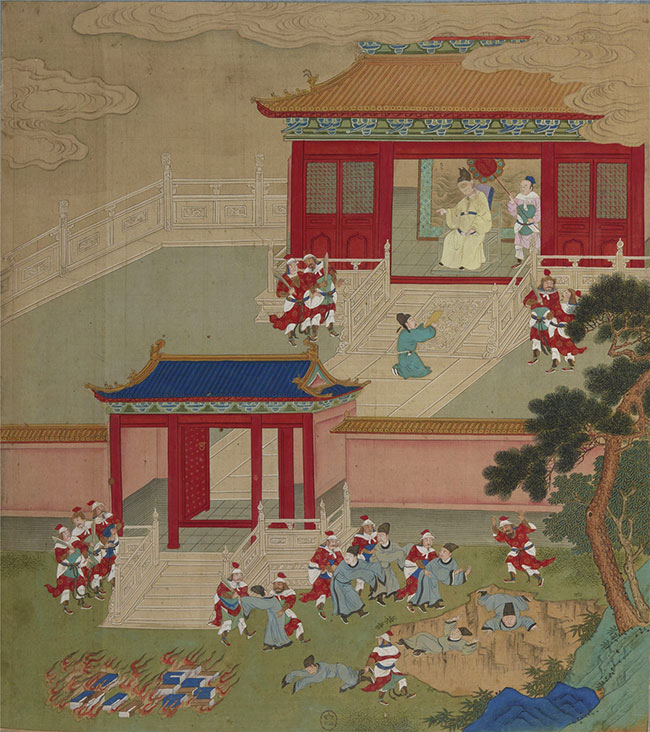
    The chancellor Li Si submitted a memorandum: “The kingdoms once recruited migrant scholars to their courts with opulent perks when they were jostling for power. Now, the country is in peacetime, and all laws and orders come from a single place. Ordinary households should work hard on farming and crafting, while intellectuals should study law and order. Today, there are Confucianists who do not study current laws and policies but reference the archaic texts to criticize the new. They baffle the public with their speeches and teach fallacies in their private schools. Whenever a new law is promulgated, they make remarks based on their own theories. They hold their dissent silently in court yet spread discord on the street. They praise the lord to elevate their own fame, dispute to show their superiority, and mislead the masses to denigrate policies. If these activities are not prohibited, it will diminish the authority of the court from above and form dissident parties from below. A ban is in the best interest of the country! I plead that the court historians burn all the history books except those from the kingdom of Qin. Unless they are court scholars who need the books for their duty, all people must turn in books in their possession—such as the ‘Book of Songs,’ the ‘Book of Documents,’ and other works authored by scholars and philosophers before our time—to the governors and military officers to be burned together. Those who speak of these books should be executed publicly. Those who disparage current policy by referencing ancient books should be punished by executing their entire clans. Government officials who do not prosecute these crimes will be treated as accomplices. After thirty days of this decree taking effect, those who do not burn their books will be branded on their faces and sent to labor on the Great Wall. Only books about medicine, divination, and horticulture can remain. Those who wish to study the law and policies can learn from government officials.” 

    The First Emperor issued an edict: “Approved.”

    Chen Yu, who was from Wei, spoke to Kong Fu (a direct descendant of Confucius), “The emperor of Qin wants to destroy the classic works of your ancestor. You are the owner of these books. You are in trouble.” Zi Yu (the courtesy name of Kong Fu) replied: “My study is about useless theory. Only my friends know me. I am no friend of Qin. Why am I in trouble? I stock up my books, waiting for someone to solicit them. Once there is a demand for them, I won’t have any worries.”

    The 35th year of the First Emperor(212 B.C.)

    The First Emperor directed Meng Tian to widen and straighten an expressway from the town of Jiuyuan to Yunyang county. The road, which was a thousand and eight hundred miles long, cut through mountains and leveled canyons along the way, taking years to complete.

    The First Emperor thought the city of Xianyang was too crowded and the palaces from his predecessors were too small. He built new palaces in Shanglin Park, south of the Wei River. The first palace under construction was the front palace called E’fang. It extended five hundred paces from east to west and five hundred feet from south to north. The top level could seat ten thousand people, and the bottom level could hoist banners as high as fifty feet. Around the palace, there was a causeway that led from the palace to the South Mountain. A gateway was erected on top of the South Mountain as the entrance to the palace. An overpass was built across the Wei River, connecting E’fang Palace to downtown Xianyang, symbolizing the North Star and Cassiopeia crossing over the Milky Way to Encampment.

    Seven hundred thousand criminals, punished by castration or sentenced to servitude, were poured into laboring in E’fang Palace or the Emperor’s Mausoleum at Lishan. Stone was quarried from the North Mountain, and timbers were shipped from the states of Shu and Jing (Chu). The building materials all arrived at the site. The total number of palaces within the four passes of the Qin kingdom was three hundred, with more than four hundred palaces outside the four passes. A monument had been installed within the Qu County of Donghai Commandery, serving as the east portal of the Qin Empire.

    The First Emperor ordered thirty thousand families to settle in Liyi County and fifty thousand families in Yunyang County. These families were exempted from taxation and conscription for ten years.

    Scholar Lu spoke to the First Emperor: “In an unholy world, Your Majesty should often travel secretly to avoid evil spirits. In the absence of evil spirits, the holy man will appear. I hope the palace where Your Majesty stays will be kept a secret, so we can obtain the immortal panaceas we have sought.” The First Emperor replied, “I wish to be the holy man.” He referred to himself as “this holy man” instead of “we.”

    He ordered the two hundred palaces within two hundred miles around the city of Xianyang to be connected via causeways or porticos, with draperies, percussion instruments, and beautiful ladies furnished at designated places. The settings were to be on record and not moved. The revelation of his itinerary was punishable by death. When the First Emperor toured Liangshan palace, he was displeased by the lavish entourage of the Chancellor seen from the hilltop. One of the eunuchs informed the Chancellor, who then reduced his retinue. The First Emperor became furious, saying, “Someone divulged what I said.” He ordered a formal investigation, but nobody confessed. He arrested everyone present at the time and executed them all. From then on, no one knew where the emperor was. All ministers who needed the emperor’s approval had to wait at the palace in Xianyang.

    Court scholars Lu and Hou satirized the Emperor’s behaviors and fled from the court. When the First Emperor heard this, he was livid, “This holy man gave scholars like Lu high respect and paid them well, and they turned around and disparaged this holy man! This holy man sent investigators to look into those scholars at Xianyang, and some reported that they spread heresy to instigate the people.” He directed law officers to prosecute the scholars.

    The scholars snitched on each other to exonerate themselves. The emperor sentenced four hundred sixty perpetrators to be buried alive at Xianyang. The burials were widely publicized to admonish posterity. More scholars were banished to the remote frontiers. The eldest son of the emperor, Fusu, beseeched for leniency: “These scholars are the leading Confucianists of the country. Your Majesty is applying severe punishment to all of them. I am afraid it would lead to unrest in the empire.”

    The First Emperor was roiled by Fusu’s plea. He sent Fusu away to Shangjun commandery to monitor General Meng Tian.

  • Comprehensive Reflections to Aid in Governance(Part 58): A Tour of The Empire

    Comprehensive Reflections to Aid in Governance

    By Sima Guang

    Translated By Yiming Yang

    Annals of Qin Book 2 Scroll 7 (continued)

    South Gate to Heaven, Mount Tai

    The 27th year of the First Emperor(220 B.C.)

    The First Emperor toured the region of Longxi and Beidi commandery, reaching Mount Jitou and then back home passing the Huizhong Palace.

    Changxin Palace was built on the south bank of Wei River.  It was renamed as the Supreme Temple once it was finished construction.  A road was made from the Supreme Temple to the Lishan Mausoleum.  The Front Hall of the Ganquan Palace had been built.  A corridor was built leading it to Xianyang.  Expressways reserved for the emperor were built from Xianyang to the other parts of the country.

    The 28th year of the First Emperor(219 B.C.)

    The First Emperor toured the commanderies and counties of the east. He ascended Mount Yi in Zou county and erected a monument extolling his achievements. At the foot of Mount Tai, he summoned seventy Confucianists from the state of Lu to discuss a sacrificial ceremony for heaven(Feng) and earth(Shan). Some Confucianists suggested: “In the ancient way of ceremony, the wheels of wagons must be wrapped with sedge grass to avoid squashing the dirt, rocks, trees, and grass of the mountain. Sacrificing for the earth involves sweeping the ground, then covering it with mats made of straw and stalks.” Other Confucianists proposed different, equally impractical ideas. From that moment, the First Emperor despised the Confucianists, finding their advice difficult to implement. He ordered the road to be widened for wagons. He reached the top of Mount Tai from the sunny side, erected monuments to laud his virtues, then descended from the shady side and sacrificed for the earth at a small peak named Mount Liangfu. The liturgy of the ceremonies adhered to those used by the worship ministers of Qin when they conducted ceremonies for God in progenitor temples at Yong. These rites were kept secret, and none could be recorded.

    From there, the First Emperor traveled east and cruised the coastal area. He paid homage to numerous temples, famous mountains, and rivers, and honored the eight gods: Heaven, Earth, Soldier, Yin, Yang, Month, Day, and the Four Seasons. The First Emperor then journeyed south and ascended to the top of Langya Terrace. Delighted with the location, he stayed in the commandery for three months. A palace named Langya was built there, and another stone monument was erected to express his satisfaction.

    Song Wuji and Xianmen Zigao from the kingdom of Yan claimed they had learned the way to immortality and sublime into celestial beings. Many gullible and eccentric scholars followed them enthusiastically, propagating their teachings. Kings, from King Wei and King Xuan of Qi to King Zhao of Yan, became believers and sent people to search for three fairy islands—Penglai, Fangzhang, and Yingzhou—in the Bohai Sea. According to myths, these islands were not far from the human world, but magical winds would blow ships away as they approached. A few fortunate people who reached the islands reported that fairies lived there and that they possessed elixirs for immortality.

    When the First Emperor toured the coast, sorcerers from the kingdom of Qi, including one named Xu Fu, vied for his favor by submitting a proposal. Xu Fu petitioned to lead a group of virgin boys and girls to search for the fairy islands after a period of fasting. The First Emperor approved, and Xu Fu selected several thousand boys and girls to seek fairies in the ocean. However, their ships were blown back by inauspicious winds. They reported, “We could not reach them, yet we could see them.”

    The First Emperor was on his way back to Xianyang when he passed through Pengcheng commandery. There, he held a worship ritual in a temple after a period of fasting. He sought to recover a caldron from the Zhou dynasty that had sunk in the Si River, by ordering a thousand people to dive into the river, but they found nothing.

    He then headed southwest, clearing the Huai River, and reached Mount Heng and Nanjun commandery. His entourage sailed downstream on the Yangtze River and arrived at a temple on Mount Xiang. They encountered strong winds that nearly wrecked their ship. The First Emperor asked the scholar accompanying him, “What kind of goddess is Madame Xiang?” The scholar replied, “I heard she was the daughter of Emperor Yao and married Emperor Shun. She was buried here.”

    In a rage, the First Emperor ordered three thousand prisoners to hack down all the trees on Mount Xiang, leaving the mountain bare and exposing its dark red soil. The First Emperor then left Nanjun and returned to Xianyang through the Wu Pass.

    Zhang Liang was from the kingdom of Han. His father and grandfather, up to five generations, had been prime ministers of Han. After the kingdom of Han perished, Zhang Liang devoted all his assets, amounting to a thousand catties of gold, to avenging the fall of Han.

    The 29th year of the First Emperor(218 B.C.)

    The First Emperor toured the eastern regions and passed through Yangwu county. Zhang Liang hired a hitman to ambush him with an iron mallet at a place called Bolangsha. The mallet, thrown at the emperor, struck one of his escorting wagons in the cavalcade. The emperor was frightened and ordered his guards to search for the perpetrators, but they did not catch anyone. He then commanded a nationwide manhunt for ten days.

    The First Emperor ascended Mount Zhifu and inscribed his achievements on the rocks there. He then traveled to Langya Commandery before returning to Xianyang via Shangdang Commandery.

    The 31st year of the First Emperor(216 B.C.)

    The First Emperor decreed that all plebeians in the country report their properties and acreage.

    The 32nd year of the First Emperor(215 B.C.)

    The First Emperor visited Mount Jieshi. He sent a Daoist named Lu to pay a visit to Xianmen Zigao from the kingdom of Yan, a hermit reputed to know the secret of becoming a celestial being. The emperor made an inscription on the gate of Jieshi. He decreed that the walls of castles be broken down, and levees, dikes, and dams be flattened or breached. The First Emperor then surveyed the northern borders and returned via Shangjun commandery.

    Daoist Scholar Lu returned from his visit to Xianmen Zigao overseas and submitted a report to the emperor titled “Record Map Book.” In the book, there was an ominous prophecy: “It is Hu who causes the kingdom of Qin to perish.” Hu was the derogatory name people gave to the Xiongnu in the north. The First Emperor ordered General Meng Tian to lead a 300,000-strong army to conquer Xiongnu in the north.

    The 33rd year of the First Emperor(214 B.C.)

    The First Emperor decreed conscription for men who were former fugitives, son-in-laws living in their wives’ houses, and merchants to join the army. This army conquered the rolling hills of the state of Southern Yue, establishing commanderies such as Guiling, Nanhai, and Xiang. Five hundred thousand disgraced and punished individuals were relocated to the Five Hills region to guard the southern border, where they cohabitated with the local population.

    General Meng Tian chased Xiongnu away and recovered a swath of land south of the Yellow River, establishing forty-four counties in this area. The Great Wall of China was built according to the geographic features, with fortresses constructed to control the strategic passes along the northern borders. Extending tens of thousands of miles from Lintao County to Liaodong Commandery, the Great Wall marked a formidable boundary. Meng Tian led his army across the Yellow River and occupied Mount Yangshan, zigzagging northwards. His troops were deployed on the frontier for more than ten years. For years, General Meng Tian stationed at Shangjun and governed the northern frontier, his fame serving as a deterrent to Xiongnu.

  • Comprehensive Reflections to Aid in Governance(Part 57): The Unification of the Realm

    Comprehensive Reflections to Aid in Governance

    By Sima Guang

    Translated By Yiming Yang

    Annals of Qin Book 2 Scroll 7 (continued)

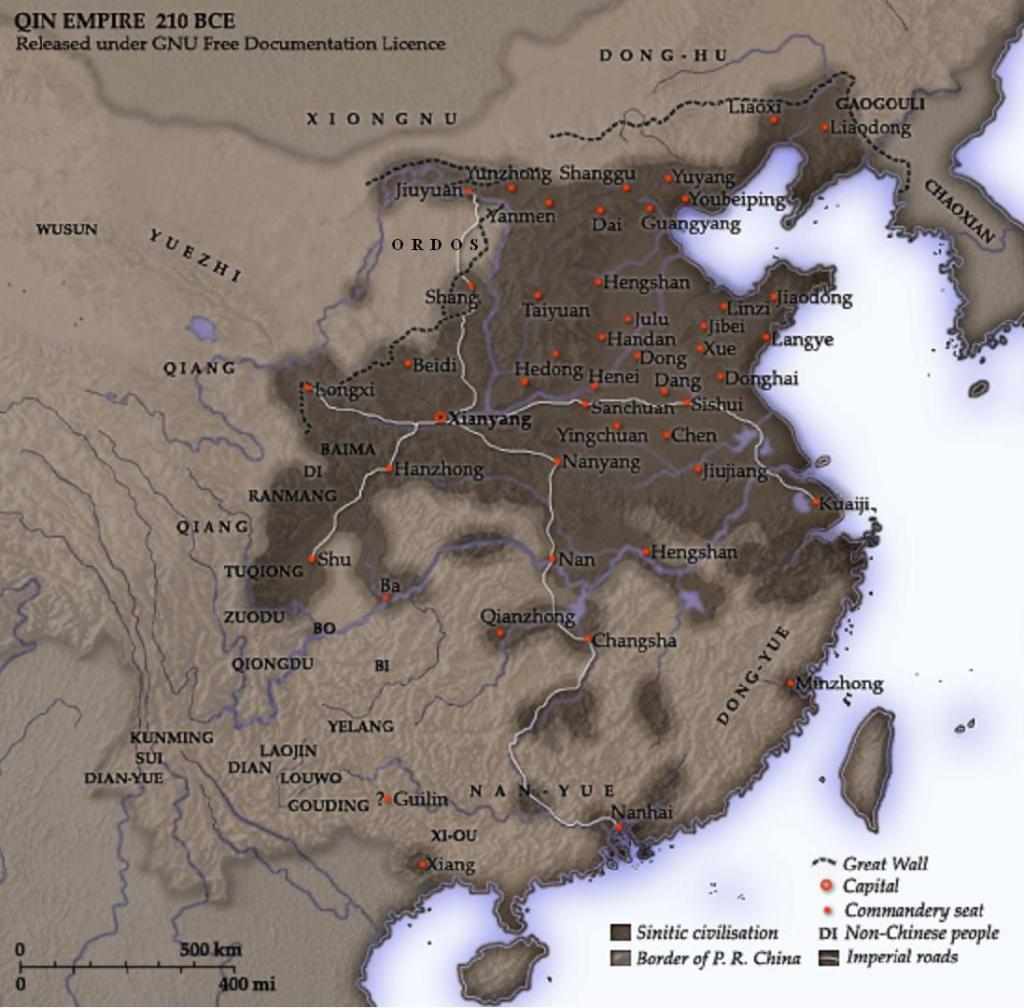
    Map of Qin Dynasty

    The 25th year of the First Emperor(222 B.C.)

    The king of Qin mobilized more troops, led by General Wang Ben, to invade Liaodong, the remnant of the kingdom of Yan. They captured the king of Yan, Ji Xi.

    Sima Guang’s comments: Crown Prince Ji Dan of Yan could not contain his resentment and riled up the king of Qin, who was as wicked and violent as tigers and wolves. He instigated more ill will and hastened the calamity with his reckless and poorly devised assassination plots. As a result, the temple of Duke Zhao of Yan was suddenly destroyed, and there were no more worshipers. There wasn’t a greater sin than this. Was it beyond the pale when some commentators said that he was a refined man?

    A statesman should appoint masterminds to the right posts, promulgate policies according to propriety, oversee the people with benevolence, and interact with neighbors with honesty. Had he done that, the officials would have followed him, the government would have been regulated by him, the people would have been grateful for his kindness, and the neighbors would have formed close ties with him because of his uprightness. Such a state would be as solid as granite and as bright as a blaze. Whoever struck it would be crushed. Whoever infringed upon it would be burned. Such a state would not fear anyone, even the presence of violent states. Crown Prince Ji Dan did not do that. He gambled with his large kingdom, with ten thousand chariots, to vent his anger and carry out a plot of assassination like raiders. As a result, he was killed, his reputation ruined, and his kingdom reduced to rubble. Isn’t it tragic?

    Ji Dan’s walking on his knees and prostrating did not signify respect; his doing what he said and adhering to his promises did not signify integrity; his free spending of gold and dispensing jades did not signify charity; his suicide and self-disemboweling did not signify bravery. In summary, his plan was short-sighted, and his motivation was not righteous. He degraded himself to the class of the Duke of Bai, Xiong Sheng of Chu!

    Jing Ke repaid his personal benefits from the prince’s indulgence, disregarding the lives of the seven clans of kinfolk. He intended to strengthen the feeble Yan kingdom and weaken the powerful Qin with a dagger of a foot and eight inches. Isn’t it foolish! That’s why Yang Xiong commented: Yao Li’s death was the death of a bug; Nie Zheng’s death was the death of a strongman; Jing Ke’s death was the death of an assassin. None of these deaths are honorable. Yang Xiong also said, “Jing Ke was just a burglar in the view of a refined man.” Those are apt comments!

    General Wang Ben attacked the state of Dai and captured its king, Zhao Jia. 

    General Wang Jian secured the regions south of the Yangtze River, overcame the resistance of the Lord of Baiyue, and established the commandery of Kuai’ji.

    In May, during the summer, a national drinking banquet was held everywhere in Qin to celebrate these military victories.

    The queen dowager of Qi was a wise monarch. The kingdom of Qi prudently cooperated with the kingdom of Qin and maintained cordial relationships with other monarchs. With a coastline in the east, Qi was strategically positioned. Meanwhile, the kingdom of Qin had been constantly attacking the three kingdoms derived from the kingdom of JinHan, Wei, and Zhao—as well as the kingdoms of Yan and Chu. The five kingdoms were in survival mode. Therefore, Tian Jian, the king of Qi, had not engaged in any warfare for the forty years since his inauguration.

    When the queen dowager was dying, she advised King Tian Jian, “Someone among all the ministers should be in charge.” King Tian Jian said, “Please write his name down.” The queen dowager replied, “Fine.” King Tian Jian fetched the brush pen and the tablet and prepared to write. The queen dowager then said, “This old lady has forgotten it.”

    After the queen dowager died, Hou Sheng became the prime minister of Qi. He accepted many bribes from Qin. When migrant consultants of Qi went to Qin, they were bribed with gold and became agents of Qin when they returned. They all persuaded the king of Qi to go on a pilgrimage to the king of Qin, instead of building up defense capability against invasion or aiding the other five kingdoms under attack by Qin. Consequently, the five kingdoms were annihilated by Qin.

    The king of Qi was about to embark on his pilgrimage journey to Qin. However, the guard at the Yong Gate stood in front of his horses, holding a halberd, and asked, “Is the throne of a king for the state or for the king himself?” The king replied, “It is for the state.” The guard retorted, “If the throne is for the state, why does Your Majesty go to serve the kingdom of Qin while leaving our state behind?” The king turned his carriage around and went back.

    The grand master of Jimo heard about the king’s decision and came to speak to him: “The kingdom of Qi has land spanning thousands of miles and millions of armored soldiers. The officers of the three kingdoms derived from Jin—namely, Han, Wei, and Zhao—do not wish to benefit the kingdom of Qin. More than a hundred of them are settled in Dong’e county and Zhencheng. If Your Majesty acquires their allegiance and gives them a million soldiers to lead, allowing them to recoup the territories of Han, Wei, and Zhao, we may someday reach the Linjin Pass of Qin. The officers from Yanying of Chu, do not wish to work for Qin either. Hundreds of them are displaced in the south of Nancheng. If Your Majesty secures their loyalty and lets them lead a million soldiers to reclaim the land of Chu, we will break through the Wu Pass of Qin. Thus, the fame of Qi would rise, and the kingdom of Qin would be demolished. Why should we merely seek the survival of our state?”

    The king of Qi, however, did not heed his advice.

    The 26th year of the First Emperor(221 B.C.)

    General Wang Ben led an attack on the Kingdom of Qi from the south of Yan. They broke into the capital, Linzi, and none of the people of Qi dared to fight back. The King of Qin enticed the King of Qi with a fiefdom of five hundred miles. The King of Qi finally surrendered to Qin. He was moved to Gong county, and left in a wooded area with pine and cypress trees, where he was starved to death. The people of Qi blamed King Tian Jian for not joining the vertical alliance. They faulted him for taking advice from migrant counselors who acted as agents of Qin, which led to the perishing of the state. They sang a rhyme about Tian Jian’s folly of listening to the wrong counselors: “Was it pine tree or cypress, guests made Jian at Gong helpless.”

    Sima Guang’s comment: Although the talk about vertical and horizontal alliances was shifting and confusing, the gist was that the vertical alliance was in the best interest of the six kingdoms. The primogenitor king awarded feudal states to his family and friends to enhance social exchange, visit, wine and dine at each other’s places, and develop friendship and alliances. There was no other agenda for them than to bind together with prepossession to safeguard the country. Had the six kingdoms treated each other with trust and fairness, even in the face of the mighty and violent Qin kingdom, they would not have been annihilated. The kingdoms of Han, Wei, and Zhao served as the fences and shelters for the kingdoms of Qi and Chu, whereas the kingdoms of Qi and Chu were the roots and bases of the other three kingdoms. Their relationship should be founded on interdependence of interior and exterior and coordinated actions. When the kingdoms of Han, Wei, and Zhao attacked the kingdoms of Qi and Chu, they dug up their own roots. When the kingdoms of Qi and Chu attacked the other three kingdoms, they pulled out their fences and shelters. How could one uproot his fortress to appease the raiders, then say, “The raiders will love me and won’t hurt me”? How absurd was that!

    The King of Qin unified the realm for the first time. He believed his virtue matched that of the three legendary sovereigns and that his achievements surpassed those of the five historical emperors. He changed his title to “August Sovereign” (The Emperor). His orders were called decrees, his proclamations were called edicts, and he referred to himself as “We.” He bestowed the title Emperor Emeritus on his father, King Zhuangxiang. His decree stated: “The tradition of giving a deceased king a posthumous title based on his behavior is nonsensical. It allows a son to assess his father and a subject to appraise his lord. From now on, the ritual of giving posthumous titles will be abolished. We are the First Emperor, and my successors will be named numerically, from the Second Emperor, the Third Emperor, to the Ten-Thousandth Emperor, and so on to infinity.”

    During the era of King Wei of Qi and King Xuan of Qi, Zou Yan developed a theory of five virtues based on the five elements, where each element nourishes one element while overcoming another in a continuous cycle. When the emperor unified the country, the people of Qi submitted a proposal based on this theory. The emperor adopted it, believing that the virtue of the Zhou dynasty was fire. Since the Qin dynasty replaced the Zhou dynasty, the virtue of the Qin dynasty must be water, as the element fire could never overcome the element water. He also changed the official calendar, making the annual obeisance to the emperor and celebration of the new year on October 1 each year. He promoted black as the color of official gowns, flags, and tallies. Additionally, he selected a senary numeral system with a base of six.

    The prime minister, Wang Wan, and others proposed: “The states of Yan, Qi, and Chu are remote. It is difficult to control them without rulers. Please install Your Majesty’s sons as rulers of these places.” The emperor sent the proposal to all the ministers for discussion. Li Si, the Minister of Justice, disputed: “King Wen and King Wu of Zhou assigned titles to their numerous sons and brothers. Over the years, their descendants grew apart, attacking each other like enemies, and the emperor could not stop their fights. Thanks to Your Majesty’s divine power, the whole country has been unified and subdivided into commanderies and counties. The princes and heroes have been highly compensated with state taxes. When they are satisfied and conform, there will be no dissension in the country. That’s the art of achieving peace and tranquility. It is not a good idea to set up monarchs.”

    The emperor approved, stating: “The country has long suffered from incessant wars due to the existence of monarchs and kings. Thanks to our ancestors’ temples, we have finally unified the country. It would be a daunting task to maintain peace once we split into states, which will reignite conflicts. The Minister of Justice’s remark is right on target.”

    The country was divided into thirty-six commanderies. A governor, a military minister, and a prefect were appointed for each commandery. 

    All the weapons in the country were confiscated and transported to the capital, Xianyang. These weapons were melted and cast into bells and carillons. Twelve golden statues were made to decorate the court, each weighing more than a hundred thousand kilograms. Measures for length, volume, and weight were standardized. Additionally, a hundred and twenty thousand wealthy and highborn families from all over the country were forced to move to Xianyang.

    The royal temples, Zhangtai Palace, and Shanglin Park were all located on the south bank of the Wei River. Whenever a kingdom was conquered, a replica of its palace was built on the north slope of the Wei River at Xianyang. A roadway aligned with palaces, bridges, overpasses, towers, and pavilions extended from the Gate Yong to the east, reaching as far as the confluence of Jing River and Wei River. The beautiful women from the surrendered kingdoms, along with their musical instruments, filled the edifices with fanfare.

  • Comprehensive Reflections to Aid in Governance(Part 56): General Wang Jian and the King

    Comprehensive Reflections to Aid in Governance

    By Sima Guang

    Translated By Yiming Yang

    Annals of Qin Book 2 Scroll 7

    Duration of 19 years

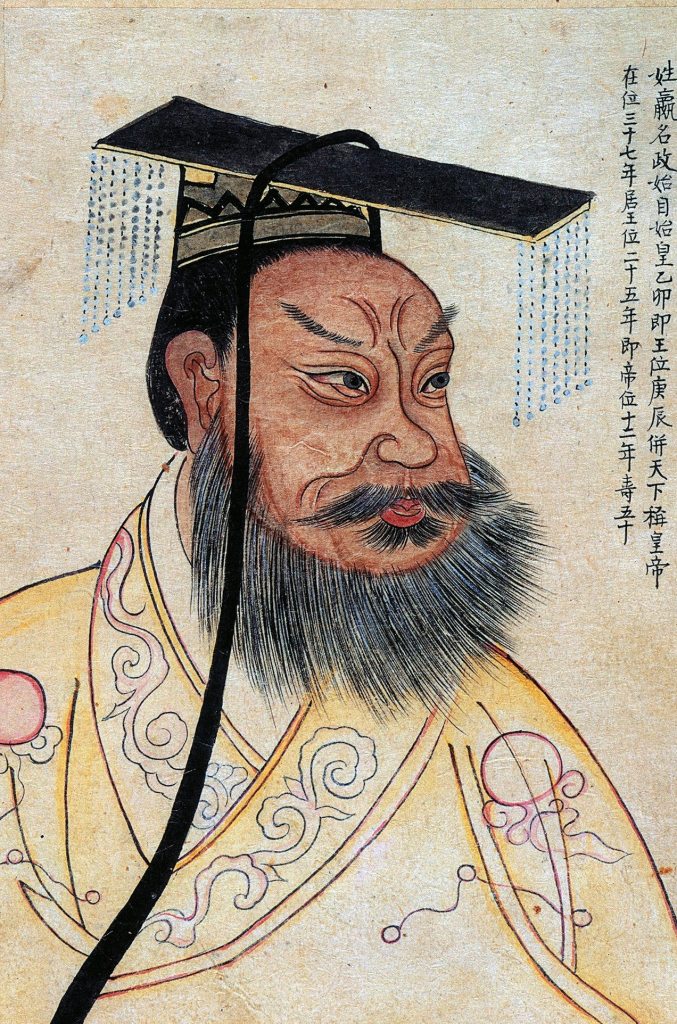
    The First Emperor of Qin

    The 20th year of the First Emperor(227 B.C.)

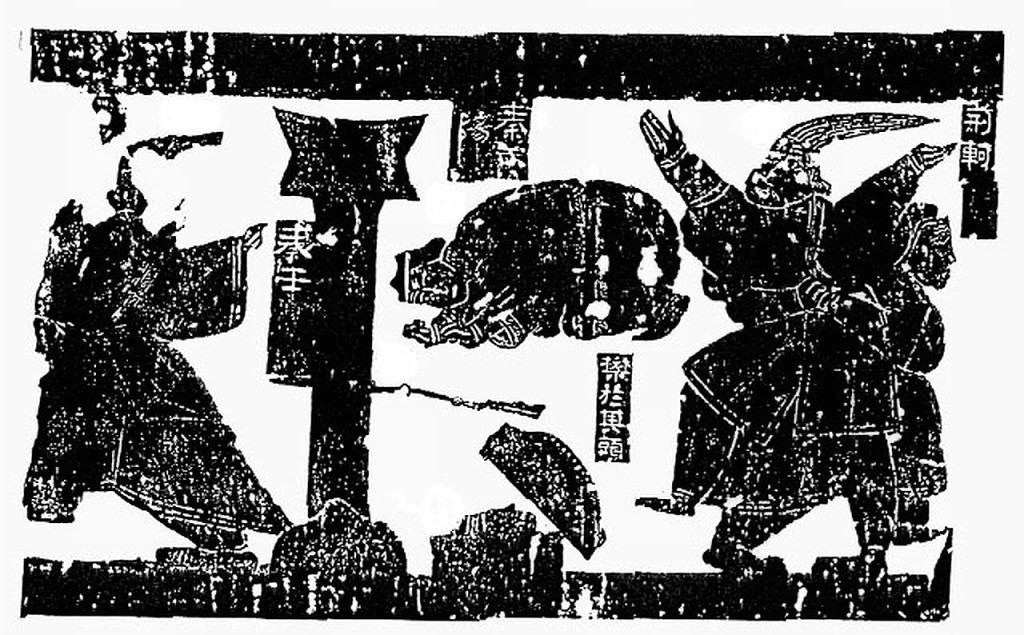
    Jing Ke arrived at the city of Xianyang. Through a favorite attendant of the king named Meng Jia, he delivered a humble plea to see the king. The king was pleased and arranged a formal reception with all the ministers attending. Dressed in a formal gown, the king granted an audience to Jing Ke. Jing Ke unfurled the map for the king, and as it uncoiled to the end, the hidden dagger appeared. Jing Ke grabbed the king’s sleeves and thrust the dagger toward him. The king jumped away and tore off his sleeves. Jing Ke chased the king around the pillars in the palace. The attendants and ministers were jolted by the surprise attack and stunned into a panic. 

    According to the law of Qin, no one except the king could approach the court with any weapon, so the attendants could only join the struggle with their bare hands. They reminded the king, “Move the sword to your back!” The king shifted the sword to his back, drew out the long blade, and hacked at Jing Ke, chopping off his left leg with a swing. Jing Ke, now incapacitated, threw the dagger at the king but only hit a bronze pillar. Realizing his failure, Jing Ke shouted, “I failed because I wanted to capture you alive! I wanted you to pledge to give back the land. I wanted to return the favor to the crown prince of Yan!” Jing Ke was then mutilated to death. 

    The king of Qin, furious, mobilized more troops to augment Wang Jian’s forces in the land of Zhao. Wang Jian trounced the troops of Yan and Dai in a battle west of the Yishui River.

    The 21st year of the First Emperor(226 B.C.)

    In October of that winter, General Wang Jian broke into the city of Ji. The king of Yan and the crown prince led their elite forces eastward, fleeing to protect their territory in Liaodong. General Li Xin of Qin led his troops in hot pursuit. The king of Dai, Zhao Jia wrote a letter to the king of Yan, urging him to submit the head of the crown prince to the king of Qin. At that time, the crown prince was hiding by the Yanshui River. The king of Yan sent an envoy to behead the crown prince and prepared to deliver the head to the king of Qin. However, the king of Qin sent more troops to pursue the king of Yan.

    General Wang Ben invaded the kingdom of Chu and captured more than ten cities. The king of Qin asked General Li Xin, “I want to seize the kingdom of Chu. How many soldiers do you think would be enough?” Li Xin replied, “Not more than two hundred thousand soldiers.” The king then posed the same question to General Wang Jian, who responded, “No less than six hundred thousand soldiers.” The king chuckled and said, “General Wang has become old. He is  now so timid!” Despite Wang Jian‘s advice, the king ordered General Li Xin and Meng Wu to lead two hundred thousand troops in a campaign against the kingdom of Chu. General Wang Jian then returned to his home in Pinyang on sick leave. 

    The 22nd year of the First Emperor(225 B.C.)

    General Wang Ben raided the kingdom of Wei, directing water from the Bian River into canals to flood Wei‘s capital, Daliang. In March, during the spring, the walls of Daliang collapsed. The king of Wei, Wei Jia, capitulated, was killed, and the kingdom of Wei came to an end.

    The king of Qin sent an envoy to speak to Lord Anling: “We want to exchange the state of Anling for five hundred miles of land in another area.” Lord Anling replied, “Your Majesty blesses me with grace, offering a larger piece of land in exchange for a smaller one. I feel so lucky. Even though it is a good deal, I would like to hold onto the land bestowed upon me by the late king of Wei. I would like to retain it for the rest of my life and dare not trade.” The king of Qin considered it a righteous plea and approved it.

    General Li Xin attacked Pingyu county while General Meng Wu raided Qin county. They both trounced the army of Chu. Li Xin then moved on to attack Yanying and barged into it. His troops then advanced westward and united with Meng Wu‘s forces at Chengfu county. The army of Chu tailed Li Xin’s troops for three days and three nights without respite. At last, they thrashed Li Xin and his cohorts, overran two barracks, and killed seven army commandants of Qin. Li Xin scurried back home.

    The king of Qin was enraged by the defeat. He personally drove to the village Pinyang to visit Wang Jian and apologized face-to-face: “We did not take your advice, and as a result, Li Xin humiliated the army of Qin. Even though you are sick, are you going to turn your back on me?” Wang Jian still declined the appointment, citing poor health. The king of Qin insisted, “That is enough, don’t say that anymore.” Wang Jian countered, “If you must insist, Your Majesty, I cannot do it without six hundred thousand troops.” The king approved: “I’ll listen to you this time.”

    Thus, General Wang Jian led a campaign against the kingdom of Chu with six hundred thousand soldiers. The king of Qin saw his troops off at a place named Bashang. Wang Jian pleaded for a lot of beautiful houses and good land. The king said, “General, you can surely go with peace of mind. Don’t worry about being poor anymore.” Wang Jian explained, “I have been your general and have won some battles. I would not become a nobleman in the end. I want some land and houses to pass down to my posterity while I am still in favor with Your Majesty.” The king laughed heartily.

    Wang Jian sent five more envoys back to the king to petition for good land after he went through the Wu Pass. Someone commented, “Don’t you think your solicitations are a little over the top?” Wang Jian replied, “No. The king is brutal and trusts nobody. Now he has put the armed forces of the entire kingdom under my command. If I don’t ask for properties for my descendants to pursue personal interest, it would make the king suspicious of me.”

    The 23rd year of the First Emperor(224 B.C.)

    Wang Jian went around the south of Chen county and reached the county of Pingyu. Learning that General Wang Jian came with strengthened forces, the whole kingdom of Chu mobilized to defend their homeland. Wang Jian ordered his troops to stay within their garrisons and forbade direct combat. Many times the soldiers of Chu came to challenge Wang Jian’s troops, but the soldiers of Qin would not engage. Wang Jian required his soldiers to rest and bathe daily, providing them with good food. He talked to them and had meals with them.

    After a long while, Wang Jian asked his officers, “What games are the soldiers playing?” The answer was, “They are throwing rocks and practicing long jumps.” Wang Jian said, “Now they are ready to fight.” The troops of Chu, unable to engage the troops of Qin, moved eastward. Wang Jian led his troops to go after them. He sent his commandos to attack the army of Chu and won a decisive battle. Then Wang Jian pursued the fleeing army of Chu to the south of Qi county and killed the commander of Chu, General Xiang Yan. The army of Chu collapsed. Wang Jian took the momentum, chased the troops of Chu out, and then stabilized the towns and cities on his path.

    The 24th year of the First Emperor(223 B.C.)

    General Wang Jian and Meng Wu captured the king of Chu, Fuchu. They established the Commandery of Chu in the former kingdom’s land.

  • Comprehensive Reflections to Aid in Governance(Part 55): Assassin Jing Ke

    Comprehensive Reflections to Aid in Governance

    By Sima Guang

    Translated By Yiming Yang

    Annals of Qin Book 1 Scroll 6 (continued)

    The Assassination of King of Qin depicted by a 3rd century artist

    The 18th year of the First Emperor(229 B.C.)

    General Wang Jian led troops from the Shangdi region, General Qiang Hui led troops from the Jingjing region, and General Yang Duanhe led troops from the Henei region. These three prongs made a coordinated attack on the kingdom of Zhao. General Li Mu and General Sima Shang led the defense of Zhao. However, Qin’s agents had bribed Guo Kai, a favorite toady of the King of Zhao, with gold. Guo Kai smeared the reputations of Li Mu and Sima Shang in front of the king, accusing them of plotting a mutiny. The King of Zhao replaced Li Mu and Sima Shang with Zhao Cong and Yan Ju, a general from Qi.

    Li Mu refused to relinquish his command and was arrested and killed by the king’s delegates. General Sima Shang was also dismissed. General Wang Jian then launched an attack, crushing the Zhao army and killing Zhao Cong. Yan Ju fled. Wang Jian laid siege to the city of Handan.

    The 19th year of the First Emperor(228 B.C.)

    In October of the winter, the capital city of Handan was breached. The King of Zhao, Zhao Qian, was captured, and all the land of Zhao was annexed by the kingdom of Qin. The King of Qin visited Handan, his birthplace, where he ordered the execution of anyone his mother’s family held a grudge against. He returned to the capital Xianyang via the cities of Taiyuan and Shangjun.

    The Empress Dowager, the King’s mother, passed away.

    General Wang Jian camped his troops in Zhongshan, overlooking the kingdom of Yan. A prince of Zhao, named Zhao Jia, led his clan of a few hundred people and fled to the commandery of Dai. He enthroned himself as King of Dai. More and more former officials of Zhao in exile joined Prince Zhao Jia, and they were reinforced by troops from the kingdom of Yan, eventually camping in Shanggu commandery.

    King You of Chu died, and his brother Mi Shi was installed as the new king. In March of spring, Hao’s half-brother Fu Chu killed him and claimed the throne for himself.

    King Jingmin of Wei died, and his son Wei Jia was installed as the new king.

    The Crown Prince of Yan, Ji Dan, harbored deep hatred for the King of Qin. Seeking advice on how to exact revenge, he consulted his tutor, Ju Wu. Ju Wu proposed allying with the three kingdoms that had split from Jin, bonding with the kingdoms of Qi and Chu in the south, and fostering good relations with the Xiongnu in the north to unite all forces against Qin. However, the prince was not satisfied, saying, “Professor’s proposal takes too much time to implement and makes my head spin. I am afraid that I cannot wait that long.”

    Soon after this conversation, a general named Fan Wuji fled from Qin to Yan to escape criminal charges. The Crown Prince Dan offered General Fan shelter. Ju Wu argued against it, saying, “As cruel and ruthless as the King of Qin is, being agitated by the kingdom of Yan is more than enough to send chills down our spines, let alone hosting General Fan. What we are doing is analogous to throwing meat on the trail of a hungry tiger. I beg Your Grace to send General Fan to Xiongnu immediately.”

    The Crown Prince replied, “General Fan had nowhere to go. He came to me at a time when I needed fighters. I wish you would think it through.”

    Ju Wu countered, “Taking risky actions to seek safety; getting into trouble to find happiness; plotting shallow gains in exchange for deep-rooted enmity; disregarding the harm to the state to earn a new personal friend—this is fanning hostility and inducing disasters.”

    The Crown Prince would not heed his advice.

    The Crown Prince of Yan learned that Jing Ke from the state of Wey was a mastermind. He sent lavish gifts and flattering letters to arrange a meeting with Jing Ke. When they met, the Crown Prince Ji Dan spoke: “Now the kingdom of Qin has already captured the King of Han. They have mobilized troops to attack the kingdom of Chu in the south and Zhao in the north. The turmoil will reach the kingdom of Yan once Zhao collapses. Yan is small and weak, and has been plagued by wars for years. How can we resist Qin‘s aggression? All the monarchs are submissive to Qin; no one dares to form a vertical alliance. I have a foolish idea. I think it would be best if we recruited a warrior to serve as an envoy to Qin and kidnap the King of Qin. The warrior would force the king to return the land he had annexed from the monarchs, as Cao Mo did to the Duke Huan of Qi in the past. Or he could assassinate the king if the first plan fails.”

    “The generals of Qin are leading troops in various areas outside the kingdom. If there were commotions back home, the leaders and rank and file would be thrown into confusion and suspicion. The monarchs could seize this opportunity to form a vertical alliance. Then we will defeat the kingdom of Qin. Please keep this in mind, Mr. Jing.”

    Jing Ke agreed. The prince invited Jing Ke to live in the best house and provided whatever he wanted. The prince paid daily visits to Jing Ke‘s house to satisfy his every desire.

    When the news arrived that Wang Jian had demolished the kingdom of Zhao, the Crown Prince of Yan was frightened and wanted to send Jing Ke on his mission. Jing Ke told him, “If I go empty-handed and no one trusts me, I won’t be able to get close to the King of Qin. I need to present the head of General Fan Wuji and the map of the Duhang region of Yan as tributes to the King of Qin. This would please him, and then I would have the chance to repay your kindness.”

    The Crown Prince of Yan hesitated, saying, “General Fan came to me when he was desperate. Dan cannot bear to harm him!”

    Jing Ke went to see Fan Wuji in private and said, “The kingdom of Qin has treated you with extreme cruelty. Your parents and families were all slaughtered or enslaved. Now, I have heard that a bounty for your head is worth a thousand caddies of gold and a fief of ten thousand families. What are you going to do?”

    Fan Wuji sobbed, “What should I do?”

    Jing Ke proposed, “If I could take your head and present it to the King of Qin, he would be happy to see me. I would grab his sleeve with my left hand and stab him in the chest with my right hand. Your revenge would be taken, and the disgrace of the assault on the kingdom of Yan would be eradicated!”

    Fan Wuji exclaimed, “That’s exactly what I have been grinding my teeth and breaking my heart over, day and night!”

    Fan Wuji then slit his throat. The Crown Prince of Yan heard the news and ran over to cry over Fan Wuji‘s body in vain. They put Fan‘s head in a case. The Crown Prince procured the sharpest dagger they could find and quenched it in a poisonous potion that would kill a man instantly if it contaminates his blood. He geared up for Jing Ke’s journey and provided him with an assistant, a warrior of Yan named Qin Wuyang. Jing Ke then went to the kingdom of Qin as an envoy from Yan.

  • Comprehensive Reflections to Aid in Governance(Part 54): Stuttering Legalist Han Fei

    Comprehensive Reflections to Aid in Governance

    By Sima Guang

    Translated By Yiming Yang

    Annals of Qin Book 1 Scroll 6 (continued)

    Word Cloud of Han Fei

    The 13th year of the First Emperor(234 B.C.)

    General Huan Yi of Qin attacked the kingdom of Zhao, defeating the Zhao army led by General Hu Zou at the city of Pingyang. One hundred thousand Zhao soldiers were beheaded, and General Hu Zou was killed. In October, during the winter, General Huan Yi launched another attack on Zhao.

    The 14th year of the First Emperor(233 B.C.)

    General Huan Yi attacked the kingdom of Zhao, killing the commander of the Zhao army and capturing the cities of Yi’an, Pingyang, and Wucheng. In response, the King of Zhao appointed General Li Mu as Grand Marshal to defend Yi’an. Li Mu routed the Qin army near the town of Feixia, forcing General Huan Yi to flee back to Qin. The King of Zhao then bestowed the title of Lord Wu’an upon General Li Mu.

    The King of Han begged to become a vassal by ceding land and offering the seal of Han to the kingdom of Qin. He sent Han Fei to pay homage to the King of Qin. Han Fei, a prince of Han, was a leading legalist in the school of crime, punishment, and theurgy. Witnessing the decline of the kingdom of Han, he wrote numerous proposals to the king, who did not take his advice. Han Fei resented that the administration did not seek and promote capable talents but instead elevated glib and superficial individuals over those who got things done. In more peaceful times, celebrities and scholars were the crowd favorites, but in times of crisis, only military men were relied upon. Thus, those who squandered resources were not those who could be counted on, and those depended upon by the state were not those nurtured by the state. Han Fei was mournful about how honest and upright servants of the state were trampled by evil and corrupt officials. As he examined the vicissitudes of the past, he composed books such as Solitary Indignation, The Five Vermins, Inner and Outer Congeries of Sayings, Collected Persuasions, and The Difficulties of Persuasion, totaling fifty-six essays and more than one hundred thousand words.

    The King of Qin heard of Han Fei’s reputation and wanted to meet him. When Han Fei arrived in Qin, he wrote a letter to the king, “Now the kingdom of Qin has territory spanning thousands of miles and claims a standing army of a million soldiers. Your competent command system and fair legal system have no match in the world. I take the liberty to see Your Majesty to present my plan to break the vertical alliance. If Your Majesty listens to me and implements my plan yet still has no successful outcomes—i.e., the vertical alliance does not collapse, the kingdom of Zhao does not capitulate, the kingdom of Han does not perish, the kingdoms of Chu and Wei are not submissive, the kingdoms of Yan and Qi are not friendly, Your Majesty does not gain hegemony, and the neighboring monarchs do not pay homage—then Your Majesty can behead me in public to warn those who give disloyal advice.”

    The king liked what he heard but did not give Han Fei an important position. Li Si, jealous of Han Fei, spoke to the king, “Han Fei is one of the princes of Han, after all. His plan to annex all the monarchs is ultimately for the benefit of Han, not Qin. That’s just human nature. Now, Your Majesty has not utilized him, making him a risk to Qin. We would be better off killing him than letting him go back.” The king agreed with Li Si and ordered prosecutors to charge Han Fei with crimes. Li Si sent his lackey to deliver poison to Han Fei in jail and ordered him to commit suicide. Han Fei wanted to appeal but had no chance to see the king. When the king regretted and pardoned him, Han Fei had already died.

    Yang Xiong commented in his book Exemplary Figures: Someone asked, ‘Han Fei wrote a book about the difficulty of persuasion. He died because of a difficult persuasion. May I ask, what makes it so ironic?’ The answer was, ‘Difficult Persuasion was the cause of his death.’ The person asked, ‘Why was that?’ The answer was, ‘A gentleman follows propriety when he moves forward and stops when he crosses ethical boundaries. He goes all in if propriety is adhered; he backs off if it is not. He does not stress about whether the person he lobbies agrees with him. When you persuade someone while being bothered about whether they agree with you, you are likely to push too far.’ The question was, ‘Han Fei worried about the person’s consent. What was wrong with that?’ The answer was, ‘One should be concerned with whether the lobbying is done the right way; it should not be about whether the ideas are agreed upon.’

    Sima Guang’s commentary: I have learned that a gentleman cares for his kindred and then extends that care to others; he loves his country and then extends that love to other countries. Such people can achieve their goals and earn their fame, thus enjoying their lives. Han Fei was doing the King of Qin’s bidding to fulfill his political ambition. His crime warranted more than the death penalty, so why would anyone feel pity for him? 

    The 15th year of the First Emperor(232 B.C.)

    The King of Qin launched a large military campaign against the kingdom of Zhao. One prong reached the city of Ye, while the other prong reached the city of Taiyuan, took the county of Langmeng, and continued to a place Fanwu. There, they encountered the defense led by General Li Mu. The Qin army was clobbered and forced to retreat.

    The Crown Prince of Yan, named Ji Dan, had previously been a hostage in the kingdom of Zhao and was a friend of the King of Qin. When the King of Qin was inaugurated, Crown Prince Dan came to Qin as a hostage again. However, the King of Qin was heedless of him, causing Crown Prince Dan to become outraged and flee from the kingdom of Qin.

    The 16th year of the First Emperor(231 B.C.)

    The kingdom of Han offered the city of Nanyang to Qin. In the fall, during September, the King of Qin called up soldiers to take over Nanyang from Han.

    The kingdom of Wei submitted their land as tribute to Qin.

    In the Dai commandery in the kingdom of Zhao, an earthquake struck. The affected areas extended from the town of Lexu in the west, to Pingyin in the north. Most of the buildings and walls collapsed, and a crack in the ground appeared, stretching as wide as one hundred and thirty yards from east to west.

    The 17th year of the First Emperor(230 B.C.)

    Interior Minister of Qin, Sheng, led a campaign that exterminated the kingdom of Han. The King of Han, Han An, was captured, and the prefecture of Yingchuan was established on the land of the Han.

    Empress Dowager Huayang died.

    A great famine spread in the kingdom of Zhao.

    Lord Yuan of Wey died, and his son Jiao was installed in his place.

  • Comprehensive Reflections to Aid in Governance(Part 53): Migrant Worker Li Si

    Comprehensive Reflections to Aid in Governance

    By Sima Guang

    Translated By Yiming Yang

    Annals of Qin Book 1 Scroll 6 (continued)

    An inscription by Li Si

    The 10th year of the First Emperor(237 B.C.)

    In October, during the winter, Marquis Wenxin was dismissed from his position as Chancellor and left for his fief town. 

    The imperial clans and court officials proposed: “All the foreigners from other kingdoms who came to our state for employment are agents lobbying or spying for their lords. Please deport all of them from our country.” The king promulgated a decree for a broad search and deportation of all foreigners. An official named Li Si, hailed from the kingdom of Chu, was on the list to be deported. On his way out, he submitted a plea to the king:

    “When Duke Mu of Qin sought talents, he acquired You Yu from Tribe Rong in the west. From the east, he recruited Baili Xi from Wan, a city in the kingdom of Chu. He welcomed Jian Shu from the state of Song and invited Pi Bao and Gongsun Zhi from the kingdom of Jin. These talents enabled the kingdom of Qin to annex around twenty states and dominate the western frontier. Duke Xiao of Qin adopted the laws proposed by Shang Yang, causing other monarchs to bow down to the kingdom of Qin. King Hui of Qin utilized the strategy of Zhang Yi to dismantle the vertical alliance of six kingdoms, making them concede to Qin. King Zhaoxiang of Qin strengthened the power of the Royal Court and weakened private enterprises. These achievements were made possible with the help of these four foreigners. From this perspective, what harm has been done by these guest workers?”

    “Beautiful women, music, pearls, and jade that are not produced in the kingdom of Qin, did not prevent them being collected and enjoyed by Your Majesty. Guest workers are treated differently. People are deported simply because they are foreigners, regardless of their qualifications and character. This policy prioritizes the appeal of beauty, music, pearls, and jade over men. I have learned that Mount Tai becomes great because it does not reject any soil; the Yellow River and oceans become deep because they do not reject any trickle. A lord demonstrates his kindness by not rejecting ordinary people. That is why the three Sovereigns and five Emperors in history were unmatched. Now, Your Majesty abandons immigrants to enemy kingdoms and repels guest workers to other monarchs. This amounts to providing supply for invaders and gifting grain to burglars.”

    The king called Li Si back, reinstated him as a top official, and rescinded the deportation decree. Li Si had already traveled to the town of Liyi and returned to the capital. Eventually, the king adopted Li Si’s proposal. He sent orators carrying gold and jade to lobby other monarchs. Those nobles who accepted the bribes were bought off, and those elites who declined the bribes were assassinated. Sowing discord among the lords and their ministers, followed by armed invasions led by generals with excellent records, led the king of Qin to unify the country within a few years.

    The 11th year of the First Emperor(236 B.C.)

    The army of Zhao attacked the kingdom of Yan and captured the cities of Li and Yangcheng. Before the war concluded, the army of Qin, led by generals Wang Jian, Huan Yi, and Yang Duanhe, raided the kingdom of Zhao. They attacked the city of Ye and seized nine towns. Specifically, Wang Jian captured the cities of Yuyu and Liaoyang, while Huan Yi took the cities of Ye and Anyang.

    King Daoxiang of Zhao died, and his son Zhao Qian succeeded him as King Youmiu of Zhao. His mother, a prostitute, had bewitched King Daoxiang of Zhao, leading him to install Zhao Qian as the crown prince, replacing his eldest son Zhao Jia. Prince Zhao Qian had a poor reputation for his misconduct in the kingdom.

    Marquis Wenxin had been in his fiefdom for about a year. Envoys and admirers from other monarchs tripped over each other on visiting him, all inviting him to their states. The king of Qin feared potential unrest and wrote a letter to Marquis Wenxin: “What achievements did you accomplish for the kingdom of Qin to justify a fief of one hundred thousand households and being the lord of Henan city? What lineage do you have to the court to deserve the appellation of The Uncle? Take your family to Shu!”

    Marquis Wenxin realized his fate was doomed and was terrified of his impending execution.

    The 12th year of the First Emperor(235 B.C.)

    Marquis Wenxin committed suicide by drinking a toxic potion, and his family buried him quietly. His minions who had participated in the funeral were driven into exile. The king declared, “From now on, the possessions of ministers who commit indecency, such as Lao Ai and Lü Buwei, will be confiscated. This sets the precedent.”

    Yang Xiong commented in his book “Exemplary Figures”:  Someone asked, ‘Was Lü Buwei wise, as he traded people like merchandise?’ The answer was, ‘Who said Lü Buwei was a wise man? He traded his family’s life for a fiefdom. A burglar like Lü Buwei is merely a master gopher. I have seen a gopher get away with a hundred kilograms of grain, but I have never seen a gopher steal a city like Luoyang.’

    There was no rainfall from June to August in the kingdom of Qin

    The king of Qin mobilized the armed forces from four commanderies to aid the kingdom of Wei in a raid against Chu.

  • Comprehensive Reflections to Aid in Governance(Part 52): The Fall of Lord Chunshen

    Comprehensive Reflections to Aid in Governance

    By Sima Guang

    Translated By Yiming Yang

    Annals of Qin Book 1 Scroll 6 (continued)

    Four Lords of the Waring States

    The 9th year of the First Emperor(238 B.C. continued)

    King Kaolie of Chu did not have a son, which worried Lord Chunshen. He selected many women to bear a son for the king, but to no avail. A man named Li Yuan from the kingdom of Zhao took his younger sister to the kingdom of Chu, hoping to present her to the king. Upon hearing that the king had difficulties fathering a son, Li Yuan changed his plan. He knew his sister would fall out of favor if she couldn’t bear a son for the king. He applied to be an attendant to Lord Chunshen and was employed. He took leave to go home and intentionally returned later than the preset date.

    When Lord Chunshen asked about his late return, Li Yuan said, “The king of Qi sent an envoy to marry my younger sister. I dined with the envoy and got drunk. That’s why I was late returning.” Lord Chunshen, interested, asked, “Have they engaged yet?” Li Yuan replied, “Not yet.” Lord Chunshen then took the woman to be his concubine, and she became pregnant.

    Li Yuan instructed his younger sister to influence Lord Chunshen: “The king favors you and relies on you more than he does his own brothers. You have been the prime minister of Chu for twenty years, and the king still does not have a son. When the king passes away, his brother will succeed him. His brothers all have their own favorites and will promote them instead. How can you maintain your influence? Not only that, you have been in power for a long time and have offended the king’s brothers at times. If one of them becomes the king, you would be in big trouble. Now I am pregnant, but nobody knows. If you present me to the king, he will accept me out of respect for you. If I bear a son, he could become the future king. Then the whole kingdom of Chu would be yours. Compared to the uncertain future of his brother becoming king, which option is better?”

    Lord Chunshen loved the idea. He moved Li Yuan’s sister to a well-protected residence and recommended her to the king. The king of Chu summoned her, and they consummated their relationship. Soon she gave birth to a son, who was designated the crown prince.

    Li Yuan’s sister became the queen, and Li Yuan was elevated to royal status, gaining significant power. Fearing that Lord Chunshen might reveal their plot, Li Yuan secretly hired assassins to silence him permanently. However, many people in the country were aware of what he was doing.

    When the king of Chu fell ill, Zhu Ying went to speak with Lord Chunshen: “There are unexpected felicities; there are also unexpected disasters. You are living in an unpredictable world and serving an unpredictable lord. How could you be without an unexpected helper?”

    Lord Chunshen asked, “What do you mean by unexpected felicities?”

    Zhu Ying answered, “You have been the Chancellor of the kingdom for more than twenty years. Your position is the Chancellor, but you essentially act as the king. The king is sick and could pass away at any time. You would be the regent for a young king and in charge of the kingdom. As the king grows up, you can return power to him. Otherwise, you may take the throne yourself. That’s what I mean by unexpected felicities.”

    Lord Chunshen followed up, “What do you mean by unexpected disasters?”

    Zhu Ying continued, “Li Yuan does not manage the government, yet he sees you as his antagonist. He does not manage military affairs, yet he has hired assassins. When the king passes away, Li Yuan will usurp power and kill you to execute his plot. That’s what I mean by unexpected disasters.”

    Lord Chunshen kept asking, “What do you mean by an unexpected helper?”

    Zhu Ying replied, “You should appoint me as the king’s guard. When the king passes away, Li Yuan will be the first to enter the court. I will take him out first. That’s what I mean by an unexpected helper.”

    Lord Chunshen said, “Leave this to me. Li Yuan is a wimpy person. I have treated him well. Why would he do this to me?”

    Fearing for his life, Zhu Ying ran away as he saw that Lord Chunshen did not heed his advice. Seventeen days later, the king died. As expected, Li Yuan was the first to enter the court. He had hidden assassins inside the palace gate. When Lord Chunshen arrived, he was stabbed to death, and his head was thrown outside the palace gate. Li Yuan then ordered the arrest and execution of Lord Chunshen‘s entire family. The crown prince, whose name was Han, was installed as King You of Chu.

    Yang Xiong commented in his book Exemplary Figures: “Someone asked, ‘Lord Xinling, Lord Pingyuan, Lord Mengchang, and Lord Chunshen, were they beneficial for their states?’ The answer is, ‘The monarch mishandled his government, and the treacherous court officials usurped the power of the state. What benefits did they bring to their states?’”

    The king of Qin could not bear the idea of killing Marquis Wenxin because of his merits in helping his father ascend to the throne.

  • Comprehensive Reflections to Aid in Governance(Part 51): Insurgence at Qinian Palace

    Comprehensive Reflections to Aid in Governance

    By Sima Guang

    Translated By Yiming Yang

    Annals of Qin Book 1 Scroll 6 (continued)

    Eave Tile of Qinian Palace

    The 4th year of the First Emperor(243 B.C.)

    General Meng Ao attacked the Kingdom of Wei in the spring, capturing the cities of Chang and Yougui. The warfare ceased in March.

    A prince of Qin, who had been held hostage in the Kingdom of Zhao, returned home. Conversely, the prince of Zhao, who was in Qin, also returned home.

    In the fall, widespread locust plagues and epidemics afflicted the Kingdom of Qin. The king decreed that those who contributed more than fifty thousand kilograms of grain would be appointed as local officials.

    King Anxi of Wei died, and his son Wei Wu succeeded him as King Jingmin of Wei.

    The 5th year of the First Emperor(242 B.C.)

    General Meng Ao attacked the Kingdom of Wei and captured about thirty towns, including Suanzao, Yan, Changping, Yongqiu, and Shanyang. He established the East Prefecture for the first time.

    In earlier days, Ju Xin had a good friend named Pang Nuan when they lived in the Kingdom of Zhao. Later, Ju Xin became an official in the Kingdom of Yan. The King of Yan wanted to exploit the exhaustion of Zhao, which had been tormented by Qin numerous times. General Pang Nuan was in command after General Lian Po left. The King of Yan consulted Ju Xin on the matter. Ju Xin replied, “Pang Nuan is easy to deal with.” The King of Yan appointed Ju Xin as the commander to attack Zhao. General Pang Nuan led the defense of Zhao, killed Ju Xin, and captured twenty thousand Yan soldiers.

    The monarchs were troubled by the relentless assaults from the Kingdom of Qin.

    The 6th year of the First Emperor(241 B.C.)

    The kingdoms of Chu, Zhao, Wei, Han, Yan, and Wey formed a vertical alliance against the Kingdom of Qin. The King of Chu served as the chief, with Lord Chunshen actually in charge. The allied troops took the city of Shouling and reached the foot of Hangu Pass. The Qin army emerged from the pass and trounced the allied troops. The King of Chu blamed the defeat on Lord Chunshen, causing a distance between them growing.

    Zhu Ying, a person from the region of Guanjin, observed to Lord Chunshen, “People think that the Kingdom of Chu was a powerful state and became enfeebled under your watch. I don’t think so. Qin was friendly to Chu under the former king’s rule. Why had Qin not attacked Chu for twenty years? The Qin troops would be encumbered if they had to get through Mengai Pass; they would be prohibited from passing between the states of East and West Zhou, exposing their back to Han and Wei while fighting Chu. Now the situation is different. Wei is on the brink of collapse and cannot take care of their cities of Xu and Yanling. Once Wei yields these two cities to Qin, the Qin troops will be only one hundred sixty miles from the Chu capital, Chen. Then all I foresee is daily grinding struggles between Qin and Chu.”

    The Kingdom of Chu moved its capital from Chen to Shouchun, renaming Shouchun to Ying. Lord Chunshen returned to his fief, the city of Wucheng, and continued his duties as the prime minister.

    The army of Qin conquered the city of Chaoge in the Kingdom of Wei and the city of Puyang in the state of Wey. Lord Yuan of Wey relocated to the city of Yewang with his entourage and family. They defended the Henei Prefecture of Wei, utilizing the natural barrier of the mountains.

    The 7th year of the First Emperor(240 B.C.)

    The Kingdom of Qin raided the Kingdom of Wei and captured the city of Ji.

    The Queen Dowager Xia passed away.

    General Meng Ao died.

    The 8th year of the First Emperor(239 B.C.)

    The Kingdom of Wei ceded the city of Ye to the Kingdom of Zhao.

    King Huanhui of Han died, and his son Han An succeeded him.

    The 9th year of the First Emperor(238 B.C.)

    The kingdom of Qin invaded Wei and captured the cities of Yuan and Puyang.

    In April, during an unusually cold summer, some people of Qin died due to the freezing weather. The king of Qin resided in the city of Yong.

    On April 20th, the king of Qin held a coronation ceremony, during which he began to carry a sword, symbolizing his coming of age.

    General Yang Duanhe led an attack on the kingdom of Wei and captured the city of Yanshi.

    The king was enthroned when he was very young. The queen dowager often had sexual liaisons with Marquis Wenxin. As the king grew older, Marquis Wenxin became fearful of the consequences if the affair was exposed. To protect himself, he introduced one of his attendants, Lao Ai, to the queen dowager, disguised as an eunuch. The queen dowager liked Lao Ai and had two sons with him. She awarded Lao Ai the title of Marquis Changxin and granted him the city of Taiyuan as his fief. She delegated all state affairs of the kingdom to Lao Ai. Many intellectuals sought patronage or employment from Lao Ai.

    Attendants of the king who had feuds with Lao Ai disclosed that Lao Ai was not an eunuch. The king ordered officials to investigate Lao Ai. Frightened, Lao Ai stole the king’s tally to issue military commands and plotted a coup d’état by seizing the Qinian Palace, where the king was residing. The king ordered the prime minister Lord Changping, and Lord Changwen to mobilize troops to counter Lao Ai. A fight broke out in the capital city of Xianyang, and hundreds of people were beheaded. Lao Ai’s forces were crushed, and he fled. Eventually, Lao Ai was captured.

    In September, Lao Ai and his three associated clans (his father, mother, and wife) were summarily executed. Lao Ai’s confidants were quartered, and their families were all killed. Those followers of Lao Ai with lesser crimes were sentenced to exile in the state of Shu. More than four thousand families had to move. The queen dowager was relocated to the Fuyang Palace in the city of Yong, and her two sons with Lao Ai were killed. The king issued an order: “Whoever pleads on behalf of the queen dowager must be quartered, and their body piled outside the palace door.” Twenty-seven people were killed this way.

    A visitor from Qi named Mao Jiao submitted a note and appealed to the king. The king sent an usher out with a response, “Have you seen the pile of bodies outside the door?” Mao Jiao replied, “I hear there are twenty-eight mansions in the constellation system. There are currently twenty-seven bodies; I came to meet the lucky number. I am not afraid of dying.” The messenger reported what Mao Jiao said. Mao Jiao’s roommates and fellow travelers, seeing this, packed up their belongings and fled from Qin.

    The king was furious: “Who is this guy? He upset me on purpose. Go and set up a big pot to boil him alive. I would not pile him outside the door!” The king sat up with sword in hand, with a scowl on his face and spittle flying. An usher went out to let Mao Jiao in. Mao Jiao walked slowly towards the king and paid homage repeatedly. Then he began to speak: “I hear that a living person does not mind talking about death; a monarch of a state does not mind talking about the perishing of a state. Banning the talk of death would not give you extra life. Banning the talk of the perishing of a state would not make a state prevail. A wise monarch is usually eager to hear about the life or death, the survival or perishing of a state. Would Your Majesty like to hear me out?”

    The king allowed, “What do you want to say?” Mao Jiao continued, “Your Majesty has committed atrocities, did you realize that? You quartered your stepfather; you put your half-brothers in a bag and beat them to death; you put your mother under house arrest; you butchered loyal advisers. Your cruelty surpasses the tyrants in history such as Jie of Xia and Zhou of Shang. When the news is heard by the world, everyone will be disgusted by it. No one will root for the kingdom of Qin. I am really worried for Your Majesty’s wellbeing. That’s all I want to say.” Mao Jiao took off his clothes and laid down to face his death.

    The king got down from his pedestal and helped Mao Jiao to his feet: “Please stand up and put on your clothes, Professor. I will listen to your advice from now on!” The king appointed Mao Jiao as his top adviser. The king then drove his carriage to the city of Yong, with the left seat unoccupied, to welcome back the queen dowager. They mended their relationship as mother and son.