Comprehensive Reflections to Aid in Governance
By Sima Guang
Translated By Yiming Yang
Annals of Han Book 6 Scroll 14 (continued)
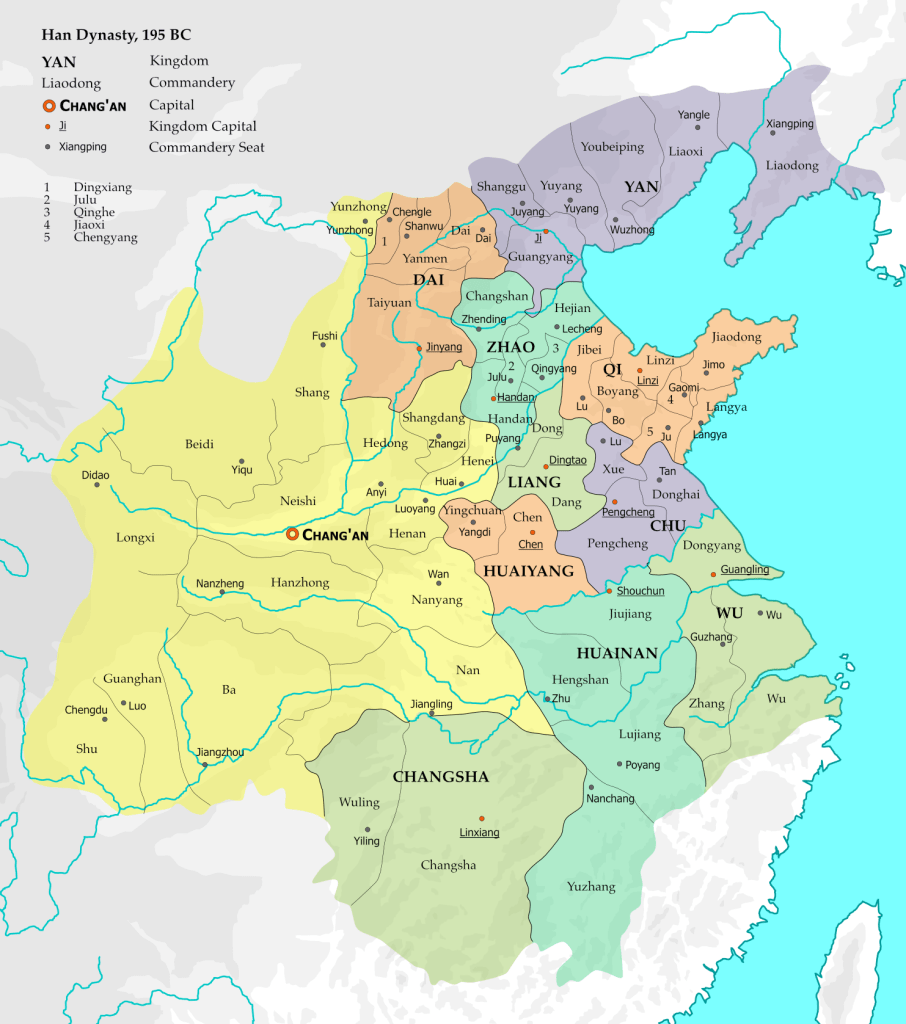
The 6th year of the Emperor Wen’s Early Era (174 B.C.)
In October of winter, peaches and plums blossomed out of season.
Prince Li of Huainan, Liu Chang, enacted his own laws and expelled officials appointed by the Han court. He sought to appoint his own prime minister and officials of ministerial rank (i.e., 2000 picul officials), and the Emperor acquiesced to his request. Prince Li also arbitrarily executed innocent people and conferred noble titles on undeserving individuals, elevating some to the rank of Marquess within the Pass. He repeatedly sent disrespectful letters to the Emperor, who was reluctant to admonish him directly. Instead, the Emperor ordered Bo Zhao to write a letter of admonition, citing the punishments of Guan Shu Xian (Uncle Guan) and Cai Shu Du (Uncle Cai) from the Zhou dynasty, as well as the banishment of Prince Qing of Dai (Liu Zhong) and Prince of Jibei (Liu Xingju) to serve as a warning.
The Prince of Huainan was not pleased with the letter. He conspired with 70 individuals, including Grandee Dan, officer Kai Zhang, and Chai Qi, who was the son of Chai Wu, the Marquis of Jipu, to lead an uprising of 40 chariots at Gukou County. They also sought assistance from the Minyue and Xiongnu states. However, the plot was discovered, and they were arrested. The Emperor summoned the Prince of Huainan to Chang’an, where Chancellor Zhang Cang and Grand Hareld Feng Jing, acting as Grand Master of the Censorate, along with the Minister of imperial Clan and the Minister of Justice, submitted a joint memorial: “Liu Chang should be executed in the public market for his crimes.” The imperial edict commuted the Prince of Huainan‘s death sentence to banishment at Qiong Post Station in Yandao County, Shu Commandery, and stripped him of his title. All those who conspired with him were executed. The Prince of Huainan was transported in prison vehicles, carried in stages by each county along the postal route to Qiong.
Yuan Ang remonstrated, “Your Majesty has always indulged the Prince of Huainan and has not appointed strict teachers and advisors for him, which has led to this situation. The Prince of Huainan is strong-willed and fragile by nature, and now he is being brutally crushed. I fear he may die from illness on the road to exile, and Your Majesty will be accused of fratricide. What do we do then?”
The Emperor replied, “I just wanted to give him a hard time. I will call him back now.”
The Prince of Huainan, livid, died from a hunger strike. When the cart reached Yong County, the officers opened the sealed cart and found his corpse. News eventually reached the Emperor in Chang’an. Filled with grief, the Emperor regretted not heeding Yuan Ang‘s advice and sought counsel on how to atone for his mistake. Yuan Ang suggested that the only way to appease the people was to execute the Chancellor and the Grand Master of the Censorate to show remorse. Instead, the Emperor ordered the Chancellor and the Grand Master of the Censorate to investigate the local officials and publicly execute those who had failed to provide food and attendants for the Prince of Huainan. He also ordered the Prince’s burial in Yong with a tomb styled and scaled like that of a marquess, guarded by thirty households.
Modu Chanyu of the Xiongnu(Huns) sent a letter to the Han, stating: “Earlier, the Emperor mentioned a marriage proposal and sent a letter expressing his intentions, which fostered friendship between our nations. However, Han officials have been harassing the Right Tuqi King. Without my permission, he listened to the advice of the Marquis of Houyilu, Nanzhi, and others, and confronted the Han officials. This violated the treaty between our nations and disrupted our bond of brotherhood. As a result, the Right Tuqi King was punished and sent west to seek out and attack the Yuezhi. Thanks to heaven’s favor, our soldiers were strong and our horses swift, and the Yuezhi were utterly defeated, with all either killed or surrendered. This brought stability to the northern frontier and solidified our rule over 26 neighboring kingdoms, including Loulan, Wusun, and Hujie. The various tribes with their bows and arrows have become one family. I request that we lay down our weapons, rest our soldiers, care for our horses, forget past grievances, and resume the old treaty to ensure peace for the border people. If Your Majesty prefers that our people stay away from the borders, I will issue a decree to my officials and people to remain at a greater distance.”
The Emperor replied in a letter, saying: “The Chanyu’s desire to forget past grievances and resume the old treaty pleases me greatly. This reflects the wisdom of the ancient sage kings. The Han and Xiongnu made a treaty to be brothers, which is why the Han has treated the Chanyu with such generosity. Those who violate the treaty and disrupt our brotherhood are often found among the Xiongnu. However, the matter of the Right Tuqi King occurred before the amnesty, so I ask the Chanyu not to punish him too severely. If the Chanyu clearly communicates these intentions to your officials and ensures that they do not break the treaty, the Han will likewise honor the treaty and the goodwill expressed in the Chanyu’s letter.”
Some time later, Modu Chanyu died and was succeeded by his son, Jiyu, who took the title of Laoshang Chanyu. Upon Laoshang Chanyu’s ascension, the Emperor once again sent a princess from the imperial clan to be his consort. An eunuch named Zhonghang Yue from Yan was sent to accompany the princess as her tutor. Zhonghang Yue was reluctant to go, but the Han government forced him. He remarked, “If it must be me, I will cause trouble for the Han!” Upon his arrival, Zhonghang Yue surrendered to the Chanyu, who treated him with great favor and affection.
In the past, the Xiongnu were fond of Han’s silk and food. Zhonghang Yue warned, “Though the Xiongnu are numerous, they cannot compare to even a commandery of the Han. However, their strength lies in their distinct clothing and food, making them independent from Han. If the Chanyu adopts Han’s goods and customs, the Xiongnu will be under Han‘s control once they receive no more than ten or twenty percent of Han’s exports.”
When Zhonghang Yue obtained Han silk, he rode through thorns and grass, deliberately tearing his clothes to show that they were inferior to Xiongnu woolen cloaks and furs. When he received Han food, he rejected it, claiming it was less tasty and convenient than Xiongnu dairy products. He also taught the Chanyu’s attendants to keep records of their people and livestock. The letters and seals exchanged with the Han were enlarged to signify superiority. The letters were written in a haughty tone, referring to the Chanyu as “the great Xiongnu Chanyu, born of Heaven and Earth, and appointed by the Sun and Moon.”
When Han envoys criticized the Xiongnu for lacking propriety and righteousness in their customs, Zhonghang Yue always countered by saying, “The Xiongnu have simple rules that are easy to follow. The relationship between their rulers and subjects is straightforward and enduring. Their statecraft functions as one cohesive body. Therefore, although the Xiongnu may at times be chaotic, they always establish a ruler from within the tribe.
“Now, while the Middle Kingdom claims to uphold propriety and righteousness, as family relations grow distant, people kill and steal from one another, and even the ruling clan is changed. Propriety or not, they all belong to the same kind of people. Alas! Those who live in earthen houses should not babble so much, or padding themselves on the back.
“As for the goods that Han delivers to the Xiongnu—silk, cloth, rice, and wheat—let them be of good quality and appear pleasing. What more is there to say? If the goods are sufficient and of good quality, then all is well. But if the goods are lacking and of poor quality, then let them wait until autumn harvest, for our riders to sweep in and tramp on their crops.”


 Reflection by Rio Grande