Comprehensive Reflections to Aid in Governance
By Sima Guang
Translated By Yiming Yang
Annals of Han Book 16 Scroll 24 (continued)
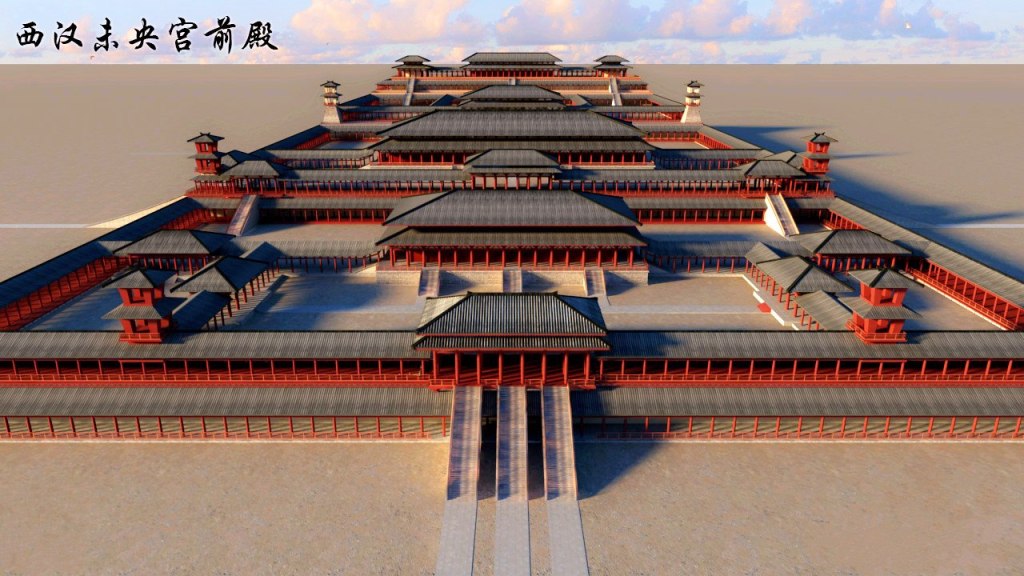
The 1st year of Emperor Zhao’s Yuanping Era (74 B.C. continued)
When the Prince of Changyi came to pay homage to the Empress Dowager, and was about to depart in his carriage toward the Wenshi Chamber, eunuchs held each door along the way. As the Prince entered, the doors were shut behind him, and the ministers of Changyi were barred from entry. The Prince asked: “What does this mean?”
The Grand General knelt and said: “The Empress Dowager has issued an edict, prohibiting the ministers of Changyi from entering.”
The Prince said: “Take things calmly and slowly. Why cause alarm and frighten men?”
Huo Guang thereupon ordered the ministers of Changyi expelled, and placed them outside the Golden Horse Gate. The General of Chariots and Cavalry, Zhang Anshi, led the Feathered Forest Cavalry, seized more than two hundred of the Prince’s minions, and delivered them to the Ministry of Justice for trial.
Huo Guang commanded the eunuchs who had formerly served Emperor Zhao to guard the Prince, saying: “Be ever watchful! Should he die or take his own life, I would be accused of regicide, and the whole empire would be betrayed.”
The Prince, still unaware of his deposition, said to those about him: “How could my ministers and attendants be guilty? Why has the Grand General seized them all?”
Soon the Empress Dowager summoned the Prince of Changyi. When he heard the summons, the Prince was fearful, saying: “What offense have I committed, that I should be summoned?”
The Empress Dowager, in a pearl vest, sat in a resplendent robe within the command tent. Several hundred attendants bearing arms stood about her, and guards with weapons were arrayed at the gates. The ministers entered the hall in order. The Prince of Changyi was called forward to hear the edict.
Huo Guang and the ministers submitted a memorial of impeachment, and the Chief of the State Secretariat read it aloud:
“Chancellor Yang Chang and the ministers, prostrate, dare to address the Empress Dowager: The late Emperor Zhao was cut off in youth, leaving no heir. The Prince of Changyi was summoned to perform the mourning rites, yet he donned mourning garb without true grief. He cast aside the rules of mourning, ate and drank at will, permitted his officers to convey women in covered carriages, and joined them in revelry at their lodgings. On his arrival he was forthwith proclaimed Crown Prince, and still he privately purchased chickens and swine for his meals.
“He received the Imperial Trust Seal[for military command] and the Personnel Seal before the pall of the late Emperor, yet left them unguarded. He caused more than two hundred attendants and slaves of Changyi to be escorted into the palace, where they engaged in frivolities within the forbidden precincts. He even wrote a letter, saying: The Emperor greets the court attendants. I have ordered Gao Chang, Supervisor of the Changyi Treasury, to grant you a thousand catties of gold and bestow upon you ten wives.
“Even while the pall of the late Emperor stood in the front hall, he opened the Music Office, called in the performers of Changyi to strike drums, sing songs, blow flutes, and play lewd and vulgar farces. He summoned the ensemble of the Grand Ancestral Temple and the physicians’ musicians to perform. He drove carriages through the Northern Palace and Gui Palace, staging contests of pigs and battles of tigers. He commandeered the Empress Dowager’s miniature carriage, with slave attendants mounted beside him, and rollicked about the courtyard. He committed lewd acts with palace women, even Lady Mong of the late Emperor, and through the Superintendent of the Courtyard issued an edict, saying: Whoever dares to leak this will be cut in twain at the waist!”
The Empress Dowager said: “Wait a moment! As a subject, should one act with such wantonness?” The Prince of Changyi rose from his seat and prostrated himself.
The Chief of the State Secretariat continued to read:
“…He took the ribbons of princes, marquises, and officials of two-thousand-picul rank, together with the black and yellow insignia, and bestowed them upon his attendants and pardoned slaves of Changyi. He lavished gold coins, knives, swords, jade ornaments, and woven silks from the Imperial Treasury as rewards for revelry. He held night banquets with his officials and slaves, drowning himself in wine.
“On a solitary night he feasted in the Wenshi Chamber, receiving his brother-in-law, the Marquis Within the Passes from Changyi, with the highest rites. Before the ancestral sacrifices had been offered, he sent forth a sealed command to dispatch an envoy to sacrifice to the late Prince of Changyi, his father Liu Bo, in the royal garden, and styled himself the ‘Successor Emperor.’
“In the span of twenty-seven days after receiving the imperial seal, the Prince issued one thousand one hundred and twenty-seven orders to the various offices of government. He has abandoned himself to extravagance and debauchery, cast aside the rites and proprieties of an emperor, and thrown the governance of Han into disorder.
“Chancellor Yang Chang and the ministers, again and again, offered admonition, yet he never amended his conduct, but daily grew worse. Fearing peril to the state and turmoil within the empire, the ministers consulted the learned, and all were of one accord: The sovereign who succeeded Emperor Zhao has engaged in licentious and lawless conduct, in defiance of filial piety.
“The Classic of Filial Piety says: Among the five categories of crime, unfilial conduct is the gravest. In the Spring and Autumn Annals, it is recorded: King Xiang of Zhou mistreated his mother, and the heavenly king was driven from the capital to dwell in Zheng. His want of filial piety made him an outcast beneath Heaven.
“The ancestral temple is greater than the throne. His Majesty has failed to receive Heaven’s mandate, to revere the ancestral temple, and to fulfill the duty of succession. Therefore it is meet and right that he be deposed. We request that a solemn offering of a great victim—ox, sheep, and swine—be made to the ancestral temple.”
The Empress Dowager decreed: “It is permitted.”
Huo Guang bade the Prince of Changyi rise and receive the decree. The Prince said: “I have heard it said: Though the Son of Heaven lost his way, if seven ministers remonstrate with him, the empire shall not be lost.”
Huo Guang replied: “The Empress Dowager has decreed your deposition. How can you still call yourself Son of Heaven?”
He then took the Prince by the hand, untied the ribbon of the imperial seal, and presented the seal to the Empress Dowager. He led the Prince down from the hall, out through the Golden Horse Gate, the ministers following behind.
Facing west, the Prince knelt and said: “I am foolish and ignorant, unfit to bear the enterprise of Han!” Then he rose, mounted his carriage, and the Grand General escorted him to the residence of Changyi princedom.
Huo Guang said with gratitude: “Sire by his own conduct has severed the bond with Heaven. I would rather betray Sire than betray the state. May Sire preserve himself; I, a subject, shall no longer attend at your side.” He departed in tears.
The ministers memorialized, saying: “In antiquity, those deposed and banished were sent afar, severed from affairs of state. We request that Prince Liu He be relocated to Fangling county of Hanzhong Commandery.”
The Empress Dowager decreed that Prince Liu He be returned to Changyi, granted a fief of two thousand households, and the possessions of his house restored. To the four daughters of the late Prince of Changyi, each was granted a thousand households. The principality itself was abolished, and its lands annexed to Shanyang Commandery.
In the time of Liu He’s reign in Changyi, the court officials, though seated in office, made no report of his misdeeds. They concealed his faults from the Han court and failed to guide him in the righteous path, whereby the Prince fell into grave transgressions. Thereupon all were implicated, arrested, and more than two hundred were executed. Only the Commandant of the Capital Guard, Wang Ji, and the Chamberlain, Gong Sui, who had steadfastly remonstrated with a loyal heart, were spared from death. Yet they were shaven of hair and sent to labor upon the city walls.
When Wang Shi, tutor to the Prince of Changyi, was cast into prison and faced death, the interrogator asked him: “Why did you not submit a memorial of admonition to the Prince?”
Wang Shi replied: “Day and night I recited the three hundred and five poems of the Book of Songs to the Prince. Those chapters that speak of loyal ministers and filial sons, I recited again and again. When the odes told of rulers in peril and princes astray, I never ceased to weep and admonish. With all three hundred and five poems I made my remonstrance. What need did I have for a separate memorial?”
The interrogator, moved by these words, commuted his sentence and spared him from death.

 Reflection by Rio Grande