Tag: Li Si

  • Comprehensive Reflections to Aid in Governance(Part 60): Conspiracy at Shaqiu Palace

    Comprehensive Reflections to Aid in Governance

    By Sima Guang

    Translated By Yiming Yang

    Annals of Qin Book 2 Scroll 7 (continued)

    Terracotta Warriors in Mausoleum of the First Emperor

    The 36th year of the First Emperor(211 B.C.)

    A meteor fell in Dongjun Commandery, and someone engraved on the meteor rock: “The First Emperor dies and his land is divided.” The First Emperor ordered his justice minister to launch an inquisition around the stone’s landing place, but no one confessed. In response, the First Emperor decreed the execution of all the people who lived in the neighborhood. The rock was then incinerated.

    In response to an augury, the First Emperor relocated thirty thousand households to the regions of Yuzhong to the North of Yellow River. Each head of the household was promoted by one rank.

    The 37th year of the First Emperor(210 B.C.)

    The First Emperor was traveling in October of the winter.  He was accompanied by the Chancellor Li Si.  Vice Chancellor Feng Quji stayed behind in the capital.  Among the twenty or so sons, the First Emperor favored the youngest son HuhaiHuhai pleaded to travel with the Emperor and his wish was granted.

    The First Emperor arrived in Yunmeng county in November. There, he held a rite to worship Emperor Shun while looking towards Jiuyi Mountains. Then he sailed down the Yangtze River, sightseeing at the town of Jike, watching an islet in the river, passing through Danyang county, and finally reaching Qiantang county. The waves were high and treacherous at the Zhe River. They traveled two hundred and twenty li westward to cross the river at a narrow point.

    The First Emperor ascended Mount Kuaiji and held a ritual in honor of Emperor Yu the Great, looking towards the South Sea. The First Emperor installed another tablet with inscriptions praising his virtue. On the way home, the First Emperor passed through the State of Wu, crossed the Yangtze River at Jiangsheng County, and sailed north on the East Ocean, reaching Mount Langya and Mount Zhifu. There, they saw a huge fish in the sea, and the First Emperor shot the fish with a crossbow. They sailed west along the coast and reached a crossing called Pingyuanjin, where the First Emperor fell ill.

    The First Emperor hated the word “death,” and none of the ministers dared to mention the subject. As his illness worsened, he ordered his chief dispatcher of central command, Zhao Gao, who was in charge of the royal seal, to write a letter to his eldest son Fusu: “Come to my funeral, come to Xianyang for my entombment.” The letter was sealed and held by Zhao Gao, but had not been given to a messenger yet.

    In July of the autumn, the First Emperor died at the Palace of Shaqiu in the village of Pingtai. Chancellor Li Si, fearing possible power wrangling among the princes with the Emperor dying away from the capital, kept the news of his death a secret. The Emperor’s coffin was insulated in his wagon to keep the temperature low, and the same favorite eunuchs drove and escorted the wagon. Whenever they traveled to a new place, food and local officials were brought to the wagon as usual. The eunuchs processed the reports and dealt out decrees as before. Only Huhai, Zhao Gao, and five or six of the most trusted eunuchs knew of the Emperor’s death.

    The First Emperor was fond of the Meng clan and trusted them deeply. Meng Tian, the top general, was stationed on the frontier as the army commander, while Meng Yi served in the court as chief of staff, holding the title “The Faithful.” Other ministers and generals dared not challenge their dominance.

    Zhao Gao was castrated at birth. The First Emperor, hearing that Zhao Gao was a capable administrator and knowledgeable about criminal laws, appointed him as the court dispatcher and asked him to teach Huhai how to judge legal cases. Huhai developed a predilection for Zhao Gao. Once, Zhao Gao committed an offense that Meng Yi deemed punishable by death. However, the First Emperor pardoned Zhao Gao because of his administrative efficiency and reinstated him to his position. Zhao Gao, having Huhai’s favor, harbored ill feelings toward the Meng family.

    Zhao Gao advised Huhai to kill Prince Fusu and install himself as crown prince using a forged will of the First Emperor. Huhai approved the plot. Zhao Gao then told Huhai, “I am afraid this plot won’t work without the consent of the Chancellor.” He approached Chancellor Li Si, saying, “His Majesty had a letter for his eldest son. The letter and the royal seal are both in the possession of Huhai. Who the crown prince will be is a matter of what Your Excellency and I decide.”

    Li Si was startled and responded, “Why do you talk about a topic that could jeopardize the fate of this empire? It is not a subject that servants like you and me are supposed to discuss!” Zhao Gao reasoned with him, “In terms of capability, strategic thinking, military achievements, popularity, and trust from the eldest son of the emperor, how do you compare to Meng Tian?” Li Si conceded, “I am not as good as Meng Tian in all aspects.”

    Zhao Gao continued, “If the eldest son succeeded his father as emperor, he certainly would appoint Meng Tian as his Chancellor. It is obvious that Your Excellency would not retire to your hometown with the seal of Marquis Tong. Huhai is a kind and magnanimous person and a good successor to the emperor. I wish Your Excellency could think long and hard to make the decision.” Li Si yielded under pressure.

    They colluded to forge an edict from the First Emperor, designating Huhai as the crown prince. They also fabricated a letter from the First Emperor to Prince Fusu. The letter reprimanded Fusu for not expanding the frontier enough, yet causing significant attrition of soldiers. It listed several instances where Fusu wrote to his father, rudely criticizing the Emperor and constantly bickering about not being able to return home and become the crown prince. The letter accused General Meng Tian of not rectifying Fusu’s behavior and being a co-conspirator. It granted the death penalty to both Fusu and Meng Tian, ordering them to pass command of the army to Meng Tian’s lieutenant, General Wang Li.

    Fusu opened the letter and burst into sobs. He went into his bedroom, preparing to commit suicide. Meng Tian stopped him, saying, “His Majesty is away from home. The position of crown prince has not been designated. His Majesty entrusted me with commanding three hundred thousand troops on the frontier and appointed you as the supervisor. That is a tremendous responsibility to the country. Now a messenger arrives, and you are going to kill yourself! Do you know whether this is not trickery? Let’s submit a memorandum to the throne for verification first; then it won’t be too late to die.”

    The envoy pressed Prince Fusu several times. Fusu said to Meng Tian, “A father grants his son death; what else do we have to verify!” He then killed himself. Meng Tian refused to comply. The envoy handed him over to the local wardens and imprisoned him in the town of Yangzhou. The envoy appointed a minion of Li Si as the supervisor of the army and went back to report to Zhao Gao and Li Si.

    Huhai learned that Prince Fusu had died and intended to set Meng Tian free. Meng Yi happened to come to debrief the Emperor after performing sacrificial ceremonies for mountains and rivers on the First Emperor’s behalf. Zhao Gao spoke to Huhai, “The late emperor had long meant to pick the best and make you the crown prince, but Meng Yi advised against it. It would be better to get rid of Meng Yi.” Meng Yi was then incarcerated in Dai commandery.

    The cortege arrived at Jiuyuan Commandery from Jingjing County during the intense heat of mid-summer. The wagon began to emit a terrible stench. To cover up the smell, they forged another edict to obtain one picul of abalone for the emperor. Eventually, they got on the thoroughfare and reached Xianyang, where they announced the funeral and Huhai usurped the throne.

    In September, the First Emperor was sepulchered at the Lishan Mausoleum. Three layers of aquifers were blocked around the tomb. It was filled with treasures and rare stones transported from all over the country. Booby-trapped crossbows were installed to shoot any trespassers. Mercury was injected into the tomb to symbolize rivers and seas. The ceiling of the tomb was decorated with celestial bodies, while the base was laid with geographical models. The concubines who had not yet borne children were ordered to die with the emperor in the tomb. When someone reminded the authorities that the technicians who made the mechanisms knew the key to the treasure and could leak the secret, all the technicians were shut in the tomb when the burial was completed.

    The Second emperor wanted to execute Meng Tian and his brother. The son of his elder brother, Ziying, advised against it: “King Qian of Zhao killed General Li Mu and promoted Yan Ju; King Jian of Qi killed his father’s loyal servant and replaced him with Hou Sheng. Both lost their kingdoms in the end. The Meng family has contributed elite ministers and strategists to the kingdom of Qin for generations, yet Your Majesty would discard them at once. Executing loyal ministers and replacing them with someone lacking character would cause ministers to lose faith within the court and dishearten warriors outside the court.”

    The Second Emperor disregarded this advice. He ordered the execution of Meng Yi and pursued Meng Tian, who was the interior minister. Meng Tian said, “From my grandfather onward, the Meng family has served the kingdom of Qin for three generations. Though I am in jail today, my influence over the three hundred thousand soldiers under my command would be enough to incite a mutiny. I keep my faith knowing I will die for this, because I do not want to tarnish my ancestors’ reputation and I have not forgotten the trust of the late emperor.” He then committed suicide by taking poison.

    Yang Xiong commented in his book Exemplary Figures: “Someone asks, ‘Meng Tian was loyal and was killed, what is the benefit of being loyal?’ The answer is: ‘From Lintao county to Liao River, he flattened mountains and filled ravines. He did not make the empire more prosperous yet left many cadavers behind. Being loyal is not good enough to be a prime minister.’”

    Sima Guang‘s comments: When the First Emperor was ravaging the country, Meng Tian was his enabler. Meng Tian was not a benevolent and wise person. However, Meng Tian maintained his loyalty to his lord and would rather die than rebel despite being innocent. This act is commendable.
  • Comprehensive Reflections to Aid in Governance(Part 59): Burning Books and Burying Scholars

    Comprehensive Reflections to Aid in Governance

    By Sima Guang

    Translated By Yiming Yang

    Annals of Qin Book 2 Scroll 7(continued)

    The 34th year of the First Emperor(213 B.C.)

    Officials who abused the criminal justice system by releasing criminals or wrongfully imprisoning the innocent were punished. They were either sent to build the Great Wall in the north or exiled to the state of Southern Yue.

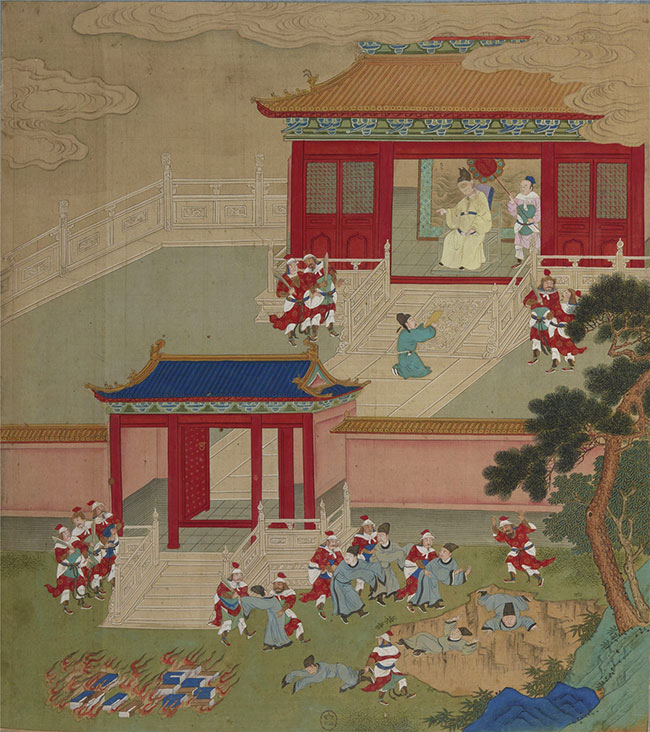
    The chancellor Li Si submitted a memorandum: “The kingdoms once recruited migrant scholars to their courts with opulent perks when they were jostling for power. Now, the country is in peacetime, and all laws and orders come from a single place. Ordinary households should work hard on farming and crafting, while intellectuals should study law and order. Today, there are Confucianists who do not study current laws and policies but reference the archaic texts to criticize the new. They baffle the public with their speeches and teach fallacies in their private schools. Whenever a new law is promulgated, they make remarks based on their own theories. They hold their dissent silently in court yet spread discord on the street. They praise the lord to elevate their own fame, dispute to show their superiority, and mislead the masses to denigrate policies. If these activities are not prohibited, it will diminish the authority of the court from above and form dissident parties from below. A ban is in the best interest of the country! I plead that the court historians burn all the history books except those from the kingdom of Qin. Unless they are court scholars who need the books for their duty, all people must turn in books in their possession—such as the ‘Book of Songs,’ the ‘Book of Documents,’ and other works authored by scholars and philosophers before our time—to the governors and military officers to be burned together. Those who speak of these books should be executed publicly. Those who disparage current policy by referencing ancient books should be punished by executing their entire clans. Government officials who do not prosecute these crimes will be treated as accomplices. After thirty days of this decree taking effect, those who do not burn their books will be branded on their faces and sent to labor on the Great Wall. Only books about medicine, divination, and horticulture can remain. Those who wish to study the law and policies can learn from government officials.” 

    The First Emperor issued an edict: “Approved.”

    Chen Yu, who was from Wei, spoke to Kong Fu (a direct descendant of Confucius), “The emperor of Qin wants to destroy the classic works of your ancestor. You are the owner of these books. You are in trouble.” Zi Yu (the courtesy name of Kong Fu) replied: “My study is about useless theory. Only my friends know me. I am no friend of Qin. Why am I in trouble? I stock up my books, waiting for someone to solicit them. Once there is a demand for them, I won’t have any worries.”

    The 35th year of the First Emperor(212 B.C.)

    The First Emperor directed Meng Tian to widen and straighten an expressway from the town of Jiuyuan to Yunyang county. The road, which was a thousand and eight hundred miles long, cut through mountains and leveled canyons along the way, taking years to complete.

    The First Emperor thought the city of Xianyang was too crowded and the palaces from his predecessors were too small. He built new palaces in Shanglin Park, south of the Wei River. The first palace under construction was the front palace called E’fang. It extended five hundred paces from east to west and five hundred feet from south to north. The top level could seat ten thousand people, and the bottom level could hoist banners as high as fifty feet. Around the palace, there was a causeway that led from the palace to the South Mountain. A gateway was erected on top of the South Mountain as the entrance to the palace. An overpass was built across the Wei River, connecting E’fang Palace to downtown Xianyang, symbolizing the North Star and Cassiopeia crossing over the Milky Way to Encampment.

    Seven hundred thousand criminals, punished by castration or sentenced to servitude, were poured into laboring in E’fang Palace or the Emperor’s Mausoleum at Lishan. Stone was quarried from the North Mountain, and timbers were shipped from the states of Shu and Jing (Chu). The building materials all arrived at the site. The total number of palaces within the four passes of the Qin kingdom was three hundred, with more than four hundred palaces outside the four passes. A monument had been installed within the Qu County of Donghai Commandery, serving as the east portal of the Qin Empire.

    The First Emperor ordered thirty thousand families to settle in Liyi County and fifty thousand families in Yunyang County. These families were exempted from taxation and conscription for ten years.

    Scholar Lu spoke to the First Emperor: “In an unholy world, Your Majesty should often travel secretly to avoid evil spirits. In the absence of evil spirits, the holy man will appear. I hope the palace where Your Majesty stays will be kept a secret, so we can obtain the immortal panaceas we have sought.” The First Emperor replied, “I wish to be the holy man.” He referred to himself as “this holy man” instead of “we.”

    He ordered the two hundred palaces within two hundred miles around the city of Xianyang to be connected via causeways or porticos, with draperies, percussion instruments, and beautiful ladies furnished at designated places. The settings were to be on record and not moved. The revelation of his itinerary was punishable by death. When the First Emperor toured Liangshan palace, he was displeased by the lavish entourage of the Chancellor seen from the hilltop. One of the eunuchs informed the Chancellor, who then reduced his retinue. The First Emperor became furious, saying, “Someone divulged what I said.” He ordered a formal investigation, but nobody confessed. He arrested everyone present at the time and executed them all. From then on, no one knew where the emperor was. All ministers who needed the emperor’s approval had to wait at the palace in Xianyang.

    Court scholars Lu and Hou satirized the Emperor’s behaviors and fled from the court. When the First Emperor heard this, he was livid, “This holy man gave scholars like Lu high respect and paid them well, and they turned around and disparaged this holy man! This holy man sent investigators to look into those scholars at Xianyang, and some reported that they spread heresy to instigate the people.” He directed law officers to prosecute the scholars.

    The scholars snitched on each other to exonerate themselves. The emperor sentenced four hundred sixty perpetrators to be buried alive at Xianyang. The burials were widely publicized to admonish posterity. More scholars were banished to the remote frontiers. The eldest son of the emperor, Fusu, beseeched for leniency: “These scholars are the leading Confucianists of the country. Your Majesty is applying severe punishment to all of them. I am afraid it would lead to unrest in the empire.”

    The First Emperor was roiled by Fusu’s plea. He sent Fusu away to Shangjun commandery to monitor General Meng Tian.

  • Comprehensive Reflections to Aid in Governance(Part 54): Stuttering Legalist Han Fei

    Comprehensive Reflections to Aid in Governance

    By Sima Guang

    Translated By Yiming Yang

    Annals of Qin Book 1 Scroll 6 (continued)

    Word Cloud of Han Fei

    The 13th year of the First Emperor(234 B.C.)

    General Huan Yi of Qin attacked the kingdom of Zhao, defeating the Zhao army led by General Hu Zou at the city of Pingyang. One hundred thousand Zhao soldiers were beheaded, and General Hu Zou was killed. In October, during the winter, General Huan Yi launched another attack on Zhao.

    The 14th year of the First Emperor(233 B.C.)

    General Huan Yi attacked the kingdom of Zhao, killing the commander of the Zhao army and capturing the cities of Yi’an, Pingyang, and Wucheng. In response, the King of Zhao appointed General Li Mu as Grand Marshal to defend Yi’an. Li Mu routed the Qin army near the town of Feixia, forcing General Huan Yi to flee back to Qin. The King of Zhao then bestowed the title of Lord Wu’an upon General Li Mu.

    The King of Han begged to become a vassal by ceding land and offering the seal of Han to the kingdom of Qin. He sent Han Fei to pay homage to the King of Qin. Han Fei, a prince of Han, was a leading legalist in the school of crime, punishment, and theurgy. Witnessing the decline of the kingdom of Han, he wrote numerous proposals to the king, who did not take his advice. Han Fei resented that the administration did not seek and promote capable talents but instead elevated glib and superficial individuals over those who got things done. In more peaceful times, celebrities and scholars were the crowd favorites, but in times of crisis, only military men were relied upon. Thus, those who squandered resources were not those who could be counted on, and those depended upon by the state were not those nurtured by the state. Han Fei was mournful about how honest and upright servants of the state were trampled by evil and corrupt officials. As he examined the vicissitudes of the past, he composed books such as Solitary Indignation, The Five Vermins, Inner and Outer Congeries of Sayings, Collected Persuasions, and The Difficulties of Persuasion, totaling fifty-six essays and more than one hundred thousand words.

    The King of Qin heard of Han Fei’s reputation and wanted to meet him. When Han Fei arrived in Qin, he wrote a letter to the king, “Now the kingdom of Qin has territory spanning thousands of miles and claims a standing army of a million soldiers. Your competent command system and fair legal system have no match in the world. I take the liberty to see Your Majesty to present my plan to break the vertical alliance. If Your Majesty listens to me and implements my plan yet still has no successful outcomes—i.e., the vertical alliance does not collapse, the kingdom of Zhao does not capitulate, the kingdom of Han does not perish, the kingdoms of Chu and Wei are not submissive, the kingdoms of Yan and Qi are not friendly, Your Majesty does not gain hegemony, and the neighboring monarchs do not pay homage—then Your Majesty can behead me in public to warn those who give disloyal advice.”

    The king liked what he heard but did not give Han Fei an important position. Li Si, jealous of Han Fei, spoke to the king, “Han Fei is one of the princes of Han, after all. His plan to annex all the monarchs is ultimately for the benefit of Han, not Qin. That’s just human nature. Now, Your Majesty has not utilized him, making him a risk to Qin. We would be better off killing him than letting him go back.” The king agreed with Li Si and ordered prosecutors to charge Han Fei with crimes. Li Si sent his lackey to deliver poison to Han Fei in jail and ordered him to commit suicide. Han Fei wanted to appeal but had no chance to see the king. When the king regretted and pardoned him, Han Fei had already died.

    Yang Xiong commented in his book Exemplary Figures: Someone asked, ‘Han Fei wrote a book about the difficulty of persuasion. He died because of a difficult persuasion. May I ask, what makes it so ironic?’ The answer was, ‘Difficult Persuasion was the cause of his death.’ The person asked, ‘Why was that?’ The answer was, ‘A gentleman follows propriety when he moves forward and stops when he crosses ethical boundaries. He goes all in if propriety is adhered; he backs off if it is not. He does not stress about whether the person he lobbies agrees with him. When you persuade someone while being bothered about whether they agree with you, you are likely to push too far.’ The question was, ‘Han Fei worried about the person’s consent. What was wrong with that?’ The answer was, ‘One should be concerned with whether the lobbying is done the right way; it should not be about whether the ideas are agreed upon.’

    Sima Guang’s commentary: I have learned that a gentleman cares for his kindred and then extends that care to others; he loves his country and then extends that love to other countries. Such people can achieve their goals and earn their fame, thus enjoying their lives. Han Fei was doing the King of Qin’s bidding to fulfill his political ambition. His crime warranted more than the death penalty, so why would anyone feel pity for him? 

    The 15th year of the First Emperor(232 B.C.)

    The King of Qin launched a large military campaign against the kingdom of Zhao. One prong reached the city of Ye, while the other prong reached the city of Taiyuan, took the county of Langmeng, and continued to a place Fanwu. There, they encountered the defense led by General Li Mu. The Qin army was clobbered and forced to retreat.

    The Crown Prince of Yan, named Ji Dan, had previously been a hostage in the kingdom of Zhao and was a friend of the King of Qin. When the King of Qin was inaugurated, Crown Prince Dan came to Qin as a hostage again. However, the King of Qin was heedless of him, causing Crown Prince Dan to become outraged and flee from the kingdom of Qin.

    The 16th year of the First Emperor(231 B.C.)

    The kingdom of Han offered the city of Nanyang to Qin. In the fall, during September, the King of Qin called up soldiers to take over Nanyang from Han.

    The kingdom of Wei submitted their land as tribute to Qin.

    In the Dai commandery in the kingdom of Zhao, an earthquake struck. The affected areas extended from the town of Lexu in the west, to Pingyin in the north. Most of the buildings and walls collapsed, and a crack in the ground appeared, stretching as wide as one hundred and thirty yards from east to west.

    The 17th year of the First Emperor(230 B.C.)

    Interior Minister of Qin, Sheng, led a campaign that exterminated the kingdom of Han. The King of Han, Han An, was captured, and the prefecture of Yingchuan was established on the land of the Han.

    Empress Dowager Huayang died.

    A great famine spread in the kingdom of Zhao.

    Lord Yuan of Wey died, and his son Jiao was installed in his place.

  • Comprehensive Reflections to Aid in Governance(Part 53): Migrant Worker Li Si

    Comprehensive Reflections to Aid in Governance

    By Sima Guang

    Translated By Yiming Yang

    Annals of Qin Book 1 Scroll 6 (continued)

    An inscription by Li Si

    The 10th year of the First Emperor(237 B.C.)

    In October, during the winter, Marquis Wenxin was dismissed from his position as Chancellor and left for his fief town. 

    The imperial clans and court officials proposed: “All the foreigners from other kingdoms who came to our state for employment are agents lobbying or spying for their lords. Please deport all of them from our country.” The king promulgated a decree for a broad search and deportation of all foreigners. An official named Li Si, hailed from the kingdom of Chu, was on the list to be deported. On his way out, he submitted a plea to the king:

    “When Duke Mu of Qin sought talents, he acquired You Yu from Tribe Rong in the west. From the east, he recruited Baili Xi from Wan, a city in the kingdom of Chu. He welcomed Jian Shu from the state of Song and invited Pi Bao and Gongsun Zhi from the kingdom of Jin. These talents enabled the kingdom of Qin to annex around twenty states and dominate the western frontier. Duke Xiao of Qin adopted the laws proposed by Shang Yang, causing other monarchs to bow down to the kingdom of Qin. King Hui of Qin utilized the strategy of Zhang Yi to dismantle the vertical alliance of six kingdoms, making them concede to Qin. King Zhaoxiang of Qin strengthened the power of the Royal Court and weakened private enterprises. These achievements were made possible with the help of these four foreigners. From this perspective, what harm has been done by these guest workers?”

    “Beautiful women, music, pearls, and jade that are not produced in the kingdom of Qin, did not prevent them being collected and enjoyed by Your Majesty. Guest workers are treated differently. People are deported simply because they are foreigners, regardless of their qualifications and character. This policy prioritizes the appeal of beauty, music, pearls, and jade over men. I have learned that Mount Tai becomes great because it does not reject any soil; the Yellow River and oceans become deep because they do not reject any trickle. A lord demonstrates his kindness by not rejecting ordinary people. That is why the three Sovereigns and five Emperors in history were unmatched. Now, Your Majesty abandons immigrants to enemy kingdoms and repels guest workers to other monarchs. This amounts to providing supply for invaders and gifting grain to burglars.”

    The king called Li Si back, reinstated him as a top official, and rescinded the deportation decree. Li Si had already traveled to the town of Liyi and returned to the capital. Eventually, the king adopted Li Si’s proposal. He sent orators carrying gold and jade to lobby other monarchs. Those nobles who accepted the bribes were bought off, and those elites who declined the bribes were assassinated. Sowing discord among the lords and their ministers, followed by armed invasions led by generals with excellent records, led the king of Qin to unify the country within a few years.

    The 11th year of the First Emperor(236 B.C.)

    The army of Zhao attacked the kingdom of Yan and captured the cities of Li and Yangcheng. Before the war concluded, the army of Qin, led by generals Wang Jian, Huan Yi, and Yang Duanhe, raided the kingdom of Zhao. They attacked the city of Ye and seized nine towns. Specifically, Wang Jian captured the cities of Yuyu and Liaoyang, while Huan Yi took the cities of Ye and Anyang.

    King Daoxiang of Zhao died, and his son Zhao Qian succeeded him as King Youmiu of Zhao. His mother, a prostitute, had bewitched King Daoxiang of Zhao, leading him to install Zhao Qian as the crown prince, replacing his eldest son Zhao Jia. Prince Zhao Qian had a poor reputation for his misconduct in the kingdom.

    Marquis Wenxin had been in his fiefdom for about a year. Envoys and admirers from other monarchs tripped over each other on visiting him, all inviting him to their states. The king of Qin feared potential unrest and wrote a letter to Marquis Wenxin: “What achievements did you accomplish for the kingdom of Qin to justify a fief of one hundred thousand households and being the lord of Henan city? What lineage do you have to the court to deserve the appellation of The Uncle? Take your family to Shu!”

    Marquis Wenxin realized his fate was doomed and was terrified of his impending execution.

    The 12th year of the First Emperor(235 B.C.)

    Marquis Wenxin committed suicide by drinking a toxic potion, and his family buried him quietly. His minions who had participated in the funeral were driven into exile. The king declared, “From now on, the possessions of ministers who commit indecency, such as Lao Ai and Lü Buwei, will be confiscated. This sets the precedent.”

    Yang Xiong commented in his book “Exemplary Figures”:  Someone asked, ‘Was Lü Buwei wise, as he traded people like merchandise?’ The answer was, ‘Who said Lü Buwei was a wise man? He traded his family’s life for a fiefdom. A burglar like Lü Buwei is merely a master gopher. I have seen a gopher get away with a hundred kilograms of grain, but I have never seen a gopher steal a city like Luoyang.’

    There was no rainfall from June to August in the kingdom of Qin

    The king of Qin mobilized the armed forces from four commanderies to aid the kingdom of Wei in a raid against Chu.