Tag: Li Mu

  • Comprehensive Reflections to Aid in Governance(Part 120): Feng Tang: A General’s Prerogative

    Comprehensive Reflections to Aid in Governance

    By Sima Guang

    Translated By Yiming Yang  

    Annals of Han Book 7 Scroll 15 (continued)

    General Li Mu of Zhao

    The 14th year of the Emperor Wen of Early Era (166 B.C.)

    In the winter, Laoshang Chanyu of the Xiongnu led 140,000 cavalry and invaded Chaona County and Xiao Pass, killing the Commandant of Beidi Commandery, Sun Ang, and capturing a large number of people and livestock. They advanced to Pengyang County and sent elite troops in a surprise attack to burn down the Huizhong palace. Their reconnaissance cavalry even reached Yong County and Ganquan County. 

    The Emperor appointed Zhou She, the Commandant of the imperial guard, and Zhang Wu, the Chamberlain, as generals. They mobilized a force of 1,000 chariots and 100,000 cavalry to guard the outskirts of Chang’an, preparing to defend against the Xiongnu invaders. The Emperor also appointed the Marquis of Chang, Lu Qing, as General of Shangjun; the Marquis of Ning, Wei Chi, as General of Beidi; and the Marquis of Longlü, Zhou Zao, as General of Longxi, stationing them in the three commanderies of Beidi, Shangjun, and Longxi. The Emperor personally visited the troops, issued military orders, and bestowed rewards upon the officers and soldiers, intending to lead an expedition against the Xiongnu himself. His ministers’ advice against it, he did not listen. Only after the Empress Dowager strongly objected did he relent. As a result, Zhang Xiangru, the Marquis of Dongyang, was appointed Grand General, while Dong Chi, the Marquis of Cheng, and Luan Bu, the Minister of Interior, were also appointed as generals to lead the attack on the Xiongnu. The Chanyu remained within the borders for over a month before departing. The Han forces pursued them beyond the borders but returned immediately, unable to inflict any casualties.

    As he passed by the office of the gentlemen-in-waiting, the Emperor asked the Director of the gentlemen-in-waiting, Feng Tang, “Where is your venerable ancestral home?” 

    Feng Tang replied, “My grandfather was from Zhao, and my father moved to Dai.” 

    The Emperor said, “When I lived in Dai, the chief of the imperial kitchen, Gao Qu, often praised the talented Zhao general Li Qi, who fought in the Battle of Julu. Even now, whenever I have a meal, my thoughts always turn to Julu. Do your venerable know Li Qi?” 

    Feng Tang replied, “Li Qi was not as accomplished a general as Lian Po or Li Mu.” 

    The Emperor, clutching his thigh, exclaimed, “Alas! If only I had Lian Po and Li Mu as my generals, would I still worry about the Xiongnu?” 

    Feng Tang responded, “Even if Your Majesty had Lian Po and Li Mu, you would not be able to utilize them.”

    The Emperor was offended, stood up, and entered the Forbidden Chamber. After some time, he summoned Feng Tang and reproached him, saying, “How dare you insult me in front of so many people? Couldn’t you find a private moment to say that?” 

    Feng Tang apologized, replying, “I, a lowly person, did not realize what was inappropriate.”

    Still concerned about the Xiongnu, the Emperor eventually asked Feng Tang again, “How do you know that I cannot use Lian Po and Li Mu effectively?” 

    Feng Tang responded, “I have heard that in ancient times, when kings dispatched generals, they would kneel and push the axle of the chariot, saying, ‘The things within the palace gates, I control them; those outside, the general commands.’ Military achievements, their merits, and the rewards were all determined by the generals in the field, not reviewed by central authorities.  The rewards were only reported to the court when they returned from action. This is not mere hearsay.

    “My grandfather said that when Li Mu served as a general of Zhao, he governed the border and used the proceeds from the military markets to feast with the soldiers. Rewards and gifts were distributed within the camp without interference from the central government. By entrusting him with responsibility and holding him accountable for success, the king fully utilized Li Mu‘s intelligence and abilities. Li Mu selected 1,300 chariots, 13,000 cavalry, and recruited 100,000 skilled soldiers. With this force, he drove the Xiongnu Chanyu out of the north, defeated the Donghu, annihilated the Danlin (also known as Chanlan) tribe, restrained the strong Qin forces to the west, and supported Han and Wei to the south. At that time, Zhao was on the verge of dominance.

    “However, after King Zhao Qian ascended the throne, Guo Kai spread slanderous rumors, leading to Li Mu‘s execution, and Yan Ju took his place. As a result, the army was defeated, and the soldiers were captured and annihilated by Qin.”

    “I have heard that Wei Shang used the proceeds from the military market to provide for the soldiers during his tenure as Prefect of Yunzhong Commandery. He slaughtered a cow every five days to reward guests, military officers, and attendants from his own salary. As a result, the Xiongnu kept their distance and did not approach the borders of Yunzhong. When the enemy invaded, Wei Shang personally led the cavalry in a counterattack and killed a great number of them. The soldiers, being sons of farming families, left their fields to serve in the army. How can they be expected to understand the military merit book and team registry? They fight all day, beheading enemies and capturing prisoners. Yet, when they submit their merits to the military headquarters, they are subject to judicial scrutiny if their reports cannot be verified. The civil officials, bound by law, must enforce it, and while the soldiers’ rewards are delayed, their punishments are promptly carried out. In my humble opinion, Your Majesty’s rewards are too meager, and the punishments too severe. 

    “Furthermore, when Wei Shang, the Prefect of Yunzhong, was accused of a discrepancy of merely six head counts in the recognition of enemy kills, Your Majesty handed him over to the judicial officers, stripped him of his rank, and imposed a one-year prison sentence. Based on this, even if Your Majesty had Lian Po and Li Mu, you would not be able to fully utilize them!”

    The Emperor was pleased by the critique. That very day, he ordered Feng Tang to carry the imperial insignia to pardon Wei Shang, releasing him from prison and reinstating him as the Prefect of Yunzhong. Feng Tang was also appointed as the Commandant of the Chariots and Cavalry.

    In the spring, a decree was issued to significantly expand the altars and ceremonial offerings of jade and silk for various sacrificial rituals. The decree stated, ‘We have heard that the officials in charge of sacrificial ceremonies attribute blessings solely to mine and not to the people. We are deeply ashamed of this. It reflects my own lack of virtue to enjoy exclusive blessings while the people are left out. Therefore, We command the sacrificial officials to pray without making any specific requests for mine.’

    That same year, Prince Wen of Hejian, Liu Piqiang, passed away.

    Initially, Chancellor Zhang Cang believed that the Han Dynasty was aligned with the essence of water, while Gongsun Chen of Lu believed it should be associated with the essence of earth, citing the sighting of a yellow dragon as evidence. However, Zhang Cang dismissed this, arguing it was senseless and rejecting the proposal to adopt yellow official gowns.
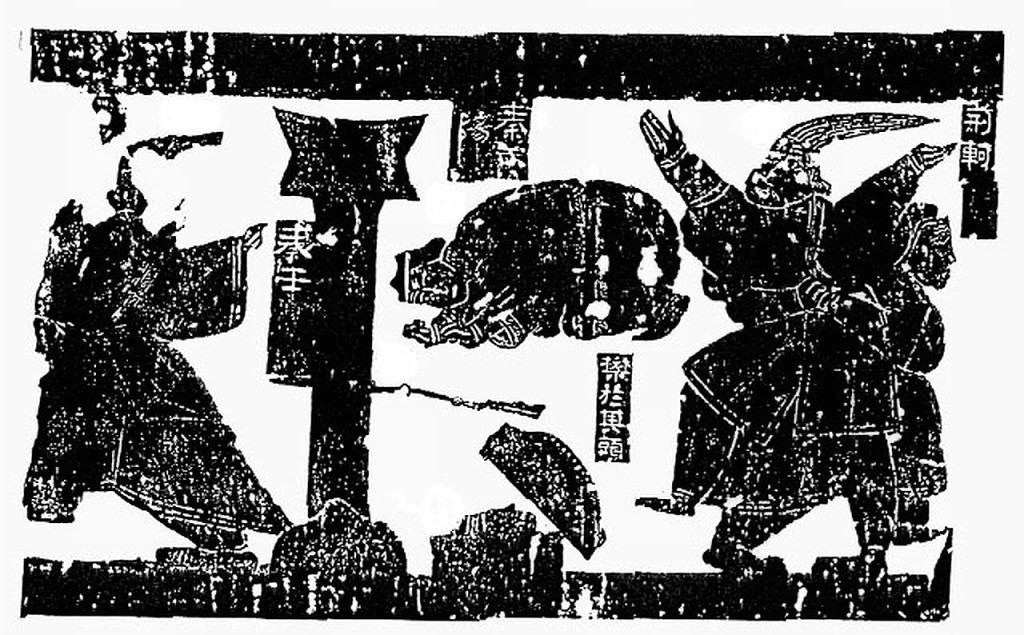
  • Comprehensive Reflections to Aid in Governance(Part 55): Assassin Jing Ke

    Comprehensive Reflections to Aid in Governance

    By Sima Guang

    Translated By Yiming Yang

    Annals of Qin Book 1 Scroll 6 (continued)

    The Assassination of King of Qin depicted by a 3rd century artist

    The 18th year of the First Emperor(229 B.C.)

    General Wang Jian led troops from the Shangdi region, General Qiang Hui led troops from the Jingjing region, and General Yang Duanhe led troops from the Henei region. These three prongs made a coordinated attack on the kingdom of Zhao. General Li Mu and General Sima Shang led the defense of Zhao. However, Qin’s agents had bribed Guo Kai, a favorite toady of the King of Zhao, with gold. Guo Kai smeared the reputations of Li Mu and Sima Shang in front of the king, accusing them of plotting a mutiny. The King of Zhao replaced Li Mu and Sima Shang with Zhao Cong and Yan Ju, a general from Qi.

    Li Mu refused to relinquish his command and was arrested and killed by the king’s delegates. General Sima Shang was also dismissed. General Wang Jian then launched an attack, crushing the Zhao army and killing Zhao Cong. Yan Ju fled. Wang Jian laid siege to the city of Handan.

    The 19th year of the First Emperor(228 B.C.)

    In October of the winter, the capital city of Handan was breached. The King of Zhao, Zhao Qian, was captured, and all the land of Zhao was annexed by the kingdom of Qin. The King of Qin visited Handan, his birthplace, where he ordered the execution of anyone his mother’s family held a grudge against. He returned to the capital Xianyang via the cities of Taiyuan and Shangjun.

    The Empress Dowager, the King’s mother, passed away.

    General Wang Jian camped his troops in Zhongshan, overlooking the kingdom of Yan. A prince of Zhao, named Zhao Jia, led his clan of a few hundred people and fled to the commandery of Dai. He enthroned himself as King of Dai. More and more former officials of Zhao in exile joined Prince Zhao Jia, and they were reinforced by troops from the kingdom of Yan, eventually camping in Shanggu commandery.

    King You of Chu died, and his brother Mi Shi was installed as the new king. In March of spring, Hao’s half-brother Fu Chu killed him and claimed the throne for himself.

    King Jingmin of Wei died, and his son Wei Jia was installed as the new king.

    The Crown Prince of Yan, Ji Dan, harbored deep hatred for the King of Qin. Seeking advice on how to exact revenge, he consulted his tutor, Ju Wu. Ju Wu proposed allying with the three kingdoms that had split from Jin, bonding with the kingdoms of Qi and Chu in the south, and fostering good relations with the Xiongnu in the north to unite all forces against Qin. However, the prince was not satisfied, saying, “Professor’s proposal takes too much time to implement and makes my head spin. I am afraid that I cannot wait that long.”

    Soon after this conversation, a general named Fan Wuji fled from Qin to Yan to escape criminal charges. The Crown Prince Dan offered General Fan shelter. Ju Wu argued against it, saying, “As cruel and ruthless as the King of Qin is, being agitated by the kingdom of Yan is more than enough to send chills down our spines, let alone hosting General Fan. What we are doing is analogous to throwing meat on the trail of a hungry tiger. I beg Your Grace to send General Fan to Xiongnu immediately.”

    The Crown Prince replied, “General Fan had nowhere to go. He came to me at a time when I needed fighters. I wish you would think it through.”

    Ju Wu countered, “Taking risky actions to seek safety; getting into trouble to find happiness; plotting shallow gains in exchange for deep-rooted enmity; disregarding the harm to the state to earn a new personal friend—this is fanning hostility and inducing disasters.”

    The Crown Prince would not heed his advice.

    The Crown Prince of Yan learned that Jing Ke from the state of Wey was a mastermind. He sent lavish gifts and flattering letters to arrange a meeting with Jing Ke. When they met, the Crown Prince Ji Dan spoke: “Now the kingdom of Qin has already captured the King of Han. They have mobilized troops to attack the kingdom of Chu in the south and Zhao in the north. The turmoil will reach the kingdom of Yan once Zhao collapses. Yan is small and weak, and has been plagued by wars for years. How can we resist Qin‘s aggression? All the monarchs are submissive to Qin; no one dares to form a vertical alliance. I have a foolish idea. I think it would be best if we recruited a warrior to serve as an envoy to Qin and kidnap the King of Qin. The warrior would force the king to return the land he had annexed from the monarchs, as Cao Mo did to the Duke Huan of Qi in the past. Or he could assassinate the king if the first plan fails.”

    “The generals of Qin are leading troops in various areas outside the kingdom. If there were commotions back home, the leaders and rank and file would be thrown into confusion and suspicion. The monarchs could seize this opportunity to form a vertical alliance. Then we will defeat the kingdom of Qin. Please keep this in mind, Mr. Jing.”

    Jing Ke agreed. The prince invited Jing Ke to live in the best house and provided whatever he wanted. The prince paid daily visits to Jing Ke‘s house to satisfy his every desire.

    When the news arrived that Wang Jian had demolished the kingdom of Zhao, the Crown Prince of Yan was frightened and wanted to send Jing Ke on his mission. Jing Ke told him, “If I go empty-handed and no one trusts me, I won’t be able to get close to the King of Qin. I need to present the head of General Fan Wuji and the map of the Duhang region of Yan as tributes to the King of Qin. This would please him, and then I would have the chance to repay your kindness.”

    The Crown Prince of Yan hesitated, saying, “General Fan came to me when he was desperate. Dan cannot bear to harm him!”

    Jing Ke went to see Fan Wuji in private and said, “The kingdom of Qin has treated you with extreme cruelty. Your parents and families were all slaughtered or enslaved. Now, I have heard that a bounty for your head is worth a thousand caddies of gold and a fief of ten thousand families. What are you going to do?”

    Fan Wuji sobbed, “What should I do?”

    Jing Ke proposed, “If I could take your head and present it to the King of Qin, he would be happy to see me. I would grab his sleeve with my left hand and stab him in the chest with my right hand. Your revenge would be taken, and the disgrace of the assault on the kingdom of Yan would be eradicated!”

    Fan Wuji exclaimed, “That’s exactly what I have been grinding my teeth and breaking my heart over, day and night!”

    Fan Wuji then slit his throat. The Crown Prince of Yan heard the news and ran over to cry over Fan Wuji‘s body in vain. They put Fan‘s head in a case. The Crown Prince procured the sharpest dagger they could find and quenched it in a poisonous potion that would kill a man instantly if it contaminates his blood. He geared up for Jing Ke’s journey and provided him with an assistant, a warrior of Yan named Qin Wuyang. Jing Ke then went to the kingdom of Qin as an envoy from Yan.