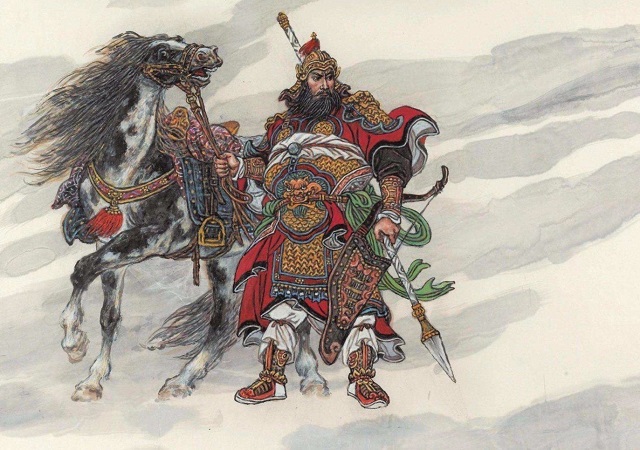
Tag: Li Guang

  • Comprehensive Reflections to Aid in Governance(Part 153): Crash Landing of The Flying General

    Comprehensive Reflections to Aid in Governance

    By Sima Guang

    Translated By Yiming Yang  

    Annals of Han Book 11 Scroll 19 (continued)

    Khentii(Langjuxu) Mountains, Mongolia

    The 4th year of Emperor Wu’s Yuanshou Era (119 B.C. continued)

    The Emperor discussed with his generals, “The Marquis of Xi, Zhao Xin, often plans on behalf of the Xiongnu. He believes that the Han forces cannot cross the desert quickly and will less likely linger. Now, with the massive mobilization of soldiers, we are sure to get what we desire.” Therefore provisions for 100,000 grain-fed horses were prepared. The Grand General, Wei Qing, and the General of Agile Cavalry, Huo Qubing, each led 50,000 cavalry.  Additionally they had 40,000 extra horses for private provisioning. Also, hundreds of thousands of infantry and supply porters followed behind the cavalry, and the daring and skilled warriors were all under the command of the General of Agile Cavalry Huo Qubing.

    The General of Agile Cavalry planned to cross the border from Dingxiang to face the Xiongnu Chanyu. Captured prisoners informed that the Chanyu had moved east. Subsequently, the General of Agile Cavalry was ordered to exit passes in Dai Commandery, while the Grand General Wei Qing went out of Dingxiang. Chamberlain, Li Guang, repeatedly requested to join the expedition. The Emperor initially refused due to his age, but eventually allowed him to be General of the Front. The Grand Coachman, Gongsun He, was appointed as the General of the Left, the Commandant of Title Ranking, Zhao Yi’ji, as the General of the Right, and Marquis Pingyang, Cao Rang, as the General of the Rear, all under the command of the Grand General. Zhao Xin, said to the Chanyu on strategy, “Once the Han forces have crossed the desert and exhausted their men and horses, the Xiongnu can easily take them prisoners.” Therefore, he sent his supply train far north and positioned elite troops to wait for the Han forces to the north of the desert.

    The Grand General Wei Qing, having advanced beyond the borders, captured a prisoner who knew the whereabouts of the Chanyu. Taking his elite troops, he went forth, while instructing the  General of the Front Li Guang to rendezvous with the forces of the General of the Right Zhao Yi’ji and proceed through the eastern route. The eastern path was circuitous, distant and lacked sufficient water and grass. Li Guang pleaded, “I am supposed to be the General of the Front and the vanguard, yet now the Grand General commands me to take the eastern path. I’ve fought the Xiongnu since adolescence, and now that I have the chance to confront the Chanyu, I wish to be in the front, to face the Chanyu first and duel with him.”

    The Grand General, aware of the private warning from the Emperor, “Li Guang is old and unlucky. It’s better not to let him confront the Chanyu because I am afraid that he might not accomplish what we want, the capture of Chanyu.” Additionally, the Grand General wished to send Gongsun Ao, recently demoted from his marquis status, to confront the Chanyu to earn merit credit, hence the transfer of the General of the Front Li Guang to the east. Li Guang, upon learning this, staunchly appealed to the Grand General. The Grand General stuck to his decision, Li Guang, without formal farewell, rose and departed, filled with deep resentment.

    The Grand General marched beyond the borders for over a thousand li, and crossing the Gobi desert, he saw the Chanyu’s forces arrayed and waiting. Thus, the Grand General ordered heavy chariots to encircle and create a camp, and then unleashed five thousand cavalry to confront the Xiongnu. The Xiongnu, in turn, released about ten thousand cavalry. As they were about to engage near sunset, a fierce wind stirred up sand and pebbles, obstructing visibility between the two armies. Taking advantage of this, the Han forces extended their left and right wings to encircle the Chanyu in a pincer maneuver.

    Assessing that the Han forces were numerous and the soldiers and horses were still robust, the Chanyu reckoned that he couldn’t contend with the Han forces in battle. Consequently, the Chanyu, riding on a team of six swift mules, accompanied by a few hundred sturdy riders, broke through the Han encirclement and fled swiftly to the northwest. It was already dusk, and both the Han and Xiongnu forces suffered about equal amounts of casualties and engaged in heavy fighting. A Xiongnu captive caught by the left wing Colonel confessed that the Chanyu had taken cover of the darkness and departed earlier. The Han troops, dispatching light cavalry, pursued the Chanyu through the night. The army of the Grand General followed behind. The Xiongnu forces were in disarray and dispersed. By dawn, having traveled over two hundred li, they failed to capture the Chanyu. Nevertheless, they seized and beheaded nine thousand enemy soldiers and reached the Tianyan Mountains and the City garrisoned by Zhao Xin, where they found the Xiongnu‘s stocked grain and replenished supplies for the Han army. They stayed for a day, burned the remaining grain in the city, and then returned.

    The General of the Front Li Guang, along with the General of the Right Zhao Yi’ji, lost their way due to a lack of local guide, which led to their arrival late for the battle against the Chanyu, missing the rendezvous with Grand General. As the Grand General returned and passed by the southern desert, he encountered the two generals. The Grand General instructed his chief of staff to question Li Guang and Zhao Yi’ji regarding their lost way, summoning Li Guang to the headquarter to file a report.

    Li Guang said, “The ranking colonels and captains are not at fault; it was my own mistake in losing the way. I will present myself to the headquarters before the higher authorities to account for my actions.”

    Li Guang then spoke to his subordinates, saying, “I have engaged in more than seventy battles with the Xiongnu, large and small, since I was sixteen. Today, I was fortunate to follow the Grand General to face the Chanyu’s forces. The Grand General transferred my command to the east route, and I lost my way. Isn’t this the will of heaven? Anyway, I am over sixty years old and do not want to face the scrutiny of bureaucratic officials anymore!” He then drew his sword and took his own life.

    Li Guang was known for his honesty and integrity; he would share rewards and gifts received with his subordinates and shared meals and drinks with his soldiers. He held the position of 2000 picul salary for over forty years, yet his family had no surplus wealth. He had long and strong arms like a gorilla and was skilled in archery; whenever he drew his bow, he wouldn’t shoot if he was not sure to hit the target. In places where there was a shortage of water, Li Guang refrained from drinking until all his soldiers had drunk enough. Similarly, when food was scarce, he abstained from eating until all his soldiers had been fed. His soldiers cherished and respected him for these reasons. Upon his death, the entire army sobbed in mourning.

    When news of his death reached the common people, regardless of whether they knew him personally or not, tears were shed by the old and young alike. However, the General of the Right, Zhao Yi’ji, being held accountable by the authorities, faced death but was pardoned and relegated to a commoner.

    After the Chanyu’s escape, his troops frequently scattered and followed him, causing disorder whenever they encountered the Han forces. For a long time, the Chanyu didn’t reunite with the majority of his forces. The Right Luli King assumed the Chanyu was dead and proclaimed himself as the new Chanyu. However, after around ten days, the real Chanyu emerged to regain his followers, causing the Right Luli King to abandon his claim to the Chanyu’s title.

    The General of the Agile Cavalry, with an equal number of cavalry and heavy chariots, had equivalent military strength to the Grand General’s forces but lacked subordinate generals. Li Gan [a son of Li Guang] and others were appointed as senior colonels, acting as his lieutenants. They traveled over two thousand li, crossing the Dai and Youbeiping, traversing the great Gobi desert, and directly confronted the east division of Xiongnu’s troops. They captured three junior kings including the Prince of Tuntou, the king of Han, and eighty-three military and civil officers, including generals, ministers, chiefs and commandants. They ascended Khentii Mountains (Langjuxu Mountain) to worship the heavens, offered sacrifices at Guyan Mountain to the earth, and reached Lake Baikal (Hanhai). They captured 74443 prisoners. 

    The Emperor increased the fiefdom of the General of the Agile Cavalry by 5,800 households. He also granted titles to four individuals, including the Youbeiping Prefect Lu Bode, and augmented the households of two marquises, including Marquis of Congbiao, Zhao Puonu, and appointed Senior Colonel Li Gan, as the Marquis within Passes with a fief. Many military officers and soldiers received official positions, rewards, and honors. However, the Grand General did not receive an increase in his fiefdom, and none of his military officers or soldiers were granted noble titles.

    When the two armies departed beyond the border passes, the tally of official and privately-owned horses amounted to a total of 140,000 horses. However, upon their return within the borders, the number of horses did not exceed 30,000.

  • Comprehensive Reflections to Aid in Governance(Part 150): Out to The Unknown

    Comprehensive Reflections to Aid in Governance

    By Sima Guang

    Translated By Yiming Yang  

    Annals of Han Book 11 Scroll 19 (continued)

    A Goddess stone figure, Bronze Age Bactria (Daxia), photo by Jumbokedama

    The 1st year of Emperor Wu’s Yuan’shou Era (122 B.C. continued)

    In April of summer, a general amnesty was declared throughout the realm.

    On April 9, the imperial son, Liu Ju, was declared Crown Prince at the tender age of seven.

    On May 30, a solar eclipse occurred.

    In that same period, a large group of ten thousand Xiongnu entered Shanggu and slaughtered several hundred Han people.

    Earlier, Zhang Qian had returned from his western expedition to Yuezhi and presented a detailed report to the Emperor, recounting the customs and cultures of various polities in the western territories. He stated:

    Dayuan lies directly to the west of the Han, approximately ten thousand li away. The people of Dayuan live in settled communities and engage in agriculture. They breed a brand of horses known as the Ferghana horse, whose sweat is red, and they are highly prized. Their cities and houses resemble those of the Middle Kingdom.

    “To their northeast lies the Wusun, and to the east are the Kingdom of Khotan. West of Khotan, all rivers flow westward into the Western Sea, while to the east, the rivers flow toward a salt marsh. This salt marsh runs underground, and to the south lies the source of the Yellow River, approximately five thousand li from Chang’an.

    “East of the salt marsh lies the western boundary of the Xiongnu, extending to the Great Wall at Longxi. To the south, they border the Qiang, who have cut off the road from Han to the west.

    “The Wusun, Kangju, Yancai (Alans), and the Greater Yuezhi are nomadic peoples who move with their herds and have customs similar to those of the Xiongnu. Daxia lies southwest of Dayuan and shares many similar customs. During my time in Daxia, I saw bamboo canes from Qiong and cloth from Shu. Upon inquiry, the people of Daxia told me, ‘Our merchants travel to Shendu (India) to trade with them.’

    Shendu (India) lies several thousand li southeast of Daxia, and its customs resemble those of Daxia. In my estimation, Daxia is twelve thousand li from the Han, located to the southwest. Now, Shendu (India) lies several thousand li southeast of Daxia and possesses goods from Shu. Therefore, its distance from Shu cannot be too great. Should we send emissaries to Daxia, traveling through Qiang territories would be dangerous, as the Qiang people despise outsiders. Going northward would bring us into the hands of the Xiongnu. The safest and shortest route is through Shu, which is free from raiders.”

    Upon learning of the existence of Dayuan, Daxia, Anxi (the Parthian Empire), and other such powerful and prosperous kingdoms, the Emperor recognized their abundance of exotic goods, their settled communities, and their shared commercial activities with the Middle Kingdom. He observed their military weakness and noted their apparent inclination to value the wealth and goods of the Han. To the north of these territories lay Daxia, Kangju, and similar regions known for their military strength, presenting a potential opportunity for suzerainty through gifts and offerings.

    The Emperor firmly believed that it would expand the empire’s territory by thousands of li if these territories were brought under righteous allegiance, rather than military conquest. It would allow distant peoples to trade and pay homage, utilizing interpreters who spoke nine different languages. This would also introduce diverse cultures and spread the prestige and virtue of the Han Empire throughout the four seas. The Emperor approved of Zhang Qian’s report and ordered that he send emissaries to explore routes via Shu and Qianwei. Envoys, including Wang Ranyu and others, were dispatched in four directions: through Mang tribe, Ran tribe, and Xiyu tribe, and through Qiong tribe and Bo tribe, with each team traveling one to two thousand li towards Shendu.

    To the north, the envoys were blocked at Jiandi and Zuodu, while to the south they were halted at Yuexi and Kunming. In the region around Kunming, there were no recognized rulers and the area was rife with banditry, with frequent attacks on Han envoys, making communication impossible.

    Despite these challenges, Han’s efforts to reach Shendu (India) eventually led to communication with the Dian kingdom. The King of Dian, whose name was Dangqiang, asked the Han envoys, “Who is greater, Han or us?” Similarly, the Marquis of Yelang posed the same question. With no established communication channels between these territories and the Han Empire, each considered itself a sovereign state and was unaware of the vastness of the Han Empire. When the envoys returned and highly praised the magnificence of the Dian kingdom, suggesting it should be ruled as a vassal state, the Emperor renewed his attention to the southwestern uncivilized regions.

    The 2nd year of Emperor Wu’s Yuanshou Era (121 B.C.)

    In October of the winter, the Emperor made a pilgrimage to Yong and performed ceremonies at the Five Altars.

    On March 3, the Marquis of Pingjin, Gongsun Hong, passed away. On March 22, Li Cai, the Marquis of Le’an and the Grand Master of Censorate, was appointed as the Chancellor, and Zhang Tang, the Minister of Justice, was appointed as Grand Master of Censorate.

    Huò Qùbīng was appointed as the General of Agile Cavalry and led ten thousand cavalry troops from Longxi to attack the Xiongnu. He traversed through five kingdoms, engaging in battles for six days and covering over a thousand li across the Yanzhi Mountains. They killed the King of Shelan, beheaded the King of Luhou, captured the son of King Hunye along with the Prime Minister and Commandant, and seized over 8,900 enemy soldiers. They also obtained the golden statue that the King of Xiutu dedicated for sacrificial rituals. The Emperor decreed to increase Huo Qùbīng‘s land holdings by two thousand households.

    During the summer, Huo Qubing, along with the Marquis of Heqi, Gongsun Ao, led tens of thousands of riders separately into Beidi along different routes. The Commandant of Capital Guard Zhang Qian and the Chamberlain Li Guang also traveled towards Youbeiping on separate paths. Li Guang led four thousand riders in advance for several hundred li, while Zhang Qian followed behind with ten thousand riders.

    The Xiongnu’s Left Tuqi King besieged Li Guang with forty thousand riders, causing fear among Li Guang‘s troops. Li Guang sent his son Li Gan alone with several dozen riders to penetrate the enemy’s ranks, riding through their formation and returning to report to his father, saying, “The enemy is easily dealt with!” This reassured the soldiers. Li Guang then formed his troops into a circular formation, facing outwards. The enemy attacked fiercely, and arrows fell like raindrops. More than half of the Han soldiers were killed, and the Han‘s arrows were nearly exhausted.

    Li Guang ordered his soldiers to hold arrows without shooting while he personally used a large yellow bow to shoot at the enemy’s subordinate generals, killing several of their leaders, which deterred the Xiongnu further. As the day drew to a close, the soldiers were frightened, losing their countenance, but Li Guang remained composed and continued to rally his troops, earning the respect of all within the army. The next day, they fought again with even greater force, resulting in casualties exceeding half of the troops, but killed many more enemies. At this time, the Marquis of Bowang, Zhang Qian‘s army also arrived, causing the Xiongnu to retreat. The Han troops were too tired to pursue and returned.

    According to Han’s military law, the Marquis of Bowang, Zhang Qian was late and deserving of execution, but he was allowed to redeem himself as a commoner. Although Li Guang demonstrated significant military achievements, he received no reward because of substantial loss of troops. 

    Huo Qubing, the General of Agile Cavalry, ventured more than two thousand li deep into enemy territory, but he and the Marquis of Heqi, Gongsun Ao, missed communication with each other. Huo Qubing ventured beyond Juyan Lake, passing through the Lesser Yuezhi, and arrived at the Qilian Mountains, where he captured Shanhuan and Qiutu, two Xiongnu kings, along with the Prime Minister, Commandant, and their 2500 followers. They beheaded thirty-two thousand enemy soldiers and captured more than seventy lesser chieftains. 

    The Emperor further increased Huo Qubing‘s land holdings by five thousand households. Additionally, his lieutenants who performed meritorious deeds were rewarded: the Falcon Striker Marshal Zhao Ponu was appointed as an Marquis of Congpiao, Colonel Gao Bushi became Marquis of Yiguan, and Colonel Pu Duo was titled as the Marquis of Huiqu. Marquis of Heqi, Gongsun Ao, was found guilty of dereliction of duty for not meeting Huo Qubing at rendezvous and was sentenced to death, later redeeming himself as a commoner.

    At that time, all the commanders of various camps had soldiers, horses, and weapons which were inferior compared to the General of Agile Cavalry. The General of Agile Cavalry always selected his troops meticulously, yet dared to venture deep into the enemy lines, often taking the lead with valiant cavalry ahead of the larger army. This forerunner force was also blessed with good fortune and was never in a desperate situation. Meanwhile, the other camp commanders often remained stagnant and were not equally matched. Consequently, the General of Agile Cavalry gained increasing favor and affection by the Sovereign, approaching the status of the Grand General Wei Qing.

    The Xiongnu invaded Dai and Yanmen, killing and plundering several hundred people.

  • Comprehensive Reflections to Aid in Governance(Part 143): Rags to Riches

    Comprehensive Reflections to Aid in Governance

    By Sima Guang

    Translated By Yiming Yang  

    Annals of Han Book 10 Scroll 18 (continued)

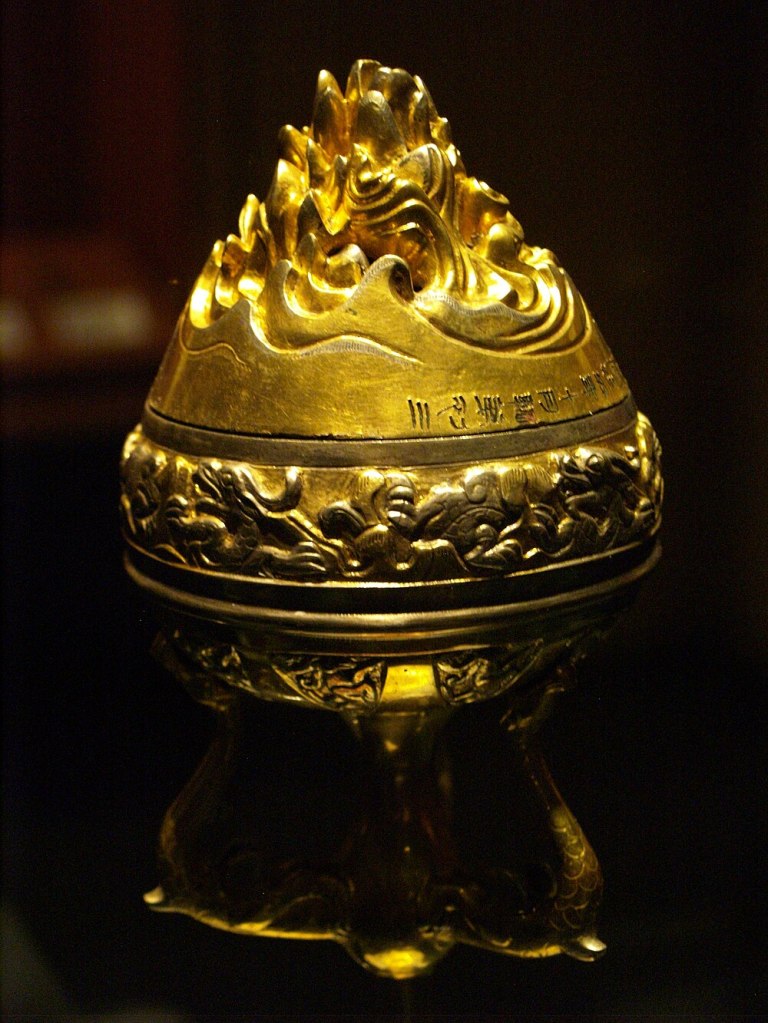
    A Incense Burner, allegedly given to Wei Qing by the Emperor Wu of Han

    The 6th year of Emperor Wu’s Yuan’guang Era (129 B.C.)

    In the winter, the court instituted the registration of merchant carriages throughout the realm, so as to levy taxes upon them.

    The Grand Minister of Agriculture, Zheng Dangshi, memorialized, saying, “If a canal is dug from the Wei River to the Yellow River, it will ease the transport of grain from the eastern provinces and irrigate more than ten thousand acres of arable land.”

    In the spring of the following year, the Emperor issued an edict mobilizing tens of thousands of laborers to undertake the work in accordance with Zheng Dangshi’s plan. After three years, the canal was completed, and it was praised throughout the land as a boon to the people.

    That same year, four armies were dispatched to strike the Xiongnu at the frontier markets. General of Chariots and Cavalry Wei Qing set forth from Shanggu; General of Cavalry Gongsun Ao from Dai; General of Light Chariot Gongsun He from Yunzhong; and General of Gallant Cavalry Li Guang from Yanmen. Each commanded ten thousand horsemen.

    Wei Qing advanced as far as Longcheng and captured seven hundred of the Xiongnu. Gongsun He returned without success. Gongsun Ao suffered defeat and lost seven thousand cavalrymen. Li Guang, too, was defeated and taken captive. The Xiongnu riders bound him, placed him between two horses, and bore him prone for more than ten li. Feigning death, Li Guang suddenly leapt onto a Xiongnu rider’s horse, seized his bow, and spurred the beast southward. Thus did he escape and return alive.

    Gongsun Ao and Li Guang, having suffered defeat in battle, were condemned to death by the Han court. They each redeemed their lives by paying the statutory ransom, and were thereafter stripped of rank and reduced to commoner status. Only Wei Qing, whose campaign deemed success, was enfeoffed with the title of Marquis Within Passes.

    Though born of low station, Wei Qing was skilled in horsemanship and archery, possessed great physical strength, and treated his officers with due respect while showing kindness to the common soldiery. The troops held him in high regard and followed him without hesitation. He had the makings of a competent commander; thus, in every expedition he achieved victory. The empire, observing this, gave credit to the Emperor for his discerning eye in recognizing and raising up the worthy.

    In the summer, the land suffered from severe drought, and locusts swarmed across the fields.

    In June, the Emperor set forth on an inspection tour, journeying to Yong.

    In autumn, the Xiongnu launched frequent incursions along the frontier, with Yuyang Commandery bearing the brunt of the attacks. The court appointed Han Anguo, Commandant of the Court Guard, as Infantry General, and ordered him to garrison his troops in Yuyang for the defense of the realm.

    The 1st year of Emperor Wu’s Yuanshuo Era (128 B.C.)

    In November of winter, an imperial edict was issued, proclaiming:

    “We have long instructed our officials to honor filial piety and uphold integrity, that such virtues might be extolled throughout the realm, establishing a standard for the generations to come and preserving the noble legacy of our forebears. Within every group of ten households, there ought to be one loyal and upright man; among every three, one who is worthy of emulation. Yet there are commanderies in which not a single name has been recommended. Such negligence obstructs the cultivation of virtue and hinders worthy men from receiving due recognition by the Sovereign.

    “In antiquity, those who advanced the worthy were rewarded, while those who concealed talent were punished with death in the marketplace. Thus excellence was encouraged, and the good brought to light. Let it be deliberated: what punishment befits those senior officials whose emoluments exceed 2000-piculs, yet who fail to put forth even one name in recommendation of the filial and upright?”

    The ministers submitted a memorial, stating: “To neglect the promotion of the filial is to disregard the imperial will; such is the crime of defying the sovereign. To be unable to discern the virtuous is to reveal one’s unfitness for office. Such officials ought to be removed.”

    The Emperor assented, and the measure was enacted.

    In December, King Yi of Jiangdu, Liu Fei, passed away.

    Prince Liu Ju was born to Madame Wei. That same day, Madame Wei was elevated to the throne of Empress, and a general amnesty was proclaimed throughout the realm.

    In autumn, twenty thousand Xiongnu cavalry breached the frontier. They slew the Prefect of Liaoxi and carried off more than two thousand captives. Advancing further, they laid siege to the garrison under Han Anguo’s command. Thereafter, they swept through Yuyang and Yanmen, each suffering over a thousand killed or captured. Han Anguo withdrew to Beiping, where he died after several months. The court then reappointed Li Guang as Prefect of Youbeiping. The Xiongnu chieftains, having long feared him, referred to him as the “Flying General of Han” and henceforth did not dare approach the territory under his watch.

    That same season, General Wei Qing led thirty thousand cavalry to strike the Xiongnu in the region of Yanmen, while General Li Xi advanced into Dai Commandery. Wei Qing’s troops slew several thousand of the enemy and returned in triumph.

    At this time, Nam Ryeo, chieftain of the Yemaek, together with his followers—numbering two hundred eighty thousand—submitted in surrender. The court established Canghai Commandery to govern them. The expense of their resettlement matched that incurred in pacifying the southwestern tribes such as Yelang, which led to disturbances between the territories of Yan and Qi.

    In that same year, the Prince of Lu, Liu Yu and the Prince of Changsha, Liu Fa passed away.

  • Comprehensive Reflections to Aid in Governance(Part 138): Ji An, Mr. Insensitive

    Comprehensive Reflections to Aid in Governance

    By Sima Guang

    Translated By Yiming Yang  

    Annals of Han Book 9 Scroll 17 (continued)

    Minyue(Fujian Province), Nanyue(Guangdong, China; Vietnam)

    The 6th year of the Emperor Wu’s Jianyuan Era (135 B.C. continued)

    At that time, the Han forces had already set forth on their southern campaign, though they had yet to cross the mountain passes. The King of Minyue, Zōu Yīng, mustered his troops to resist. But his younger brother, Zōu Yǔshān, secretly plotted with his kinsmen and ministers: “The king raised arms against Nanyue without first petitioning the Son of Heaven; for this offense the Han army now comes to chastise us. Their forces are vast and mighty. Should we by chance repel them, they will only return in greater numbers, and our state shall be utterly destroyed. Now, if we slay the king to placate the Han emperor, and he accepts our submission, the army may withdraw and our state be preserved. But if he refuses, then we shall fight to the last. And if defeat befalls us, we shall flee across the seas.”

    All present assented to this counsel. Thereupon, they took up a short spear and slew the king. They then dispatched an envoy bearing his severed head to the Grand Herald, Wáng Huī.

    When Grand Herald Wáng Huī received the severed head of the King of Minyue, he said, “Our expedition was undertaken to punish the king. Now that his head has been delivered, our purpose is fulfilled without bloodshed—this is the most fortunate outcome.” Thereupon, Wáng Huī notified the forces under the Minister of Agriculture, Hán Ānguó, and dispatched an envoy to the capital, bearing the head of Zōu Yīng to report to the Son of Heaven.

    The Emperor issued a decree recalling both generals and their armies, saying, “The principal offender, Zōu Yīng, is no more. Of his kin, only the Lord Yáo, Zōu Chóu, grandson of King Wǔzhū, took no part in the conspiracy.” He then dispatched a General of the Household as his envoy to appoint Zōu Chóu as King Yáo, thus continuing the ancestral rites of Minyue.

    Meanwhile, Zōu Yǔshān, having slain Zōu Yīng, seized command of Minyue and won the support of the people. He proclaimed himself King of Minyue. The Emperor judged it unnecessary to mount another campaign, and declared: “Though Zōu Yǔshān conspired with Zōu Yīng in rebellion, he later slew the traitor and thereby spared the army from battle.” In recognition, the Emperor enfeoffed Zōu Yǔshān as King of East Yuè, allowing him to reign alongside Zōu Chóu, King Yáo of Minyue.

    The Son of Heaven dispatched Zhuāng Zhū to convey his will to the King of Nanyue, Zhào Hu. The king received the envoy with deference, prostrating himself and declaring, “The Emperor has raised troops to chastise Minyue; I shall devote my life to repay this favor and virtue!” He thereupon sent his crown prince to serve in the palace guard and said to Zhuāng Zhū, “Our state has only just emerged from the turmoil of invasion. The envoy is prepared, and Zhào Hu makes daily preparations to journey north to pay homage at court.”

    Zhuāng Zhū took his leave. On his return, he passed through Huáinán, whereupon the Emperor again dispatched him to present the circumstances of the Minyue campaign to the Prince of Huáinán, Liú Ān, and to commend his earlier counsel. Liú Ān respectfully received the imperial message, giving thanks and confessing that his advice had been inferior to the Emperor’s judgment.

    After Zhuāng Zhū departed from Nanyue, the ministers of the southern court said to their king, “The Han raised arms to punish Zōu Yīng, and the reverberations have reached even our borders. Formerly, the late king often said, ‘When serving the Son of Heaven, it is sufficient to maintain proper rites and decorum.’ More than this is unwise. Be not beguiled by the pleasing words of envoys—for if you go to court, you may never return, and our state could be lost.”

    Thereafter, King Zhào Hu claimed illness and never proceeded to an audience with the Emperor.

    That same year, Hán Ānguó was appointed Grand Master of the Censorate.

    Ji An of Pǔyáng, formerly Commandant of Dōnghǎi Commandery, was appointed as Commandant for the management of the nobility registers. In his early service, Ji An held the post of internuncio. Known for his stern disposition and uncompromising conduct, he was feared by his peers.

    When strife erupted among the Eastern Yuè tribes, the Emperor dispatched Ji An to investigate. Yet Ji An returned from Commandery without reaching his destination, saying, “The internecine conflict of the Yuè reflects their native customs. It is unworthy of tainting the Emperor’s authority.”

    Later, a great fire broke out in Hénán, destroying over a thousand dwellings. The Emperor again sent Ji An to inquire into the matter. Upon his return, he reported, “It was but an ordinary fire, spreading from a single household to several others—not cause for alarm. However, while passing through Hénán, I observed tens of thousands afflicted by flood and drought. In desperation, some parents had turned to cannibalism. I therefore took it upon myself to open the state granaries and distribute grain to relieve their suffering. I now return the authority to Your Majesty and stand ready to receive punishment for acting in your stead.”

    The Emperor commended Ji An’s compassion and absolved him of any fault.

    During his administration in Dōnghǎi commandery, Ji An governed with restraint and simplicity, favoring the Taoism of non-intervention over rigid legalism. He appointed worthy subordinates, entrusted them with full responsibilities, and did not burden the administration with trifling matters, attending only to what was essential.

    However, Ji An was blunt in speech and lacking in courtesy, intolerant of others’ failings and often causing embarrassment in public discourse. When the Emperor once summoned scholars and men of talent to court, he expressed a desire to initiate new policies, saying, “I wish to do such and such.” Ji An replied, “Your Majesty conceals ambition beneath a guise of benevolence and virtue. Why don’t you really learn to govern like the ancient sages Yáo and Shùn?”

    At this, the Emperor fell silent and departed the court in anger, leaving ministers and courtiers in dread.

    Later, the Emperor spoke with his attendants, saying, “Ji An is obstinate beyond reason and wholly lacking in tact!”

    When some courtiers rebuked Ji An for his words, he replied, “The Emperor appoints ministers to serve as remonstrators. If they merely flatter his desires, how will the realm be justly ruled? I hold this office not to preserve myself, but to uphold righteousness. If I remain silent out of fear, would that not dishonor the court?”

    Ji An, long afflicted by illness, had taken extended leave from office, exceeding three months. The Emperor, mindful of his service, repeatedly prolonged his furlough, yet Ji An’s condition showed no improvement. In the end, as his final illness took hold, Zhuāng Zhù requested leave on Ji An’s behalf.

    The Emperor inquired, “What manner of man is Ji An of Pǔyáng?”

    Zhuāng Zhù replied, “When in office, Ji An does not exceed his station with ostentation. But if entrusted with the guardianship of a young sovereign, or withholding a besieged city, he will neither be swayed by enticement nor retreat at dismissal. In such matters, not even gallants like Mèng Bēn or Xià Yu could overcome him.”

    The Emperor sighed and said, “Indeed, the ancients had loyal ministers, and Ji An approaches their measure.”

    At that time, the Xiōngnú came forth with a request for peace through heqin—marriage alliance. The Emperor, weighing the matter, summoned counsels. The Grand Herald Wáng Huī, hailed from Yān, versed in frontier affairs, opposed the proposal, “In past times, the Han court entered into marriage pacts with the Xiōngnú, yet not long after, they betrayed the covenant and resumed their raids. Their pledges are hollow; it is better to gird our defenses and prepare for war.”

    On the other hand, Hán Ānguó urged acceptance of the proposal: “The Xiōngnú are a nomadic people, fleet as birds in migration, and long unbound by any sovereign’s yoke. Should we send troops across a thousand li in contest for gain, the cost in men and horses would be ruinous. In such terrain, the Xiōngnú possess mastery. This is a perilous road. It is better to pacify them by alliance and avoid entanglement in a distant war.”

    The court was divided in counsel, yet a majority inclined toward Han Ānguó’s view. Thus, the Son of Heaven consented to the treaty and accepted the peace by marriage.

    The 1st year of the Emperor Wu’s Yuan’guang Era (134 B.C.)

    In November of winter, an edict was proclaimed, directing each commandery and principality to put forth one candidate as exemplar of Filial Piety and Incorruptibility, in accordance with the counsel of Dong Zhongshu.

    Li Guang, Commandant of the Court Guard, was appointed General of Agile Cavalry and posted to Yunzhong. Cheng Bushi, Commandant of the Capital Guard, was made General of Chariots and Cavalry and dispatched to Yanmen. In June, both were relieved of command.

    Li Guang and Cheng Bushi had gained renown during their tenures as prefects of border commanderies. Li Guang commanded his troops without rigid formation. The army encamped where water and pasture were abundant. Each man was left to attend to his own needs. No sentries patrolled the perimeter by night, and official registers were kept in simple form. Yet scouts were dispatched without fail, and the camp was never taken by surprise.

    Cheng Bushi, by contrast, upheld the formalities of military order. His troops drilled by formation; records were kept with precision. Camps were set with strict guard, and sentinels made their rounds through the night. Officers and soldiers were meticulously documented; the army seldom knew rest. Yet his ranks, too, were never assailed.

    Cheng Bushi remarked, “Li Guang’s troops are light and unencumbered. The Xiongnu dare to trespass but find no means to strike. His soldiers rejoice in their freedom and are ready to die for him. My army is bound by order and appears burdened, yet the Xiongnu do not dare test us.”

    Indeed, the Xiongnu feared Li Guang’s unorthodox methods. Yet the soldiers of Cheng Bushi were less enthusiastic in their service.

    Sima Guang’s Commentary: The Book of Changes states: “The army must go forth under strict discipline; without it, there is no auspicious outcome.” This teaches that the management of multitudes without observance of disciplines leads inevitably to disorder.

    Li Guang’s manner of command—permitting each man to act at his own discretion—may have suited a man of singular talent. Yet such a method cannot be set forth as a general model. Why so? Because it is rare to find one of equal caliber to succeed him, and still rarer to find many generals alike in virtue and capability.

    The disposition of the common man is to pursue ease and disregard hidden danger. Freed from the rigor of Cheng Bushi’s governance, they would readily take joy in Li Guang’s leniency. But such liberty also breeds resentment and disobedience. When indulgence reigns, disorder follows. Thus, the peril of a lax and simple system lies not only in the diminished vigilance of Li Guang’s troops, but also in deeper unrest.

    It is said: “Military affairs require strictness to the end.” Those who take command must be resolute and unwavering. To emulate Cheng Bushi may yield no immediate glory, yet it is less prone to ruin. To adopt the ways of Li Guang may seem effective, but more often ends in misfortune.

    In April of summer, a general amnesty was proclaimed across the empire.

    In May, an imperial edict ordered the commanderies and principalities to recommend men of worth and erudition. These the Son of Heaven would examine in person.

    On July 29 in autumn, there was a solar eclipse.

  • Comprehensive Reflections to Aid in Governance(Part 131): Eccentric General Li Guang

    Comprehensive Reflections to Aid in Governance

    By Sima Guang

    Translated By Yiming Yang 

    Annals of Han Book 8 Scroll 16 (continued)

    General Li Guang

    The 3rd year of Emperor Jing’s Middle Era (147 B.C.)

    In November of winter, the office of Grand Master of the Censorate in all principalities was abolished.

    In April  of summer, an earthquake occurred.

    Drought prevailed, and a prohibition was issued against the brewing and drinking of alcohol.

    On March 8, Liu Cheng was enfeoffed as Prince of Qinghe.

    In September of autumn, locusts swarmed.

    A comet was observed in the northwest.

    On September 30, there was a solar eclipse.

    When the Emperor deposed Crown Prince Li (Liu Rong). Chancellor Zhou Yafu protested earnestly but could not prevail; thereafter, the Emperor became estranged from Zhou Yafu.

    Meanwhile, Prince Xiao of Liang often spoke ill of the Marquis of Tiao, in front of Empress Dowager Dou.

    Empress Dowager Dou said, “The Empress’s brother, Wang Xin, is worthy of being made a marquis.”  The Emperor declined, “In the time of the late Emperor, neither the Marquis of Nanpi, Dou Pengzu (the Empress Dowager’s nephew), nor the Marquis of Zhangwu, Dou Guangguo (the Empress Dowager’s younger brother), were granted marquisates. Only after my accession were these titles conferred. As for Wang Xin, he has yet to be ennobled (for lack of merit).”

    Empress Dowager Dou replied, “Fortunes rise and fall with the times. In my lifetime, my elder brother Dou Zhangjun was not granted a marquisate, and only after his death was his son Dou Pengzu ennobled. To this day, I deeply regret it. I beg Your Majesty to bestow a marquisate upon Wang Xin without delay.”

    The Emperor said, “Let me first consult with the Chancellor.”

    The Emperor then discussed the matter with Zhou Yafu. Zhou Yafu said, “Emperor Gaozu swore an oath: ‘Only those bearing the Liu surname shall be made princes, and only those with meritorious service shall be made marquises.’ Now, although Wang Xin is the Empress’s brother, he has no achievements. If he is granted a marquisate, it would violate the ancestral pact.”

    The Emperor fell silent and pursued the matter no further.

    Later, when six Xiongnu leaders, including King Xu Lu, surrendered, the Emperor wished to grant them marquises to encourage further defections. Zhou Yafu objected, “If they betray their sovereigns and Your Majesty rewards them with marquisates, how can Your Majesty demand loyalty from your own ministers?”

    The Emperor said, “I cannot follow the Chancellor’s advice.”  Thus, he granted marquisates to Xu Lu and the others.

    In September, Zhou Yafu cited illness and resigned from his post. The Grand Master of the Censorate, the Marquis of Tao, Liu She, was appointed Chancellor in his stead.

    The 4th year of Emperor Jing’s Middle Era (146 B.C.)

    In the summer, there was a locust infestation.

    In the winter, on October 26, there was a solar eclipse.

    The 5th year of Emperor Jing’s Middle Era (145 B.C.)

    In the summer, Prince Liu Shun was appointed as the Prince of Changshan.

    On June 29, a general amnesty was declared throughout the realm.

    There were extensive floods.

    In the autumn, on August 22, a fire broke out at the eastern gate of the Weiyang Palace.

    In November, a decree was issued: “For difficult cases where doubts persist in people’s hearts even though the legal procedures have been meticulously followed and led to the death penalty, such cases should be re-examined immediately and properly decided.”

    There was an earthquake.

    The 6th year of Emperor Jing’s Middle Era (144 B.C.)

    In October of winter, the Prince of Liang came to the capital to pay respects. He submitted a memorial expressing a desire to stay, but the Emperor did not grant permission. After returning to his princedom, the Prince seemed to be in a mood of despondent.

    In December, the names of multifarious officials and ministers, such as the Minister of Justice or Chief Architect, were changed.

    In the spring, on February 1, the Emperor conducted a tour to Yong and held the Sacrificial Rite at the temple of Five Color Emperors.

    In March there was rain and snow.

    In April of summer, Prince Xiao of Liang, Liu Wu, passed away. Empress Dowager Dou, upon hearing the news, was filled with grief and sorrow, refusing to eat. She lamented, “The Emperor has indeed killed my son!” The Emperor was deeply saddened and didn’t know what to do. He consulted with his elder sister, the Royal Princess(Princess Guantao) and decided to divide the principality of Liang into five separate princedoms. He then established five sons of Liu Wu as kings: Liu Mai as the Prince of Liang, Liu Ming as the Prince of Jichuan, Liu Pengli as the Prince of Jidong, Liu Ding as the Prince of Shanyang, and Liu Bushi as the Prince of Jiyin. Additionally, each of Prince Xiao of Liang‘s five daughters was granted a fiefdom.

    When this plan was presented to the Empress Dowager, she found solace in it and her mood improved. She resumed one meal a day. Before the Prince Xiao of Liang‘s death, his wealth had been immense, calculated to be billions of coins. After his death, there were still over four hundred thousand catties of pure gold left in his treasury, not to mention various other valuables.

    As the Emperor had already reduced the severity of the corporal punishment in the law books, it was observed that the number of caning deaths did not decline as expected. Therefore, he further reduced the number of strokes from three hundred to two hundred for certain offenses, and from two hundred to one hundred for others. Additionally, the law established specifications for the use of a proper instrument for caning: a cane that was five feet long, with a one-inch thick base made of bamboo, and a thin tip measuring half an inch, ensuring that the nodes were flattened. The strokes were applied to the buttocks, instead of the back.  The striker must be the same person to complete one punishment. This revision aimed to ensure that the person being punished survives. 

    However, while the caning penalty had been mitigated, the severity of the death penalty remained, leading to a situation where the penalties for minor offenses were lenient compared to serious crimes. This discrepancy in the severity of punishments made it easier for the people to commit lesser offenses without significant fear of consequences.

    In the month of June, the Xiongnu invaded the region near Yanmen Pass and reached Wuquan. They entered the Shangjun Commandery and seized horses from the imperial pastures. In the ensuing conflict, two thousand officials and soldiers lost their lives. 

    Li Guang from Longxi, was then the Prefect of Shangjun Commandery. On one occasion, he ventured out with a hundred cavalry and unexpectedly encountered several thousand Xiongnu horsemen. Witnessing Li Guang’s retinue, they perceived them as bait, causing an alarm that led them up a hill and organized a formation.

    Li Guang‘s hundred riders were filled with fear, eager to flee. Li Guang said to them, “We are several dozen li away from the main army. If we flee with just a hundred riders like this, the Xiongnu will chase us and shoot us down in no time. But if we stay and present ourselves as bait, they will hesitate to attack us, thinking we are part of a larger force.” He instructed his riders, “Forward!” 

    When they were about two li away from the Xiongnu formation, he halted and commanded, “Dismount and loosen your saddle girths!” 

    The riders were concerned, “The enemy is numerous and so close. What if they attack us?” 

    Li Guang responded, “The Xiongnu are thinking that we are fleeing. Now, by dismounting and loosening our saddle girths, we show that we’re not retreating, thus strengthening their suspicions that we are luring them.”

    As a result, the Xiongnu cavalry refrained from attacking. There was a commander among them riding a white horse, guarding his troops. Li Guang mounted his horse, rode with about ten riders, shot and killed the commander on the white horse, and then returned to his own troops. Once among his troops, Li Guang ordered them to dismount and loosen their saddle girths, instructing them to lie down beside their horses. As nightfall approached, the Xiongnu soldiers grew increasingly suspicious. Around midnight, they speculated that the Han forces had an ambush nearby, planning to attack at night. Thus, the Xiongnu retreated with their troops.

    At dawn, Li Guang returned to his main army.

    In the autumn, on July 29, there was a solar eclipse.

    After the death of Zhi Du, many members of the imperial family in and around Chang’an began to commit various crimes without restraint. As a response to this situation, the Emperor summoned Ning Cheng, who was serving as the Commandant of Jibei, to become the new Commandant of the Capital. Ning Cheng‘s methods of governance resembled those of Zhi Du, but his honesty and incorruption was not as pronounced. Nonetheless, both the imperial family members and influential figures were apprehensive and cautious.The Prince Gong of Chengyang, Liu Xi, passed away.