Princess Royal Gai had illicit relations with Ding Wairen of He’jian, a retainer of her son. Shangguan An was Ding Wairen’s friend, and spoke to him, “My daughter’s beauty is without peer. If, by the Princess Royal Gai’s connection, she may be admitted to the harem, and in time become Empress, then my father and I shall hold great strength in court. As for you—by the custom of the Han, princesses are wed to marquises; why then should you doubt that you will not be made a marquis?”
Ding Wairen was pleased, and conveyed these words to the Princess Royal Gai. The Princess Royal Gai consented, and ordered that Shangguan An’s daughter enter the palace as a consort. Shangguan An was thereupon appointed Commandant of Cavalry.
The 4th year of Emperor Zhao’s Shiyuan Era (83 B.C.)
On March 25 of spring, Empress Shangguan was established, and a general amnesty was proclaimed throughout the realm.
In the southwest, the tribes of Gu Zeng and Ye Yu rose again in rebellion. The Commandant of Water Conservancy, Lü Bihu, was ordered to lead the troops of Yizhou against them. But Lü Bihu, being fearful, did not advance. The barbarians slew the Governor of Yizhou, and, pressing their advantage, fought with Lü Bihu. More than four thousand soldiers were slain or drowned. In winter, the Grand Herald, Tian Guangming, was sent to subdue them.
That year, the Minister of Justice, Li Zhong, was convicted of sanctioning criminals on death roll, sentenced to death, and his corpse cast into the marketplace.
In the same year, Shangguan An was made General of Chariots and Cavalry.
The 5th year of Emperor Zhao’s Shiyuan Era (82 B.C.)
In January of spring, the Emperor’s maternal grandfather, Zhao Fu, was posthumously honored with the title Marquis of Shuncheng. The Marquis of Shuncheng had a sister, Zhao Junxu, who was enriched with a grant of two million coins, slaves, and a residence. Each of her brothers, according to their closeness to the throne, was rewarded with gifts, but none of them were employed in government or awarded titles.
At that time, a man driving a cart drawn by a yellow calf arrived at the northern gate, claiming to be the Crown Prince Wei, Liu Ju. The matter was reported by the Office of Public Transportation. An edict was issued, commanding the Three Excellencies, ministers, generals, and officials of two-thousand-picul rank to investigate and ascertain the truth. Tens of thousands of people gathered in Chang’an to witness the event, and the General of the Right mobilized troops to guard against disturbances. The Chancellor, the Censors, and the officials of two-thousand-picul rank all assembled, yet none dared to speak.
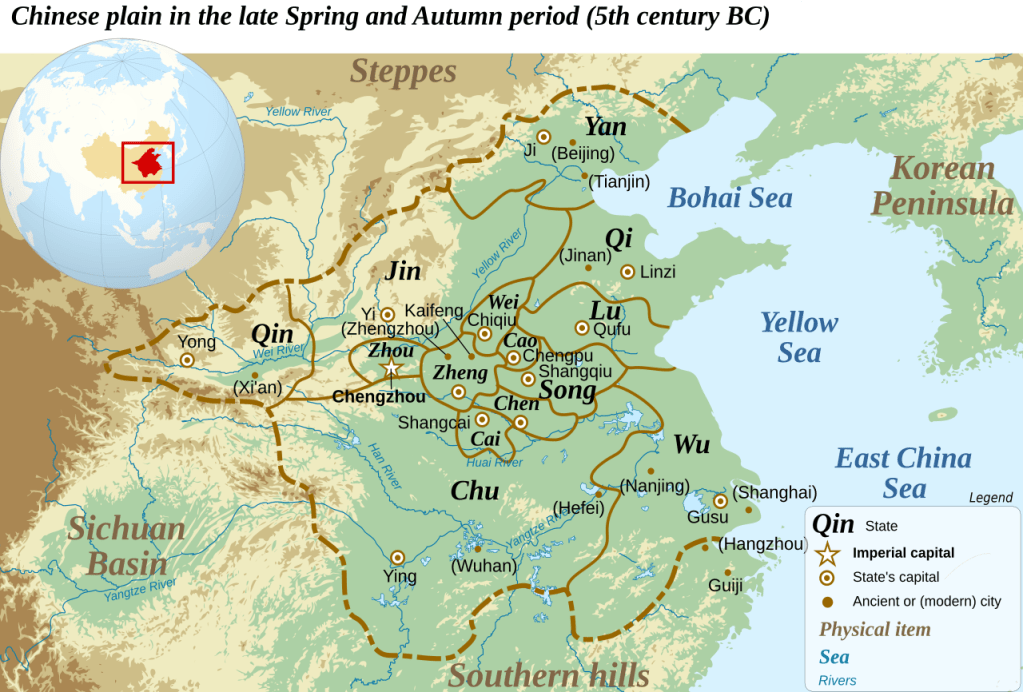
Later, the Intendant of Jingzhao, Juan Buyi, arrived and ordered his subordinates to arrest the man. Some advised waiting until the truth could be verified, but Juan Buyi declared: “Why hesitate over the so-called Crown Prince Wei? In the past, Kuai Kui, Duke Zhuang of Wey, defied orders and fled, yet he was rejected by his son Kuai Zhe, Duke Chu of Wey, as recorded approvingly in the Spring and Autumn Annals. The Crown Prince Wei committed offenses against the late Emperor. Even if he had not yet met his end, to come forth now of his own accord still marks him as a criminal!”
The man was seized and thrown into the imperial prison. The Emperor and the Grand General Huo Guang commended Juan Buyi, saying: “Officials and ministers should be men proficient in the Classics and upright in righteousness.”
Thus Juan Buyi rose to fame in the court, and even those in positions of power regarded themselves as his inferiors. The Minister of Justice investigated the matter and discovered that the man was in fact a swindler named Cheng Fangsui from Xiayang, who had been practicing divination by casting lots in Hu County. A former attendant of the Crown Prince had once consulted Cheng Fangsui and remarked, “Your appearance bears a striking resemblance to the Crown Prince Wei.” Cheng Fangsui seized upon this comment, hoping thereby to gain wealth and rank. Found guilty of deception, he was sentenced to be waist-chopped.
In the sixth month of summer, Shangguan An was ennobled as Marquis of Sang’le. Arrogant and self-indulgent, Shangguan An was often the recipient of lavish gifts within the palace. In the company of guests, he would boast of his intimacy with the Emperor, declaring: “I drank merrily with my son-in-law! When I see the clothes he wears, I feel compelled to return home and burn all my own garments.” When his son fell ill and died, he looked upward and cursed Heaven. His conduct was obstinate and recalcitrant.
The commanderies of Dan’er (Hainan Island) and Zhenfan (in Korea) were abolished.
In autumn, the Grand Herald Tian Guangming and the Judge General Wang Ping led an attack against rebels in Yizhou, beheading and capturing more than thirty thousand of the indigenous people and seizing over fifty thousand head of livestock.
Grandee of Remonstration Du Yannian, seeing the extravagance and frequent military expeditions after the reign of Emperor Wu, repeatedly counseled the Grand General Huo Guang, saying: “The harvests have been poor for consecutive years, and the displaced people have not yet fully returned to their homes. It would be wise to emulate the governance of Emperor Wen—practicing frugality, leniency, and harmony; attuning to the will of Heaven, bringing joy to the people, and in time the seasons will improve.” Huo Guang accepted his advice. Du Yannian was the son of the former Grand Master of Censorate, Du Zhou.
The Ruins of the Xiongnu’s Court Longcheng(Dragon City), Mongolia
The 1st year of Emperor Zhao’s Shiyuan Era (86 B.C.)
In summer, the tribes of twenty-four towns in Yizhou rose in rebellion, numbering more than thirty thousand. The Commandant of Waterways, Lü Bihu, summoned officials and civilians, and drew forth the troops of Qianwei and Shu commanderies to strike them. The rebels were routed, and a great victory was won.
In July of autumn, a general amnesty was proclaimed throughout the realm.
Heavy rains endured until October, the waters surged and swept away the bridge upon the Wei River.
When Emperor Wu first passed away, the new Emperor issued an edict of mourning to all the feudal lords. The Prince of Yan, Liu Dan, on receiving it, declined to wear mourning garb, saying, “The seal-envelope is smaller than before; surely some irregularity has arisen at the capital.” He dispatched his trusted men Shouxi Chang, Sun Zongzhi, Wang Ru, and others to Chang’an, outwardly to inquire into ritual observances, but in truth to spy upon court affairs.
The Son of Heaven, by decree, sent gracious words and bestowed gifts upon Liu Dan: three hundred thousand coins, with an increase of thirteen thousand households in his fief. Yet Liu Dan waxed wroth, saying, “It is I who should be enthroned as Emperor, not be given trifles.”
He conspired with his kin, the Prince of Zhongshan, Liu Chang, and Liu Ze, grandson of the Prince of Qi. Together they forged false decrees, alleging the late Emperor Wu having granted them governance and personnel of principalities, urging them to strengthen their armaments and make preparations beyond the ordinary.
The Gentleman of the Household, Cheng Zhen, admonished Liu Dan, saying, “Your Highness, why idly contend for what is yours by right? You must rise and seize it. When Your Highness raises the standard, even the women of the realm will rally to your cause.”
Thus Liu Dan entered into a secret covenant with Liu Ze, and together they composed a false proclamation to be spread abroad, declaring, “The young sovereign is no true son of Emperor Wu, but one foisted upon the throne by ministers. Let the whole realm rise together and strike him down!” Thereupon emissaries were dispatched to the provinces, sowing sedition among the people.
Liu Ze plotted to raise troops and march upon Linzi, intending to slay the Inspector of Qingzhou, Juan Buyi. Liu Dan gathered disloyal men from the provinces, amassed copper and iron to forge armor, conducted wapenshaws of his horsemen, chariots and infantry officers, and held great hunts to drill his soldiers, awaiting the appointed day.
The Palace Gentleman Han Yi and others often remonstrated with him, but Liu Dan grew wrathful, and slew fifteen men, Han Yi among them.
At that time, the Marquis of Ping, Liu Cheng, discerned Liu Ze’s treachery and secretly informed Juan Buyi. In August, Juan Buyi seized Liu Ze and his accomplices, and reported the matter to the throne.
The Son of Heaven dispatched the Associate Grand Herald to investigate, and summoned the Prince of Yan. By edict it was declared: “The Prince of Yan, being of close kin, shall be spared punishment.” Liu Ze and his followers were executed. Juan Buyi was promoted to Intendant of the Jingzhao(the Capital).
Juan Buyi, as Intendant of the Jingzhao, was held in reverence by both officials and the people. Whenever he went forth to circuit the counties or to review the prisons, his mother would inquire of him, saying, “Have you redressed any wrongs? How many have been acquitted?”
Whenever Juan Buyi overturned false judgments, his mother rejoiced greatly, her countenance more radiant than at other times. But if no injustices were set right, she grew wrathful and refused food. Thus Juan Buyi, in office, was stern yet not harsh, severe yet not cruel, ever weighing fairness in his judgments.
On September 2, Marquis Jing of Du, Jīn Mìdī, passed away. Earlier, when Emperor Wu lay ill, a testamentary decree had ordered that Jīn Mìdī be enfeoffed as Marquis of Du, Shangguan Jie as Marquis of Anyang, and Huo Guang as Marquis of Bolu, in recognition of their merits in subduing rebels such as Ma Heluo. Yet Jīn Mìdī, considering the tender age of the new Emperor, declined the title; Huo Guang and the others likewise did not dare to accept.
When Jīn Mìdī was stricken with grave illness, Huo Guang memorialized that he should be ennobled. As Jīn Mìdī lay upon his bed, the seal and ribbon were brought to him; he received them, but died that very day.
His two sons, Jin Shang and Jin Jian, both served as attendants to the new Emperor, being of near equal age. They slept and ate together. Jin Shang was appointed Commandant of the Imperial Chariot, and Jin Jian Commandant of the Imperial Cavalry.
After Jin Shang inherited his father’s marquisate, he bore two ribbons. The Emperor said to General Huo Guang, “The two brothers of the Jīn clan—should both of them wear two ribbons?”
Huo Guang replied, “Jin Shang inherited his father’s marquisate, thus he wears one ribbon more.”
The Emperor smiled, saying, “But is not the granting of titles a matter between you and me, General?”
Huo Guang answered, “It was the decree of the late Emperor, that titles be bestowed according to merit.” Thus the matter was put to rest.
In the intercalary month of October, the former Minister of Justice, Wang Ping, and others were dispatched, bearing the imperial sceptre, to make circuits through the provinces, to seek out men of virtue, to hear the grievances of the people, and to rectify cases of injustice and incompetence.
That winter was unseasonably warm, and no ice was formed.
The 2nd year of Emperor Zhao’s Shiyuan Era (85 B.C.)
In January of spring, General Huo Guang was enfeoffed as Marquis of Bolu, and General Shangguan Jie as Marquis of Anyang.
There were those who admonished Huo Guang, saying: “General, have you not observed the fate of the partisans of the Lü clan? Though they held the offices of Yi Yin and the Duke of Zhou, they grasped the reins of state alone, monopolized power, slighted the imperial clan, and shared not their duties with others. Thus the trust of the realm was lost, and ruin swiftly came upon them.
“Now you stand in a position of utmost weight, while the Emperor grows toward maturity. It is meet and right that you draw in the scions of the imperial house, confer with ministers, and reverse the ways of the Lü faction, so that calamity may be averted.”
Huo Guang assented to this counsel. He therefore summoned worthy men of the imperial clan, and appointed Liu Piqiang, grandson of Prince Yuan of Chu(Liu Jiao), and Liu Changle, of the imperial lineage, as Grand Master of Chamberlain. Liu Piqiang was further made Commandant of the Changle Palace Guard.
In March, envoys were dispatched to extend loans and relief to the poor who lacked seed grain and sustenance.
In August of autumn, an edict was issued, declaring: “In previous couple of years, calamities have been many. This year, the mulberry and wheat production suffers greatly. Let the loans and relief granted for seed and food not be repaid, and let the people be exempt from this year’s land tax.”
In earlier times, Emperor Wu had pursued the Xiongnu without respite for more than twenty years, whereby the Xiongnu suffered grievous losses in horses, livestock, and populace. The foaling of horses and calving of cattle declined sharply, and the Xiongnu were sorely troubled by the failing of their herds. Ever did they yearn for peace, yet no settlement was achieved.
The Chanyu Hulugu had a younger half-brother of the same father, who served as Left Grand Commandant, a man of talent and greatly esteemed among the people. But Hulugu’s mother, Zhuanqu Yanzhi, feared her son would be set aside and the younger brother chosen as heir. She therefore caused him to be secretly slain.
An elder brother of the Left Grand Commandant, born of the same mother, nourished hatred in his heart and refused to attend the Chanyu’s court.
In that year, the Chanyu fell gravely ill and neared death. He spoke to the nobles, saying: “My sons are yet young and cannot rule the state. I would appoint my brother, the Right Guli King, to succeed me as Chanyu.”
When the Chanyu died, Wei Lü and others conspired with Zhuanqu Yanzhi to conceal the news. They forged a decree in the Chanyu’s name, and set up her son, the Left Guli King, as the new Chanyu, taking the title Huyandi.
The Left Tuqi King and the Right Guli King bore anger and resentment. With their followers, they resolved to march south and surrender to the Han. Fearing they could not accomplish this alone, they compelled King Lutu to defect with them to the Western Wusun.
King Lutu revealed their plot to the Chanyu. The Chanyu sent envoys to question them, but the Left Guli King refused obedience, and in turn accused King Lutu of treason. The people bewailed the injustice.
Thereafter, the two princes departed, each establishing his own dwelling, and no longer appeared at the Chanyu’s court–Longcheng, where deities were worshiped. From this time, the power of the Xiongnu waned.
Sima Qian’s Tomb and Ancestral Temple, Photo by dayu490301
The 2nd year of Emperor Wu’s Tianhan Era (99 B.C. continued)
Li Guang had a grandson named Li Ling, who served as a privy counselor and was skilled in horse riding and archery. He had a good rapport with common soldiers. The Emperor, noticing his similarity to Li Guang‘s character, appointed him as the Commandant of Cavalry. Li Ling was tasked with leading five thousand men from Danyang and Chu areas to train in archery at Jiuquan and Zhangye to prepare against the Xiongnu.
During the campaign against the Xiongnu, the Emperor issued a decree to Li Ling, intending to make him responsible for leading the supply train for Ershi General‘s army. Li Ling kowtowed and pleaded, “The soldiers I command stationed at the border are all brave warriors from Jingzhou and Chu, with exceptional swordsmanship skills. They can wrestle with tigers and hit the mark with their arrows. I request to lead a detachment, heading to the south of Mount Lanyu, to divide the Chanyu’s forces and prevent them from solely targeting Ershi General’s army.”
The Emperor replied, “You don’t like to be under another commander, do you? I have already dispatched so many troops and have no cavalry to spare for you.”
Li Ling countered, “Without cavalry, I am willing to lead a small force against a large one. I will take five thousand infantry to confront the Chanyu in his court.”
The Emperor, in a moment of inspiration, granted his request.
He then ordered Lu Bode to lead troops to meet Li Ling halfway. However, Lu Bode felt embarrassed to trail behind Li Ling, so he reported, “It is still in autumn, the Xiongnu‘s horses are fat and strong, it’s not suitable for battle yet. I propose keeping Li Ling‘s forces until spring before setting out together.”
The Emperor, angered and suspicious that Li Ling was chickened out, reluctant to engage and telling Lu Bode to propose delay, decreed Lu Bode to lead troops to fight the Xiongnu in the Xihe immediately.
Li Ling received the decree to depart in September. The Emperor ordered him to set out from the Juyan Pass, reaching the Longle River south of the East Mount Junji, scouting the enemy territory, and returning if not encountering any adversaries, resting the troops in the “Home of Defectors” city.
Li Ling led his five thousand infantrymen leaving Juyan Pass, traveling north for thirty days until they reached a stop at Mount Junji. He charted the topography of the mountains and rivers along the way, instructing his cavalry subordinate Chen Bule to bring the map to the Emperor. Upon meeting the Emperor, Chen Bule praised Li Ling‘s leadership and the efforts of his soldiers who risked their lives. The Emperor was greatly pleased and appointed Chen Bule as a Palace Gentleman.
Li Ling arrived at Mount Junji, encountering the Chanyu’s forces. The Xiongnu had around thirty thousand cavalry surrounding Li Ling‘s army, positioned between two mountains with their camp fortified using large chariots. Li Ling arranged his soldiers outside the camp in formation, with the front rows holding spears and shields while the rear rows carried bows and crossbows. Seeing the smaller Han army, the enemy charged straight towards the camp. Li Ling engaged them in battle, launching a volley of a thousand crossbows, causing chaos among the enemy ranks. The Xiongnu retreated uphill, with the Han forces pursuing and killing thousands.
The Chanyu, alarmed, summoned more than eighty thousand cavalry from the left and right flanks to attack Li Ling. Li Ling fought while retreating southwards for several days, reaching a mountain valley where continuous battles occurred, and his soldiers suffered arrow wounds. Those with three wounds were carried to chariots, those with two wounds driving the chariots, and those with one continued fighting. They beheaded over three thousand enemies.
Leading his troops southeastward, following the former Longcheng Road for four to five days, Li Ling arrived at a vast marshland with reeds. The Xiongnu set fire from an advantageous position, and Li Ling ordered his army to do the same for defense. Continuing southward to the foothills, the Chanyu was positioned on a southern hill and sent his son to lead a cavalry attack against Li Ling. Li Ling‘s forces fought amidst the trees and killed thousands more. Li Ling then unleashed a barrage of crossbows toward the Chanyu, forcing him to retreat downhill.
On that day, the Han soldiers captured a Xiongnu soldier who reported, “The Chanyu said, ‘These are elite Han soldiers. We cannot defeat them. They continually draw us southward near the border. Could they not have ambushes waiting for us?’ All the Xiongnu chiefs and leaders agreed, ‘The Chanyu himself led tens of thousands of riders against a few thousand Han soldiers, and yet he couldn’t eliminate them. There’s no way to send generals to the frontier later, making Han further disdainful of the Xiongnu. Let’s fight fiercely in the mountain valleys, it is forty to fifty lis before we reach the plain. If we couldn’t conquer them by then, we will turn back.’”
The situation for Li Ling‘s army grew increasingly dire. With numerous Xiongnu cavalry attacks occurring multiple times a day, they managed to kill over two thousand enemy soldiers. The Xiongnu leaders were frustrated, and they intended to withdraw. However, at that critical moment, a Han officer named Guan Gan, who had been insulted by Colonel Han Yannian, defected to the Xiongnu and revealed crucial information. He told them, “The army led by Li Ling has no reinforcements, their arrows are almost depleted. Only General Li Ling and Colonel Han Yannian, the Marquis of Cheng’an leading eight hundred men each as the front line, identified by their yellow and white flags. They are the ones to shoot at; once they’re down, victory will be certain.”
The Chanyu was delighted upon hearing this and ordered a full-on assault against the Han army, loudly urging, “Li Ling, Han Yannian, surrender quickly!” They immediately blocked Li Ling‘s path and attacked fiercely. Li Ling was in a valley, while the Xiongnu were on the mountain, shooting arrows from all directions like rain fall. As the Han army moved southward and before reaching Mount Dihan, their five hundred thousand arrows were exhausted within a single day, and they abandoned their chariots. With only over three thousand men remaining, soldiers broke the chariot axles and carried them as cudgels, civil clerks held scribe knives as weapons. They advanced toward the mountains, entering a narrow valley where the Chanyu blocked their retreat, throwing rocks from the mountains, resulting in many deaths among the Han soldiers, preventing them from advancing.
After dusk, Li Ling, dressed plainly, walked out of the camp alone, saying, “Don’t follow me! I will take on the Chanyu man-to-man!” After some time, Li Ling returned, sighed deeply, and said, “The battle is lost; death is imminent!” He then proceeded to cut down all the banners and buried the treasures in the ground. Li Ling lamented, “If only I could find dozens of arrows, I could escape. Now, without soldiers for battle, by daybreak, I will be captured and bound. Why don’t we disperse like birds and animals, some of us might manage to escape and report to the Emperor.”
He instructed his soldiers to carry two liters of grain and a piece of ice each, agreeing to rendezvous at the defense barrier at the border. At midnight, when Li Ling beat the drums to issue commands, the drums were broken and failed to make a sound. Both Li Ling and Han Yannian mounted their horses, accompanied by around ten brave men. Several thousand Xiongnu cavalry pursued them, and in the ensuing battle, Han Yannian perished. Li Ling, realizing the situation and said to himself: “I have no dignity to face the Emperor”, surrendered, and the soldiers scattered, with over four hundred managing to escape to the border.
The place of Li Ling‘s defeat was over a hundred li (approximately 50 kilometers) towards the border and his situation was widely known to the frontier. The Emperor wished Li Ling to fight to the death. However, upon hearing of Li Ling‘s surrender, the Emperor was greatly angered and interrogated Chen Bule. Unable to withstand the pressure, Chen Bule committed suicide.
All court officials blamed Li Ling, and the Emperor asked Sima Qian, the Grand Astronomer, for his opinion.
Sima Qian defended Li Ling, “Li Ling was filial to his family, loyal to his soldiers, and always showed selfless dedication to the urgent needs of the country. His inherent qualities were those of a true patriot. Unfortunately, in this instance of adversity, those who have selfishly protected themselves and their families rush to exploit his shortfall. It’s truly regrettable! Moreover, Li Ling led less than five thousand soldiers, facing tens of thousands of enemies. The Xiongnu neglected tending to their wounded and deceased so as to mobilize their full populace to encircle Li Ling. Li Ling still fought a thousand-li journey. When their arrows were depleted and the path blocked, the soldiers stood empty-handed, risking their lives, fighting valiantly against their northern adversaries. The power of the soldiers’ sacrificial bravery in the face of death rivals that of renowned ancient generals. Though Li Ling himself faced defeat, his conquests and defeats are enough to win admiration of the world. The fact that he did not die perhaps signifies his wish to have the opportunity to repay the court in the future.”
The Emperor charged Sima Qian with falsehood, alleging that he had conspired to slander the Ershi General and plead on behalf of Li Ling, and sentenced him to be castrated.
After some time, regretting that Li Ling had received no assistance, the Emperor proclaimed, “When Li Ling exited the borders. I should have issued an edict for the Commandant of Strong Crossbows Lu Bode to go after him as reinforcement. My edict was issued too early, inciting old general Lu Bode to be jealous, acting dishonorably.” He then sent envoys to reward and honor those remaining soldiers of Li Ling‘s army who managed to escape.
The Emperor, enforcing strict laws, favored the use of austere officials, and as a result, many of the prime ministers and prefects in charge of the commanderies and principalities, holding ranks of 2000 piculs, were generally cruel and oppressive. This led to the people and officials increasingly disregarding the law. Bandits and thieves in the eastern regions multiplied, forming large groups of several thousand gangs, attacking cities and towns, seizing armories, releasing prisoners on death row, and humiliating the county magistrates and commandants, leading to the killing of officials holding the rank of 2000 piculs. Smaller gangs, each numbering in the hundreds, pillaged countless villages and neighborhoods, making the roads impassable.
Initially, the Emperor tasked the Chief of Censorate and the Chief of Staff of the Chancellor to supervise the public safety, but they couldn’t control it. Subsequently, the Emperor dispatched his special agents, the Grandee of Chamberlain, Fan Kun, and former Nine Ministers, such as Zhang De, donned in embroidered silk clothing, holding the sceptres and tiger seals, to raise armies and suppress the uprising. The beheading of a large number of individuals, some exceeding ten thousand, was followed by the legal execution of those who were complicit in communications, provisions, or any other connections, with several thousand people in the various commanderies facing punishment. After several years, they managed to capture some of the leaders, but many of the scattered gangs, who had lost contact, regrouped and formed bands, retreating to strongholds in the mountains and on rivers, often gathering in large numbers. There was nothing that could be done to stop them by the government.
The Emperor issued the “Law of Life Censure,” which stated, “In the case of banditry arising without being reported, or if discovered but not fully resolved, officials ranging from 2000 piculs rank to minor officials shall face the death penalty.”
Following this law, the fear of punishment among lower officials became widespread, resulting in instances where even if theft occurred, they dared not report it, fearing their inability to resolve it would lead to punishment. The commandery officials, afraid of being implicated, refrained county magistrates from reporting such incidents. Consequently, the numbers of bandits and thieves increased as both high-ranking officials and ordinary citizens concealed crimes through crafty speech to evade punishment.
At that time, Bao Shengzhi, who was directly appointed by the Emperor as an agent. He executed an unusual number of 2000-picul ranked officials, establishing a strong authority over the commanderies and principalities. Upon reaching Bohai Commandery, he heard about a man named Juan Buyi, who was highly esteemed by the locals and requested an audience with him. Juan Buyi had a dignified appearance and wore impressive attire. When Bao Shengzhi heard Juan Buyi was coming to meet him, Bao Shengzhi rose to greet him without properly tying his shoes. After sitting down, Juan Buyi pushed up from the floor and said, “Even lying low on the coast, I have long heard of the fame of Bao Gongzi(Bao Shengzhi’s courtesy name). Today, I humbly receive your audience. In serving as an official, if one is overly rigid, people tend to break out; if too yielding, the law is not enforced. To establish one’s achievements and fame enduringly, wield authority tempered with kindness.” Bao Shengzhi deeply appreciated his admonition.
At that time, Bao Shengzhi, who was directly appointed by the Emperor as an agent. He executed an unusual number of 2000-picular ranked officials, establishing a strong authority over the commanderies and principalities. Upon reaching Bohai Commandery, he heard about a man named Juan Buyi, who was highly esteemed by the locals and requested an audience with him. Juan Buyi had a dignified appearance and wore impressive attire. When Bao Sheng heard Juan Buyi was coming to meet him, Bao Shengzhi rose to greet him without properly tying his shoes. After sitting down, Juan Buyi pushed up from the floor and said, “Even lying low on the coast, I have long heard of the fame of Bao Gongzi(Bao Shengzhi’s courtesy name). Today, I humbly receive your audience. In serving as an official, if one is overly rigid, they tend to break; if too yielding, they are useless. To establish one’s achievements and fame enduringly, wield authority tempered with kindness.” Bao Shengzhi deeply appreciated his admonition.
Upon his return, Bao Shengzhi recommended Juan Buyi. The Emperor summoned Juan Buyi and appointed him as the Inspector of Qingzhou. Similarly, Wang He of Ji’nan, also served as a censor in embroidery, chasing and capturing bandits in Wei Commandery. He had released and pardoned many of them, contrary to the requirements of his mission. He was dismissed. He sighed, “I’ve heard that saving a thousand lives earns a title for one’s descendants. I’ve saved more than ten thousand lives; will there be a future reward for my posterity?”In that year, the Han court bestowed the title of Marquis of Kailiang upon Cheng Wan, the Jiehe King of the Xiongnu who defected to the Han. Cheng Wan led troops from the Loulan kingdom to attack Cheshi. However, the Xiongnu dispatched the Right Tuqi King with tens of thousands of cavalry to reinforce Cheshi. The Han forces did not fare well in the encounter and subsequently withdrew from the conflict.


 Reflection by Rio Grande