After the nomination ceremony, the King of Han sat down with Han Xin and said, “The Prime Minister has recommended you so many times. What can you teach me about strategy?” Han Xin expressed his gratitude and downplayed the praise before addressing the King of Han, “It is King Xiang Yu who contends with Your Majesty for power in the east, isn’t it?”
Han Xin then asked, “In terms of strength and chivalry, how do you compare yourself to Xiang Yu?”
After a moment of thought, the King of Han admitted, “I am not as good as him.”
Han Xin saluted the King of Han and encouraged him, saying, “I agree with Your Majesty’s assessment. However, I once served under Xiang Yu, so I know his personality well. Xiang Yu‘s roar alone can make thousands tremble with fear, but he lacks the ability to choose capable people to assist him, which makes him a force of one. While he treats people kindly and is compassionate, he is also soft-hearted and sentimental. He cries when he sees someone suffering from illness and shares his food and drink with the sick. However, he is also stingy in rewarding his subordinates. Even when they achieve great merits, he is reluctant to grant them high ranks, keeping the seals of power firmly in his own hands until edges are worn out. This is what we call the petty kindness of a woman.”
“Xiang Yu dominates the nation, and all the rulers submit to him, but he chose Pengcheng as his capital instead of staying in the strategically advantageous Guanzhong region. He gave away territories to his friends unjustly, violating the agreement made with the Honorary Emperor. He removed legitimate rulers and replaced them with generals or ministers of his liking, and he even banished the Honorary Emperor to the south of the Yangtze River. Wherever he goes, he leaves destruction in his wake. The people do not support him; they only fear his might. Although he appears to be the hegemon of the country, he has already lost the people’s hearts. This is his weakness.”
“If Your Majesty does the opposite of what Xiang Yu does, then his strength could easily turn into his vulnerability. Who could cling to life if you deployed the country’s bravest warriors against him? Who would not heed your command if you rewarded your allies with the nation’s best cities? Who would dare stand in your way if you lead your troops back home rightfully? The three kings of Qin (Zhang Han, Sima Xin, Dong Yi) were once generals who forced the people of Qin to fight for years, witnessing countless deaths. Yet, they coerced these same people to surrender to the Chu forces. When Xiang Yu buried 200,000 prisoners of war alive at Xianyang, only the three generals survived. The people of Qin hate these three to the bone.”
“The Chu authority installed these generals as kings of Qin by decree, but the people did not accept them. When Your Majesty entered Wu Pass, your troops did not harm a single civilian, and you abolished Qin‘s harsh laws, replacing them with the simple law of three articles. The people of Qin love you and wish for you to be their king. According to the allies’ agreement, you should indeed be the rightful king of Qin. The people all knew the pact, and were outraged when you were sent to Hanzhong. Now, if Your Majesty advances eastward, the three kingdoms of Qin could be conquered simply by issuing a proclamation.”
The King of Han was deeply moved by Han Xin‘s words and regretted not promoting him sooner. He decided to adopt Han Xin‘s strategy and assigned his generals to their respective targets of attack, while leaving Xiao He in Ba and Shu commanderies to collect taxes and ensure a stable food supply for the army.
In August, the King of Han launched a surprise attack on the Kingdom of Yong by advancing through Gudao county. Zhang Han, the King of Yong, countered the attack at Chencang county, but his forces were defeated and retreated. They regrouped at Haoshi county but were beaten again and fled back to their capital, Feiqiu. The King of Han captured most of the territory of the Yong Kingdom, advancing as far east as Xianyang, and laid siege to the city of Feiqiu and its ruler, Zhang Han. Meanwhile, he dispatched his generals to capture other territories in the Qin region. The King of Sai, Sima Xin, and the King of Di(Zhai), Dong Yi, both surrendered to the King of Han. The King of Han then established the commanderies of Weinan, Heshang, and Shangjun within Qin‘s territory.
The King of Han ordered Generals Xue Ou and Wang Xi to move eastward through Wu Pass, where they linked up with Wang Ling‘s forces to escort the King of Han’s father and his wife, Queen Lü, to Guanzhong. Upon hearing this, Xiang Yu deployed his troops to block their advance at Yangxia county.
Wang Ling, originally from Pei County, had gathered thousands of his followers and occupied Nanyang before joining the King of Han‘s camp with his troops. When Xiang Yu learned of Wang Ling‘s approach, he took Wang Ling’s mother hostage and held her under house arrest in his camp. To persuade Wang Ling to switch allegiance, Xiang Yu received Wang Ling’s envoy with respect, seating Wang Ling’s mother in a place of honor. During a private conversation with the envoy, Wang Ling’s mother said, “Please tell my son to remain loyal to the King of Han. The King of Han is destined to rule the country. He must not waver for the sake of me. I will die to see him off.” She then took her own life by throwing herself onto a sword in front of the envoy.
Enraged by this act of defiance, Xiang Yu ordered his men to boil the corpse of Wang Ling’s mother.
King Xiang Yu conferred the title of King of Hán to Zheng Chang, the former magistrate of Wu county, to hinder the advance of the King of Han.
Zhang Liang sent a letter to King Xiang Yu: “The King of Han did not get what he deserved. He only wishes to possess Guanzhong (Three Qins). He will stop where all agreed upon in the pact and dares not go further east.” He also sent the rebellion manifestos from the Kingdom of Qi and Kingdom of Liang (Wei) to King Xiang Yu, stating: “The Kingdom of Qi intends to ally with the Kingdom of Zhao to annihilate the Kingdom of Chu.” These communications distracted Xiang Yu‘s attention from the west and redirected his attacks to the north.
The former King of Yan, Han Guang, had no intention of going to his kingdom in Liaodong. The new King of Yan, Zang Tu, attacked and killed him, then annexed Han Guang’s kingdom.
The King of Han appointed Zhou Ke, an old friend from Pei County and the current mayor of Xianyang, as the Grand Master of Censorate.
King Xiang Yu hastened the relocation of the Honorary Emperor to his new court, and some of the emperor’s ministers and attendants chose to leave his court.
A man from Huaiyin county, named Han Xin, came from a poor family and was unruly. He was neither recommended for a government position nor inclined to make a living through trade or labor. Instead, he spent his time around people, often relying on them for food and drink, which caused most to shun him. One day, while Han Xin was fishing outside the city walls, an old woman doing laundry nearby saw him starving and gave him some food. Han Xin expressed his gratitude, saying, “Aunty, I will reward you greatly someday.” The old woman was unimpressed and reproached him, “You’re a grown man who can’t even feed yourself. I gave you food out of pity, not because I expect anything in return.”
One day in downtown Huaiyin, a young butcher who liked to bully Han Xin confronted him: “You look tall and strong and like to wear swords and machetes, but I bet you’re a coward inside!” He challenged Han Xin publicly, saying, “If you’re not afraid of death, stab me; if you are, crawl between my legs!” Han Xin stared at the butcher for a long moment, then got down on his hands and knees, crawling under the butcher’s crotch before prostrating himself. The crowd burst into laughter, jeering at Han Xin.
When Xiang Liang revolted against Qin and led his troops across the Huai River, Han Xin joined his forces with his sword, serving under Xiang Liang but failing to distinguish himself. After Xiang Liang‘s defeat and death, Han Xin joined Xiang Yu’s army as a guard officer in his central command. Despite presenting several strategies, his ideas were dismissed by Xiang Yu. Later, when the King of Han entered Shu commandery, Han Xin left Chu‘s camp and joined his forces, where he remained unnoticed, serving as a logistics officer.
Han Xin was implicated in a case due for collective punishment, which was punishable by death. Thirteen of his fellow cohorts had already been executed, and it was Han Xin’s turn next. As he looked up, he saw the Duke of Teng, Xiahou Ying, and called out for help: “Does the king want to conquer the country? Why is he beheading a capable fighter?” Xiahou Ying, impressed by Han Xin‘s words and his stature, commuted his death sentence. After speaking with Han Xin at length, Xiahou Ying was delighted and introduced him to the King of Han, who appointed Han Xin as Colonel of Grain Procurer. Despite this promotion, Han Xin‘s role remained unremarkable.
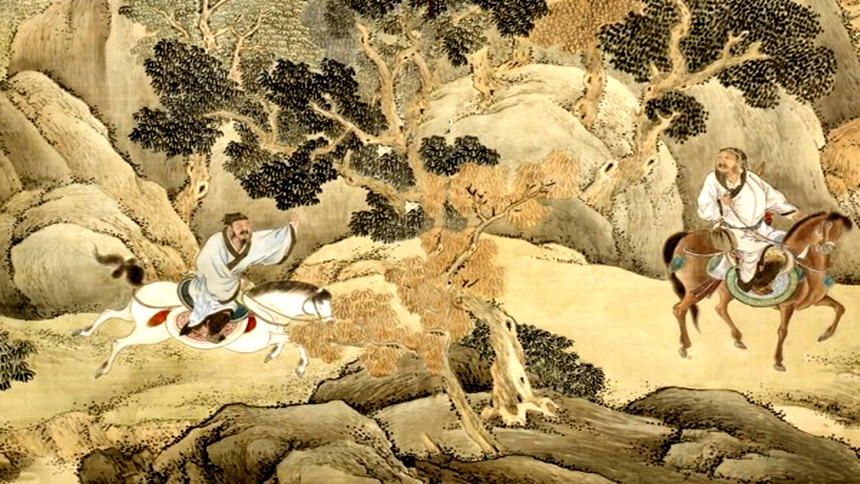
Han Xin had several conversations with Xiao He, who was captivated by his potential. When the King of Han reached Nanzheng County, many of his subordinates missed their homeland in the east. They sang folk songs together and many deserted along the way. Frustrated by his lack of advancement despite Xiao He and Xiahou Ying‘s endorsements, Han Xin also decided to leave. Upon hearing that Han Xin had fled, Xiao He, shocked, immediately chased after him without even informing the King of Han.
When someone reported to the King of Han, “Prime Minister Xiao He has run away,” the king was livid, feeling as though he had lost his right hand. Two days later, Xiao He returned to see the King of Han, who was both angry and relieved. The King demanded, “Why did you run away?” Xiao He replied, “I didn’t run away; I was chasing after a man who had fled.” When the King asked who that man was, Xiao He answered, “Han Xin.” The King of Han, still upset, retorted, “Dozens of generals have deserted, yet you ran after Han Xin? You are lying!” Xiao He explained, “Those other generals are easy to find, but Han Xin is a rare talent without equal. If Your Majesty only wishes to be King of Han, then Han Xin isn’t essential. But if you intend to conquer the entire realm, there is no better strategist than Han Xin. It all depends on your ambitions.”
The King of Han admitted, “I do want to return to the east. Who could bear staying in this desolate place for long?” Xiao He urged, “If that is your plan, then you must offer Han Xin a significant position to keep him from leaving.” The King of Han agreed, saying, “For your recommendation, I will make Han Xin a general.” Xiao He was unimpressed, responding, “He won’t stay for just a general’s rank.” The King of Han then said, “How about Grand Marshal?” Xiao He finally approved, “That would be appropriate!”
As the King of Han prepared to summon Han Xin, Xiao He advised him, “Your Majesty has treated people too casually. You call for someone to take a high position as if you were calling a child. That’s why Han Xin ran away in the first place. If you truly want him to accept the role, you must fast and pray, choose an auspicious day, and hold a ceremony with all due rites. That would be fitting.” The King of Han agreed to the proposal.
When the news spread, the generals were thrilled, believing they might have a chance at the top military rank. But when the ceremony revealed that Han Xin was being appointed Grand Marshal, the entire army was left in stunned silence.
In December, Xiang Yu’s troops reached the Xi River. Meanwhile, Cao Wushang, the left wing major under Duke of Pei, sent a messenger to Xiang Yu, slandering the Duke of Pei: “The Duke of Pei intends to become the King of Qin. He plans to make Ziying his chancellor and seize all the treasures of Qin.” Cao Wushang said this to gain favors from Xiangyu. Infuriated by this information, Xiang Yu organized a feast for his soldiers and prepared to launch an attack on the Duke of Pei the following morning. At that time, Xiang Yu commanded four hundred thousand troops, though he claimed to have a million, and camped at a village called Hongmen[Swan Goose Gate] in Xinfeng County. The Duke of Pei had one hundred thousand troops, with claims of two hundred thousand, and was stationed at Bashang.
Fan Zeng advised Xiang Yu: “The Duke of Pei was known for his greed and indulgence when he lived east of the Hangu Pass. But since entering the Pass, he hasn’t hoarded any valuables or sought out women. His ambitions now are far greater than mere wealth or pleasure. I sent people to observe the clouds around him, and they reported seeing auspicious signs like those of the dragon and tiger. They even saw a rainbow over him—an omen of the Son of Heaven. You must act quickly and strike him decisively. Do not let him slip away.”
The left-wing commander of the Chu army was Xiang Yu’s uncle, Xiang Bo, who was a good friend of Zhang Liang. Late at night, Xiang Bo secretly visited the Duke of Pei’s camp to meet with Zhang Liang. He warned Zhang Liang about the imminent attack and urged him to flee together: “You don’t want to die along with all the troops here.” Zhang Liang responded, “The King of Han instructed me to accompany the Duke of Pei into the Pass. Now that the Duke of Pei faces a crisis, it would be a dishonor of me to abandon him. I must speak with him first.”
Zhang Liang entered the Duke of Pei’s tent and informed him of the situation. Startled, the Duke of Pei asked, “Do you think our soldiers can withstand Xiang Yu’s attack?” Zhang Liang replied, “Our troops are indeed no match for Xiang Yu. But we must act swiftly.” He suggested, “Please speak to Xiang Bo and assure him that the Duke of Pei has no intention of betraying Xiang Yu.” Curious, the Duke of Pei asked, “How do you know Xiang Bo so well?” Zhang Liang explained, “We were playmates under Qin’s rule. He once killed someone, and I saved his life. Now, he repays that favor by warning me.” The Duke of Pei inquired further, “Between you and him, who is older?” Zhang Liang replied, “Xiang Bo is a few years older than I am.” The Duke of Pei decided, “Please invite him to meet me. I will honor him as an elder brother.”
Zhang Liang returned and insisted that Xiang Bo meet the Duke of Pei, and Xiang Bo eventually agreed. Upon entering the Duke of Pei’s tent, the Duke of Pei warmly received him, raising wine cups and toasting in his honor. He even proposed a marriage alliance between their families. The Duke of Pei explained, “Since entering the Pass, I have not taken even the smallest treasure from Qin. I preserved all the household records and sealed the vaults and warehouses of the Qin government, waiting for General Xiang to distribute these valuables. The reason I ordered the Hangu Pass closed was to prevent bandits and any other incidents. We eagerly await General Xiang’s arrival day and night. How dare I turn against him? Please, Mr. Xiang Bo, convey my pledge that I have no intention of betraying General Xiang.” Xiang Bo affirmed and advised the Duke of Pei, “You must come tomorrow morning to see General Xiang and clear any misunderstandings in person.” The Duke of Pei promised, “You have my word.”
Xiang Bo returned to his camp that same night, relayed the Duke of Pei’s message, and pleaded with Xiang Yu, “If the Duke of Pei had not entered the Wu Pass first, you would not have so easily walked into the land of Qin. Attacking someone who has just accomplished such a significant feat would be unjust. It would be better to treat him with respect.” Xiang Yu assured Xiang Bo that he would do that.
The Duke of Pei arrived at Hongmen the next morning with a hundred cavalrymen to meet Xiang Yu. He expressed his regret to Xiang Yu, saying, “I fought alongside the General against the army of Qin. The General battled in the north of the Yellow River, while I fought in the south. By sheer luck, I entered the Wu Pass and arrived in the kingdom of Qin first, which gave me this opportunity to meet the General again. Unfortunately, it seems the General harbors some hard feelings towards me due to the slander of a troublemaker.” Xiang Yu inadvertently admitted, “I wouldn’t have doubted you weren’t it for the words of your left wing major, Cao Wushang.”
Xiang Yu then invited the Duke of Pei to join him for a meal in his tent. While they were drinking, Fan Zeng repeatedly eye-signaled Xiang Yu and by raising his jade ornament three times, but Xiang Yu ignored these prompts. Frustrated, Fan Zeng left the tent and summoned Xiang Zhuang, Xiang Yu’s younger cousin, giving him an urgent order: “Your Lord is too hesitant. Go inside, toast the Duke of Pei, then perform a sword dance. During the dance, take the opportunity to kill the Duke of Pei. If you don’t act now, we may all end up as his captives one day.”
Xiang Zhuang entered the tent, made a toast to the Duke of Pei, and then suggested, “There isn’t much entertainment in the army, so let me perform a sword dance.” Xiang Yu approved, “Sure!” Xiang Zhuang drew his sword and began his dance, making threatening moves. Seeing this, Xiang Bo quickly drew his own sword and joined the dance, placing himself between Xiang Zhuang and the Duke of Pei, skillfully shielding the Duke of Pei from Xiang Zhuang’s strike attempts.
Zhang Liang rushed to the gate of the camp and called for Fan Kuai. Fan Kuai asked, “How are things going today?” Zhang Liang replied, “Xiang Zhuang is dancing with his sword, clearly aiming to harm the Duke of Pei.” Fan Kuai immediately said, “This is urgent! I must go in and share the fate with him.”
Armed with his shield and sword, Fan Kuai forced his way into the camp. When the guard at the entrance tried to stop him, Fan Kuai knocked the guard down with his shield and pushed his way into the tent. He threw open the curtains, staring directly at Xiang Yu, hairs standing on his head and canthus almost splitting. Xiang Yu was startled and, rising from his seat, reached for his sword. “Who is this guest?” he asked. Zhang Liang quickly introduced him, “He is the Duke of Pei’s body guard, Fan Kuai.” Impressed by Fan Kuai‘s intrepidness, Xiang Yu ordered, “What a strong man! Bring him some wine!”
A large jar of wine was brought to Fan Kuai, who bowed in gratitude, then stood and drank it all in one go. Xiang Yu then offered him a whole ham. Fan Kuai placed his shield on the ground, used his sword to cut the ham, and ate it with gusto. Xiang Yu asked, “Do you want more wine, brave man?” Fan Kuai responded, “I am not afraid to die; why would I fear more wine?”
Fan Kuai then launched into a speech, saying, “The rulers of Qin were as cruel as tigers or wolves. They killed without mercy and punished people as if they were in a competition of brutality. This is why the entire country rose up against them. King Huai of Chu made a pact with all his commanders: whoever conquered Qin and entered Xianyang first would become the king of Qin. Now, the Duke of Pei defeated Qin‘s defenders and entered Xianyang first. He didn’t even touch a single piece of treasure. He then withdrew to Bashang to await the General’s arrival. Despite his tremendous effort and success, he hasn’t received any reward. Instead, he faces death because of the slander of a mere loser. This is nothing but a continuation of Qin‘s tyranny. General, I don’t think you should do that!”
A while later, the Duke of Pei excused himself to go to the restroom, and Fan Kuai followed. Outside, the Duke of Pei said, “We could flee, but leaving without a proper farewell seems impolite.” Fan Kuai bluntly replied, “They are the cleaver, and we are the fish and meat on the chopping board. What need is there for politeness?” Without further delay, they fled.
From Hongmen to Bashang it is about 40 li. The Duke of Pei left without his wagon and cavalrymen. The Duke of Pei, on a single horse, raced back to Bashang, with his four loyal guards—Fan Kuai, Xiahou Ying, Jin Qiang, and Ji Xin—following on foot, holding swords and shields. They took a shortcut from Lishan through Zhiyang to Bashang, to avoid detection. Before leaving, the Duke of Pei instructed Zhang Liang to stay behind and offer gifts to Xiang Yu and Fan Zeng as an apology for his hasty departure. He reminded Zhang Liang, ”It is only 20 li by taking this route to our camp. You may go in to thank General Xiang with our presents when we have arrived at camp.”
After allowing sufficient time for the Duke of Pei to reach his army, Zhang Liang returned to Xiang Yu‘s tent. He offered the gifts and explained, “The Duke of Pei drank too much and couldn’t say a proper farewell, but he asked me to present these white jade pieces to General Xiang and jade vessels to Uncle Fan Zeng as tokens of his gratitude.”
Xiang Yu accepted the white jade with indifference, placing it on the table. Fan Zeng, however, furiously smashed the jade vessels with his sword, exclaiming, “One can’t make grand plans with an unworthy brat! The Duke of Pei will take this realm from King Xiang, and soon we all will be his prisoners!”
The Duke of Pei returned to his camp and immediately executed the informant, Cao Wushang.
In October of that winter, the Duke of Pei arrived at a place called Bashang. The King of Qin, Ziying, dressed in a white gown and riding a white wagon drawn by white horses, with a rope around his neck, surrendered to the Duke of Pei at a post called Zhidao. Alongside him were all the seals, tallies, and scepters of his kingdom. Some generals proposed to kill the King of Qin, but the Duke of Pei refused, saying, “King Huai II of Chu sent me west because I was known for my leniency. It would also be dishonorable to kill someone who has already surrendered.” He then handed Ziying over to his judiciary officers.
Jia Yi’s comment: Qin, which began as a small, narrow state, grew into a superpower with tens of thousands of chariots. It dominated the other eight provinces, commanded its peers’ (six kingdoms) homage for over a hundred years. It then unified the six dimensions (Heaven, Earth, East, West, South and North) into one home, turning Xiao Mountain and Hangu Pass into its palaces. Yet, when a mere peasant rose against it, the seven ancestral temples crumbled, and the last descendant of Qin was destroyed. Why did it become the laughingstock of the realm? It was because they lacked benevolence in their governance, and their capabilities in offense and defense were vastly imbalanced.
The Duke of Pei entered the city of Xianyang, where his generals began looting gold and treasures from the wealthy households. Only Xiao He focused on gathering all the government records and maps stored in the chancellor’s office and sealing them. Using these documents, the Duke of Pei gained critical knowledge of strategic routes, population distribution, and defense positions throughout the country.
The Duke of Pei then toured the emperor’s palaces, marveling at the thousands of elaborate buildings, luxurious decorations, fine horses, dogs, and beautiful women. He expressed a desire to stay in the palace. His bodyguard, Fan Kuai, strongly objected, saying, “Does the Duke of Pei aim to rule the empire, or does he just want to be a rich old man? The luxury and grandeur are precisely why the Qin empire fell. What use are these for the Duke of Pei? I urge you to return to Bashang immediately and not linger here!” Despite this, the Duke of Pei was reluctant to leave.
Zhang Liang then joined the argument, saying, “The Duke of Pei has come this far due to the immoral rule of the Qin. If we are to eliminate the remaining evils in the realm, we should be dressed in plain white cloth as a sign of mourning. Indulging in the luxuries of the Qin palaces would be like aiding tyrants such as Xia Jie in their abuse of people. Honest words may be harsh, but they guide you toward better conduct, just as bitter medicine cures illness. I hope the Duke of Pei listens to Fan Kuai’s advice.” Following this counsel, the Duke of Pei returned to his camp at Bashang.
In November, the Duke of Pei invited the elders and prominent figures from several nearby counties to a meeting. He addressed them: “You have suffered under the harsh laws of the Qin for far too long. I made an agreement with other leaders that whoever first entered the Hangu Pass would become the King of Qin. I believe I should be your king. Now, I make a covenant with you: We will adopt a simple law with only three articles—murderers will receive the death penalty, while those who commit injury or theft will be punished accordingly. All other laws of Qin are hereby repealed. All government structures and social institutions will remain intact. We are here to relieve you from hardships and will not plunder your homes or livelihoods. There is no need to fear us. I have stationed my troops at Bashang to wait for the leaders of our allies so that we can make rules together.”
He then sent messengers, along with the officers of the Kingdom of Qin, to promulgate the new law at the county, town, and village levels. The people of Qin were delighted and competed to offer beef, mutton, and wine to the soldiers. The Duke of Pei declined these tributes, saying, “Our storerooms are well-stocked with grain; there is no shortage. We do not want to burden the people.” The people of Qin were overjoyed, their only fear being that the Duke of Pei might not become the King of Qin.
Xiang Yu had successfully quelled the resistance of the Qin army to the north of the Yellow River and was preparing to lead the allied forces westward into the Hangu Pass. The soldiers, officers, and supporters of the allied troops, many of whom had been laborers or conscripts under Qin‘s harsh rule, were eager for revenge. Now, as victors, they retaliated against Zhang Han’s surrendered troops, treating them like slaves and casually demeaning them. The former Qin soldiers were disgruntled and resentful, whispering among themselves, “General Zhang and the others tricked us into surrendering to the allied forces. It would be better if we could enter the Hangu Pass and defeat the Qin army. If we fail, we’ll be dragged eastward with the allied forces, and our parents, wives, and children will be killed by the Qin. What will we do then?”
The generals heard these murmurs and reported them to Xiang Yu. Concerned, Xiang Yu summoned Qing Bu and General Pu, saying, “There are still so many soldiers from the Qin army, and they are sulky and discontented. It would be a great danger if they refuse to follow orders when we reach the Hangu Pass. I would rather eliminate them all and only take Zhang Han, Chief-Staff Sima Xin, and Commandant Dong Yi into the land of Qin.”
That night, the army of Chu carried out Xiang Yu‘s orders, massacring the surrendered Qin soldiers and burying two hundred thousand of them alive to the south of Xin’an county.
Someone advised the Duke of Pei: “The Kingdom of Qin is wealthy and has ten times the resources of the rest of the country. It holds a superior strategic position. I’ve heard that Xiang Yu has given the title of King of Yong to Zhang Han, meaning Zhang Han will effectively control Qin. When they arrive, the land of Qin won’t be yours anymore. You should immediately send troops to defend the Hangu Pass, preventing the allied forces from entering. Let’s draft more soldiers within the Pass to strengthen our defenses and halt their advance.” The Duke of Pei accepted this advice, and when Xiang Yu arrived at the Hangu Pass, he found its gates shut. Enraged to learn that the Duke of Pei had already secured the area inside the Pass, he ordered Qing Bu to open it with force.
The 3rd year of the Second Emperor(207 B.C. continued)
The Duke of Pei launched a siege of the city of Kaifeng in March but did not succeed in taking it. He moved westward and skirmished with a Qin general named Yang Xiong in the town of Baima, then engaged in combat east of village Quyu and achieved a decisive victory. Yang Xiong fled to the city of Xingyang, where the Second Emperor sent an envoy who beheaded him to set an example.
In April, the Duke of Pei captured Yingchuan commandery in the south and ordered a mass execution in the city. He then led battles to take the land of the Kingdom of Han in aid of Zhang Liang. A general of the Kingdom of Zhao, named Sima Ang, was about to cross the Yellow River and enter Hangu Pass. The Duke of Pei conquered the county of Pingyin and seized the southern crossing of the Yellow River. He then engaged in another battle east of Luoyang but suffered a setback. Turning south, he passed through the Huanyuan Pass and united with Zhang Liang’s troops. The Duke of Pei ordered the King of Han, Han Cheng, to stay behind in Yangzhai county while he and Zhang Liang led their troops southward.
The Duke of Pei defeated Lü Yi, the governor of Nanyang Commandery, in a battle east of Chou County, seizing control of Nanyang. Lü Yi retreated to the city of Wan, where he fortified its defenses. The Duke of Pei led his army westward, bypassing the city. Zhang Liang then advised him: “Although you are eager to enter Wu Pass, a large Qin force is defending the natural stronghold. If we leave Wan intact and they attack from behind, we will be in a dangerous position, facing a strong army in front.”
The Duke of Pei heeded this counsel, turning his troops around and quietly marching back to Wan by an alternate route at night. By morning, they had encircled the city with three rings of troops. The governor, Lü Yi, was about to commit suicide when his attendant, Chen Hui, stopped him, saying: “Wait! There is still time to die.”
Chen Hui scaled the city wall to meet the Duke of Pei and said: “I understand you have a pact that whoever reaches Xianyang first will become king. Currently, you cannot take Wan. The city connects to numerous counties and commanderies, and the people here fear a massacre if you break through, so they defend it with all their might. Prolonging the siege will cost the lives of your soldiers and officers. If you bypass Wan, its army will pursue you from behind, and you will miss the chance to reach Xianyang first while worrying about attacks from the rear. If I were you, I would negotiate the governor’s surrender, reward him handsomely, and reinstate him as the governor of Nanyang. His troops would join your westward expedition, and other cities, hearing of this, would open their gates to you. Your march to Xianyang would then be unopposed.”
The Duke of Pei approved, “Good idea!” In July, Governor Lü Yi capitulated and was granted the title Marquis Yin, while Chen Hui was awarded a fiefdom of 1,000 families. From that point, the westward expedition faced no resistance. As they advanced to Danshui county, high-ranking Qin officers, including Marquis Gaowu, whose name was Sai and Marquis Xiang, Wang Ling, surrendered. When the Duke of Pei approached Huyang county, he encountered General Mei Juan, commander of a detachment under Lord Fan. They joined forces and proceeded to capture Xi County and Li County, both of which capitulated. Throughout the campaign, the Duke of Pei forbade pillaging, which won over the people of Qin.
After General Wang Li’s demise, General Zhang Han camped at Jiyuan, while General Xiang Yu stationed his forces at the south of Zhang River. The two armies reached a stalemate. Having suffered multiple defeats, the Second Emperor sent a messenger to reprimand Zhang Han. Fearing the consequences, Zhang Han dispatched his chief-of-staff, Sima Xin, to Xianyang to seek guidance. However, upon arrival, Sima Xin was held at the palace gate for three days, during which Chancellor Zhao Gao refused to see him. Growing suspicious, Sima Xin hurriedly took an alternate route back to camp, narrowly escaping assassins sent by Zhao Gao, as he had expected.
Upon his return, Sima Xin reported to Zhang Han: “Zhao Gao is in total control of the court, and no one can act without his approval. If we win, Zhao Gao will be jealous of our success; if we lose, death is certain. I implore you, General, to make the right decision.”
Chen Yu also wrote a letter to Zhang Han, saying: “When General Bai Qi commanded the army of Qin, he conquered the cities Yan and Ying of Chu in the south. He triumphed at Mafu and buried the entire Zhao army alive in the north. He captured countless cities and vast territories for Qin. His reward? A death sentence. When General Meng Tian led the Qin army, he drove the nomads back to the north and developed thousands of miles of land in the Yuzhong region. Yet he was beheaded at Yangzhou. What was their mistake? They achieved too much. Qin could not properly reward them, so the corrupt court sentenced them to death.”
“General Zhang, you have commanded the Qin army for three years, losing hundreds of thousands of soldiers, while more and more rebels arise from the other kingdoms. Zhao Gao rose to power by lying and slandering others. Now, with the kingdom in crisis, Zhao Gao fears the emperor will kill him. He plans to accuse you of crimes and kill you as a scapegoat, only to replace you with another puppet of his. You have been on the battlefield for so long that you have accumulated many enemies at court. You will be killed, regardless of your military success.”
“These days, everyone—whether wise or foolish—knows that the collapse of Qin is Heaven’s mandate. You cannot give honest counsel to your lord at court, nor can you survive as a commander of a dying kingdom. What a tragedy! Why not turn and join the alliance of other kingdoms to bring down Qin? We can divide the kingdom and become kings ourselves. Would that not be better than lying on the chopping block and watching your family slaughtered before your eyes?”
Zhang Han remained indecisive and secretly sent an officer named Shi Cheng to negotiate a surrender with Xiang Yu, but no agreement was reached. In response, Xiang Yu ordered General Pu to march his troops day and night to seize the Sanhu Crossing. General Pu camped on the south bank of the Zhang River and engaged the Qin army, achieving another victory. Xiang Yu then coordinated an all-out attack on the Qin forces along the Yushui River, delivering a crushing blow.
Zhang Han sent another envoy to Xiang Yu to seek terms. Xiang Yu gathered his officers and said, “We are running short on supplies. Let’s make a deal.” His officers all agreed. Xiang Yu then arranged for an armistice ceremony to be held near the Huan River at the site of Yinxu, the ancient ruins of the Shang dynasty.
Once the armistice was signed, Zhang Han went to meet Xiang Yu, where he tearfully denounced Zhao Gao. Xiang Yu rewarded Zhang Han by granting him the title of King of Yong and kept him at his headquarters. He appointed Zhang Han’s chief-of-staff, Sima Xin, as the commander of the Qin army, leading the westward expedition.
Meanwhile, Shen Yang, another rebel leader from Xiaqiu County, crossed to the south of the Yellow River and placed his troops under Xiang Yu’s command.
The 3rd year of the Second Emperor(207 B.C. continued)
The King of Zhao, Zhao Xie, and Zhang Er emerged from the city of Julu to thank all the forces that had come to their aid. Zhang Er met Chen Yu face-to-face and reprimanded him for his reluctance to relieve the siege of Julu. He also inquired about the whereabouts of his deputies, Zhang Yan and Chen Ze, suspecting that Chen Yu had caused their deaths. Despite Chen Yu’s explanation, Zhang Er continued to question him repeatedly. Infuriated, Chen Yu exclaimed, “I didn’t realize your mistrust of me ran so deep! Do you think I will tolerate this distrust forever just because I value this commander’s seal?” He then took off his commander-in-chief’s seal and threw it in front of Zhang Er. Startled, Zhang Er hesitated and did not pick it up.
When Chen Yu went to the restroom, one of Zhang Er’s retainers intervened, saying, “I have heard it said: you have no one but yourself to blame if God gives you an opportunity and you pass it on. General Chen has given up his seal, and you do not take it. You are defying God’s will. Please take the seal immediately!” Heeding this advice, Zhang Er placed the seal on himself and began to command Chen Yu‘s troops. When Chen Yu returned from the restroom and saw that Zhang Er had neither returned the seal nor urged him to stay, he left the meeting. He departed with a few hundred of his followers to fish and hunt in the rivers and swamps. Meanwhile, the King of Zhao, Zhao Xie, returned to the capital, Xindu.
In February that spring, the Duke of Pei launched an offensive against Changyi county in the north, where he met General Peng Yue. Peng Yue, originally from Changyi, placed his troops under the Duke of Pei’s command. Peng Yue had been a fisherman in the lakes of the Juye region before becoming a leader of outlaws. When Chen Sheng and Xiang Liang began their uprising, about a hundred local youngsters approached Peng Yue and said, “Would you please be our leader?” Peng Yue initially declined, saying, “I don’t want to.” However, the youngsters persisted, and Peng Yue finally agreed.
He instructed them to muster at sunrise the next morning, warning that anyone who was late would be beheaded. The following day at sunrise, dozens were late, with the last one not arriving until noon. Peng Yue expressed his regret, saying, “I am older than you, and you wanted me to be your leader. Now, so many are late for muster. I cannot kill all of you, but I will kill the last one to arrive.” He ordered his officers to behead the last offender. The youngsters laughed and said, “How could you be so serious? We won’t be late anymore, OK?” Peng Yue led the offender to be executed. Then, he ordered a memorial altar to be built and required all his followers to offer sacrifices. Terrified by this act, his followers no longer dared to look him in the eyes.
Under Peng Yue’s strict discipline, they began taking over towns and villages, growing their ranks with stragglers from other armed forces. They formed a force of more than a thousand soldiers and joined the Duke of Pei‘s campaign against Changyi.
The Duke of Pei’s siege of Changyi was unsuccessful, so he led his troops westward, passing by the town of Gaoyang. In Gaoyang lived a man named Li Yiji, who came from a poor family and worked as the gatekeeper of his neighborhood community. A cavalryman under the Duke of Pei was from the same neighborhood as Li Yiji. Li Yiji approached him and said, “I have met dozens of generals from other kingdoms passing through Gaoyang. To me, they are all unpleasant—fixated on rituals, egotistical, and deaf to discussions of grand strategies. I’ve heard that the Duke of Pei is haughty and disrespectful but has great vision. That’s the kind of leader I would like to follow. No one has introduced me to him. If you have the chance, please tell him, ‘There is a scholar in my neighborhood named Li. He is over sixty years old and six feet tall. Everyone thinks he is a crazy scholar except himself.’”
The cavalryman warned him, “The Duke of Pei does not like scholars. Once, a scholar wearing a Confucian cap came to meet him, and the Duke of Pei took off the cap and urinated on it. He often insults scholars when speaking to them. You’d better not call yourself a scholar.” Li Yiji insisted, “Just pass on what I said.” The cavalryman did as requested.
When the Duke of Pei arrived at a lodge in Gaoyang, he summoned Li Yiji to his room. Li Yiji called on him while he was in bed with two women washing his feet. When Li Yiji entered, he saluted him but did not kneel. Li Yiji began with a question: “Do you want to help the Kingdom of Qin attack the other kingdoms, or do you want to lead the other kingdoms to bring down the Kingdom of Qin?”
The Duke of Pei shouted, “What a stupid scholar! The rest of the world has suffered under Qin’s tyranny for so long. People have spontaneously rebelled against Qin. Why would I help Qin attack the other kingdoms?”
Li Yiji responded, “If you intend to lead an army in a righteous cause against the evil Qin, you should not be so impolite to an old man.” The Duke of Pei got up, dressed formally, invited Li Yiji to sit, and apologized for his rudeness. Li Yiji then spoke of forming a vertical alliance among the six kingdoms, which greatly interested the Duke of Pei. He offered Li Yiji food and asked, “What is your plan for me?”
Li Yiji replied, “The forces under your command are a crowd of stragglers and drifters. To face the powerful Qin army with fewer than ten thousand men is like putting meat in a tiger’s mouth. Chenliu is a critical transport hub and currently holds significant grain stores. I am friends with the mayor of the city. Send me there as your representative to persuade him to surrender. If he refuses, you can launch a siege, and I will act as your agent from within.”
Li Yiji received the order and led the way, with the Duke of Pei following with his troops. In this way, Chenliu county was conquered. In gratitude, Li Yiji was granted the title of Lord Guangye. He introduced his younger brother, Li Shang, who commanded four thousand young rebels, to join the Duke of Pei. The Duke of Pei appointed Li Shang as the commander of the forces from Chenliu. Meanwhile, Li Yiji became a lobbyist and diplomat, meeting the leaders of other kingdoms on behalf of the Duke of Pei.
In October that winter, General Tian Du of Qi joined the Kingdom of Chu‘s effort to aid the Kingdom of Zhao, breaking ranks with his superior, Tian Rong.
The Duke of Pei‘s troops overpowered the forces at Chengwu, led by the commander of Dong Commandery.
Song Yi led his army to the city of Anyang, where he halted the march and stayed for forty-six days. Xiang Yu approached him and said, “The Kingdom of Zhao is in a critical situation under the siege of the Qin army. We should cross the Yellow River immediately and strike the Qin troops from outside. If the Zhao forces coordinate from inside, we can end the siege.”
Song Yi rejected this plan, saying, “No, you are mistaken. Swatting a gadfly won’t get rid of the ticks and lice. The Qin army will be exhausted even if they defeat Zhao. Then we can exploit their fatigue. If the Qin army is defeated, we will beat our drums and chase them westward, taking over the Kingdom of Qin. It is better to let Qin and Zhao weaken each other. When it comes to putting on armor and fighting with blades, Song Yi is no match for General Xiang. On the other hand, you are not as good as Song Yi at strategizing attacks from behind the scenes.”
Song Yi then issued a directive to the army: “Behead all those who are as fierce as tigers, as unrelenting as goats, as greedy as wolves, and who disobey orders!” Song Yi sent his son, Song Xiang, to the Kingdom of Qi to become the prime minister. He accompanied his son to Wuyan county, where he held lavish drinking parties to bid him farewell. It was raining heavily and bitterly cold; the soldiers were freezing and hungry. Xiang Yu voiced his grievance: “We should be attacking the Qin army, not sitting here doing nothing! This is a year of poor harvest, and people are starving. Half of our soldiers’ food is just beans and lentils; there is no food reserve for our troops. Meanwhile, he is content drinking and partying. He refuses to cross the river and join the Zhao forces in their fight against Qin, which would also secure food supplies from Zhao. He makes excuses about exploiting the Qin army’s fatigue, but the powerful Qin army attacking the newly formed Kingdom of Zhao is a guaranteed victory. When Zhao falls, the Qin will only grow stronger—there will be no fatigue to exploit. Our troops recently suffered a defeat, and our king is anxious. Our king scraped together all the forces in our kingdom to be under his command. The fate of our kingdom depends on this battle. Yet Song Yi is ignoring the suffering of the soldiers and putting his self-interest first. He is not worthy of being an officer the kingdom can rely on!”
One morning in November, Xiang Yu paid a visit to General Song Yi and beheaded him inside the general’s tent. He emerged and announced, “Song Yi colluded with the Kingdom of Qi in a treasonous act. The king has given me a secret order to kill him.” The other generals were terrified and did not dare to voice any disapproval. They all submitted to Xiang Yu, saying, “The King of Chu was enthroned by General Xiang’s family. Now it is General Xiang who has eliminated the traitor.” They supported Xiang Yu as the acting commander-in-chief. Xiang Yu then sent assassins after Song Yi’s son. The assassins pursued him into the Kingdom of Qi and killed him. Xiang Yu sent General Huan Chu to report the incident to King Huai II of Chu, who appointed Xiang Yu as the new commander-in-chief.
In December, the Duke of Pei led his troops to Li county, where he encountered Marquis Gangwu. The Duke of Pei captured Marquis Gangwu and incorporated his four thousand soldiers into his own army. He then joined forces with Generals Huang Xin and Wu Man of the Kingdom of Wei. Together, they launched assaults on a corps of Qin soldiers and defeated them.
Tian An, the grandson of the late King of Qi (Tian Jian), conquered the Jibei commandery and joined forces with Xiang Yu in his effort to save the Kingdom of Zhao.
Zhang Han built an express highway from the riverbank to the county of Julu to deliver supplies to General Wang Li at the front lines. With an ample supply of food, Wang Li’s soldiers launched even more ferocious assaults on the city of Julu. Inside the besieged city, food supplies were dwindling, and the number of defending soldiers was steadily decreasing. Zhang Er sent messengers several times urging Chen Yu to advance. However, Chen Yu believed his army was too small and no match for the Qin forces, so he hesitated to move forward for several months. Enraged by this inaction, Zhang Er sent his officers, Zhang Yan and Chen Ze, to confront Chen Yu, saying, “We were sworn friends of life and death. The King of Zhao and I are on the brink of death. You have tens of thousands of troops under your command and yet do nothing. Is this what it means to live and die together? If you still honor your vow, why not fight the Qin army with us? There is still a ten to twenty percent chance of surviving together.”
Chen Yu replied, “I do not want my soldiers to die in vain without relieving the Kingdom of Zhao. I seek revenge for the King of Zhao and Mr. Zhang in the future; therefore, I choose not to die together now. What benefit is there if we all throw ourselves to the hungry tigers?”
Zhang Yan and Chen Ze insisted on fighting to the death, so Chen Yu allocated them five thousand troops. They charged against the Qin army, but none returned. At that time, troops from the Kingdoms of Qi and Yan also came to aid Zhao. Zhang Ao recruited ten thousand soldiers from Dai Commandery in the north. They all gathered at Julu and built their walled barracks next to Chen Yu, but none dared to attack the Qin army.
Xiang Yu became a fearsome figure in the Kingdom of Chu after he beheaded Grand Marshal Song Yi. He ordered his lieutenants, Lord Dangyang and General Pu, to lead twenty thousand soldiers across the Yellow River to relieve the siege of Julu. They successfully cut off the express highway built by Zhang Han, severing the supply line of food to General Wang Li and his troops. Chen Yu also pleaded for assistance from Xiang Yu, who then led his entire army across the Zhang River. Upon crossing, Xiang Yu ordered his men to sink all the boats, break all the earthenware pots and steamers, and burn their temporary shelters. He provided only a three-day supply of food for his soldiers, making it clear that they were to fight to the death with no way to retreat.
Xiang Yu‘s forces encircled Wang Li’s army and routed the Qin troops in nine battles. Zhang Han led his forces in retreat. Encouraged by Xiang Yu‘s success, all the other rescuing forces finally dared to attack the Qin army. They killed General Su Jiao and captured General Wang Li, while another Qin general, She Jian, set himself on fire rather than surrender. The army of Chu outperformed those of the other kingdoms. Dozens of rescuing forces had previously built fortified barracks around Julu, but none had dared to attack the Qin army.
When the Chu army struck the Qin forces, the generals of the other kingdoms watched from their ramparts. Each Chu soldier fought against ten Qin soldiers. Their battle cries shook heaven and earth, stunning the soldiers of the other kingdoms. After the Qin army was decisively defeated, Xiang Yu summoned the generals of the other kingdoms to his camp. As they entered the camp gate, the generals began walking on their knees, too frightened to make eye contact with Xiang Yu. Xiang Yu thus became the undisputed commander-in-chief of all the allied forces.
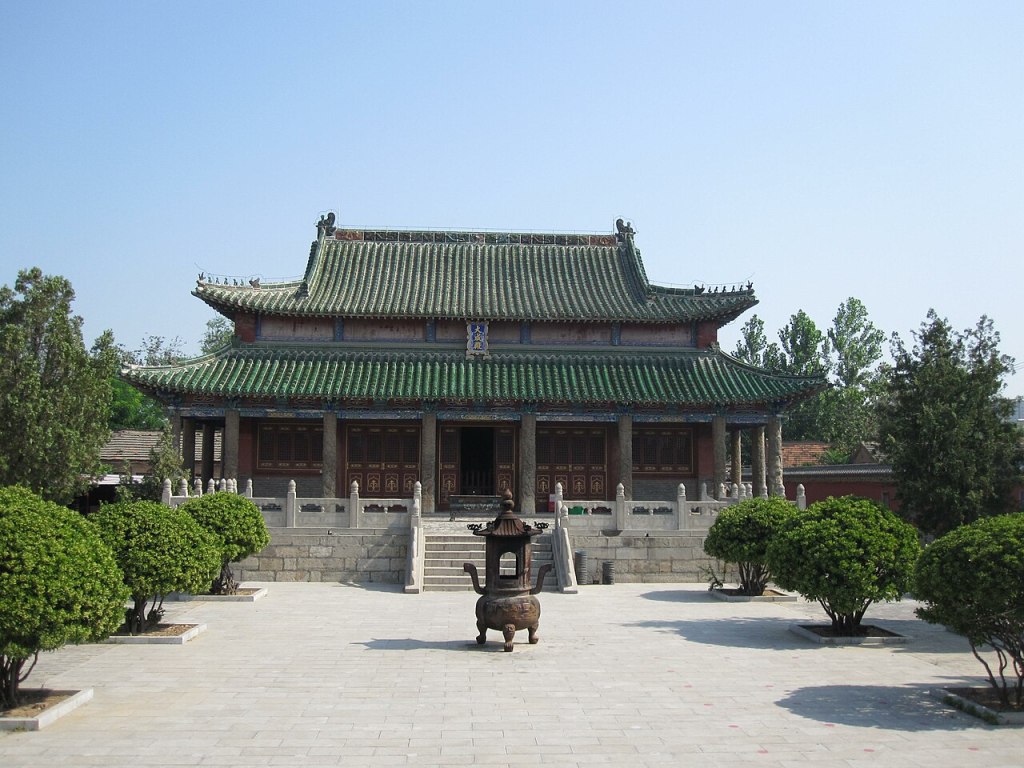
Baiyun Temple in Minquan (Waihuang) county, Henan Province
The 2nd year of the Second Emperor(208 B.C. continued)
Xiang Liang defeated Zhang Han in Dong’e county. His troops advanced westward and crushed the Qin army at Dingtao. Xiang Yu and the Duke of Pei then engaged the Qin forces at Yongqiu county, delivered another severe beating, and beheaded Li You, Li Si’s eldest son. Buoyed by these victories, Xiang Liang grew arrogant and began to underestimate the Qin army. Song Yi, the former Prime Minister of Chu, warned him, “Commanders become cocky and soldiers become sloppy after many victories, which often lead to defeat. Our soldiers are slackening while the Qin army is gaining strength. I worry for you.” Xiang Liang dismissed his advice and sent Song Yi to the Kingdom of Qi as his envoy.
On the road, Song Yi encountered the ambassador of Qi, Lord Gaoling, whose name was Xian. He asked Lord Gaoling, “Are you going to meet Lord Wuxin?” Lord Gaoling affirmed. Song Yi replied, “In my opinion, Lord Wuxin‘s troops will soon suffer a major loss. You would avoid death if you proceed slowly, by rushing in you’ll plunge into a disaster.”
There were continuous rainfalls from July to September.
Xiang Yu and the Duke of Pei laid siege to Waihuang county but failed to break in. They withdrew and attacked Chenliu county instead. Then came the news that Lord Wuxin was dead, which shook the rank and file. They led their troops eastward and joined forces with General Lü Chen. Together, they moved King Huai II of Chu from the capital Xuyi to the new capital, Pengcheng. Lü Chen‘s troops camped to the east of Pengcheng, while Xiang Yu‘s forces camped to the west. The Duke of Pei and his followers took a rest at Dang county.
Wei Bao had taken control of over twenty cities of Wei, and King Huai II of Chu awarded him the title of King of Wei.
In late September, King Huai II of Chu reorganized the troops under Lü Chen and Xiang Yu, bringing them directly under his command. He appointed the Duke of Pei as the prefect of Dang Commandery, granting him the title of Marquis Wu’an and command of the forces there. He also granted Xiang Yu the title of Marquis Chang’an with the moniker Duke of Lu. Lü Chen was appointed Minister of Internal Affairs, and his father, Lü Qing, became the Prime Minister.
Zhang Han, believing that the armed forces of Chu were no longer a serious threat after the death of Xiang Liang, crossed the Yellow River and launched a raid on the Kingdom of Zhao. He crushed the Zhao army, conquered the city of Handan, relocated its residents to the south of the Yellow River, and dismantled the city’s fortifications. Zhang Er and the King of Zhao, Zhao Xie, fled to Julu county. General Wang Li of Qin then laid siege to Julu. Chen Yu regrouped tens of thousands of soldiers around Changshan commandery and camped to the north of Julu, while Zhang Han stationed his army in a town Jiyuan, to the south of Julu. The King of Zhao repeatedly appealed to the Kingdom of Chu for reinforcements.
Lord Gaoling, whose name is Xian, met with King Huai II of Chu and shared his conversation with Song Yi: “Song Yi predicted Lord Wuxin‘s demise. I stayed put for a few days, and indeed, the news came that the army of Chu had collapsed. He must be well-versed in warfare if he could foresee the outcome of a battle before it even began.” Impressed, King Huai II summoned Song Yi to discuss upcoming battles and was greatly impressed with his strategic plans. As a result, he appointed Song Yi as Commander-in-Chief, Xiang Yu as his lieutenant, and Fan Zeng as a General. He ordered them to come to the aid of Zhao, placing all other generals under Song Yi‘s command and granting him the title of Generalissimo.
King Huai II of Chu had made a pact among his commanders: “Whoever breaks into the Passes of Qin first will be made the King of Qin.” At this time, the army of Qin remained strong and often chased the allies troops northward through the momentum of victories. All commanders, except Xiang Yu, believed it was disadvantageous to assault the interior of the Kingdom of Qin. Xiang Yu, however, held a deep grudge against the army of Qin for killing Xiang Liang and volunteered to go west, entering Qin territory with the Duke of Pei. A few senior generals who had served alongside him advised King Huai II of Chu, “Xiang Yu has a brutal and devious personality. He obliterated the city and buried all its people alive when he conquered Xiangcheng. He leaves total devastation in his path. Previous expeditions against Qin by the Kingdom of Chu, such as those led by Chen Sheng and Xiang Liang, ended in failure. Our next Western Campaign should be led by a mature leader, with a righteous cause and calling for the support of the people of Qin. The people of Qin have suffered under their rulers for a long time. If a more experienced leader comes along who does not ransack their properties, he may be able to take down Qin‘s defenses. Please do not send Xiang Yu westward. Only the Duke of Pei, who is magnanimous and mature, should lead the Western Campaign.”
The Duke of Pei‘s army marched out of Dang county and attacked the Qin camps at Yangcheng county and Gangli county, successfully trampling down both camps.
Zhang Liang advised Xiang Liang, “Now that you have installed the King of Chu, Lord Hengyang—whose name is Cheng—was the most capable among the princes of the Kingdom of Han. You should install him as the King of Han to strengthen our ranks.” Following this suggestion, Xiang Liang sent Zhang Liang to find Han Cheng and installed him as the King of Han. He appointed Zhang Liang as the defense minister. Zhang Liang, along with the new King of Han, led a force of around a thousand soldiers to reclaim territories of the former Kingdom of Han to the west. They managed to capture a few cities, but these were soon retaken by the Qin army. Zhang Liang and his king then resorted to guerrilla warfare tactics in the Yingchuan Commandery.
General Zhang Han of Qin had crushed Chen Sheng’s regime and led his army to attack the King of Wei in Linji county. The King of Wei sent Zhou Fu as his envoy to seek aid from the kingdoms of Qi and Chu. The King of Qi, Tian Dan, and General Xiang Ta of Chu led their troops with Zhou Fu to assist the Kingdom of Wei. Zhang Han launched a surprise night attack, keeping his soldiers silent by ordering them to hold sticks in their mouths. The Qin army defeated the joint forces of Qi and Chu in Linji county. The King of Qi and Zhou Fu were killed in the battle. The King of Wei, Wei Jiu, attempted to placate Zhang Han by surrendering on behalf of his people. After the settlement was signed, the King of Wei committed suicide by self-immolation. His brother, Wei Bao, escaped to the Kingdom of Chu. King Huai II of Chu assigned several thousand soldiers to Wei Bao and ordered him to retake the lost territory of Wei.
Tian Rong, a younger brother of Tian Dan, gathered the remaining troops of Tian Dan and fled eastward to the city of Dong’e. General Zhang Han relentlessly pursued them and laid siege to Dong’e. When the people of Qi learned that their king had died, they installed Tian Jia, a younger brother of the late King of Qi, Tian Jian4, as their new king. Tian Jiao became the prime minister, and his younger brother, Tian Jian1, was made commander-in-chief. They formed a new government to defend against the aggression of other kingdoms.
In July, there was non-stop rainfall. Lord Wuxin led a campaign to seize Kangfu county. Upon hearing of Tian Rong‘s crisis, he shifted his attack to Zhang Han at Dong’e county and overran the Qin troops. General Zhang Han retreated westward, while Tian Rong and his forces moved back eastward to the Kingdom of Qi. Lord Wuxin pursued the Qin army to the north and ordered Xiang Yu and the Duke of Pei to capture Chengyang county. They breached the city and slaughtered its inhabitants. The army of Chu then moved east of the city of Puyang, where they engaged Zhang Han’s troops in another battle and secured another victory. Zhang Han received reinforcements from the Kingdom of Qin and strengthened the defense of Puyang by surrounding the city with water drawn from a nearby river. The Duke of Pei and Xiang Yu withdrew their forces and attacked the town of Dingtao.
In August, Tian Rong’s troops attacked the King of Qi, Tian Jia, who fled to the Kingdom of Chu. The Prime Minister of Qi, Tian Jiao, escaped to the Kingdom of Zhao. Commander Tian Jian, who had led an army to aid the Kingdom of Zhao, dared not return upon hearing the news. Tian Rong installed Tian Shi, the son of Tian Dan, as the King of Qi and assumed the position of prime minister himself. Tian Heng took command of the military. Together, they laid claim to the Kingdom of Qi. Meanwhile, Zhang Han‘s forces became emboldened. Xiang Liang sent several envoys to the Kingdoms of Qi and Zhao, pleading with them to join forces to counter Zhang Han‘s offensive. Tian Rong’s response was: “The Kingdom of Chu should kill Tian Jia. The Kingdom of Zhao must kill Tian Jue and Tian Jian. We will join forces with you once you have done that.” The Kingdoms of Chu and Zhao did not comply. Offended, Tian Rong refused to send his troops.
Zhao Gao, the Grand Chamberlain of Qin, had free rein over the court of Qin, relying on the trust of the Second Emperor, whose favorite eunuch he was. He murdered many people out of personal spite and feared that court officials might report him. He spoke to the Emperor, saying: “The Son of Heaven is far above everyone else if all his subjects can only hear from him but cannot see him face to face. Your Majesty is still young and may not yet be skilled in all matters. The flaws in your judgment on punishments and rewards will be fully exposed to court officials if Your Majesty attends court regularly. This is not a way to demonstrate your divine wisdom to the world. It would be better for Your Majesty to stay in the seraglio and allow me and other attendants who are well-versed in the laws to handle daily governance. Your Majesty would only need to address escalated issues. Thus, the officials would not dare to bring difficult problems before you, and the people of the world would praise Your Majesty as a saint.”
The Second Emperor approved Zhao Gao’s advice. He stopped attending court to face the officials and spent his days idling in the inner court. Zhao Gao and the eunuchs served as intermediaries between the Emperor and the court, with Zhao Gao making all the decisions on governance.
Zhao Gao learned that Chancellor Li Si wanted to speak out, so he visited Li Si and said, “The bandits outside the Hangu Pass are becoming uncontrollable, yet the Emperor demands more corvée labor to build the E’fang Palace and collects rare breeds of dogs and horses that are useless. I would like to raise objections, but I am just a lowly servant. These matters are for lords and marquis like you to discuss. Why don’t you offer your advice?” Li Si replied, “That is indeed my duty. The Emperor avoids court and won’t come to hear matters of state these days. The advice I want to give cannot be conveyed indirectly. I need to meet with the Emperor, but he has no time for me.” Zhao Gao promised, “If you truly wish to speak to the Emperor, I will arrange for you to see him when he has time.”
Zhao Gao would then summon Li Si when the Second Emperor had just indulged in female companionship, saying, “Please come in; the Emperor has time to meet.” Chancellor Li Si would request an audience, interrupting the Emperor’s leisure. This happened three times, and the Emperor became enraged: “The Chancellor never comes when I am free, but always seeks to discuss state affairs as soon as I relax and enjoy myself! Does the Chancellor think I am too young? Does he want to discipline me?” Zhao Gao seized the opportunity and said, “The Chancellor played a major role in the Shaqiu scheme. Now that Your Majesty has become Emperor, he remains in his position and might want to divide the land and declare himself king. I would not speak of this if Your Majesty did not ask. The Chancellor’s eldest son, Li You, is the governor of Sanchuan Commandery. The bandits from Chu, like Chen Sheng, hail from counties near the Chancellor’s hometown. When they wreaked havoc in Chu and passed by Sanchuan, the governor did not attack them. I have heard that the governor exchanged letters with the bandits. I have not investigated this fully, so I did not report it to Your Majesty. As you know, the Chancellor wields great power outside the court.”
The Second Emperor believed Zhao Gao. He wanted to prosecute the Chancellor but was concerned about the lack of evidence. He sent investigators to look into the alleged communications between the governor of Sanchuan and the bandits.
Li Si sensed a plot against him and wrote to the Emperor to denounce Zhao Gao: “Zhao Gao arrogates to himself the power to mete out benefits and punishments, behaving as if he were no different from Your Majesty. When Tian Heng was the prime minister under Duke Jian of Qi, he expropriated the grace and authority of his lord. He forged alliances with the officers and gained popularity among the common people. Eventually, he murdered Duke Jian and usurped the Kingdom of Qi. This is a well-known historical fact. Zhao Gao‘s devious motives, treacherous activities, and personal wealth rival Tian Heng‘s influence over the Kingdom of Qi. He is even more aggressive and greedy. Now, his standing is second only to Your Majesty, yet his avarice knows no bounds. He will strip you of your prestige and supremacy. His ambition is to be like Han Qi, the last prime minister of King Han An. If Your Majesty does not take proactive measures, I fear he will overthrow you.”
The Second Emperor rebuked Li Si, saying, “What are you talking about? Zhao Gao is just an old eunuch. He does not indulge himself in times of peace, nor does he waver in times of peril. His exemplary conduct and charity have earned him his position. He has risen through his loyalty and holds his office through his truthfulness. We greatly value him, and yet you accuse him. Why? Moreover, whom would I rely on if I didn’t trust Mr. Zhao? Mr. Zhao is a scrupulous and capable person. He understands the common people and makes We feel good. You should not slander him.”
The Second Emperor liked Zhao Gao personally and trusted him. Fearing that Li Si might try to kill Zhao Gao, he informed Zhao Gao of Li Si’s memorandum. Zhao Gao countered, “I am the only one the Chancellor is worried about. If he manages to get rid of me, he will do what Tian Heng did to your Majesty.”
More “bandits” emerged everywhere, prompting more soldiers to be drafted within the Hangu Pass and sent eastward incessantly to quash them. Vice Chancellor Feng Quji, Chancellor Li Si, and General Feng Jie went to speak to the Emperor, saying, “There are many brigands rising to the east of Hangu Pass. The army of Qin has struck these brigands and killed many, but their spread has not been contained. These brigands are numerous because the people’s lives have been made miserable by the heavy burdens of garrison duties, transportation of goods, logistical services for war, and excessive taxation. We plead for a temporary halt to the construction of the E’fang Palace and a reduction in garrison duties and logistical costs.”
The Second Emperor was outraged and responded, “The majesty of being the lord of the empire is to do whatever he pleases. The lord promulgates laws, and the subjects dare not infringe upon them, ensuring the world is under his complete control. Lords in the legendary Yu dynasty and the Xia dynasty, exalted as the sons of heaven, had to lead poor and arduous lives to set examples for the people. Then what is the purpose of laws? My father, the late Emperor, began as the lord of a single state and unified the realm. He brought peace to the empire and kept the barbarians at bay. Building palaces was to relish his joy and let you witness his series of achievements. During my reign over the last two years, so many bandits have emerged from the woods. You have failed to suppress their lawlessness, yet you dare to propose suspending the project of the late Emperor. First, you are not honoring the late Emperor’s wishes; second, you are not serving me loyally. Why are you still holding your posts?”
The Second Emperor ordered the three ministers to be put on trial for various charges. Feng Quji and Feng Jie committed suicide, but Li Si reported to prison. The Second Emperor appointed Zhao Gao as the judge, charging Li Si and his son Li You with seditious acts. The entire Li Si clan and their attendants were arrested. Zhao Gao had Li Si whipped thousands of strokes. Unable to withstand the pain, Li Si confessed to the false charges of sedition.
Li Si chose to live because he believed in his power of persuasion, his past accomplishments, and his innocence regarding the charge of sedition. He hoped to defend himself in writing, believing that the Second Emperor might come to his senses and pardon him. From his jail cell, he wrote to the Emperor:
“I have been the Chancellor and governed the people of Qin for more than thirty years. In the earlier years, the territory of the Kingdom of Qin was narrow, only about a thousand li across, with armed forces of merely a few hundred thousand soldiers. I made an all-out effort to recruit strategists in secret and financed them with gold and treasures to lobby other monarchs. I also covertly trained armored warriors and educated them in ethics and religion. I selected these elite fighters to be officers and awarded those who provided extraordinary service. Eventually, we terrorized the Kingdom of Han, weakened the Kingdom of Wei, conquered the Kingdoms of Yan and Zhao, and dismantled the Kingdoms of Qi and Chu. Finally, we annexed the six kingdoms and captured their kings. I enthroned the King of Qin as the Son of Heaven.”
“I demonstrated the strength of the Qin Empire by driving out the nomadic tribes like the Hu and the He in the north and subduing the hundreds of tribes in the land of Yue in the south. I established the institutions of the Qin Empire by unifying the writing, measuring, and weighing systems and promulgating them throughout the world. These are my crimes, and I should have died long ago! Thanks to Your Majesty’s wishing me to serve with all my ability, I have managed to last until this day. I hope Your Majesty will look into my case!”
The letter was submitted. However, Zhao Gao instructed the jail warden to suppress it, saying, “A criminal does not get to write to the authorities!”
Zhao Gao instructed his minions to interrogate Li Si in turns, pretending to be inspectors, court heralds, and palace attendants. At first, Li Si rescinded his guilty plea, but he was beaten more severely. After several rounds of interrogation and torture, Li Si gave up on retracting his confession. Later, when the Second Emperor sent his personal inquirer to see him, Li Si, unable to distinguish between them and Zhao Gao’s men, stuck to his false statements. The inquirer reported back to the Emperor, who was gleeful: “I would have been betrayed by the Chancellor were it not for Mr. Zhao!”
By the time the investigator sent by the Second Emperor reached the Commandery of Sanchuan, Li Si‘s eldest son, Li You, who was the governor, had already been killed by soldiers of Chu. The investigator returned to the capital just as the Chancellor was charged with crimes. Although the investigator submitted his findings, Zhao Gao relayed the opposite to the Second Emperor. The verdict against Li Si included the five cruel punishments, culminating in being chopped in half in Xianyang’s public market.
Li Si was taken out of prison, shackled alongside his second son. He spoke to his son: “I wish I could go with you and our yellow dog to hunt rabbits outside the East Gate of Shangcai, as we did in the past. Couldn’t we do it?” Father and son faced each other and wailed. The three clans of Li Si—his father’s, mother’s, and wife’s—were all exterminated. The Second Emperor then appointed Zhao Gao as the Chancellor. Zhao Gao monopolized all decision-making, whether crucial or trivial.
On October 10, during the winter, a national amnesty was declared.
In the spring, the Second Emperor embarked on a journey to the eastern provinces, accompanied by Chancellor Li Si. They traveled eastward to Mount Jieshi on the coast and southward to the commandery Kuaiji before returning. The Second Emperor inscribed his name on all the monuments previously erected by the First Emperor, adding the names of his entourage alongside. These inscriptions reiterated the achievements and virtues of the late emperor.
Around April, nearing summer, the Second Emperor returned to Xianyang. He said to Zhao Gao, “The time of a person in this world passes as swiftly as driving a six-horse chariot over a crack in the road. Now that I am the lord of the empire, I should indulge my senses with as much pleasure as possible and fill my heart with as much joy as I desire. Can I live this way until my time is up?” Zhao Gao replied, “That is exactly what a wise lord would do, but a foolish one would not. However, we are not there yet. Let me advise Your Majesty: The princes and ministers are suspicious of what happened at Shaqiu. These princes are your elder brothers, and these ministers were appointed by the late emperor. Your Majesty has just ascended to the throne, and these princes and ministers, harboring doubts and fears, may incite rebellion. I fear for my life every day. How can Your Majesty enjoy yourself under these circumstances?”
The Second Emperor asked, “What should we do?” Zhao Gao responded, “Your Majesty must strengthen the law and intensify punishments. Encourage criminals to inform on others, and eliminate all royalties and ministers by guilt of association. Then, elevate the oppressed, enrich the poor, and promote the low-born to high positions. Replace the ministers from the late emperor’s reign with people who are close to and trusted by Your Majesty. These new appointees will be grateful to Your Majesty. By purging the discontented and conspirators, leaving only your loyal supporters, Your Majesty will finally enjoy peaceful nights and as much pleasure as you wish. This is the best advice I can offer.” The Second Emperor agreed to the plan. He made criminal laws more draconian and cruel. Once an official or royal was accused of an offense, he immediately handed them over to Zhao Gao for interrogation and prosecution. Twelve princes were executed in Xianyang, and ten princesses were quartered in Du County. Their properties were confiscated, and countless others implicated by them were arrested.
Prince Jiang Lü and his two brothers, born of the same mother, were confined in the inner palace. They were the latest to be accused. A messenger from the Second Emperor informed Jiang Lü, “Your conduct toward the emperor was improper for a subject. This crime is punishable by death. Justice will be served by law officers.” Jiang Lü responded, “I have never violated court protocol, never misbehaved during ceremonies, and never been disrespectful when speaking to the Emperor. What inappropriate behavior have I committed? I wish to know my crime before I die!” The messenger replied, “The sentencing is beyond my authority. I am merely delivering the verdict.” Prince Jiang Lü cried out “Heaven” three times and wailed, “I am innocent!” His brothers wept with him before they took their own lives with their swords. The entire royal family was horrified.
Prince Gao, another half-brother of the Second Emperor, considered fleeing but feared that his kin would suffer. He wrote to the Second Emperor, saying, “When the late Emperor was alive, I was granted fine food every time I attended court; I was provided with chariots whenever I needed to travel. His Majesty gifted me robes made for the emperor and horses from the royal stables. I should have accompanied His Majesty, but I did not. I am unfilial as his son and disloyal as his servant. A person lacking both filial piety and loyalty has no place in this world. I wish to die and be buried at the foot of Lishan Mausoleum. I beg Your Majesty to grant me this mercy!” The Second Emperor read the letter with delight and showed it to Zhao Gao, saying, “He is truly desperate, isn’t he?” Zhao Gao replied, “Subjects won’t contemplate rebellion when they are preoccupied with how to die.” The Second Emperor approved the request and granted burial money of one hundred thousand coins.
The Second Emperor resumed the construction of the E’fang Palace. Fifty thousand gladiators were conscripted to Xianyang to form the royal guard, where they were trained in archery. The court raised a large number of dogs, horses, birds, and other wild animals. Fearing a shortage of fodder, the Second Emperor ordered all commanderies and counties to supply soybeans, grains, straw, and hay. Those transporting fodder to Xianyang had to provide their own food. Grain produced within a three-hundred-mile radius of Xianyang was prohibited for private consumption, and must proffer the grain to the court.
In July of that autumn, Chen Sheng from Yangcheng county and Wu Guang from Yangxia county led an insurgency in Qi County. They had been drafted in the fourth round to secure the border near Yuyang commandery, along with nine hundred other conscripts stranded in a village called Daze[Big Marsh]. Chen Sheng and Wu Guang, both team leaders, found themselves delayed due to heavy rain, which caused road closures and made them miss the rendezvous. According to the law, this delinquency was punishable by beheading. Recognizing the people’s grievances and resentment, Chen Sheng and Wu Guang killed their commanders. They then addressed their comrades: “We’re doomed to be beheaded for being late. Even if pardoned, life on the frontier is so harsh that six or seven out of ten of us would surely die. A man doesn’t want to die; if he must die, he would rather die making a name for himself. Do the kings and nobles truly have blue blood in their veins?” Inspired, everyone followed their lead.
They built an altar and made pledges in the name of Prince Fusu and General Xiang Yan, claiming to restore the fallen kingdoms and calling their state Great Chu. Chen Sheng declared himself general, and Wu Guang became his lieutenant. They took control of Daze Village, then raided Qi County, overcoming the resistance there. They sent Ge Ying, a man from the town Fuli, to lead troops to the east of Qi County, where they attacked and conquered Zhi county, Cuo county, Ku county, Zhe county, and Qiao county. By the time they approached Chen county, their forces had grown to six or seven hundred chariots, more than a thousand cavalry, and tens of thousands of foot soldiers. With the county chief and sheriff absent, only the administrator was left to defend the gate rampart. The defenders could not hold off the attackers and were killed. Chen Sheng then occupied Chen county.






 Reflection by Rio Grande