Tag: Gongsun Hong

  • Comprehensive Reflections to Aid in Governance(Part 147): The Right To Bear Arms

    Comprehensive Reflections to Aid in Governance

    By Sima Guang

    Translated By Yiming Yang  

    Annals of Han Book 11 Scroll 19

    Duration of 6 years
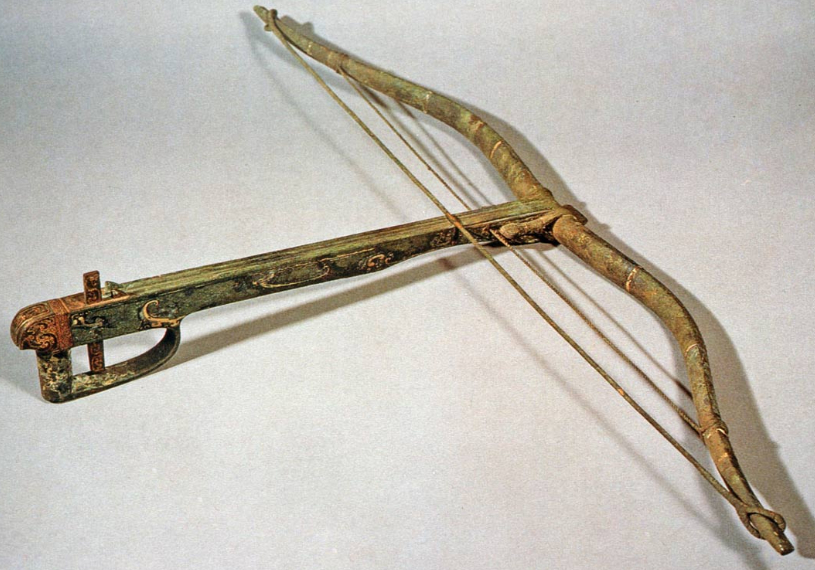
    A Crossbow, Terra Cotta Warrior Museum

    The 5th year of Emperor Wu’s Yuan’shuo Era (124 B.C.)

    In winter, on November 5, Xue Ze was relieved of his office. In his place, Gongsun Hong was appointed Chancellor and ennobled as the Marquis of Pingjin. From that time forth, the custom of conferring noble titles upon those who held the chancellorship began with Gongsun Hong.

    The Son of Heaven set his heart upon vast enterprises and the glory of national achievement. Gongsun Hong, opening the Eastern Gate of the Chancellor’s Office, summoned worthies and men of counsel, discoursing with them on state affairs. Whenever he entered court to present matters for deliberation, he would bring up proposals aimed at the benefit of the realm. The Emperor, esteeming his words, would summon scholars of the court to contend in debate with him.

    On one occasion, Gongsun Hong memorialized, saying: “Let it be forbidden for the people to bear bows and crossbows. For the sake of public safety, such arms must be restrained. Ten brigands with crossbows may cause a hundred officials to shrink in fear and not step forward.”

    The Emperor commanded the court to deliberate upon this proposal.

    Thereupon Yuqiu Shouwang, an Attendant-in-waiting, stepped forth and replied: “I have heard that the Five Arms—spear, halberd, bow, sword, and dagger-axe—were not devised to bring harm, but to subdue evil and restrain violence. In the time of Qin, when the empire was first united, weapons were cast into molten cauldrons and swords were blunted. Thereafter, the people fought each other with hoes, riding crops, and clubs. Crimes multiplied, banditry spread, and rebellion ensued. In the end, the state fell to ruin.

    “Thus, the sage kings of old taught the people by virtue and governed by rites, knowing that prohibitions alone could not suffice. The Book of Rites records: ‘When a male child is born, raise the mulberry-wood bow, and shoot arrows of reed to Heaven, to Earth, and to the four directions’—signifying that the man is destined to serve in arms throughout his life. The Grand Archery Rite, practiced from the Son of Heaven to the commoner, has been a ceremony passed down since the Three Dynasties.

    “I have heard of kings instructing the people through archery rites, but never of those who banned bows and arrows. What is forbidden is intended to prevent theft and assault; yet though death is decreed as punishment, still such crimes do not cease. This shows that even the severest law does not check the greatest of transgressions. If evil men conceal arms in secret while honest men are stripped of means to defend themselves, the law serves not justice but misfortune. I humbly submit: this measure is ill-advised.”

    This memorial was entered into the official record and submitted for imperial consideration. The Sovereign summoned Gongsun Hong and inquired of him regarding the matter, but Gongsun Hong could offer no rebuttal.

    Gongsun Hong was by nature suspicious and inwardly vindictive. All who had once opposed him, whether near or distant, though they might appear on cordial terms, would in time meet with his concealed vengeance.

    Dong Zhongshu, a man of upright character and moral resolve, regarded Gongsun Hong as sycophantic and insincere. Gongsun Hong, harboring envy, bore ill will toward him. The Prince of Jiaoxi, Liu Duan, indulged in lawlessness and brought about many deaths, including the demise of several officials of the 2,000-picul rank. Gongsun Hong, seeking to distance Dong Zhongshu from the Emperor, recommended him to serve as prime minister of the Principality of Jiaoxi. Yet Dong Zhongshu, pleading illness, did not assume the post.

    Ji An, who often voiced criticisms of Confucian doctrine, had long held differences with Gongsun Hong. Desiring to entrap him, Gongsun Hong seized upon an opportunity to destroy him. He memorialized the Emperor, saying: “The jurisdiction of the Right Interior Minister(intendant of Right Fufeng) is replete with nobles and high ministers. It is a post fraught with difficulty, and only one of great stature may govern it. I propose the transfer of Ji An to serve as Right Interior Minister.” The Emperor approved this request.

    In January of spring, a great drought afflicted the land.

    At that time, the Right Tuqi King of the Xiongnu made repeated incursions into Shuofang Commandery, harassing the border regions. The Sovereign dispatched the General of Chariots and Cavalry, Wei Qing, with thirty thousand cavalrymen departing from Gaoque Pass. Su Jian, Commandant of the Palace Guard, was appointed as Guerrilla General; Li Zu, the Left Interior Minister, was made Strong Crossbow General; Gongsun He, Grand Coachman, was named Cavalry General; and Li Cai, Prime Minister of Dai, was appointed Light Chariot General. All were placed under the overall command of Wei Qing. They departed from Shuofang to strike the enemy.

    In addition, the Grand Usher Li Xi and the Marquis of Antou, Zhang Cigong, were each appointed as generals and marched from Youbeiping. Altogether, the expeditionary force exceeded one hundred thousand men, advancing in concert against the Xiongnu.

    The Right Tuqi King, believing the Han troops too distant to pose a threat, indulged in wine and became inebriated. But Wei Qing led his men swiftly by night, advancing six to seven hundred li without pause, and fell upon the Right Tuqi King’s encampment. Caught unawares, the Right Tuqi King was seized with panic. In the dead of night, he broke through the encirclement and fled northward with but a few hundred elite riders.

    The Han forces captured more than ten subordinate kings under the Right Tuqi King, and seized over fifteen thousand men and women. Livestock taken numbered in the hundreds of thousands. With their objectives achieved, the army withdrew in good order and returned in triumph.

    When the army reached the border pass, the Son of Heaven dispatched an envoy bearing the seal of the Grand General, and in the field conferred upon Wei Qing the title of Grand General. All other generals were henceforth subordinated to his command.

    In April of summer, Wei Qing was further rewarded with an increase of fief comprising 8,700 households. His three sons—Wei Kang, Wei Buyi, and Wei Deng—though yet in infancy, were each ennobled as marquises.

    Wei Qing respectfully declined, memorializing thus: “By the grace of Heaven and the favor of Your Majesty, I have received fortune beyond measure. The great victory of the army was due to the valor and exertions of all the colonels and officers. The generous increase of my fief, and the enfeoffment of my sons with marquisates, though they are yet swaddled in cloth, is not the example I had hoped to set for those soldiers who risked their lives in the field.”

    The Emperor replied, “I have not forgotten the meritorious deeds of all the colonels.”

    Thereafter, the Emperor granted titles and honors to the various officers of distinction:
    Gongsun Ao, Colonel of Army Protectors, was made Marquis of Heqi;
    Han Yue, Commandant, was made Marquis of Long’e;
    Gongsun He, Commandant, was made Marquis of Nanjiao;
    Li Cha, Commandant, was made Marquis of Le’an;
    Li Shuo, Colonel, was made Marquis of Shezhi;
    Zhao Buyu, Colonel, was made Marquis of Suicheng;
    Gongsun Rongnu, Colonel, was made Marquis of Congping.

    In addition, Li Zu, Li Xi, and Colonel Dou Ruyi were each granted the title of Marquis Within the Passes.

    At this time, Wei Qing stood in highest favor among all court officials and ministers; none within the realm equaled his prestige. From the Three Excellencies down through the Nine Ministers, all bore themselves with deference before him. Only Ji An alone treated Wei Qing as an equal, neither yielding nor posturing.

    Some among the court cautioned Ji An, saying, “Now that the Son of Heaven commands all officials to bow before the Grand General, and the Grand General’s rank is exalted beyond compare, how can you refrain from bowing?”

    Ji An replied, “When the Grand General salutes his peer, does his status thereby lessen?”

    When these words reached the ears of the Grand General, he held Ji An in even greater esteem. Thereafter, Wei Qing often consulted Ji An concerning affairs of state and matters of court, treating him with a respect greater than he accorded others.Though Wei Qing’s position was lofty, when he came into an audience, the Emperor would recline upon his couch and receive him with ease. When Chancellor Gongsun Hong was summoned for informal audiences, the Son of Heaven at times dispensed with donning his imperial crown. Yet on one occasion, when Ji An came to request an audience, the Emperor, seated in the armory tent without his crown, glimpsed Ji An’s approach, and at once withdrew to the rear tent. He dispatched an attendant to grant Ji An’s petition in full, without requiring his presence. Thus was the reverence accorded to Ji An.

  • Comprehensive Reflections to Aid in Governance(Part 146): Early Journey to The West

    Comprehensive Reflections to Aid in Governance

    By Sima Guang

    Translated By Yiming Yang  

    Annals of Han Book 10 Scroll 18 (continued)

    Yuezhi Prince, Khalchayan

    The 2nd year of Emperor Wu’s Yuan’shuo Era (127 B.C. continued)

    The Prince of Yan, Liu Dingguo, violated the rites by engaging in illicit relations with the consort of his father, King Kang, and further transgressed the bonds of kinship by forcibly taking his brother’s wife as his concubine. He slew the Magistrate of Feiru County, a man named Yingren. Thereupon, Yingren’s brothers submitted a memorial, exposing the prince’s crimes. Zhufu Yan also took part in presenting the truth before the court.

    The court officials petitioned for the execution of Prince Liu Dingguo, and the Emperor gave his assent. Liu Dingguo thereupon took his own life. His princedom was abolished.

    Prince Li of Qi, Liu Cichang, committed incest with his elder sister, Princess Ji(her mother’s maiden name). Zhufu Yan sought to wed his daughter to Liu Cichang, but the Queen Dowager of Qi, mother of the prince, opposed the match. Thereafter, Zhufu Yan addressed the Emperor, saying, “The city of Linzi, capital of Qi, encompasses one hundred thousand households, and its market revenues exceed a thousand catties of gold. It is a land of wealth and population, exceeding even the capital of Chang’an in splendor. Only Your Majesty’s nearest kin and most favored sons ought to govern such a place. Now, the bond between Qi and the Throne grows faint, and moreover, I have heard of the Prince’s incestuous conduct with his sister. I entreat Your Majesty to rectify this impropriety.”

    The Emperor then appointed Zhufu Yan as the Prime Minister of Qi, commanding him to investigate and set affairs in order. Upon arriving in Qi, Zhufu Yan swiftly interrogated the prince’s consorts and palace attendants. Their confessions implicated Prince Liu Cichang. The prince, in fear, drank poison and died.

    In former days, Zhufu Yan had traveled throughout the principalities of Qi, Yan, and Zhao. When later elevated to high office, he successively dismantled the principalities of Yan and Qi. Alarmed, the Prince of Zhao, Liu Pengzu, memorialized the Throne, accusing Zhufu Yan of accepting bribes of gold from feudal lords in exchange for bestowing marquisates upon their sons.

    When the Emperor received word of the suicide of the Prince of Qi, he flew into a rage. He suspected that Zhufu Yan had coerced the prince into taking his own life, and thus had him arrested. Zhufu Yan admitted to accepting gold but denied that he had compelled the prince to die.

    Though the Emperor was reluctant to order his execution, Gongsun Hong remonstrated, saying, “Now that the Prince of Qi has perished and left no heir, his princedom shall be abolished and absorbed as a commandery under direct rule. Zhufu Yan stands at the root of these upheavals. If Your Majesty does not punish him, resentment will spread across the realm.”

    Thus, Zhufu Yan and his entire clan were executed.

    At that time, the Grand Master of the Censorate, Zhang Ou, was dismissed. The Emperor appointed Kong Zang, Marquis of Liao, to the post. Kong Zang declined, saying, “My family has, for generations, devoted itself to the pursuit of scholarship. I humbly request to be appointed Minister of Ceremonies, so that I may continue the scholarly path alongside my cousin Kong Anguo, who now serves as Palace Attendant. In this way, the teachings of the ancients may be preserved for posterity.”

    The Emperor granted his request, appointing him Minister of Ceremonies, and bestowed upon him honors and stipends equal to those of the Three Excellencies.

    The 3rd year of Emperor Wu’s Yuan’shuo Era (126 B.C.)

    In winter, the Chanyu of the Xiongnu, Junchen, passed away. His younger brother, the Left Luli King Yizhixie, declared himself Chanyu and led troops to attack the Crown Prince Yudan, defeating him. Yudan fled south and surrendered to the Han court.

    Gongsun Hong was appointed Grand Master of the Censorate. At that time, the Emperor was planning to extend the realm into the southwestern frontiers, establishing Canghai Commandery in the east and constructing Shuofang Commandery in the north. Gongsun Hong repeatedly memorialized the throne, urging that the Middle Kingdom’s resources not be exhausted on far-flung and unprofitable ventures, and petitioned to abandon the plan. The Emperor sent Zhu Maichen and others to present ten arguments in favor of the Shuofang expansion. Gongsun Hong did not contest their points but replied: “I am a coarse and ignorant man from east of the Xiao Mountains, unfamiliar with such intricate calculations. However, I respectfully propose that the southwestern expansion and the Canghai Commandery be abandoned, so that efforts may focus on the construction of Shuofang.” The Emperor accepted his counsel.

    In January of spring, the establishment of Canghai Commandery was canceled.

    Gongsun Hong led a life of frugality, dressing in coarse garments and partaking of simple meals with only a single dish of meat. Ji An denounced him, “Gongsun Hong is one of the Three Excellencies and receives a high salary, yet he lives as a pauper—surely a performance to court praise.”

    The Emperor, upon inquiry, summoned Gongsun Hong, who replied, “It is as Ji An says. Among the Nine Ministers, there is none more familiar with me than Ji An. Today, he has exposed my pretense. For a high official to feign the life of a commoner is deceitful, a ploy to pursue reputation. Without Ji An’s loyalty and honesty, Your Majesty would not have known this.” The Emperor was moved by his frankness and held him in greater esteem.

    In March, a general amnesty was declared across the realm.

    On April 7, Crown Prince Yudan of the Xiongnu was granted the title of Marquis of She’an. He died within the same year.

    Previously, Xiongnu defectors recounted: “The Yuezhi people once dwelled between Dunhuang and the Qilian Mountains. They were strong, but were crushed by Modu Chanyu. Later, Laoshang Chanyu slew their king and fashioned his skull into a drinking cup. The Yuezhi survivors fled far to the west, harboring hatred yet lacking power to retaliate.”

    The Emperor desired to open relations with the Yuezhi and sought envoys. Attendant Cadet Zhang Qian of Hanzhong volunteered. Departing from Longxi, he entered the heart of Xiongnu lands but was captured and detained for over a decade. Eventually escaping, he reached Dayuan. The people of Dayuan, eager to trade with Han, received him with favor and provided guides and interpreters to accompany him to Kangju. From there, Zhang Qian arrived at Greater Yuezhi. A new king had just been enthroned, and their conquest of Daxia was complete. The land was rich and secure, and the people were content. They harbored no will to avenge the Xiongnu.

    Zhang Qian remained for over a year and did not make inroads with the King of Yuezhi, then resolved to return. Passing through the southern ranges and the land of the Qiang, he was again seized by the Xiongnu and imprisoned for another year. During a time of disorder caused by the power wrangling between Chanyu Yizhixie and Crown Prince Yudan, Zhang Qian escaped with a nomad slave named Tangyi Ganfu(a.k.a. Tangyi Fu). He had departed with over a hundred men; after thirteen years, only he and Tangyi Ganfu returned.

    The Emperor appointed Zhang Qian as Grandee of the Palace and Tangyi Ganfu as Ambassador-at-large.

    In summer, tens of thousands of Xiongnu horsemen raided the northern frontier, killing the Prefect of Dai, Gong, and capturing over a thousand people.

    On June 2, the Empress Dowager(Wang) passed away.

    In autumn, the government relinquished control of most southwestern territories, retaining only two counties—Nanyi and Yelang—and one commandant. Qianwei Commandery gradually consolidated its own defenses. The court shifted its focus to fortifying Shuofang.

    The Xiongnu again raided Yanmen, killing and capturing over a thousand.

    In the same year, Zhang Tang, Grandee of the Palace, was promoted to Minister of Justice. He was a cunning man, skilled in manipulation. Observing the Emperor’s enthusiasm for the classics, he feigned devotion to Confucianism and associated with Dong Zhongshu and Gongsun Hong.

    Zhang Tang appointed Ni Kuan of Qiansheng as transcriber to present legal cases, deciding difficult cases following ancient statutes and classic doctrines. Zhang Tang interpreted the law in accordance with the Emperor’s wishes: assigning harsh judges to cases where punishment was desired, and lenient ones where mercy was intended. Thus he won imperial favor.

    Zhang Tang, while rigid, vindictive, and sometimes biased in legal affairs, showed extraordinary attention to his former acquaintances’ descendants and paid visits to high officials in all seasons rain or shine. Though strict to a fault, his public image remained favorable.

    Ji An frequently criticized Zhang Tang, saying, “As one of the Nine Ministers, you fail to honor the virtues of past rulers, nor do you suppress the wickedness of men. You should bring peace to the state and lighten the prisons, yet you distort the statutes of Emperor Gaozu. These actions shall leave you with no descendants.”

    In debate, Ji An upheld principles but could not prevail against Zhang Tang’s legalist hair-splitting. Frustrated, he exclaimed, “It is said that clerks should not be made ministers—and now I understand why! If one governs as Zhang Tang does, men will stand one-legged and cast sidelong glances, and the world will be gripped by fear!”

    The 4th year of Emperor Wu’s Yuan’shuo Era (125 B.C.)

    During winter, the Emperor made a trip to Ganquan Palace.

    In summer, the Xiongnu invaded three commanderies: Dai, Dingxiang, and Shangjun, each with thirty thousand cavalry. They killed and captured several thousand people.

  • Comprehensive Reflections to Aid in Governance(Part 142): A Mind Reader

    Comprehensive Reflections to Aid in Governance

    By Sima Guang

    Translated By Yiming Yang  

    Annals of Han Book 10 Scroll 18 (continued)

    Zibo, f.k.a. Zichuan the hometown of Gongsun Hong, Shandong Province

    The 5th year of Emperor Wu’s Yuan’guang Era (130 B.C.)

    The Emperor appointed Zhang Tang as Grand Palace Grandee. Together with Zhao Yu, he codified statutes and ordinances, multiplying their intricacies. They enforced strict observance of official duties, and promulgated the Law of Misprision, whereby subjects were urged to denounce one another and overseers were bound to scrutinize their subordinates. From that time forth, the rule of law grew ever more exacting.

    In August, rice borers afflicted the fields.

    In that same year, persons among the officials and common folk who possessed knowledge of current statecraft or were versed in the teachings of the ancient sages were summoned to the capital. They were grouped according to their native counties, provisioned food along the way, while traveling with the provincial officers who reported statistics to the court.

    Gongsun Hong of Zichuan, in his memorial submitted during the official selection examination, wrote:

    “I have heard that in high antiquity, under the reigns of Emperor Yao and Shun, rank and reward were not esteemed, yet the people urged one another toward virtue. Punishments were not severe, yet transgressions were few. This was because the sovereigns were upright, and their virtue inspired trust among the people. But in the decline of later ages, high honors failed to encourage good conduct, and harsh laws could not restrain evil. This was because the ruler lacked righteousness, and the people no longer believed in him. Therefore, one cannot govern by rewards and punishments alone; the essential matter is that the people place their trust in the state.

    “The government, then, must employ the worthy in their proper stations, entrusting them with the management of affairs. Idle discourse must be silenced, lest it hinder execution. Superfluous production must be curtailed, that taxation may be eased. The people must not be robbed of their time or labor, that they may enrich themselves through their own efforts. Those of virtue must be raised up; the unworthy must be cast down, that authority may be honored. Those of merit must be rewarded; the idle and ineffectual dismissed, that rank may be justly ordered. If punishments fit the crime, corruption will cease; if rewards accord with service, ministers will be diligent. These eight measures form the foundation of good government.

    “The people are the root. When occupied with their tasks, they do not contend; when given proper guidance, they do not harbor resentment; when treated with ritual and propriety, they do not rebel; when cherished by their superiors, they respond with loyalty. These are the urgent concerns of statecraft. Rites and righteousness are the bonds that hold the people. When reward and punishment accord with these, the laws would not be transgressed.

    “I have also heard it said: ‘Like nature attracts; harmonious tones respond in kind.’ Thus, when the ruler above cultivates harmony and virtue, the people below dwell in concord. When the heart is harmonized, the vital energies are balanced; when the energies are balanced, the body is sound; when the body is sound, the voice is in tune; and when the voice is in tune, Heaven and Earth respond in accord. When yin and yang are in harmony, the winds and rains arrive in season, sweet dew descends, the five grains flourish, the six livestock prosper, fields yield in abundance, auspicious plants appear, the mountains remain verdant, and the marshes do not dry—such is the ultimate fruit of harmony.”

    At that time, more than a hundred men presented themselves for examination. The Minister of Ceremonies ranked Gongsun Hong’s memorial among the lower entries. Yet the Emperor, discerning its worth, raised it above all others, appointed Gongsun Hong as Erudite, and ordered him to await summons at the Golden Horse Gate.

    There was another man, Yuan Gu of Qi, over ninety years of age, who was likewise summoned to the capital as one of the Worthies. Renowned for his virtue and learning, he was held in esteem by many. Gongsun Hong regarded him only with a sidelong glance. Yuan Gu reproached him, saying, “Master Gongsun, one must speak the truth in accordance with the Confucian Way. To please the current populace is to stray from righteousness.”

    Many among the Confucians harbored resentment toward Yuan Gu and maligned him in secret. Thereafter, he withdrew from service, citing the infirmities of old age.

    In those years, the imperial court sought to open the mountain roads leading to the four commanderies of the southwest—Guanghan, Qianwei, Ba, and Shu. Provisions for the laborers were borne over thousands of li. For several years, the roads remained impassable; soldiers perished in great numbers from hunger, pestilence, and the miasmic climate. Moreover, the tribes of the southwestern barbarians rose in frequent rebellion, consuming the empire’s wealth with no gain in territory nor submission.

    The Emperor was disquieted and dispatched Gongsun Hong to investigate the matter. Upon his return, Gongsun Hong memorialized the court, reporting the misery of the southern marches and declaring that the tribes were of no benefit to the state. But the Emperor set aside his counsel and did not act upon it.

    In court deliberations, Gongsun Hong was ever measured in speech, laying forth the essential facts and leaving judgment to the Emperor. He refrained from contentious disputation and did not press his views. This comportment pleased the Emperor, who deemed him prudent in conduct, skilled in argument, well-versed in law and governance, and adept in citing the Classics of the Sage. Rejoicing in his comportment, the Emperor within the year appointed him Left Interior Minister.

    At court, Gongsun Hong never openly opposed the Emperor. He and Ji An often requested private audiences. Ji An would raise the matter, and Gongsun Hong would follow with further remarks. The Emperor found Gongsun Hong’s manner agreeable, often adopted his counsel, and favored him ever more. On several occasions, though he had earlier expressed a contrary view in council, Gongsun Hong would later amend his position to accord with the Emperor’s will.

    During one such session, Ji An rebuked Gongsun Hong before the assembled ministers, saying, “Men of Qi are known for their cunning ways. In our early consultations, you agreed with my proposal. Now, before His Majesty, you reverse your stands entirely. You are evasive and untrustworthy!”

    The Emperor turned to Gongsun Hong for a reply. Gongsun Hong bowed and said, “Those who know me well regard me as honest and loyal. Those who do not may hold doubts.” The Emperor accepted his words in good faith. Though there were those at court who spoke ill of him, the Emperor’s trust in Gongsun Hong only deepened.