Tag: Emperor Wu of Han

  • Comprehensive Reflections to Aid in Governance(Part 146): Early Journey to The West

    Comprehensive Reflections to Aid in Governance

    By Sima Guang

    Translated By Yiming Yang  

    Annals of Han Book 10 Scroll 18 (continued)

    Yuezhi Prince, Khalchayan

    The 2nd year of Emperor Wu’s Yuan’shuo Era (127 B.C. continued)

    The Prince of Yan, Liu Dingguo, violated the rites by engaging in illicit relations with the consort of his father, King Kang, and further transgressed the bonds of kinship by forcibly taking his brother’s wife as his concubine. He slew the Magistrate of Feiru County, a man named Yingren. Thereupon, Yingren’s brothers submitted a memorial, exposing the prince’s crimes. Zhufu Yan also took part in presenting the truth before the court.

    The court officials petitioned for the execution of Prince Liu Dingguo, and the Emperor gave his assent. Liu Dingguo thereupon took his own life. His princedom was abolished.

    Prince Li of Qi, Liu Cichang, committed incest with his elder sister, Princess Ji(her mother’s maiden name). Zhufu Yan sought to wed his daughter to Liu Cichang, but the Queen Dowager of Qi, mother of the prince, opposed the match. Thereafter, Zhufu Yan addressed the Emperor, saying, “The city of Linzi, capital of Qi, encompasses one hundred thousand households, and its market revenues exceed a thousand catties of gold. It is a land of wealth and population, exceeding even the capital of Chang’an in splendor. Only Your Majesty’s nearest kin and most favored sons ought to govern such a place. Now, the bond between Qi and the Throne grows faint, and moreover, I have heard of the Prince’s incestuous conduct with his sister. I entreat Your Majesty to rectify this impropriety.”

    The Emperor then appointed Zhufu Yan as the Prime Minister of Qi, commanding him to investigate and set affairs in order. Upon arriving in Qi, Zhufu Yan swiftly interrogated the prince’s consorts and palace attendants. Their confessions implicated Prince Liu Cichang. The prince, in fear, drank poison and died.

    In former days, Zhufu Yan had traveled throughout the principalities of Qi, Yan, and Zhao. When later elevated to high office, he successively dismantled the principalities of Yan and Qi. Alarmed, the Prince of Zhao, Liu Pengzu, memorialized the Throne, accusing Zhufu Yan of accepting bribes of gold from feudal lords in exchange for bestowing marquisates upon their sons.

    When the Emperor received word of the suicide of the Prince of Qi, he flew into a rage. He suspected that Zhufu Yan had coerced the prince into taking his own life, and thus had him arrested. Zhufu Yan admitted to accepting gold but denied that he had compelled the prince to die.

    Though the Emperor was reluctant to order his execution, Gongsun Hong remonstrated, saying, “Now that the Prince of Qi has perished and left no heir, his princedom shall be abolished and absorbed as a commandery under direct rule. Zhufu Yan stands at the root of these upheavals. If Your Majesty does not punish him, resentment will spread across the realm.”

    Thus, Zhufu Yan and his entire clan were executed.

    At that time, the Grand Master of the Censorate, Zhang Ou, was dismissed. The Emperor appointed Kong Zang, Marquis of Liao, to the post. Kong Zang declined, saying, “My family has, for generations, devoted itself to the pursuit of scholarship. I humbly request to be appointed Minister of Ceremonies, so that I may continue the scholarly path alongside my cousin Kong Anguo, who now serves as Palace Attendant. In this way, the teachings of the ancients may be preserved for posterity.”

    The Emperor granted his request, appointing him Minister of Ceremonies, and bestowed upon him honors and stipends equal to those of the Three Excellencies.

    The 3rd year of Emperor Wu’s Yuan’shuo Era (126 B.C.)

    In winter, the Chanyu of the Xiongnu, Junchen, passed away. His younger brother, the Left Luli King Yizhixie, declared himself Chanyu and led troops to attack the Crown Prince Yudan, defeating him. Yudan fled south and surrendered to the Han court.

    Gongsun Hong was appointed Grand Master of the Censorate. At that time, the Emperor was planning to extend the realm into the southwestern frontiers, establishing Canghai Commandery in the east and constructing Shuofang Commandery in the north. Gongsun Hong repeatedly memorialized the throne, urging that the Middle Kingdom’s resources not be exhausted on far-flung and unprofitable ventures, and petitioned to abandon the plan. The Emperor sent Zhu Maichen and others to present ten arguments in favor of the Shuofang expansion. Gongsun Hong did not contest their points but replied: “I am a coarse and ignorant man from east of the Xiao Mountains, unfamiliar with such intricate calculations. However, I respectfully propose that the southwestern expansion and the Canghai Commandery be abandoned, so that efforts may focus on the construction of Shuofang.” The Emperor accepted his counsel.

    In January of spring, the establishment of Canghai Commandery was canceled.

    Gongsun Hong led a life of frugality, dressing in coarse garments and partaking of simple meals with only a single dish of meat. Ji An denounced him, “Gongsun Hong is one of the Three Excellencies and receives a high salary, yet he lives as a pauper—surely a performance to court praise.”

    The Emperor, upon inquiry, summoned Gongsun Hong, who replied, “It is as Ji An says. Among the Nine Ministers, there is none more familiar with me than Ji An. Today, he has exposed my pretense. For a high official to feign the life of a commoner is deceitful, a ploy to pursue reputation. Without Ji An’s loyalty and honesty, Your Majesty would not have known this.” The Emperor was moved by his frankness and held him in greater esteem.

    In March, a general amnesty was declared across the realm.

    On April 7, Crown Prince Yudan of the Xiongnu was granted the title of Marquis of She’an. He died within the same year.

    Previously, Xiongnu defectors recounted: “The Yuezhi people once dwelled between Dunhuang and the Qilian Mountains. They were strong, but were crushed by Modu Chanyu. Later, Laoshang Chanyu slew their king and fashioned his skull into a drinking cup. The Yuezhi survivors fled far to the west, harboring hatred yet lacking power to retaliate.”

    The Emperor desired to open relations with the Yuezhi and sought envoys. Attendant Cadet Zhang Qian of Hanzhong volunteered. Departing from Longxi, he entered the heart of Xiongnu lands but was captured and detained for over a decade. Eventually escaping, he reached Dayuan. The people of Dayuan, eager to trade with Han, received him with favor and provided guides and interpreters to accompany him to Kangju. From there, Zhang Qian arrived at Greater Yuezhi. A new king had just been enthroned, and their conquest of Daxia was complete. The land was rich and secure, and the people were content. They harbored no will to avenge the Xiongnu.

    Zhang Qian remained for over a year and did not make inroads with the King of Yuezhi, then resolved to return. Passing through the southern ranges and the land of the Qiang, he was again seized by the Xiongnu and imprisoned for another year. During a time of disorder caused by the power wrangling between Chanyu Yizhixie and Crown Prince Yudan, Zhang Qian escaped with a nomad slave named Tangyi Ganfu(a.k.a. Tangyi Fu). He had departed with over a hundred men; after thirteen years, only he and Tangyi Ganfu returned.

    The Emperor appointed Zhang Qian as Grandee of the Palace and Tangyi Ganfu as Ambassador-at-large.

    In summer, tens of thousands of Xiongnu horsemen raided the northern frontier, killing the Prefect of Dai, Gong, and capturing over a thousand people.

    On June 2, the Empress Dowager(Wang) passed away.

    In autumn, the government relinquished control of most southwestern territories, retaining only two counties—Nanyi and Yelang—and one commandant. Qianwei Commandery gradually consolidated its own defenses. The court shifted its focus to fortifying Shuofang.

    The Xiongnu again raided Yanmen, killing and capturing over a thousand.

    In the same year, Zhang Tang, Grandee of the Palace, was promoted to Minister of Justice. He was a cunning man, skilled in manipulation. Observing the Emperor’s enthusiasm for the classics, he feigned devotion to Confucianism and associated with Dong Zhongshu and Gongsun Hong.

    Zhang Tang appointed Ni Kuan of Qiansheng as transcriber to present legal cases, deciding difficult cases following ancient statutes and classic doctrines. Zhang Tang interpreted the law in accordance with the Emperor’s wishes: assigning harsh judges to cases where punishment was desired, and lenient ones where mercy was intended. Thus he won imperial favor.

    Zhang Tang, while rigid, vindictive, and sometimes biased in legal affairs, showed extraordinary attention to his former acquaintances’ descendants and paid visits to high officials in all seasons rain or shine. Though strict to a fault, his public image remained favorable.

    Ji An frequently criticized Zhang Tang, saying, “As one of the Nine Ministers, you fail to honor the virtues of past rulers, nor do you suppress the wickedness of men. You should bring peace to the state and lighten the prisons, yet you distort the statutes of Emperor Gaozu. These actions shall leave you with no descendants.”

    In debate, Ji An upheld principles but could not prevail against Zhang Tang’s legalist hair-splitting. Frustrated, he exclaimed, “It is said that clerks should not be made ministers—and now I understand why! If one governs as Zhang Tang does, men will stand one-legged and cast sidelong glances, and the world will be gripped by fear!”

    The 4th year of Emperor Wu’s Yuan’shuo Era (125 B.C.)

    During winter, the Emperor made a trip to Ganquan Palace.

    In summer, the Xiongnu invaded three commanderies: Dai, Dingxiang, and Shangjun, each with thirty thousand cavalry. They killed and captured several thousand people.

  • Comprehensive Reflections to Aid in Governance(Part 145): Three Types of Wandering Men

    Comprehensive Reflections to Aid in Governance

    By Sima Guang

    Translated By Yiming Yang  

    Annals of Han Book 10 Scroll 18 (continued)

    A Knights-Errant

    The 2nd year of Emperor Wu’s Yuan’shuo Era (127 B.C. continued)

    Among those relocated to Maoling was Guo Xie of Zhi County, a man known for his chivalrous bearing. When his name appeared among the households selected for relocation, General Wei Qing memorialized the Emperor, saying, “Guo Xie’s family is impoverished and does not meet the criteria for resettlement.”

    The Emperor replied, “Guo Xie is but a commoner. If he holds such sway that a general pleads on his behalf, then he is certainly not destitute.” Thus, the relocation proceeded.

    Guo Xie was notorious throughout his life for numerous killings under the guise of vengeance, often over the slightest offense, even a glance perceived as disrespectful. When the Emperor was informed of his past deeds, he ordered an investigation. The findings revealed that most of Guo Xie’s crimes had been committed prior to the issuance of a general amnesty.

    In Zhi County, a Confucianist, serving as an assistant to a court-appointed investigator, overheard a guest speaking in praise of Guo Xie. The scholar remarked, “Guo Xie defies state law with impunity. How can such a man be deemed virtuous?” Words of these reached Guo Xie’s retainers. One among them murdered the scholar and cut out his tongue. When officials questioned Guo Xie, it became clear he had no knowledge of the assailant’s identity. The killer was never found.

    The local authorities concluded that Guo Xie bore no direct culpability. However, Gongsun Hong submitted the following memorial: “Guo Xie, though a commoner, has long assumed the role of a self-styled hero, committing countless acts of violence. Even if he is uninvolved in this particular crime, his past conduct reflects a spirit of lawlessness and contempt for royal authority. Such behavior must be treated as rebellion.”

    The court concurred. Guo Xie and his entire household were executed.

    Ban Gu‘s Commentary:
    In high antiquity, the Son of Heaven established dominion, and the feudal lords founded their noble houses. Ministers and officials, commoners and artisans, each abided within their prescribed stations. Thus, the lower served the higher with deference; none transgressed the bounds of station, nor coveted what was above.

    As the Zhou house declined, the rites and music fell into disuse, and war was waged not by kings but by vassals. After the ascendancy of Duke Huan of Qi and Duke Wen of Jin, power passed into the hands of noble clans for generations, and authority came to be wielded by ministers. Disorder took root; the realm fractured into Warring States; the states formed leagues or alliances, and the sons of nobles—Lord Xinling of Wei, Lord Pingyuan of Zhao, Lord Mengchang of Qi, and Lord Chunshen of Chu—took advantage of their lineage. They assembled wandering knights and retained clients whose skill included imitating cock crow or stealing like dogs.

    The prime minister of Zhao, Yu Qing, forsook his lord and abandoned his state, enduring peril to honor a personal friendship with Wei Qi. Lord Xinling, Prince Wuji, heedless of consequence, stole the military tally, forged decrees, executed the general in command, and took over his forces to rescue Lord Pingyuan in his hour of distress. Their deeds were aimed at courting fame among the feudal states, seeking glory throughout the land. To those who admired chivalric valor and wept in admiration, these four were hailed as paragons.

    From this arose a spirit that disdained loyalty to sovereign and state, and took pride instead in sacrificing oneself for private camaraderie. The ancient code of fealty and upright service was cast aside and forgotten.

    With the rise of the Han, laws grew lax and controls were loosened. The cavalcade of Chen Xi (the Prime Minister of Dai) had a thousand carriages. Princes such as Liu Pi of Wu and Liu An of Huainan gathered clients numbering in the thousands. Among the imperial kin, the Marquis of Weiqi and the Marquis of Wu’an contended for influence in the capital. Even commoners and drifters like Ju Meng and Guo Xie traversed the land at will, overpowering nobles and winning the awe of the people.

    Though subjected to the weight of law, and though many embraced death for renown as once did Ji Lu and Qiu Mu, none showed regret. Thus Zengzi said: “When the ruler strays from the Way, the people are already lost.” If the wise monarch fails to uphold morality and distinguish right from wrong; if rites and laws do not guide customs and conduct—how shall the common folk know thou-shalt-not and return to rectitude?

    In ancient reckoning, the Five Hegemons brought ruin to the legacy of the Three Kings, and the Six States were the undoing of the Five Hegemons. These Four Lords must likewise be held culpable for the fall of the Six states.

    Consider the conduct of Guo Xie. Though of lowly rank, he wielded power over life and death. His offense defies reckoning. Yet he was not without virtue: in hardship he showed compassion, in victory he remained modest and unboastful. These were men of exceptional endowment. Alas, they failed to cleave to the Way, indulging instead in vulgar ambition. Their downfall and extermination was not due to misfortune—a lamentable fate indeed.

    Xun Yue’s Commentary:
    There are three kinds of wandering men under Heaven, and all are enemies of virtue. The first are knights-errant, the second are lobbyists-errant, and the third are wannabes-errant.

    Those who wield power through intimidation, forge private alliances, and seek dominance through force and favor are called knights-errant. Those who adorn their speech with embellishment, devise stratagems of duplicity, and flit across the land to pursue shifting trends are called lobbyists-errant. Those who feign virtue to gain advantage, form hollow cliques, and construct artificial reputations for their own profit are called wannabes-errant.

    These three types are the root of disorder. They injure principle, erode virtue, confound the law, and bring turmoil upon the realm—precisely what the kings of antiquity vigilantly guarded against.

    A well-ordered state maintains four classes of people: the gentry, the farmers, the artisans, and the merchants—each devoted to their proper occupation. Those who stray from the labors of these four classes are deemed base and untrustworthy. When such base men do not arise, the Way of benevolent kings flourishes; but when they proliferate, the Hegemonic Way prevails.

    These three errant types thrive in the waning days of dynasties. They were rampant in the decline of Zhou and widespread in the fall of Qin. In such times, the high ranks lack clarity, and the lower ranks lack integrity. Institutions fall into disrepair, and norms are cast aside. Reputation is awarded or reviled without investigation, favor and resentment dictate reward and punishment without regard to justice.

    When the distinction between noble and base is obscured, chaos ensues. Men tailor their words to the preferences of those before them. Appointments are made not by merit, but by proximity and partisanship. The difference between virtue and vice are erroneously judged by public opinions; reward and punishment are doled out against the intent of the law. In such an age, righteousness no longer yields benefit, nor does moral conduct ensure safety.

    Thus, the gentlemen infringe propriety, while the petty men violate the law. They curry favor up and down the ranks, transgressing boundaries and usurping offices. They make a grand display of formality while abandoning substance, vying for immediate gain. They neglect reverence for elders and elevate courtesy for strangers; they lessen familial bonds while extolling friendship; they forsake the cultivation of the self in pursuit of public acclaim; they jettison farming and weaving livelihoods in favor for banquets and splendor.

    Their gates are crowded with gift-bearing guests, while inquiries and entreaties spill into the streets. Letters in private outnumber official dispatches, and personal dealings surpass matters of state. Thus the vulgar becomes trendy, and the True Way lies in ruin.

    Therefore, when a sage king ascends, he governs the realm with order, aligns the people with their duties, and rectifies the institutions. He distinguishes good from evil by weighing merit and crime, unmoved by empty praise or baseless censure. He listens to words, but judges by deeds; he evaluates reputation through verifiable fact.

    Hence, those whose conduct belies their speech are called impostors; those whose character is not as their appearance suggests are deemed hypocrites; those who distort names and reputations are branded slanderers; those who misrepresent the truth are named tricksters. Sham and artifice are not welcomed; slander and deception are not tolerated. The guilty find no refuge, while the innocent live without fear. Thus, bribery and favor lose their place, glib tongues are stilled, spurious argument is extinguished, and false wisdom is purged. While weeding out the diverse polemics of the Hundred Schools, all are brought under the guidance of the sage’s Way—nourished by benevolence and righteousness, adorned with ritual and music. Thereupon, customs are rectified, and civilization flourishes in grandeur.

  • Comprehensive Reflections to Aid in Governance(Part 144): Meteor Rise And Spread of Grace

    Comprehensive Reflections to Aid in Governance

    By Sima Guang

    Translated By Yiming Yang  

    Annals of Han Book 10 Scroll 18 (continued)

    Maoling Mausoleum Museum, Shaanxi Province

    The 1st year of Emperor Wu’s Yuan’shuo Era (128 B.C. continued)

    Zhufu Yan, Yan An of Linzi, and Xu Le of Wuzhong each submitted memorials to the court.

    In his early years, Zhufu Yan journeyed through the principalities of Qi, Yan, and Zhao, seeking patronage, yet was met with disdain by the local scholars and found no means of livelihood. Thus he traveled west to the capital and presented a memorial at the palace gates. The memorial set forth nine proposals; of these, eight were later enacted as law. The remaining point, concerning the campaign against the Xiongnu, read as follows:

    The Methods of the Sima(Rangju) states: ‘A state obsessed with warfare, however vast, shall surely perish; a realm at peace, if unmindful of arms, shall fall into peril.’ Fervor stands in opposition to virtue; war is a weapon of destruction; contention is not essential to good governance. Those who pursue nothing but military triumph and are consumed by warfare shall, in the end, rue their endeavors.

    “In the past, the First Emperor of Qin annexed the feudal states and strove endlessly for military conquest. He intended to attack the Xiongnu. Yet Li Si remonstrated with him, saying: ‘This must not be done. The Xiongnu possess no settled cities, no granaries or storehouses. They dwell in constant movement, like migratory birds. To conquer them is no easy task. Should Your Majesty send troops deep into their territory, the supply lines will break. If the soldiers carry their provisions, the weight of the rations will far exceed the gains of the expedition. Their land is of little use to us; their people cannot be governed. To defeat them would necessitate their extermination—this is not the way of a ruler who acts as the parent of his people. The campaign will impoverish the Central States and bring satisfaction only to the Xiongnu. This is no strategy for the long term.’

    “The First Emperor heeded him not, but instead dispatched Meng Tian with a great army against the Xiongnu. The borders were extended by over a thousand li, and the Yellow River was set as the frontier. Yet the new territory was mired in swamps and salt marshes, unfit for the cultivation of the Five Grains. Troops were garrisoned north of the Yellow River for over a decade, exposed to the elements and suffering grievous losses. They could not press further, not for want of men or arms, but because the terrain was ill-suited to their aims. The empire was compelled to transport grain from the eastern coasts of Langya and the heartlands near Bohai Sea. One picul of grain came at the cost of thirty zhong [480 bushel]. Men toiled in the fields without rest, yet it did not suffice to feed the army. Women spun thread without ceasing, yet could not meet the demand for tents. The campaign beggared the realm. The old, the widowed, the orphaned, the frail—all were left to fend for themselves. The roads lay strewn with corpses. It was then that rebellion swept across the land, and the Qin fell.”

    “When Emperor Gaozu of Han rose and unified the realm, he too sought to expand the frontiers. Learning that the Xiongnu had gathered beyond Dai Valley, he resolved to strike them. The Imperial Censor Cheng Jin submitted counsel: ‘This must not be done. The Xiongnu are like wild beasts—when they gather, they disperse again. To contend with them is like grasping at shadows. Your Majesty, though you possess great virtue, would be ill-served by confronting them in open war. I beg you to reconsider.’

    “But Emperor Gaozu did not accept the remonstrance, and marched north to Dai Valley, where he was eventually besieged at Pingcheng. He repented too late. Thereafter, Liu Jing was dispatched to make peace with the Xiongnu, and only then was tranquility restored to the realm.

    “The Xiongnu are not a people to be subdued in one generation. Their customs, rooted in pillage and foray, are innate and enduring. From the time of Yu the Great through dynasties of Xia, Shang, and Zhou, none have ever taxed them or ruled over them. We have regarded them as beasts, not subjects. If now, Your Majesty does not follow the example of the sages of antiquity, but instead repeats the missteps of the recent past, I fear this will be the root of great sorrow for the people.”

    Yan An submitted a memorandum, stating:

    “Today, the people of the realm revel in extravagance. They vie to outdo one another in adorning carriages and steeds, in donning furs and silks, in the construction of opulent mansions. They attune the five musical tones to perfect harmony, blend the five colors to dazzle the eye, and obsess over the five flavors laid upon their tables. Such displays are now held as the ideal throughout the land. When the people behold what is beautiful, they aspire to it; thus, without intent, the state instructs the people in excess.

    “But unchecked luxury is unsustainable. When people abandon their roots in pursuit of the superficial, their foundations are lost. The fleeting adornments of wealth corrupt the heart. Thus, those clad in official robes resort to fraud without shame, and those who bear arms speak proudly of killing, that they might plunder the property of others. The realm grows envious of wrongdoers who escape justice; and so, lawbreakers multiply.

    “I humbly propose the establishment of a systematic order to restrain such tendencies—to prevent indulgence, to temper the ostentatious swaggers by the wealthy, to bring repose to the people’s minds. When the heart is at peace, theft and robbery decline, punishment diminishes, harmony prevails, and all things flourish.

    “In former times, the First Emperor of Qin harbored vast ambitions. Wishing to awe distant lands, he dispatched Meng Tian north to contend with the Xiongnu, and sent  Commandant Tu Sui to lead the navy ships to strike the Yue through the waterway. Thus Qin found itself imperiled on two fronts—north by the Xiongnu, south by the Yue. The armies were stationed in barren lands, compelled to advance without hope of retreat. For more than ten years, men were conscripted without rest, and women were driven to labor in transport, enduring boundless hardship. The roads were lined with the bodies of the hanged; corpses littered every path. Upon the death of the First Emperor, rebellion swept the empire, and the Qin perished—brought low by its own excess of militarism.

    “The Zhou House fell for its weakness; the Qin, for its excess of force. Both succumbed to the same ailment: the failure to adapt.

    “Now, as we pursue the Western Barbarians, lure Yelang to show fealty, subdue the Qiang and Bo tribes, press into Yemaek, raise colonial cities, and march deep into  the Xiongnu and torch its capital, there are those who celebrate such exploits. Yet these are not the strategies of enduring rule, but rather the ambitions of those who serve within the court.”

    Xu Le submitted a memorandum, stating:

    “Your servant has heard it said: the peril of a state lies not in the collapse of its roof, but in the crumbling of its foundations. This principle has held true from ancient times to the present day.

    “What is meant by the crumbling of foundations? Consider the fall of the Qin. Chen Sheng, though neither a lord commanding ten thousand chariots, nor master of a fief, held no noble title, bore no illustrious lineage. He was not famed like Confucius, Zengzi, or Mozi, nor wealthy like Mr. Taozhu[Fan Li] and Yi Dun. Yet, from lowly station, he rose—gathering the impoverished, giving voice to their anguish, and winning the hearts of the people. How did this happen? It was because the plight of the people went unheard by the rulers, the grievances of the lowly went unseen, and the decay of morals went uncorrected. These three ills became Chen Sheng’s strength and Qin’s undoing. Thus it is said: the peril of a nation lies in the collapse of its foundations.

    “And what is meant by the disintegration of the roof? This refers to the insurrection of the principalities of Wu, Chu, Qi, and Zhao. The seven princes rose in concerted rebellion, each a sovereign in his own right, commanding ten thousand chariots and myriad troops, possessing fortified cities, ample wealth, and strong soldiers. Yet none could advance westward; all were crushed in the heartland. Why? Not because their power was less than Chen Sheng’s, nor their military forces were weaker. Rather, the virtue of the reigning emperor had not yet decayed, and the common people remained accustomed to the order he preserved. Thus the monarchs found no support among the people. This is what is called the disintegration of the roof. Therefore, it is said: the peril of a nation lies not in disintegration.

    “These two cases mark the distinction between safety and peril. It is the duty of the enlightened ruler to grasp their essence with clarity and foresight.

    “Now, in recent years, the eastern provinces have suffered poor harvests. The people struggle under growing hardship. Add to this the strain of border campaigns, and by all signs and measures, their burdens grow ever heavier. Where hardship accumulates, unrest follows. Where unrest festers, the foundations begin to crack. This, too, is a sign of the foundation collapsing.

    “Therefore, a wise sovereign must perceive the hidden stirrings of change before they become manifest, discern the fragile threshold between order and disorder, and rectify the upper echelons of governance so as to avert the faintest sign of foundational crumbling.”

    Upon reading their memorials, the Emperor summoned the three men to court. He sighed deeply and said, “Where have you been until now? It is a sorrow that we have not met earlier.” He thereupon appointed them as Gentlemen-in-waiting.

    Of the three, Zhufu Yan soon gained great favor. Within a single year, he was promoted four times and rose to become Grandee of the Palace. Bold in speech and sharp in counsel, he struck fear into the hearts of other ministers. Many, seeking to shield themselves from his censure, sent him bribes worth thousands in gold.

    When someone accused him of audacity and overreach, Zhufu Yan replied, “If I cannot feast on delicacies served from five tripod cauldrons in the rites of state, then I would rather be boiled alive in those same five cauldrons!”

    The 2nd year of Emperor Wu’s Yuan’shuo Era (127 B.C.)

    In the winter season, the Emperor conferred upon the Prince of Huainan a cane and a tea table, and granted him exemption from court attendance.

    Zhufu Yan memorialized the throne, saying:

    “In high antiquity, the feudal lords governed domains no greater than one hundred li in breadth, their power restrained, their authority easily checked. Now, the princes command multiple cities across distances spanning thousands of li. When treated with leniency, they grow haughty and indulgent, giving rise to disorder. Yet when swift and severe action is taken, they may form an alliance in rebellion, threatening the capital itself.

    “To reduce their strength by law invites peril, as was the case with Chao Cuo, who met his end through such means. At present, many of the lords have a dozen sons or more. Yet only the heir-apparent(the eldest legitimate son) receives the fief, while the rest—though of the same blood—are left without land or title. Thus, filial affection and fraternal harmony do not extend far and apparent.

    “I respectfully request that Your Majesty allow the feudal lords to bestow favor around and assign land to their other legatees, granting them titles and territories. This will bring great joy to each individual as they satisfy their desires. By spreading the grace and dividing the land justly, the central authority will be strengthened without taking away from the monarchs, the principalities will be gradually weakened without the appearance of diminution.”

    The Emperor approved this counsel.

    In January of spring, an edict(Spread of Grace) was proclaimed: “Those among the princes who wish to bestow lands upon their non-heir sons shall submit petitions for imperial review. We shall personally confer their titles and determine their ranks.”

    Henceforth began the division of fiefs within the vassal domains, and the younger sons received marquisates by inheritance.

    The Xiongnu invaded Shanggu and Yuyang, killing and capturing more than one thousand officials and commoners. In response, the Sovereign dispatched Generals Wei Qing and Li Xi, who set out from Yunzhong westward to Longxi, and thereupon launched an assault against the Xiongnu chieftains, the King of Loufan and the King of Baiyang, south of the Yellow River. They captured several thousand Xiongnu people, seized over a million head of cattle and sheep, and, driving away the Kings of Loufan and Baiyang, occupied the lands south of the Yellow River.

    For this, the Emperor conferred upon Wei Qing the title of Marquis of Changping. His subordinates, Colonels Su Jian and Zhang Cigong, also rendered distinguished service. Su Jian was ennobled as Marquis of Pingling, and Zhang Cigong as Marquis of Antou.

    Zhufu Yan memorialized the Emperor: “The land south of the Yellow River is fertile and well shielded by the river’s natural barrier. If cities are built there to repel the Xiongnu, and the transport of provisions is maintained steadily within, the Middle Kingdom will expand, and the strongholds of the Xiongnu shall be annihilated.”

    When deliberated upon in court, most officials opposed the measure. Yet the Emperor ultimately accepted Zhufu Yan’s proposal and established Shuofang Commandery. Su Jian was ordered to lead over one hundred thousand men to construct the city of Shuofang, repairing and expanding the old fortifications built by Meng Tian in the Qin era, and reinforcing them along the Yellow River.

    The undertaking strained the realm’s resources. The people to the east of the Xiao Mountains bore the brunt of the burden, and the labor and transport depleted the granaries. The expenses ran into tens and hundreds of millions, draining the imperial treasury. Moreover, the distant and exposed Zaoyang County in Shanggu, protruding into the wilderness like a pan-handle, was relinquished and left to the Xiongnu.

    On March 30, there was an eclipse.

    In the summer, the court relocated one hundred thousand settlers to Shuofang.

    Zhufu Yan again offered counsel: “Now that the mausoleum of Maoling has been established, let the influential households, as well as the unruly and the defiant from all regions, be relocated there. In this way, the capital will be fortified in strength, while disruptive elements are removed without the shedding of blood.”

    The Emperor approved. Those tycoons whose net worth surpassed three million coins from various commanderies and principalities were thereafter resettled in Maoling.

  • Comprehensive Reflections to Aid in Governance(Part 143): Rags to Riches

    Comprehensive Reflections to Aid in Governance

    By Sima Guang

    Translated By Yiming Yang  

    Annals of Han Book 10 Scroll 18 (continued)

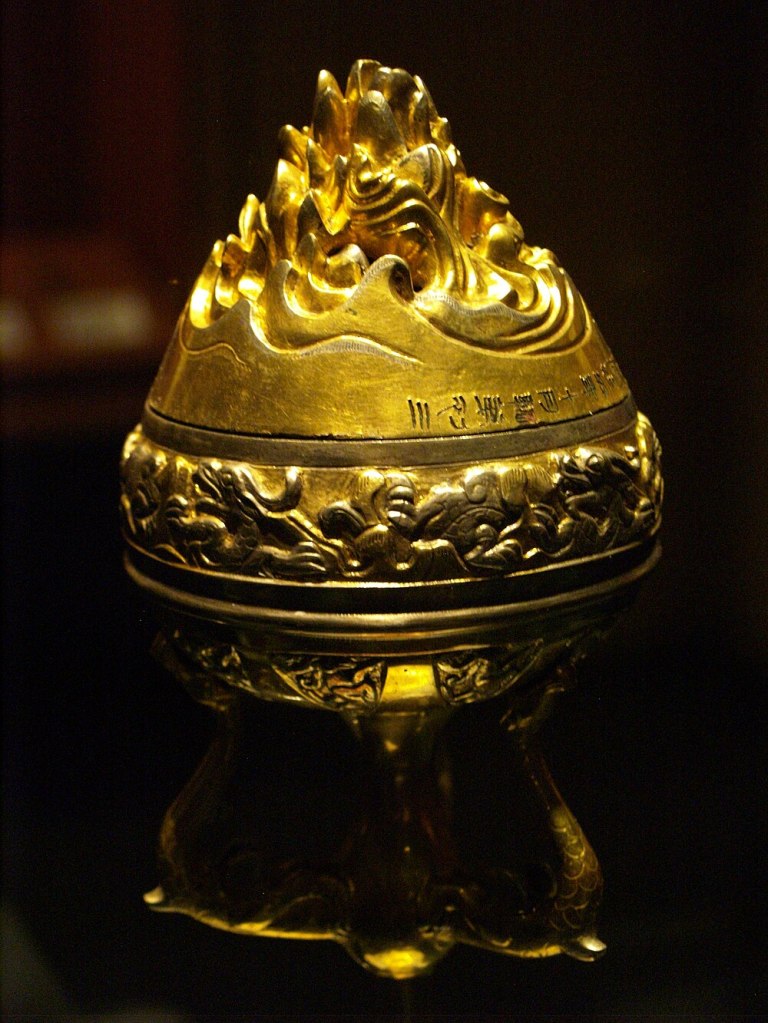
    A Incense Burner, allegedly given to Wei Qing by the Emperor Wu of Han

    The 6th year of Emperor Wu’s Yuan’guang Era (129 B.C.)

    In the winter, the court instituted the registration of merchant carriages throughout the realm, so as to levy taxes upon them.

    The Grand Minister of Agriculture, Zheng Dangshi, memorialized, saying, “If a canal is dug from the Wei River to the Yellow River, it will ease the transport of grain from the eastern provinces and irrigate more than ten thousand acres of arable land.”

    In the spring of the following year, the Emperor issued an edict mobilizing tens of thousands of laborers to undertake the work in accordance with Zheng Dangshi’s plan. After three years, the canal was completed, and it was praised throughout the land as a boon to the people.

    That same year, four armies were dispatched to strike the Xiongnu at the frontier markets. General of Chariots and Cavalry Wei Qing set forth from Shanggu; General of Cavalry Gongsun Ao from Dai; General of Light Chariot Gongsun He from Yunzhong; and General of Gallant Cavalry Li Guang from Yanmen. Each commanded ten thousand horsemen.

    Wei Qing advanced as far as Longcheng and captured seven hundred of the Xiongnu. Gongsun He returned without success. Gongsun Ao suffered defeat and lost seven thousand cavalrymen. Li Guang, too, was defeated and taken captive. The Xiongnu riders bound him, placed him between two horses, and bore him prone for more than ten li. Feigning death, Li Guang suddenly leapt onto a Xiongnu rider’s horse, seized his bow, and spurred the beast southward. Thus did he escape and return alive.

    Gongsun Ao and Li Guang, having suffered defeat in battle, were condemned to death by the Han court. They each redeemed their lives by paying the statutory ransom, and were thereafter stripped of rank and reduced to commoner status. Only Wei Qing, whose campaign deemed success, was enfeoffed with the title of Marquis Within Passes.

    Though born of low station, Wei Qing was skilled in horsemanship and archery, possessed great physical strength, and treated his officers with due respect while showing kindness to the common soldiery. The troops held him in high regard and followed him without hesitation. He had the makings of a competent commander; thus, in every expedition he achieved victory. The empire, observing this, gave credit to the Emperor for his discerning eye in recognizing and raising up the worthy.

    In the summer, the land suffered from severe drought, and locusts swarmed across the fields.

    In June, the Emperor set forth on an inspection tour, journeying to Yong.

    In autumn, the Xiongnu launched frequent incursions along the frontier, with Yuyang Commandery bearing the brunt of the attacks. The court appointed Han Anguo, Commandant of the Court Guard, as Infantry General, and ordered him to garrison his troops in Yuyang for the defense of the realm.

    The 1st year of Emperor Wu’s Yuanshuo Era (128 B.C.)

    In November of winter, an imperial edict was issued, proclaiming:

    “We have long instructed our officials to honor filial piety and uphold integrity, that such virtues might be extolled throughout the realm, establishing a standard for the generations to come and preserving the noble legacy of our forebears. Within every group of ten households, there ought to be one loyal and upright man; among every three, one who is worthy of emulation. Yet there are commanderies in which not a single name has been recommended. Such negligence obstructs the cultivation of virtue and hinders worthy men from receiving due recognition by the Sovereign.

    “In antiquity, those who advanced the worthy were rewarded, while those who concealed talent were punished with death in the marketplace. Thus excellence was encouraged, and the good brought to light. Let it be deliberated: what punishment befits those senior officials whose emoluments exceed 2000-piculs, yet who fail to put forth even one name in recommendation of the filial and upright?”

    The ministers submitted a memorial, stating: “To neglect the promotion of the filial is to disregard the imperial will; such is the crime of defying the sovereign. To be unable to discern the virtuous is to reveal one’s unfitness for office. Such officials ought to be removed.”

    The Emperor assented, and the measure was enacted.

    In December, King Yi of Jiangdu, Liu Fei, passed away.

    Prince Liu Ju was born to Madame Wei. That same day, Madame Wei was elevated to the throne of Empress, and a general amnesty was proclaimed throughout the realm.

    In autumn, twenty thousand Xiongnu cavalry breached the frontier. They slew the Prefect of Liaoxi and carried off more than two thousand captives. Advancing further, they laid siege to the garrison under Han Anguo’s command. Thereafter, they swept through Yuyang and Yanmen, each suffering over a thousand killed or captured. Han Anguo withdrew to Beiping, where he died after several months. The court then reappointed Li Guang as Prefect of Youbeiping. The Xiongnu chieftains, having long feared him, referred to him as the “Flying General of Han” and henceforth did not dare approach the territory under his watch.

    That same season, General Wei Qing led thirty thousand cavalry to strike the Xiongnu in the region of Yanmen, while General Li Xi advanced into Dai Commandery. Wei Qing’s troops slew several thousand of the enemy and returned in triumph.

    At this time, Nam Ryeo, chieftain of the Yemaek, together with his followers—numbering two hundred eighty thousand—submitted in surrender. The court established Canghai Commandery to govern them. The expense of their resettlement matched that incurred in pacifying the southwestern tribes such as Yelang, which led to disturbances between the territories of Yan and Qi.

    In that same year, the Prince of Lu, Liu Yu and the Prince of Changsha, Liu Fa passed away.

  • Comprehensive Reflections to Aid in Governance(Part 142): A Mind Reader

    Comprehensive Reflections to Aid in Governance

    By Sima Guang

    Translated By Yiming Yang  

    Annals of Han Book 10 Scroll 18 (continued)

    Zibo, f.k.a. Zichuan the hometown of Gongsun Hong, Shandong Province

    The 5th year of Emperor Wu’s Yuan’guang Era (130 B.C.)

    The Emperor appointed Zhang Tang as Grand Palace Grandee. Together with Zhao Yu, he codified statutes and ordinances, multiplying their intricacies. They enforced strict observance of official duties, and promulgated the Law of Misprision, whereby subjects were urged to denounce one another and overseers were bound to scrutinize their subordinates. From that time forth, the rule of law grew ever more exacting.

    In August, rice borers afflicted the fields.

    In that same year, persons among the officials and common folk who possessed knowledge of current statecraft or were versed in the teachings of the ancient sages were summoned to the capital. They were grouped according to their native counties, provisioned food along the way, while traveling with the provincial officers who reported statistics to the court.

    Gongsun Hong of Zichuan, in his memorial submitted during the official selection examination, wrote:

    “I have heard that in high antiquity, under the reigns of Emperor Yao and Shun, rank and reward were not esteemed, yet the people urged one another toward virtue. Punishments were not severe, yet transgressions were few. This was because the sovereigns were upright, and their virtue inspired trust among the people. But in the decline of later ages, high honors failed to encourage good conduct, and harsh laws could not restrain evil. This was because the ruler lacked righteousness, and the people no longer believed in him. Therefore, one cannot govern by rewards and punishments alone; the essential matter is that the people place their trust in the state.

    “The government, then, must employ the worthy in their proper stations, entrusting them with the management of affairs. Idle discourse must be silenced, lest it hinder execution. Superfluous production must be curtailed, that taxation may be eased. The people must not be robbed of their time or labor, that they may enrich themselves through their own efforts. Those of virtue must be raised up; the unworthy must be cast down, that authority may be honored. Those of merit must be rewarded; the idle and ineffectual dismissed, that rank may be justly ordered. If punishments fit the crime, corruption will cease; if rewards accord with service, ministers will be diligent. These eight measures form the foundation of good government.

    “The people are the root. When occupied with their tasks, they do not contend; when given proper guidance, they do not harbor resentment; when treated with ritual and propriety, they do not rebel; when cherished by their superiors, they respond with loyalty. These are the urgent concerns of statecraft. Rites and righteousness are the bonds that hold the people. When reward and punishment accord with these, the laws would not be transgressed.

    “I have also heard it said: ‘Like nature attracts; harmonious tones respond in kind.’ Thus, when the ruler above cultivates harmony and virtue, the people below dwell in concord. When the heart is harmonized, the vital energies are balanced; when the energies are balanced, the body is sound; when the body is sound, the voice is in tune; and when the voice is in tune, Heaven and Earth respond in accord. When yin and yang are in harmony, the winds and rains arrive in season, sweet dew descends, the five grains flourish, the six livestock prosper, fields yield in abundance, auspicious plants appear, the mountains remain verdant, and the marshes do not dry—such is the ultimate fruit of harmony.”

    At that time, more than a hundred men presented themselves for examination. The Minister of Ceremonies ranked Gongsun Hong’s memorial among the lower entries. Yet the Emperor, discerning its worth, raised it above all others, appointed Gongsun Hong as Erudite, and ordered him to await summons at the Golden Horse Gate.

    There was another man, Yuan Gu of Qi, over ninety years of age, who was likewise summoned to the capital as one of the Worthies. Renowned for his virtue and learning, he was held in esteem by many. Gongsun Hong regarded him only with a sidelong glance. Yuan Gu reproached him, saying, “Master Gongsun, one must speak the truth in accordance with the Confucian Way. To please the current populace is to stray from righteousness.”

    Many among the Confucians harbored resentment toward Yuan Gu and maligned him in secret. Thereafter, he withdrew from service, citing the infirmities of old age.

    In those years, the imperial court sought to open the mountain roads leading to the four commanderies of the southwest—Guanghan, Qianwei, Ba, and Shu. Provisions for the laborers were borne over thousands of li. For several years, the roads remained impassable; soldiers perished in great numbers from hunger, pestilence, and the miasmic climate. Moreover, the tribes of the southwestern barbarians rose in frequent rebellion, consuming the empire’s wealth with no gain in territory nor submission.

    The Emperor was disquieted and dispatched Gongsun Hong to investigate the matter. Upon his return, Gongsun Hong memorialized the court, reporting the misery of the southern marches and declaring that the tribes were of no benefit to the state. But the Emperor set aside his counsel and did not act upon it.

    In court deliberations, Gongsun Hong was ever measured in speech, laying forth the essential facts and leaving judgment to the Emperor. He refrained from contentious disputation and did not press his views. This comportment pleased the Emperor, who deemed him prudent in conduct, skilled in argument, well-versed in law and governance, and adept in citing the Classics of the Sage. Rejoicing in his comportment, the Emperor within the year appointed him Left Interior Minister.

    At court, Gongsun Hong never openly opposed the Emperor. He and Ji An often requested private audiences. Ji An would raise the matter, and Gongsun Hong would follow with further remarks. The Emperor found Gongsun Hong’s manner agreeable, often adopted his counsel, and favored him ever more. On several occasions, though he had earlier expressed a contrary view in council, Gongsun Hong would later amend his position to accord with the Emperor’s will.

    During one such session, Ji An rebuked Gongsun Hong before the assembled ministers, saying, “Men of Qi are known for their cunning ways. In our early consultations, you agreed with my proposal. Now, before His Majesty, you reverse your stands entirely. You are evasive and untrustworthy!”

    The Emperor turned to Gongsun Hong for a reply. Gongsun Hong bowed and said, “Those who know me well regard me as honest and loyal. Those who do not may hold doubts.” The Emperor accepted his words in good faith. Though there were those at court who spoke ill of him, the Emperor’s trust in Gongsun Hong only deepened.

  • Comprehensive Reflections to Aid in Governance(Part 141): Jester Not Always Joking

    Comprehensive Reflections to Aid in Governance

    By Sima Guang

    Translated By Yiming Yang  

    Annals of Han Book 10 Scroll 18 (continued)

    Zangke River, Guizhou Province

    The 5th year of Emperor Wu’s Yuan’guang Era (130 B.C. continued)

    In earlier years, when Wang Hui led a campaign against Minyue, he dispatched the Magistrate of Poyang, Tang Meng, to deliver their strategy to Nanyue. While in Nanyue, Tang Meng was served with betel sauce. Inquiring of its origin, he was told, “It comes from the northwest, along the Zangke River. That river is several li across and passes near the city of Panyu.”

    Upon returning to Chang’an, Tang Meng questioned merchants from Shu. They confirmed that betel sauce was a product solely of Shu, and that much of it was illicitly transported and sold to the Yelang people. The kingdom of Yelang lies along the Zangke River, which spans over one hundred chi(feet) in breadth, broad enough to bear boats. Nanyue was compelled to provide them with goods and labor, reaching even as far as Tongshi, yet still failed to bring them fully under subjugation.

    Tang Meng thereupon submitted a memorial to the Emperor:

     “The King of Nanyue rides beneath a yellow canopy and displays a royal standard. His domain stretches more than ten thousand li from east to west. Though styled a vassal beyond the borders, in truth he governs as an autonomous prince. Now, should we wish to march upon Nanyue, we must pass through the territories of Changsha and Yuzhang, where the waterways are intricate and difficult to navigate.

    “I have heard that the elite troops of Yelang number in excess of ten thousand. If we launch vessels upon the Zangke River and strike by surprise, catching them unawares, it will be a most advantageous strategy against Nanyue. Moreover, the might of the Han, supported by the wealth of Ba and Shu, is sufficient to establish an administrative command over Yelang with ease.”

    The Emperor received the memorial with approval.

    Tang Meng was appointed General of the Household, given command of one thousand soldiers, with a supporting force of more than ten thousand men, and ample military provisions. He advanced through the Zuo Pass from the commanderies of Ba and Shu and made contact with Duotong, the Marquis of Yelang. Tang Meng bestowed generous gifts and extolled the rewards of submission. He proposed the establishment of Han governance, offering to appoint Duotong’s son as the local magistrate.

    The lesser towns nearby, coveting Han silk and fine cloth, judged the southern route too perilous to be practicable. Thus they acceded to Tang Meng’s proposal.

    Upon his return, Tang Meng reported to the Emperor. The Emperor thereupon established Yelang as a commandery, naming it Qianwei, and dispatched troops from Ba and Shu to open a road from Bodao to the Zangke River. Laborers numbered in the tens of thousands. Many perished from hardship; many more deserted. Martial law was enforced with severity, and leaders of desertion were punished according to the statutes. This sowed great fear and unrest among the people of Ba and Shu.

    When word of this reached the throne, the Emperor dispatched Sima Xiangru to censure Tang Meng and the commanders. Sima Xiangru addressed the people, proclaiming that these harsh measures were not in accord with the sovereign’s intent. Having pacified the region, he returned to report at court.

    At that time, the tribal chieftains of Qiongdu and Dingzuo, hearing of the honors and rewards bestowed upon the southwestern barbarians who submitted, sought to become vassals of the Han. They memorialized the throne, requesting the dispatch of imperial envoys and the appointment of Han officials to administer their lands.

    The Emperor consulted Sima Xiangru, who submitted the following counsel:

    Qiongzuo, and Ranmang lie close to Shu. The roads thither are readily traversed. In the time of Qin, these regions were opened and established as commanderies and counties, but with the fall of Qin and the rise of Han, they were abandoned. Now, if once more commanderies and counties are founded therein, they will prove more governable than other southern tribes.”

    The Emperor accepted this proposal and appointed Sima Xiangru as General of the Household. He was sent as an envoy to the southwestern regions, bearing imperial insignia. Accompanied by Assistant Envoy Wang Ranyu et al. and riding mail carriages, he bore generous gifts and gold to secure the allegiance of the tribal leaders.

    The chieftains of Qiongzuo, Ranmang, and Siyu all submitted memorials requesting to become Han subjects. The empire abolished the former border passes, extended its frontiers with new checkpoints, and in the west reached the Moshui and Ruoshui Rivers, while in the south, the border extended to the Zangke. A new road was tunneled through Lingguan Mountain, bridging over the Sunshui River, and through Qiongdu. A commandant’s office was established, and more than ten counties were placed under the administration of Shu Commandery.

    The Emperor was well pleased.

    An imperial edict was issued to dispatch ten thousand troops to reinforce and fortify the defenses at Yanmen Pass.

    In July of autumn, a great wind arose; trees were toppled, and the land was shaken.

    At that time, Chu Fu, a woman versed in sorcery and illicit rites, gathered a band of witches and conspired to instruct Empress Chen—who had fallen from favor—in the use of spells and incantations to curse those who held the Emperor’s affection, and to regain his love through occult means. When word of this reached the Emperor, he commanded censor Zhang Tang to conduct a full inquiry.

    Zhang Tang’s investigation was exhaustive and uncovered a vast conspiracy implicating more than three hundred persons. Chu Fu was executed; her head was exposed at the city gate as a warning to all.

    On July 9, the Empress was stripped of her title. Her seals and regalia were taken, and she was confined in retirement within the Changmen Palace.

    Dowager Duchess Dou, a.k.a. Princess of Guantao and mother of the Empress Chen, was stricken with remorse and dread, fearing punishment for the transgressions of her daughter. She prostrated herself before the Emperor and offered words of gratitude for his clemency.

    The Emperor replied: “The Empress transgressed the bounds of righteousness, and thus I had no recourse but to depose her. Yet this is not a judgment upon you. Hold fast to your virtue, and let not idle tongues breed mistrust. Though the Empress is dethroned, she shall enjoy all due rites and honors as before. The Changmen Palace shall differ in no wise from the central palace.”

    In years past, the Emperor had held a banquet at the residence of Dowager Duchess Dou. There, he encountered Dong Yan, a purveyor of jewelry and a paramour of the duchess. Pleased with his manner, the Emperor honored Dong Yan with rich robes and high station, addressing him as “Master of the House” rather than by name, and having him join the imperial revelries.

    Thereafter, Dong Yan stood high in favor. His name was renowned throughout the realm. He amused himself in the northern palace, galloping through the Pingle Garden, organizing cockfights, soccer ball games, races of horses and hounds—pastimes that brought great delight to the Emperor.

    Once, the Emperor held a feast in the great hall of Weiyang Palace. He sent an attendant to summon Dong Yan.

    At that moment, Dongfang Shuo, Gentleman of the Household and bearer of the halberd, laid down his weapon and stepped forward, saying, “Dong Yan has committed three grave offenses. Why is he permitted to enter the inner court?”

    The Emperor asked, “What are these offenses?”

    Dongfang Shuo replied: “First, though a commoner, he consorted intimately with a princess—this is his first crime. Second, he has corrupted the norms between men and women, subverted the rites of matrimony, and thereby harmed the moral order of the realm—this is his second crime. Third, Your Majesty has reached an age to devote yourself to the Six Classics, to cultivate virtue and uphold the teachings of the sages. Yet Dong Yan neither reveres the Classics nor encourages learning. Instead, he delights in frivolity and extravagance, indulging in horse races and dog chases, and wallows in the pleasures of the eyes and ears. Such a man is a blight upon the state and a canker upon the ruler. This is his third crime.”

    The Emperor remained silent. After a long pause, he said, “The feast has already been prepared. We will mend it by ourselves later.”

    Dongfang Shuo said, “No! The main hall is where the Mandate of the Former Emperors resided; no man guilty of transgression should be permitted to set foot therein. From indulgence grows disorder; from disorder, usurpation. The corruption of the inner chambers has brought ruin to states since ancient times. Consider the calamity of the State of Qi[Duke Huan of Qi], brought about by the cruelty and wickedness of flatterers such as Shu Diao and Yi Ya. The execution of Qingfu preserved the State of Lu.”

    The Emperor replied, “Your words are just,” and at once ordered that the feast be moved to the Northern Palace. Dong Yan was summoned instead through the East Gate, an entrance for marshals.

    In recognition of Dongfang Shuo’s upright counsel, the Emperor bestowed upon him thirty cattie of gold. Thereafter, Dong Yan’s favor steadily declined.

    From that time forward, the princesses and consorts increasingly overstepped the bounds of decorum.

  • Comprehensive Reflections to Aid in Governance(Part 140): Rise from Riches And Fame Unsoiled

    Comprehensive Reflections to Aid in Governance

    By Sima Guang

    Translated By Yiming Yang  

    Annals of Han Book 10 Scroll 18 (continued)

    Imperial Academy, Photo by Martin, W. A. P.

    The 3rd year of Emperor Wu’s Yuan’guang Era (132 B.C.)

    In the spring, the Yellow River altered its course, flowing southeastward from Dunqiu County.

    In May of summer, the swollen river again burst its dikes near Huzi Dam in Puyang, pouring into Juye. The waters joined the Huai and Si rivers, inundating sixteen commanderies. The Emperor dispatched Ji An and Zheng Dangshi drafting one hundred thousand corvees to seal the breach, yet their labors proved fruitless. The surging waters swiftly swept away the embankments they had raised.

    At that time, Tian Fen, whose fief lay in Shu County to the north of the river and who had been spared the flood and reaped abundant harvests, memorialized the throne. He declared that to obstruct the Yellow River by human means was in vain. The meandering of the Yangtze and the Yellow River, he said, followed the workings of nature and could not be restrained by mortal hands. He further contended that such resistance might stand contrary to the will of Heaven.

    Tian Fen’s words found favor among those who observed the movements of Heaven and Earth. Thus it was that the Emperor, heeding their counsel, suspended the works to dam the river for many years.

    In the reign of Emperor Jing, Dou Ying, Marquis of Weiqi, served as Grand General. At that time, Tian Fen, Marquis of Wu’an, held the humble post of attendant-in-waiting, ever pouring wine before Dou Ying, rising and kneeling without ceasing, bearing himself as though he were a son or nephew in service.

    As years passed, Tian Fen’s power waxed. He ascended to the Chancellorship, while Dou Ying’s prestige declined and his favor with the court diminished. His retainers scattered, and only Guan Fu of Yingyin, former prime minister of Yan, remained by his side. Dou Ying held Guan Fu in high esteem and treated him as a father would a son.

    Guan Fu was upright in disposition, forthright in speech, and lacking in restraint when drinking. He would often provoke those of higher station, quarreling with them in his cups. On several occasions, he came into conflict with Chancellor Tian Fen, and discord grew between them. In time, Tian Fen memorialized the Emperor, saying: “Guan Fu and his kin harass the common people; the residents of Yingchuan suffer grievously at their hands.”

    Guan Fu and his kin were seized and sentenced to public execution. Dou Ying, Marquis of Weiqi, submitted a memorial in his defense. The Emperor commanded both the Marquis of Weiqi and the Marquis of Wu’an to present their arguments before the East Court, where the Empress Dowager presided. Yet rather than plead their cases, the two marquises used the occasion to level accusations against one another.

    The Emperor then summoned his ministers and inquired who among the two was in the right. Of them, only Ji An stood in support of the Marquis of Weiqi. Han Anguo declared that both parties were justified. Zheng Dangshi at first inclined toward the Marquis of Weiqi, but dared not hold onto his view. The Emperor, displeased by Zheng Dangshi’s evasiveness, declared, “Men like you deserve execution.”

    Thereafter, the Emperor withdrew to the inner palace and dined with the Empress Dowager. Stricken with anger, she would not eat, and said, “While I still live, they already have assailed my younger brother. When I am gone, will they cut him like fish or meat upon the chopping board?” The Emperor, having no alternative, ordered that the sentence be carried out: the clan of Guan Fu was exterminated.

    Dou Ying, Marquis of Weiqi, was also arrested and tried. He was found guilty on multiple counts and condemned to death.

    The 4th year of Emperor Wu’s Yuan’guang Era (131 B.C.)

    On December 30, in the depth of winter, Dou Ying, Marquis of Weiqi, was executed at Weicheng.

    On March 17 of spring, Tian Fen, Marquis of Wu’an, passed away. In the aftermath of the rebellion of Liu An, Prince of Huainan, it was revealed that Tian Fen had received gold from the prince and spoken words that gave him encouragement. Upon hearing this, the Emperor said, “Had the Marquis of Wu’an still lived, his entire clan would have been put to death.”

    In April, during early summer, a great frost descended and destroyed the crops.

    Han Anguo, Grand Master of the Censorate, was entrusted with the duties of the Chancellor. While directing the imperial passage, he fell from his chariot and was lamed.

    On May 20, Xue Ze, Marquis of Pingji, was appointed Chancellor. Han Anguo, stricken with illness, was discharged from office.

    In that year, the earth trembled, and a general amnesty was proclaimed throughout the realm.

    In September, Zhang Ou, Commandant of the Capital Guard, was appointed Grand Master of the Censorate. Han Anguo, whose health had recovered, was reappointed as Commandant of the Capital Guard.

    Liu De, Prince of Hejian, delighted in learning and venerated the ancient texts. He pursued truth in study with sincerity, and richly rewarded those who presented worthy books, granting them gold and silk. He gathered writings from all quarters, and the number of volumes in his collection surpassed even that of the imperial archives. By contrast, Liu An, Prince of Huainan, likewise showed an interest in books, yet his compilations abounded in hollow theories and fanciful arguments.

    The works collected by Prince Liu De were chiefly ancient writings from before the Qin dynasty, and treatises concerning rites and music. He collated and lightly amended these texts, reissuing more than five hundred pieces. In clothing and conduct, he upheld the forms of Confucian propriety, and scholars from the eastern commanderies esteemed him and came to follow his example.

    The 5th year of Emperor Wu’s Yuan’guang Era (130 B.C.)

    In October of winter, Liu De, Prince of Hejian, entered the capital. He presented formal music for ceremonial use, and responded to more than thirty inquiries from the Emperor concerning the rites and protocols of Sanyong Palaces (Three Institutions—the Imperial Academy, the Luminous Hall, and the Spiritual Terrace). In his replies, he displayed deep comprehension of Confucian doctrine, speaking with clarity, precision, and graceful brevity.

    The Emperor commanded the Imperial Musicians to record the harmonies offered by the Prince and to rehearse them for use in grand ceremonies held throughout the year, though not as part of regular observances.

    In January of spring, the Prince of Hejian passed away. Cheng Li, Commandant of the Capital Guard, memorialized the court with news of the prince’s death, praising him as upright and virtuous, modest and frugal, respectful of elders, and compassionate toward widows and orphans. He further extolled the prince’s deep discernment and keen judgment.

    The Grand Herald submitted a formal petition, requesting that the Prince be granted the posthumous title “King of Xian,” meaning “Bright and Wise,” in accordance with the ancient ordinances governing posthumous honorifics.

    Ban Gu’s praising remark: Duke Ai of Lu said, “I was born in the inner palace, reared among women, and knew not sorrow, nor fear.” Indeed, these words reveal a fundamental truth. Even should such a ruler strive with utmost care to shield his people from harm, peril cannot be wholly averted. Thus did the ancients regard indulgence and ease as a hidden poison, and wealth unaccompanied by virtue as a source of calamity.

    From the founding of the Han to the reign of Emperor Ping, the princes and feudal lords numbered over a hundred. Many among them fell into arrogance and dissipation, straying far from the proper path. Why so? Immersed in luxury and indulgence, they became heedless, squandering their positions in reckless abandon. Even the common folk are shaped by habit and custom—how much more are those, like Duke Ai of Lu, reared in palaces, surrounded by opulence? 

    Only those who adhere steadfastly to the greater principles, standing above the vulgar multitude, may escape such fate. The late King Xian of Hejian approached this ideal.

  • Comprehensive Reflections to Aid in Governance(Part 139): The Farce at Ma’yi

    Comprehensive Reflections to Aid in Governance

    By Sima Guang

    Translated By Yiming Yang  

    Annals of Han Book 10 Scroll 18

    Duration of 9 years

    Ambush at Ma’yi

    The 2nd year of Emperor Wu’s Yuan’guang Era (133 B.C.)

    In October of winter, the Emperor traveled to Yong county and offered sacrifices at the Altars for Five Deities.

    An occultist known as Li Shaojun was granted an audience with the Emperor, for being able to reverse aging by worshiping the kitchen god. The Emperor highly respected him. Li Shaojun, formerly an attendant of the Marquis of Shenze, Zhao Xiu, concealed his age and upbringing. He traveled widely among the feudal lords without revealing any information about his life, He seemed to have no spouse and child. He was known for his ability to influence material goods, longevity, and claimed to possess knowledge of beings who won’t die. People donated food and money to him, so he had a surplus of wealth. People believed him even more when they witnessed that he didn’t engage in regular occupations yet lived in abundance. They vied to serve him and provided him with offerings, including money, clothing, and food.

    Li Shaojun was good at making surprising predictions that later were proved to be true. Once, Li Shaojun joined a gathering with Marquis Wu’an(Tian Fen) for a drink. Being present at  the gathering, there was an old man who was more than ninety years old. Li Shaojun spoke about a place where he used to go hunting with the old man’s grandfather. To everyone’s astonishment, the elderly man recognized that place, having accompanied his grandfather there during his childhood.

    Li Shaojun told the Emperor: “When one makes offerings to the kitchen deity, it attracts spiritual beings. By connecting with these spiritual beings, one can transform cinnabar into gold, extend his life, and even encounter the Immortals of Penglai. If one meets these Immortals and performs the Feng-Shan ceremony[worship of Heaven and Earth at Mount Tai], one will attain immortality. This is what happened to the Yellow Emperor.”

    “Once, I traveled to the sea and encountered Anqi Sheng, an Immortal. He shared jujubes with me, each as big as a melon. Anqi Sheng is a being of great enlightenment, capable of traveling through the realm of Penglai. When one is in harmony with him, one can see him. When one is not, he remains hidden.”

    As a result, the Emperor began to personally perform sacrifices to the kitchen god, and he sent occultists to search the sea for islands like Penglai and demigods like Anqi Sheng. They also embarked on efforts to transmute cinnabar sand into gold. After some time, Li Shaojun became seriously ill and passed away. The Emperor believed that he had undergone a transformation and not actually died. However, many occultists(necromancers and alchemists, etc.) along the coasts of Yan and Qi came to the Emperor and talked about gods and spirits.

    Miu Ji of Bo raised awareness about the offering to Taiyi(North Star). He said, “The most revered heavenly deity is Taiyi, and Taiyi is assisted by the Five Deities.” Following this, the Emperor established the altar to Taiyi at the southeast outskirts of Chang’an.

    Nie Yi, a wealthy man from Ma’yi County of Yanmen Commandery, suggested a plan, through the Grand Herald Wang Hui, to lure the Xiongnu through the strategy of feigned friendship and then launch a surprise attack. The Emperor consulted with his ministers, and Wang Hui said, “I’ve heard that the state of Dai, when it was a sovereign state, had a formidable enemy in the north, and yet maintained vigilance against internal warfare of the middle kingdoms. At that time, their elderly and the young were still well taken care of, trees were planted at the right time, and the granaries were always full. This made the Xiongnu hesitant to invade. Now, Your Majesty’s power unifies the entire nation. However, the incessant Xiongnu incursions are because they no longer fear us. I believe that we should launch an attack.”

    Han Anguo disagreed, stating, “I’ve heard that Emperor Gaozu once was besieged in Pingcheng and ran out of food for seven days. After lifting the siege, he showed no sign of hatred and revenge. A wise ruler measures the entire world, not harboring personal resentment that harms the interests of the people. That’s why he sent Liu Jing to negotiate peace with the marriage agreement, and to this day, we’ve enjoyed five generations of benefits. I believe that we shouldn’t attack.”

    Wang Hui argued, “That’s not the case. Emperor Gaozu, wearing armor and wielding sharp weapons, had gone through wars for decades. He didn’t seek vengeance for the grudge at Pingcheng not because he didn’t have the strength, But he aimed at calming the hearts of the people and giving people a respite from incessant wars. Nowadays, frequent border alarms, injured soldiers, and the sight of hearses come one after another. A benevolent person should be sad about this. That’s why I say we should attack.”

    Han Anguo said, “I disagree. I’ve heard that in military affairs, you should keep our forces with satiety versus an enemy who is hungry, to maintain order versus an enemy who is in chaos, and to keep our forces well rested versus an enemy who is exhausted. By keeping our forces well-provisioned and disciplined, we can conquer enemy armies, destroy their countries, and capture their cities. This is the way of warfare advocated by wise leaders. Currently, the plan to swiftly deploy is unwise, and the depth of our invasion is difficult to execute. Rushing in a long column would lead to side ambushes, while marching in parallel would lead to less reinforcement. Moving too fast leads to supply shortage.  Procrastinating leads to missed opportunities. In less than a thousand miles, we would run out of food. The horses and men would be starved, and the ancient law says, ‘Sending troops far away, and you let them be captured.’ That’s why I say we shouldn’t attack.”

    Wang Hui countered, “That’s not the case. When I suggest attacking, it doesn’t mean an all-out invasion. We will go along with the greed of the Chanyu and lure him to our borders. Then, we’ll select elite cavalry and strong warriors to lay in ambush. We’ll examine the difficult terrains and use them as strategic positions for attacking the enemy. We’ll have our forces established and stationed to encircle him. Once ready, we’ll block him from the left, the right, the front, and the back. We can capture the Chanyu, and a complete victory is inevitable.” 

    The Emperor agreed with Wang Hui‘s plan.

    In June of summer, The Emperor appointed Han Anguo, the Grand Master of Censerate, as the General Guards the Army, Commandant of the Court Guard–Li Guang, as the General of Agile Cavalry, the Grand Coachman, Gongsun He, as the General of Light Chariots, the Grand Usher Wang Hui as the General of Stationed Troops, and Grandee of Palace Li Xi as the General of Infantry. These generals were tasked with leading over 300,000 cavalry, chariots and infantry to hide in the valley near Ma’yi, preparing to ambush the Xiongnu. They secretly made a plan to launch an attack as soon as  the Xiongnu entered Ma’yi.

    They also sent Nie Yi as a double agent to the Xiongnu, promising to deliver the surrender of Ma’yi and the capture of its officials. Nie Yi executed criminals and placed their heads under the walls of Ma’yi. Nie Yi sent a message to the Xiongnu emissary: “The officials of Ma’yi were dead. Come soon!”  Xiongnu Chanyu led his forces and crossed the border into the Wuzhou Pass. However, as they advanced, they encountered empty pastures without anyone herding livestock. They continued to advance and reached a garrison where they captured a staff of Commandant of Yanmen.  The captive told the Chanyu where the Han forces were positioned as they were about to execute him.

    Surprised by this revelation, Xiongnu Chanyu exclaimed, “I had my suspicions!” and decided to retreat. He considered the capture of the Han staff officer as divine revelation, and named him “the king of heaven”.

    News of the Xiongnu‘s retreat reached the Han forces, who stopped their pursuit. Wang Hui led a separate unit to attack the Xiongnu‘s baggage train but also retreated when they heard that the chieftain had returned and its force was strong.

    The Emperor was furious with Wang Hui. Wang Hui argued: “Initially, the plan was to lure the Xiongnu into Ma’yi and engage them in a battle. Simultaneously, I was to attack their supply train, hoping to gain an advantage. However, when the Xiongnu chieftain did not arrive and instead retreated, my 30,000 soldiers were no-match to Chanyu’s large forces and an attack would add insult to injury.  I decided to return to Ma’yi and face beheading. At least I preserved the lives of 30,000 soldiers for Your Majesty.” Nevertheless, Wang Hui‘s case was brought before the Minister of Justice. The Justice Minister ruled that Wang Hui wavered and missed the opportunity, and sentenced him to death.

    Wang Hui bribed the Chancellor Tian Fen with a thousand caddies of gold. Tian Fen didn’t dare to speak to The Emperor directly. Instead, he shared his opinion with the Empress Dowager, his elder sister. The Empress Dowager, in turn, informed the Emperor of Tian Fen‘s concerns: “Wang Hui was the proponent of the battle of Ma’yi.  If we kill Wang Hui for failure to capture Chanyu, we are doing the bidding of the Xiongnu.” 

    The Emperor responded: “Wang Hui had been the one who initiated the campaign, and his actions had led to the mobilization of a large army. Even though their main objective was not achieved, Wang Hui‘s attack on the Xiongnu‘s baggage train would have helped to soothe the discontent among the soldiers and the gentry. Without punishing Wang Hui, I would not be able to appease the rest of the empire.” Wang Hui heard the verdict and committed suicide.

    Thereafter, the Xiongnu broke off the marriage alliance, assailed the frontier passes, and made frequent incursions into the Han territory, their raids beyond number. Yet they remained covetous of the border markets, delighting in trade and craving the Han goods. The Han people, too, kept the markets open, thereby meeting their needs.

  • Comprehensive Reflections to Aid in Governance(Part 138): Ji An, Mr. Insensitive

    Comprehensive Reflections to Aid in Governance

    By Sima Guang

    Translated By Yiming Yang  

    Annals of Han Book 9 Scroll 17 (continued)

    Minyue(Fujian Province), Nanyue(Guangdong, China; Vietnam)

    The 6th year of the Emperor Wu’s Jianyuan Era (135 B.C. continued)

    At that time, the Han forces had already set forth on their southern campaign, though they had yet to cross the mountain passes. The King of Minyue, Zōu Yīng, mustered his troops to resist. But his younger brother, Zōu Yǔshān, secretly plotted with his kinsmen and ministers: “The king raised arms against Nanyue without first petitioning the Son of Heaven; for this offense the Han army now comes to chastise us. Their forces are vast and mighty. Should we by chance repel them, they will only return in greater numbers, and our state shall be utterly destroyed. Now, if we slay the king to placate the Han emperor, and he accepts our submission, the army may withdraw and our state be preserved. But if he refuses, then we shall fight to the last. And if defeat befalls us, we shall flee across the seas.”

    All present assented to this counsel. Thereupon, they took up a short spear and slew the king. They then dispatched an envoy bearing his severed head to the Grand Herald, Wáng Huī.

    When Grand Herald Wáng Huī received the severed head of the King of Minyue, he said, “Our expedition was undertaken to punish the king. Now that his head has been delivered, our purpose is fulfilled without bloodshed—this is the most fortunate outcome.” Thereupon, Wáng Huī notified the forces under the Minister of Agriculture, Hán Ānguó, and dispatched an envoy to the capital, bearing the head of Zōu Yīng to report to the Son of Heaven.

    The Emperor issued a decree recalling both generals and their armies, saying, “The principal offender, Zōu Yīng, is no more. Of his kin, only the Lord Yáo, Zōu Chóu, grandson of King Wǔzhū, took no part in the conspiracy.” He then dispatched a General of the Household as his envoy to appoint Zōu Chóu as King Yáo, thus continuing the ancestral rites of Minyue.

    Meanwhile, Zōu Yǔshān, having slain Zōu Yīng, seized command of Minyue and won the support of the people. He proclaimed himself King of Minyue. The Emperor judged it unnecessary to mount another campaign, and declared: “Though Zōu Yǔshān conspired with Zōu Yīng in rebellion, he later slew the traitor and thereby spared the army from battle.” In recognition, the Emperor enfeoffed Zōu Yǔshān as King of East Yuè, allowing him to reign alongside Zōu Chóu, King Yáo of Minyue.

    The Son of Heaven dispatched Zhuāng Zhū to convey his will to the King of Nanyue, Zhào Hu. The king received the envoy with deference, prostrating himself and declaring, “The Emperor has raised troops to chastise Minyue; I shall devote my life to repay this favor and virtue!” He thereupon sent his crown prince to serve in the palace guard and said to Zhuāng Zhū, “Our state has only just emerged from the turmoil of invasion. The envoy is prepared, and Zhào Hu makes daily preparations to journey north to pay homage at court.”

    Zhuāng Zhū took his leave. On his return, he passed through Huáinán, whereupon the Emperor again dispatched him to present the circumstances of the Minyue campaign to the Prince of Huáinán, Liú Ān, and to commend his earlier counsel. Liú Ān respectfully received the imperial message, giving thanks and confessing that his advice had been inferior to the Emperor’s judgment.

    After Zhuāng Zhū departed from Nanyue, the ministers of the southern court said to their king, “The Han raised arms to punish Zōu Yīng, and the reverberations have reached even our borders. Formerly, the late king often said, ‘When serving the Son of Heaven, it is sufficient to maintain proper rites and decorum.’ More than this is unwise. Be not beguiled by the pleasing words of envoys—for if you go to court, you may never return, and our state could be lost.”

    Thereafter, King Zhào Hu claimed illness and never proceeded to an audience with the Emperor.

    That same year, Hán Ānguó was appointed Grand Master of the Censorate.

    Ji An of Pǔyáng, formerly Commandant of Dōnghǎi Commandery, was appointed as Commandant for the management of the nobility registers. In his early service, Ji An held the post of internuncio. Known for his stern disposition and uncompromising conduct, he was feared by his peers.

    When strife erupted among the Eastern Yuè tribes, the Emperor dispatched Ji An to investigate. Yet Ji An returned from Commandery without reaching his destination, saying, “The internecine conflict of the Yuè reflects their native customs. It is unworthy of tainting the Emperor’s authority.”

    Later, a great fire broke out in Hénán, destroying over a thousand dwellings. The Emperor again sent Ji An to inquire into the matter. Upon his return, he reported, “It was but an ordinary fire, spreading from a single household to several others—not cause for alarm. However, while passing through Hénán, I observed tens of thousands afflicted by flood and drought. In desperation, some parents had turned to cannibalism. I therefore took it upon myself to open the state granaries and distribute grain to relieve their suffering. I now return the authority to Your Majesty and stand ready to receive punishment for acting in your stead.”

    The Emperor commended Ji An’s compassion and absolved him of any fault.

    During his administration in Dōnghǎi commandery, Ji An governed with restraint and simplicity, favoring the Taoism of non-intervention over rigid legalism. He appointed worthy subordinates, entrusted them with full responsibilities, and did not burden the administration with trifling matters, attending only to what was essential.

    However, Ji An was blunt in speech and lacking in courtesy, intolerant of others’ failings and often causing embarrassment in public discourse. When the Emperor once summoned scholars and men of talent to court, he expressed a desire to initiate new policies, saying, “I wish to do such and such.” Ji An replied, “Your Majesty conceals ambition beneath a guise of benevolence and virtue. Why don’t you really learn to govern like the ancient sages Yáo and Shùn?”

    At this, the Emperor fell silent and departed the court in anger, leaving ministers and courtiers in dread.

    Later, the Emperor spoke with his attendants, saying, “Ji An is obstinate beyond reason and wholly lacking in tact!”

    When some courtiers rebuked Ji An for his words, he replied, “The Emperor appoints ministers to serve as remonstrators. If they merely flatter his desires, how will the realm be justly ruled? I hold this office not to preserve myself, but to uphold righteousness. If I remain silent out of fear, would that not dishonor the court?”

    Ji An, long afflicted by illness, had taken extended leave from office, exceeding three months. The Emperor, mindful of his service, repeatedly prolonged his furlough, yet Ji An’s condition showed no improvement. In the end, as his final illness took hold, Zhuāng Zhù requested leave on Ji An’s behalf.

    The Emperor inquired, “What manner of man is Ji An of Pǔyáng?”

    Zhuāng Zhù replied, “When in office, Ji An does not exceed his station with ostentation. But if entrusted with the guardianship of a young sovereign, or withholding a besieged city, he will neither be swayed by enticement nor retreat at dismissal. In such matters, not even gallants like Mèng Bēn or Xià Yu could overcome him.”

    The Emperor sighed and said, “Indeed, the ancients had loyal ministers, and Ji An approaches their measure.”

    At that time, the Xiōngnú came forth with a request for peace through heqin—marriage alliance. The Emperor, weighing the matter, summoned counsels. The Grand Herald Wáng Huī, hailed from Yān, versed in frontier affairs, opposed the proposal, “In past times, the Han court entered into marriage pacts with the Xiōngnú, yet not long after, they betrayed the covenant and resumed their raids. Their pledges are hollow; it is better to gird our defenses and prepare for war.”

    On the other hand, Hán Ānguó urged acceptance of the proposal: “The Xiōngnú are a nomadic people, fleet as birds in migration, and long unbound by any sovereign’s yoke. Should we send troops across a thousand li in contest for gain, the cost in men and horses would be ruinous. In such terrain, the Xiōngnú possess mastery. This is a perilous road. It is better to pacify them by alliance and avoid entanglement in a distant war.”

    The court was divided in counsel, yet a majority inclined toward Han Ānguó’s view. Thus, the Son of Heaven consented to the treaty and accepted the peace by marriage.

    The 1st year of the Emperor Wu’s Yuan’guang Era (134 B.C.)

    In November of winter, an edict was proclaimed, directing each commandery and principality to put forth one candidate as exemplar of Filial Piety and Incorruptibility, in accordance with the counsel of Dong Zhongshu.

    Li Guang, Commandant of the Court Guard, was appointed General of Agile Cavalry and posted to Yunzhong. Cheng Bushi, Commandant of the Capital Guard, was made General of Chariots and Cavalry and dispatched to Yanmen. In June, both were relieved of command.

    Li Guang and Cheng Bushi had gained renown during their tenures as prefects of border commanderies. Li Guang commanded his troops without rigid formation. The army encamped where water and pasture were abundant. Each man was left to attend to his own needs. No sentries patrolled the perimeter by night, and official registers were kept in simple form. Yet scouts were dispatched without fail, and the camp was never taken by surprise.

    Cheng Bushi, by contrast, upheld the formalities of military order. His troops drilled by formation; records were kept with precision. Camps were set with strict guard, and sentinels made their rounds through the night. Officers and soldiers were meticulously documented; the army seldom knew rest. Yet his ranks, too, were never assailed.

    Cheng Bushi remarked, “Li Guang’s troops are light and unencumbered. The Xiongnu dare to trespass but find no means to strike. His soldiers rejoice in their freedom and are ready to die for him. My army is bound by order and appears burdened, yet the Xiongnu do not dare test us.”

    Indeed, the Xiongnu feared Li Guang’s unorthodox methods. Yet the soldiers of Cheng Bushi were less enthusiastic in their service.

    Sima Guang’s Commentary: The Book of Changes states: “The army must go forth under strict discipline; without it, there is no auspicious outcome.” This teaches that the management of multitudes without observance of disciplines leads inevitably to disorder.

    Li Guang’s manner of command—permitting each man to act at his own discretion—may have suited a man of singular talent. Yet such a method cannot be set forth as a general model. Why so? Because it is rare to find one of equal caliber to succeed him, and still rarer to find many generals alike in virtue and capability.

    The disposition of the common man is to pursue ease and disregard hidden danger. Freed from the rigor of Cheng Bushi’s governance, they would readily take joy in Li Guang’s leniency. But such liberty also breeds resentment and disobedience. When indulgence reigns, disorder follows. Thus, the peril of a lax and simple system lies not only in the diminished vigilance of Li Guang’s troops, but also in deeper unrest.

    It is said: “Military affairs require strictness to the end.” Those who take command must be resolute and unwavering. To emulate Cheng Bushi may yield no immediate glory, yet it is less prone to ruin. To adopt the ways of Li Guang may seem effective, but more often ends in misfortune.

    In April of summer, a general amnesty was proclaimed across the empire.

    In May, an imperial edict ordered the commanderies and principalities to recommend men of worth and erudition. These the Son of Heaven would examine in person.

    On July 29 in autumn, there was a solar eclipse.

  • Comprehensive Reflections to Aid in Governance(Part 137): The Hazard of Campaigns against Yue

    Comprehensive Reflections to Aid in Governance

    By Sima Guang

    Translated By Yiming Yang  

    Annals of Han Book 9 Scroll 17 (continued)

    The Prince of Huainan, Liu An’s Book, Huainanzi

    The 6th year of the Emperor Wu’s Jianyuan Era (135 B.C.)

    On February 3 of the spring, a fire occurred at the Shrine of Emperor Gaozu in Liáodōng commandery, causing damage.

    On April 21 of the summer, a fire broke out at the side house in Emperor Gaozu’s tomb. As a result, the Emperor wore plain mourning clothes for five days.

    On May 26, the Grand Empress Dowager Dou passed away.

    On June 3, the Chancellor Xu Chang was dismissed from office. Marquis Wu’an, Tian Fen, was appointed as Chancellor.

    Tian Fen was spendthrift and self-indulgent. He built vast mansions that outclassed any other residence; his manors were the most fecund. The carriages bearing tribute from the counties and commanderies crowded before his gates. He accepted bribes from across the realm, and his household overflowed with treasures, concubines, hounds, steeds, and musicians, the luxuries beyond reckoning. When presenting memorials to the Emperor, he would discourse from morning till night, and all he spoke was approved. Those whom he recommended swiftly rose to ranks as high as two-thousand-piculs, and his influence came to surpass that of the throne.

    The Emperor once complained to him, “All the ministers have been appointed by you; I had wished to make some appointments myself.” When Tian Fen petitioned for land from the imperial armory to expand his mansion, the Emperor grew angry, saying, “Why don’t you take the entire armory for yourself?” After this, Tian Fen restrained his conduct somewhat.

    In August of autumn, a comet appeared in the east, its tail stretching across the sky.

    In this same year, the King of Minyue, Zou Ying, raised an army and attacked the borderlands of Nanyue. The King of Nanyue, mindful of his allegiance to the Emperor, dared not raise troops without imperial authorization and dispatched an envoy to submit a memorial reporting the matter.

    The Emperor, moved by his loyalty, resolved to act. He ordered the Grand Herald, Wang Hui, to set forth from Yuzhang Commandery, and the Minister of Agriculture, Han Anguo, to march from Kuaiji Commandery, each commanding forces to chastise Minyue.

    At this time, the Prince of Huainan, Liu An, memorialized to remonstrate:

    “Your Majesty, who reigns over all under Heaven, has extended benevolence and nurtured virtue. Within the seas, all is at peace, and the people live in harmony. Throughout your reign, there has been no turmoil or disorder. Now I hear that officials propose to raise an army to chastise Minyue, and I, your humble subject, am compelled to offer my counsel.

    Yuè is an outer land, inhabited by those who cut their hair and tattoo their bodies. They do not submit to the codes and customs of the Middle Kingdom. Since the days of the Three Dynasties, the Nomads and Yuè have never willingly adopted our calendar and rites. It was not that the Three Dynasties lacked strength to subdue them, but rather that these peoples dwell in inhospitable places and pursue ways intractable to governance.

    “Since the founding of Han, seventy-two years have passed. Though conflicts among the Yuè have been numerous, the Son of Heaven has never campaigned personally against them. Their lands lack walled cities and ordered towns; they live in valleys and among bamboo groves, skilled in river warfare and adept at boat-fighting. Their terrain is dense with forests and cut by treacherous waters; to one ignorant of the land, one hundred soldiers from the Middle Kingdom would scarcely match one of theirs. Those who seize their territory cannot establish counties and commanderies; those who attack cannot gain swift victories. The strategic passes and rivers, though appearing close on a map, span hundreds and thousands of miles in truth. Many routes are unrecorded and unknown. Though the path seems near, it is exceedingly difficult.

    “Now, by the blessings of the ancestral temples, all under Heaven enjoys peace. Men grow old and grey without knowing warfare; fathers, sons, and wives live in security. This is due to Your Majesty’s virtue. Yuè is named a vassal only in empty words. They offer no tribute, no sacrifices; they do not provide soldiers for the army. Their internal strife is constant. If Your Majesty now dispatches forces to intervene in their squabbles, it would exhaust the wealth of the Middle Kingdom for the sake of barbarians.

    “Moreover, the Yuè are rash and fickle, ignorant of propriety, prone to breaking faith. If whenever they disobey, we raise armies to punish them, then campaigns will be endless, and the soldiers of the empire will know no rest.”

    “Of late, the realm has suffered successive years of poor harvests and famine. People have sold their titles and married away their sons into in-law’s households merely to sustain themselves. Only through Your Majesty’s benevolence and relief efforts so that the ditches and valleys have not been filled with corpses. Yet it has been four years of failed crops, and now a fifth year with the scourge of locusts. The people’s vitality has not yet recovered.

    “Now to raise an army to march thousands of miles, to bear clothing and provisions over rugged terrain, to carry litters over mountains and drag boats across rivers, traversing countless valleys choked with dense forests and bamboo, would impose untold hardship. Soldiers would journey across hundreds and thousands of li, striking against rocks in the water, threading through woods rife with venomous serpents and fierce beasts. In the sweltering summer, fevers, dysenteries, and pestilences will inevitably follow. Even before encountering the enemy, deaths and injuries will be many.

    “In former days, when the King of Nanhai(Zhi) rebelled, Your Majesty’s subject, my late father, dispatched the general Jian Ji to lead an expedition. Though some among the Nanhai forces defected and surrendered, and were thereafter resettled in the upstream of Ganshui River, the Han forces withdrew without deep incursion, yet later, rebellion revived. That summer happened to be very hot and rainy, and many of our naval troops, confined aboard ship for months, succumbed to waterborne diseases before they ever faced battle. Without fighting, more than half perished. The old mourned, orphans wailed, households were broken, estates left desolate. Families had to journey a thousand li to collect the bones of their dead, wrapping them for burial and bringing them home. Their grief and lamentations have endured for years without ceasing. Even now, elders recall those sorrows.

    “All this befell us though our forces had not yet entered enemy lands.

    “Your Majesty’s virtue matches Heaven and Earth, your light shines like the Sun and Moon, your benevolence extends to the grass and trees, and you are grieved when even a single soul endures hunger or cold or is cut short before their appointed years. Yet now, with no hounds barking at the borders, no clamor of arms within the seas, Your Majesty would send tens of thousands to perish in the wilderness, to stain the mountains and rivers with blood, to expose their corpses to sun and carrion birds. Border towns will bolt their gates at dusk and hesitate to open them at dawn, and the people at sunrise will not know what disaster may befall them at sunset.

    “I, your humble servant, bow low and beg that Your Majesty weigh this matter again.”

    “Those unacquainted with the terrain of the southern reaches often assume that the Yuè tribes are numerous, their armies formidable, and thus a threat to our border cities. Yet in the days when Huáinán remained whole, before it was partitioned into three polities, I was acquainted with many who held office near the frontier. From them I learned that the land there differs markedly from that of the Middle Kingdom. Lofty mountains mark the bounds, where human footprints are scarce and the passage of chariots is hindered—thus do Heaven and Earth place a barrier between the inner realm and the outer wilds.

    “When the Yuè tribes venture northward into the Middle Kingdom, they must first descend to the basin of the Lǐng River. There, mountain torrents surge through precipitous gorges, strewn with tumbling rocks that may shatter vessels. Provisions cannot be conveyed downstream in large boats; the route is treacherous and impassable for loaded craft.

    “Should the Minyue harbor designs of mischief, they must first cultivate fields and amass grain at Yúgan County. Only then may they approach the border, fell timber, and fashion boats. Yet the defenses of the frontier cities are ever watchful. When the Minyue cross the boundary and commence logging, our garrisons promptly seize them and set fire to their storehouses. However many their number, what force can they muster against fortified cities?

    “Moreover, the Yuè people are of lean frame and want capable commanders. They possess neither cavalry nor chariot legions, and they are unskilled in the arts of crossbow and siege. Though invulnerable to conquest owing to the defenses of their rugged terrain, they themselves are ill-suited for campaigns in the Middle Kingdom, whose climate and customs lie beyond their ken.

    “It is said that the Yuè commanded several hundred thousand armed men. Yet to subdue them, an invading host must outnumber them fivefold, and this reckoning omits those tasked with bearing provisions. The southern climes are sultry and damp. With the approach of summer, the heat intensifies, pestilence thrives, and fevers spread unchecked. Exposure to the marshes, to serpents and noxious vapors, afflicts the troops. Long before engaging the enemy, sickness fell them; oft one in ten, or even one in five, perish before a battle is fought. Even were the whole of Yuè to be taken, with its lands and its people, it would not suffice to balance the loss in men.

    “It is said that after the King of Yuè was slain by his own brother, a man named Jia, the traitor was swiftly put to death, and the Yuè tribes have since lacked a sovereign. If Your Majesty desires to receive them into the fold, you may summon them to the Middle Kingdom, appoint worthy ministers to oversee their affairs, extend to them the warmth of virtue, and bestow upon them generous rewards. In so doing, they shall surely bring their elders and their young to submit themselves beneath your benevolent governance.

    “If they cannot be employed directly, it would be fitting to establish a surviving scion of their royal line as a lord, thereby preserving the name of their fallen state. Grant him a title, endow him with lands, and keep him as the guardian of the Yuè people. In return, they will of their own accord offer hostages to the court, and for generations will render tribute and pay their dues. With but a seal of a square inch and a silken ribbon twelve feet long, Your Majesty shall rule the distant regions without the march of armies or the clash of arms; and your virtue shall resound beyond the borders of civilization.

    “But should arms be raised and troops dispatched into their territory, alarm will spread like wildfire. The Yuè tribes will believe the generals mean to exterminate them, and they will flee into the forests and mountains, evading capture. When the army withdraws, they will reassemble and return. Should we garrison troops and maintain a permanent force in their land, over the years our strength will dwindle, our grain stores will be depleted, and the people shall suffer under the weight of war. Disorder will take root, and lawless bands shall rise.

    “It is said that in the time of the Qin, Commandant Túsuī led troops against the Yuè, while Supervisor Lu oversaw the digging of a canal to open a passage. The Yuè fled into remote mountain fastnesses where the army could not follow. Qin forces remained encamped for many months, the soldiers grew weary and dispirited. When the Yuè launched their counterattack, the Qin army was crushed, and reinforcements had to be summoned. This, coupled with unrest within the realm, gave rise to great panic and caused a tide of refugees. In the east of Mount Xiāo, uprisings began to stir. Such are the perils of war—it brings calamity in all directions. I fear that if we proceed down this path, disorder will be sown, wickedness awakened, and great trouble will follow.

    “I have heard that the Son of Heaven embarks on conquests, but not wars—that is, his virtue is such that none dare oppose him. Yet if, in this endeavor, a single man—be he porter or cart-driver—fails to return in safety, even should the head of the Yuè King be taken, I would feel profound shame on behalf of the Han.

    “Your Majesty’s dominion extends to the Four Seas; all living things fall under your protection. Your kindness and generosity shall become the enduring blessing of the people and the legacy of future generations. The peace and security of the realm are as weighty as Mount Tài, bound fast by cords drawn from all directions. What worth is there in the land of the barbarians, that it should merit the sweat and blood of Han soldiers?

    “As it is written in the Book of Songs: ‘The king is majestic and radiant; afar, the people come to him.’ Thus is the power of benevolent rule—that even those in distant lands offer themselves in submission. In my humble judgment, to send a hundred thousand troops under generals and officers is to do the work of a mere envoy.”