Tag: Chen Sheng

  • Comprehensive Reflections to Aid in Governance(Part 64): Implosion of Zhang-Chu

    Comprehensive Reflections to Aid in Governance

    By Sima Guang

    Translated By Yiming Yang

    Annals of Qin Book 3 Scroll 8

    Duration of 2 years
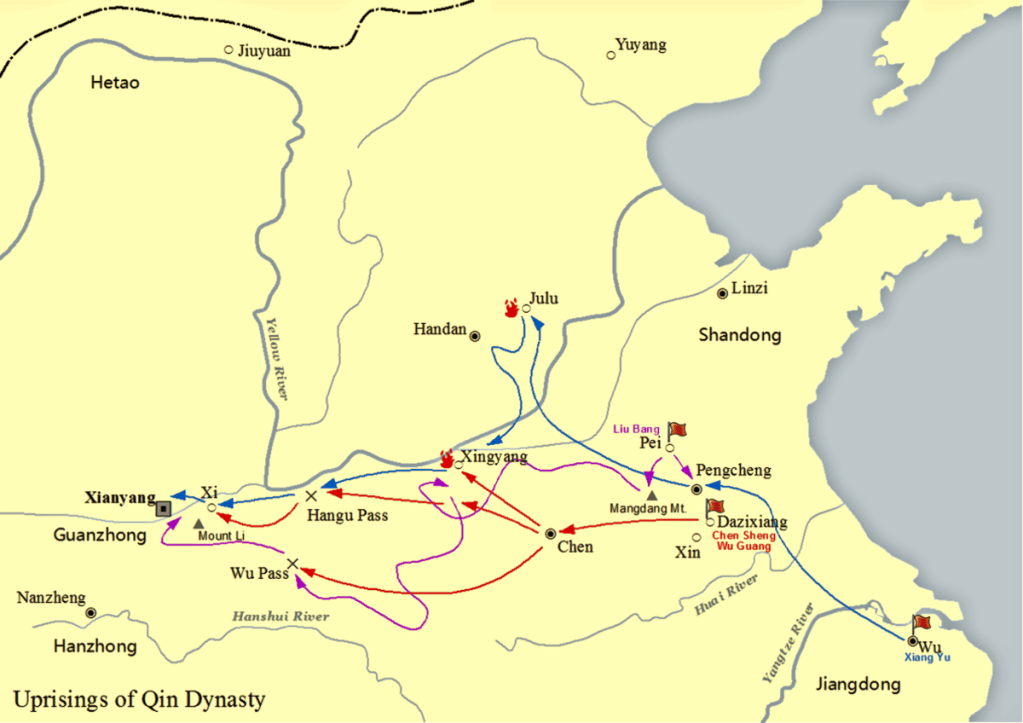
    The Rise of Zhang-Chu

    The 2nd year of the Second Emperor(208 B.C.)

    In October of that winter, the inspector general of the Sichuan commandery, named Ping, led an armed force to surround the Duke of Pei in Feng county. The Duke of Pei emerged from the city and defeated Ping’s troops. He then assigned Yong Chi to defend Feng county. In November, the Duke of Pei led his forces toward Xue county. The governor of the Sichuan commandery, named Zhuang, came out to engage the Duke of Pei in a battle but was routed. Zhuang fled to Qi County, where he was captured and killed by the Left Major of the Duke of Pei’s forces.

    General Zhou Wen fled from the Hangu Pass and halted at Caoyang post. About two months later, General Zhang Han pursued him and defeated his troops again. Zhou Wen retreated to Mianchi county, where Zhang Han attacked him again after a dozen days. This time, Zhou Wen’s troops were decisively crushed. Zhou Wen slit his throat, and his troops ceased fighting.

    The Deputy King of Zhang-Chu, Wu Guang, led the siege of Xingyang. Li You, the governor of the Sanchuan commandery, commanded the defense of the city, successfully thwarting Wu Guang’s efforts. A general of Zhang-Chu named Tian Zang conspired with his confidants: “The army of Zhou Wen has collapsed, and the Qin army could arrive any day now. We cannot breach Xingyang, and we will be defeated when the Qin forces come. It would be better to leave a small contingent to continue the siege of Xingyang and concentrate our finest troops to face the incoming Qin army head-on. However, the Deputy King Wu Guang is arrogant and ignorant of military strategy. Discussing this plan with him would be pointless and could make matters worse.” They plotted to forge a decree from Chen Sheng, ordering Wu Guang‘s execution. They beheaded Wu Guang and delivered his head to Chen Sheng. In response, Chen Sheng sent an envoy to Tian Zang, granting him the seal of Prime Minister of Zhang-Chu and appointing him as the top general.

    Tian Zang left General Li Gui and several other generals to maintain the siege of Xingyang. He then led his core forces westward to confront the Qin army at the town of Aocang. In the ensuing battle, Tian Zang was killed, and his troops were slaughtered. General Zhang Han advanced to Xingyang and broke the siege. General Li Gui and the other generals were killed.

    General Deng Shui of Zhang-Chu from Yangcheng County had his troops camped at Jia county, but a lieutenant under Zhang Han routed them. General Wu Feng from Zhi County led his troops to the town Xu, where Zhang Han‘s army crushed them. Both Zhang-Chu forces collapsed, and their commanders fled back to their king. Enraged, Chen Sheng had Deng Shui executed.

    The Second Emperor lampooned Chancellor Li Si several times: “You hold the highest ministerial position in the court; why do you allow bandits and thieves to be so rampant?” Li Si was frightened. He greatly valued his high rank and rewards but did not know how to address the issue. 

    Seeking to please the emperor, he drafted a proposal: “A wise ruler must master the art of surveillance and supervision. When Mr. Shen Buhai said, ‘When one owns the world and does not do whatever he wants, it can be said that he lets the world be a shackle on himself,’ he meant that a ruler who fails to surveil and supervise properly, like Emperors Yao and Yu who served all the people with their own labor, effectively shackles himself. If a ruler does not practice the wise arts developed by Mr. Shen Buhai and Mr. Han Fei, and instead burdens himself with the distress of ordinary people, making himself haggard, he is merely devoting himself to serving the people. This is the labor of a commoner, not the duty of a lord of the world. What is noble about that? Therefore, a wise monarch should enhance the surveillance of his subordinates and make all decisions himself to prevent power from falling into the hands of his subjects. Furthermore, he should stop the practice of benevolence and block all counsel and debate. The lord should do whatever he pleases, and no one would dare to resist. This way, officials and the people will be too busy correcting their own mistakes to plot any insurgency.”

    The Second Emperor was pleased with this proposal. He began scrutinizing officials more strictly, equating the brightest officers with those who taxed the people most severely and the loyalists with those who killed the most. Half of the people on the streets had criminal records, and dead bodies piled up in public squares daily. The people of Qin were terrified and yearned for insurgence.

    General Li Liang of Zhao had just subdued the chaos in Changshan commandery and reported back to the King of Zhao. The king then sent him to capture the city of Taiyuan. However, Li Liang‘s troops were halted at the town of Shiyi when the Qin army blocked the Jingjing Pass. The Qin commander forged a letter from the Second Emperor, attempting to persuade General Li Liang to change his allegiance. After reading the letter, Li Liang was not convinced and returned to Handan to request reinforcements. His request had not yet been answered when the king’s older sister went out on a drinking spree. Seeing her entourage of about a hundred people, Li Liang mistakenly thought it was the king himself and prostrated himself by the roadside to pay homage. The king’s sister, drunk and unaware of who was there, merely sent a cavalier to acknowledge him.

    General Li Liang, from an aristocratic background, felt humiliated in front of his troops. One of his officers stepped forward and said, “The people across the empire are revolting against Qin. Whoever has the might will come out on top. The King of Zhao used to rank below you, General. Yet this woman did not even get off her carriage to greet you. Allow me to catch and kill her.” Having received the letter from Qin, Li Liang was already wavering about his loyalty to the King of Zhao. Infuriated by the insult, he sent his man to catch up with the king’s sister and kill her. Li Liang then led his troops to attack the capital, Handan. The city was caught off guard. Li Liang killed the King of Zhao and Vice Prime Minister Shao Sao. Zhang Er and Chen Yu managed to escape, as they had many informants throughout the state.

    Qin Jia from Ling and Zhu Jishi from Fuli county raised an armed force and surrounded the governor of Donghai commandery in Tan county. When King Chen Sheng heard about it, he sent General Xin, titled Lord Wuping, to oversee the troops besieging Tan. Qin Jia, unwilling to accept Lord Wuping’s authority, declared himself Grand Marshal.  He hated being under General Xin’s command. He told his fellow officers, “Lord Wuping is too young and knows nothing about military matters. Do not listen to him!” Claiming he had received an order from Chen Sheng, Qin Jia then killed Lord Wuping(General Xin).

    The Second Emperor sent the court chief of staff, Sima Xin, and commandant Dong Yi to assist General Zhang Han in suppressing the “bandits and burglars.” Zhang Han had already defeated Wu Feng and proceeded to attack the top general of Zhang-Chu, Lord Fang, killing him. He then moved on to attack the troops of Zhang He, located west of Chen county. Chen Sheng himself came out to oversee the battle, but Zhang He was killed.

    In December, while returning from Ruyin county, Chen Sheng was assassinated by his chauffeur, Zhuang Jia, in a village called Xiachengfu. Zhuang Jia subsequently defected to Qin.

    In the early days when Chen Sheng became king, his fellow countrymen came to visit him, including his father-in-law. Chen Sheng treated him like any other visitor—he saluted him but did not kneel. His father-in-law was furious, saying, “You are a rioter and a title-grabber. You disrespect your elders; you won’t last long!” He turned around and left. Chen Sheng knelt and apologized, but his father-in-law did not look back. Encouraged by this, Chen Sheng‘s childhood friends began recounting old stories from their youth. Someone advised Chen Sheng, “These guests of yours are uneducated and boorish. Their talk is careless and out of control; it will bring dishonor to your name.” In response, Chen Sheng beheaded a few of the loose talkers. His chums deserted him afterward.

    Chen Sheng appointed Zhu Fang as chief examiner and Hu Wu as inquisitor. These two supervised all his officers and generals. When generals returned from conquering cities, they were often punished as criminals if their actions were deemed inappropriate. Zhu Fang and Hu Wu equated harshness with loyalty; if they found any mistakes, they either issued punishments themselves or handed them over to prosecutors. Because of this, the generals distanced themselves from King Chen Sheng. This alienation contributed to Chen Sheng’s downfall.

    General Lü Chen, a former housekeeper of King Chen Sheng, formed an armed force in Xinyang County, known as the Black-Head Army, as all the soldiers wore black headscarves. They broke into Chen county and killed Zhuang Jia, reinstating the Kingdom of Chu there. They buried King Chen Sheng in Dang county and gave him the posthumous title of King Yin of Chu.

    Chen Sheng had sent Song Liu from Zhi county to lead troops to capture the city of Nanyang and breach Wu Pass. Song Liu had already occupied Nanyang when he learned of Chen Sheng’s death. The Qin army retook Nanyang, and Song Liu surrendered. The Second Emperor ordered Song Liu to be quartered in public.

    Zhou Fu of Wei led troops to seize lands in Feng county and Pei county. He sent envoys to persuade Yong Chi to change allegiances. Yong Chi, who had previously been aloof and reluctant to report to the Duke of Pei, surrendered Feng county to the Kingdom of Wei. The Duke of Pei launched an attack on Feng county but was thwarted.

    Zhang Er and Chen Yu of Zhao reassembled an armed force from the remnants of their collapsed troops. They led tens of thousands of soldiers to attack Li Liang, defeating him.  As a result, Li Liang fled to surrender to General Zhang Han of Qin. An attendant of Zhang Er and Chen Yu advised them, “You are not natives of the Kingdom of Zhao, just mere travelers here, so you cannot claim kingship on your own. You need to find a descendant of the King of Zhao and help him become king. Then you may achieve your goals.” Following this advice, Zhang Er and Chen Yu found Zhao Xie. In January, during the spring, they installed Zhao Xie as the new King of Zhao and established Xindu county as its capital.

    The rebels in Dongyang county, led by Ning Jun and Qin Jia, learned that Chen Sheng’s troops had been defeated. They installed Jing Ju as the King of Chu and led their troops to Fangyu county, planning an attack on the Qin army at Dingtao. They sent Gongsun Qing as an envoy to the Kingdom of Qi, requesting that the Qi army join forces with them to confront the Qin army. The King of Qi, Tian Dan, rebuked the envoy: “King Chen Sheng was defeated. We do not know if he is dead or alive. Why did you install a new king without consulting us?” Gongsun Qing retorted, “The Kingdom of Qi installed its king without consulting the Kingdom of Chu. Why should the Kingdom of Chu consult with the Kingdom of Qi before installing its king?” In response, Tian Dan had Gongsun Qing executed.
  • Comprehensive Reflections to Aid in Governance(Part 63): A Commoner and An Aristocrat

    Comprehensive Reflections to Aid in Governance

    By Sima Guang

    Translated By Yiming Yang

    Annals of Qin Book 2 Scroll 7 (continued)

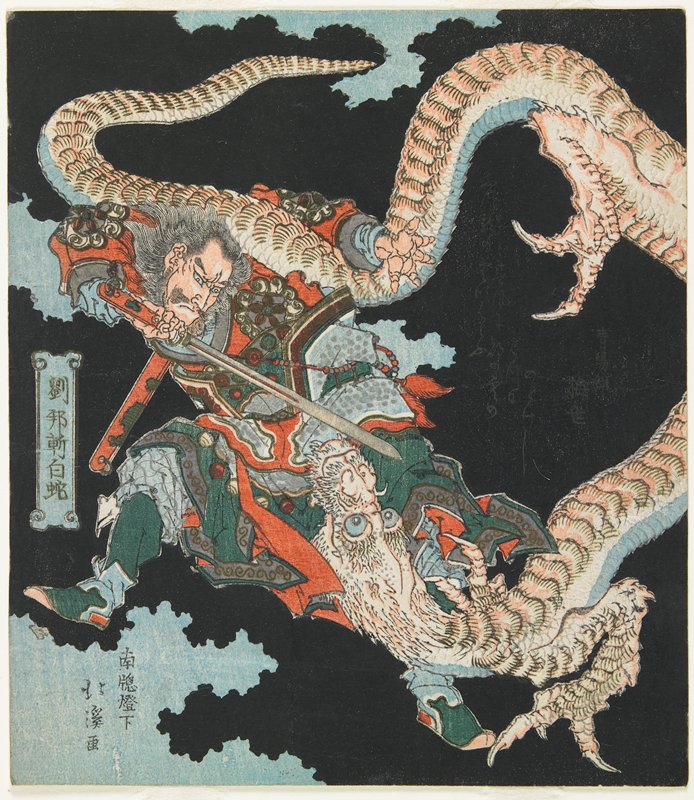
    Liu Ban Beheading A White Snake

    The 1st year of the Second Emperor(209 B.C. continued)

    In September, Liu Bang from Pei county rose in arms, Xiang Liang from Xiaxiang county revolted in the state of Wu, and Tian Dan from Di county did the same in the state of Qi

    Liu Bang, whose courtesy name was Liu Ji, had a prominent nasal bridge and a noble face, with seventy-two ink spots on his left thigh. He was known for his bold personality, generosity, and extroversion, often expressing his feelings openly. Ambitious and disinclined to engage in farming or handicrafts like his family members, he eventually became the head of Sishang Post. Mr. Lü from Shanfu county, a skilled physiognomist, was fascinated by Liu Ji’s extraordinary appearance and married his daughter to him despite Liu Ji’s low rank.

    Liu Ji was once tasked with escorting a group of convicts to Lishan on behalf of the county magistrate. As they traveled, many convicts escaped along the way, and Liu Ji realized that by the time they reached their destination, all would likely have fled. When the group stopped at a post in a swamp in Feng county, Liu Ji drank wine with the convicts. He then released them, saying, “Go your own ways; I am escaping myself.” About a dozen strong men among the convicts volunteered to join him.

    As the legend has it, Liu Ji, in a drunken state, wandered along a trail in the swamp when a large snake rose up in his path. Drawing his sword, Liu Ji swiftly hacked the snake in half. Suddenly, an old woman appeared, wailing: “My son, the son of the White Emperor, transformed into a snake on this trail and was killed by the son of the Red Emperor!” She then vanished. Liu Ji hid in the swamps between Mang County and Dangshan County, where several eerie phenomena were reported, attracting many young men from Pei County who were eager to join his growing band.

    When Chen Sheng’s uprising erupted, the magistrate of Pei County considered joining the rebellion. However, his chief operating officer, Xiao He, and his chief correction officer, Cao Shen, cautioned him: “As an officer of the Qin Empire, the people of Pei may not follow you in betraying your duty. It would be wiser to summon those in exile and gather a mob of a few hundred. With pressure from the mob, no one in Pei would dare oppose you.” The magistrate then sent Fan Kuai to summon Liu Ji, who had already assembled nearly a hundred followers. Fearing a mutiny, the magistrate reconsidered, ordering the city gates shut and defensive positions established. He also intended to execute Xiao He and Cao Shen. Alarmed, they escaped, clearing the city walls and sought refuge with Liu Ji.

    Liu Ji wrote a proclamation on a piece of silk and delivered it to the city elders by tying it to an arrow and shooting it over the ramparts. The message outlined the benefits and consequences of the uprising, urging the elders of Pei to take action. Persuaded, the elders led their sons and brothers to kill the magistrate and opened the gates for Liu Ji. The people gathered around Liu Ji, proclaiming him the Duke of Pei. With the help of Xiao He and Cao Shen, Liu Ji recruited young men from Pei, amassing a force of two to three thousand. They soon joined forces with other rebels from neighboring counties.

    Xiang Liang, the son of General Xiang Yan of the Kingdom of Chu, was hiding with his nephew Xiang Ji in the Wuzhong region due to a murder charge. The scholars and elites of Wuzhong admired Xiang Liang and often sought his friendship and counsel. Xiang Ji, however, struggled with reading and writing as a child and eventually abandoned his studies. He then turned to fencing but did not excel in it either, prompting Xiang Liang‘s disapproval. Xiang Ji retorted, “Reading and writing are only useful for recording names, and fencing is for fighting a single person. These are not worthy of my time. I want to learn how to fight ten thousand people.” Impressed by his ambition, Xiang Liang began teaching him the art of war, which Xiang Ji eagerly learned. However, once he grasped the basics, he lost interest in deeper studies. Xiang Ji grew to over six feet tall, had the strength to lift sacrificial tripods, and was known for his extraordinary talent and character.

    The governor of Kuaiji Commandery, Yin Tong, heard of Chen Sheng’s rebellion and decided to send troops to support the uprising, appointing Xiang Liang and Huan Chu as co-captains. However, Huan Chu was still hiding in the swamps as an outlaw. Xiang Liang told the governor, “Only Xiang Ji knows where Huan Chu is hiding.” Xiang Liang stationed Xiang Ji outside the governor’s residence, sword in hand, while he entered to speak with Yin Tong. He proposed, “Please call Xiang Ji in and have him bring Huan Chu.” The governor agreed. Xiang Liang then brought Xiang Ji inside, and after a few moments, he signaled him with a wink: “It is time to do it!” Xiang Ji drew his sword and decapitated Yin Tong. Xiang Liang held up the governor’s severed head and donned his official seal. The governor’s attendants were thrown into panic, and chaos erupted throughout the residence. Xiang Ji killed dozens, possibly over a hundred people. Terrified, everyone in the residence laid flat on the ground, not daring to move.

    Xiang Liang summoned the local leaders and former officials he knew, announcing his plans to rebel against the Qin Empire. He recruited young men from Wuzhong and dispatched deputies to draft fighters from the counties under Kuaiji Commandery. Xiang Liang assembled an elite force of eight thousand warriors and declared himself the governor of Kuaiji, appointing Xiang Ji as his lieutenant general. Together, they governed all the counties of the commandery. Xiang Ji was only twenty-four years old at the time.

    Tian Dan was a member of the royal clan of Qi, with cousins named Tian Rong and Tian Heng. The Tian brothers were wealthy, influential, and highly regarded. When General Zhou Fu of Zhang-Chu arrived to seize Di County for Chen Sheng, the county magistrate closed the gates and fortified his defenses. To gain access, Tian Dan staged a scene by tying up his house slave and dragging him to the county court, accompanied by a crowd of young men. Pretending to seek permission from the magistrate to execute the slave for wrongdoing, Tian Dan waited until the magistrate appeared in court. Seizing the opportunity, he killed the magistrate on the spot. He then gathered the wealthy and powerful figures of Di County and declared, “All the kingdoms are rising against the Qin Empire and restoring their kings. The Kingdom of Qi has a long history, and as a member of the Tian family, I, Tian Dan, shall be the king of Qi.” Proclaiming himself king, he led his forces against Zhou Fu’s troops, driving them back. Tian Dan then marched east and reclaimed the former lands of the Kingdom of Qi.

    Meanwhile, General Han Guang led an expedition north to the former Kingdom of Yan. The local elites urged him to become the King of Yan, but Han Guang hesitated, saying, “My mother still lives in the Kingdom of Zhao. I cannot be king.” The leaders of Yan persisted, arguing, “Zhao is preoccupied with the Qin Empire to the west and wary of the Zhang-Chu Kingdom to the south. It lacks the strength to challenge us. Even the powerful Zhang-Chu Kingdom does not harm the relatives of the King of Zhao. Why would Zhao target your family, General?” Convinced, Han Guang proclaimed himself King of Yan. A few months later, Zhao handed over Han Guang’s mother and her retinue to the Kingdom of Yan.

    The King of Zhao, accompanied by Zhang Er and Chen Yu, ventured to the northern border with the Kingdom of Yan in pursuit of land. During an excursion, he was captured by Yan soldiers and imprisoned. Yan demanded territorial concessions for his release, and envoys sent to negotiate were executed. A cook of the Zhao army approached the Yan camp and spoke with the commander, asking, “Do you know what Zhang Er and Chen Yu want most right now?” The commander replied, “They probably want their king back.” The cook laughed and said, “You have no idea what those two truly desire. Wu Chen, Zhang Er, and Chen Yu conquered dozens of Zhao cities with little effort. Each of them aspires to be a king, not merely commanders or prime ministers. Initially, they didn’t divide Zhao into three kingdoms because the situation was still unstable, and they supported Wu Chen’s claim to the throne due to seniority while they secured the loyalty of the Zhao people. Now that Zhao is stable under their rule, they’re waiting for the right moment to split the kingdom and crown themselves kings. With your capture of the King of Zhao, Zhang Er and Chen Yu publicly advocate for his release but secretly hope the people of Yan kill him, allowing them to claim their own kingdoms. One Zhao kingdom would tolerate Yan, but two Zhao kingdoms, each led by wise and ambitious leaders, would surely push each other to avenge their fallen king, making Yan’s downfall inevitable.” Alarmed, the Yan commander released the King of Zhao, and the cook safely escorted him back.

    General Zhou Fu, having withdrawn from Di County, marched toward the former Kingdom of Wei with the intention of reinstating a Wei prince named Jiu, titled Lord Ningling, as king. However, Jiu was stranded in Chen County and could not reach Wei. Zhou Fu already controlled the land of Wei, and local dignitaries proposed that he became the king.  Zhou Fu refused, saying, “A loyal servant must prove himself in turbulent times. The world is rebelling against Qin, and we must restore a descendant of the former king.” Despite the people’s insistence, Zhou Fu remained firm in his refusal and sent envoys to Chen County five times before Chen Sheng finally approved Prince Jiu’s return. The people of Wei then installed Jiu as King of Wei, appointing Zhou Fu as prime minister.

    Meanwhile, the Second Emperor stripped Jiao, the Lord of Wey, of his title and banished him to a commoner, effectively ending the lineage of the state of Wey.

  • Comprehensive Reflections to Aid in Governance(Part 62): Two Sworn Friends

    Comprehensive Reflections to Aid in Governance

    By Sima Guang

    Translated By Yiming Yang

    Annals of Qin Book 2 Scroll 7 (continued)

    A Temple in Zhoukou, Henan Province (f.m.a. Chen County)

    The 1st year of the Second Emperor(209 B.C. continued)

    Two friends from Daliang, the capital of the Kingdom of Wei, named Zhang Er and Chen Yu, shared a bond akin to that of Damon and Pythius. When the Kingdom of Wei was annexed, the King of Qin sought to hire them, offering monetary rewards for their good reputation. However, the two friends changed their names and fled to Chen County, where they took jobs as guards at a neighborhood gate to survive. On one occasion, the community officer paddled Chen Yu for a minor offense. Chen Yu was ready to fight back, but Zhang Er discreetly signaled him with a foot tap to accept the punishment. After the officer left, Zhang Er took Chen Yu aside under a mulberry tree and rebuked him: “What did I tell you? Were you really going to fight to the death over such a trivial insult from a lackey?” Chen Yu apologized for his reaction.

    When Chen Sheng entered Chen county, Zhang Er and Chen Yu visited him at his residence. Chen Sheng was delighted, as he was aware of their good reputation. The local elites in Chen county advocated for installing Chen Sheng as the King of Chu. Chen Sheng consulted Zhang Er and Chen Yu, who advised: “The Kingdom of Qin has been evil, annexing other kingdoms and oppressing the people. You rose against Qin at the risk of certain death, bringing relief to those across the empire. However, if you claim the title of king immediately after taking Chen county, it will appear as if you seek personal gain. We suggest postponing the proclamation and leading your forces westward instead. You should send envoys to install the descendants of the six former kingdoms as kings. These new monarchs would become your allies and enemies of Qin. Qin’s military would then be divided, facing many foes, while your forces would grow stronger with more allies. In doing so, you won’t need to battle Qin’s army in the battlefields or defend the ramparts within the city. You can bring down the wicked Qin empire, capture Xianyang, and call upon all the monarchs to follow your lead. Having regained their lost reigns, they would gladly answer your call. This would allow you to achieve your imperial ambitions through virtue. Claiming kingship in Chen county now would only cause the movement to lose momentum.” Despite their counsel, Chen Sheng did not heed their advice. He proclaimed himself King of Zhang-Chu.

    At that time, the people could no longer bear the draconian laws of Qin. They eagerly rose up to kill their local commandery or county officers in response to Chen Sheng‘s call. A messenger returning from a mission in the east reported on the rebellions to the Qin court. The Second Emperor, enraged by the news, had the messenger referred to prosecutors. After that, whenever envoys returned from their missions, the Emperor would ask about the rebels. They all gave the same response: “They are merely petty thieves and bandits. The local officers have dealt with them thoroughly. There is nothing to worry about.” The Emperor was pleased with these assurances.

    Chen Sheng appointed Wu Guang as deputy king, tasking him with supervising the generals in their campaign to attack the county of Xingyang in the west.

    Zhang Er and Chen Yu went to see Chen Sheng again, requesting a detachment for a surprise attack on the territory of the Kingdom of Zhao. Chen Sheng appointed his close associate, Wu Chen from Chen County, as the commander, and Shao Sao as the supervisor. Zhang Er was made the left-wing colonel, and Chen Yu the right-wing colonel. The detachment, consisting of three thousand soldiers, then marched toward the Kingdom of Zhao.

    Chen Sheng also directed Deng Zong from Ruyin county to lead a campaign to capture the Jiujiang Commandery. By this time, the number of rebel mobs throughout the Kingdom of Chu, each with several thousand members, had become innumerable.

    Ge Ying took control of Dongcheng county and installed Xiang Qiang, a descendant of the King of Chu, as the new King of Chu. However, upon learning that Chen Sheng had already declared himself King of Chu, Ge Ying quickly killed Xiang Qiang and reported back to Chen Sheng. Despite Ge Ying’s quick reversal, Chen Sheng still had him executed.

    Chen Sheng then ordered Zhou Fu from the Kingdom of Wei to take over the lands of Wei in the north, appointing Cai Ci from Shangcai county, known by the title Lord Fang, as the grand general of this force.

    Chen Sheng also heard that Zhou Wen, a local celebrity from Chen county, was knowledgeable in warfare. He granted Zhou Wen the commander’s seal and sent him to lead the attack on the Kingdom of Qin to the west.

    Wu Chen and his cohorts crossed the Yellow River at the town of Baima. They reached the counties belonging to the Kingdom of Zhao and rallied the local gentry, who responded favorably to their call. As they began enrolling local conscripts, their ranks swelled to tens of thousands. They proclaimed Wu Chen as Lord Wuxin and seized more than ten counties. However, other cities resisted them. Wu Chen then led an attack on Fanyang County.

    A resident of Fanyang, Kuai Che, approached Wu Chen and said, “You believe you must defeat resistance on the battlefield to take land and break through fortifications to capture cities. In my opinion, that’s a misconception. If you follow my plan, you can take a city without besieging it, seize land without fighting for it, and quash resistance across thousands of miles by merely sending out proclamations. What do you think?”

    Intrigued, Lord Wuxin asked, “What is your plan?”

    Kuai Che explained, “The Magistrate of Fanyang, Mr. Xu, is a greedy coward who wants to be the first in the country to surrender. If you kill him, as you did with the Qin-appointed officers in the other ten cities, the rest of the cities in the land of Zhao would become impregnable citadels. But if you allow me to bestow the Marquis’ seal upon this county chief, along with pompous wagons for him to parade around the lands of Yan and Zhao, all the cities would capitulate without a fight.”

    Lord Wuxin replied, “A great idea!” He provided Kuai Che with a hundred wagons and two hundred cavalry guards of honor to court the Magistrate of Fanyang, Mr. Xu. More than thirty cities across the Kingdoms of Yan and Zhao surrendered without a battle after receiving the leaflets and witnessing the horse parade.

    After Chen Sheng sent out Zhou Wen, he became complacent and underestimated the Qin Empire. He neglected to prepare for defense. The renowned scholar Kong Fu pleaded with him, saying, “I have learned from the books on the art of war: ‘Do not rely on the enemy not attacking; rely on your own defenses.’ Currently, you are counting on the enemy’s inability to attack us rather than strengthening our own defenses. If we stumble and fail to recover, it will be too late to regret it!” Chen Sheng dismissed the warning, saying, “Warfare is my concern. Don’t trouble yourself, Professor.”

    Meanwhile, Zhou Wen recruited followers along his march. By the time he reached Hangu Pass, his forces had grown into an enormous army with hundreds of thousands of soldiers and thousands of chariots. They set up camp at the town of Xi. The Second Emperor was terrified and summoned his ministers, asking, “What are we going to do?” Privy Treasurer, Zhang Han, proposed, “The bandits are already at our door. It is too late to mobilize all the commanderies and counties. The forced laborers at Lishan Mausoleum are numerous. Please issue an amnesty to these laborers and arm them to fight off the bandits.”

    The Second Emperor declared a national amnesty, allowing Zhang Han to conscript from the forced laborers at Lishan as well as from the sons of house slaves and maids who had previously been disqualified from military service. Zhang Han led his newly assembled army against the forces of Zhang-Chu, delivering them a crushing defeat. Zhou Wen fled.

    Zhang Er and Chen Yu arrived in Handan, the capital of the Kingdom of Zhao. Upon hearing of Zhou Wen‘s downfall and the fates of Chen Sheng’s generals—who had been executed on trumped-up charges after conquering lands for him—they persuaded Wu Chen to proclaim himself king of Zhao. In August, Wu Chen declared himself king and appointed Chen Yu as Grand General, Zhang Er as Prime Minister, and Shao Sao as Vice Prime Minister. He sent a messenger to inform Chen Sheng of the news. Enraged, Chen Sheng planned to kill Wu Chen’s kith and kin and sent troops to attack Zhao. However, his Prime Minister, Lord Fang, intervened: “When the Qin Empire was still alive, you killed Lord Wuxin’s clan and others’ families, effectively creating another Qin Empire. It would be wiser to congratulate him on his self-promotion and urge him to attack the Qin to the west immediately.” Chen Sheng heeded his advice, moving Wu Chen’s family and followers into palace house arrest. He granted the title of Lord Chengdu to Zhang Er’s son, Zhang Ao, and sent an envoy to Zhao to congratulate Wu Chen, urging him to march westward and invade the Hangu Pass.

    Zhang Er and Chen Yu then advised Wu Chen: “The King of Zhang-Chu’s congratulations are insincere and merely political expediency. Once Zhang-Chu defeats Qin, they will likely turn against Zhao. We suggest you refrain from sending troops westward; instead, direct your forces north to capture lands from Yan and Dai, then move south to take Henei, expanding Zhao’s territory. With the Yellow River as a natural defense and Yan and Dai as your backing, Zhang-Chu will not dare challenge Zhao even if they defeat Qin. Should Zhang-Chu fail against Qin, they will rely on Zhao even more, placing Zhao in a powerful position to exploit both the exhausted Qin and Zhang-Chu.” The King of Zhao agreed and did not send his army westward. He dispatched General Han Guang to invade Yan, General Li Liang to Changshan commandery, and General Zhao Yan to Shangdang commandery.