Tag: Bing Ji

  • Comprehensive Reflections to Aid in Governance(Part 193): Dislodging Spider Web by The Gang of Huo

    Comprehensive Reflections to Aid in Governance

    By Sima Guang

    Translated By Yiming Yang  

    Annals of Han Book 17 Scroll 25

    Duration of 6 years

    The Hometown of Xiao Wangzhi and Shu Guang, Lanling, Shandong Province

    The 3rd year of Emperor Xuan’s Di’jie Era (67 B.C.)

    In March of spring, an imperial edict was proclaimed, stating: “If merit be left unrewarded and faults unpunished, even the virtue of Emperors Yao and Shun could not transform the people. Now, the Prime Minister of Jiaodong, Wang Cheng, has diligently fulfilled his duties; the refugees under his administration have surpassed eighty thousand households, and his achievements are manifest. Let Wang Cheng be enfeoffed as Marquis Within the Passes, with the emolument of a two-thousand-picul official.” Before the decree could be carried out, Wang Cheng fell ill and died.

    Thereafter, another edict commanded the Chancellor and the Imperial Censor to investigate the affairs of the commanderies and provinces through the Chiefs of Staff and Associates of the Prefects who reported their records to the capital, in order to examine their execution of laws and decrees. Some officials memorialized, saying: “The late Prime Minister of Jiaodong, Wang Cheng, exaggerated his achievements to obtain undue reward. From this precedent, many inferior officials now seek hollow fame and empty titles.”

    In summer, on April 22, the Emperor installed his son Liu Shi as Crown Prince. He appointed Bing Ji as Grand Tutor and the Grandee of the Palace, Shu Guang, as Junior Tutor. The Emperor further enfeoffed Xu Guanghan, the maternal grandfather of the Crown Prince, as Marquis of Ping’en, and Huo Yun, General of the Household and grand-nephew of Huo Guang, as Marquis of Guanyang.

    When Grand Madame Huo Xian, the widow of Huo Guang, heard that the Crown Prince had been established, she was seized with rage and distress. She refused food, spat blood, and cried aloud: “This child is but of common birth! How can he be made Crown Prince? Should the Empress later bear a son, he would be but a prince beneath him!” Again she urged the Empress to poison the Crown Prince. The Empress often summoned the Crown Prince to dine, but the Nanny and Wet Nurse, by custom, always tasted the food beforehand, so the Empress’s scheme could not be carried out.

    On May 25, the Chancellor, Wei Xian, citing age and illness, requested leave from his duties. He was granted one hundred catties of gold and a four-horse carriage of honor, and retired to his residence. This was the first instance of a Chancellor’s retirement being formally approved.

    On June 7, Wei Xiang was appointed Chancellor. On June 16, Bing Ji was made Grand Master of the Censorate; Shu Guang was appointed Grand Tutor to the Crown Prince, and his nephew, Shu Shou, was made Junior Tutor.

    The Crown Prince’s grandfather, Xu Guanghan, Marquis of Ping’en, memorialized, requesting that his younger brother, Xu Shun, be assigned to oversee and protect the household of the young Crown Prince. When the Emperor consulted Shu Guang on this matter, Shu Guang replied: “The Crown Prince, being heir to the state, should be surrounded by worthy teachers and companions chosen from among the able men of the realm. It is not fitting to grant undue favor solely to the Xu clan, though Uncle Xu is his grandfather. Moreover, the Crown Prince already has his Grand Tutors and Junior Tutors duly appointed, and all attendants are in place. To add Xu Shun now as guardian of his household would appear superficial and unseemly, and would not elevate the Crown Prince’s virtue in the eyes of the people.”

    The Emperor commended Shu Guang’s counsel and reported it to Wei Xiang. Wei Xiang, moved by his discernment, removed his cap in respect, saying, “Shu Guang’s foresight surpasses us all.” Thus Shu Guang’s reputation for integrity and wisdom grew ever more illustrious.

    In the capital, there was heavy rain and hail. The Associate Grand Usher, Xiao Wangzhi of Donghai, submitted a memorial declaring that the concentration of power among a few great families had brought forth these calamities. The Emperor, having long heard of Xiao Wangzhi’s integrity and discernment, appointed him Imperial Usher. At that time, the Emperor earnestly sought out men of talent; many among the people presented memorials offering counsel and proposals. The Emperor ordered that such petitions be referred to Xiao Wangzhi for deliberation. Those whose proposals were substantial were recommended to serve under the Chancellor or in the Censorate; those of lesser merit were assigned magistracies with the rank of two-thousand-picul officials. They were tested in office and assessed after one year; those who proved unfit were dismissed. All matters proposed by Xiao Wangzhi received imperial approval.

    In October of winter, an imperial edict was issued, declaring: “On September 19, the ground was shaken by an earthquake, which greatly alarmed Us. We now seek those who can admonish Us for Our faults, and those who are virtuous and upright, that they may speak freely and correct Our deficiencies. Let there be no concealment before the authorities. Since Our virtue is wanting and cannot extend afar, the borders remain unsettled with troops. Now We command that the General of Chariots and Cavalry and the General of the Right withdraw their stationed forces, to lighten the people’s burdens; for prolonged deployments exhaust the realm and hinder its pacification.”

    Another edict proclaimed: “The fish ponds and aviaries that We have not visited shall be opened to the people, that the poor may share in their use. The palaces and mansions within the commanderies and provinces shall not be repaired or rebuilt. Those who have returned from exile or displacement shall be granted public lands and seed for planting, and shall be exempted from taxes and corvée.”

    The family of Huo Guang grew ever more extravagant and unrestrained. The Grand Madame Xian, enlarged their mansions with ornate halls and towers, and fashioned carriages and palanquins adorned with painted designs, embroidered silks, and gilded ornaments. Their wheels were cushioned with braided leather and cotton; attendants in garments of variegated silk drew her carriages when she took her leisure within the residence. Huo Xian engaged in illicit relations with her slave overseer, Feng Zidu. Likewise, Huo Yu and Huo Shan rebuilt and adorned their estates, holding horse races and diversions at the Pingle Resort.

    When summoned to court audience, Huo Yun often feigned illness, yet privately went abroad accompanied by many retainers. He hunted in the Huangshan Park, sending servants to stand in his stead at court; none dared to censure him. Huo Xian and her daughters passed in and out of the Changxin Palace at all hours, heedless of restraint or decorum. Their conduct exceeded the bounds of propriety.

    The Emperor, who had once dwelt among the common people, perceived the long-entrenched hubris and unchecked influence of the Huo clan, and discerned that disorder was festering within. When he took personal charge of state affairs, the Grand Master of the Censorate, Wei Xiang, often conferred with him on matters of government. Huo Xian said to Huo Yu, Huo Yun, and Huo Shan: “You neglect the charge left by the Grand General. Now, the Grand Master of the Censorate serves as the Emperor’s close adviser within the palace. Should he speak ill of you, what means do you have to save yourselves?”

    Soon thereafter, the retainers of the two households quarreled over precedence on the road. A slave of the Huo family sought to break down the gate of the Grand Master’s mansion. A Censor came forth and prostrated himself in apology, whereupon the slave withdrew. When word reached the Huo household, Huo Xian and her kin grew fearful, sensing that calamity was near.

    During the tenure of Wei Xiang as Chancellor, he often conferred with the Emperor in private. The Marquis of Ping’en, Xu Guanghan, and the Privy Counselor, Jin Anshang, freely entered and withdrew from the inner court. Huo Shan held authority over the State Secretariat. The Emperor decreed that officials and commoners alike might submit sealed memorials directly to the throne, without passing through the Secretariat; and that ministers might be received in a private audience apart from its supervision. This deeply displeased the Huo clan.

    The Emperor, having heard reports that the Huo family had poisoned Empress Xu but lacking conclusive proof, began to take precautionary measures. He appointed Fan Mingyou, Marquis of Pingling and son-in-law of Huo Guang—then serving as General of the Northern Garrisons and Commandant of the Weiyang Palace Guards—as Chamberlain. He dispatched Ren Sheng, husband of Huo Guang’s second daughter and formerly General of the Household and Supervisor of the Feather-Forest Guard, to serve as Prefect of Anding. After several months, Zhang Shuo, husband of Huo Guang’s elder sister and Grandee of Merit with duties as palace liaison, was sent to govern Shu Commandery. Wang Han, General of the Household and grandson-in-law of Huo Guang, was appointed Prefect of Wuwei. Later, Deng Guanghan, Commandant of the Changle Palace Guard and husband of Huo Guang’s eldest daughter, was transferred to serve as Privy Treasurer.

    On August 14, Zhang Anshi was made Guard General, with command over the palace guards, the city gates, and the Northern Army. Huo Yu was appointed Grand Marshal, yet he wore only a small cap and bore neither seal nor ribbon of office. The Emperor dissolved the military units formerly under his control, though Huo Yu still retained the nominal title once held by Huo Guang. Fan Mingyou, the Duliao General, was stripped of his seals and tallies, left only with his duties as Chamberlain. Zhao Ping, Commandant of the Cavalry, Cavalier Attendant, and Grandee of Merit, also son-in-law to Huo Guang, was likewise deprived of his seal and ribbon as Commandant of the Cavalry.

    All commanders of the imperial guards stationed about for eastern(residence of the Crown Prince) and western(residence of the Emperor) palaces—those of the frontier units drawn from the Nomad, the Yue tribes and the Feather-Forest guards—were replaced by men of the Xu and Shi clans, whom the Emperor trusted as his own kin and allies.

  • Comprehensive Reflections to Aid in Governance(Part 187): Leapfrogging to The Throne

    Comprehensive Reflections to Aid in Governance

    By Sima Guang

    Translated By Yiming Yang  

    Annals of Han Book 16 Scroll 24 (continued)

    Old City of Qi, Zibo(Qiansheng), Shandong Province 

    The 1st year of Emperor Zhao’s Yuanping Era (74 B.C. continued)

    After the deposition of the Prince of Changyi, the choice of successor was debated among the senior ministers, including Huo Guang and Zhang Anshi. As no decision was yet reached, Bing Ji submitted a memorial to Huo Guang, saying:

    “Grand General, you served Emperor Wu, bearing the charge of raising his heir from infancy, entrusted with the care of the entire realm. When Emperor Zhao passed away untimely, leaving no heir, fear and unease spread throughout the empire. On the day of the funeral, for the sake of the great enterprise, a successor was hastily chosen; but perceiving the choice amiss, he was deposed for the greater cause, and all under Heaven assented. At this juncture, the fate of the state, the ancestral temples, and the lives of the people depend upon your judgment.

    “I have listened to the voices of the people and observed the discourse regarding the princes of the imperial clan, yet have heard no worthy name outside the court. Meanwhile, within the harem by posthumous decree, the Imperial Great-Grandson Liu Bingyi has been fostered, reared under the care of the inner palace and his maternal great grandmother. When I once served at the commandery prison, I beheld him as a child. Now he is eighteen or nineteen years of age, well versed in the Confucian classics, of comely talent and serene bearing.

    “I earnestly entreat the General, considering the highest righteousness, to seek the judgment of the tortoise oracle; if it proves auspicious, then let him be appointed attendant to the Empress Dowager and enter the palace, so that all under Heaven may behold him. Then, with the world’s gaze upon him, the final decision may be made, to the blessing of the empire.”

    Du Yannian also discerned the virtue of the Imperial Great-Grandson, and urged Huo Guang and Zhang Anshi to establish him as successor.

    In July of autumn, Huo Guang, seated in the court, convened with the Chancellor Yang Chang and the ministers to deliberate, and together they memorialized, saying: “The Great-Grandson of Emperor Wu, Liu Bingyi, is now eighteen years of age. He has been instructed in the Book of Songs, the Analects, and the Classic of Filial Piety. He himself practices frugality, kindness, and benevolence. He is fit to succeed Emperor Zhao, to continue the sacrifices of the ancestral temples, and to nurture the people. We memorialize this, even at the cost of our lives.”

    The Empress Dowager decreed: “It is permitted.”

    Huo Guang sent the Minister of the Imperial Clan, Liu De, to the residence of the Imperial Great-Grandson at Shangguanli, where he was bathed and robed in imperial garments. The Grand Coachman dispatched a light carriage to escort him to the Ministry of the Imperial Clan.

    On July 25, Liu Bingyi entered Weiyang Palace, audience with the Empress Dowager, and was ennobled as Marquis of Yangwu.

    Afterward the court officials presented the imperial seal and ribbon, and he was formally enthroned as Emperor. He went to offer sacrifice at the Temple of Emperor Gaozu, and honored the Empress Dowager with the title of Grand Empress Dowager.

    The Imperial Censor Yan Yannian accused Huo Guang, submitting a memorandum, saying: “General Huo has deposed and established an emperor of his own will, not in accord with the rites of a loyal minister. This is not fitting.” Though the charge was dismissed, the officials of the court ever after revered and feared Yan Yannian.

    On August 5, Yang Chang, Marquis of Anping, died.

    In September, a general amnesty was proclaimed throughout the empire. 

    On September 5, Cai Yi was appointed Chancellor.

    Earlier, the daughter of Xu Guanghan had been wedded to the Imperial Great-Grandson Liu Bingyi. After one year she bore him a son, Liu Shi. Within a few months thereafter, the Great-Grandson became Emperor, and the house of Xu grew in influence. At that time the General Huo Guang had a young daughter, kin to the Empress Dowager. When the choice of an empress was under discussion, some secretly inclined toward Huo Guang’s daughter, but none dared to speak openly.

    The Emperor thereupon issued a decree, seeking for the old sword he had carried in his obscurity. The wise among the ministers discerned his inkling, and proposed the daughter of Xu Guanghan as the Empress. On November 9, Consort Xu(Jieyu[Lady of Handsome Fairness]) was established as Empress. Later, Huo Guang judged Xu Guanghan, who had been punished by castration, unfit to hold the title of a head of state. After one year, he was enfeoffed as Lord of Changcheng.

    The Grand Empress Dowager returned to dwell in Changle Palace, where guards were stationed for the first time.

    The 1st year of Emperor Xuan’s Benshi Era (73 B.C.)

    In the spring, an imperial decree ordered the ministers to deliberate on the merit of securing the imperial succession and continuing the ancestral sacrifices. The Grand General Huo Guang was augmented with a fief of seventeen thousand households, in addition to his former twenty thousand. The Chariot and Cavalry General, Zhang Anshi, Marquis of Fuping, together with ten others of lesser rank, all received increases of fief. Five men were enfeoffed as marquises, and eight were created Inner Marquises.

    The Grand General Huo Guang prostrated himself, humbly petitioning to return the affairs of state to the Emperor, but the Emperor refused, insisting that he continued his duty. He decreed that all matters must first be presented to Huo Guang for judgment, and only then submitted for imperial sanction.

    From the time of Emperor Zhao, Huo Guang’s son Huo Yu, and his elder brother Huo Qubing’s grandson, Huo Yun, both served as Generals of the Household. Huo Yun’s younger brother, Huo Shan, was Commandant of Chariots and Privy Counselor, commanding troops of the northern and southern tribes. Two sons-in-law of Huo Guang held the posts of Guard Commandants of the Eastern and Western Palaces. His kinsmen by blood and marriage—brothers, sons-in-law, and grandsons—crowded the court, filling the offices of administrators, grandees, commandants, and palace liaisons. Thus they formed a tightly bound faction.

    As the power of Huo Guang grew, especially after the deposition of the Prince of Changyi, his authority became ever more preeminent. In court audiences the Emperor humbled his bearing, withdrew his countenance, and displayed undue deference toward him.

    On April 10, in summer, there was an earthquake.

    In May, phoenixes gathered in Jiaodong and Qiansheng. A general amnesty was proclaimed throughout the empire, and the collection of land taxes and levies was suspended.

    In June, an imperial decree was issued, saying: “The former Crown Prince, who lies at rest in Hu County, has neither been granted a posthumous name nor received annual sacrifice. Let there be discussion on bestowing a posthumous title and establishing an estate for his tomb garden.”

    The officials in charge memorialized, saying: “According to the rites, when one inherits the title of a man, he must be accounted his son; thus the sacrifices to his true parents must cease, in order to honor the ancestral line. Now Your Majesty, as the descendant of Emperor Zhao, inherits the sacrifices of the imperial temple. We propose that the posthumous title of Your Majesty’s  true(biological) father be Prince Dao, and of Your Majesty’s  true(biological) mother be Queen Dao. Further, that the former Crown Prince, Your Majesty’s true grandsire, be posthumously named Crown Prince Li, and his consort, Lady Shi, be styled Madame Li.”

    All these were accordingly reburied with their proper honors.

  • Comprehensive Reflections to Aid in Governance(Part 186): It Takes A Nation to Raise An Imperial Great-Grandson

    Comprehensive Reflections to Aid in Governance

    By Sima Guang

    Translated By Yiming Yang  

    Annals of Han Book 16 Scroll 24 (continued)

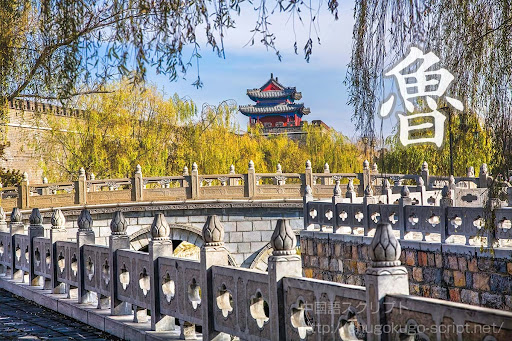
    The Kingdom of Lu

    The 1st year of Emperor Zhao’s Yuanping Era (74 B.C. continued)

    Huo Guang, directing that memorials of state be submitted to the Eastern Palace, judged that the Empress Dowager should be instructed in the Confucian classics. He commanded Xiahou Sheng to expound the Book of Documents to her. Xiahou Sheng was then promoted to Privy Treasurer of Changxin Palace, and ennobled as Marquis Within the Passes.

    In former times, Crown Prince Liu Ju, born of Empress Wei, had taken to wife a Lady Shi of the kingdom of Lu, and she bore him a son, Liu Jin, styled the Emperor’s Grandson Shi. The Grandson Shi took to wife a Lady Wang of Zhuo Commandery, and she bore a son Liu Bingyi, who was styled the Imperial Great-Grandson. When the Great-Grandson was but a few months old, he was implicated in the witchcraft affair. The three sons and one daughter of the Crown Prince, with their wives and concubines, all perished in that calamity. Only the Great-Grandson survived, yet he too was cast into the commandery prison.

    At that time, Bing Ji, former Associate Minister of Justice of Lu, was charged by decree to investigate the witchcraft case. Knowing the Crown Prince to be guiltless, he grieved for the unjust suffering of the Imperial Great-Grandson. He chose trustworthy and compassionate women among the inmates—Hu Zu of Weicheng and Guo Zhengqing of Huaiyang—to nourish the child, and placed him in a drier and cleaner cell. Bing Ji himself came every other day to inspect.

    The witchcraft case dragged on unresolved. When Emperor Wu fell ill, he often lodged at the Changyang and Wuzha Palaces. Astrologers declared that an imperial aura arose within the prison at Chang’an. Emperor Wu therefore ordered that all prisoners there be executed, without regard to guilt or crime.

    One night the palace usher Guo Rang came with men to the commandery prison, but Bing Ji refused to open the gates, saying: “Within is the Imperial Great-Grandson. To kill the innocent is unlawful; how much more the close kin of the Emperor!” He barred the gates until dawn. Guo Rang returned and impeached Bing Ji.

    When Emperor Wu awoke and heard, he said: “This is Heaven’s intervention.” He issued a general amnesty, and only those imprisoned in the commandery residence were spared—preserved through the loyal protection of Bing Ji.

    Later, Bing Ji, deeming it unfitting that the Imperial Great-Grandson should remain in prison, instructed the warden Shei Ru to present a letter to the Intendant of Jingzhao. Shei Ru, together with Hu Zu, carried the letter, but the Intendant refused to receive it and sent them back. When the time came for Hu Zu’s release, the Imperial Great-Grandson clung to her with longing. Bing Ji then spent his own wealth to persuade Hu Zu to remain, and with Guo Zhengqing she continued to rear the child. After some months, Hu Zu was permitted to depart.

    Thereafter the county treasurer reported to Bing Ji that no decree authorized provisions for the Imperial Great-Grandson. Bing Ji again drew upon his own purse, each month supplying rice and meat. When the child fell ill, he arranged for wet-nurses without ceasing, and himself oversaw the use of medicines. Many times by such care Bing Ji drew the Imperial Great-Grandson back from the brink of death.

    When Bing Ji learned that Consort Shi, grandmother of the Great-Grandson, had a mother Zhenjun and a brother Shi Gong, he sent the child in a carriage and entrusted him to them. The aged Zhenjun, beholding her sole great grandson, was moved with compassion, and took upon herself the burden of nurture, cherishing him with utmost care.

    Later an imperial decree commanded that the Imperial Great-Grandson be raised within the inner palace, his name entered in the register of the Minister of the Imperial Clan. At that time Zhang He was Director of the Inner Palace. He had once served Crown Prince Liu Ju, and out of remembrance for former grace, pitied the orphaned scion. He tended the Imperial Great-Grandson with devotion, sustaining him and instructing him at his own expense. When the Great-Grandson reached maturity, Zhang He, seeking to strengthen his household bond, proposed to wed his granddaughter to him.

    At that time Emperor Zhao had just come of age. His stature was eight feet two inches. Zhang He’s younger brother, Zhang Anshi, served as General of the Right and assisted in the government. When he heard that Zhang He praised the Imperial Great-Grandson and even thought to marry his granddaughter to him, he grew angry and said: “The Imperial Great-Grandson is but a remnant scion of Crown Prince Liu Ju and Empress Wei. It is fortunate enough that the state sustains him with the livelihood of a commoner. How can you speak of wedding him to our granddaughter?” Zhang He, hearing this, abandoned the plan.

    At that time there was a clerk of the weaving chamber within the harem, eunuch Xu Guanghan. Zhang He gave a banquet and invited him. When the wine was deep, Zhang He said: “The Imperial Great-Grandson is a kin to the Emperor. At the least, he will bear the rank of Marquis Within the Passes. He would be a worthy match for your daughter.” Xu Guanghan agreed. On the morrow, when Xu’s wife heard of it, she was wroth; yet Zhang He pressed the matter, and in the end the marriage was made. Zhang He himself bore the expense of the dowry.

    Thus the Imperial Great-Grandson relied upon the support of Xu Guanghan and his brethren, together with his grandmother’s house, the Shi clan. He received instruction in the Book of Songs from Fu Zhongweng of Donghai. Though he was quick of wit and ardent in study, he also delighted in knight-errant’s hobbies, such as cockfighting and dog-racing. In this he came to know the ways of good and evil among the people, and to discern the success and failure of local administration.

    He roamed often through the counties and commanderies, visiting ancient tombs, and explored widely the Three Metropolitan regions of Jingzhao, Pingyi, and Fufeng. Once he met hardship near Lianshao Salt Lake, and he especially liked the counties of Du and Hu, and would often reside at Xiadu City. When entering court, he lodged in the quarter of Shangguanli outside the capital of Chang’an.

  • Comprehensive Reflections to Aid in Governance(Part 182): Sudden Death of Young Emperor And His Psychotic Successor

    Comprehensive Reflections to Aid in Governance

    By Sima Guang

    Translated By Yiming Yang  

    Annals of Han Book 16 Scroll 24

    Duration of 7 years

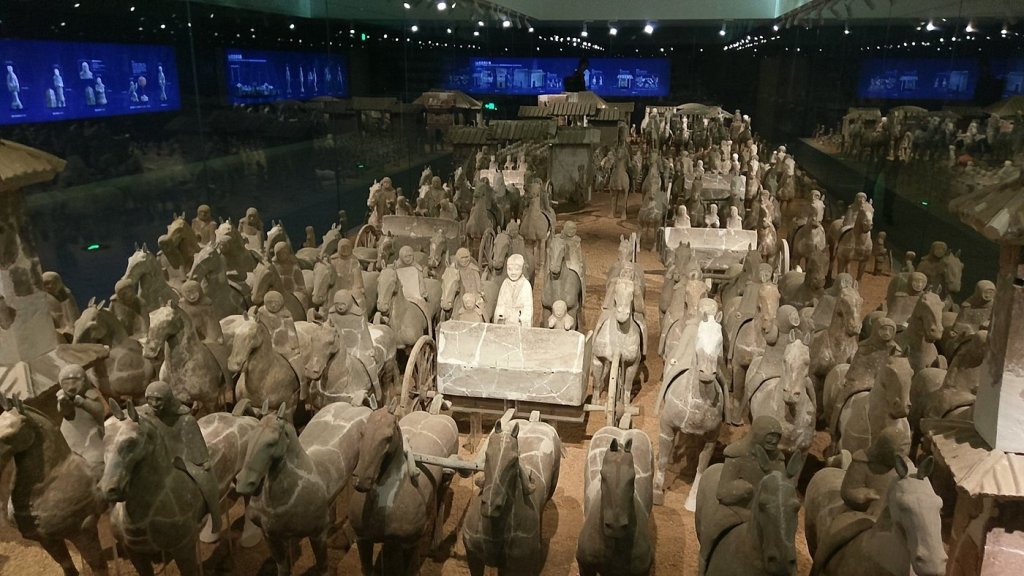
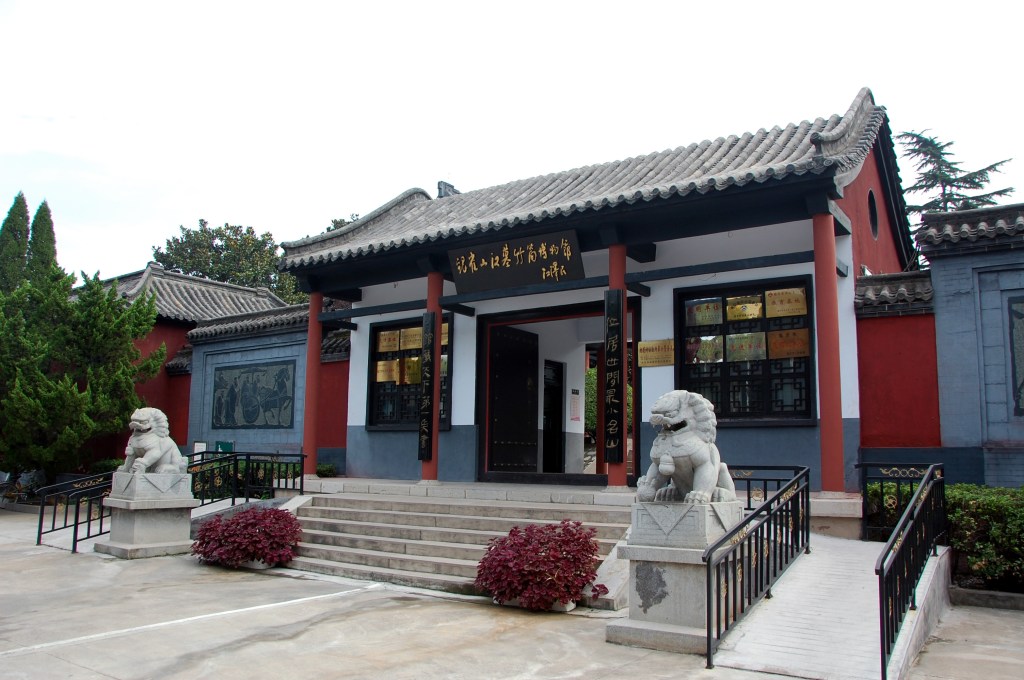
    Han Tomb Museum in Linyi(Langya), Shandong Province. Photo by kanegen

    The 1st year of Emperor Zhao’s Yuanping Era (74 B.C.)

    In February of spring, an edict was issued to reduce the child head tax, levied upon those between the ages of seven and fourteen, by three-tenths.

    In summer, on April 17, the Emperor, being twenty one years of age, passed away in the Weiyang Palace, leaving no heir.

    At that time, among the sons of Emperor Wu, only the Prince of Guangling, Liu Xu, remained. The Grand General Huo Guang, together with the court officials, deliberated upon the succession, and all were in agreement to support the Prince of Guangling. Yet the Prince had formerly been disfavored for his wanton conduct, and Emperor Wu had never considered him worthy.

    The Grand General was uneasy in heart. Then a Palace Gentleman memorialized, saying: “When King Tai of Zhou set aside Taibo in favor of King Ji of Zhou, and when King Wen of Zhou advanced King Wu above his elder son Bo Yikao, both decisions were founded upon virtue and capacity. To pass over an elder in favor of a younger may at times be fitting, yet the Prince of Guangling assuredly is unfit to inherit the ancestral temple.”

    These words accorded with Huo Guang’s mind. He presented the memorial to the Chancellor, Yang Chang, and others, and advanced the Palace Gentleman to the Prefect of Jiujiang.

    On the same day, acting under the decree of the Empress Dowager, Huo Guang dispatched the acting Grand Herald, the Privy Treasurer Shi Lecheng, the Imperial Clan Minister Liu De, the Grand Master of Chamberlain Bing Ji, and the General of the Household Lihan, together with others, to receive the Prince of Changyi, Liu He, and escort him to the capital in seven mail carriages. Liu He lodged in the Chang’an official residence of the Principality of Changyi.

    At the same time, Huo Guang advised the Empress Dowager to appoint the General of the Right, Zhang Anshi, as General of Chariots and Cavalry.

    Liu He was the son of Prince Ai of Changyi. In his native land he was famed for extravagance and wantonness. Even during the mourning for Emperor Wu, he indulged in dissipation, and would often ride out hunting without restraint. Once, hunting in Fangyu County, he covered two hundred li in less than half a day.

    The Commandant of the Capital Guard, Wang Ji of Langya, submitted a memorial admonishing him:

    “Sire neglects the pursuit of learning and delights only in pleasure and wandering. He rides in reckless haste, his horse’s bits and reins never held in check. His mouth grows weary from shouting, his hands sore from the bridle, his body exhausted by carriage and chariot. In the mornings he is drenched with mist and dew; by day he is covered with dust. In summer he is scorched by the fierce heat; in winter he is chilled by the bitter winds. Thus his frail and delicate frame is wearied with excessive exertion. Such practice neither preserves life nor advances benevolence and righteousness.

    “Beneath the spacious hall, upon the fine mats, eminent teachers may sit in front, while diligent reciters attend behind. There he may discourse on the eras of Emperor Yao and Shun, and examine the prosperous reigns of Yin and Zhou; there he may study the spirit of humane sages, and practice the art of governing the state. Zealous and intent, he may forget his meals, daily renewing his virtue. How could such delight be found amidst the bustle of streets and markets?

    “When at rest, let him bend and stretch to ease the body; when advancing and retreating, stepping and pacing, let him cultivate proper bearing and strength of limb. By inhaling the new and exhaling the old may he nourish his vitality; by concentrating the mind and gathering skill may he enrich his spirit. Thus shall he preserve life and attain longevity.

    “If Sire would earnestly give heed, then your mind shall cherish the aspirations of Emperor Yao and Shun; your body shall enjoy the long years of Crown Prince Jin and Chisongzi; your illustrious renown, once heard above, shall bring blessings and honors, and the realm shall be at peace.

    “The Emperor, benevolent and sagacious, even now remains ever mindful and admiring, and has not indulged in the pleasures of palace halls, gardens, ponds, or hunting. Sire ought from dawn till dusk to contemplate this, in order to carry forward the Emperor’s intent.

    “Among the feudal lords and kinsmen, none are nearer than Sire. In kinship Sire is as a son; in office Sire is as a minister. One person thus bears the double charge of both duties. Should affection and righteousness fail to be fully displayed, and come to the notice of the Emperor, it will not redound to the blessing of the state.”

    Prince Liu He issued a proclamation, saying: “We, being unable to restrain my misprision, acknowledge the earnestness of the Commandant of the Capital Guard, who often admonishes me for my faults.” He commanded the usher Qianqiu to present Wang Ji with five hundred catties of beef, five piculs of wine, and five bundles of dried meat. Yet thereafter he still abandoned himself to profligacy, without restraint.

    Chamberlain Gong Sui of Shanyang was loyal and sincere, firm and resolute in character. Within the palace he would remonstrate and contend with the Prince; outside the palace he would censure the prime minister and grand tutor, citing principle and weighing consequences, even to the point of shedding tears. He was unyielding, facing the Prince directly and pointing out his faults. The Prince, on hearing him, would cover his ears and flee, saying, “The Chamberlain is truly skilled at shaming men!”

    The Prince was often given to prolonged revels, gaming, and lavish gifts to his attendants and palace officials. Gong Sui came before him, weeping and crawling on his knees; all the attendants and ministers present were moved to tears. The Prince asked, “Why does Chamberlain weep?”

    Gong Sui replied, “I grieve deeply for the peril of the state. I beg a moment’s attention to declare my humble counsel.” The Prince thereupon dismissed his attendants. Gong Sui said, “Does Sire know why the Prince of Jiaoxi was condemned for immorality?”

    The Prince of Changyi said, “I do not know.”

    Gong Sui said, “I have heard that the Prince of Jiaoxi had a sycophant named Hou De. The Prince of Jiaoxi imitated the deeds of the despots Jie of Xia and Zhou of Shang, yet in Hou De’s mouth he was equal to Emperor Yao and Shun. The Prince delighted in Hou De’s words, favored his presence, lived and slept with him, and thus came to ruin. Now Sire is close to a band of petty men, gradually steeped in their corrupt ways. The border between survival and destruction must not be trifled with. It is meet and right so to choose men learned and upright, who follow the Way, to be Sire’s companions. When seated, let them recite the Book of Songs and the Book of Documents; when standing, let them practice ritual and propriety. This will bring benefits.”

    The Prince assented. Gong Sui then selected ten men, led by Zhang An, who were versed in the Classics and possessed a sense of righteousness, to serve the Prince. Yet after a few days the Prince dismissed Zhang An and the rest.

    Once, the Prince beheld a great white dog, whose form from the neck downward resembled that of a man. It wore a crown shaped like a square mountain and bore no tail. The Prince, in wonder, asked Gong Sui concerning it. Gong Sui replied: “This is a heavenly warning. It signifies that those who speak before Sire are dogs with human caps. If they are not kept away, calamity will follow.”

    Later, the Prince heard one exclaim, “Bear!” Looking about, he saw a great bear, yet none of those present beheld it. The Prince asked Gong Sui about this. Gong Sui said: “The bear, a wild beast of the mountains, has entered the palace, yet only Sire can see it. This again is a divine portent, declaring that the palace will soon be desolate, and peril is near at hand.”

    The Prince lamented, gazing upward to Heaven, and said: “Why do these ill omens keep appearing?”

    Gong Sui knocked his head upon the ground and said: “I dare not conceal my loyal heart. I have often spoken of the impending danger, though I know it has displeased Sire. Yet whether the state endures or falls does not rest upon my words. I entreat Sire to reflect deeply. The Book of Songs contains three hundred and five odes, embracing the affairs of men and the Way of kingship. Which conduct of Sire accords with even a single verse therein? As a prince among the lords, Sire acts more soiled than the common people. This is to imperil your life and invite destruction. It is fitting to ponder with utmost seriousness!”

    Later again blood stained the royal seat. The Prince asked Gong Sui about it. Gong Sui wailed and said: “The palace will long stand empty; portents of ill fortune are repeated. This blood signifies hidden and inauspicious omens. One must be prudent, fearful, and examine oneself!”

    Yet despite these warnings, the Prince altered nothing in his behavior.