Yiming Yang’s Blog

  • Comprehensive Reflections to Aid in Governance(Part 10): Shang Yang’s Reform

    Comprehensive Reflections to Aid in Governance

    By Sima Guang

    Translated By Yiming Yang

    Annals of Zhou Book 2 Scroll 2 (continued)

    Shang Yang

    The 8th year of King Xian (361 B.C.)

    Duke Xiao promulgated an edict seeking capable officials in the state of Qin: ”In ancient times, my ancestor Duke Mu, through cultivating virtue and practicing martial arts between Qi and Yong, brought peace to Jin in the east and established the Yellow River as the boundary. He then dominated the Rong and Di tribes in the west, expanding his territory for thousands of miles. The King of Zhou bestowed the title of Count upon him, and the other feudal lords all congratulated him. His achievements were admired by later generations and shone brightly.”

    “However, during the reigns of the previous rulers – Duke Li, Duke Zao, Duke Jian, and Duke Chu – the country faced internal troubles, and there was no time to deal with external affairs. The Three Jin attacked and seized the territory west of the Yellow River, causing great humiliation. When Duke Xian ascended the throne, he stabilized and pacified the borders, moved the capital to Liyang, and intended to launch an eastern expedition to reclaim the ancestral land of Duke Mu and uphold his policies and laws. I often feel sad at the thought of my father’s unfulfilled aspirations.  I would like to open prominent positions, for all the citizens and visitors, whoever had great ideas to build a stronger Qin would be my distinguished ministers.  I will grant them a portion of the land.”

    The decree reached Gongsun Yang in the state of Wey, prompting him to relocate to the state of Qin. As the grandson of Wey’s ruler, Gongsun Yang immersed himself in studying the teachings of Legalists. He had previously served under Gongshu Cuo, the prime minister of Wei, who recognized his potential but had not yet recommended him for advancement.

    When Gongshu Cuo fell seriously ill, King Hui of Wei paid him a visit to offer comfort. Concerned about the management of state affairs in Gongshu Cuo‘s absence, King Hui inquired, “Who will oversee the state affairs? Heaven forbid, what will happen if you are gone?” To this, Gongshu Cuo replied, “My assistant, Wey Yang, is a young and exceptionally talented individual. You can rely on his advice for all state affairs.” King Hui listened but remained silent. Gongshu Cuo continued, “If you don’t promote him, then kill him, please do not let him leave this state.”

    Agreeing with Gongshu Cuo‘s proposal, King Hui left. Gongshu Cuo immediately summoned Wey Yang and apologized, stating, “I prioritize serving our lord above all else, including my subordinates. I have just provided him with advice and informed you. You must leave immediately.” However, Wey Yang responded confidently, “If our lord did not accept your advice to promote me, why would he accept your advice to kill me?” Despite the gravity of the situation, Wey Yang did not flee.

    As King Hui of Wei departed from Gongshu Cuo‘s residence, he expressed sadness over Gongshu Cuo‘s illness and recounted the prime minister’s seemingly contradictory statements. “Gongshu Cuo entrusted the entire state to Wey Yang, and yet he advised me to kill him. Is there a contradiction here?” he pondered.

    Subsequently, Wey Yang made his way to the state of Qin.  Through a eunuch named Jingjian, He sought an audience with Duke Xiao of Qin to present his strategies for the state’s prosperity and security. After engaging in discussions about governance, Duke Xiao of Qin was greatly pleased with Wey Yang‘s insights.

    The kingdom of Wei moved its capital from Anyi to Daliang during the summer. 

    In the kingdom of Yue, a minister named Si, who was the younger brother of another minister named Shiqu, assassinated its king, Mangan. Subsequently, Wu Zhuan was crowned as the new king.

    Prior to Wu Zhuan‘s ascension, the kingdom had endured a tragic history of regicide, with three generations of kings being murdered by their own subordinates. Fearing for his life, Prince Sou, who was in line for the throne, fled and sought refuge in a mining cave. As the kingdom urgently needed a new ruler, people embarked on a search for Prince Sou and eventually discovered him hiding in the cave.

    Despite their efforts to persuade him to come out, Prince Sou refused to emerge. Consequently, the people of Yue decided to smoke him out of the cave by burning wormwood inside. With no other option, Prince Sou finally emerged from the cave. He was then placed on a carriage and proclaimed as the rightful king. As he slowly ascended the carriage, he looked up to the sky and exclaimed, “Oh my lord! Oh my lord! Why won’t you leave me alone!”

    Prince Sou’s official name after becoming king was Wu Zhuan.

    The 10th year of King Xian (359 B.C.)

    Wey Yang started his reform, the people of Qin were not pleased by the reform.  Wey Yang persuaded Duke Xiao of Qin: ”The people cannot be convinced at the beginning, but they can be delighted with the achievements in the end. Those who pursue supreme virtue do not conform to prevailing customs, and those who accomplish great deeds do not consult with the masses. Therefore, the sages, if they can strengthen the state, do not follow established norms.”  

    Gan Long, another adviser to Duke Xiao of Qin, disagreed:”That’s not right.  When governance is based on established laws and regulations, officials are trained and the people find peace in it.”  

    Wey Yang rebutted: ”Ordinary people are content with their familiar customs, and scholars often become trapped in what they have heard. In such cases, it is appropriate for them to follow the established laws and regulations while in their official positions, and not engage in discussions beyond the scope of the law. Wise individuals create new laws, while the ignorant adhere to existing ones; virtuous people may change rituals, while the unworthy remain constrained by them.” 

    Duke Xiao of Qin appraised:”A good argument!”.  He appointed Wey Yang as vice prime minister and immediately approved the new reform orders.

    The new order organized the people into groups of ten families, where they were responsible for one another and faced collective punishment for wrongdoings. Those who reported criminals were rewarded similarly to those who killed enemies in battle, while those who concealed criminals received the same punishment as those who surrendered to the enemy. Families with more than two adult males were taxed twice as much. Those who achieved military merit were rewarded with higher titles. Infights were punished according to the seriousness of the offense. Taxes were lowered or forgiven to those endeavoring to produce surplus food or clothings.  Those who neglected their duties, sought personal gains, or were lazy despite being wealthy were banished as slaves. Members of the royal family without military merit were not granted official status. A strict hierarchy was established, with titles, ranks, and other distinctions determined by one’s position in society. The distribution of land, houses, servants, and clothing was allocated based on one’s social rank. Those who achieved merit were honored, while those without military achievements, even if wealthy, did not receive any fame and acclimations.

    Before the executive order had been promulgated, Wey Yang was concerned that people wouldn’t believe he meant it. To demonstrate the seriousness of the order, he erected a thirty-feet pole at the south gate of the capital and offered a reward of 10 ounces of gold to anyone who could move it to the north gate. People found this strange and were hesitant to step forward. Wey Yang then increased the prize to 50 ounces of gold. One brave individual eventually moved the pole and was immediately rewarded. From that point on, the executive orders were strictly followed.

    In the first year of enforcing the new laws, thousands of people complained about the inconveniences they brought. However, a turning point came when the crown prince himself broke one of the laws. Wey Yang responded by stating that the new laws could not be enforced if the elite were exempt from them. He decided not to punish the crown prince, who was the future king and not subject to criminal laws. Instead, he took action against the crown prince’s teacher, Gongzi Qian, and branded the face of Gongzi Qian’s teacher, Gongsun Gu. The people of Qin followed the laws faithfully from the very next day.

    After ten years of enforcing the new laws, the state of Qin became exceptionally well-governed. Crime decreased significantly, and even in remote mountain areas, there were no bandits. The public was willing to defend the state in times of war, yet they were afraid to engage in conflicts amongst themselves. The affairs of towns and villages were in excellent order. Those who had initially complained about the inconveniences of the new laws now changed their minds and praised the convenience they brought. Wey Yang accused these individuals of interfering with law enforcement and ordered them all to be exiled to the border areas. As a result, nobody dared to speak about state affairs again.

    Sima Guang’s comments: Trust is the invaluable treasure of a statesman. The security of a state relies on its people, and the people’s security is ensured by their trust in the leadership. Without trust, a statesman would struggle to mobilize the people, and without the support of the people, a state would be unable to defend itself. Hence, since ancient times, kings refrained from lying to their subjects, and dominant states refrained from deceiving their neighbors. A good statesman refrains from deceiving their own people, just as a good head of household refrains from lying to their kinsmen.

    Conversely, a bad leader resorts to cheating and deceit. They deceive neighboring states, their own people, siblings, and even their parents and children. Leaders lose the trust of their subordinates, while the common people lose trust in their leaders. Failure to establish a unifying force among leaders and their supporters leads to defeat. It is a tragic situation where the gains from cheating cannot heal the wounds of mistrust, and the advantages gained cannot compensate for what has been lost.

    In historical examples, Duke Huan of Qi remained true to his pledge to Cao Mo, and Duke Wen of Jin did not abandon his promise for advantageous positions in the battle with Chu. Similarly, Marquis Wen of Wei honored his appointments with friends at Yu, and Duke Xiao of Qin did not go back on the reward for moving the pole across the capital. These four leaders were not without flaws or had impeccable reputations. Despite living in a time of violence and deception, even as unforgiving as the Lord of Shang (Wey Yang), they understood the importance of keeping their word and educating their people. Even in times of turmoil, they did not forget the significance of honesty and trustworthiness, which are even more critical attributes for statesmen ruling in times of peace.

    Marquis Yi of Han has passed away, and his son succeeded him as Marquis Zhao.

  • Comprehensive Reflections to Aid in Governance(Part 9): Gongsun Cuo’s Humility

    Comprehensive Reflections to Aid in Governance

    By Sima Guang

    Translated By Yiming Yang

    Annals of Zhou Book 2 Scroll 2

    Duration of 48 years

    The 1st year of King Xian (368 B.C.)

    The state of Qi launched a raid on Wei, capturing Guanjin

    The state of Zhao invaded Qi and reached the Great Wall of Qi.

    Amidst this chaos, an official from Wei named Cuo fled to the state of Han, seeking refuge.

    In the West Zhou, Duke Wei passed away, and his crown Prince Chao succeeded him as Duke Hui of Zhou. However, his younger brother, Prince Ban, had gained favor with Duke Wei during his lifetime. Upon Duke Wei’s death, Prince Ban rebelled against his brother’s rule.

    To address the turmoil, the states of Zhao and Han took action and dispatched troops to Zhou.

    The 2nd year of King Xian (367 B.C.)

    The states of Zhao and Han divided the territory of Zhou into two princedoms. King Xian granted Prince Ban a city named Gong as his fiefdom, and he became known as Duke Hui of East Zhou. As a result of this division, the power and authority of the Zhou court diminished further. The administration of the court was mainly concentrated in the West Zhou.

    The 3rd year of King Xian (366 B.C.)

    The rulers of Wei and Han held a meeting at Zhaiyang

    The army of the State of Qin achieved victory by defeating the armies of Wei and Han in the battle at Luoyang.

    The 4th year of King Xian (365 B.C.)

    The state of Wei raided the state of Song, capturing Yitai.

    The 5th year of King Xian (364 B.C.)

    At the Battle of Shimen, King Xian of Qin defeated the armies of the three states derived from Jin (i.e., Wei, Han and Zhao)  and beheaded sixty thousand enemy soldiers. In recognition of his achievement, the King Xian of Zhou bestowed upon him the honor of wearing the ceremonial robes with royal emblems decorated with feathers, which were reserved for distinguished nobles.

    The 6th year of King Xian (363 B.C.)

    Upon the passing of Duke Xiu of Song, his son Pibing ascended to the throne as Duke Huan of Song.

    Similarly, after the death of Marquis Yi of Han, his son Wu inherited his title and became Marquis Zhao of Han.

    The 7th year of King Xian (362 B.C.)

    The State of Wei defeated the armies of Han and Zhao at Kuai and captured the general Yue Zuo. In recognition of this victory, King Hui of Wei held a grand ceremony to welcome the troops back, and he rewarded the general Gongsun Cuo with a land grant of one million acres.

    However, General Gongsun Cuo, also known as Gongshu Cuo, walked backwards and declined the rewards: “The reason our soldiers were able to stand firm without wavering, to charge straight and not deviate, to resist and not retreat, is because of the Wu Qi‘s military training. I am incapable of achieving such feats. The reason our troops were able to navigate through dangerous terrain and make strategic decisions to win over our enemies without confusion is due to the strength and preparation of commanders like Ba Ning and Cuan Xiang. The reason the soldiers were motivated and believed in the rewards and punishments set by the king is due to the clarity of your laws and regulations. I merely carried out my duties as a general, and beat the drum vigorously when it was time to attack the enemy.  How about your grace awarding me just for my tireless right hand? As for the achievements, I have not contributed much to claim any.”

    The king was impressed by Gongsun Cuo‘s humility and wisdom, so he visited the descendants of Wu Qi and awarded them two hundred thousand acres.  He awarded Ba Ning and Cuan Xiang each with one hundred thousand acres.

    The king praised him: “Gongsun Cuo, aren’t you truly a great man! You not only defeated strong enemies for me but also showed magnanimity by not forgetting to credit the wise leader in the past and commend the achievements of capable officers. Why shouldn’t I award you even more?”  He awarded him an additional four hundred thousand acres.

    In the battle at Shaoliang, the state of Qin emerged victorious over the state of Wei, and Gongsun Cuo was captured during the conflict.

    Following the death of Duke Sheng of Wey, his son Su took over the title and became Marquis Cheng, assuming the leadership of the state.

    Similarly, after the passing of Duke Huan of Yan, his son succeeded him and became Duke Wen, becoming the new ruler of the state of Yan.

    Upon the death of Duke Xian of Qin, his twenty-one-year-old son succeeded him and became Duke Xiao of Qin. At this time, the east boundaries of Qin were dominated by six strong states, each separated by rivers and mountains. Between the Huai River and the Si River, there were over ten smaller states. Qin shared borders with the states of Chu and Wei.

    The state of Wei had constructed a great wall, starting from the city of Zheng and extending along the Luo River, up to the city of Shangjun in the north. Meanwhile, the state of Chu‘s border reached as far as Hanzhong, and there were regions like Ba and Qianzhong to the south of Qin. However, despite being geographically connected to the heartland of China, the states there viewed Qin as a foreign and barbaric entity. They excluded Qin from their unions and alliances.Duke Xiao of Qin aimed to elevate the status of Qin and make it the strongest state among its neighbors. To achieve this, he sought to improve governance and promote the welfare of his people.

  • Comprehensive Reflections to Aid in Governance(Part 8): Facts versus Opinions

    Comprehensive Reflections to Aid in Governance

    By Sima Guang

    Translated by Yiming Yang

    Annals of Zhou Book 1 Scroll 1 (continued)

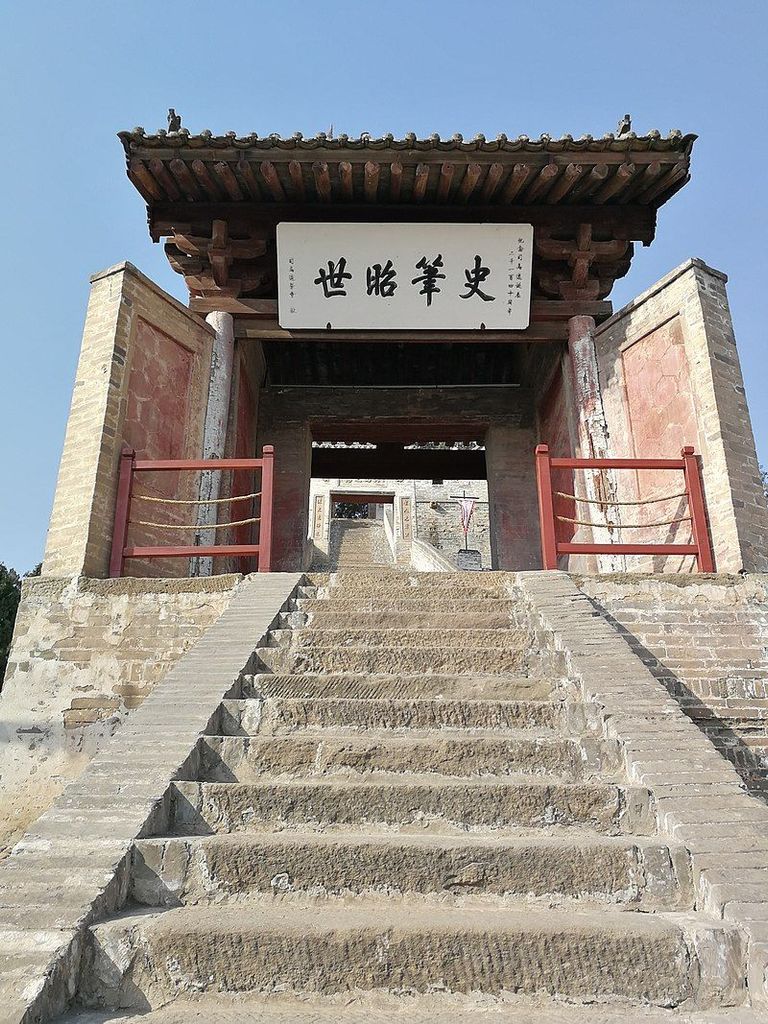
    Tomb of Sima Qian, Shaanxi Province

    The 1st Year of King Lie (375 B.C.)

    A solar eclipse occurred.

    In a military conquest, the State of Han annexed the State of Zheng, leading to the decision to relocate the capital of Han to Zheng.

    Following the passing of the Marquis Jing of Zhao, his son Zhong assumed the title of Marquis Cheng, taking his place as the ruler of Zhao.

    The 2nd Year of King Lie (374 B.C.)

    Yan Sui assassinated Marquis Ai of Han, and the people of the state installed his son, Marquis Yi, Ruo Shan, as the new ruler. Initially, Marquis Ai had favored Han Wei as his prime minister, but he also had affection for Yan Sui, leading to intense rivalry between the two. Yan Sui ordered someone to stab Han Wei at the court, and Han Wei fled to Marquis Ai, who embraced him. However, the assailant’s attack not only stabbed Han Wei but also fatally wounded Marquis Ai.

    The 3rd Year of King Lie (373 B.C.)

    The State of Yan achieved victory over the army of Qi in the battle at Linhu.

    In an offensive move, the State of Lu launched an attack on Qi, successfully breaking into Yangguan.

    The State of Wei also launched an attack on Qi, managing to reach Boling.

    Following the demise of Duke Xi of Yan, his son assumed the position of Duke Pi.

    Similarly, after the passing of Duke Xiu of Song, his son succeeded him as Duke Huan.

    With the passing of Duke Shen of Wey, his son Xun took over as Duke Sheng.

    The 4th Year of King Lie (372 B.C.)

    The State of Zhao launched an offensive against the State of Wey, successfully capturing seventy-three towns and villages.

    The State of Wei managed to achieve victory over the army from Zhao in the battle at Beilin.

    The 5th Year of King Lie (371 B.C.)

    The State of Wei launched an attack on the State of Chu, capturing Luyang.

    The 6th Year of King Lie (370 B.C.)

    King Wei of Qi demonstrated his respect by paying homage to King Lie of Zhou. This act stood out as a remarkable gesture since the Zhou dynasty had lost its influence, and no other vassal state paid such visits except for the state of Qi. As a result, King Wei of Qi gained widespread acclaim for his display of loyalty.

    The State of Zhao launched an attack on the State of Qi, targeting the place called Juan

    The State of Wei defeated the army of Zhao in the battle at Huai.

    King Wei of Qi summoned his official from Jimo and addressed the negative rumors surrounding him since his appointment. However, after a thorough assessment by the king’s envoy, it was evident that Jimo was thriving, with well-cultivated land and prosperous people. The absence of government turmoil and external threats in the east of Qi indicated that the official had refrained from resorting to bribery to gain favor. In recognition of his integrity and effective governance, King Wei rewarded him with a fief encompassing ten thousand households.

    Conversely, another official from E faced severe consequences. The king spoke to him: “I have heard many commendable things about you since your appointment. However, upon inspection by my envoy, it was evident that the land lay in ruins and the people were suffering from starvation. You failed to provide aid when the State of Zhao attacked Juan, and you did not even report on the capture of Xueling by the state of Wey. It seems that your focus has been solely on paying individuals to speak highly of you, rather than fulfilling your responsibilities.” As a result, the official of E, along with those who had accepted bribes to praise the official, were boiled to death on that day.

    The swift and decisive actions of King Wei struck fear into the hearts of his subordinates, deterring any engagement in corrupt practices. This created an environment where officials focused on their duties, leading to well-ordered state affairs in Qi. As a result, the state of Qi became renowned as one of the strongest and most respected states.

    King Su of Chu passed away without leaving an heir. Consequently, his brother Liangfu ascended to the throne and became King Xuan of Chu.

    In the state of Song, Duke Pi also died, and his son Ticheng succeeded him as the new ruler.

    A similar situation unfolded in the state of Wei when Marquis Wu passed away before designating a prince as his successor. This led to a power struggle between his son Ying and Gongzhong Huan, causing turmoil within the state as they vied for the throne.

    The 7th Year of King Lie (369 B.C.)

    There was a solar eclipse that occurred during this time.

    Following the death of King Lie of Zhou, his brother Bian ascended to the throne as King Xian.

    In the midst of the turmoil in the state of Wei, an official named Wang Cuo fled to the state of Han. Gongsun Xin proposed to Marquis Yi of Han, “Now that the state of Wei is in chaos, it is an opportune time to overthrow it.” Marquis Yi of Han, in collaboration with the army of Marquis Cheng of Zhao, launched an attack on the state of Wei. They engaged in a decisive battle at Zhuoze and emerged as the victors, subsequently besieging the state of Wei.

    Marquis Cheng of Zhao suggested, “Let us kill Ying and install Gongzhong Huan as the new ruler, dividing the land between our states. This would be beneficial for both parties.” However, Marquis Yi of Han disagreed, stating, “Taking the life of a prince through violence and seeking personal gain by seizing land is not justifiable. It would be better to divide the state of Wei into two separate states, with neither being stronger than the State of Song or Wey. This way, we can put an end to our concerns regarding Wei.” The people of Zhao did not agree with this proposal, causing dissatisfaction for Marquis Yi of Han, who subsequently withdrew his army overnight. The army of Zhao also retreated. Ying, seeing this opportunity, killed Gongzhong Huan and proclaimed himself as King Hui of Wei.

    The Great Historian (Sima Qian) comments on this event: The reason King Hui of Wei survived and the state of Wei did not divide into two was due to the inability of the victorious states to reach an agreement. Accepting either proposal would have resulted in the division of Wei. There was a saying: “When a ruler passes away without a suitable heir, his kingdom is vulnerable to invasion.”

  • Comprehensive Reflections to Aid in Governance(Part 7): Zisi’s Observation

    Comprehensive Reflections to Aid in Governance

    By Sima Guang

    Translated by Yiming Yang

    Annals of Zhou Book 1 Scroll 1 (continued)

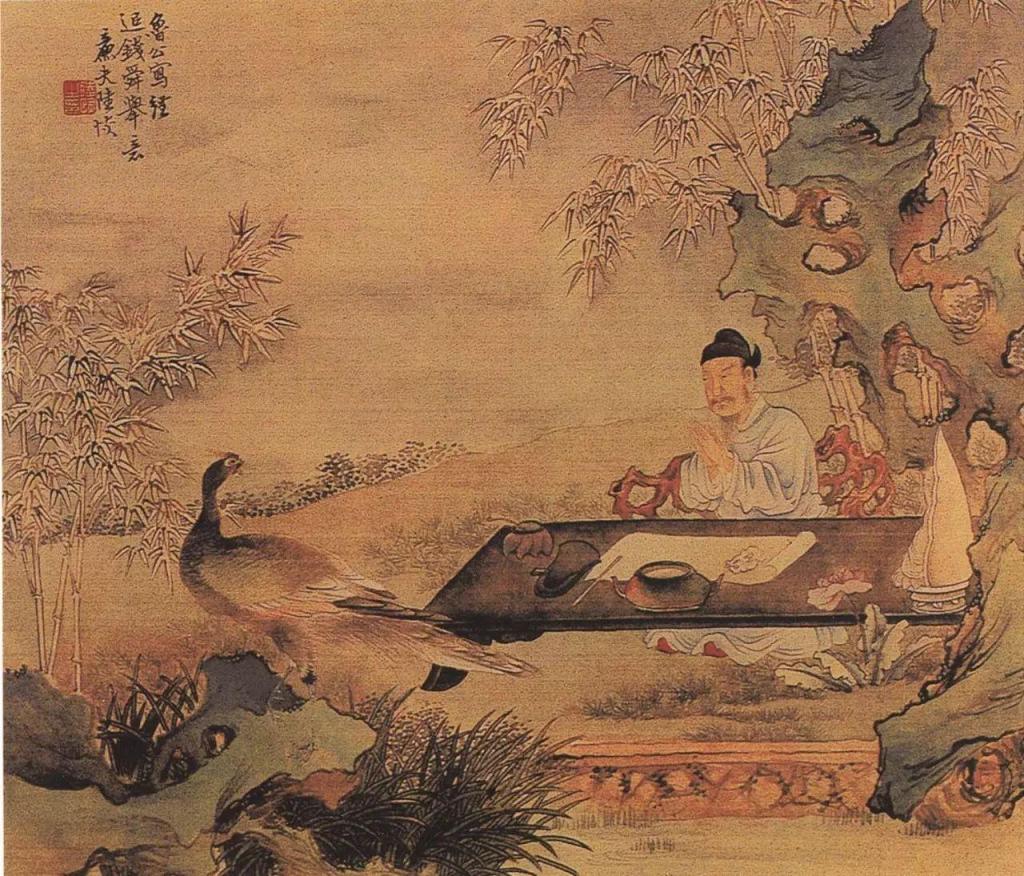
    A Painting depicting Zisi

    The 22nd Year of King An (380 B.C.)

    The state of Qi launched an attack on the state of Yan, successfully capturing the city of Sangqiu

    The combined forces of Wei, Han, and Zhao launched a counterattack on the state of Qi, pushing forward and reaching the city of Sangqiu.

    The 23rd Year of King An (379 B.C.)

    The state of Zhao launched a surprise raid on the state of Wey, but their attack was unsuccessful. 

    In the state of Qi, Duke Kang passed away without leaving an heir. As a result, the Tian family assumed control over the entire state of Qi.

    The 24th Year of King An (378 B.C.)

    The nomadic tribes in the north successfully defeated the army of Wei at the river Hui. 

    The combined forces of the states of Wei, Han, and Zhao continued their military campaign against the state of Qi and advanced as far as Lingqiu

    In the state of Jin, Duke Xiao passed away, and his son Jujiu ascended to the throne as Duke Jing, assuming the role of ruler in Jin.

    The 25th Year of King An (377 B.C.)

    The state of Shu launched a surprise raid on the state of Chu and successfully captured Zifang,

    Zisi, the grandson of Confucius, recommended Gou Bian to Marquis Wey (the ruler of the state of Wey), praising his ability to lead a troop of 500 chariots. However, Marquis Wey expressed concerns about Gou Bian’s past as a government official, where he was involved in an incident of taking two eggs from people during tax collection. Marquis Wey cited this as the reason for not appointing him as a general.

    In response, Zisi conveyed his view to Marquis Wey: “The role of a sage in employing individuals is akin to that of a carpenter working with wood. They recognize their strengths and overlook their weaknesses. Just as a skilled craftsman does not discard a giant tree that may have a few feet of decay while still possessing valuable qualities, so should a ruler in the tumultuous era of the Warring States choose talented individuals and not overlook a capable general due to minor flaws. Such a decision should not be made known to neighboring states.”

    Moved by Zisi‘s wisdom, Marquis Wey bowed to him, expressing gratitude for the lesson learned.

    Marquis Wei of the state of Wey continued to make inappropriate plans, and his advisers and ministers faithfully echoed his order in unison. Observing this, Zisi couldn’t help but sneer and express his perspective on the state of Wey. He remarked that the lord of Wey did not behave as a true lord, and the ministers did not act as true ministers.

    When Gongqiu Yizi questioned Zisi about his statement, Zisi explained his reasoning: ”When a ruler indulges in flattery and fails to heed the counsel of others, the collective wisdom of the people will not be forthcoming. Even if a ruler makes the right decision, not listening will only further discourage the sharing of ideas, let alone everyone second the bad decision and amplify the wrong doing. Ignoring the rightness or wrongness of matters and only seeking praise from others is the epitome of darkness. Failing to consider reason and resorting to sycophancy in order to gain favor is the epitome of fawning. When a ruler is blind and the courtiers are sycophantic, they distance themselves from the people they govern, and the people will no longer be united. If this continues, the country will lose its cohesion.”

    Zisi expressed his concerns to the Marquis Wey, saying, “Your governance of the state is gradually deviating from the right path.” The Marquis asked, “Why do you say so?” Zisi replied, “There are certain reasons for it. You speak with a sense of infallibility, and none of your ministers and high officials dare to correct your errors. Similarly, the ministers and high officials speak with a sense of infallibility, and the common people dare not correct their errors. If both the ruler and his subjects consider themselves wise and no one dares to challenge their wisdom, then they will be praised when they are right and followed obediently, but if they are wrong, any correction will get people into trouble. In such a situation, how can goodness prosper? As the Book of Songs says, ‘When everyone thinks themself wiseman, who can tell the crow’s sex?’ Could it be that the relationship between you and your subjects is similar to this?”

    Marquis Wen of Han has passed away, and his son has succeeded him as Marquis Ai.

    The 26th Year of King An (376 B.C.)

    King An of Zhou passed away, and his son Xi ascended to the throne as King Lie of Zhou.

    In a significant turn of events, the three influential families of Wei, Han, and Zhao joined forces to strip the Duke Jing of Jin of his power and status. They reduced him to the position of a domestic servant and divided his land among the three families.

  • Comprehensive Reflections to Aid in Governance(Part 6): The Ultimate Revenge

    Comprehensive Reflections to Aid in Governance

    By Sima Guang

    Translated by Yiming Yang

    Annals of Zhou Book 1 Scroll 1 (continued)

    Eponym County of Wu Qi, Shaanxi Province

    The 11th Year of King An (391 B.C.)

    The State of Qin launched an invasion against the State of Han, successfully capturing and annexing six towns from the city Yiyang.

    Tian Chang gave birth to Viscount Xiang, Tian Pan. Tian Pan, in turn, gave birth to Tian Bai, who gave birth to Tian He. TIan He was called the Great Grandpa Qi. It was Tian He who took over the state of Qi and decided to relocate Duke Kang, the lord of the State of Qi to an island in the sea, establishing a city as his designated domain to safeguard the ancestral heritage of Great Grandpa Jiang.

    The 12th Year of King An (390 B.C.)

    The city of Wucheng became the battleground where the forces of the State of Qin and the State of Wei clashed in a fierce battle.

    In another military engagement, the State of Qi launched an attack on the State of Wei, managing to capture the city of Xiangling and gain control over it.

    Meanwhile, the State of Lu achieved a significant victory over the army of the State of Qi in a decisive battle at the city of Pinglu.

    The 13th Year of King An (389 B.C.)

    The State of Qin launched an invasion against the State of Jin.

    During this time, Tian He, the prime minister of the State of Qi, met with Marquis Wei Wen and representatives from both the States of Chu and Wey at Zhuoze. Tian He sought the lordship of Qi from King An of Zhou, while Marquis Wei Wen supported and advocated for Tian He‘s cause before the king. Ultimately, King An granted his approval and officially bestowed the lordship upon Tian He.

    The 15th Year of King An (387 B.C.)

    The State of Qin launched an invasion against the State of Shu, successfully capturing the city of Nanzheng.

    In the midst of these events, Marquis Wei Wen passed away, and his eldest son, Crown Prince Ji, ascended to the position of Marquis Wei Wu.

    Marquis Wei Wu embarked on a journey down the Xihe (West River) on a ship. As he observed the surrounding landscape, he expressed his admiration to Wu Qi, the commandant of Xihe prefecture. Marquis Wei Wu remarked on the beauty and strength of the mountains and rivers, considering them valuable assets for the State of Wei. However, Wu Qi offered a different perspective: “The security and stability of a state truly lie in the virtues of its ruler, rather than the natural barriers that surround it. Consider the Sanmiao tribe of the past, situated between Dongting Lake and Pengli Lake. Despite the physical protection offered by these natural features, they were ultimately vanquished by Yu the Great, when they failed to uphold virtuous governance.”

    “Another case worth mentioning is Jie, a ruler of the Xia dynasty, who resided in an area encompassed by the Ji River, Mount Taihua, the pass of Yique in the south, and the Yangchang slope in the north. However, King Tang of the Shang dynasty exiled Jie due to his tyrannical and inhumane rule.”

    “Similarly, King Zhou of the Shang dynasty ruled within a territory surrounded by imposing barriers: Mengmen mountain on the left, Taihang mountain on the right, Mount Heng to the north, and a great river to the south. Nevertheless, King Wu of the Zhou dynasty successfully overthrew him, as King Zhou‘s immoral and unethical rule undermined his position of power.”

    “From these examples, we can derive an important lesson: the rule of benevolence and moral virtue is paramount for the security and prosperity of a state. Regardless of the presence of natural barriers, if a ruler lacks morality and neglects the welfare of the people, even those within the confines of a ship could turn against him”.

    Marquis Wei Wu acknowledged the validity of Wu Qi‘s argument. He concurred, stating, “You make a good point.”

    The state of Wei made the decision to appoint Tian Wen as its prime minister, a choice that did not sit well with Wu Qi. Filled with discontent, Wu Qi approached Tian Wen and issued him a challenge: “Shall we compare our accomplishments?”

    Tian Wen responded, “Certainly, we can do that.” Wu Qi wasted no time and began, “When it comes to leading three armies into battle, instilling unwavering courage in soldiers, and deterring our enemy states from plotting against us, are you superior to me?” Tian Wen replied, “No, I am not.”

    Undeterred, Wu Qi continued, “And what about efficiently governing all officials, showing compassion towards citizens, and ensuring the stability of the country’s food supply and finances? Are you better than me in these aspects?” Tian Wen reluctantly admitted, “No, I am not.”

    Wu Qi pressed on, “Furthermore, when it comes to guarding the West River, preventing the State of Qin from advancing eastward, and securing alliances with the State of Han and Zhao, are you better than me?” Once again, Tian Wen‘s response remained the same.

    Wu Qi then argued, “If you are not superior to me in any of these three aspects, why are you ranked above me?” Tian Wen countered, “The State is currently governed by a young lord, and its position is precarious. The officials have yet to fully pledge their allegiance to the lord, and the people are still uncertain about their trust in him. Considering the current circumstances, who is better suited to handle this situation: you or me?”

    After a long pause, Wu Qi finally conceded, “You are better equipped to handle the challenges at hand.”

    Over time, the prime minister Tian Wen passed away, leaving a vacancy in the position. The new prime minister of Wei, named Gongshu, who had married a daughter of Marquis Wei Wu, saw Wu Qi as a potential threat. One of Gongshu‘s servants devised a scheme: “Getting rid of Wu Qi is easy. He is a proud and upright individual. Here’s what you can do: Go to the lord and express your concerns, saying, ‘Wu Qi is an exceptional talent, but I fear that our state may be too small to accommodate his ambitions in the long run. Why not offer your daughter’s hand in marriage to him? If he refuses, it will be a clear indication that he has no intention of staying.’” The servant continued, “Then, invite Wu Qi to your home and have your wife, who is a princess, insult and belittle you in front of him. If Wu Qi witnesses her disdainful behavior, he will reject the marriage proposal, and your plot will succeed.” Gongshu approved the plan and put it into motion. As anticipated, Wu Qi declined the marriage proposal, causing Marquis Wei Wu to become suspicious and lose trust in him. Wu Qi‘s favor rapidly declined, and fearing for his life, he made the decision to flee to the Kingdom of Chu.

    Upon his arrival in the Kingdom of Chu, Wu Qi‘s reputation had already preceded him, catching the attention of King Dao. Impressed by his capabilities, King Dao appointed Wu Qi as the prime minister. Wu Qi wasted no time in implementing his reforms, promulgating laws and regulations to streamline the government. He eliminated unnecessary bureaucratic positions, reduced public-supported entitlements for distant royal relatives, and allocated the savings as pensions for soldiers. His primary focus was on strengthening the armed forces and countering the influence of the two factions of strategic alliances. Under Wu Qi‘s leadership, the Kingdom of Chu successfully suppressed insurgencies in the “Yue” territories, repelled threats from the three “Jin” vassal states, and launched an offensive against the State of Qin to the West. The strength and prowess of Chu left neighboring states in awe.

    However, despite his remarkable achievements, Wu Qi faced resentment from many royals and nobles within the Kingdom of Chu who were displeased with his reforms and the consolidation of his power.

    Duke Hui of Qin passed away, and his son succeeded him as Duke Chu

    The State of Zhao also experienced a change in leadership as Marquis Wu died. The people of Zhao installed Zhao Zhang, the eldest son of Marquis Lie, as the new ruler, bestowing him with the title of Marquis Jing

    In the State of Han, Marquis Lie passed away, and his son ascended to the throne as Marquis Wen.

    The 16th Year of King An (386 B.C.)

    Tian He, an official of the State of Qi, has been granted the title of Duke, marking his formal promotion to royalty.

    Prince Chao of Zhao rebelled and sought refuge in the State of Wei. In an attempt to regain power, he led a covert attack by the Wei forces against Handan. However, the attack was ultimately unsuccessful in achieving its objectives.

    The 17th Year of King An (385 B.C.)

    In a shocking turn of events, the chancellor of the State of Qin named Gai orchestrated a reception at Hexi and installed Duke Xian as the new ruler, while also carrying out a brutal act of violence. Gai killed Duke Chu of Qin, as well as his mother, and disposed of their bodies near a deep river.

    The State of Qi launched an attack on the State of Lu

    The State of Han launched offensives against both the State of Zheng and the State of Song. They successfully seized the city of Yangcheng from Zheng and captured Duke Dao of Song.  The people of the Song have established Duke Xiu, Zi Tian, as their ruler.

    Duke Tai of Qi, also known as Tian He, passed away. His son, Tian Wu, succeeded him as the new ruler, taking on the title of Duke Huan of Qi.

    The 19th Year of King An (383 B.C.)

    The state of Wei defeated the army of Zhao at a place named Tutai.

    The 20th Year of King An (382 B.C.)

    There was a solar eclipse, which became annular soon.

    The 21st Year of King An (381 B.C.)

    Following the death of King Dao of Chu, a chaotic situation unfolded in the kingdom. The royals and officers revolted, targeting Wu Qi, who sought refuge in the palace. In a desperate act of seeking revenge, Wu Qi laid on top of King Dao‘s lifeless body. Those who shot at Wu Qi  with arrows also defiled the deceased king’s body.

    After the funeral ceremonies, King Su, Xiong Zang, was installed as the new ruler of Chu. Determined to quell the rebellion and restore order, King Su issued a harsh decree. He ordered his prime minister to execute all the rebels and their families who tarnished the corpse of the former king, resulting in the eradication of over 70 families in total.

  • Comprehensive Reflections to Aid in Governance(Part 5): Assassin Nie Zheng

    Comprehensive Reflections to Aid in Governance

    By Sima Guang

    Translated by Yiming Yang

    Annals of Zhou Book 1 Scroll 1 (continued)

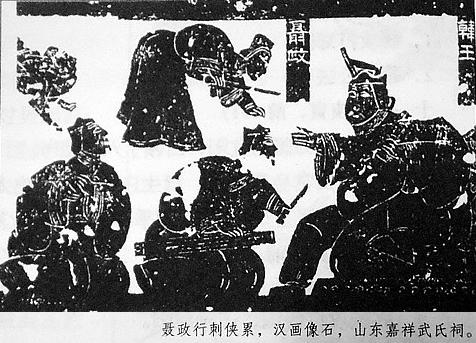
    Relief of Nie Zheng, Jiaxiang, Shangdong Province

    The 24th Year of King Weilie (402 B.C.)

    King Weilie of Zhou passed away, and his son King An, Ji Jiao, ascended to the throne.

    King Sheng of Chu was assassinated by bandits. In response, the people of the Kingdom of Chu proclaimed his son, Mi Yi, as the new ruler, bestowing upon him the title of King Dao of Chu.

    The 1st Year of King An (401 B.C.)

    The Kingdom of Qin launched an invasion against the Kingdom of Wei, and their military campaign extended as far as Yanghu.

    The 2nd Year of King An (400 B.C.)

    The armies of the kingdoms of Wei, Han, and Zhao launched a joint attack against the kingdom of Chu, advancing as far as Sangqiu.

    Meanwhile, the troops of the state of Zheng laid siege to the city of Yangzhai in the kingdom of Han.

    In the kingdom of Han, Marquis Jing passed away, and his son Han Qu ascended to the throne, assuming the title of Marquis Lie.

    Similarly, in the kingdom of Zhao, Marquis Lie died, and his younger brother was installed as Marquis Wu.

    In the kingdom of Qin, Duke Jian passed away, and his son Duke Hui succeeded him as the new ruler.

    The 3rd Year of King An (399 B.C.)

    Prince Ding of Chu sought refuge in the State of Jin, fleeing from the turmoil in his own state.

    In a catastrophic event, Mount Guo erupted, resulting in the blockage of the Yellow River.

    The 4th Year of King An (398 B.C.)

    The army of Chu laid siege to the capital of the State of Zheng, putting pressure on the city and its inhabitants. In a desperate and tumultuous turn of events, the people of Zheng turned against their prime minister, Si Ziyang, and ended his life.

    The 5th Year of King An (397 B.C.)

    A solar eclipse occurred, casting a momentary darkness over the land.

    In the month of March, the prime minister of Han, Xia Lei, was assassinated. Xia Lei had incurred the wrath of Yan Zhongzi from Puyang, who sought vengeance against him. Yan Zhongzi discovered the renowned warrior Nie Zheng from Zhi and attempted to hire him for the assassination. Yan Zhongzi offered generous gifts, including hundred ounces of gold, to Nie Zheng‘s mother in an attempt to persuade him. However, Nie Zheng initially refused the offer, stating that he would not sell his skills while his mother was alive. After his mother’s passing, Nie Zheng accepted the task.

    The assassination took place at Xia Lei‘s mansion, even with multiple guards present. Nie Zheng ascended the stairs, fatally stabbing Xia Lei. In a shocking display, Nie Zheng disfigured his own face, gouged out his own eyeballs, and inflicted fatal wounds upon himself by stabbing his abdomen and pulling out his intestines. The people of Han displayed his corpse publicly, offering a reward for anyone who could identify the assassin. However, no one recognized Nie Zheng.

    Nie Zheng‘s sister, Nie Ying, learned of the tragic event and came to mourn at her brother’s side. She revealed his true identity: “This is my brother, from Village Shengjingli of Zhi.  He had disfigured himself as he knew that I was alive. I don’t like his great name being forgotten because I was afraid to be implicated.” Distraught, she took her own life beside his lifeless body.

    The 6th Year of King An (396 B.C.)

    In a period of turmoil, the partisans of Si Ziyang, the former prime minister of Zheng, assassinated Duke Ru of Zheng. As a result, Duke Ru‘s brother, Ji Yi, was installed as his successor and became known as Duke Kang of Zheng.

    Meanwhile, in the State of Song, Duke Dao passed away, and his son Zi Tian succeeded him as Duke Xiu of Song.

    The 8th Year of King An (394 B.C.)

    The State of Qi launched an attack on the State of Lu and successfully captured the town of Zui. In response, the State of Han came to the aid of Lu to help defend against the aggression from Qi.

    The people of Fuji in the State of Zheng staged a riot and decided to reunite with the State of Han.

    The 9th Year of King An (393 B.C.)

    ​​The State of Wei launched an attack on the State of Zheng

    In a different realm, the ruler Duke Lie of Jin passed away, and his son Ji Qing ascended to the throne, assuming the title of Duke Xiao. 

    The 11th Year of King An (391 B.C.)

    The State of Qin launched an invasion against the State of Han, successfully capturing and annexing six cities from their territory.

    Tian Chang gave birth to Viscount Xiang, Tian Pan. Tian Pan, in turn, gave birth to Tian Bai, who gave birth to Tian He. Tian He was called the Great Grandpa Qi. It was Tian He who took over the state of Qi and decided to relocate Duke Kang, the lord of the State Qi to an island in the sea, establishing a city as his designated domain to safeguard the ancestral heritage of Great Grandpa Jiang. The kingdom of Qi experienced a lineage change from the Family of Jiang to the Family of Tian.

  • Comprehensive Reflections to Aid in Governance(Part 4): General Wu Qi

    Comprehensive Reflections to Aid in Governance

    By Sima Guang

    Translated by Yiming Yang

    Annals of Zhou Book 1 Scroll 1 (continued)

    Duration of 48 years
    The founding father of Legalism, Li Kui (a.k.a. Li Ke)

    The 23rd year of King Weilie (403 B.C. continued)

    Marquis Wen of Wei sat down with Tian Zifang, enjoying a glass of wine. During their conversation, he remarked, “The chime bells seem to be out of tune, with the left one slightly too high.” Tian Zifang let out a chuckle in response. Intrigued, Marquis Wei of Wen inquired, “What amuses you?” Tian Zifang replied with a hint of humor, “I recall a saying: A wise ruler excels in governance, while an unwise ruler excels in music. Your Excellency, being knowledgeable in music, might not necessarily possess expertise in governing.” Marquis Wen of Wei acknowledged, “You speak the truth.”

    Crown Prince Ji, the son of Marquis Wen of Wei, unexpectedly encountered Tian Zifang while venturing outside. Upon seeing him, Crown Prince Ji promptly descended from his wagon and knelt by the roadside to show his respect to Tian Zifang, who was his father’s esteemed teacher. However, to his dismay, Tian Zifang completely disregarded the prince’s presence and offered no reciprocal greeting. Offended by this behavior, Crown Prince Ji couldn’t help but reproach Tian Zifang, saying, “Do the wealthy and noble think themselves above others, or is it the poor and lowly who display such arrogance?”

    In response, Tian Zifang retorted, “Indeed, the poor and lowly can exhibit snobbishness, but do the wealthy and noble have the audacity to do so? When a leader becomes arrogant, he risks losing his power, just as a head of a family risks losing their wealth when they succumb to snobbery. Once you lose your state, no one will serve you as a state ruler, and once you lose your family’s fortune, no one will serve you as a family head. For the poor and lowly, they always have the option to leave and find new paths if their ideas and actions are not recognized or appreciated. Are there any places where one cannot be poor and lowly?”

    Realizing his mistake, Crown Prince Ji humbly apologized to Tian Zifang for his earlier outburst.

    Marquis Wen of Wei sought counsel from Li Ke, saying, “You once mentioned to me, ‘A poor family longs for a good mistress, and a state in turmoil yearns for a good minister.’ Now, I must choose between Wei Cheng and Zhai Huang for the position of prime minister. What are your thoughts on these two candidates?”

    Li Ke, however, was not forthcoming to share his opinion. He replied, “It is not fitting for someone of lowly status to meddle in the affairs of the noble, nor for an outsider to interfere in matters of the inner circle. As an outsider, I cannot offer my opinions.”

    Marquis Wen of Wei, pressing for guidance, urged Li Ke, saying, “As my advisor, you should not evade this important state affair.”

    Li Ke responded, “You lack the ability to evaluate a person. To assess an individual, observe whom they associate with when they are at home, notice how they contribute when they attain prosperity, observe whom they recommend when they rise to eminence, take note of what they refrain from doing when they are in dire straits, and consider what they decline to take when they are impoverished. These five criteria are sufficient to help you make a decision. Why do you seek my input?”

    Marquis Wen of Wei gained confidence from Li Ke‘s words and declared, “You may go home now, Mr. Li. I have made up my mind regarding the selection of the prime minister.”

    As Li Ke was on his way out, he coincidentally encountered Zhai Huang. Curious about the outcome of the prime minister selection, Zhai Huang asked Li Ke, “I heard that our lord summoned you to assist in choosing the prime minister. Do you know whom the lord has chosen?”

    Li Ke responded calmly, “It is likely that the choice is Wei Cheng.”

    Zhai Huang‘s face flushed with anger. He retorted, “It was I who recommended Wu Qi to be the governor of Xihe. It was I who suggested Ximen Bao when our lord was concerned about internal affairs in the city of Ye. I also recommended Yue Yang when our lord launched the campaign against Zhong Shan. Furthermore, when we needed a governor after capturing Zhong Shan, it was I who recommended you. And when our lord’s son required a teacher, it was I who recommended Qu Houfu. Take a moment to recognize my contributions. Where have I not served better than Wei Cheng?”

    Li Ke calmly responded, “Did you bring me before your lord merely to join your faction and advance your own position? I expressed my opinion when your lord consulted me regarding the choice of prime minister. Why did I know that he would select Wei Cheng? It is because Wei Cheng dedicates ninety percent of his generous remuneration to public welfare, while only ten percent is used for his own family. This is why he has garnered the respect and admiration of scholars such as Bu Zixia, Tian Zifang, and Duan Ganmu from the eastern region. Your lord appointed these three gentlemen as his teachers. The five individuals you recommended are mere ministers. How can you compare yourself to Wei Cheng?”

    Zhai Huang took a step back, repeatedly bowing to Li Ke, and said, “I have acted rashly. I have lost my bearings. I would like to become your student for the rest of my life.”

    The aforementioned Wu Qi hailed from the state of Wey and served as an officer in the state of Lu. When the state of Qi launched an attack on Lu, Wu Qi was considered the leading general of Lu‘s armed forces. However, his marriage to a woman from the state of Qi caused unease among the people of Lu. In order to solidify his appointment, Wu Qi made the drastic decision to kill his wife. He then led the troops of Lu and decisively defeated the invading forces from Qi. Despite his success, Wu Qi faced criticism in front of the Marquis of Lu. It was argued, “Wu Qi once served under Zeng Shen, a disciple of Confucius. Zeng Shen severed ties with him when Wu Qi neglected his mother’s funeral rites. Now he has killed his wife to secure a military position. He is a cruel and unethical individual. While he may have defeated Lu‘s enemy this time, his tarnished reputation could attract further attacks from others.”

    Upon hearing rumors of a potential indictment, Wu Qi traveled to the state of Wei, where he learned that Marquis Wei Wen welcomed talented individuals. Marquis Wei Wen discussed Wu Qi with Li Ke, who commented, “Wu Qi is driven by greed and lust. However, in terms of military leadership, he surpasses even Sima Rangju.” Impressed by his capabilities, Marquis Wei Wen appointed Wu Qi as the commander to launch an attack on the kingdom of Qin. Under Wu Qi‘s command, the Lu forces had successfully taken five cities of Qin.

    As a general, Wu Qi maintained the same living conditions as the lowest-ranking soldier. He rested on the ground and traveled on foot, just like his soldiers. He carried his own food, sharing in their labor and hardships. In a notable incident, when a soldier developed an infectious wound, Wu Qi personally sucked out the pus with his mouth. When the soldier’s mother heard this story, she burst into tears. Someone approached her and asked, “Your son is just a common soldier. The general sucked out the pus to heal him. Why are you crying?” The mother replied, “You don’t understand. General Wu also sucked the wound of my son’s father in the past. His father fought tirelessly and died on the battlefield. Now General Wu is sucking my son’s wound, and I don’t know when and where he will meet his own end. That’s why I am crying.”

    Duke Min of Yan passed away, and his son Duke Xi succeeded him.

  • Comprehensive Reflections to Aid in Governance(Part 3): The Revenge of Yu Rang

    Comprehensive Reflections to Aid in Governance

    By Sima Guang

    Translated by Yiming Yang

    Annals of Zhou Book 1 Scroll 1 (continued)

    The 23rd year of King Weilie (403 B.C. contined)

    The land of the Zhi family was divided among three families: Han, Wei, and Zhao. In a gruesome act, Viscount Zhao Xiang transformed Zhi Bo‘s skull into a drinking cup by lacquering it. Seeking revenge for the death of Zhi Bo, a courtier named Yu Rang devised a plan. He disguised himself as a prisoner laborer and volunteered to paint Viscount Zhao Xiang‘s lavatory. As fate would have it, Viscount Zhao Xiang felt a sudden uneasiness when he went to the restroom. Suspecting something amiss, he ordered a search that led to the capture of Yu Rang. Although his bodyguards were ready to kill Yu Rang, Viscount Zhao Xiang intervened, acknowledging Yu Rang‘s righteous intentions. He realized that Yu Rang sought revenge for the Zhi family despite their lack of descendants. Impressed by his determination, Viscount Zhao Xiang released Yu Rang.

    To ensure his anonymity, Yu Rang painted his body to resemble scabies and swallowed char coke to mute his voice. He assumed the role of a beggar in the marketplace, going unrecognized even by his own wife. However, a friend eventually identified him and tried to dissuade him from his path of suffering. The friend pointed out that Yu Rang possessed the abilities to become a courtier of Viscount Zhao Xiang and gain close access to Zhao Wuxu, making revenge easier to achieve. The friend questioned why Yu Rang chose the arduous path of suffering. In response, Yu Rang declared, “No, if I become a courtier and then betray him, I would be disloyal. I choose to take the most challenging route in whatever I do. My purpose is to shame those future courtiers who are disloyal to their lords.” With unwavering determination, Yu Rang hid under a bridge, observing Viscount Zhao Xiang coming out of his house. It was on that bridge that Viscount Zhao Xiang‘s horse became startled, leading to a search that resulted in Yu Rang‘s capture once again. In the end, Yu Rang was killed, but not before he was given the opportunity to plunge a dagger into Zhao Wuxu‘s empty robe.

    Viscount Zhao Xiang had five sons, but he did not choose any of them as the heir to the Zhao family. Instead, he believed that the descendants of his older brother Bolu should rightfully inherit the position. As a result, Viscount Zhao Xiang granted the land of Dai to Bolu‘s son, appointing him as Lord Dai Cheng. Sadly, Lord Dai Cheng passed away at a young age.

    Viscount Zhao Xiang selected the son of Lord Dai-Cheng, named Zhao Huan, as the new heir to the Zhao family. However, upon Viscount Zhao Xiang‘s death, his younger brother Viscount Huan, named Zhao Jia, expelled Zhao Huan from his position and took his place as the family heir. Regrettably, Viscount Huan‘s reign was short-lived as he passed away within a year.

    The people within the Zhao Family held the belief that Viscount Huan as the family heir had not been the true intention of Viscount Zhao Xiang. Taking matters into their own hands, they took decisive action by killing Viscount Huan‘s son and reinstating Zhao Huan as the head of the Zhao family. From that point on, he became known as Viscount Zhao Xian. Notably, Viscount Zhao Xian‘s son, referred to as Marquis Zhao Lie, is the Zhao Ji mentioned at the beginning of this book.

    As for the other two Marquises mentioned, Wei Si and Han Qian, they have their own lineage and connections. Wei Si, one of the three Marquises, is the grandson of Viscount Wei Huan and is referred to as Marquis Wei Wen. On the other hand, Viscount Han Kang‘s son is named Han Qizhang, or Viscount Han Wu. Viscount Han Wu, in turn, named his own son Han Qian, who is recognized as the Marquis Han Jing among the three Marquises granted titles by the King of Zhou.

    Marquis Wei Wen, known for his reverence for knowledge, extended invitations to two esteemed scholars, Bu Zixia and Tian Zifang, to be his teachers. Additionally, he held a deep respect for another scholar named Duan Ganmu, who declined the offer to become his teacher. Despite this, Marquis Wei Wen continued to show his admiration for Duan Ganmu by paying a respectful salutation every time he passed by the scholar’s house. His sincere gestures demonstrated his appreciation for intellectual pursuits.

    Due to his reputation as a patron of learning, intellectuals from far and wide were drawn to work for Marquis Wei Wen. They recognized the value he placed on intellectual pursuits and were eager to contribute their knowledge and skills to his court.

    On one occasion, Marquis Wei Wen was enjoying a lively drinking party with his courtiers when a sudden rain shower began. Undeterred by the weather, Marquis Wei Wen expressed his desire to arrange chariots and venture into the woods. Perplexed by his decision, his assistants questioned why they should go out in the rain when they were already having a good time. Marquis Wei Wen explained, “I just remembered that I had made an appointment with the administrator of the forest to go hunting. We must honor our commitments, even if we are currently engaged in leisurely activities.” He insisted on going to his hunting appointment and canceled it in person.

    The state of Han approached Marquis Wei Wen, seeking troops for a campaign against the state of Zhao. However, Marquis Wei Wen declined the request, stating, “Zhao is my brother state. We cannot oblige.” In a similar fashion, when the state of Zhao requested troops from Marquis Wei Wen for a campaign against the state of Han, he provided the same response. Initially, both Han and Zhao were disappointed with the Marquis’s refusal.

    However, their disappointment turned into deep respect for the state of Wei when they discovered that both states had received the same answer. The consistent stance taken by Marquis Wei Wen showcased his unwavering loyalty to his friends and his commitment to maintaining harmonious relationships. The other states recognized and appreciated the integrity and principle that Marquis Wei Wen displayed.

    As a result, the state of Wei emerged as the strongest among the three states that derived from the state of Jin. Its unwavering loyalty and the respect it garnered from other states solidified its position of superiority.

    General Yue Yang of the Wei state successfully led a campaign and conquered the state of Zhong Shan. Marquis Wei Wen bestowed the conquered territory upon his son, Prince Ji. Seeking validation for his actions, Marquis Wei Wen questioned his assistants, asking them how he was performing as a lord. To this inquiry, all of his assistants responded by praising him as a gracious lord, except for Ren Zuo.

    Ren Zuo voiced his dissent, pointing out that Marquis Wei Wen had conquered Zhong Shan and granted it to his son instead of his younger brother. Ren Zuo argued that this act contradicted the notion of being a gracious lord. Marquis Wei Wen was unhappy, and Ren Zuo got out quickly.

    Later, Marquis Wei Wen posed the same question to Zhai Huang, who echoed the sentiment that he was indeed a gracious lord. Curious about Zhai Huang‘s reasoning, Marquis Wei Wen inquired further. Zhai Huang replied: ”I hear that the subordinates are out-spoken when their lord is gracious.  I heard that Ren Zuo spoke out the other day, therefore, I thought that you were gracious.” Amused by Zhai Huang‘s response, Marquis Wei Wen instructed him to invite Ren Zuo back. Welcoming Ren Zuo at the door, Marquis Wei Wen treated him with utmost respect and honored him as a distinguished guest.

  • Comprehensive Reflections to Aid in Governance(Part 2): Morals versus Abilities

    Comprehensive Reflections to Aid in Governance

    By Sima Guang

    Translated By Yiming Yang

    Annals of Zhou Book 1 Scroll 1(continued)

    Duration 35 years

    The 23rd year of King Weilie (403 B.C. continued)

    The head of the Zhi family, Viscount Zhi Xuan, had intended to name Yao as his heir. However, Zhi Guo objected and suggested choosing Zhi Xiao instead: “While Yao possessed superior qualities such as height, good looks, an enviable beard, excellent archery and chariot driving skills, athleticism, eloquence in debate and skillful writing, as well as strong character and resolute decision-making abilities, he lacked benevolence.” Zhi Guo argued that if someone lacking benevolence were chosen as the heir, nobody would be willing to follow him. Despite Zhi Guo‘s advice, Viscount Zhi Xuan did not change his decision. Zhi Guo eventually left the Zhi family and officially joined another clan, the Fu family, by changing his name in the family register.

    Viscount Zhao Jian, the head of the Zhao family, had two sons named Bolu and Wuxu. As he could not decide which one to make his heir, he wrote an admonition on two bamboo slips and gave one to each of his sons, instructing them to remember it well. Three years later, when he asked Bolu about the text, he couldn’t recall it and had lost the slip. In contrast, Wuxu had memorized the text and produced the slip from his sleeve. Impressed by his wisdom and ability to study, Zhao Jian chose Wuxu as his heir.

    Viscount Zhao Jian appointed Yin Duo as the governor of Jinyang. Yin Duo asked Zhao Jian whether he wanted Jinyang to serve as a revenue source or as a barrier and fortress. Zhao Jian replied that he wanted it to be a barrier and fortress. As a result, Yin Duo reduced the number of taxable households in the region. Zhao Jian was pleased with the results and remarked to Wuxu that he could always seek refuge in Jinyang during times of disaster in the Kingdom of Jin, even though Yin Duo was young and Jinyang was far away. 

    After the death of Viscount Zhi Xuan, Zhi Bo (also known as Yao) succeeded him as the head of the family. He hosted a banquet at Lantai with Viscount Han Kang and Viscount Wei Huan, the heads of two prominent households. During the banquet, Zhi Bo ridiculed Han Kang and insulted his prime minister, Duan Gui.

    When Zhi Guo heard about this, he admonished Zhi Bo, warning him that trouble was coming if he wasn’t vigilant. Zhi Bo dismissed the idea, saying: “What troubles?  Who would make trouble if I don’t?”  Zhi Guo argued that wrong doing, if repeated, could lead to resentment and danger. He cited a saying from the Book of Summer: “If one has done wrong repeatedly, he should be prepared even if there is no perceived resentment.”

    Zhi Guo pointed out: “You insulted a lord at a feast and didn’t take precautions today. You say that no one makes trouble but yourself, but won’t it be too late if trouble begins? Crabs, ants, bees, and wasps can all harm people, let alone a lord and his prime minister?” However, Zhi Bo did not heed his advice.

    Zhi Bo solicited land from Viscount Han Kang, but Viscount Han Kang was unwilling to comply. Duan Gui advised him, saying, “Zhi Bo is known for his arrogance and greed. If we refuse to give him the land, he might initiate a war against us. It would be wiser to appease him. Once he perceives his demands are met, he may seek land from others as well. If others refuse, it could lead to conflicts. However, we can avoid the trouble and observe from the sidelines.” Viscount Han Kang agreed, stating, “That’s a good idea,” and sent an ambassador to Zhi Bo, granting him a town with ten thousand households. Zhi Bo was delighted with the outcome.

    He then requested land from Viscount Wei Huan, but Viscount Wei Huan was unwilling to concede. Ren Zhang inquired, “Why won’t you grant it to him?” to which Viscount Wei Huan responded, “I refuse to submit to his baseless request.”

    “Indeed, his baseless demands have instilled fear among all the officials. If we give in to his wishes, he will only become more emboldened and disdainful towards others. Those who are intimidated by him would unite against him, while he underestimates his enemies. The Zhi family’s power and influence won’t last long. As the Book of Zhou states, ‘Pretend to assist when you want him to fail; pretend to give when you wish to take from him.’ My lord, you should grant him the land, fueling his overbearing nature, and seek alliances among those he has wronged to conspire against him. Why should we bear the brunt of Zhi Bo‘s attacks?”

    Viscount Wei Huan, upon hearing the suggestion, responded, “That’s a good idea.” He also decided to grant a town with ten thousand households to Zhi Bo.

    Zhi Bo attempted to acquire the lands of Cai and Gaolang from Viscount Zhao Xiang, but his request was flatly rejected. Enraged by this refusal, Zhi Bo ordered the troops of Han and Wei to join an attack on Zhao. As a result, Viscount Zhao Xiang was compelled to flee and sought advice from his followers regarding his next move. One of them suggested, “Changzi city is nearby and has sturdy and well-preserved city walls.”

    However, Viscount Zhao Xiang dismissed the idea, expressing his concern, “The people of Changzi dedicated their efforts to constructing those walls. If I now ask them to defend them with their lives, how would they view me?” Others proposed an alternative, saying, “Handan city has abundant food supplies in its warehouses.”

    Viscount Zhao Xiang countered this suggestion, explaining, “The people there have already been stripped of their resources, and now I would ask them to fight to the death. How would they treat me in such circumstances?” He then proposed an alternative plan, stating, “Why don’t we go to Jinyang? Jinyang is my father’s stronghold, and Yin Duo has been benevolent towards the people there. They would surely treat me well.” Consequently, Viscount Zhao Xiang fled to Jinyang.

    The three families mobilized their troops to besiege Jinyang city by deliberately flooding its surrounding area. Only a mere six feet of the city walls remained above the water level. The flooding was so severe that even the city’s stoves were submerged, leading to the emergence of frogs. Despite these challenging conditions, the citizens of Jinyang did not show any signs of desertion.

    During this time, Zhi Bo went to survey the extent of the flood. Viscount Wei Huan took charge of driving the chariot, with Viscount Han Kang seated beside him. Observing the situation, Zhi Bo remarked, “Today, I have come to realize the power of water in conquering other states.” In response, Viscount Wei Huan discreetly nudged Viscount Han Kang with his elbow, and Viscount Han Kang acknowledged him by stepping on Viscount Wei Huan‘s foot. They were exchanging ominous possibilities: diverting the Fen River to flood Anyi, the capital city of the Wei State, while using the Jiang River to flood Pingyang, the capital city of the Han State.

    Chi Ci conveyed his concern to Zhi Bo, saying, “Han and Wei will eventually turn against us.” Perplexed, Zhi Bo inquired, “How can you be so sure?”

    Chi Ci responded, “I can gather this information from the people around you. You commanded the forces of Han and Wei to attack Zhao, and if we succeed in defeating the Zhao family, it will put Han and Wei in a precarious situation. Now, as we are on the verge of victory and about to divide Zhao‘s territory, their city is submerged under water, with only six feet of the city wall still visible. The citizens are resorting to eating their own horses, and the city is on the verge of collapse within a matter of days. Despite this dire situation, the leaders of Han and Wei do not exhibit any signs of joy but rather grave concern. Are these not clear indications of an impending revolt?”

    The following day, Zhi Bo repeated Chi Ci‘s concerns to Viscount Han Kang and Wei Huan. However, both of them vehemently denied the accusations, asserting that this was a ploy orchestrated by malicious officers who sought to support the Zhao family. They argued that the purpose behind such claims was to divert attention from the pressure on Zhao and sow suspicions about Han and Wei. They emphasized that it made no sense for them to reject the immediate benefits of sharing Zhao‘s territory and willingly court disaster by engaging in irrational actions.

    After Viscount Han Kang and Wei Huan left, Chi Ci entered the room and questioned Zhi Bo, asking why he had shared their conversation with them. Incredibly, Zhi Bo asked how Chi Ci knew about it. Chi Ci explained that he had encountered Viscount Han Kang and Wei Huan as they were leaving. They noticed his presence and hastened their pace, thus revealing that Zhi Bo had indeed shared the information.

    Despite Chi Ci‘s disappointment, Zhi Bo remained unrepentant for his actions. Chi Ci expressed his desire to become the ambassador to the State of Qi, perhaps seeking a change in his position due to the unfolding circumstances.

    Viscount Zhao Xiang, understanding the precarious situation and the potential defection of Viscount Han Kang and Wei Huan, sent Zhang Mengtan to meet with the two officials secretly. Zhang Mengtan, acting as an envoy, persuaded them, saying, “I have heard that when the lips are gone, the teeth feel the chill. Now, Zhi Bo is leading the troops of Han and Wei to attack Zhao. Once the Zhao family is destroyed, Han and Wei will be the next targets.”

    The two officials acknowledged the truth of Zhang’s words, expressing their genuine concern that if their conspiracy were to be exposed, disaster would befall them immediately. In response, Zhang Mengtan reassured them, saying, “The conspiracy spoken from your honorable mouths to my humble ears, is there any problem with that?”

    Subsequently, the two officials privately discussed the planned date of the revolt and sent Zhang Mengtan back to Zhao. Viscount Zhao Xiang, upon receiving the information, took decisive action. He dispatched assassins to eliminate the officers guarding the dam, causing a breach that flooded the troops of Zhi Bo. The troops of Zhi Bo were thrown into disarray.

    Seizing the opportunity, the forces of Han and Wei launched attacks on the flanks of Zhi Bo‘s troops, while Viscount Zhao Xiang personally led his soldiers in a frontal assault against Zhi Bo. The result was a resounding victory as Zhi Bo‘s troops was decisively defeated, and Zhi Bo, along with his entire family, was killed. Only Fu Guo, formerly known as Zhi Guo, survived the disaster.

    Sima Guang’s commentary: The death of Zhi Bo highlights the significance of the capabilities overriding morals.  While capabilities and morals are distinct, many people struggle to differentiate between them. They often mistakenly refer to both as virtues, resulting in misjudging candidates.  

    Brilliance, knowledge, strength, and perseverance are examples of capabilities, whereas integrity, honesty, fairness, and gentleness are aspects of morals. Capabilities support morals, and in turn, morals guide capabilities. For instance, bamboo from Yunmeng would not become the most penetrating arrows in the world without straightening and attaching feathers to it. Similarly, the metal from Tangxi would not become the sharpest weapon without undergoing processes such as tempering, quenching, forging, and grinding.  Therefore, individuals who possess both morals and capabilities are considered saints, while those lacking in both are deemed fools. A person whose morals govern their capabilities is referred to as a nobleman, while someone whose capabilities override their morals is seen as a con-man. 

    When selecting a candidate for a job, it is preferable to choose a fool over a con-man if neither saints nor noble individuals are available.

    Why? A nobleman employs their full capabilities to do good, whereas a con-man employs their full capabilities to do evil. Superb capabilities applied to good causes will yield positive results. Superb capabilities applied to evil causes will inevitably result in negative consequences. Even a fool may wish to do evil, but they lack the intelligence or strength to cause significant damage. Like a puppy biting its owner, the owner can easily keep it under control. However, a con-man possesses both the trickery to deceive and the strength to violate, similar to a violent tiger with wings, and can cause great damage.

    It is true that individuals with moral values may come across as stoic, while those with capabilities may be more likable. People often gravitate towards likable individuals and may distance themselves from the stoic ones. Consequently, officials may be easily overwhelmed by a candidate’s capabilities and overlook their moral character. Throughout history, administrators who disrupt state affairs or descendants who bring ruin to family fortunes are often individuals with impressive capabilities but deficient morals. This can lead to the downfall of states or families. Zhi Bo is not an isolated example in this regard.

    By understanding the distinction between capabilities and morals and placing importance on moral character, we can avoid selecting the wrong person for important positions in both state and family affairs.

  • Comprehensive Reflections to Aid in Governance(Part 1): Three Officials Divide Jin

    Comprehensive Reflections to Aid in Governance

    By Sima Guang

    Translated by Yiming Yang

    Annals of Zhou Book 1 Scroll 1

    Duration 35 years

    The 23rd year of King Weilie (403 B.C.)

    The city where the nine cauldrons were preserved had an earthquake. Earlier this year, the King of the Zhou dynasty granted status of aristocrats to three officials of Jin (a vassal state of Zhou): Wei Si, Zhao Ji and Han Qian.

    Sima Guang’s comments: I hear that an emperor’s greatest responsibility lies in upholding propriety. Within the realm of etiquette, social standings hold great importance, and entitlements such as dukes, marquises, nobles, and officials represent the highest positions in society. As an emperor oversees the lives of billions of people, it is paramount that they make every effort to establish propriety as the foundation of laws and rules. To achieve this, the emperor oversees three dukes who lead the aristocrats, who in turn supervise the officials responsible for managing the people. The royals manage the subjects, while the subjects in turn support the royals. It is through this hierarchy that the superior directs the inferior, just as our minds guide our hands and feet, or roots control the branches and leaves. When each individual within this hierarchy fulfills their role with propriety, we can ensure that people of different social standings can work together and that the state is orderly. Therefore, I believe that the emperor’s responsibility for maintaining propriety is of utmost importance.

    King Wen of Zhou placed the universe at the top in his preface to the Book of Changes.  Confucius said when espousing the Book of Changes: “The heaven is high and the earth is low; the universe sets up as is. There are distinct positions for the inferior and superior, and the noble and the poor.”  Confucius said that the positions of kings and its subject were not interchangeable, similar to the relationship between heaven and earth.  When compiling the book Spring and Autumn Annals, Confucius reduced the importance of the vassal princes and elevated the King of Zhou, emphasizing the importance of maintaining the order of hierarchies.  He ranked King of Zhou above the vassal princes even when the power of King of Zhou trended downward.  The saint was very careful in dealing with hierarchies, and unless it was predestined by the will of the people and the selection of heaven, the distinction between rulers and subjects must be held with loyalty until death. The benevolent rulers of King Tang of Shang and King Wu of Zhou replacing the tyrannies of the king Jie of Xia and the king Zhou of Shang was an exception to this rule.  If Weizi had replaced king Zhou of Shang or Jili had taken over Kingdom Wu, King Tang of Shang‘s dynasty would have lasted forever and Taibo‘s bloodline would have continued. However, these two princes refused to break the hereditary rules and chose to let their kingdoms perish. They believed that propriety was an inviolable moral principle. Therefore, social hierarchies represent the ultimate propriety, as there is no bigger responsibility than maintaining the order of hierarchies.

    The concept of propriety guides us in distinguishing social standings, affiliations, and disputes, as well as in navigating daily interactions. It emphasizes the importance of entitlements and bronzeware for those who hold public positions and royal titles. Titles and bronzeware are bestowed, not assumed, and their presence establishes a clear social order. Without them, can the principle of propriety still exist?

    In the past, Zhongshu Yuxi rendered great service to the Lord of State Wey. He initially requested for emblems as a reward, but Confucius suggested that more land would be a better reward. The titles and corresponding emblems are not things to exchange, but rather exclusive possessions of the lord. When a government collapses, the state will follow suit. When the lord of the State Wey asked Confucius to be in charge of the government, Confucius wanted to start with entitlements, because without entitlements, people do not know how to conduct themselves. When a government collapses, the state will inevitably follow. When the Lord of State Wey appointed him to govern, Confucius stressed the importance of establishing proper entitlements, for without them, people cannot conduct themselves appropriately. Confuciuspaid attention even to small details, such as emblems, and prioritized less significant tasks like entitlements, as the disruption of these symbols can lead to social hierarchy collapse. There is nothing significant that does not come from minutiae. Saints think in the long term and work on problems when they are small, while near-sighted individuals only act when a crisis looms large. Managing a small task only needs a little effort leading to significant effects; salvaging a disaster is beyond us even if we exert all our strength. “Frost on shoes leads to hard ice”, says the Book of Changes. “Managing ten thousand items in one day,” says the Book of Documents. These sayings are about this topic. Therefore, I assert that nothing is more significant in the social hierarchy than entitlements.

    Alas! King You and King Li of Zhou lost their moral values, leading to the weakening of the Zhou Dynasty day by day. The social fabric was torn apart; the higher echelon bullied the lower and the lower usurped the higher echelon, suzerains levied undue taxes; officials abused their power. The body of propriety was destroyed seventy to eighty percent.  Nonetheless, the worship of King Wen and King Wu of Zhou persisted as their descendants safeguarded their hierarchies and entitlements.  

    Here is another story that supports my assertion.  Duke Wen of Jin had significant contributions to the Zhou court. When he requested permission from King Xiang of Zhou to construct an emperor-like tomb, the latter did not grant it.  He replied: “The law of Zhou is clear, my uncle. I would have opposed the idea of having two emperors coexisting solely for the sake of honoring your virtues.  On the other hand, the land belongs to you; why do you ask for permissions?”  The Duke Wen of Jin became fearful and withdrew his request.  

    Although the territory governed by the Court of Zhou was smaller than that of the States of Cao and Teng, and it governed fewer people than the States of Zhu and Lv, it maintained its sovereignty over the world for several hundred years. This was due to the Court of Zhou‘s unwavering protection of entitlements. Even the powerful suzerain states of Jin, Chu, Qi, and Qin dared not overstep their bounds.  Many individuals, such as the Jisun family in the State of Lu, Tian Changin the State of Qi, Duke Bai Sheng in the State of Chu,  and Zhi Bo in the State of Jin, had enough influence to take over their respective states, yet they never dared to make such a move. They feared the repercussions of breaking propriety and entitlements, which would have led to attacks from the entire country. Were they not strong enough, or was it too great a burden on their conscience? They understood the importance of upholding the social order and the consequences of failing to do so.

    The officials of Jin had overthrown their lords and divided the state among themselves.  Shockingly, the emperor not only refrained from punishing them but also granted them aristocratic peerage titles. This abandonment of the protection of entitlements by the emperor resulted in the loss of our ancestor’s propriety. However, it would be erroneous to suggest that the court of Zhou was too weak, and the three families in Jin were too strong to be stopped. This argument overlooks the fact that these families would not have petitioned the court of Zhou for titles if they were not afraid of the opposition from around the country when they crossed the lines of propriety. The families knew that if they declared their own peerage without permission, they would have become usurpers. In the past, there were royal figures like Duke Huan of Qi or Duke Wen of Jin who would have attacked the usurpers in the name of propriety and justice.  The emperor granted the peerage when the officials petitioned, who was going to attack them?  The officials got their wish to become royals, not because of their overstepping propriety, but because the emperor himself overstepped propriety.

    Alas! With the breakdown of the traditional relationship between rulers and subjects, the world is now dominated by those with intelligence and strength. As a result, even the descendants of saints and sages who become feudal lords may lead to the destruction of their estate and the suffering, even death of the people. How pitiful it is!