Category: translation

  • Comprehensive Reflections to Aid in Governance(Part 55): Assassin Jing Ke

    Comprehensive Reflections to Aid in Governance

    By Sima Guang

    Translated By Yiming Yang

    Annals of Qin Book 1 Scroll 6 (continued)
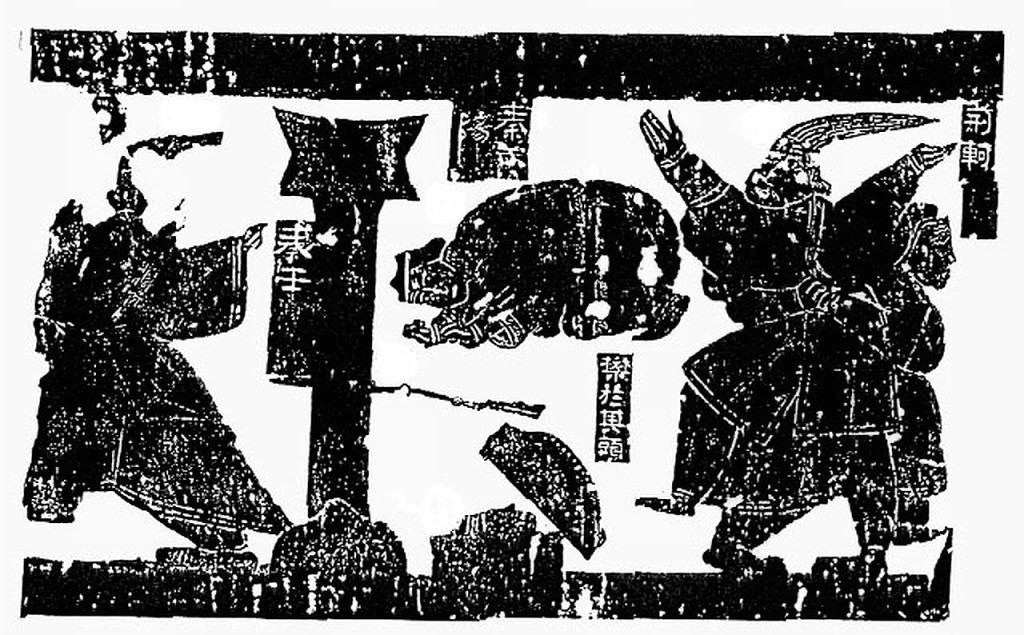
    The Assassination of King of Qin depicted by a 3rd century artist

    The 18th year of the First Emperor(229 B.C.)

    General Wang Jian led troops from the Shangdi region, General Qiang Hui led troops from the Jingjing region, and General Yang Duanhe led troops from the Henei region. These three prongs made a coordinated attack on the kingdom of Zhao. General Li Mu and General Sima Shang led the defense of Zhao. However, Qin’s agents had bribed Guo Kai, a favorite toady of the King of Zhao, with gold. Guo Kai smeared the reputations of Li Mu and Sima Shang in front of the king, accusing them of plotting a mutiny. The King of Zhao replaced Li Mu and Sima Shang with Zhao Cong and Yan Ju, a general from Qi.

    Li Mu refused to relinquish his command and was arrested and killed by the king’s delegates. General Sima Shang was also dismissed. General Wang Jian then launched an attack, crushing the Zhao army and killing Zhao Cong. Yan Ju fled. Wang Jian laid siege to the city of Handan.

    The 19th year of the First Emperor(228 B.C.)

    In October of the winter, the capital city of Handan was breached. The King of Zhao, Zhao Qian, was captured, and all the land of Zhao was annexed by the kingdom of Qin. The King of Qin visited Handan, his birthplace, where he ordered the execution of anyone his mother’s family held a grudge against. He returned to the capital Xianyang via the cities of Taiyuan and Shangjun.

    The Empress Dowager, the King’s mother, passed away.

    General Wang Jian camped his troops in Zhongshan, overlooking the kingdom of Yan. A prince of Zhao, named Zhao Jia, led his clan of a few hundred people and fled to the commandery of Dai. He enthroned himself as King of Dai. More and more former officials of Zhao in exile joined Prince Zhao Jia, and they were reinforced by troops from the kingdom of Yan, eventually camping in Shanggu commandery.

    King You of Chu died, and his brother Mi Shi was installed as the new king. In March of spring, Hao’s half-brother Fu Chu killed him and claimed the throne for himself.

    King Jingmin of Wei died, and his son Wei Jia was installed as the new king.

    The Crown Prince of Yan, Ji Dan, harbored deep hatred for the King of Qin. Seeking advice on how to exact revenge, he consulted his tutor, Ju Wu. Ju Wu proposed allying with the three kingdoms that had split from Jin, bonding with the kingdoms of Qi and Chu in the south, and fostering good relations with the Xiongnu in the north to unite all forces against Qin. However, the prince was not satisfied, saying, “Professor’s proposal takes too much time to implement and makes my head spin. I am afraid that I cannot wait that long.”

    Soon after this conversation, a general named Fan Wuji fled from Qin to Yan to escape criminal charges. The Crown Prince Dan offered General Fan shelter. Ju Wu argued against it, saying, “As cruel and ruthless as the King of Qin is, being agitated by the kingdom of Yan is more than enough to send chills down our spines, let alone hosting General Fan. What we are doing is analogous to throwing meat on the trail of a hungry tiger. I beg Your Grace to send General Fan to Xiongnu immediately.”

    The Crown Prince replied, “General Fan had nowhere to go. He came to me at a time when I needed fighters. I wish you would think it through.”

    Ju Wu countered, “Taking risky actions to seek safety; getting into trouble to find happiness; plotting shallow gains in exchange for deep-rooted enmity; disregarding the harm to the state to earn a new personal friend—this is fanning hostility and inducing disasters.”

    The Crown Prince would not heed his advice.

    The Crown Prince of Yan learned that Jing Ke from the state of Wey was a mastermind. He sent lavish gifts and flattering letters to arrange a meeting with Jing Ke. When they met, the Crown Prince Ji Dan spoke: “Now the kingdom of Qin has already captured the King of Han. They have mobilized troops to attack the kingdom of Chu in the south and Zhao in the north. The turmoil will reach the kingdom of Yan once Zhao collapses. Yan is small and weak, and has been plagued by wars for years. How can we resist Qin‘s aggression? All the monarchs are submissive to Qin; no one dares to form a vertical alliance. I have a foolish idea. I think it would be best if we recruited a warrior to serve as an envoy to Qin and kidnap the King of Qin. The warrior would force the king to return the land he had annexed from the monarchs, as Cao Mo did to the Duke Huan of Qi in the past. Or he could assassinate the king if the first plan fails.”

    “The generals of Qin are leading troops in various areas outside the kingdom. If there were commotions back home, the leaders and rank and file would be thrown into confusion and suspicion. The monarchs could seize this opportunity to form a vertical alliance. Then we will defeat the kingdom of Qin. Please keep this in mind, Mr. Jing.”

    Jing Ke agreed. The prince invited Jing Ke to live in the best house and provided whatever he wanted. The prince paid daily visits to Jing Ke‘s house to satisfy his every desire.

    When the news arrived that Wang Jian had demolished the kingdom of Zhao, the Crown Prince of Yan was frightened and wanted to send Jing Ke on his mission. Jing Ke told him, “If I go empty-handed and no one trusts me, I won’t be able to get close to the King of Qin. I need to present the head of General Fan Wuji and the map of the Duhang region of Yan as tributes to the King of Qin. This would please him, and then I would have the chance to repay your kindness.”

    The Crown Prince of Yan hesitated, saying, “General Fan came to me when he was desperate. Dan cannot bear to harm him!”

    Jing Ke went to see Fan Wuji in private and said, “The kingdom of Qin has treated you with extreme cruelty. Your parents and families were all slaughtered or enslaved. Now, I have heard that a bounty for your head is worth a thousand caddies of gold and a fief of ten thousand families. What are you going to do?”

    Fan Wuji sobbed, “What should I do?”

    Jing Ke proposed, “If I could take your head and present it to the King of Qin, he would be happy to see me. I would grab his sleeve with my left hand and stab him in the chest with my right hand. Your revenge would be taken, and the disgrace of the assault on the kingdom of Yan would be eradicated!”

    Fan Wuji exclaimed, “That’s exactly what I have been grinding my teeth and breaking my heart over, day and night!”

    Fan Wuji then slit his throat. The Crown Prince of Yan heard the news and ran over to cry over Fan Wuji‘s body in vain. They put Fan‘s head in a case. The Crown Prince procured the sharpest dagger they could find and quenched it in a poisonous potion that would kill a man instantly if it contaminates his blood. He geared up for Jing Ke’s journey and provided him with an assistant, a warrior of Yan named Qin Wuyang. Jing Ke then went to the kingdom of Qin as an envoy from Yan.

  • Comprehensive Reflections to Aid in Governance(Part 54): Stuttering Legalist Han Fei

    Comprehensive Reflections to Aid in Governance

    By Sima Guang

    Translated By Yiming Yang

    Annals of Qin Book 1 Scroll 6 (continued)

    Word Cloud of Han Fei

    The 13th year of the First Emperor(234 B.C.)

    General Huan Yi of Qin attacked the kingdom of Zhao, defeating the Zhao army led by General Hu Zou at the city of Pingyang. One hundred thousand Zhao soldiers were beheaded, and General Hu Zou was killed. In October, during the winter, General Huan Yi launched another attack on Zhao.

    The 14th year of the First Emperor(233 B.C.)

    General Huan Yi attacked the kingdom of Zhao, killing the commander of the Zhao army and capturing the cities of Yi’an, Pingyang, and Wucheng. In response, the King of Zhao appointed General Li Mu as Grand Marshal to defend Yi’an. Li Mu routed the Qin army near the town of Feixia, forcing General Huan Yi to flee back to Qin. The King of Zhao then bestowed the title of Lord Wu’an upon General Li Mu.

    The King of Han begged to become a vassal by ceding land and offering the seal of Han to the kingdom of Qin. He sent Han Fei to pay homage to the King of Qin. Han Fei, a prince of Han, was a leading legalist in the school of crime, punishment, and theurgy. Witnessing the decline of the kingdom of Han, he wrote numerous proposals to the king, who did not take his advice. Han Fei resented that the administration did not seek and promote capable talents but instead elevated glib and superficial individuals over those who got things done. In more peaceful times, celebrities and scholars were the crowd favorites, but in times of crisis, only military men were relied upon. Thus, those who squandered resources were not those who could be counted on, and those depended upon by the state were not those nurtured by the state. Han Fei was mournful about how honest and upright servants of the state were trampled by evil and corrupt officials. As he examined the vicissitudes of the past, he composed books such as Solitary Indignation, The Five Vermins, Inner and Outer Congeries of Sayings, Collected Persuasions, and The Difficulties of Persuasion, totaling fifty-six essays and more than one hundred thousand words.

    The King of Qin heard of Han Fei’s reputation and wanted to meet him. When Han Fei arrived in Qin, he wrote a letter to the king, “Now the kingdom of Qin has territory spanning thousands of miles and claims a standing army of a million soldiers. Your competent command system and fair legal system have no match in the world. I take the liberty to see Your Majesty to present my plan to break the vertical alliance. If Your Majesty listens to me and implements my plan yet still has no successful outcomes—i.e., the vertical alliance does not collapse, the kingdom of Zhao does not capitulate, the kingdom of Han does not perish, the kingdoms of Chu and Wei are not submissive, the kingdoms of Yan and Qi are not friendly, Your Majesty does not gain hegemony, and the neighboring monarchs do not pay homage—then Your Majesty can behead me in public to warn those who give disloyal advice.”

    The king liked what he heard but did not give Han Fei an important position. Li Si, jealous of Han Fei, spoke to the king, “Han Fei is one of the princes of Han, after all. His plan to annex all the monarchs is ultimately for the benefit of Han, not Qin. That’s just human nature. Now, Your Majesty has not utilized him, making him a risk to Qin. We would be better off killing him than letting him go back.” The king agreed with Li Si and ordered prosecutors to charge Han Fei with crimes. Li Si sent his lackey to deliver poison to Han Fei in jail and ordered him to commit suicide. Han Fei wanted to appeal but had no chance to see the king. When the king regretted and pardoned him, Han Fei had already died.

    Yang Xiong commented in his book Exemplary Figures: Someone asked, ‘Han Fei wrote a book about the difficulty of persuasion. He died because of a difficult persuasion. May I ask, what makes it so ironic?’ The answer was, ‘Difficult Persuasion was the cause of his death.’ The person asked, ‘Why was that?’ The answer was, ‘A gentleman follows propriety when he moves forward and stops when he crosses ethical boundaries. He goes all in if propriety is adhered; he backs off if it is not. He does not stress about whether the person he lobbies agrees with him. When you persuade someone while being bothered about whether they agree with you, you are likely to push too far.’ The question was, ‘Han Fei worried about the person’s consent. What was wrong with that?’ The answer was, ‘One should be concerned with whether the lobbying is done the right way; it should not be about whether the ideas are agreed upon.’

    Sima Guang’s commentary: I have learned that a gentleman cares for his kindred and then extends that care to others; he loves his country and then extends that love to other countries. Such people can achieve their goals and earn their fame, thus enjoying their lives. Han Fei was doing the King of Qin’s bidding to fulfill his political ambition. His crime warranted more than the death penalty, so why would anyone feel pity for him? 

    The 15th year of the First Emperor(232 B.C.)

    The King of Qin launched a large military campaign against the kingdom of Zhao. One prong reached the city of Ye, while the other prong reached the city of Taiyuan, took the county of Langmeng, and continued to a place Fanwu. There, they encountered the defense led by General Li Mu. The Qin army was clobbered and forced to retreat.

    The Crown Prince of Yan, named Ji Dan, had previously been a hostage in the kingdom of Zhao and was a friend of the King of Qin. When the King of Qin was inaugurated, Crown Prince Dan came to Qin as a hostage again. However, the King of Qin was heedless of him, causing Crown Prince Dan to become outraged and flee from the kingdom of Qin.

    The 16th year of the First Emperor(231 B.C.)

    The kingdom of Han offered the city of Nanyang to Qin. In the fall, during September, the King of Qin called up soldiers to take over Nanyang from Han.

    The kingdom of Wei submitted their land as tribute to Qin.

    In the Dai commandery in the kingdom of Zhao, an earthquake struck. The affected areas extended from the town of Lexu in the west, to Pingyin in the north. Most of the buildings and walls collapsed, and a crack in the ground appeared, stretching as wide as one hundred and thirty yards from east to west.

    The 17th year of the First Emperor(230 B.C.)

    Interior Minister of Qin, Sheng, led a campaign that exterminated the kingdom of Han. The King of Han, Han An, was captured, and the prefecture of Yingchuan was established on the land of the Han.

    Empress Dowager Huayang died.

    A great famine spread in the kingdom of Zhao.

    Lord Yuan of Wey died, and his son Jiao was installed in his place.

  • Comprehensive Reflections to Aid in Governance(Part 53): Migrant Worker Li Si

    Comprehensive Reflections to Aid in Governance

    By Sima Guang

    Translated By Yiming Yang

    Annals of Qin Book 1 Scroll 6 (continued)

    An inscription by Li Si

    The 10th year of the First Emperor(237 B.C.)

    In October, during the winter, Marquis Wenxin was dismissed from his position as Chancellor and left for his fief town. 

    The imperial clans and court officials proposed: “All the foreigners from other kingdoms who came to our state for employment are agents lobbying or spying for their lords. Please deport all of them from our country.” The king promulgated a decree for a broad search and deportation of all foreigners. An official named Li Si, hailed from the kingdom of Chu, was on the list to be deported. On his way out, he submitted a plea to the king:

    “When Duke Mu of Qin sought talents, he acquired You Yu from Tribe Rong in the west. From the east, he recruited Baili Xi from Wan, a city in the kingdom of Chu. He welcomed Jian Shu from the state of Song and invited Pi Bao and Gongsun Zhi from the kingdom of Jin. These talents enabled the kingdom of Qin to annex around twenty states and dominate the western frontier. Duke Xiao of Qin adopted the laws proposed by Shang Yang, causing other monarchs to bow down to the kingdom of Qin. King Hui of Qin utilized the strategy of Zhang Yi to dismantle the vertical alliance of six kingdoms, making them concede to Qin. King Zhaoxiang of Qin strengthened the power of the Royal Court and weakened private enterprises. These achievements were made possible with the help of these four foreigners. From this perspective, what harm has been done by these guest workers?”

    “Beautiful women, music, pearls, and jade that are not produced in the kingdom of Qin, did not prevent them being collected and enjoyed by Your Majesty. Guest workers are treated differently. People are deported simply because they are foreigners, regardless of their qualifications and character. This policy prioritizes the appeal of beauty, music, pearls, and jade over men. I have learned that Mount Tai becomes great because it does not reject any soil; the Yellow River and oceans become deep because they do not reject any trickle. A lord demonstrates his kindness by not rejecting ordinary people. That is why the three Sovereigns and five Emperors in history were unmatched. Now, Your Majesty abandons immigrants to enemy kingdoms and repels guest workers to other monarchs. This amounts to providing supply for invaders and gifting grain to burglars.”

    The king called Li Si back, reinstated him as a top official, and rescinded the deportation decree. Li Si had already traveled to the town of Liyi and returned to the capital. Eventually, the king adopted Li Si’s proposal. He sent orators carrying gold and jade to lobby other monarchs. Those nobles who accepted the bribes were bought off, and those elites who declined the bribes were assassinated. Sowing discord among the lords and their ministers, followed by armed invasions led by generals with excellent records, led the king of Qin to unify the country within a few years.

    The 11th year of the First Emperor(236 B.C.)

    The army of Zhao attacked the kingdom of Yan and captured the cities of Li and Yangcheng. Before the war concluded, the army of Qin, led by generals Wang Jian, Huan Yi, and Yang Duanhe, raided the kingdom of Zhao. They attacked the city of Ye and seized nine towns. Specifically, Wang Jian captured the cities of Yuyu and Liaoyang, while Huan Yi took the cities of Ye and Anyang.

    King Daoxiang of Zhao died, and his son Zhao Qian succeeded him as King Youmiu of Zhao. His mother, a prostitute, had bewitched King Daoxiang of Zhao, leading him to install Zhao Qian as the crown prince, replacing his eldest son Zhao Jia. Prince Zhao Qian had a poor reputation for his misconduct in the kingdom.

    Marquis Wenxin had been in his fiefdom for about a year. Envoys and admirers from other monarchs tripped over each other on visiting him, all inviting him to their states. The king of Qin feared potential unrest and wrote a letter to Marquis Wenxin: “What achievements did you accomplish for the kingdom of Qin to justify a fief of one hundred thousand households and being the lord of Henan city? What lineage do you have to the court to deserve the appellation of The Uncle? Take your family to Shu!”

    Marquis Wenxin realized his fate was doomed and was terrified of his impending execution.

    The 12th year of the First Emperor(235 B.C.)

    Marquis Wenxin committed suicide by drinking a toxic potion, and his family buried him quietly. His minions who had participated in the funeral were driven into exile. The king declared, “From now on, the possessions of ministers who commit indecency, such as Lao Ai and Lü Buwei, will be confiscated. This sets the precedent.”

    Yang Xiong commented in his book “Exemplary Figures”:  Someone asked, ‘Was Lü Buwei wise, as he traded people like merchandise?’ The answer was, ‘Who said Lü Buwei was a wise man? He traded his family’s life for a fiefdom. A burglar like Lü Buwei is merely a master gopher. I have seen a gopher get away with a hundred kilograms of grain, but I have never seen a gopher steal a city like Luoyang.’

    There was no rainfall from June to August in the kingdom of Qin

    The king of Qin mobilized the armed forces from four commanderies to aid the kingdom of Wei in a raid against Chu.

  • Comprehensive Reflections to Aid in Governance(Part 52): The Fall of Lord Chunshen

    Comprehensive Reflections to Aid in Governance

    By Sima Guang

    Translated By Yiming Yang

    Annals of Qin Book 1 Scroll 6 (continued)

    Four Lords of the Waring States

    The 9th year of the First Emperor(238 B.C. continued)

    King Kaolie of Chu did not have a son, which worried Lord Chunshen. He selected many women to bear a son for the king, but to no avail. A man named Li Yuan from the kingdom of Zhao took his younger sister to the kingdom of Chu, hoping to present her to the king. Upon hearing that the king had difficulties fathering a son, Li Yuan changed his plan. He knew his sister would fall out of favor if she couldn’t bear a son for the king. He applied to be an attendant to Lord Chunshen and was employed. He took leave to go home and intentionally returned later than the preset date.

    When Lord Chunshen asked about his late return, Li Yuan said, “The king of Qi sent an envoy to marry my younger sister. I dined with the envoy and got drunk. That’s why I was late returning.” Lord Chunshen, interested, asked, “Have they engaged yet?” Li Yuan replied, “Not yet.” Lord Chunshen then took the woman to be his concubine, and she became pregnant.

    Li Yuan instructed his younger sister to influence Lord Chunshen: “The king favors you and relies on you more than he does his own brothers. You have been the prime minister of Chu for twenty years, and the king still does not have a son. When the king passes away, his brother will succeed him. His brothers all have their own favorites and will promote them instead. How can you maintain your influence? Not only that, you have been in power for a long time and have offended the king’s brothers at times. If one of them becomes the king, you would be in big trouble. Now I am pregnant, but nobody knows. If you present me to the king, he will accept me out of respect for you. If I bear a son, he could become the future king. Then the whole kingdom of Chu would be yours. Compared to the uncertain future of his brother becoming king, which option is better?”

    Lord Chunshen loved the idea. He moved Li Yuan’s sister to a well-protected residence and recommended her to the king. The king of Chu summoned her, and they consummated their relationship. Soon she gave birth to a son, who was designated the crown prince.

    Li Yuan’s sister became the queen, and Li Yuan was elevated to royal status, gaining significant power. Fearing that Lord Chunshen might reveal their plot, Li Yuan secretly hired assassins to silence him permanently. However, many people in the country were aware of what he was doing.

    When the king of Chu fell ill, Zhu Ying went to speak with Lord Chunshen: “There are unexpected felicities; there are also unexpected disasters. You are living in an unpredictable world and serving an unpredictable lord. How could you be without an unexpected helper?”

    Lord Chunshen asked, “What do you mean by unexpected felicities?”

    Zhu Ying answered, “You have been the Chancellor of the kingdom for more than twenty years. Your position is the Chancellor, but you essentially act as the king. The king is sick and could pass away at any time. You would be the regent for a young king and in charge of the kingdom. As the king grows up, you can return power to him. Otherwise, you may take the throne yourself. That’s what I mean by unexpected felicities.”

    Lord Chunshen followed up, “What do you mean by unexpected disasters?”

    Zhu Ying continued, “Li Yuan does not manage the government, yet he sees you as his antagonist. He does not manage military affairs, yet he has hired assassins. When the king passes away, Li Yuan will usurp power and kill you to execute his plot. That’s what I mean by unexpected disasters.”

    Lord Chunshen kept asking, “What do you mean by an unexpected helper?”

    Zhu Ying replied, “You should appoint me as the king’s guard. When the king passes away, Li Yuan will be the first to enter the court. I will take him out first. That’s what I mean by an unexpected helper.”

    Lord Chunshen said, “Leave this to me. Li Yuan is a wimpy person. I have treated him well. Why would he do this to me?”

    Fearing for his life, Zhu Ying ran away as he saw that Lord Chunshen did not heed his advice. Seventeen days later, the king died. As expected, Li Yuan was the first to enter the court. He had hidden assassins inside the palace gate. When Lord Chunshen arrived, he was stabbed to death, and his head was thrown outside the palace gate. Li Yuan then ordered the arrest and execution of Lord Chunshen‘s entire family. The crown prince, whose name was Han, was installed as King You of Chu.

    Yang Xiong commented in his book Exemplary Figures: “Someone asked, ‘Lord Xinling, Lord Pingyuan, Lord Mengchang, and Lord Chunshen, were they beneficial for their states?’ The answer is, ‘The monarch mishandled his government, and the treacherous court officials usurped the power of the state. What benefits did they bring to their states?’”

    The king of Qin could not bear the idea of killing Marquis Wenxin because of his merits in helping his father ascend to the throne.

  • Comprehensive Reflections to Aid in Governance(Part 51): Insurgence at Qinian Palace

    Comprehensive Reflections to Aid in Governance

    By Sima Guang

    Translated By Yiming Yang

    Annals of Qin Book 1 Scroll 6 (continued)

    Eave Tile of Qinian Palace

    The 4th year of the First Emperor(243 B.C.)

    General Meng Ao attacked the Kingdom of Wei in the spring, capturing the cities of Chang and Yougui. The warfare ceased in March.

    A prince of Qin, who had been held hostage in the Kingdom of Zhao, returned home. Conversely, the prince of Zhao, who was in Qin, also returned home.

    In the fall, widespread locust plagues and epidemics afflicted the Kingdom of Qin. The king decreed that those who contributed more than fifty thousand kilograms of grain would be appointed as local officials.

    King Anxi of Wei died, and his son Wei Wu succeeded him as King Jingmin of Wei.

    The 5th year of the First Emperor(242 B.C.)

    General Meng Ao attacked the Kingdom of Wei and captured about thirty towns, including Suanzao, Yan, Changping, Yongqiu, and Shanyang. He established the East Prefecture for the first time.

    In earlier days, Ju Xin had a good friend named Pang Nuan when they lived in the Kingdom of Zhao. Later, Ju Xin became an official in the Kingdom of Yan. The King of Yan wanted to exploit the exhaustion of Zhao, which had been tormented by Qin numerous times. General Pang Nuan was in command after General Lian Po left. The King of Yan consulted Ju Xin on the matter. Ju Xin replied, “Pang Nuan is easy to deal with.” The King of Yan appointed Ju Xin as the commander to attack Zhao. General Pang Nuan led the defense of Zhao, killed Ju Xin, and captured twenty thousand Yan soldiers.

    The monarchs were troubled by the relentless assaults from the Kingdom of Qin.

    The 6th year of the First Emperor(241 B.C.)

    The kingdoms of Chu, Zhao, Wei, Han, Yan, and Wey formed a vertical alliance against the Kingdom of Qin. The King of Chu served as the chief, with Lord Chunshen actually in charge. The allied troops took the city of Shouling and reached the foot of Hangu Pass. The Qin army emerged from the pass and trounced the allied troops. The King of Chu blamed the defeat on Lord Chunshen, causing a distance between them growing.

    Zhu Ying, a person from the region of Guanjin, observed to Lord Chunshen, “People think that the Kingdom of Chu was a powerful state and became enfeebled under your watch. I don’t think so. Qin was friendly to Chu under the former king’s rule. Why had Qin not attacked Chu for twenty years? The Qin troops would be encumbered if they had to get through Mengai Pass; they would be prohibited from passing between the states of East and West Zhou, exposing their back to Han and Wei while fighting Chu. Now the situation is different. Wei is on the brink of collapse and cannot take care of their cities of Xu and Yanling. Once Wei yields these two cities to Qin, the Qin troops will be only one hundred sixty miles from the Chu capital, Chen. Then all I foresee is daily grinding struggles between Qin and Chu.”

    The Kingdom of Chu moved its capital from Chen to Shouchun, renaming Shouchun to Ying. Lord Chunshen returned to his fief, the city of Wucheng, and continued his duties as the prime minister.

    The army of Qin conquered the city of Chaoge in the Kingdom of Wei and the city of Puyang in the state of Wey. Lord Yuan of Wey relocated to the city of Yewang with his entourage and family. They defended the Henei Prefecture of Wei, utilizing the natural barrier of the mountains.

    The 7th year of the First Emperor(240 B.C.)

    The Kingdom of Qin raided the Kingdom of Wei and captured the city of Ji.

    The Queen Dowager Xia passed away.

    General Meng Ao died.

    The 8th year of the First Emperor(239 B.C.)

    The Kingdom of Wei ceded the city of Ye to the Kingdom of Zhao.

    King Huanhui of Han died, and his son Han An succeeded him.

    The 9th year of the First Emperor(238 B.C.)

    The kingdom of Qin invaded Wei and captured the cities of Yuan and Puyang.

    In April, during an unusually cold summer, some people of Qin died due to the freezing weather. The king of Qin resided in the city of Yong.

    On April 20th, the king of Qin held a coronation ceremony, during which he began to carry a sword, symbolizing his coming of age.

    General Yang Duanhe led an attack on the kingdom of Wei and captured the city of Yanshi.

    The king was enthroned when he was very young. The queen dowager often had sexual liaisons with Marquis Wenxin. As the king grew older, Marquis Wenxin became fearful of the consequences if the affair was exposed. To protect himself, he introduced one of his attendants, Lao Ai, to the queen dowager, disguised as an eunuch. The queen dowager liked Lao Ai and had two sons with him. She awarded Lao Ai the title of Marquis Changxin and granted him the city of Taiyuan as his fief. She delegated all state affairs of the kingdom to Lao Ai. Many intellectuals sought patronage or employment from Lao Ai.

    Attendants of the king who had feuds with Lao Ai disclosed that Lao Ai was not an eunuch. The king ordered officials to investigate Lao Ai. Frightened, Lao Ai stole the king’s tally to issue military commands and plotted a coup d’état by seizing the Qinian Palace, where the king was residing. The king ordered the prime minister Lord Changping, and Lord Changwen to mobilize troops to counter Lao Ai. A fight broke out in the capital city of Xianyang, and hundreds of people were beheaded. Lao Ai’s forces were crushed, and he fled. Eventually, Lao Ai was captured.

    In September, Lao Ai and his three associated clans (his father, mother, and wife) were summarily executed. Lao Ai’s confidants were quartered, and their families were all killed. Those followers of Lao Ai with lesser crimes were sentenced to exile in the state of Shu. More than four thousand families had to move. The queen dowager was relocated to the Fuyang Palace in the city of Yong, and her two sons with Lao Ai were killed. The king issued an order: “Whoever pleads on behalf of the queen dowager must be quartered, and their body piled outside the palace door.” Twenty-seven people were killed this way.

    A visitor from Qi named Mao Jiao submitted a note and appealed to the king. The king sent an usher out with a response, “Have you seen the pile of bodies outside the door?” Mao Jiao replied, “I hear there are twenty-eight mansions in the constellation system. There are currently twenty-seven bodies; I came to meet the lucky number. I am not afraid of dying.” The messenger reported what Mao Jiao said. Mao Jiao’s roommates and fellow travelers, seeing this, packed up their belongings and fled from Qin.

    The king was furious: “Who is this guy? He upset me on purpose. Go and set up a big pot to boil him alive. I would not pile him outside the door!” The king sat up with sword in hand, with a scowl on his face and spittle flying. An usher went out to let Mao Jiao in. Mao Jiao walked slowly towards the king and paid homage repeatedly. Then he began to speak: “I hear that a living person does not mind talking about death; a monarch of a state does not mind talking about the perishing of a state. Banning the talk of death would not give you extra life. Banning the talk of the perishing of a state would not make a state prevail. A wise monarch is usually eager to hear about the life or death, the survival or perishing of a state. Would Your Majesty like to hear me out?”

    The king allowed, “What do you want to say?” Mao Jiao continued, “Your Majesty has committed atrocities, did you realize that? You quartered your stepfather; you put your half-brothers in a bag and beat them to death; you put your mother under house arrest; you butchered loyal advisers. Your cruelty surpasses the tyrants in history such as Jie of Xia and Zhou of Shang. When the news is heard by the world, everyone will be disgusted by it. No one will root for the kingdom of Qin. I am really worried for Your Majesty’s wellbeing. That’s all I want to say.” Mao Jiao took off his clothes and laid down to face his death.

    The king got down from his pedestal and helped Mao Jiao to his feet: “Please stand up and put on your clothes, Professor. I will listen to your advice from now on!” The king appointed Mao Jiao as his top adviser. The king then drove his carriage to the city of Yong, with the left seat unoccupied, to welcome back the queen dowager. They mended their relationship as mother and son.

  • Comprehensive Reflections to Aid in Governance(Part 39): The Art of Persuasion

    Comprehensive Reflections to Aid in Governance

    By Sima Guang

    Translated By Yiming Yang

    Annals of Zhou Book 5 Scroll 5 (continued)

    Chu Long and Queen Dowager

    The 50th year of King Nan(265 B.C.)

    In the winter of that year, Queen Dowager Xuan of Qin passed away in October, and during the preceding autumn, Marquis Rang went into exile in his fief town of Tao in September.

    Sima Guang’s comment: Marquis Rang played a crucial role in establishing King Zhao of Qin, shielding him from potential challenges. He advocated for Bai Qi as the general, leading campaigns to the south and successfully annexing the cities of Yan and Ying. Marquis Rang also expanded Qin‘s territory eastward, reaching the border of Qi. He compelled all the Lords to submit to Qin‘s authority. The significant rise in the power of the Qin kingdom was attributed to Marquis Rang‘s dedicated efforts. While he exhibited authoritarian, arrogant, and greedy traits that eventually led to his own troubles, his discretion was not as egregious as Fan Ju portrayed. Figures like Fan Ju, whose strategies did not solely prioritize the interests of the kingdom of Qin, coveted Marquis Rang‘s position and actively sought to undermine his power. They influenced the king of Qin to sever familial ties with his mother and uncles, to whom he was indebted. In essence, Fan Ju is a treacherous individual indeed!

    The King of Qin designated Lord An‘guo as the crown prince.

    The troops of Qin conducted a raid on the kingdom of Zhao, successfully capturing three cities. The recently installed king of Zhao was young, so the Queen Dowager of Zhao was in charge. The kingdom of Zhao sought assistance from Qi. In exchange for sending troops to aid Zhao, the kingdom of Qi requested Lord Chang’an, the king’s younger brother, as indemnity. Queen Dowager of Zhao firmly rejected this condition, leading to a standoff.

    Despite Qi holding onto its troops, officials of Zhao implored Queen Dowager forcefully. In a defiant response, Queen Dowager made her stance clear: “Whoever speaks to me about making Lord Chang’an a hostage again, this old lady would spit on his face!” Despite the tension, Vice Chief Strategist Chu Long of Zhao expressed a desire to speak with Queen Dowager. The Queen Dowager granted him an audience, waiting with an unpleasant disposition. 

    Chu Long shuffled towards the Queen Dowager, apologizing for his slow pace, “I apologize, but these old feet of mine are not in the best condition, preventing me from moving quickly. Thus, I haven’t had the chance to see your majesty for quite some time. I hope you can pardon my physical limitations. Additionally, my concern for the well-being of your majesty has grown, and that’s why I humbly request the opportunity for a visit.”

    “I’ve been relying on a hand-cart to get around.”  The queen dowager sympathized.

    “Is your majesty’s appetite still good?”

    “I sustain myself on porridge.” Her hostility diminished somewhat.

    “My humble son, Shuqi, is the youngest and seemingly without much promise. However, in my old age, I still hold great affection for him. I would like to enroll him in the waiting list of the black-jacket guards to ensure the protection of your majesty. I dare to request this despite the potential offense it may cause.”

    “I grant your wish. How old is he?”

    “He is fifteen. Although young, I wish to entrust him to your majesty before I am buried deep in earth.”

    Queen Dowager, surprised by a man’s deep affection for his youngest son, pondered aloud, “Does a man also love his youngest son like that?” Chu Long asserted, “More so than a lady does,” prompting Queen Dowager to laugh and say, “Women love their sons so much more.” 

    “This old man observes that your majesty loves her princess, the Queen of Yan, more than Prince Chang’an.”

    “You are mistaken. I love Lord Chang’an just as much, if not more.”

    “Parents plan for the long-term well-being of their loved ones. When my lady sent off Queen of Yan, the old lady clung to her heels and sobbed. You were saddened because she went far away from home, and the longing persisted even after her departure. However, your prayers have consistently been along the lines of: ‘Please don’t make her come back!’ Is this because you envision her welfare in the long run, ensuring her sons and grandsons become the kings of Yan?”

    “Yes, it is.”  The Queen Dowager admitted.

    “Tracing back three generations, are there any descendants of the king of Zhao who have inherited the title of Marquis from their father and still hold that title?”

    The Queen Dowager replied, “There are none.” Chu Long went further, asking, “Not just counting the descendants of Zhao, are there any rulers who inherited marquis titles in other kingdoms?” Queen Dowager conceded, “This old lady is not aware of.”

    Chu Long concluded, “Inheriting a marquis title brings short-term trouble to the individual and, in the long run, affects the welfare of their descendants. Why is inheriting a marquis title necessarily detrimental for a king’s son? Because they hold esteemed positions without contributing to the state, receive high compensation for little effort, and possess the state’s wealth. Today, my lady bestowed upon Lord Chang’an a royal title, fertile fief land, and state treasures, yet he has made no contributions to the state. When my lady passes away, what justification can Lord Chang’an offer for his position in the kingdom of Zhao? That’s why I believe my lady is primarily concerned about Lord Chang’an current well-being, suggesting that she loves the Queen of Yan more than her son.”

    The Queen Dowager sighed and said, “Fine. You can do to him as you please.”

    Queen Dowager reluctantly consented to send Lord Chang’an to the kingdom of Qi as a hostage, accompanied by a hundred chariots. In adherence to the agreement, the kingdom of Qi sent troops to aid Zhao, and as a result, the kingdom of Qin withdrew its forces.

    Lord Anping of Qi, Tian Dan, assumed the role of a minister in Zhao. He orchestrated an invasion of the kingdom of Yan with the army of Zhao, successfully capturing the city of Zhongyang. Subsequently, he led another raid on the kingdom of Han, seizing the city of Zhuren.

    In the kingdom of Qi, King Xiang passed away, and his son Jian was appointed as the new king. As Jian was underage, the state affairs were overseen by the Queen Dowager of Qi, who had previously eloped with King Xiang and held the title of Lord Queen Dowager.

  • Comprehensive Reflections to Aid in Governance(Part 37): Fan Ju and His Strategy

    Comprehensive Reflections to Aid in Governance

    By Sima Guang

    Translated By Yiming Yang

    Annals of Zhou Book 5 Scroll 5 (continued)

    Fan Ju

    The 45th year of King Nan(270 B.C. continued)

    Marquis Rang of Qin recommended Zao, an immigrant who had risen to the position of minister in Qin, to the king of Qin. In response, the king of Qin instructed Zao to lead a raid on the kingdom of Qi. Under Zao’s leadership, Qin successfully annexed the towns of Gang and Shou, thereby expanding the fiefdom of Marquis Rang in the towns of Tao. 

    Earlier this year, Fan Ju traveled to the kingdom of Qi as the attendant of high official Xu Jia, who was an envoy from the kingdom of Wei. King Xiang of Qi, impressed by Fan Ju‘s reputation for talent in speech and debate, personally gifted him with gold, cattle, and wine. However, suspicions arose when Xu Jia believed that Fan Ju had potentially shared state secrets with the kingdom of Qi. Upon their return, Xu Jia disclosed Fan Ju‘s gifts to Wei Qi, the prime minister of Wei.

    In a fit of rage, Wei Qi severely beat Fan Ju, breaking his ribs and teeth. To escape further punishment, Fan Ju pretended to be dead. He was then wrapped in a bamboo mat and placed in an outhouse. Taking it to an extreme, Wei Qi allowed his intoxicated guests to urinate on Fan‘s body, intending to set an example for those who dared to communicate with foreign leaders.

    Seizing an opportunity, Fan Ju pleaded with a guard, promising a significant payback if he were released. The guard, in turn, persuaded Wei Qi to dispose of the supposedly lifeless body. Wei Qi, in a drunken state, approved, and Fan Ju managed to escape. Upon awakening, Wei Qi regretted his decision and sought to capture Fan Ju once again.

    Learning of the impending danger, Zheng Anping from the kingdom of Wei assisted Fan Ju in going into hiding. Fan Ju adopted the alias Zhang Lu and kept a low profile to avoid further persecution.

    Wang Ji, a court usher of Qin, visited the kingdom of Wei as an envoy. During his visit, Fan Ju approached him at night. Wang Ji concealed Fan Ju in his wagon and smuggled him back to the kingdom of Qin. Recognizing Fan Ju‘s talents, Wang Ji recommended him to the king of Qin.

    In response, the king of Qin decided to meet Fan Ju at a vacation palace. Fan Ju, in a clever ruse, pretended to enter the palace alley accidentally. When the king arrived, palace eunuchs tried to expel the intruder. Fan Ju boldly proclaimed, “There is no king in Qin. There is only the Queen and Marquis Rang!” Hearing the commotion, the king ordered his attendants to stand down and met Fan Ju privately.

    Sitting on his heels in front of Fan Ju, the king earnestly pleaded, “Professor, please give me some advice.” Fan Ju answered, “Yes, Yes, Your Grace.”, and the king repeated his request three times, receiving the same affirmative response each time. Puzzled, the king asked, “Professor, you don’t want to teach me, do you?” Fan Ju explained, “How dare I not! I am a man on the run. I don’t know your grace well. What I want to speak about concerns rectifying state affairs and may involve your grace’s close family members. I want to show my blind loyalty, but I did not know your grace’s intent. That is why I dare not reply when you asked three times. Today, I speak out, and death punishment will follow, yet I dare not evade. A man will die anyway. If my death benefits the kingdom of Qin even a little, that would be my great bequest. My only concern is that people may be silent and hesitant after my death. No one may be willing to come to the kingdom of Qin.”

    Still sitting on his heels, the king reassured Fan Ju, “What are you talking about! I met the professor today because I am dim-witted, and heaven has granted the professor to protect the temple of my ancestors. Please teach me, no matter how significant or trivial the matters are. Extend your guidance as high as the queen dowager, and as low as my subordinates. Please hold nothing back, and do not question my sincerity.”

    Fan Ju bowed down to the king, and the king reciprocated with a bow. Fan Ju began his discourse: “With a large state and as many militant soldiers as the kingdom of Qin has, dealing with other kingdoms would be like driving pitbulls into crippled rabbits. However, the kingdom of Qin has shut down the Hangu Pass and avoided sending soldiers to the east of the Xiao Mountains for the last fifteen years. This is due to Marquis Rang‘s failure to devise strategies beneficial to the kingdom and also a miscalculation on your grace’s part.”

    Intrigued, the king sat down on his heels again, expressing a desire to learn about his miscalculation. Aware of the attendants listening in the shadows, Fan Ju chose to address external affairs first before delving into internal matters. He pointed out, “Marquis Rang‘s decision to bypass the kingdoms of Han and Wei and attack the regions of Gang and Shou in the kingdom of Qi proved to be a detrimental strategy. This move mirrored the past actions of King Min of Qi, who, despite winning battles and claiming vast territories, ultimately gained no lasting benefits. The geographical constraints prevented effective occupation, leading to protracted warfare. As Qi struggled, other neighboring kingdoms took advantage, nearly destroying it.”

    Fan Ju advocated for a more prudent approach, suggesting that the kingdom of Qin focus on capturing neighboring states while fostering alliances with those more distant. Fan Ju elucidated: “Through this strategy, acquiring an inch of land translates into an additional inch for your grace, and seizing a foot of land results in another foot for your grace. Currently, the kingdoms of Han and Wei hold a pivotal position within the realm, serving as the axis of the world. If your grace aspires to achieve hegemony, it is imperative to gain control over this axis. The kingdom of Qin, through its military prowess, exerts dominance over the kingdoms of Chu and Zhao. In our tactical approach, we align ourselves with the kingdom of Zhao when Chu is stronger, and vice versa. When both Chu and Zhao align with us, the kingdom of Qi becomes intimidated. Aligning with the kingdom of Qi, on the other hand, facilitates the capture of the kingdoms of Han and Wei.”

    The King of Qin commended Fan Ju’s insights, lauding it as an excellent discourse. Acknowledging his strategic acumen, the king honored Fan Ju by appointing him as a visiting minister, assigning him the responsibility of providing counsel on all matters pertaining to warfare.

  • Comprehensive Reflections to Aid in Governance(Part 36): Lord Mafu

    Comprehensive Reflections to Aid in Governance

    By Sima Guang

    Translated By Yiming Yang

    Annals of Zhou Book 5 Scroll 5

    Duration of 17 years

    Zhao She

    The 43rd year of King Nan(272 B.C.)

    The kingdom of Chu dispatched Crown Prince Mi Wan to the kingdom of Qin as a hostage as part of their pledge. Accompanying the crown prince was Huang Xie, serving as the state counselor of Chu and assisting the prince in his diplomatic role.

    Meanwhile, the kingdom of Qin established the office of Nanyang commandery.

    The kingdoms of Han, Qin, Wei, and Chu joined forces in a war against the kingdom of Yan.

    King Hui of Yan passed away. His son ascended to the throne, becoming King Wu’cheng of Yan

    The 44th year of King Nan(271 B.C.)

    Lin Xiangru of the kingdom of Zhao initiated a campaign against the kingdom of Qi, and the invading forces advanced as far as the city of Pingyi.

    Zhao She held the position of minister of the department of agriculture and was responsible for tax collection in the kingdom of Zhao. However, the family of Lord Ping’yuan refused to pay taxes, leading to a confrontation. In response, Zhao She enforced the law and imposed the death penalty on nine attendants of Lord Pingyuan. Enraged, Lord Ping’yuan sought revenge, intending to kill Zhao She.

    In a bold move, Zhao She addressed Lord Pingyuan, “Your excellency holds a position of great honor in the kingdom of Zhao. Yet, you’ve allowed your family members to shirk their responsibilities to the common good. This not only undermines the rule of law but jeopardizes the strength of our entire state. A weakened state becomes a target for external threats, and if Zhao falls, where will your excellency enjoy your wealth?”

    “Consider the respect your excellency commands in our kingdom. If your excellency upholds the law and contributes to public service, both the higher and lower classes will stand behind you without complaint. Fair treatment for all strengthens the state; it ensures that every citizen feels a part of our shared prosperity. The kingdom of Zhao‘s fortitude lies in a unified and just state.”

    “As a person of esteemed royalty, who in the world would dare to disregard your excellency’s influence? Embracing the principles of justice and public service not only secures our kingdom but also cements your excellency’s legacy as a wise and revered leader.”

    Impressed by Zhao She‘s wisdom and integrity, Lord Ping’yuan recommended Zhao She to the king of Zhao, who subsequently appointed him in charge of the kingdom’s treasury. Under Zhao She‘s leadership, taxes were lowered, leading to increased prosperity among the people and a well-stocked state treasury.    

    The 45th year of King Nan(270 B.C.)

    The kingdom of Qin launched an attack on the kingdom of Zhao, putting the city of Yuyu under siege. Seeking counsel, the King of Zhao consulted with military strategists Lian Po and Yue Sheng, asking if they could provide relief for the besieged city. Both responded, “It is far away, and the road there is narrow and treacherous. It is difficult to bring relief to them.”

    Turning to Zhao She with the same question, the king received a different perspective. Zhao She remarked, “It is far away, and the road there is narrow and treacherous. It is like two mice fighting inside their burrow. The side with courage would win.” Impressed by Zhao She‘s insight, the King of Zhao appointed him as the leader of the rescue mission.

    Zhao She halted the march when they were thirty miles away from Handan, the capital of the kingdom. He issued a decisive order: “Death to those petitioning for military strategy.” The Qin army approached the west of Wu’an city, causing vibrations in the roof tiles as they pounded drums and hollered. When a Zhao scout spoke out to rescue Wu’an, Zhao She beheaded him, commanding the troops to fortify the barracks and hold out for twenty-eight days. The Zhao army continued strengthening their barracks, and Qin sent spies to infiltrate the camp. Zhao She treated the spies well and sent them back.

    The Qin general, misinterpreting Zhao She’s slow-walking as timidness, expressed delight, believing Yuyu would soon fall. Zhao She, seizing the opportunity, ordered his troops to expedite their movement. They speed-marched to Yuyu in one day and one night, building barracks fifty miles from the city. Anticipating the Qin army’s response, Zhao She received military advice from a Zhao soldier named Xu Li. Xu Li recommended consolidating troops’ formation and confronting Qin head-on to maintain high morale. Zhao She, acknowledging the wisdom, refused to punish Xu Li when he asked to be sentenced, saying, “Wait!  The order expired after Handan.”

    Xu Li then suggested occupying the high ground of the Northern Mountain first, emphasizing the advantage of those who arrive early. Zhao She approved and deployed ten thousand soldiers to secure the high ground. The Qin troops, arriving late, were repelled from the Northern Mountain. Zhao She seized the opportunity for a full-throttle attack, defeating the Qin army. With this victory, Zhao She and his troops successfully relieved the siege of Yuyu and returned triumphantly.

    In recognition of his outstanding leadership, the king of Zhao bestowed upon Zhao She the title of Lord Mafu, elevating him to the same rank as Lian Po and Lin Xiangru. Xu Li, too, was rewarded with a promotion to the position of a brigade general.

  • Comprehensive Reflections to Aid in Governance(Part 17): Su Qin And The Vertical Alliance

    Comprehensive Reflections to Aid in Governance

    By Sima Guang

    Translated By Yiming Yang

    Annals of Zhou Book 2 Scroll 2 (continued)

    A Play on Su Qin

    The 36th year of King Xian (333 B.C. continued)

    Su Qin continued his persuasive efforts with King Xuanhui of Han: “The kingdom of Han boasts a large expanse of land, spanning nine hundred miles, and possesses hundreds of thousands of well-armed soldiers. The world’s finest bows, crossbows, and swords are all crafted right here in the state of Han. Han‘s archers are so skilled that they can leap into the air and unleash a continuous barrage of a hundred arrows. It is beyond doubt that the valor of a single Han soldier, armed with the best weaponry, can withstand the assault of a hundred adversaries.”

    “Your grace, if you yield to Qin‘s demands, they will not stop at just taking Yiyang and Chenggao as they did this year. Next year, they will seek even more territory. In the end, you will have nothing left to give. Any concession made now will only nullify the goodwill you have shown before, inviting calamity upon us. Your land is limited, while the kingdom of Qin‘s appetite is boundless. Attempting to satiate an insatiable hunger with limited resources is akin to trading grievances for misfortune. We are losing territory without putting up a fight. As the saying goes, ‘I would rather be a chick’s beak than the behind of a cow.’ It is regrettable that your wisdom, your grace, and the valor of Han‘s army are earning a reputation as the backend of a cow!” King Xuanhui of Han heeded Su Qin‘s counsel and decided not to concede to Qin‘s demands

    Su Qin continued his diplomatic efforts, this time directing his persuasive skills toward the King of Wei: “Your grace, your kingdom, although not extensive in terms of land, spans a thousand miles. It is a densely populated region filled with countless farms and residences, leaving little room for pastures. The population is so dense, and the traffic so bustling, that one might think it’s perpetually hosting armies on the move. In my humble opinion, your kingdom rivals the vastness of the kingdom of Chu.”

    “I have also come to understand the might of your armed forces: you command two hundred thousand heavily armed soldiers, two hundred thousand black-cap servicemen, two hundred thousand gladiators, and one hundred thousand auxiliary supporters. In addition, you possess six hundred chariots and five thousand cavalry.”

    “Yet, it troubles me to see that you are currently heeding advisors who advocate servility towards the Kingdom of Qin. I implore you to reconsider this stance and examine the charter of alliance provided by my lord, the King of Zhao. The charter is unequivocal: your commands are to be executed by the alliance!” King of Wei, after consideration, agreed to Su Qin‘s proposal.

    Su Qin‘s persuasive efforts extended to the King of Qi: “Your grace, the Kingdom of Qi boasts fortresses on all four borders, with territory spanning two thousand miles. It commands hundreds of thousands of well-armed soldiers and vast grain reserves. Your standing armies are well-disciplined, and five independent military forces are at your disposal in five cities. Your warriors move as swiftly as arrows, fight fiercely like thunderstorms, and retreat like showers. Even if a military conflict were to arise, the aggressors would have to clear Mount Tai, cross the Qing River, and navigate Bohai Bay.”

    “The city of Linzi alone houses seventy thousand families, and a rough estimate of three able-bodied men per family gives you two hundred and ten thousand potential fighters in Linzi alone, without counting neighboring counties. Linzi‘s people are prosperous and affluent, indulging in activities like cockfighting, dog racing, chess, and football. On Linzi‘s streets, cartwheels clash, pedestrians rub shoulders, and their sleeves brushing together could form a backdrop curtain, while wiping sweat from their brows could create a downpour.”

    “However, certain ministers who fear Qin‘s proximity dominate the strategic decisions of the states of Han and Wei because they share borders with Qin. The survival or downfall of these states can be decided within ten days of mobilizing their troops. Even if they win, they might lose half their forces and face border incursions. If they lose, their state may face defeat and collapse. This is why the states of Han and Wei tend to appease Qin and hesitate to engage in combat. Qi‘s security against a Qin invasion is entirely different. Qin invaders must traverse the lands of Han and Wei, navigate the narrow road at Yanjin (in Wei), and break through the strategic Kangfu Pass. Qin‘s chariots cannot move in combat formations, and cavalry cannot advance side by side through these passages. A hundred defenders on these bastions can thwart thousands of attackers. Qin‘s army may want to advance deep into Qi, but they must also be cautious, wary of attacks from Han and Wei from behind.”

    “It is evident that Qin does not pose an immediate threat to Qi. They resort to trickery, threats, and bluster rather than moving into combat. Those ministers who advocate submission to Qin do not fully grasp the situation, Your grace. You possess the means to safeguard your state and need not be labeled as subservient to Qin. Please consider our strategy carefully.” The King of Qi approved of Su Qin‘s counsel.

    Su Qin continued his diplomatic efforts in the southwest, addressing the King of Chu: “The Kingdom of Chu stands as a world superpower, spanning a vast territory of six thousand miles. Its army numbers one million strong, equipped with thousands of chariots and tens of thousands of horses. Its granaries hold enough grain to sustain the state for a decade, a resource that signifies dominance. To the Kingdom of Qin, Chu represents a greater threat than any other state. The strength of Chu corresponds to the weakness of Qin, and vice versa. Qin and Chu cannot coexist peacefully.”

    “To your advantage, the Kingdom of Chu should join the vertical alliance to isolate the Kingdom of Qin. I will ensure that other states east of Xiao Mountain pay tribute to you with seasonal produce, obey your orders, entrust their state affairs and heritage to you, and train their soldiers to follow your lead. Joining the vertical alliance implies that all states cede their lands and are subject to Chu, while joining the horizontal alliance implies that the Kingdom of Chu surrenders its land and is subject to Qin. The consequences of these two options are vastly different. Which one do you choose?” The King of Chu concurred with Su Qin‘s proposal.

    With Su Qin‘s successful diplomacy, he assumed the role of chief commander and prime minister for all six states of the vertical alliance. He traveled north to report to the Marquis of Zhao, accompanied by an impressive entourage equipped with chariots and well-armed guards, rivaling that of a king.

    King Wei of Qi passed away, and his son, Piqiang, ascended to the throne as King Xuan of Qi. King Xuan of Qi recognized that Marquis Cheng (Zou Ji) had wrongfully accused Tian Ji and reinstated Tian Ji to his former position.

    Duke Wen of Yan also passed away, and his son succeeded him as King Yi of Yan.

    Marquis Cheng of Wey passed away, and his son took over as Marquis Ping of Wey.

    The 37th year of King Xian (332 B.C.)

    The king Hui of Qin, in an attempt to disrupt the vertical alliance, sent Xi Shou to deceive the Kingdoms of Qi and Wei into forming a coalition against the state of Zhao. This move aimed to thwart the alliance that Su Qin had been working on. When Marquis Su of Zhao discovered this plot, he held Su Qin responsible, and Su Qin became fearful.

    To make amends, Su Qin offered to lobby the state of Yan to seek revenge for Qi‘s actions. As Su Qin left the state of Zhao, the vertical alliance fell apart. The people of Zhao breached a dam to flood the armies of Qi and Wei, forcing them to withdraw.

    In a gesture of reconciliation, the Kingdom of Wei ceded the city of Yinjin to the Kingdom of Qin. This city is now known as Huayin.

    Subsequently, the King of Qi launched a campaign against the state of Yan, capturing ten cities. However, they later returned these cities to their original owner Yan.

  • Comprehensive Reflections to Aid in Governance(Part 16): Su Qin and Zhang Yi

    Comprehensive Reflections to Aid in Governance

    By Sima Guang

    Translated By Yiming Yang

    Annals of Zhou Book 2 Scroll 2 (continued)

    The Book by Guiguzi

    The 36th year of King Xian (333 B.C.)

    The king of Chu launched an attack on the state of Qi and defeated the Qi army. He besieged Xuzhou and ordered the expulsion of Tian Ying. However, Tian Ying sent an envoy named Zhang Chou to plead with the King of Chu. After hearing Zhang Chou’s plea, King of Chu decided to halt the attack on Qi.

    The construction of the grand palace portal in the state of Han has been completed. Marquis Zhao of Han had passed away, and his son had succeeded him, assuming the title of King Xuanhui of Han.

    Earlier, Su Qin from the city of Luoyang had approached the King of Qin with a proposal for unifying China, but the King of Qin had not taken his advice seriously.

    Su Qin then decided to visit Duke Wen of Yan and presented a persuasive argument: “The reason the state of Yan has remained free from the harassment of bandits and soldiers is the protective shield provided by the state of Zhao to the south. If the state of Qin were to wage war against Yan, it would have to do so thousands of miles away from its own territory. On the other hand, if the state of Zhao were to engage in conflict with Yan, it would be doing so only hundreds of miles from its own borders. It is unwise to worry about a distant enemy while ignoring a threat much closer to home. I propose, Your Grace, that you form a marital alliance with Zhao, ultimately uniting with the state of Zhao. This way, Yan will have no more cause for concern.”

    Duke Wen of Yan recognized the wisdom in Su Qin‘s advice and not only accepted it but also facilitated his journey to the state of Zhao to pursue this alliance further.

    Su Qin employed his persuasive skills once more, this time lobbying Marquis Su of Zhao. He presented his case: “At present, there is no state stronger than Zhao. Qin considers Zhao its primary adversary but has refrained from launching an offensive due to concerns that Han and Wei may conspire against them from behind. There are no natural barriers like large mountain ranges and rivers between Qin and these two states. Qin‘s strength allows it to gradually encroach on their territory, eventually besieging their capitals. Han and Wei would then succumb to Qin‘s pressure, becoming Qin‘s vassals. If Han and Wei no longer pose a threat, the state of Zhao will be next in line.

    “As I examine the map of the realm, I see that the combined land area of all the other states is five times greater than that of Qin. It is estimated that these states possess ten times as many soldiers as Qin. If the six major states unite and launch a westward offensive against Qin, Qin will be overpowered.  There are consultants who will attempt to encourage other states to dole out territories to appease Qin‘s threat. They will be rich and famous if Qin gets its wish. They will not concern themselves with the danger Qin poses to their states. This is why you are seeing these lobbyists constantly urging you to cede land to pacify Qin.

    “Therefore, I implore you, your grace, to scrutinize their proposals. If I may offer a plan, it would be to unite the six states—Han, Wei, Qi, Chu, Yan, and Zhao—through marriage alliances to resist Qin‘s aggression. We can invite ministers and generals from all six states to a conference near the Huan River, forming an alliance by exchanging hostages as a guarantee. Our alliance charter will state: ‘All states shall send their finest soldiers to aid any state attacked by Qin or to retaliate against Qin. Any state violating this charter will face collective retaliation from the other five states.’ With all six states united against Qin, Qin‘s armored divisions will not dare to venture out of the Hangu Pass to threaten the states east of Xiao mountain.”

    Marquis Su of Zhao was greatly impressed by Su Qin‘s wisdom and appreciated his advice. He treated Su Qin with great honor, bestowing him with gifts and rewards, and entrusted him as his envoy to negotiate with the leaders of the other states.

    During this period, the army of Qin, under the leadership of Xi Shou [Gongsun Yan], launched a military campaign against the state of Wei. They defeated the Wei army of forty thousand troops, captured the Wei general Long Gu, and seized the city of Diaoyin. With the Qin army poised to advance further eastward, Su Qin became increasingly concerned that they would reach the state of Zhao before he could establish the alliance. He couldn’t think of anyone in Qin who would be willing to collaborate with him.

    In an act of chicanery, Su Qin deliberately angered his friend Zhang Yi, who was also a student of Master Guigu and had expertise in political strategy. Su Qin believed that Zhang Yi was more skilled than himself in this art. Zhang Yi had been traveling among various states trying to garner support for their cause but had found few willing listeners. He became stranded in the state of Chu.

    Su Qin summoned Zhang Yi to the state of Zhao and personally insulted him. This mistreatment infuriated Zhang Yi, who realized that only the state of Qin had the potential to pose a significant threat to Zhao. Consequently, he decided to travel westward to Qin, with the intention of aiding them in their campaign against the eastern states.

    Su Qin acted covertly by sending his servant along with Zhang Yi, providing him with gold coins for his journey. Zhang Yi used these resources to bribe his way into an audience with the King of Qin. The King was impressed with Zhang Yi‘s persuasive abilities and appointed him as an advisor.After successfully gaining the King of Qin’s favor, Zhang Yi’s servant bid him farewell and explained Su Qin‘s strategy. Su Qin had intentionally provoked Zhang Yi and then arranged for him to travel to Qin. This was all part of Su Qin‘s plan to ensure Zhang Yi could wield influence in Qin, preventing a Qin invasion of Zhao and preserving the alliance. Zhang Yi was deeply impressed by Su Qin‘s strategic acumen: ”Alas! This is my specialty and I did not even realize what happened!  It is obvious that Mr. Su is a superior strategist.  Please convey my gratitude to Mr. Su.  As long as he is in charge, Zhang Yi won’t interfere with his plan.”