Comprehensive Reflections to Aid in Governance
By Sima Guang
Translated By Yiming Yang
Annals of Qin Book 2 Scroll 7 (continued)

The 27th year of the First Emperor(220 B.C.)
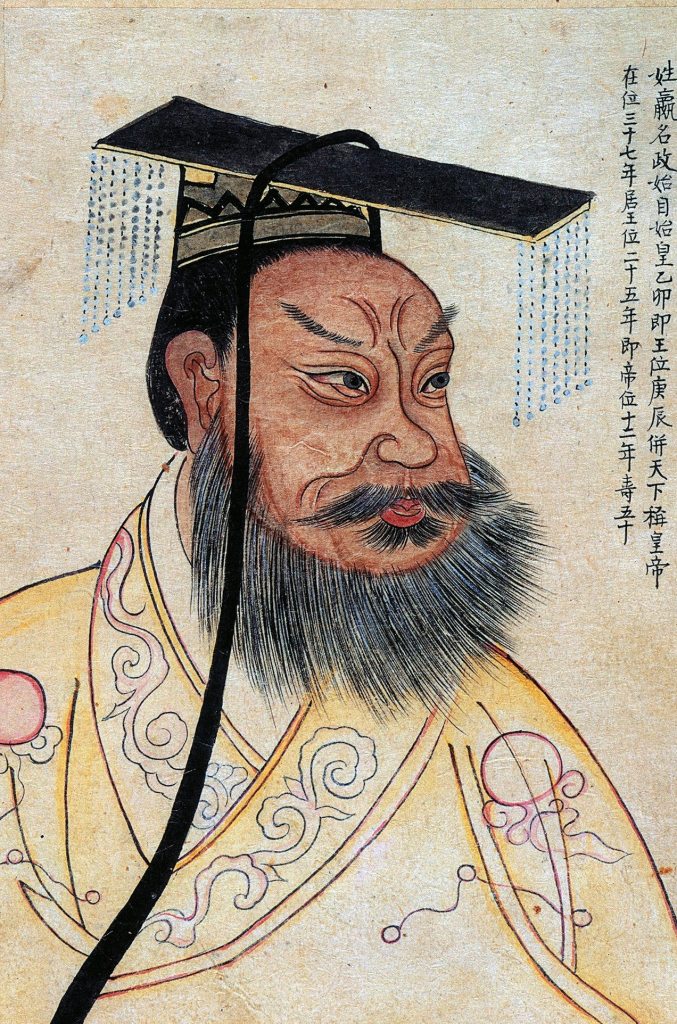
The First Emperor toured the region of Longxi and Beidi commandery, reaching Mount Jitou and then back home passing the Huizhong Palace.
Changxin Palace was built on the south bank of Wei River. It was renamed as the Supreme Temple once it was finished construction. A road was made from the Supreme Temple to the Lishan Mausoleum. The Front Hall of the Ganquan Palace had been built. A corridor was built leading it to Xianyang. Expressways reserved for the emperor were built from Xianyang to the other parts of the country.
The 28th year of the First Emperor(219 B.C.)
The First Emperor toured the commanderies and counties of the east. He ascended Mount Yi in Zou county and erected a monument extolling his achievements. At the foot of Mount Tai, he summoned seventy Confucianists from the state of Lu to discuss a sacrificial ceremony for heaven(Feng) and earth(Shan). Some Confucianists suggested: “In the ancient way of ceremony, the wheels of wagons must be wrapped with sedge grass to avoid squashing the dirt, rocks, trees, and grass of the mountain. Sacrificing for the earth involves sweeping the ground, then covering it with mats made of straw and stalks.” Other Confucianists proposed different, equally impractical ideas. From that moment, the First Emperor despised the Confucianists, finding their advice difficult to implement. He ordered the road to be widened for wagons. He reached the top of Mount Tai from the sunny side, erected monuments to laud his virtues, then descended from the shady side and sacrificed for the earth at a small peak named Mount Liangfu. The liturgy of the ceremonies adhered to those used by the worship ministers of Qin when they conducted ceremonies for God in progenitor temples at Yong. These rites were kept secret, and none could be recorded.
From there, the First Emperor traveled east and cruised the coastal area. He paid homage to numerous temples, famous mountains, and rivers, and honored the eight gods: Heaven, Earth, Soldier, Yin, Yang, Month, Day, and the Four Seasons. The First Emperor then journeyed south and ascended to the top of Langya Terrace. Delighted with the location, he stayed in the commandery for three months. A palace named Langya was built there, and another stone monument was erected to express his satisfaction.
Song Wuji and Xianmen Zigao from the kingdom of Yan claimed they had learned the way to immortality and sublime into celestial beings. Many gullible and eccentric scholars followed them enthusiastically, propagating their teachings. Kings, from King Wei and King Xuan of Qi to King Zhao of Yan, became believers and sent people to search for three fairy islands—Penglai, Fangzhang, and Yingzhou—in the Bohai Sea. According to myths, these islands were not far from the human world, but magical winds would blow ships away as they approached. A few fortunate people who reached the islands reported that fairies lived there and that they possessed elixirs for immortality.
When the First Emperor toured the coast, sorcerers from the kingdom of Qi, including one named Xu Fu, vied for his favor by submitting a proposal. Xu Fu petitioned to lead a group of virgin boys and girls to search for the fairy islands after a period of fasting. The First Emperor approved, and Xu Fu selected several thousand boys and girls to seek fairies in the ocean. However, their ships were blown back by inauspicious winds. They reported, “We could not reach them, yet we could see them.”
The First Emperor was on his way back to Xianyang when he passed through Pengcheng commandery. There, he held a worship ritual in a temple after a period of fasting. He sought to recover a caldron from the Zhou dynasty that had sunk in the Si River, by ordering a thousand people to dive into the river, but they found nothing.
He then headed southwest, clearing the Huai River, and reached Mount Heng and Nanjun commandery. His entourage sailed downstream on the Yangtze River and arrived at a temple on Mount Xiang. They encountered strong winds that nearly wrecked their ship. The First Emperor asked the scholar accompanying him, “What kind of goddess is Madame Xiang?” The scholar replied, “I heard she was the daughter of Emperor Yao and married Emperor Shun. She was buried here.”
In a rage, the First Emperor ordered three thousand prisoners to hack down all the trees on Mount Xiang, leaving the mountain bare and exposing its dark red soil. The First Emperor then left Nanjun and returned to Xianyang through the Wu Pass.
Zhang Liang was from the kingdom of Han. His father and grandfather, up to five generations, had been prime ministers of Han. After the kingdom of Han perished, Zhang Liang devoted all his assets, amounting to a thousand catties of gold, to avenging the fall of Han.
The 29th year of the First Emperor(218 B.C.)
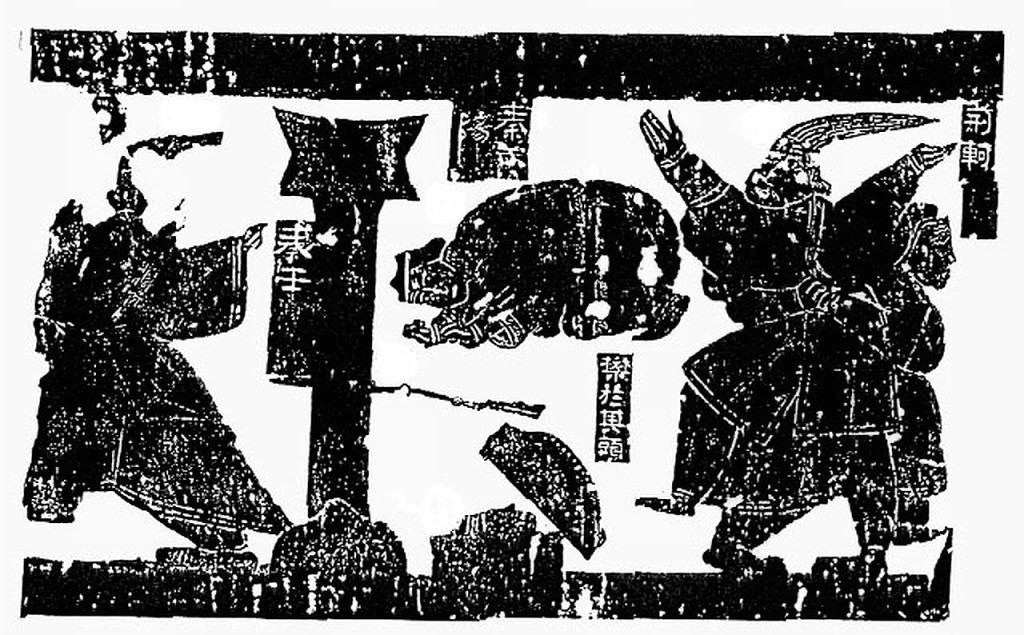
The First Emperor toured the eastern regions and passed through Yangwu county. Zhang Liang hired a hitman to ambush him with an iron mallet at a place called Bolangsha. The mallet, thrown at the emperor, struck one of his escorting wagons in the cavalcade. The emperor was frightened and ordered his guards to search for the perpetrators, but they did not catch anyone. He then commanded a nationwide manhunt for ten days.
The First Emperor ascended Mount Zhifu and inscribed his achievements on the rocks there. He then traveled to Langya Commandery before returning to Xianyang via Shangdang Commandery.
The 31st year of the First Emperor(216 B.C.)
The First Emperor decreed that all plebeians in the country report their properties and acreage.
The 32nd year of the First Emperor(215 B.C.)
The First Emperor visited Mount Jieshi. He sent a Daoist named Lu to pay a visit to Xianmen Zigao from the kingdom of Yan, a hermit reputed to know the secret of becoming a celestial being. The emperor made an inscription on the gate of Jieshi. He decreed that the walls of castles be broken down, and levees, dikes, and dams be flattened or breached. The First Emperor then surveyed the northern borders and returned via Shangjun commandery.
Daoist Scholar Lu returned from his visit to Xianmen Zigao overseas and submitted a report to the emperor titled “Record Map Book.” In the book, there was an ominous prophecy: “It is Hu who causes the kingdom of Qin to perish.” Hu was the derogatory name people gave to the Xiongnu in the north. The First Emperor ordered General Meng Tian to lead a 300,000-strong army to conquer Xiongnu in the north.
The 33rd year of the First Emperor(214 B.C.)
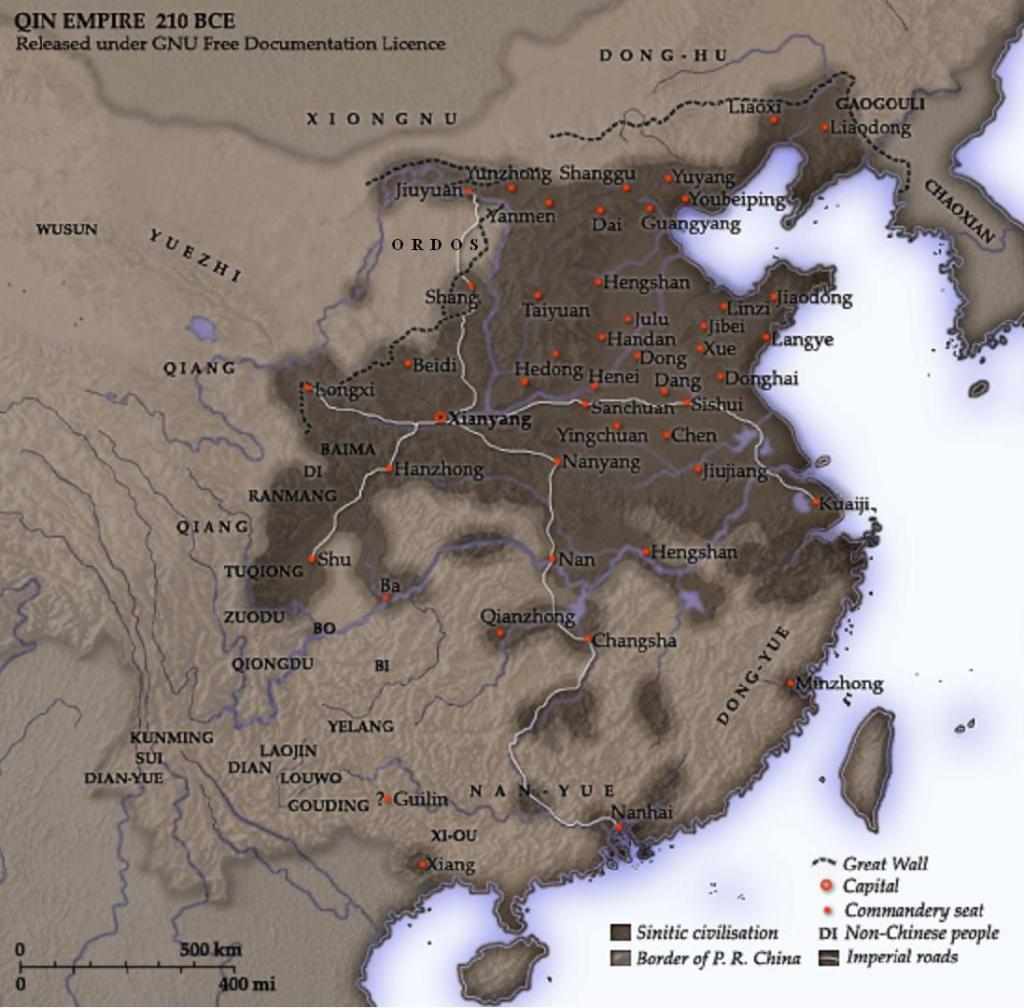
The First Emperor decreed conscription for men who were former fugitives, son-in-laws living in their wives’ houses, and merchants to join the army. This army conquered the rolling hills of the state of Southern Yue, establishing commanderies such as Guiling, Nanhai, and Xiang. Five hundred thousand disgraced and punished individuals were relocated to the Five Hills region to guard the southern border, where they cohabitated with the local population.
General Meng Tian chased Xiongnu away and recovered a swath of land south of the Yellow River, establishing forty-four counties in this area. The Great Wall of China was built according to the geographic features, with fortresses constructed to control the strategic passes along the northern borders. Extending tens of thousands of miles from Lintao County to Liaodong Commandery, the Great Wall marked a formidable boundary. Meng Tian led his army across the Yellow River and occupied Mount Yangshan, zigzagging northwards. His troops were deployed on the frontier for more than ten years. For years, General Meng Tian stationed at Shangjun and governed the northern frontier, his fame serving as a deterrent to Xiongnu.


 Reflection by Rio Grande