Comprehensive Reflections to Aid in Governance
By Sima Guang
Translated By Yiming Yang
Annals of Han Book 1 Scroll 9 (continued)

The 2nd year of Emperor Gaozu(205 B.C. continued)
Tian Heng launched an attack on Tian Jia, the King of Qi appointed by Xiang Yu, forcing Tian Jia to flee to the Kingdom of Chu, where he was eventually killed. Tian Heng then unified the three regions that made up the Kingdom of Qi, bringing them all under his rule.
The King of Han consulted with his ministers, saying, “I want to step down from leading the campaign to conquer the lands east of Hangu Pass. I wish to pass on the leadership to a few capable leaders and let them conquer on their own. To whom should I hand over this responsibility?” Zhang Liang recommended the candidates: “The King of Jiujiang, Ying Bu, is an outstanding general of Chu, but he does not see eye to eye with Xiang Yu. General Peng Yue, in collaboration with the Kingdom of Qi, is reclaiming the land of Liang (Wei). These two can immediately share the burden. Among the generals under your command, only Han Xin has the ability to take on this significant task and operate independently. If Your Majesty truly wants to step down, passing the leadership to these three generals will lead to the defeat of the Kingdom of Chu.”
Earlier, King Xiang Yu had requested troops from the Kingdom of Jiujiang for his attack on the Kingdom of Qi, The King of Jiujiang, Ying Bu, took a leave of absence and sent only one of his generals with a few thousand troops. Later, when the King of Han broke into Pengcheng, Ying Bu claimed to be ill again and did not assist in defending the Kingdom of Chu. King Xiang Yu was displeased with Ying Bu‘s actions, sending numerous messengers to reprimand him and summon him to his headquarters. Ying Bu, growing even more fearful, did not dare to comply.
At the time, King Xiang Yu‘s primary concerns were the Kingdoms of Qi and Zhao in the north and the Kingdom of Han in the west. Despite his frustration with Ying Bu, Xiang Yu valued Ying Bu‘s military prowess and knew that the King of Jiujiang was his only ally in the region, so he refrained from attacking Ying Bu’s camp.
Meanwhile, the King of Han moved his headquarters from Xiayi county to Dang county and then to Yu county. Frustrated with his situation, he vented to his advisors, saying, “I cannot discuss the important matters of this country with men like you!” Sui He, one of his internuncios, stepped forward and asked, “I don’t understand what Your Majesty means.” The King of Han sighed and said, “Who can be my envoy to Jiujiang to persuade Ying Bu to break faith with Xiang Yu? If Ying Bu could lead his troops to support us and hold Xiang Yu in check for just a few months, I would have a hundred percent chance of winning the country!” Sui He volunteered, saying, “I would like to be the envoy.” The King of Han then sent Sui He as his representative to Jiujiang with a retinue of twenty people.
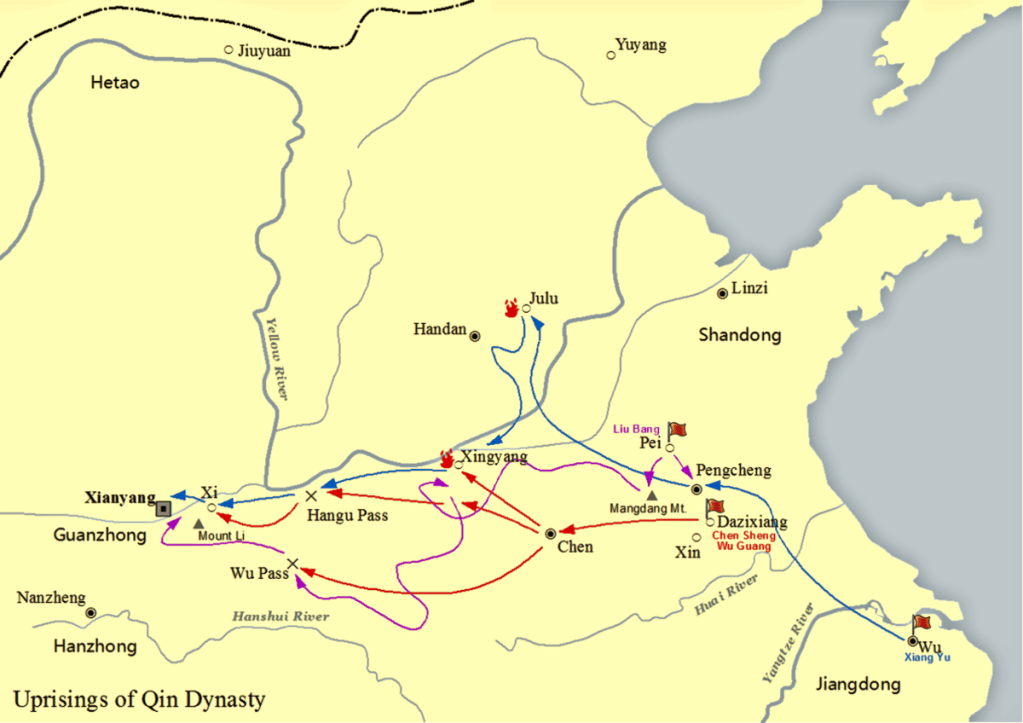
The King of Han reached the city of Xingyang in May, where several scattered and defeated troops regrouped. Xiao He also provided drafted soldiers from Guanzhong, including those who were previously unregistered because they were deemed too old or too young, all converging in Xingyang. This bolstered the strength of the Han army and greatly improved its morale.
The Chu army, having routed the Han forces in Pengcheng, pursued the fleeing Han soldiers northward all the way to Xingyang, riding the momentum of their victory. They engaged the Han army in several skirmishes in Jing County and Suo town, south of Xingyang. As more Chu cavalry joined the battle, the King of Han sought to appoint a cavalry commander from among his forces. His advisors recommended the former cavalrymen of the Qin army, Li Bi and Luo Jia, both from nearby Zhongquan County.
However, when the King of Han announced their selection, Li Bi and Luo Jia declined, saying, “We might not have the full trust of the Han soldiers because we were once subjects of Qin. We would prefer to support a leader who is both close to Your Majesty and a skilled horseman.” In response, the King of Han appointed Guan Ying as the cavalry commander, with Li Bi and Luo Jia as the Colonel of the left and right wings.
This newly appointed cavalry force, led by Guan Ying, engaged the Chu horsemen and won a decisive battle to the east of Xingyang. After this victory, the Chu army never advanced west of Xingyang again. The King of Han then set up camp in Xingyang and constructed an express highway from Xingyang to the crossing of the Yellow River, enabling the rapid delivery of grain from his warehouses in Ao’cang.
Zhou Bo and Guan Ying approached the King of Han, expressing their concerns: “Although Chen Ping is a very handsome fellow, his character is questionable. We’ve heard that he had an affair with his sister-in-law when he was still at home. He worked for the Kingdom of Wei and did not do well there. He then went to the Kingdom of Chu and failed to succeed there as well. Now, he has come to serve the Kingdom of Han. Your Majesty holds him in high regard and has appointed him as the supervisor of the army officers. We’ve heard that he has accepted bribes in gold, giving good positions to those who offered him more gold and bad positions to those who offered less. Chen Ping seems to be an opportunist and a corrupt official. Your Majesty must look into this!”
The King of Han became suspicious of Chen Ping and summoned Wei Wuzhi, who had recommended Chen Ping, to reproach him. Wei Wuzhi defended himself, saying, “What I spoke of was Chen Ping‘s ability, not his character. Suppose we have a person with an impeccable character like Weisheng or Xiaoji (ancient people known for honesty and filial piety), but who has no influence on winning or losing the war—why would Your Majesty employ such a person? Now, the Kingdoms of Chu and Han are in fierce contention. When I recommended Chen Ping, I did so based on his intelligence and clever ideas that could help the Kingdom of Han. His personal affairs with sister-in-law or accusations of accepting bribes do not disqualify him.”
The King of Han then called in Chen Ping and berated him: “You didn’t achieve success in the Kingdom of Wei, then you left the Kingdom of Chu, and now you are here with me. Does a loyal person change his allegiances so easily?”
Chen Ping replied, “I served the King of Wei, but he wouldn’t listen to my advice, so I left. When I worked for King Xiang Yu, he did not trust anyone whose surname was not Xiang or who wasn’t related to him by marriage. Even if he had talented individuals under his command, he wouldn’t make full use of them. I came to work for Your Majesty because I heard that you make the most use of talented people. I came with nothing and accepted donations because I had no resources. I hope Your Majesty will adopt my proposals if they are useful. If not, the money I accepted is all here, and I beg you to take it back and let me leave empty-handed.”
The King of Han apologized to Chen Ping, rewarded him with more gifts, and promoted him to the Central Commandant of army supervision, responsible for overseeing all the generals. This promotion silenced the complaints among the generals.
The King of Wei, Wei Bao, took a leave of absence to visit his mother, who was supposedly ill. Upon crossing the Yellow River, he blocked the crossing and switched his allegiance to the Kingdom of Chu.





 Reflection by Rio Grande