Category: Ancient Chinese History

  • Comprehensive Reflections to Aid in Governance(Part 47): Xunzi’s Catechism

    Comprehensive Reflections to Aid in Governance

    By Sima Guang

    Translated By Yiming Yang

    Annals of Qin Book 1 Scroll 6 (continued)

    Philosopher Xun Kuang

    The 52nd year of King Zhaoxiang(255 B.C.) (continued)

    Lord Chunshen of Chu appointed Xun Qing as the administrator of Lanling County. Xun Qing, also known as Xun Kuang, was originally from the kingdom of Zhao. He discussed warfare with Lord Linwu in front of King Cheng of Zhao. The king asked, “What are the key elements of conducting wars?”

    Lord Linwu began, “Master timing and weather from the above; knowing the terrain and geographic features from the below. Then it is watching the enemy’s movement closely: Moving after your enemy moves and reaching the destination before your enemy. These are the key elements of conducting wars.”

    Xun Kuang started his discourse, saying, “I don’t think so. From what I have learned from studying history, the key element of warfare lies in the people. If a bow and arrows are not calibrated well, even an excellent archer like Hou Yi would not be able to hit a small target. If the six horses on a chariot do not run at the same pace, even a great driver like Zao Fu would not be able to go very far. If the soldiers and people are not well organized, even a military leader like Shang Tang or King Wu of Zhou would not be able to secure victory. Therefore, a leader who is good at latching onto people is also a military commander who is good at conducting wars. That’s why the key element of warfare is uniting people.”

    Lord Linwu refuted, “That is not true. Military strategy emphasizes taking momentum and advantage; military tactic uses trickery and innovation. The masters of the art of war change pace so quickly and hide actions so well that you cannot anticipate their next move. Sun Zi and Wu Qi were so adept at this that no rival could compete with them. Who had the time uniting people?”

    Xun Kuang responded, “I disagree. What I am talking about is a troop of the benevolent; a troop with the will of their supreme leader at heart. You value trickery and taking advantage of the situation. A troop of the benevolent will not be tricked. On the other end, a troop of snobbish soldiers can be fooled; a troop of sloppy men can be fooled; a nation where the lord and its subjects are alienated can be fooled. Xia Jie may trick another man like him and get lucky depending on his craft. Jie’s trying to trick Emperor Yao is like hitting rocks with eggs or churning boiling water with your fingers. Doing so is like jumping into fire or flood—you get burned or drowned immediately. Therefore, a troop of the benevolent unites for one purpose; all groups of armies drive in the same direction. The relationship between countrymen and their monarch is equivalent to that between subordinates and their superiors: It works just like sons serving their father; like younger brothers respecting their elders; like hands and arms protecting the head and eyes and then covering the chest and belly.”  

    “A sneak attack on such a country is the same as alarming them and then attacking them. A state of the benevolent with ten miles of territory will have the awareness of a hundred miles; a state with a hundred miles of territory will have the awareness of a thousand miles; and a state with a thousand miles of territory will have the awareness of the whole world. This state will be perceptive and vigilant and fight together as one. Thus, the troop of the benevolent will be in formation when they congregate and spread out like wings when they disperse. They expand like the sharp blade of a Moye sword, cutting through anything in its path. They thrust like the tip of a Moye sword, piercing through anything in its way. When they station in a circle or square formation, they are solid as rocks. Those who ram into them will break their horns and run away.”

    “Moreover, with the tyrant rulers of violent nations, who will they reach out to? Those they reach out to must be their people. If their people regard us as close and beloved as parents, and cherish us as fragrant as pepper and orchids; As they look back at their superiors, they view them as if they were branded criminals, as if they were enemies and foes. The nature of people, even those like Jie and Zhi(the bandit), is similar. Would they willingly harm what they love and help what they hate? This is like making one’s descendants harm their own parents. They will certainly come to report to us, so how can deception be possible? Therefore, when a benevolent person governs a state, the state will become more enlightened, whereas other states will be more secure to comply with it first. Those who comply later will be in danger, those who oppose will be weakened, and those who rebel will perish.  The Book of Songs says: ‘When King Wu set forth, with a reverent grasp of the battle-ax, like a blazing fire, no one dared to stand in the way.’ This is what it means.”

    King Xiaocheng of Zhao and Lord Linwu both concurred: “Good speech! May we ask, what principles and actions make a troop of the benevolent?”

    “In general, if a ruler is wise, his country will be well-governed; if the ruler is incapable, his country will be in chaos. A country that emphasizes ritual and values righteousness will be well-governed; a country that neglects ritual and despises righteousness will be in chaos. A well-governed country is strong; a chaotic country is weak—this is the root of strength and weakness. If the upper ranks are respectable, the lower ranks can be employed effectively. If the upper ranks are not respectable, the lower ranks cannot be employed effectively. When the lower ranks can be employed effectively, the country is strong; when they cannot be employed effectively, the country is weak—this is the abiding principle of strength and weakness.”

    “A state is strong where scholars are appreciated and weak where scholars are disliked. A state is strong where the people are taken care of and weak where the monarch does not care about them. A state is strong where policies are believed in and weak where policies are not enforced. A state is strong where wars are the last resort and weak where wars are treated casually. A state is strong where executive powers are concentrated in one place and weak where executive powers come from two different places. This is the abiding principle of the strength and weakness of a state.”

    “The people of Qi overstate martial arts, a combat skill. They exchange four hundred grams of gold for every chopped head, which is not the appropriate reward for winning a war. They may get away with it when the war is small-scale and the enemy is weak. But when the war is significant and the enemy is tough, the martial artists will disperse and run away. They scatter like birds; they flip-flop in no time. They are the troops of a crashing state. There are no weaker troops than they are. They are not far from the troops you hire from a market and take to war.”

    “The valiant soldiers from the kingdom of Wei are recruited based on strict measures. Each soldier must put on full armor, operate a twelve hundred-pound crossbow, carry fifty arrows, hold a dagger-ax, wear a helmet, carry a sword at his side, and three days of food on his back. The fully loaded soldier must walk fifty li[half of a kilometer] in a day. Once a soldier passes the test and is chosen, his family is exempt from taxes and awarded land and houses. These benefits won’t be rescinded even when the soldier’s stamina diminishes from his prime. There is no recalculation of benefit. Therefore, the state would be short on revenue even with a large territory. This armed force presents a peril to the state.”

    “The elite of Qin make their people’s lives difficult and drive them with draconian rules. They force the people to fight through coercion, poverty, reward, and punishment. The people have no choice but to fight for their rulers. They reward and promote those who accomplish military feats. Those who behead five enemy soldiers rule five families back home. This is how they maintain a large and formidable army. They have been winners for four generations. That’s not luck but preordained. Therefore, the martial artists of Qi are no match for the valiant soldiers of Wei; the valiant soldiers of Wei are no match for the super warriors of Qin. The super warriors of Qin cannot resist the troops disciplined by Duke Huan of Qi and Duke Wen of Jin; the troops disciplined by Duke Huan of Qi and Duke Wen of Jin cannot resist the army of justice led by King Tang of Shang and King Wu of Zhou. If you really want to make them clash, it would be like hitting rocks with brittle wood. The armies of these states are made up of people who seek rewards and benefits, who sell their bodies for hire, not those who respect the monarch, are comfortable with the legal system, and strive for righteousness. If a monarch could nurture his army with sophistication, his army would pose a great threat to these states, by annexing them one day.”

    “That’s why all the advertising, recruiting, and selecting which highlight benefits and potentials are mere allurements. In contrast, education that teaches benevolence and righteousness aligns the people’s mindset. Using allurements to counter allurements is a matter of crafty versus cumbersome; using allurements to counter alignment is like trying to bring down Mount Tai with a chisel. That’s why King Tang of Shang and King Wu of Zhou easily led a coalition of states, many of them violent and powerful, to dethrone King Jie of Xia and King Zhou of Shang, and to kill them like they were pariahs. The term ‘Pariah Zhou’ in the Book of Document, chapter Taishi, refers to this history. Total alignment of the people’s minds is sufficient to conquer the world, while significant alignment is enough to overcome neighboring enemy states. The troops assembled by allurements are uncertain of winning or losing, deflated at times, inflated at others; surviving one time, perishing the next, one no better than the other. Thus, it is said that wise men do not rely on troops like bandits.”

    King Xiaocheng of Zhao and Lord Linwu agreed: “Well said! May we ask how to be a commander?”

    Xun Kuang replied: “The greatest wisdom has no suspicion; the greatest action has no blunder; the greatest achievement has no regret. Doing something with no regret left is the pinnacle of doing it, and is not a necessity. Therefore, the order and policy of the command must be rigorous and authoritative; the reward and punishment of the command must be fair and honorable; the barracks and logistics of the command must be solid and secure; the movement of the troops must be both safe and deliberate, both nimble and speedy; the reconnaissance of the enemy’s action must be stealthy and thorough; the decisive battles must be based on reliable intelligence, not suspicious information. These are the six tactics.”

    “Not being a commander yet afraid of being recalled; not craving victory yet forgetting that failure is lurking behind; not being complacent at home yet underestimating external threats; not coveting profits only yet neglecting harms; planning carefully and executing freely within the budget. These are the five measures.”

    “A commander has three cases where he does not have to follow his lord’s order: never put your troops in an insecure position even under the threat of the death penalty; never engage your troops in a no-win battle even under the threat of the death penalty; never allow your troops to mistreat civilians. These are the three high principles.”

    “As soon as he assumes duty as the commander, he must tour the three fronts of the army. When all parts of the army are in order, and all the officers are in position, then all other issues will fall into place. The lord could not make him proud; the enemy could not make him angry; that is the most competent commander.”

    “Think through first before taking action; take what you do seriously; be as cautious towards the end as in the beginning; being consistent throughout from beginning to end gives the best chance of success. Most successes come from due care, and most failures come from negligence. Therefore, warfare is promising when due care overcomes negligence; warfare is hopeless when negligence overcomes due care. Warfare goes smoothly when planning overcomes craving; warfare runs amok when craving overcomes planning. Attacking should be as cautious as defending; marching should be as vigilant as fighting; taking achievements as being lucky. No slack when planning; no slack when going to battles; no slack when dealing with officers; no slack when treating soldiers. No slack when fighting enemies. I call these the ‘five no-slacks’.”

    “A commander who can practice these six tactics, five measures, and three principles with due care and no negligence is world-class and truly blessed.”

    King Xiaocheng of Zhao and Lord Linwu were nodding: “Well said! May we ask what the system of command and control is for the king of the world?”

    Xun Kuang continued: “It is honorable that generals die while drums beat; charioteers die with the leash in their hands; officials die on their duty; and warriors die in echelons. It is imperative to forge ahead on hearing the drum and to retreat on hearing the gong. Following the order is the top quality; performing well is the second. Moving forward when told not to is as guilty as pulling back when told to stay put. Do not kill the old and the weak; do not loot the crops; do not imprison those who have surrendered. Do not forgive those who are still resisting; do not hunt those who fled. Do not kill people; kill those who agitate people if you have to kill. Those people who protect the troublemakers are troublemakers themselves. Whoever goes along with our sword lives, those who go against our sword die, and those who run away are pardoned.”

    “Weizi of Shang submitted to King Wu of Zhou and was awarded the fief state of Song. Cao Chulong of Shang was beheaded on the battlefield when he resisted King Wu of Zhou. The people of Shang who conceded to the kingdom of Zhou lived no differently from the people of Zhou. That is the reason why people near the kingdom of Zhou sang praise to King Wu of Zhou and expressed their happiness, and people from afar made the trek to relocate in the kingdom of Zhou. Even those states lying in remote and secluded areas were happy to obey King Wu of Zhou. The whole world was like a big family, and all the people whom communication could reach deferred to the same king. They called him the role model. The lyric ‘From the west to the east, from the south to the north, no one thought to defy’ talked about this in the Book of Songs.”

    “The king of the world punishes criminals but not by waging wars; he would rather defend than attack; he would congratulate his enemy if they treat their rank and file nicely. The king of the world would not raid a city; he would not launch sneak attacks; he would not leave his troops to occupy other states; he would time-box the warfare. Therefore, the people of states in political turmoil would prefer the king of the world to their own lords. They wished his troops would come to their states.”

    Lord Linwu exclaimed, “Well said!”

    Chen Xiao asked Xun Kuang: “Your theory of warfare is based on humanity and ethics. Humanity is about love; ethics is about rules and reasons. Why do people go to wars in the first place? Most wars are jockeying for things.”

    Xun Kuang retorted: “You don’t understand. Humanity is about loving people, then loathing those who hurt people. Ethics is about following the rules and morals, then loathing those who violate rules and morals. Wars are to stop atrocities against people and morals, not to jockey for other things.”

    King Xiao of Yan died. His son Xi was installed as the king. People of Zhou fled to the east. The people of Qin took their treasures. They moved the Duke of West Zhou to a village named Danhuju.


  • Comprehensive Reflections to Aid in Governance(Part 46): Never Overstay Your Welcome

    Comprehensive Reflections to Aid in Governance

    By Sima Guang

    Translated By Yiming Yang

    Annals of Qin Book 1 Scroll 6

    Duration of 28 years

    Marquis Ying, Fan Ju

    The 52nd year of King Zhaoxiang(255 B.C.)

    The governor of the province of Hedong in Qin, Wang Ji, had been secretly communicating with other kingdoms and was publicly executed for his betrayal. Marquis Ying, who had been helped by Wang Ji during his escape to Qin, had been feeling uneasy these days. One day, the king of Qin sighed in court. Marquis Ying inquired about the reason. The king lamented, “Lord Wu’an is dead, and Zheng Anping and Wang Ji have defected. I am so worried that we lack excellent commanders in the court while facing many enemies from around the world.” Marquis Ying was frightened and did not know what to say.

    There was a scholar named Cai Ze from Yan who heard about the awkward position of Marquis Ying. He traveled westward to the kingdom of Qin. Before his arrival, he sent word to Marquis Ying: “Mr. Cai Ze is a world-renowned debater. When he sees the king of Qin, he will challenge you in front of the king, and take over your job.” Marquis Ying was offended and summoned Cai Ze. When they met, Cai Ze was haughty and rude. Marquis Ying, displeased, admonished him, “You announced that you would replace me as the prime minister. Let me hear what you have to say.”

    Cai Ze retorted, “Ah! Your idea is so outdated. Just like the four seasons come and go, a winner should leave when the mission is accomplished. Have you learned about Lord Shang of Qin, Wu Qi of Chu, and Wen Zhong of Yue? Do you wish to end your career like them?”

    Marquis Ying taunted him, “Why not follow them? The three persons you mentioned maintained the utmost integrity and complete loyalty. A nobleman gains fame by giving his life. They died with no regret.”

    Cai Ze countered, “Why wouldn’t an overachiever want a perfect ending? A winner with both fame and a happy life is the top choice; winning the admiration of posterity by giving away his life is the second choice; being humiliated and assaulted but staying alive is the lowest choice. Lord Shang, Wu Qi, and Wen Zhong were loyal officers to their lords and they were exemplary. But what about Hong Yao and the Duke of Zhou? They were loyal and also respected as saints. Are these three gentlemen on the same level as Hong Yao and the Duke of Zhou?”

    Marquis Ying replied, “You are right.”

    Cai Ze continued, “Is your lord kind and magnanimous towards veterans, who has never turned his back on high achievers, compared to Duke Xiao of Qin, the King of Chu, or the King of Yue?”

    Marquis Ying said, “I don’t know.”

    Cai Ze posed another question, “How are your achievements compared to those three gentlemen?”

    Marquis Ying conceded, “Mine are not as great.”

    Cai Ze concluded, “Then your troubles might be greater than theirs if you don’t retire soon. There is a saying: ‘The sun goes to the meridian only to decline; the moon becomes full only to wane.’ Things rise and fall, expand and contract—the sages know this way. Now you have avenged your hatred and repaid the kindness that you owed. I am starting to worry about your well-being if you don’t change your course.”

    Marquis Ying invited Cai Ze to be his top adviser and recommended him to the king of Qin. The king had conversations with Cai Ze and was very impressed. He appointed Cai Ze as his guest adviser. Marquis Ying resigned due to illness, and the king of Qin, intrigued by Cai Ze‘s new strategies, appointed him as prime minister. However, Cai Ze was dismissed after several months on the job.

  • Comprehensive Reflections to Aid in Governance(Part 45): A Businessman And His Investment

    Comprehensive Reflections to Aid in Governance

    By Sima Guang

    Translated By Yiming Yang

    Annals of Zhou Book 5 Volume 5 (continued)

    The 58th year of King Nan(257 B.C.)

    In early October of the winter, Lord Wu’an was stripped of all his titles and reduced to the rank of a private. He was subsequently compelled to relocate to the modest town of Yinmi. Meanwhile, in December, additional troops were mustered and dispatched to the front lines near Fencheng, but Lord Wu’an, afflicted by illness, remained behind. As the military situation worsened with repeated retreats by Wang He under onslaught from rival kingdoms, reports of these setbacks inundated the court of Qin, prompting the king to decree Lord Wuan‘s expulsion from the city of Xianyang. Finding refuge in the nearby town of Duyou, situated roughly ten miles out of Xianyang‘s west gates, Lord Wu’an‘s fate hung in the balance. Seeking counsel from the Marquis Ying and his advisors, the king of Qin complained of Lord Wu’an‘s continued discontent and unwelcome remarks even in his exile. In a gesture both symbolic and final, the king dispatched his envoy to present Lord Wu’an with a sword. Lord Wu’an ended his own life with the blade. Despite his fall from grace, the people of Qin harbored a deep affection and sympathy for him, venerating his memory in towns and countryside alike.

    Prince Wuji decisively defeated the Qin army stationed beneath the walls of Handan, compelling Wang He’s forces to abandon their siege and retreat in disarray. Meanwhile, Zheng Anping, commanding a contingent of twenty thousand soldiers, capitulated to the encroaching Zhao troops after finding himself besieged. The blame for this surrender fell squarely on Marquis Ying due to his close association with Zheng Anping, casting a shadow over his reputation and influence.

    Prince Wuji saved the kingdom of Zhao by forging the order of the king of Wei. He dared not return to Wei and stayed in Zhao with his dependents. He let his lieutenant general command the troops of Wei and march back home. The king of Zhao discussed the reward for Prince Wuji with Lord Ping’yuan, preparing to grant five cities to the prince as a fief. The king of Zhao personally swept outside his palace in preparation for Prince Wuji’s visit. During the ceremony, the king of Zhao welcomed Prince Wuji at the west stairway of the palace. To show his modesty, Prince Wuji walked sideways, climbing from the east stairway. He remained unassuming and kept expressing his guilt towards the kingdom of Wei while taking no credit from the kingdom of Zhao. The king of Zhao wine and dined with Prince Wuji until dusk. Since the prince passed up the gratitude from the king, the five cities’ awards were withdrawn. Instead, the king of Zhao awarded Prince Wuji the town of Hao as his fief. The kingdom of Wei also reinstated the fief of the town Xinling.

    Prince Wuji learned about a wise man, Mr. Mao, who dwelt among gamblers, and another sage, Mr. Xue, who loitered in bars. When he tried to visit them, they rejected him. Undeterred, Prince Wuji followed them around on foot. When Lord Ping’yuan heard about this, he was unimpressed. Prince Wuji reacted strongly, saying, “I heard that Lord Ping’yuan was a nobleman. That’s why I turned my back on the kingdom of Wei to save the kingdom of Zhao. Now I see that Lord Ping’yuan only wants to show off his generosity without truly seeking learned men. Wuji likes to spend time with these two gentlemen and fears rejection from them. Is Lord Ping’yuan ashamed of me?” Prince Wuji packed up and prepared to leave. Lord Ping’yuan took off his hat and apologized for his comment. Prince Wuji ended up staying in Zhao.

    Lord Ping’yuan wanted to reward Lu Zhonglian. His envoys went three times to deliver the goods, but Lu rejected the offers each time. On Lu’s birthday, Lord Ping’yuan presented him with a thousand catties of gold. Lu Zhonglian laughed and said, “What is noble for a scholar is that he relieves the suffering and solves the problems for people without taking anything. If he takes compensation, he becomes a businessman. I don’t want to be a businessman.” With that, Lu Zhonglian said farewell to Lord Ping’yuan and left, never to see him again.

    The crown prince of Qin had a concubine named Madam Huayang, who bore him no sons. Another concubine, Madam Xia, had a son named Yiren. Yiren was held hostage in the kingdom of Zhao. During his stay, the kingdom of Qin raided Zhao many times, causing the people of Zhao to treat Yiren harshly. As a bastard grandson of a king held as a hostage, he received minimal funding for his living and travel expenses, and his house looked dilapidated.

    There was a wealthy merchant named Lv Buwei from the city of Yangzhai. He met Yiren during a trip to Handan and thought to himself, “This is a rare commodity to hold.” Lv Buwei visited Yiren and promised, “I will make your doorway look grand.” Yiren laughed, “Why don’t you make your own doorway look grand first?” Lv Buwei replied, “You don’t understand. My doorway will look grand only after yours does.” Understanding his intent, Yiren invited him inside, and they had a deep conversation.

    Lv Buwei explained, “The king of Qin is old. The crown prince loves Madam Huayang, but she has no son. You have more than twenty brothers, and among them, Zixi has the best chance of inheriting the kingdom with Mr. Du Cang’s assistance. You, being in the middle of the pack, are not favored and are held as a hostage far from the capital. When the crown prince is installed, you won’t have a chance to vie for the heirship.”

    Prince Yiren asked, “What can I do?” Lv Buwei answered, “The only person who can decide the heir is Madam Huayang. I am not rich, but I am willing to spend a thousand catties of gold to lobby for you to be designated as heir to the crown.” Prince Yiren agreed, “If your lobbying succeeds, I will share the kingdom of Qin with you.”

    Lv Buwei gave five hundred catties of gold to Prince Yiren to make friends with scholars and influential people. He used another five hundred ounces to buy exotic artifacts and jewelry, then traveled westward to Qin. He visited Madame Huayang’s elder sister and, through her, presented the gifts to Madam Huayang. He took the opportunity to praise Prince Yiren‘s commendable character and his popularity among scholars worldwide, emphasizing that Yiren often cried thinking of the crown prince and Madam Huayang, even declaring, “Madam Huayang, you are heaven-sent to Yiren.”

    Madam Huayang was delighted. Lv Buwei then advised Madam Huayang through her sister, “A woman’s beauty fades, but influence can last. Today, you are favored but have no son. If you don’t bond with a worthy prince now and make him the heir, will your words matter when you are old and less beautiful? Prince Yiren is decent and ranks in the middle among the princes, so he doesn’t expect to be heir. If you make him the crown prince now, he will owe everything to you. You will have a son and retain your influence in Qin.”

    Madam Huayang approved. She waited for an opportunity and, during a pillow talk with the crown prince, praised Yiren, saying, “Every guest speaks highly of him. Unfortunately, I have no son. I wish to adopt Yiren as my own and have him designated as the heir so I could depend on him.” The crown prince agreed, and they made the pledge by carving the words onto a jade charm. They then made a large endowment to Prince Yiren, delivered by Lv Buwei. With this financial backing, Prince Yiren gained more accolades and support from other kings.

    Lv Buwei married a woman of exceptional beauty from Handan. He invited Prince Yiren over to drink when he knew that she was pregnant. Prince Yiren fell in love at first sight and couldn’t help but ask for her. Lv Buwei pretended to be offended initially but eventually submitted her to Prince Yiren. The woman bore a son named Zheng after a full-term pregnancy with Prince Yiren. Prince Yiren made her the lady of his house.

    During the siege of Handan by the army of Qin, the people of Zhao wanted to kill Prince Yiren. In desperation, he gave Lv Buwei three hundred kilograms of gold to bribe the guards and allow him to flee to the camp of Qin. He finally made it home safely. Dressed in the apparel of Chu, he paid a visit to Madam Huayang. Deeply moved, she exclaimed, “I am from the kingdom of Chu. You are my son!” She changed Yiren‘s name to Zichu[Son of Chu].

    The 59th year of King Nan(256 B.C.)

    General Jiu of Qin led a campaign against the kingdom of Han, conquering the cities of Yangcheng and Fuji and beheading forty thousand soldiers of Han. He then turned his attention to the kingdom of Zhao, where the Qin army occupied more than twenty counties and beheaded ninety thousand soldiers. Horrified by these events, King Nan of West Zhou broke the pact with Qin and joined a vertical alliance with other kingdoms. Their plan was to combine their elite forces and attack Qin from the pass of Yijue, disrupting communication between the city of Yangcheng and the heart of Qin.

    In response, the king of Qin ordered General Jiu to attack the kingdom of West Zhou. Facing the overwhelming might of Qin, King Nan surrendered. He was brought to Qin, where he kowtowed to the king, begging for pardon. He submitted thirty-six towns and thirty thousand subjects to Qin. The king of Qin accepted his submission and allowed him to return home. King Nan died in the same year.

    Meanwhile, the kingdom of Chu annexed the kingdom of Lu. Duke Qing of Lu was moved to the city of Ju and demoted to the position of a housekeeper. With no descendants, his lineage ended.

  • Comprehensive Reflections to Aid in Governance(Part 44): Lord Xinling and Tiger Tally

    Comprehensive Reflections to Aid in Governance

    By Sima Guang

    Translated By Yiming Yang

    Annals of Zhou Book 5 Scroll 5 (continued)

    Tiger Tally

    The 57th year of King Nan(258 B.C. continued)

    After the passing of King Wucheng of Yan, his son, King Xiao of Yan, ascended to the throne.

    Wei Wuji, a prince of Wei renowned for his reverence towards scholars, employed up to three thousand dependents in his household. Among them was a hermit named Hou Ying, who, at the age of seventy, served as the gatekeeper of the Yi Gate in Daliang, Wei‘s capital city.

    One day, Prince Wuji hosted a grand banquet and invited numerous esteemed guests. As the guests were seated, the prince personally drove his carriage to pick up Professor Hou, reserving the left seat for him. Without hesitation, Hou Ying donned his humble attire and took his place beside the prince. The prince, showing deference, held the reins of the carriage as they set off.

    During the journey, Hou Ying requested a detour to visit a friend working in the market. The prince complied, and upon arriving, Hou Ying engaged in a lengthy conversation with his friend Zhu Hai, surreptitiously observing the prince’s reaction. Witnessing the prince’s expression became even more gracious, Hou Ying eventually concluded the conversation and returned to the carriage.

    Upon reaching the prince’s residence, Wuji invited Hou Ying to sit beside him and praised him highly to all the guests. The unexpected display of admiration left the guests astonished and impressed by the prince’s unexpected humility and respect for Hou Ying.

    Lord Ping’yuan‘s wife is Prince Wuji‘s elder sister. As the Qin troops besieged the capital of Zhao, wagons carrying messages from Lord Ping’yuan arrived one after another at Prince Wuji‘s residence. Lord Pingyuan‘s messages were poignant: “I was honored to be part of your sister’s marriage due to your noble morality and empathy, which considers others’ suffering as your own. Now, as the city of Handan is on the brink of surrender with no relief from Wei in sight, even if you disregard me, can you ignore the plight of your own sister?”

    Deeply troubled, Prince Wuji made repeated appeals to the king of Wei, urging him to command General Jin Bi to come to the rescue of the people of Zhao. Despite the efforts of his dependents and other scholars to advocate for Zhao, the king of Wei remained unmoved. Frustrated by the lack of action, Prince Wuji assembled his dependents, equipped with over a hundred chariots, and led them to the front lines, prepared to fight to the death.

    During their passage through the Yi Gate, they encountered Hou Ying. Observing Prince Wuji‘s determined efforts, Hou Ying remarked, “The prince is making a valiant effort. However, I am too old for such endeavors.” Prince Wuji, feeling disheartened by the encounter, turned back and approached Hou Ying once more.

    Anticipating the prince’s return, Hou Ying chuckled, “I knew you would come back. Your only idea seems to be seeking death on the battlefield. But what do you hope to achieve by throwing yourself into the jaws of hungry tigers?” Prince Wuji humbly bowed to Hou Ying again, seeking guidance.

    Dismissing the prince’s attendants, Hou Ying shared a plan with Prince Wuji: he revealed that half of General Jin Bi’s command tally was kept in the king’s bedroom, accessible to Ruji, the king’s favored concubine. Knowing that Prince Wuji had previously avenged the murder of Ruji’s father and that she would do anything for him, Hou Ying suggested that Prince Wuji enlist Ruji’s help to acquire the command tally, “I learned that half of General Jin Bi’s command tally is kept in the king’s bedroom. Ruji, the king’s favorite concubine, has access to steal it from him. Furthermore, I am aware that the prince avenged the murderer of Ruji’s father, and she holds deep loyalty and affection towards you. If the prince requests her assistance, she will undoubtedly obtain the commander’s tally for you. With it in your possession, you can assume command from Jin Bi, lead his troops northward, and then westward to expel the Qin army. This achievement would be on par with the feats of the five legendary hegemons.”  Embracing this plan, Prince Wuji obtained the command tally as advised by Hou Ying.

    Before the Prince departed, Hou Ying offered him advice: “A commander on the battlefield is not obliged to follow the king’s direct orders. If Jin Bi verifies the two halves of the tally and still refuses to relinquish command, trouble will arise when he consults the king. My associate, Zhu Hai, is a strong man. He can accompany you. If Jin Bi cooperates, excellent. If not, let Zhu Hai deal with him!”

    Upon hearing this, Prince Wuji invited Zhu Hai to accompany him to the city of Ye. When General Jin Bi assembled the two halves of the commander’s tally and found them to fit perfectly, he remained suspicious. Clutching the tally tightly, he scrutinized it, questioning the Prince’s sudden assumption of command with just a single chariot.

    In response, Zhu Hai swiftly produced a hefty awl weighing twenty kilograms from his sleeve and struck Jin Bi, causing his demise. With Jin Bi eliminated, Prince Wuji swiftly rallied all the troops under his command, issuing orders: “Those with family members in the army may return home. Likewise, those with siblings serving alongside them may also depart. If you are the sole son of your family, return home to tend to your household affairs.” With eighty thousand soldiers under his command, Prince Wuji set out for the city of Handan.

    Wang He, the Qin general, faced insurmountable resistance at Handan. Despite his efforts, the reinforcements from neighboring kingdoms closed in on Handan, thwarting Wang He’s advances multiple times. Upon hearing this news, Lord Wu’an expressed his dissatisfaction: “Your Majesty chose not to heed my counsel. What course of action do you plan to take now?”

    Infuriated by Lord Wu’an‘s remarks, the king of Qin attempted to compel him to assume command. However, Lord Wu’an declined the appointment, citing a worsening illness as his reason.   

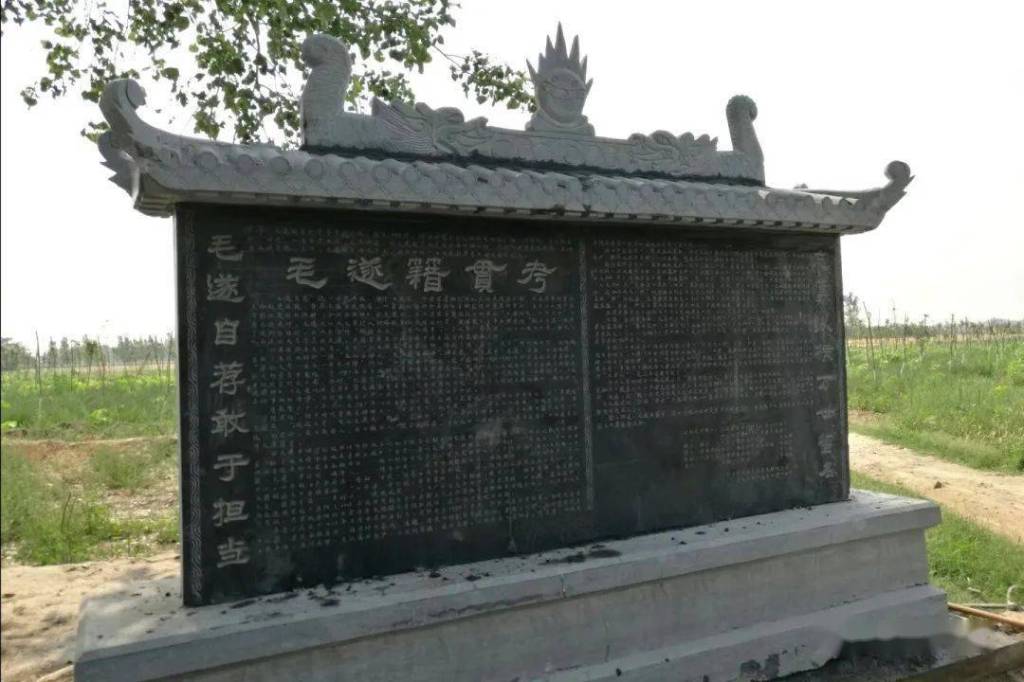
  • Comprehensive Reflections to Aid in Governance(Part 43): Self-Recommending Mao Sui

    Comprehensive Reflections to Aid in Governance

    By Sima Guang

    Translated By Yiming Yang

    Annals of Zhou Book 5 Scroll 5 (continued)

    Mao Sui’s Hometown

    The 57th year of King Nan(258 B.C.)

    In January, Wang Ling initiated an assault on Handan, the capital of the Zhao kingdom. However, his efforts were met with resistance, leading to setbacks. Responding to the situation, the King of Qin dispatched additional troops to reinforce Wang Ling’s campaign. Despite this reinforcement, Wang Ling suffered the loss of an additional five regiments of soldiers.

    Meanwhile, Lord Wu’an recovered from his illness, becoming a pivotal figure in the unfolding events. As the situation escalated, the King of Qin contemplated replacing Wang Ling with Lord Wu’an. However, Lord Wu’an, displaying strategic foresight and declined, “The fortress of Handan presents a formidable challenge to breach. Imminent reinforcements from neighboring kingdoms poised to aid Zhao further compound our difficulties. Lingering animosities towards Qin among these kingdoms exacerbate the situation, fueled by the bitter memories of past conflicts, notably the Battle of Changping, where despite our victory, we suffered significant casualties, halving our army’s strength. Consequently, our nation finds itself depleted of both manpower and resources. Attempting to traverse treacherous terrains and river crossings to lay siege to Zhao‘s capital would likely result in our forces being sandwiched between Zhao‘s defenders within and the combined might of other kingdoms attacking from without.”

    Recognizing the gravity of Lord Wuan‘s counsel, the King of Qin sought to persuade him through Marquis Ying. However, Lord Wu’an remained steadfast, citing his ongoing illness as an evasion to military engagement. Ultimately, the King of Qin appointed Wang He to assume command, relieving Wang Ling of his duties.

    Upon receiving the king of Zhao‘s directive to seek military aid from the kingdom of Chu, Lord Ping’yuan began assembling a retinue for the journey. After gathering his followers, he meticulously selected twenty attendants renowned for their prowess in both scholarly and martial pursuits. Among them, nineteen were chosen, leaving one vacancy yet to be filled.

    At this juncture, a man named Mao Sui stepped forward, recommending himself for the remaining spot. However, Lord Ping’yuan, unimpressed, rebuffed him,”Those who stand out in society are akin to an awl in a bag—The tip would show in the bottom inevitably. Professor Mao, despite being a member of my dining circle for three years, has failed to garner any praise or recognition from those around me. Your talents have not been acknowledged simply because you lack them, Professor Mao. I’m afraid you don’t possess the requisite qualities for this task. Therefore, you will remain behind.” In response, Mao Sui countered, “I am requesting to be dropped into the bag today. If I had been included earlier, I would have already made my mark, let alone just showing a tip.” Lord Ping’yuan, acknowledging Mao Sui‘s persistence and perhaps intrigued by his confidence, approved his request to join as the twentieth attendant. Meanwhile, the other nineteen attendants exchanged glances and shared a laugh at Mao Sui‘s audacity.

    Lord Ping’yuan engaged in lengthy negotiations with the king of Chu regarding the merits and drawbacks of forming a vertical alliance. Despite their efforts, a consensus proved elusive, with discussions stretching from sunrise until noon. Sensing impatience, Mao Sui,  laid his hand on his sword and walked up the stairs, interjected by approaching Lord Ping’yuan and remarking, “The advantages and disadvantages of a vertical alliance can be summed up in two sentences. Why did our talks take so long?”

    Enraged by this interruption, the king of Chu lashed out at Mao Sui, “Why don’t you leave this place! I am addressing your lord. What business do you have here?”

    Mao Sui held his sword and countered, “Your Majesty directs his ire at me due to the kingdom of Chu‘s populous nature. However, within a mere ten steps, Your Majesty cannot rely solely on numerical advantage. Your life hangs in the balance, held by my hand. Moreover, with my lord present, why address me in such a manner? I draw inspiration from historical examples: Shang Tang ascended from a mere seventy-mile base to become a global ruler, and King Wen of Zhou brought all lords under his sway with a mere hundred-mile domain. Did they achieve such feats solely through sheer force? No, they prevailed by seizing advantageous positions and fostering unwavering loyalty among their followers.”

    “The kingdom of Chu, boasting a vast territory spanning five thousand miles and an army numbering a million strong, stands as a formidable hegemon. No other kingdom can rival its might. Bai Qi, merely a lackey, led troops in a campaign against Chu, committing egregious acts such as seizing Yan and Ying, burning Yiling.  He vandalized your ancestral shrines and dishonored your progenitors in the third battle. These despicable acts echo through generations, casting shame even upon the people of Zhao. Yet, Your Majesty appears unfazed by these atrocities.  The vertical alliance serves not the interests of Zhao but those of Chu. Why then, direct your anger towards me in the presence of my lord?”

    The king of Chu, taken aback by Mao Sui‘s assertiveness, swiftly agreed, declaring, “Yes! Yes! My country will join the alliance just as the Professor suggested.” Mao Sui, seeking confirmation, inquired once more, receiving a resolute “Affirmative” from the king of Chu. With the decision made, Mao Sui directed the attendants of the king of Chu to fetch chicken, dog, and horse blood.

    Presenting a copper plate filled with animal blood, Mao Sui knelt before the king of Chu, proposing a blood oath to solidify the alliance. The king of Chu, as the primary participant, would swear first, followed by Lord Ping’yuan and then Mao Sui himself. With the ritual completed, the alliance was formally established.

    Mao Sui then gestured for the nineteen attendants of Lord Ping‘yuan to swear their allegiance using the same blood,”You all will swear the oath using this blood down there. You are nothing but useless free-riders, relying on others to accomplish tasks.”  With the pact secured, Lord Ping’yuan departed for the kingdom of Zhao, reflecting on his newfound respect for intellectuals, “Zhao Sheng will never judge an intellectual again in this world.” and elevating Mao Sui to a position of high regard.

    In support of the alliance, the king of Chu dispatched troops under the command of Lord Chun’shen to aid Zhao, while the king of Wei contributed a hundred thousand soldiers led by Jin Bi.

    The king of Qin dispatched a diplomat with a threatening message to the king of Wei: “I am poised to dismantle the kingdom of Zhao within days. Those who attempt to aid Zhao will face our wrath once Zhao falls.” Fearing Qin‘s might, the king of Wei instructed General Jin Bi to halt the advance and fortify positions near the city of Ye. Despite claiming to support Zhao, Wei’s actions suggested a pragmatic hedging of bets.

    Simultaneously, the king of Wei covertly dispatched General Xinyuan Yan to Handan, aiming to persuade the king of Zhao to crown the king of Qin as emperor, facilitated by Lord Ping’yuan. In return, Wei hoped for Qin‘s withdrawal from their territory.

    During this time, Lu Zhonglian, a scholar from Qi, encountered Xinyuan Yan in Handan. Expressing his vehement opposition,”The kingdom of Qin is a realm where principles and ethics are forsaken, and soldiers vie to amass the highest tally of severed heads as their ultimate accolade. If the king of Qin were to ascend to the imperial throne, I would sooner cast myself into the eastern ocean than submit as a subject. For people of Liang witnessing the grim repercussions of Qin‘s imperial reign, I would suggest the unthinkable: to have the king of Qin cook the king of Liang into a stew.”

    Xinyuan Yan, deeply offended, exclaimed, “How could you suggest such a gruesome act as having the king of Qin cook the king of Liang into stews?”

    Undeterred, Lu Zhonglian pressed on, saying, “Of course! Allow me to explain.”Lu Zhonglian elaborated on his analogy, recounting a historical tale, “Marquis Gui, Marquis E, and King Wen of Zhou served under King Zhou of the Shang dynasty. Marquis Gui, seeking favor, offered his beautiful daughter to King Zhou. However, displeased with her appearance, King Zhou callously had Marquis Gui cooked into stews. Marquis E attempted to reason with King Zhou through debate, but in response, King Zhou had Marquis E turned into jerky. Upon hearing of these atrocities, King Wen of Zhou lamented the cruelty. King Zhou, angered by King Wen’s disapproval, imprisoned him in a warehouse in Youli, intending to starve him to death.”

    “Now, consider this: Qin stands as a formidable nation, boasting ten thousand chariots. Yet, so does Liang. With both realms wielding equal military might and claiming kingship, why does Liang entertain the idea of elevating Qin‘s king to emperor, especially after Qin‘s recent victory? By doing so, aren’t you essentially putting yourselves at risk of being treated as mere commodities – perhaps even as ingredients for a gruesome meal? Imagine if the king of Qin boldly proclaims himself emperor. He would wield unparalleled power, dictating orders to the entire world. He would meddle in the affairs of his vassals, promoting those he favors and demoting those he despises. He would force his daughters and concubines into marriages solely for political gain, extending his influence over Liang‘s court. How could the king of Liang hope to maintain peace under such tyranny? And how could General Xinyuan retain his position as the king’s favorite?”

    Xinyuan Yan stood up and bowed repeatedly to Lu Zhonglian, expressing his newfound respect: “Now I recognize Professor to be a world-class scholar! Let me return, and I promise never to advocate for making the king of Qin emperor again!”

  • Comprehensive Reflections to Aid in Governance(Part 42): Predictions

    Comprehensive Reflections to Aid in Governance(Part 42): Predictions

    Comprehensive Reflections to Aid in Governance

    By Sima Guang

    Translated By Yiming Yang

    Annals of Zhou Book 5 Scroll 5 (continued)

    Kaifeng, Henan

    The 56th year of King Nan(259 B.C.)

    In October, Lord Wu’an deployed his army in three prongs: One branch, led by Wang He, occupied the cities of Wuan and Pilao; Another branch, led by Sima Geng, moved north to suppress any resistance in the city of Taiyuan and took control of the entire Shang’dang region. The kingdoms of Han and Wei were alarmed by these movements. They sent Su Dai to persuade Marquis Ying, saying, “Is Lord Wu’an planning to besiege Handan?” Marquis Ying confirmed this, and Su Dai continued, “Qin would indeed become the king of the realm if it annexed Zhao, and Lord Wu’an would hold significant power within Qin, and your highness would be under his thumb. Even if you don’t like to be the underling, you have to accept this reality. In the past, Qin‘s invasion of Han resulted in rebellions, with the inhabitants of Shang’dang fleeing to Zhao to escape Qin‘s rule. It’s evident that many people do not wish to live under Qin‘s authority. If Zhao were to fall to Qin, the population would scatter to neighboring kingdoms, further weakening Qin‘s control over the region. Therefore, it would be wiser to negotiate for these cities as part of a cease-fire agreement rather than allowing them to become mere trophies for Lord Wu’an.”

    Marquis Ying conveyed this advice to the king of Qin, “Our troops are weary from the prolonged conflict. It would be prudent to negotiate a cease-fire agreement with the kingdoms of Han and Zhao to allow our soldiers the opportunity to rest and recover. As part of these negotiations, we should demand the transfer of certain towns from both kingdoms to secure our position and ensure a more stable peace.” The king of Qin agreed, and they demanded the city of Yuanyong from Han and six cities from Zhao in exchange for peace. In January, the war ended, and troops returned home. However, this decision led to a rift between Lord Wu’an and Marquis Ying.

    The king of Zhao was on the verge of appointing Zhao Hao as the envoy to negotiate the terms of surrendering six counties to the kingdom of Qin. Yu Qing interjected, “Did the Qin troops withdraw due to exhaustion? Or perhaps, despite having sufficient forces to advance, did they cease their attacks out of love towards your majesty?” In response, the king speculated that Qin‘s retreat stemmed from exhaustion, as they were relentless in their quest for conquest. Yu Qing pointed out, “Qin pursued an objective but failed to achieve it due to exhaustion. By offering what they couldn’t secure through force, we inadvertently facilitate their aggression against us. When Qin inevitably attacks us next year, we’ll be left without aid or support from other kingdoms.” 

    Amidst the indecision, lobbyist Lou Huan returned from Qin, prompting consultation from the king of Zhao on territorial concessions. Lou Huan argued, “Yu Qing perceived one aspect of the situation but overlooked another. The world rejoiced when Qin and Zhao clashed because it presented opportunities for exploitation: ‘We would take advantage of the loser when the strong bullies the weak.’ To counter this, Zhao should promptly cede land to Qin to confound other nations and appease Qin‘s ambitions. Failure to do so would invite further hostility from Qin and eventual division of Zhao among other states. How can we stand against Qin if Zhao itself no longer exists?”

    Yu Qing heard the lobbying of Lou Huan and offered his counter proposal to the king of Zhao, “Mr. Lou’s proposal is detrimental as it would only heighten suspicion among other nations and fail to quell Qin‘s greed. Furthermore, it would expose our perceived cowardice. However, I didn’t mean to suggest refusing to cede land altogether when opposing yielding to Qin. Instead, consider this: Qin claims six cities from us. We could offer these cities to the king of Qi. Given the animosity between Qi and Qin, the king of Qi would likely accept our offer swiftly. By giving the cities to Qi at Qin‘s expense, we demonstrate resilience to the world. Taking this initiative may prompt Qin to negotiate a peace treaty before any reinforcements arrive at our borders. Achieving peace with Qin would earn respect from Han and Wei. In one stroke, we would win the affection of three kingdoms while compelling Qin to rethink its strategies.”  Impressed by the plan, the king of Zhao endorsed it and dispatched Yu Qing to negotiate with the king of Qi.

    Before Yu Qing‘s return from Qi, Qin‘s envoy arrived in Zhao‘s capital. Lou Huan, sensing the shift in dynamics, hastily departed. In recognition of Yu Qing‘s strategic acumen, the king granted him a city as a fief.

    The King of Wei consulted with his advisers upon news of Qin‘s assault on the kingdom of Zhao. While they believed Wei stood to gain from the conflict, Kong Bin, also known by the courtesy name Zishun, dissented: “Why do you say that?” Their reasoning was that should Qin triumph over Zhao, Wei might capitulate, and if Qin failed, Wei could exploit their exhaustion. Zishun countered, “That’s not accurate. Qin‘s military prowess has been unbroken since the time of Duke Xiao of Qin. Moreover, they’re now under the command of an exceptional leader. What exhaustion do you speak of?” One adviser argued, “If Qin conquers Zhao, it wouldn’t harm us. It’s advantageous when a neighbor is weakened.” Zishun retorted, “Qin is inherently rapacious. Once they conquer Zhao, they’ll seek further conquests. Eventually, Wei may find itself targeted by Qin‘s aggression. Let me recount a tale passed down by my ancestors: Swallows built their nest beneath a house’s eaves, feeling secure.  The mother fed the babies and the babies were chirping merrily. When a fire erupted, consuming the entire dwelling, the swallows remained oblivious until it was too late. Similarly, you fail to foresee the impending peril should Zhao fall. Are we not as blind as those swallows?”

    Zishun, the sixth-generation grandson of Confucius, was highly regarded by the King of Wei, who had heard praises of him. Impressed, the king dispatched diplomats bearing gifts of gold and silk to invite Zishun to become his prime minister. Zishun‘s response was unequivocal: “If the king heeds my counsel and adopts my policies, I shall come even if sustained by mere vegetables and water. But if I am adorned with luxury and riches without genuine influence, I am but an ordinary man. Does the king require just another ordinary man?” Due to the diplomat’s persistence, Zishun relented and accompanied him.

    Upon Zishun‘s arrival, the King of Wei personally greeted him and appointed him prime minister. Zishun wasted no time in overhauling the administration, replacing officials appointed through favoritism with those chosen based on merit and virtue. He instituted a system where achievements were duly rewarded, contrasting the previous practice of rewarding slackers.

    However, as expected, those who lost positions or privileges due to Zishun‘s reforms began to slander him behind his back. Wen Zi, a confidant, informed Zishun of the malicious gossip. Zishun, undeterred, remarked, “Not engaging the public in strategic planning in early stages is a time-honored practice. It’s a well-established fact that many competent administrators throughout history faced criticism at the outset of their careers. For instance, it took three years of Zichan’s governance in the State of Zheng to silence detractors, while my ancestor Confucius, serving as prime minister in Lu, quelled disparagement within three months. I’ve only just begun leading this new administration. I don’t possess the same level of skill as those esteemed predecessors. So, why should I concern myself with the slanderous words aimed at vilifying me?”

    “I wasn’t aware of the criticisms directed at Confucius.”  Wen Zi was curious.

    “When Confucius assumed the role of prime minister, a song circulated among the people. Its lyrics went: ‘The elite in buckskin, not a crime if being put into jail; The elite wearing buckskin, put in prison no one complains.’ However, after just three months of his administration, the cultural sentiment shifted. A new song emerged: ‘Leather coats and black hats, delivered what we want; Black hats and leather coats, served us not himself.’”

    “Today, I see that you are a saint, no different than your ancestor!” Wen Zi exclaimed

    Zishun had served as prime minister of Wei for nine months without his strategic policies being implemented. Frustrated, he lamented, “My proposals lack persuasiveness, leading to a moral dilemma where I hold a high position and salary without contributing adequately.” Using illness as a pretext, he resigned from his official post. When someone suggested seeking opportunities in other kingdoms, Zishun responded, “Where could I go? The kingdom of Qin is annexing all kingdoms to the east of Xiao Mountains, an unjustifiable action. An honorable person wouldn’t align with Qin.” Retreating home, he maintained a low profile.

    Xinyuan Gu urged Zishun to reconsider, “A virtuous individual should indeed strive to educate the populace and assist the government in their own community. You held the esteemed position of prime minister in Wei, yet I observed no significant administrative reforms during your tenure before your resignation. While I understand you may have faced challenges in implementing your desired changes, why did you opt to resign so swiftly?”  Zishun explained, “I quit because I couldn’t enact government reforms. Just as a terminally ill patient has no competent clinician to save him, our efforts to save the dying county would be futile. The kingdom of Qin‘s insatiable ambition threatens global peace, rendering our pursuit of humanity and decency futile. Reflecting on history, Yi Zhi and Lv Wang sought better administrations during the Xia and Shang dynasties’ declines, yet they couldn’t avert collapse. Today, kingdoms to the east of Xiao Mountains are weakened: the three descendants from Jin cede land to Qin, the two relics of Zhou become Qin‘s vassals, and Yan, Qi, and Chu submit to Qin. In my view, Qin will own the world within twenty years.”

    The King of Qin sought vengeance against Wei Qi for mistreating Marquis Ying. Upon discovering Wei Qi‘s hiding place in Lord Pingyuan’s residence, he lured Lord Ping’yuan into Qin territory with persuasive words and captured him. Subsequently, a messenger was dispatched to inform the King of Zhao, “I will not release your brother from the Pass until I have Wei Qi‘s head.” With no refuge, Wei Qi fled to Yu Qing, who relinquished his prime ministerial seal of Zhao and fled with Wei Qi to the kingdom of Wei. They intended to seek refuge in the kingdom of Chu with the assistance of Lord Xinling, also known as Wuji, a prince of Wei. However, Lord Xinling, caught in a difficult position, delayed meeting them. Angered by the delay, Wei Qi took his own life. Meanwhile, the King of Zhao handed over Wei Qi‘s head to Qin, leading to the release of Lord Ping’yuan.

    In September of the autumn, Wang Ling, holding the position of Wu-Daifu, launched a campaign against the kingdom of Zhao. Lord Wu’an fell ill and was unable to join the expedition.

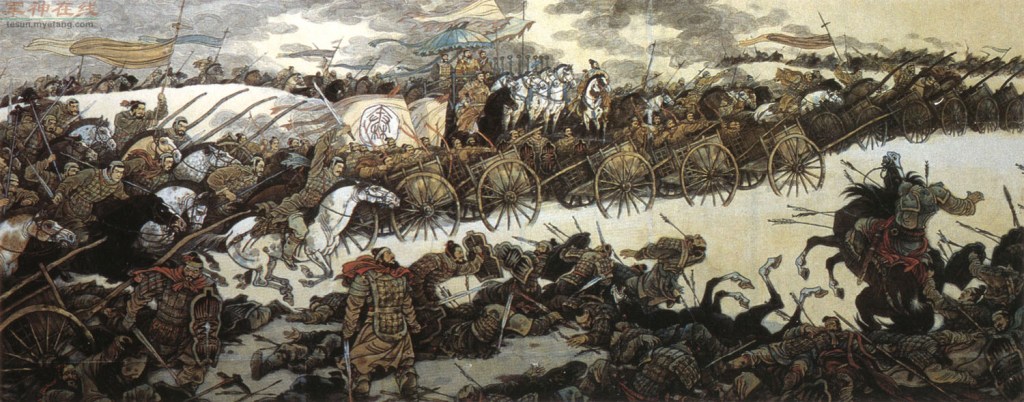
  • Comprehensive Reflections to Aid in Governance(Part 41): The Battle of Chang’ping

    Comprehensive Reflections to Aid in Governance

    By Sima Guang

    Translated By Yiming Yang

    Annals of Zhou Book 5 Scroll 5 (continued)

    Battle of Changping

    The 55th year of King Nan(260 B.C.)

    The army of Qin, under the leadership of Deputy Prime Minister Wang He, launched an attack on Shang’dang, successfully capturing it. 

    Fleeing from the turmoil, the people of Shang’dang sought refuge in the kingdom of Zhao. Responding to their plight, the army of Zhao, commanded by General Lian Po, entered the city of Chang’ping to assist the displaced inhabitants, aiding them in resettling within the kingdom of Zhao.

    In the months of April and early summer, Wang He initiated multiple assaults on the kingdom of Zhao. The army of Zhao fought back with limited success, resulting in the loss of one lieutenant general and four middle-level officers. Concerned about the escalating conflict, the king of Zhao consulted with his advisors, Lou Chang and Yu Qing, regarding potential strategies for peace.

    Lou Chang proposed initiating peace talks with a distinguished envoy to the kingdom of Qin. However, Yu Qing disagreed, “The kingdom of Qin holds complete control over the lever of peace. Their relentless determination is to obliterate Your Majesty’s army, and they would not entertain peace negotiations even if one were to seek them. A more strategic approach would be to dispatch distinguished envoys to the kingdoms of Chu and Wei. If these kingdoms respond favorably to our gestures of goodwill, it could sow seeds of suspicion within the kingdom of Qin regarding a potential alliance forming among other kingdoms against them. This strategic maneuver might prompt Qin to reconsider and accept our plea for peace.”

    Despite Yu Qing‘s objections, the king of Zhao ultimately decided to send Zheng Zhu as the envoy to Qin in pursuit of peace. Upon his arrival, Zheng Zhu was warmly received by the kingdom of Qin. The king of Zhao remarked to Yu Qing, “Zheng Zhu seemed to be well received by Qin.” Yu Qing remained skeptical, “It’s unlikely that your majesty will secure a peace treaty, and your army may face defeat. Currently, envoys from all kingdoms are in Qin, extending congratulations for their victory in Shang’dang. Zheng Zhu, being of elite stature, will undoubtedly receive an extravagant welcome from the king of Qin and Marquis Ying, designed to impress and entertain. Consequently, other kingdoms may hesitate to come to Your Majesty’s aid, as they perceive a peace treaty between Qin and Zhao. With no external support forthcoming, the king of Qin may see no need to negotiate a peace treaty with Zhao.”

    As predicted by Yu Qing, despite the grand reception, no peace treaty was established between Zhao and Qin.

    The army of Qin inflicted several defeats upon the army of Zhao, prompting General Lian Po to withdraw his troops behind a fortified barricade, ceasing engagements with Qin. This decision led to frustration and anger from the king of Zhao, who perceived Lian Po‘s actions as cowardice resulting from previous heavy losses. Despite repeated reprimands from the king, Lian Po remained steadfast in his defensive strategy.

    In response to the perceived discord, Marquis Ying dispatched spies bearing thousands of caddies of gold to the kingdom of Zhao, delivering counter-intelligence that suggested the kingdom of Qin harbored fears, particularly regarding the potential ascension of General Zhao Kuo, the son of Lord Ma-Fu, as commander-in-chief of the army of Zhao. The intelligence further insinuated that Lian Po was on the verge of surrender. Prompted by this information, the king of Zhao relieved Lian Po of his duties and appointed Zhao Kuo as the new commander-in-chief of the army.

    Lin Xiangru voiced opposition to this decision, “Your Majesty’s decision to choose Zhao Kuo over Lian Po was based on Zhao Kuo‘s reputation alone. It’s akin to attempting to tune string instruments by tightening the tuning pegs when the strings are already glued in place. Zhao Kuo‘s reliance solely on his father’s military textbooks without the ability to adapt tactics from the books to rapidly changing battlefield conditions makes him ill-prepared for the complexities of warfare.” Despite Lin Xiangru‘s counsel, the king of Zhao remained stubborn in his decision to appoint Zhao Kuo.

    Zhao Kuo had immersed himself in the study of warfare since childhood, believing himself to be unparalleled in the theory of war. He frequently engaged in discussions on the subject with his father, Zhao She. Despite his eloquence in discourse on military strategy, Zhao She remained unimpressed by his son’s understanding of warfare. When questioned about this by Zhao Kuo‘s mother, Zhao She expressed concern, stating that war is a matter of life and death, and Zhao Kuo‘s casual attitude towards it could lead to disastrous consequences if he were to assume a leadership role in the army of Zhao.

    As Zhao Kuo prepared to depart for the frontlines, his mother, troubled by his appointment, wrote to the king opposing it. Summoned by the king, she explained her concerns, “This humble woman served her husband, Zhao She, faithfully in the past. During Zhao She‘s tenure as commander-in-chief, his generosity was renowned—he provided for tens of individuals with his earnings and counted hundreds as his friends. He willingly shared the rewards bestowed upon him by the king and other royalties with his comrades and intellectuals. However, as he prepared for war, he distanced himself from family matters.”

    “In contrast, when Zhao Kuo assumed the role of commander-in-chief, he received homage from his subordinates while sitting facing east. His underlings hesitated to meet his gaze, intimidated by his presence. Unlike his father, Zhao Kuo retained all the gold and silk granted by the king, and in the last few days, he indulged in purchasing houses and land for personal gain.  The king believed that Zhao Kuo would naturally succeed his father’s position, but they are different persons. I wish your majesty would not have chosen him to be the commander!” The king of Zhao declined her plea:”Stop right here, Mom!  I have made up my mind.”

    In her final request, Zhao Kuo‘s mother implored the king to spare her family from any repercussions should Zhao Kuo‘s leadership prove unsuccessful. The king approved of her demand.

    Upon learning that Zhao Kuo had assumed the position of commander-in-chief, the king of Qin took covert action, sending Lord Wu’an as the top general of the Qin army, with Wang He as his lieutenant. Strict orders were given to maintain secrecy, with severe consequences for any leaks of the appointment.

    As Zhao Kuo arrived at the frontline, he implemented new strategies and replaced officers. The Zhao army emerged from their bunkers to confront the Qin troops. Lord Wu’an pretended to be defeated, leading the Qin troops away while leaving detachments behind to ambush the Zhao army.

    Seeing what appeared to be a sign of victory, Zhao Kuo pursued the retreating Qin troops to the camp’s bulwarks, only to find them impenetrable. Simultaneously, Qin detachments of twenty five thousand infantry maneuvered to cut off Zhao Kuo‘s retreat and another five thousand cavalry to slice through between the front and the camp. The Zhao army was severed into two isolated groups and their food supply line was broken.

    Lord Wu’an then unleashed his light infantry to attack the vulnerable Zhao troops, who struggled to fend off the relentless assault. With their situation growing dire, the Zhao forces dug up barriers and erected bastions, awaiting reinforcements.

    Upon learning that the food supply line to the Zhao army had been severed, the king of Qin took decisive action. He traveled to the commandery of Henei in person, and mobilized all men above fifteen years old to march towards Chang’ping, aiming to overwhelm any attempts at rescue or supply for the Zhao army.

    Despite the willingness of the people in the kingdoms of Qi and Chu to aid Zhao, the soldiers of Zhao found themselves lacking in food. When they requested grains from the kingdom of Qi, the king refused. His adviser, Zhou Zi, implored him to reconsider,

    “The kingdom of Zhao serves as a protective barrier for the kingdoms of Qi and Chu. Their relationship is akin to that of lips and teeth: if the lips are lost, the teeth are left vulnerable to the chill. If Zhao falls today, it foreshadows impending disasters for Qi and Chu tomorrow. Therefore, the urgency to rescue Zhao is as crucial as using leftover water in a cracked urn to cool a burned pot. Providing aid to Zhao is not just a moral duty but also a righteous act. Additionally, defeating the Qin troops would bring glory to Qi.”

    “It is our responsibility to assist a country in distress, uphold justice, and confront the formidable Qin forces to earn a heroic reputation. Neglecting this vital issue by prioritizing grains over aiding Zhao would be detrimental to our country and its values.” Despite Zhou Zi’s impassioned plea, the king of Qi refused to listen.

    In the autumn and early September, the soldiers of Zhao endured forty-six days without food. Desperation led to quiet acts of cannibalism within the camp. Despite their efforts to break the barricade, rotating attack squads proved ineffective. As the fifth squad prepared to begin, they remained trapped. Zhao Kuo, the chief commander, leading his elite guards, ventured into a skirmish and tragically met his demise, struck down by arrows, plunging the army into chaos. Without leadership, four hundred thousand Zhao soldiers surrendered.

    Lord Wu’an saw the potential danger posed by these soldiers, “The people of Shang’dang, discontented under Qin‘s rule, allied themselves with Zhao after Qin‘s conquest of Shang’dang. The enormous number of Zhao captives posed a serious threat of mutiny if left alive.” Fearing mutiny, he ordered the execution and burial of all prisoners of war, sparing only two hundred forty youths to return to Zhao. In total, four hundred fifty thousand prisoners were beheaded, shocking the people of Zhao to their core.

  • Comprehensive Reflections to Aid in Governance(Part 40): Casting Skins like Cicadas

    Comprehensive Reflections to Aid in Governance

    By Sima Guang

    Translated By Yiming Yang

    Annals of Zhou Book 5 Scroll 5 (continued)

    Shangdang, Shanxi Province

    The 51st year of King Nan(264 B.C.)

    Lord Wu’an, i.e. Bai Qi, led a campaign against the kingdom of Han.  They took nine cities and beheaded fifty thousand soldiers of Han.

    Tian Dan became the prime minister of the kingdom of Zhao.

    The 52nd year of King Nan(263 B.C.)

    Lord Wu’an launched another attack on the kingdom of Han, capturing the city of Nanyang and securing control over the entire Road Taihang, effectively dividing the kingdom in two.

    Meanwhile, King Qingxiang of Chu fell ill. Huang Xie, who was attending the crown prince of Chu held hostage in the kingdom of Qin, visited Marquis Ying of Qin with a proposition, “The King of Chu may be terminally ill, prompting consideration of strategic moves. It is advisable for the kingdom of Qin to release the crown prince back to Chu. By facilitating the installment of the crown prince as the next king, Chu would likely forge an alliance with Qin. Furthermore, this act would incur a substantial debt of gratitude towards you, the Prime Minister, from the crown prince. Such a move would not only unite the two kingdoms but also secure an alliance with a formidable state boasting ten thousand chariots. Conversely, retaining the crown prince in Xianyang renders him a mere commoner, devoid of his royal stature in Chu. In such a scenario, Chu would inevitably appoint another king, potentially souring relations with Qin. Disrupting a potentially beneficial alliance with a powerful state, without any tangible gain, is an imprudent course of action.”

    Marquis Ying relayed his message to the King of Qin, who responded, “Let the crown prince’s teacher go back first; we will address the matter upon his return.”

    Huang Xie conspired with the crown prince, cautioning, “The Kingdom of Qin detains you to leverage benefits from Chu. Presently, you lack the capacity to bring advantages to Qin. Contrastingly, Lord Yang’wen, the king’s brother, has two sons entrenched in the capital. In the event of the king’s demise and your absence, one of Lord Yang’wen’s sons would ascend to the throne, nullifying your claim to ancestral heritage. It is prudent for you to clandestinely depart Qin, accompanying the envoy back to Chu. I shall remain here to aid in negotiations with the King of Qin, even at the risk of my life.” Subsequently, the crown prince changed his attire and successfully traversed the checkpoints by assuming the role of a driver for the Chu ambassador, on their journey back to Chu.

    Huang Xie resided in the crown prince’s quarters and frequently assumed sick leave on his behalf. He visited the King of Qin only when he was confident that the crown prince had safely departed Qin‘s jurisdiction. Huang Xie boldly declared to the king, “The Crown Prince of Chu has returned to his kingdom and is now beyond your reach. Please, grant me the death sentence for my deceit.” Enraged, the King of Qin was inclined to fulfill his request. However, Marquis Ying interceded, advocating for Huang Xie‘s clemency. He argued, “Huang Xie, as the crown prince’s attendant, displayed unwavering loyalty by offering his life for his lord. Should the crown prince ascend to kingship, Huang Xie would play a significant role. Pardoning him and facilitating his return to Chu would greatly enhance our relations with Chu.” The king heeded this counsel. In the following autumn, King Qingxiang of Chu passed away, three months after Huang Xie‘s return. The crown prince ascended the throne as King Kaolie of Chu and appointed Huang Xie as his prime minister. Additionally, Huang Xie was granted extensive lands north of the Huai River as a fief and bestowed the title of Lord Chun’shen.

    The 53rd year of King Nan(262 B.C.)

    The Kingdom of Chu ceded the city of Xiazhou to the Kingdom of Qin in pursuit of peace. 

    Lord Wu’an of Qin spearheaded a campaign against the Kingdom of Han, successfully capturing the city of Yewang. Consequently, the Shang’dang region, a prefecture of Han, found itself severed from the main kingdom as Qin‘s troops blocked the route to the capital, Zheng.

    Governor Feng Ting of Shang’dang engaged in discussions with his constituents, recognizing the dire situation: “Our passage to Zheng has been obstructed, leaving us vulnerable to Qin‘s advances without aid from Han‘s army. It’s prudent to transfer control of Shang’dang to the Kingdom of Zhao. If Zhao accepts us, Qin will inevitably target them. In response, Zhao will seek an alliance with Han. With our forces combined, we can withstand Qin‘s aggression.” Unanimously, they decided to dispatch a messenger to the King of Zhao, conveying their plea: “Unable to defend Shang’dang, Han has surrendered it to Qin. The people of Shang’dang prefer to be under Zhao‘s rule rather than Qin‘s. We humbly request your Majesty’s acceptance of our submission, offering the seventeen cities and towns of Shang’dang.”

    The King of Zhao sought counsel from Lord Ping’yang, named Bao. Bao responded, “A true leader avoids profiting from unjust gains.” The King of Zhao retorted, “Under my virtuous rule, my people thrive. Why do you suggest there is no merit?” Bao explained further, “Qin methodically annexed Han‘s territory, fragmenting it, waiting for Shang’dang to surrender. By redirecting the harm toward Zhao, Han spared itself. Qin bore the costs and bloodshed, yet Zhao reaps the rewards. Can a weaker state like Zhao snatch what even mighty Qin could not from the feeble? It appears as an undeserved fortune. It’s wiser to decline the offer of Shang’dang.”

    The King then consulted Lord Ping’yuan, who advised acceptance. Consequently, the King dispatched Lord Ping’yuan to Shang’dang to formalize the acquisition. He bestowed three cities, each housing over ten thousand residents, to Governor Feng Ting, granting him the title Lord Hua’yang. Additionally, each county magistrate received three towns with more than a thousand residents. Pay scales were raised by three grades for officials and citizens alike.

    Overwhelmed with emotion, Feng Ting declined to meet Lord Ping’yuan, stating, “I cannot bear to enrich myself by selling my lord’s land.”

  • Comprehensive Reflections to Aid in Governance(Part 39): The Art of Persuasion

    Comprehensive Reflections to Aid in Governance

    By Sima Guang

    Translated By Yiming Yang

    Annals of Zhou Book 5 Scroll 5 (continued)

    Chu Long and Queen Dowager

    The 50th year of King Nan(265 B.C.)

    In the winter of that year, Queen Dowager Xuan of Qin passed away in October, and during the preceding autumn, Marquis Rang went into exile in his fief town of Tao in September.

    Sima Guang’s comment: Marquis Rang played a crucial role in establishing King Zhao of Qin, shielding him from potential challenges. He advocated for Bai Qi as the general, leading campaigns to the south and successfully annexing the cities of Yan and Ying. Marquis Rang also expanded Qin‘s territory eastward, reaching the border of Qi. He compelled all the Lords to submit to Qin‘s authority. The significant rise in the power of the Qin kingdom was attributed to Marquis Rang‘s dedicated efforts. While he exhibited authoritarian, arrogant, and greedy traits that eventually led to his own troubles, his discretion was not as egregious as Fan Ju portrayed. Figures like Fan Ju, whose strategies did not solely prioritize the interests of the kingdom of Qin, coveted Marquis Rang‘s position and actively sought to undermine his power. They influenced the king of Qin to sever familial ties with his mother and uncles, to whom he was indebted. In essence, Fan Ju is a treacherous individual indeed!

    The King of Qin designated Lord An‘guo as the crown prince.

    The troops of Qin conducted a raid on the kingdom of Zhao, successfully capturing three cities. The recently installed king of Zhao was young, so the Queen Dowager of Zhao was in charge. The kingdom of Zhao sought assistance from Qi. In exchange for sending troops to aid Zhao, the kingdom of Qi requested Lord Chang’an, the king’s younger brother, as indemnity. Queen Dowager of Zhao firmly rejected this condition, leading to a standoff.

    Despite Qi holding onto its troops, officials of Zhao implored Queen Dowager forcefully. In a defiant response, Queen Dowager made her stance clear: “Whoever speaks to me about making Lord Chang’an a hostage again, this old lady would spit on his face!” Despite the tension, Vice Chief Strategist Chu Long of Zhao expressed a desire to speak with Queen Dowager. The Queen Dowager granted him an audience, waiting with an unpleasant disposition. 

    Chu Long shuffled towards the Queen Dowager, apologizing for his slow pace, “I apologize, but these old feet of mine are not in the best condition, preventing me from moving quickly. Thus, I haven’t had the chance to see your majesty for quite some time. I hope you can pardon my physical limitations. Additionally, my concern for the well-being of your majesty has grown, and that’s why I humbly request the opportunity for a visit.”

    “I’ve been relying on a hand-cart to get around.”  The queen dowager sympathized.

    “Is your majesty’s appetite still good?”

    “I sustain myself on porridge.” Her hostility diminished somewhat.

    “My humble son, Shuqi, is the youngest and seemingly without much promise. However, in my old age, I still hold great affection for him. I would like to enroll him in the waiting list of the black-jacket guards to ensure the protection of your majesty. I dare to request this despite the potential offense it may cause.”

    “I grant your wish. How old is he?”

    “He is fifteen. Although young, I wish to entrust him to your majesty before I am buried deep in earth.”

    Queen Dowager, surprised by a man’s deep affection for his youngest son, pondered aloud, “Does a man also love his youngest son like that?” Chu Long asserted, “More so than a lady does,” prompting Queen Dowager to laugh and say, “Women love their sons so much more.” 

    “This old man observes that your majesty loves her princess, the Queen of Yan, more than Prince Chang’an.”

    “You are mistaken. I love Lord Chang’an just as much, if not more.”

    “Parents plan for the long-term well-being of their loved ones. When my lady sent off Queen of Yan, the old lady clung to her heels and sobbed. You were saddened because she went far away from home, and the longing persisted even after her departure. However, your prayers have consistently been along the lines of: ‘Please don’t make her come back!’ Is this because you envision her welfare in the long run, ensuring her sons and grandsons become the kings of Yan?”

    “Yes, it is.”  The Queen Dowager admitted.

    “Tracing back three generations, are there any descendants of the king of Zhao who have inherited the title of Marquis from their father and still hold that title?”

    The Queen Dowager replied, “There are none.” Chu Long went further, asking, “Not just counting the descendants of Zhao, are there any rulers who inherited marquis titles in other kingdoms?” Queen Dowager conceded, “This old lady is not aware of.”

    Chu Long concluded, “Inheriting a marquis title brings short-term trouble to the individual and, in the long run, affects the welfare of their descendants. Why is inheriting a marquis title necessarily detrimental for a king’s son? Because they hold esteemed positions without contributing to the state, receive high compensation for little effort, and possess the state’s wealth. Today, my lady bestowed upon Lord Chang’an a royal title, fertile fief land, and state treasures, yet he has made no contributions to the state. When my lady passes away, what justification can Lord Chang’an offer for his position in the kingdom of Zhao? That’s why I believe my lady is primarily concerned about Lord Chang’an current well-being, suggesting that she loves the Queen of Yan more than her son.”

    The Queen Dowager sighed and said, “Fine. You can do to him as you please.”

    Queen Dowager reluctantly consented to send Lord Chang’an to the kingdom of Qi as a hostage, accompanied by a hundred chariots. In adherence to the agreement, the kingdom of Qi sent troops to aid Zhao, and as a result, the kingdom of Qin withdrew its forces.

    Lord Anping of Qi, Tian Dan, assumed the role of a minister in Zhao. He orchestrated an invasion of the kingdom of Yan with the army of Zhao, successfully capturing the city of Zhongyang. Subsequently, he led another raid on the kingdom of Han, seizing the city of Zhuren.

    In the kingdom of Qi, King Xiang passed away, and his son Jian was appointed as the new king. As Jian was underage, the state affairs were overseen by the Queen Dowager of Qi, who had previously eloped with King Xiang and held the title of Lord Queen Dowager.

  • Comprehensive Reflections to Aid in Governance(Part 38): The Gift of Silken Gown

    Comprehensive Reflections to Aid in Governance

    By Sima Guang

    Translated By Yiming Yang

    Annals of Zhou Book 5 Scroll 5 (continued)

    Gift of Silken Gown, A Peking Opera

    The 46th year of King Nan(269 B.C.)

    General Hu Yang of Qin launched a raid on the city of Yuyu in the kingdom of Zhao but was unsuccessful in capturing it.

    The 47th year of King Nan(268 B.C.)

    Upon the counsel of Fan Ju, the King of Qin directed a prominent official, Wan, to spearhead another campaign against the kingdom of Wei. Subsequently, they successfully seized control of Huai county.

    The 48th year of King Nan(267 B.C.)

    The crown prince of Qin died in the kingdom of Wei while fulfilling his role as a hostage.

    The 49th year of King Nan(266 B.C.)

    In the summer, the kingdom of Qin successfully annexed the regions of Xingqiu and Huai from the kingdom of Wei. During this period, Fan Ju earned greater trust from the king and gradually assumed control over the state affairs of Qin. Exploiting the opportunity to sow discord in the king’s mind, Fan Ju remarked, “When I resided east of Xiao Mountains, my awareness did not extend to the king of Qi; my focus was solely on Lord Mengchang. Similarly, my knowledge of the king of Qin was limited, as I recognized only the queen dowager, Marquis Rang, Lord Gaoling, Lord Huayang, and Lord Jingyang within the kingdom of Qin. A true king is one who independently governs a state, weighing the welfare and harm befalling his subjects, and determining their life or death. However, the queen dowager now acts without discretion, Marquis Rang conducts visits to other kingdoms without official reports, while Lord Huayang and Lord Jingyang act unrestrained. Lord Gaoling freely enters the court without approval. With these four types of nobility in power, no state can escape peril. Marquis Rang sends envoys to other states, wielding the authority of a king, signing treaties with fellow lords, and distributing rewards across the world. No one dares to resist his aggressive pursuits, and the spoils of victory enrich Marquis Rang‘s fiefdom, while the losses burden the state, spreading grievances among the people.”

    “I have heard the saying, ‘A tree with too much fruit must be pruned. A tree with too much pruning will harm its core.’ A kingdom is precarious when a minister’s hometown surpasses its capital in size or when a minister is more revered than the king. Nao Chi, in charge of the kingdom of Qi, shot the king on his thigh, removed the king’s hamstring, and hung him in a temple, causing his death overnight. Similarly, Li Tuo, overseeing the kingdom of Zhao, detained the Father Lord in the palace of Shaqiu, leading to his starvation after a hundred days of confinement. In my assessment, the four nobilities today fall into the same category as Nao Chi and Li Tuo. Throughout history, the downfall of three dynasties resulted from lords delegating governance to ministers and indulging in excesses such as drinking and gaming. Jealous ministers manipulated the people, isolating the lord to promote their own interests rather than the lord’s. When the lord remained oblivious, the state eventually crumbled. Presently, officials in the kingdom of Qin, from town mayors to senior ministers and all assistants to the king, are appointed by Marquis Rang. Observing your Majesty’s isolation in the court, I fear that Your Majesty’s descendants may not inherit the kingdom of Qin when your Majesty passes away.” Agreeing with Fan Ju, the king of Qin deposed the queen dowager and ousted Marquise Rang, Lord Gaoling, Lord Huayang, and Lord Jingyang. He appointed Fan Ju as the prime minister of Qin and bestowed upon him the title of Marquis Ying.

    The king of Wei dispatched Xu Jia as an envoy to the kingdom of Qin. Marquis Ying, dressed in humble attire, personally visited Xu Jia. Surprised by Fan Ju‘s appearance, Xu Jia exclaimed using his courtesy name, “How have you been, Fan Shu?” He warmly invited Fan Ju to join him at the table, offering food and drink. As a gesture of hospitality, Xu Jia presented Fan Ju with a thick silken gown. Later, when Fan Ju drove the carriage of Xu Jia to the prime minister’s residence, Fan Ju went in first, stating, “I will notify the prime minister of your arrival.” However, after a prolonged wait, Xu Jia inquired with the doorman, who informed him that there was no one named Fan Ju, and that their prime minister was Mr. Zhang. Realizing he had been deceived, Xu Jia humbly kneel-walked into Marquis Ying‘s mansion, seeking forgiveness.

    Seated in the hall, Fan Ju reproached Xu Jia for his betrayal. He remarked, “Were it not for your compassion towards your old friend and the gift of the silk robe, you might not have escaped with your life.” Fan Ju then organized a grand banquet, inviting envoys from other kingdoms. Xu Jia was relegated to the lower end of the dining hall, where chopped hays and beans were placed in front of him, and he was compelled to eat from the trough without utensils, akin to a horse. Fan Ju directed Xu Jia to convey a stern message to the King of Wei: “Bring the severed head of Wei Qi to me, or we will demolish your capital, Daliang.” Xu Jia hastily returned to Wei and recounted the events to Wei Qi, who sought refuge in the kingdom of Qi, taking shelter in Lord Pingyuan’s house.

    Meanwhile, in the kingdom of Zhao, King Hui’wen passed away, and his son Dan ascended to the throne as King Xiao’cheng of Zhao. The new king appointed Lord Pingyuan as his prime minister.