Author: Yiming Yang

  • Comprehensive Reflections to Aid in Governance(Part 18): Lord Mengchang

    Comprehensive Reflections to Aid in Governance

    By Sima Guang

    Translated By Yiming Yang

    Annals of Zhou Book 2 Scroll 2 (continued)

    Lord Mengchang’s fief, Xuecheng, Shandong Province

    The 39th year of King Xian (330 B.C.)

    The Kingdom of Qin launched an offensive against the Kingdom of Wei, resulting in a siege of the cities of Jiao and Quwo. In response, the Kingdom of Wei surrendered the city of Shaoliang and other territories located on the west bank of the Yellow River to the Kingdom of Qin.

    The 40th year of King Xian (329 B.C.)

    The troops of Qin launched an invasion of the Kingdom of Wei, successfully crossing the Yellow River and capturing the cities of Fenyin and Pishi. They also managed to sack the city of Jiao during their campaign.

    King Wei of Chu passed away, and he was succeeded by his son, who took the throne as King Huai of Chu.

    Meanwhile, in the state of Song, Duke Ticheng’s brother, named Song Yan, orchestrated a surprise attack on Duke Ticheng. Fearing for his safety, Ticheng fled to the state of Qi. Following this, Song Yan declared himself the lord of Song, taking control of the state.

    The 41st year of King Xian (328 B.C.)

    Prince Hua and Zhang Yi of Qin conducted another siege, this time targeting the city of Puyang in the state of Wei. They successfully captured the city during the campaign. However, Zhang Yi, recognizing the importance of diplomacy, persuaded the King of Qin to return Puyang to Wei. In addition to this, he sent Prince Yao to Wei as a hostage to strengthen relations.

    Subsequently, Zhang Yi employed his diplomatic skills to lobby the King of Wei. He emphasized that Qin had treated Wei generously and that Wei should reciprocate in kind. As a result, the state of Wei gifted fifteen counties in the Shangjun area to Qin as a token of their gratitude. This diplomatic success led to Zhang Yi‘s promotion to the prime minister of Qin.

    The 42nd year of King Xian (327 B.C.)

    The ancient tribal state of Yiqu, a historical rival of the Kingdom of Qin, was incorporated into Qin as a county. The lord of Yiqu now became a subordinate under the rule of the King of Qin.

    Additionally, the Kingdom of Qin returned the cities of Jiao and Quwo to the Kingdom of Wei as part of a restitution agreement.

    The 43rd year of King Xian (326 B.C.)

    Following the death of Marquis Su, his son, Zhao Yong, ascended to the throne as King Wuling of Zhao. During his reign, he implemented several important reforms. He established the position of three state professors known for their extensive knowledge. Additionally, he appointed three prosecutors each to the left and right justice departments. King Wuling also paid a visit to a respected advisor of his predecessors, Feiyi, and increased his emolument as a sign of recognition and respect. 

    The 44th year of King Xian (325 B.C.)

    In the summer season, the ruler of Qin proclaimed himself as a king for the first time, signifying a shift in the state’s status.

    During this time, Marquis Ping of Wey passed away, and his son Sijun succeeded him as the new ruler. An interesting incident occurred involving a convict from the state of Wey who had managed to escape to the neighboring state of Wei. In Wei, this convict used his skills to cure an illness afflicting the Queen Dowager. Learning of this, Sijun, the ruler of Wey, decided to bring the convict back to his state and was willing to pay a hefty sum of fifty ounces of gold for his return.

    However, the envoys sent to negotiate the convict’s return failed in their mission on five separate occasions. Undeterred, Sijun made a bold decision. He offered the city of Zuoshi in exchange for the release of the convict. His advisors were initially opposed to this, questioning the wisdom of trading a city for a single convict.

    Sijun, however, remained resolute in his decision. He said: “You don’t understand. There are no small matters in governance; even the slightest disturbance can lead to chaos. If we don’t uphold the law and ensure that crimes are punished, having ten cities like Zuoshi won’t benefit our state. However, if we maintain the rule of law and hold wrongdoers accountable, the loss of ten cities is insignificant in comparison”

    Word of this exchange reached the King of Wei, who commented on the situation: “It does not bode well in opposition to another rule’s will.” He ordered that the convict be put in a prison carriage and returned to Sijun’s state without requesting any compensation, respecting the principles of justice and governance.

    The 45th year of King Xian (324 B.C.)

    Zhang Yi, leading the Qin troops, conducted a successful raid on the Kingdom of Wei, capturing a place called Shan.

    Meanwhile, Su Qin became involved in an affair with the dowager of Duke Wen of Yan. When her son, King Yi of Yan, discovered this, Su Qin was filled with terror. To remedy the situation, he proposed to King Yi of Yan that his presence in Yan did not garner more respect for the kingdom and that other states might admire Yan more if he were to go to the Kingdom of Qi and lead from there. King Yi of Yan agreed to this plan. Su Qin then pretended to have a falling-out with Yan and fled to the Kingdom of Qi. King Xuan of Qi appointed him as his visiting adviser. In this role, Su Qin encouraged the King of Qi to build grand halls, arenas, extensive gardens, and hunting grounds, intentionally worsening the finances of the Kingdom of Qi to benefit their rival, the Kingdom of Yan.

    The 46th year of King Xian (323 B.C.)

    In a meeting at the city of Niesang, the Prime Minister of Qin, Zhang Yi, convened with the Prime Ministers from the Kingdoms of Qi and Chu.

    Interestingly, during this time, the lords of the states Han and Yan both proclaimed themselves as kings. However, King Wuling of Zhao chose not to do so, stating that he saw no reason to claim a title without the substance to support it. He ordered his people to continue addressing him as Lord.

    The 47th year of King Xian (322 B.C.)

    After the meeting at Niesang, Zhang Yi was removed from his position as the Prime Minister of Qin. He then assumed the role of Prime Minister in the Kingdom of Wei. In this position, Zhang Yi aimed to set an example of submission to the Kingdom of Qin for other states. However, the King of Wei was reluctant to comply with this plan.

    In response, the King of Qin ordered an invasion of the Kingdom of Wei and successfully captured the cities of Quwo and Pingzhou. To reward Zhang Yi for his efforts, the King of Qin secretly provided him with additional compensation.

    The 48th year of King Xian (321 B.C.)

    Lord Jingguo considered building walls and fortresses around his fief city of Xue. However, one of his guest advisers offered a different perspective: “Have you heard about the giant fish in the ocean, my lord? The fish is so large that neither nets nor hooks could do anything to it. However, it becomes the victim of bugs as soon as it leaves the water. Now the Kingdom of Qi is the water to you, my lord. As long as you are in charge of Qi, why bother to secure the city of Xue? Conversely, could you count on the city of Xue even if you build the walls sky-high, if you lost the power over the kingdom of Qi?” Lord Jingguo heeded this advice and gave up the idea.

    Lord Jingguo has more than forty sons.  One of them, Tian Wen, despite his humble birth from a lowly concubine, possessed charisma and shrewdness. He advised his father, Lord Jingguo, to invest generously in hiring scholars and experts as counselors. Tian Wen himself played the role of a gracious host, wining and dining these guests extravagantly. As a result, all the counselors couldn’t help but praise Tian Wen‘s charm in front of Lord Jingguo and recommended him as the successor.

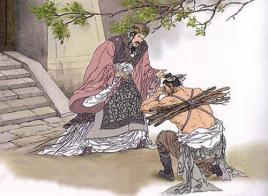
    When Lord Jingguo passed away, Tian Wen ascended to the position of Duke of Xue, known as Lord Mengchang. Lord Mengchang actively sought out talent from various states, regardless of their backgrounds as exiles, convicts, or outcasts. He provided them with not only employment but also generous compensation, lodging, and support for their families. His food court often hosted thousands of guests, each one of them thought Lord Mengchang treated him specially. He was widely regarded as a benevolent and exceptional ruler, earning fame across the kingdoms.

    Sima Guang’s comments: A ruler employs savants in order to serve his people.  As the Book of Yi says: ”A saint nurtures the talented, for the benefit of all people.” The moral character of a learned man moral has the power to shape social norms; the capabilities of a learned man’s abilities and skills can improve the functioning of an administration; the wisdom of a learned man enables them to identify flaws and anticipate future challenges; the integrity of a learned man upholds humanity and righteousness.  On a large scale, a learned man benefits the whole world; On a small scale, a learned man benefits a state or a community.  Rulers, recognizing the value of such individuals, reward them with wealth and titles as a way of nurturing them to benefit the broader population. This approach to staffing is considered wise and effective.

    On the other hand, Lord Mengchang put persons on his payroll, regardless if the person is wise or foolish, an angel or a criminal.  That’s abusing the Kingdom’s resources to fund his cronies.  They spread fake accolades of Lord Mengchang, cheating the King above them and corrupting the common people below them.  That’s a treacherous act and it is despicable, like the saying in the book Shu:”Accepting the deserters and renegades makes human sewage.”

    Lord Mengchang was sent to the state of Chu for a diplomatic mission, and the King of Chu gifted him an exquisite bed decorated with ivory carvings. He asked his attendant, Dengtu Zhi to oversee the shipment.  Dengtu Zhi did not want to take this chore.  He spoke to a disciple of Lord Mengchang, whose name is Gongsun Xu: ”The ivory bed is such a treasure worthy of thousands ounces of gold.  I could not, even if I sell my whole family, to compensate for a tiny bit of damage.  If you can talk me out of this assignment, I have a precious sword passed down from my ancestors that I’m willing to offer in return.”  Gongsun Xu promised him and went to see Lord Mengchang: ”The reason that all these small states want to appoint you as their prime minister is because you can uplift the poor, revive the fallen, and continue the lineage. They all appreciate your righteousness and admire your incorruptible integrity. But now, upon arriving in Chu, if you were to accept this ivory bed, how can you face the states that have not yet had the opportunity to host you?”  Lord Mengchang agreed.  He politely declined the gift from Chu.  As Gongsun Xu walked out and before he exited the middle court,  Lord Mengchang called him back: ”I saw you hopping out with joy, why were you so excited?”  Gongsun Xu confessed about the sword.  Lord Mengchang then posted an announcement at the city gate, which read: ”Any one who can improve Tian Wen’s reputation and correct Tian Wen’s mistakes, even if you take someone’s bribe for doing it, is urged to come forward with constructive criticism!”

    Sima Guang’s comments: It can be said that Lord Mengchang was receptive to counselings.  As long as the advice is good, even coming from ulterior motives, can still be taken, let alone the advice that is offered with selfless honesty.  The book of Shi has a poem: ”Pick collard greens, pick turnip greens; don’t care about the lower stems.” Lord Mengchang possessed the spirit of this.King Xuanhui of Han set out to appoint both Gongzhong and Gongshu to be in charge of the state affairs.  He consulted with his advisor Mu Liu.  Mu Liu was against the idea: ”Don’t do that.  Jin was characterized by the use of the Six Ministers leading to the division into three states. In the case of Qi‘s Duke Jian, he relied on Master Chen Cheng and Kan Zhi, which ultimately led to his assassination. In Wei, they relied on Xi Shou and Zhang Yi, and the lands west of the Yellow River were lost. Now, if you, my lord, rely on two prime ministers, the one with greater power will form factions internally, while the other with less power will seek external influence. Among your ministers, some will build internal factions to influence you, while others will seek external alliances to gain territory. In either case, our state is in danger.”ll form factions internally, while the other with less power will seek external influence. Among your ministers, some will build internal factions to influence you, while others will seek external alliances to gain territory. In either case, our state is in danger.”

  • Comprehensive Reflections to Aid in Governance(Part 17): Su Qin And The Vertical Alliance

    Comprehensive Reflections to Aid in Governance

    By Sima Guang

    Translated By Yiming Yang

    Annals of Zhou Book 2 Scroll 2 (continued)

    A Play on Su Qin

    The 36th year of King Xian (333 B.C. continued)

    Su Qin continued his persuasive efforts with King Xuanhui of Han: “The kingdom of Han boasts a large expanse of land, spanning nine hundred miles, and possesses hundreds of thousands of well-armed soldiers. The world’s finest bows, crossbows, and swords are all crafted right here in the state of Han. Han‘s archers are so skilled that they can leap into the air and unleash a continuous barrage of a hundred arrows. It is beyond doubt that the valor of a single Han soldier, armed with the best weaponry, can withstand the assault of a hundred adversaries.”

    “Your grace, if you yield to Qin‘s demands, they will not stop at just taking Yiyang and Chenggao as they did this year. Next year, they will seek even more territory. In the end, you will have nothing left to give. Any concession made now will only nullify the goodwill you have shown before, inviting calamity upon us. Your land is limited, while the kingdom of Qin‘s appetite is boundless. Attempting to satiate an insatiable hunger with limited resources is akin to trading grievances for misfortune. We are losing territory without putting up a fight. As the saying goes, ‘I would rather be a chick’s beak than the behind of a cow.’ It is regrettable that your wisdom, your grace, and the valor of Han‘s army are earning a reputation as the backend of a cow!” King Xuanhui of Han heeded Su Qin‘s counsel and decided not to concede to Qin‘s demands

    Su Qin continued his diplomatic efforts, this time directing his persuasive skills toward the King of Wei: “Your grace, your kingdom, although not extensive in terms of land, spans a thousand miles. It is a densely populated region filled with countless farms and residences, leaving little room for pastures. The population is so dense, and the traffic so bustling, that one might think it’s perpetually hosting armies on the move. In my humble opinion, your kingdom rivals the vastness of the kingdom of Chu.”

    “I have also come to understand the might of your armed forces: you command two hundred thousand heavily armed soldiers, two hundred thousand black-cap servicemen, two hundred thousand gladiators, and one hundred thousand auxiliary supporters. In addition, you possess six hundred chariots and five thousand cavalry.”

    “Yet, it troubles me to see that you are currently heeding advisors who advocate servility towards the Kingdom of Qin. I implore you to reconsider this stance and examine the charter of alliance provided by my lord, the King of Zhao. The charter is unequivocal: your commands are to be executed by the alliance!” King of Wei, after consideration, agreed to Su Qin‘s proposal.

    Su Qin‘s persuasive efforts extended to the King of Qi: “Your grace, the Kingdom of Qi boasts fortresses on all four borders, with territory spanning two thousand miles. It commands hundreds of thousands of well-armed soldiers and vast grain reserves. Your standing armies are well-disciplined, and five independent military forces are at your disposal in five cities. Your warriors move as swiftly as arrows, fight fiercely like thunderstorms, and retreat like showers. Even if a military conflict were to arise, the aggressors would have to clear Mount Tai, cross the Qing River, and navigate Bohai Bay.”

    “The city of Linzi alone houses seventy thousand families, and a rough estimate of three able-bodied men per family gives you two hundred and ten thousand potential fighters in Linzi alone, without counting neighboring counties. Linzi‘s people are prosperous and affluent, indulging in activities like cockfighting, dog racing, chess, and football. On Linzi‘s streets, cartwheels clash, pedestrians rub shoulders, and their sleeves brushing together could form a backdrop curtain, while wiping sweat from their brows could create a downpour.”

    “However, certain ministers who fear Qin‘s proximity dominate the strategic decisions of the states of Han and Wei because they share borders with Qin. The survival or downfall of these states can be decided within ten days of mobilizing their troops. Even if they win, they might lose half their forces and face border incursions. If they lose, their state may face defeat and collapse. This is why the states of Han and Wei tend to appease Qin and hesitate to engage in combat. Qi‘s security against a Qin invasion is entirely different. Qin invaders must traverse the lands of Han and Wei, navigate the narrow road at Yanjin (in Wei), and break through the strategic Kangfu Pass. Qin‘s chariots cannot move in combat formations, and cavalry cannot advance side by side through these passages. A hundred defenders on these bastions can thwart thousands of attackers. Qin‘s army may want to advance deep into Qi, but they must also be cautious, wary of attacks from Han and Wei from behind.”

    “It is evident that Qin does not pose an immediate threat to Qi. They resort to trickery, threats, and bluster rather than moving into combat. Those ministers who advocate submission to Qin do not fully grasp the situation, Your grace. You possess the means to safeguard your state and need not be labeled as subservient to Qin. Please consider our strategy carefully.” The King of Qi approved of Su Qin‘s counsel.

    Su Qin continued his diplomatic efforts in the southwest, addressing the King of Chu: “The Kingdom of Chu stands as a world superpower, spanning a vast territory of six thousand miles. Its army numbers one million strong, equipped with thousands of chariots and tens of thousands of horses. Its granaries hold enough grain to sustain the state for a decade, a resource that signifies dominance. To the Kingdom of Qin, Chu represents a greater threat than any other state. The strength of Chu corresponds to the weakness of Qin, and vice versa. Qin and Chu cannot coexist peacefully.”

    “To your advantage, the Kingdom of Chu should join the vertical alliance to isolate the Kingdom of Qin. I will ensure that other states east of Xiao Mountain pay tribute to you with seasonal produce, obey your orders, entrust their state affairs and heritage to you, and train their soldiers to follow your lead. Joining the vertical alliance implies that all states cede their lands and are subject to Chu, while joining the horizontal alliance implies that the Kingdom of Chu surrenders its land and is subject to Qin. The consequences of these two options are vastly different. Which one do you choose?” The King of Chu concurred with Su Qin‘s proposal.

    With Su Qin‘s successful diplomacy, he assumed the role of chief commander and prime minister for all six states of the vertical alliance. He traveled north to report to the Marquis of Zhao, accompanied by an impressive entourage equipped with chariots and well-armed guards, rivaling that of a king.

    King Wei of Qi passed away, and his son, Piqiang, ascended to the throne as King Xuan of Qi. King Xuan of Qi recognized that Marquis Cheng (Zou Ji) had wrongfully accused Tian Ji and reinstated Tian Ji to his former position.

    Duke Wen of Yan also passed away, and his son succeeded him as King Yi of Yan.

    Marquis Cheng of Wey passed away, and his son took over as Marquis Ping of Wey.

    The 37th year of King Xian (332 B.C.)

    The king Hui of Qin, in an attempt to disrupt the vertical alliance, sent Xi Shou to deceive the Kingdoms of Qi and Wei into forming a coalition against the state of Zhao. This move aimed to thwart the alliance that Su Qin had been working on. When Marquis Su of Zhao discovered this plot, he held Su Qin responsible, and Su Qin became fearful.

    To make amends, Su Qin offered to lobby the state of Yan to seek revenge for Qi‘s actions. As Su Qin left the state of Zhao, the vertical alliance fell apart. The people of Zhao breached a dam to flood the armies of Qi and Wei, forcing them to withdraw.

    In a gesture of reconciliation, the Kingdom of Wei ceded the city of Yinjin to the Kingdom of Qin. This city is now known as Huayin.

    Subsequently, the King of Qi launched a campaign against the state of Yan, capturing ten cities. However, they later returned these cities to their original owner Yan.

  • Comprehensive Reflections to Aid in Governance(Part 16): Su Qin and Zhang Yi

    Comprehensive Reflections to Aid in Governance

    By Sima Guang

    Translated By Yiming Yang

    Annals of Zhou Book 2 Scroll 2 (continued)

    The Book by Guiguzi

    The 36th year of King Xian (333 B.C.)

    The king of Chu launched an attack on the state of Qi and defeated the Qi army. He besieged Xuzhou and ordered the expulsion of Tian Ying. However, Tian Ying sent an envoy named Zhang Chou to plead with the King of Chu. After hearing Zhang Chou’s plea, King of Chu decided to halt the attack on Qi.

    The construction of the grand palace portal in the state of Han has been completed. Marquis Zhao of Han had passed away, and his son had succeeded him, assuming the title of King Xuanhui of Han.

    Earlier, Su Qin from the city of Luoyang had approached the King of Qin with a proposal for unifying China, but the King of Qin had not taken his advice seriously.

    Su Qin then decided to visit Duke Wen of Yan and presented a persuasive argument: “The reason the state of Yan has remained free from the harassment of bandits and soldiers is the protective shield provided by the state of Zhao to the south. If the state of Qin were to wage war against Yan, it would have to do so thousands of miles away from its own territory. On the other hand, if the state of Zhao were to engage in conflict with Yan, it would be doing so only hundreds of miles from its own borders. It is unwise to worry about a distant enemy while ignoring a threat much closer to home. I propose, Your Grace, that you form a marital alliance with Zhao, ultimately uniting with the state of Zhao. This way, Yan will have no more cause for concern.”

    Duke Wen of Yan recognized the wisdom in Su Qin‘s advice and not only accepted it but also facilitated his journey to the state of Zhao to pursue this alliance further.

    Su Qin employed his persuasive skills once more, this time lobbying Marquis Su of Zhao. He presented his case: “At present, there is no state stronger than Zhao. Qin considers Zhao its primary adversary but has refrained from launching an offensive due to concerns that Han and Wei may conspire against them from behind. There are no natural barriers like large mountain ranges and rivers between Qin and these two states. Qin‘s strength allows it to gradually encroach on their territory, eventually besieging their capitals. Han and Wei would then succumb to Qin‘s pressure, becoming Qin‘s vassals. If Han and Wei no longer pose a threat, the state of Zhao will be next in line.

    “As I examine the map of the realm, I see that the combined land area of all the other states is five times greater than that of Qin. It is estimated that these states possess ten times as many soldiers as Qin. If the six major states unite and launch a westward offensive against Qin, Qin will be overpowered.  There are consultants who will attempt to encourage other states to dole out territories to appease Qin‘s threat. They will be rich and famous if Qin gets its wish. They will not concern themselves with the danger Qin poses to their states. This is why you are seeing these lobbyists constantly urging you to cede land to pacify Qin.

    “Therefore, I implore you, your grace, to scrutinize their proposals. If I may offer a plan, it would be to unite the six states—Han, Wei, Qi, Chu, Yan, and Zhao—through marriage alliances to resist Qin‘s aggression. We can invite ministers and generals from all six states to a conference near the Huan River, forming an alliance by exchanging hostages as a guarantee. Our alliance charter will state: ‘All states shall send their finest soldiers to aid any state attacked by Qin or to retaliate against Qin. Any state violating this charter will face collective retaliation from the other five states.’ With all six states united against Qin, Qin‘s armored divisions will not dare to venture out of the Hangu Pass to threaten the states east of Xiao mountain.”

    Marquis Su of Zhao was greatly impressed by Su Qin‘s wisdom and appreciated his advice. He treated Su Qin with great honor, bestowing him with gifts and rewards, and entrusted him as his envoy to negotiate with the leaders of the other states.

    During this period, the army of Qin, under the leadership of Xi Shou [Gongsun Yan], launched a military campaign against the state of Wei. They defeated the Wei army of forty thousand troops, captured the Wei general Long Gu, and seized the city of Diaoyin. With the Qin army poised to advance further eastward, Su Qin became increasingly concerned that they would reach the state of Zhao before he could establish the alliance. He couldn’t think of anyone in Qin who would be willing to collaborate with him.

    In an act of chicanery, Su Qin deliberately angered his friend Zhang Yi, who was also a student of Master Guigu and had expertise in political strategy. Su Qin believed that Zhang Yi was more skilled than himself in this art. Zhang Yi had been traveling among various states trying to garner support for their cause but had found few willing listeners. He became stranded in the state of Chu.

    Su Qin summoned Zhang Yi to the state of Zhao and personally insulted him. This mistreatment infuriated Zhang Yi, who realized that only the state of Qin had the potential to pose a significant threat to Zhao. Consequently, he decided to travel westward to Qin, with the intention of aiding them in their campaign against the eastern states.

    Su Qin acted covertly by sending his servant along with Zhang Yi, providing him with gold coins for his journey. Zhang Yi used these resources to bribe his way into an audience with the King of Qin. The King was impressed with Zhang Yi‘s persuasive abilities and appointed him as an advisor.After successfully gaining the King of Qin’s favor, Zhang Yi’s servant bid him farewell and explained Su Qin‘s strategy. Su Qin had intentionally provoked Zhang Yi and then arranged for him to travel to Qin. This was all part of Su Qin‘s plan to ensure Zhang Yi could wield influence in Qin, preventing a Qin invasion of Zhao and preserving the alliance. Zhang Yi was deeply impressed by Su Qin‘s strategic acumen: ”Alas! This is my specialty and I did not even realize what happened!  It is obvious that Mr. Su is a superior strategist.  Please convey my gratitude to Mr. Su.  As long as he is in charge, Zhang Yi won’t interfere with his plan.”

  • Comprehensive Reflections to Aid in Governance(Part 15): Personal Interest

    Comprehensive Reflections to Aid in Governance

    By Sima Guang

    Translated By Yiming Yang

    Annals of Zhou Book 2 Scroll 2 (continued)

    Mencius Temple

    The 32nd year of King Xian(337 B.C.)

    Shen Buhai of Han died.

    The 33rd year of King Xian(336 B.C.)

    An altar at Taiqiu of state Songcollapsed. Meng Ke, from Zou, traveled a long distance to visit King Huiof Wei. King Huiwarmly welcomed him and remarked, “Old man, you have journeyed tens of thousands of miles to visit us. You must have Wei‘s interests at heart.”Meng Kereplied, “Why should Your Excellency speak of interests when we should be talking about love and righteousness? A king seeks the interests of the nation, an official seeks the interests of his kin, and a commoner seeks personal interests. If everyone only pursues their self-interest, it will endanger the entire country. People who love others won’t neglect their families, and those who are righteous will serve their lord first.”King Huiof Weiappreciated Meng Ke‘s wise words.Meng Ke, also known as Mencius, studied under Zisi, the eldest grandson of Confucius. During his studies, Menciusasked about the priority in managing people. Zisi responded, “Personal interest is the top priority.”Menciuswas puzzled and asked, “A virtuous person should educate their people on love and righteousness. Why do we emphasize personal interest?”Zisiexplained, “Love and righteousness ultimately serve everyone’s interests. A leader who lacks love and righteousness will not provide for the needs of their people, and an unjust leader will lead their people into deceit and harm their personal interests. This is why the Book of Changes says, ‘Personal interest is the sum of the righteousness of all people.’ It also states, ‘It is in your own interest to improve your life. A better personal life enhances your morality.’ This underscores the importance of personal interests.”Sima Guang‘s comments: The teachings of Zisiand Menciusare of the highest caliber. Only those who possess love and righteousness truly understand what constitutes their own interests. People who lack love and righteousness cannot comprehend the essence of genuine self-interest. When Mencius conversed with King Huiof Wei, he primarily emphasized the principles of love and righteousness because he recognized his audience and the significance of these virtues in governance.

    The 34th year of King Xian(335 B.C.)

    The state of Qininvaded Han, and took the city of Yiyang.The King of Qiappointed Tian Yingas the ruler of Pengcheng. Tian Yingadvised the King of Qi, saying, “The strategies and plans of the five ministers are something you should listen to and review daily.” The king followed his advice but later became weary of it, so he entrusted all his authority to Tian Ying. As a result, Tian Yinggained full control over the state affairs of Qi.

    The 35th year of King Xian(334 B.C.)

    Tian Yingserved as the prime minister of the state of Qi. The King of Qiand The King of Weiheld a meeting in Xuzhouto proclaim each other as a king. When King of Chuheard about this meeting, he became furious with Tian Ying.Marquis Zhao of Hanwas building a portal in his place.  Qu Yijiu warned him:”You should refrain from walking through this portal. Why, you ask? It’s a matter of timing, not in terms of the chosen date, but rather in the sense that people go through ups and downs in life. In the past, when everything was going well, you didn’t consider building a portal. Just last year, Qin took our city Yiyang, and this year we grappled with a drought. You seem to be overlooking the suffering and urgent needs of the people while pursuing extravagant decorations. This is akin to spending lavishly when you’re financially strained. It’s not the right timing for such endeavors.”King of Yue, Wuqiang, initially planned to launch an attack on the state of Qi. In response, the King of Qisent an envoy to persuade Wuqiang, highlighting the greater benefits of instead targeting the state of Chu. King Wuqiang reconsidered his strategy and redirected his forces towards an assault on the state of Chu.The state of Chu, however, proved to be a formidable adversary, decimating the troops of Yue. Following this victory, Chuexpanded its territory, extending eastward into Zhejiang. This defeat led to the disintegration of the state of Yue, as noble families within Yuevied for titles and power. Some declared themselves kings, while others claimed the title of princes. They scattered along the coastline and ultimately became subservient to the King of Chu.

  • Comprehensive Reflections to Aid in Governance(Part 14): The Demise of Shang Yang

    Comprehensive Reflections to Aid in Governance

    By Sima Guang

    Translated By Yiming Yang

    Annals of Zhou Book 2 Scroll 2 (continued)

    The 29th year of King Xian (340 B.C.)

    Wey Yang spoke to Duke Xiao of Qin: “The state of Wei is a threat to Qin, much like a heart disease to a person. If Qin does not annex the state of Wei, Wei will surely annex Qin. Why do I say this? The state of Wei lies to the west of a mountain range with its capital at the city of Anyi. It shares a border with Qin along the Yellow River, providing it with a unique defensive advantage to the east of the mountain range. During favorable times, Wei could launch an invasion westward into Qin. In unfavorable times, Wei could move eastward and expand its territory. Currently, Qin is strong and prosperous under your excellent leadership, while Wei suffered defeat at the hands of the state of Qi last year and has been bullied by other states. This presents an opportune moment to weaken Wei. Wei is no match for Qin, and it would have no choice but to move eastward. Qin can secure the mountain range and the Yellow River as natural defensive lines, obtaining a much better strategic posture against the states to the east. This is the path to dominate all states and establish Qin as the preeminent power.”

    Duke Xiao of Qin approved and designated Wey Yang as the commander of the invasion of Wei. On the Wei side, Prince Ang was appointed as the general leading the defense.

    When both armies were in their positions, Wey Yang sent a letter to Prince Ang: “We used to be friends, and now we find ourselves as commanders on opposing sides. I truly cannot bear the thought of attacking you. I propose that we have a reunion, share a drink together, and then cease fighting for the sake of the people in our states.”

    Prince Ang liked the idea, and they arranged to meet. During their reunion, they shared drinks. However, after the meeting, Wey Yang ordered his armored soldiers to launch a surprise attack, capturing Prince Ang.  Then he ordered an assault on the Wei army, which had lost its commander. The Wei army was decisively defeated. King Hui of Wei, fearing further losses, sent an envoy to offer all the land west of the Yellow River to the state of Qin as a means to negotiate for peace.

    As a result of these events, the state of Wei moved its capital from Anyi to Daliang. King Hui expressed his regret, acknowledging that he should have heeded the advice of Gongshu Cuo.

    The state of Qin rewarded Wey Yang with fifteen cities in Shang as his fief, and he was granted the title “the Lord of Shang,” or Shang Yang, which he held from that point forward.

    During this time, the states of Qi and Zhao launched raids against the state of Wei.

    Meanwhile, in the state of Chu, King Xuan passed away, and he was succeeded by his son, who became known as King Wei of Chu.

    The 31st year of King Xian (338 B.C.)

    Duke Xiao of Qin passed away, his son ascended to the throne as King Huiwen of Qin. Prince Qian and his supporters accused Shang Yang of plotting against the new king. King Huiwen ordered Shang Yang‘s arrest, prompting Shang Yang to flee to the state of Wei. However, he was not welcomed there and subsequently returned to Qin.

    Shang Yang and his followers attempted to escape to his fiefdom but were intercepted by the people of Qin. They fled northward and besieged the city of Zheng. However, the Qin people caught up with Shang Yang and killed him. His body was torn apart by five horses, and all his family members were executed as well.

    Shang Yang, who previously served as the prime minister of Qin, ruled with iron wrists, strict and harsh enforcement of the law. His methods were often brutal, and he frequently executed prisoners along the banks of the Wei River, staining its waters red. After governing Qin for a decade, he had accumulated many enemies.

    One day, a man named Zhao Liang approached Shang Yang. Shang Yang posed a question to him, asking whether he thought Minister Five-Goatskins [Baili Xi, the prime minister of Duke Mu of Qin] or himself was the better ruler. Zhao Liang responded cautiously, saying, “The confirmation of thousands of yes-men, is not worth the honest discourse of one. May I speak freely without fear of retaliation?” Shang Yang agreed, saying, “You have my word.”

    Zhao Liang continued his candid assessment: “Minister Five-Goatskin rose from being a cow herder in the state of Chu to becoming the prime minister of Qin, a position of immense power overseeing tens of thousands. This was an unimaginable ascent. During his six or seven years in office, he launched military campaigns against Zheng to the east, orchestrated the installation of three lords in the state of Jin, and rescued the state of Chu from dire straits. He led a frugal life, traveling without carriages or bodyguards even during sweltering summers. When he passed away, the people of Qin, regardless of age or gender, mourned his loss deeply. Even children stopped singing, and farmers halted their work to pay their respects.”

    Zhao Liang then shifted his focus to Shang Yang: “Your rise to power was facilitated by the eunuch Jing Jian’s introduction to Duke Xiao. Your governing style has been characterized by oppressing the lower classes and bullying the upper classes. Gongzi Qian endured eight years of house arrest under your rule. You executed Zhu Huan, one of his teachers, and disfigured Gongsun Gu’s face. As the Book of Songs suggests, those who are popular rise, and those who are unpopular fall. Your actions, as I mentioned earlier, have not garnered popularity.”Zhao Liang pointed out Shang Yang‘s reliance on force: “Whenever you go out, you are surrounded by chariots and heavily armed guards. A group of burly men drives your chariot while encircling you. You parade through the streets with a procession of armed guards. Without a significant armed escort, you dare not venture outside. As the Book of Shu warns, those who rely on virtue prosper, but those who rely on force perish. Your actions have not been rooted in virtue, and your reign may be as fleeting as a drop of morning dew. While you enjoy the wealth from your fief and maintain a tight grip on power in Qin, the grievances of the people are mounting. If the current King of Qin loses control of power or decides to exclude foreigners from his government, there would not have been a shortage of people in Qin who wanted to put you in prison.” Shang Yang did not heed Zhao Liang‘s advice, and within five months, he faced his downfall.

  • Comprehensive Reflections to Aid in Governance(Part 13): Pang Juan at Maling

    Comprehensive Reflections to Aid in Governance

    By Sima Guang

    Translated By Yiming Yang

    Annals of Zhou Book 2 Scroll 2 (continued)

    The 28th year of King Xian (341 B.C.)

    Pang Juan of Wei led a raid on the state of Han, prompting Han to request aid from the state of Qi. King Wei of Qi sought advice from his advisers regarding when to come to Han’s aid. Marquis Cheng, the prime minister of Qi, Zou Ji, suggested not getting involved at all. Tian Ji disagreed, stating that aiding Han sooner was better to prevent Wei from annexing it. Sun Bin, however, had a different strategy.

    “If we help the armies of Han and Wei before they are weakened, it’s like we are substituting for Han and brunt the assault of Wei‘s armies, effectively acting under the direction of Han. Furthermore, if Wei harbors ambitions to conquer other states and sees that Han is on the verge of collapse, Han will likely turn their sights to the east and seek support from Qi. Therefore, it is strategically sound to strengthen our ties with Han, profiting from their resources, while delaying our clash with Wei. In this way, we can secure significant benefits and enhance our reputation.”

    King Wei of Qi approved Sun Bin‘s plan and promised assistance to Han while letting the Han envoy leave empty-handed. Han, with the assurance of Qi‘s support, entered the battlefield confidently but lost all five battles, eventually consigning the entire state to Qi at its mercy. Qi then sent its army, led by generals Tian Ji, Tian Ying, and Tian Pan, with Sun Bin as the chief strategist, to aid Han. The army moved directly toward Wei‘s capital.

    Pang Juan, commander of Wei‘s forces, learned of Qi‘s movement and immediately returned with his army from Han. Wei mobilized its people to defend against Qi, appointing Crown Prince Shen as the commander. Sun Bin advised Tian Ji to use strategy to turn the situation in their favor.

    “Those three states derived from Jin have always possessed formidable and valiant armies, while they consider Qi as having a reputation for timidity in battle. A wise military commander takes advantage of the enemy’s disposition and leads them toward his own advantage. As mentioned in the Art of War, ‘Charging a hundred li[Chinese mile] forward to engage the enemy might lead to the loss of a top general, while charging fifty li[Chinese mile] forward might cause half the troops to fall behind.’”

    Sun Bin ordered the army to build one hundred thousand hearths on the first day upon entering Wei‘s territory. On the second day, they reduced the number to fifty thousand, and on the third day, to thirty thousand. Pang Juan heard this report and became overconfident, thinking that the soldiers of Qi feared them. He left his infantry behind and personally led his cavalry to chase the retreating Qi army all day and night.

    Sun Bin, aware of Pang Juan‘s movement, estimated he would arrive at Maling at sunset. Maling was a place with a narrow path surrounded by barriers, ideal for an ambush. Sun Bin had a large tree trunk hacked and wrote “Pang Juan dies under this tree” in white characters. He then positioned archers around the path, instructing them to shoot when they saw fire after sunset.

    At sunset, Pang Juan reached the hacked tree and lit a torch to read the white characters. Before he could finish reading, thousands of arrows were shot at him. The army of Wei fell into disarray, and realizing he had no way out, Pang Juan took his own life, saying, “I made that son of a bitch famous!” The troops of Qi capitalized on the momentum and routed the army of Wei, capturing Crown Prince Shen of Wei in the process.

    Marquis Cheng, Zou Ji, held a strong dislike for Tian Ji. In an attempt to implicate Tian Ji, Marquis Cheng devised a cunning plan. He sent an individual carrying ten ounces of gold to a local market and engaged a fortune teller’s services. The fortune teller was told that the person seeking guidance was a follower of Tian Ji and that their lord had won three battles and was revered around the world. The fortune teller was further informed that their lord was planning a significant move and inquired whether it would be successful.As soon as the fortune teller completed the session and the customer left, Zou Ji had the fortune teller arrested. Tian Ji found himself unable to defend against the accusations of conspiracy and, in response, led an attack on the capital city of Linzi with his followers. Their aim was to capture Marquis Cheng. Unfortunately for Tian Ji, they were unable to breach the defenses of Linzi, leading him to flee to the state of Chu. Ji, they were unable to breach the defenses of Linzi, leading him to flee to the state of Chu.

  • Comprehensive Reflections to Aid in Governance(Part 12): The PM of Han

    Comprehensive Reflections to Aid in Governance

    By Sima Guang

    Translated By Yiming Yang

    Annals of Zhou Book 2 Scroll 2 (continued)

    A Book on Shen Buhai

    The 17th year of King Xian (352 B.C.)

    Wey Yang, the defense minister of the State of Qin, spearheaded a military campaign against the State of Wei

    In an unexpected turn of events, Wei emerged victorious over the combined forces of several states, by leveraging assistance from the troops of Han, during a battle at Xiangling. As a response to the escalating conflict, Qi sent Jing She from Chu on a mission to negotiate peace. In response, King Hui of Wei orchestrated a meeting with the armies that had laid siege to them, representing both Qi and Song.

    The 18th year of King Xian (351 B.C.)

    Wey Yang of Qin besieged the city of Guyang in the state of Wei, which eventually surrendered to Qin.

    The state of Wei returned the city of Handan to the state of Zhao, and the two states established an alliance along the Zhang River.

    Marquis Zhao of Han appointed Shen Buhai as the prime minister of Han. Shen Buhai had a humble background, having served as a lowly servant in the state of Zheng before it was annexed by Han. He was well-versed in both Taoism and Legalism and applied his philosophical knowledge to assist Marquis Zhao in governing. Shen Buhai managed government affairs and education within the state of Han meticulously, while also maintaining diplomatic relations with other states’ princes and envoys. Over a span of fifteen years, Han‘s internal affairs were well-ordered, and its military forces were well-prepared.

    Shen Buhai made a request to Marquis Zhao on behalf of his cousin to be appointed to an official position. However, Marquis Zhao did not grant approval, leading to Shen‘s dissatisfaction. In response, Marquis Zhao engaged in a thought-provoking conversation with Shen Buhai: “You taught me about governing a state based on merits. Now you seek positions for your relatives, which principle should I follow – your advice or your request? Should I violate the regulations you’ve advocated by appointing your cousin, or should I uphold your regulations and deny your application?” Shen Buhai, acknowledging Marquis Zhao‘s wisdom, rose from his seat and bowed, stating, “You are the lord I truly want to serve!”

    An anecdote is also mentioned where Marquis Zhao had a pair of worn-out pants, which he instructed his assistant to save. When questioned about this unusual act, Marquis Zhao explained: “A wise lord cherishes his expressions of disapproval and approval. Just as a frown is reserved for matters deserving disapproval, and a smile for matters deserving approval, these worn-out pants are no different. I will give them to those who deserve them.”

    The 19th year of King Xian (350 B.C.)

    Shang Yang (formerly referred to as Wey Yang) constructed gates and palaces in Xianyang, subsequently relocating the capital of Qin there. He introduced new laws, which included a prohibition on adult sons living in the same household as their fathers and brothers. Additionally, he amalgamated numerous small towns and villages into counties, assigning an executive officer (commander) and a judicial officer (sheriff) for each county. The state of Qin encompassed a total of thirty-one counties. Shang Yang abolished the # field system, also known as the Nine-squares system, where public land (state-owned) was cultivated jointly with private lands. He flattened the ridges and gutters that divided fields into squares, constructing broader field paths within farmland. Furthermore, he standardized the measurement system across the state of Qin, publishing standard measurements for volume, weight, and length.

    The armed forces of Qin and Wei encountered each other at Tong, resulting in a confrontation.

    Marquis Cheng of Zhao passed away, and his son Xie engaged in a dispute with the Crown Prince Yu over the succession. Prince Xie’s attempt to establish himself failed, and he fled to the state of Han. The Crown Prince Yu succeeded to the throne and became Marquis Su of Zhao.

    In the state of Song, Lord Ticheng deposed the ruler and declared himself as the new ruler..

    The 21st year of King Xian (348 B.C.)

    Shang Yang introduced a new taxation law in the state of Qin, further solidifying the ongoing land taxation reform. This law was implemented immediately upon its promulgation.

    The 22nd year of King Xian (347 B.C.)

    Prince Fan of Zhao launched an attack on the capital city Handan, but his rebellion was ultimately suppressed, resulting in his death.

    The 23rd year of King Xian (346 B.C.)

    An official named Mou from the state of Qi was executed for recommending unsuitable candidates.

    Duke Kang of Lu passed away, and his son Yan succeeded him as Duke Jing of Lu.

    The smaller state of Wey reduced its noble title from Duke to Marquis and became subservient to the larger states composed of Jin, which are Han, Wei, and Zhao.

    The 25th year of King Xian (344 B.C.)

    The heads of all vassal states gathered at the capital city of Zhou for a meeting.

    Duke Xiao of Qin appointed his son, Prince Shaoguan, to lead troops to a conference at Fengze, where all the heads of states convened. Following the conference, the participants paid homage to King Xian of Zhou.

    The 26th year of King Xian (343 B.C.)

    King Xian of Zhou officially acknowledged the state of Qin as the foremost leader among all the vassal states.  The King of Qin had received congratulations from the other states.Following the passing of King Wu Zhuān, his son King Wu Qiàng ascended to the throne in the state of Yue.

  • Comprehensive Reflections to Aid in Governance(Part 11): Encircling Wei to Rescue Zhao

    Comprehensive Reflections to Aid in Governance

    By Sima Guang

    Translated By Yiming Yang

    Annals of Zhou Book 2 Scroll 2 (continued)

    Sun Bin

    The 11th year of King Xian (358 B.C.)

    The state of Qin defeated the army of Han at West Mountain.

    The 12th year of King Xian (357 B.C.)

    The troops from the states of Han, Zhao, and Wei united and joined forces at Hao.

    The 13th year of King Xian (356 B.C.)

    The troops from the states of Zhao and Yan combined their forces at E.

    The troops from the states of Zhao, Qi, and Song united at Pinglu.

    The rulers of Lu, Wey, Song, and Han paid homage to the ruler of Wei.

    The 14th year of King Xian (355 B.C.)

    King Wei of Qi and King Hui of Wei went hunting together in the suburbs. King Hui of Wei asked, “Does the state of Qi have any treasures?” King Wei of Qi replied, “No.” King Hui said, “Even my small state has pearls of an inch in diameter. We have ten of those pearls that illuminate twelve chariots in the front and twelve chariots in the back. How come there are no treasures in a large state such as Qi?”

    King Wei of Qi responded, “Your grace, our definition of treasures seems to differ. I have a minister named Tanzi, who guards the southern cities. The large state of Chu dares not harass our border, and the twelve small states along the Si River pay homage to my state. I have a minister called Panzi. When he defends the city of Gaotang, the people of state Zhao dare not fish on the east Yellow river. I have an official named Qianfu, who guards the city of Xuzhou. The people of the State of Yan pay tributes at the north gate of Xuzhou, and the people of the state of Zhao pay tributes at the west gate of the city. More than seven thousand families have since moved into the city. I also have a minister named Zhongshou. When asked to reduce robbery crimes, he has made the people won’t pick up things that others dropped. I have these four ministers who shine through thousands of miles, not to mention twelve chariots.”

    King Hui of Wei felt ashamed by King Wei‘s response.

    Duke Xiao of Qin and King Hui of Wei met at Duping.

    Duke Gong of Lu passed away. His son Mao succeeded him as Duke Kang.

    The 15th year of King Xian (354 B.C.)

    The army of the State of Qin routed the army of the State of Wei, beheading seven thousand soldiers. The State of Qin also captured the city of Shaoliang from the State of Wei.

    King Hui of Wei led a campaign against the State of Zhao and laid siege to the city of Handan.

    In response to the situation, the King of Chu ordered his general Jin She to come to the aid of the State of Zhao.

    The 16th year of King Xian (353 B.C.)

    King Wei of Qi dispatched his general Tian Ji to aid the besieged state of Zhao. It leads to a story about Sun Bin and Pang Juan.

    Sun Bin and Pang Juan, both students of the art of war in their youth, followed very different paths. While Pang Juan rose to become a general for the State of Wei. Sun Bin‘s superior capabilities ignited Pang Juan‘s jealousy. Pang Juan falsely accused Sun Bin of a crime upon summoning him to Wei. Pang had his feet cut off and branded his face, disabling him for life.

    However, fate took a twist when an envoy from the state of Qi arrived in Wei. Sun Bin, though treated as a prisoner, managed to secretly share his story with the envoy. He persuaded the envoy to hide him in his vehicle, enabling Sun Bin to escape to Qi. General Tian Ji extended respect towards Sun Bin and introduced him to King Wei of Qi. The king, recognizing Sun Bin‘s exceptional understanding of warfare, engaged in discussions with him. Impressed by Sun Bin‘s insights, King Wei appointed him as his teacher.

    As the discussion turned to aiding the state of Zhao against Wei‘s onslaught, King Wei and General Tian Ji sought Sun Bin‘s counsel. However, Sun Bin, due to his fugitive status, declined the role of a general. Instead, they decided on Tian Ji as the general and Sun Bin as his strategic adviser. Positioned in a caravan, Sun Bin oversaw the military strategies.

    When Tian Ji initially planned a direct intervention to defend Zhao, Sun Bin advised against a head-on confrontation: “In the art of warfare, direct frontal assaults are not always the most effective approach. Instead, it is wiser to target the enemy’s vulnerabilities and critical areas, altering the dynamics of the battle by imposing constraints on both sides. This strategic shift can naturally lead to the cessation of hostilities.”

    “At this time, the states of Wei and Zhao were locked in conflict along their borders. The youth and most skilled fighters were engaged in this border dispute, leaving the interior areas defended by older and weaker soldiers. Why not take advantage of this situation? Lead our troops swiftly to Wei‘s capital, seize the strategic gateways and thoroughfares of the state, and strike at its exposed weak points. The Wei forces, preoccupied with the defense of their own home, would be compelled to redirect their efforts, abandoning the siege on Zhao. By executing this strategic maneuver, we can not only defeat Wei‘s army but also relieve the siege on Zhao in one decisive move.”

    Tian Ji heeded Sun Bin‘s advice. In October of the winter, the city of Handan surrendered to the state of Wei. The Wei army rushed back to its home territory, abandoning their heavy equipment and walking day and night. They walked into a trap set by Qi‘s forces at Guiling. In this ambush, the army of Wei suffered a devastating defeat. 

    The state of Han raided the sovereign of East Zhou, took the cities of Lingguan and Linqiu.

    Zhao Xixu held the position of prime minister in the state of Chu. One day, Jiang Yi addressed the King of Chu with a story: “There is a man who has a deep affection for his dog. Unfortunately, the dog frequently urinates in the well. Observing this, concerned neighbors wished to caution the man about the contamination. However, when they approached his doorstep, the dog fiercely barked and even bit them. In a similar manner, Zhao Xixue behaves like that dog. He vehemently opposes my proposals. Just as your grace would get closer to someone who constantly praises others as he looks like a nobleman, and to avoid someone who constantly criticizes others as they might be unpleasant. There are sons who commit parricide and assistants who betray their lords, but often these matters go unnoticed. Why? Because your grace is inclined to listen to favorable things and averse to hearing unfavorable truths.”

    In response, the King of Chu concurred, acknowledging the wisdom in Jiang Yi‘s words: “You are absolutely correct. I should have made an effort to listen to both sides of the story.”

    King Xuan of Chu once asked his ministers, “I have heard that the people in the northern regions fear Zhao Xixu. Is this really the case?” The ministers remained silent. Jiang Yi spoke up and said, “The tiger seeks to eat all beasts and captures a fox. The fox says, ‘You wouldn’t dare to eat me. The Heavenly Emperor appointed me to govern all beasts. If you eat me, you are defying the Heavenly Emperor’s command. If you doubt my words, I will go ahead of you, and you can follow behind me. Let’s see if any of the other beasts dare not flee upon seeing me.’ The tiger believed this and followed the fox. When the other beasts saw them, they all fled. The tiger didn’t realize that the beasts feared itself and fled, not the fox. Similarly, although Your Majesty’s realm covers five thousand miles and you have an army of one million soldiers, the northern regions’ fear of Zhao Xixu is actually due to their fear of your mighty military force, just like the beasts’ fear of the tiger.”

    Jingshan of Song and Gongsun Cang of Wey joined the forces of Qi.  The force of the coalition besieged Wei’s army at Xiangling.

  • Comprehensive Reflections to Aid in Governance(Part 10): Shang Yang’s Reform

    Comprehensive Reflections to Aid in Governance

    By Sima Guang

    Translated By Yiming Yang

    Annals of Zhou Book 2 Scroll 2 (continued)

    Shang Yang

    The 8th year of King Xian (361 B.C.)

    Duke Xiao promulgated an edict seeking capable officials in the state of Qin: ”In ancient times, my ancestor Duke Mu, through cultivating virtue and practicing martial arts between Qi and Yong, brought peace to Jin in the east and established the Yellow River as the boundary. He then dominated the Rong and Di tribes in the west, expanding his territory for thousands of miles. The King of Zhou bestowed the title of Count upon him, and the other feudal lords all congratulated him. His achievements were admired by later generations and shone brightly.”

    “However, during the reigns of the previous rulers – Duke Li, Duke Zao, Duke Jian, and Duke Chu – the country faced internal troubles, and there was no time to deal with external affairs. The Three Jin attacked and seized the territory west of the Yellow River, causing great humiliation. When Duke Xian ascended the throne, he stabilized and pacified the borders, moved the capital to Liyang, and intended to launch an eastern expedition to reclaim the ancestral land of Duke Mu and uphold his policies and laws. I often feel sad at the thought of my father’s unfulfilled aspirations.  I would like to open prominent positions, for all the citizens and visitors, whoever had great ideas to build a stronger Qin would be my distinguished ministers.  I will grant them a portion of the land.”

    The decree reached Gongsun Yang in the state of Wey, prompting him to relocate to the state of Qin. As the grandson of Wey’s ruler, Gongsun Yang immersed himself in studying the teachings of Legalists. He had previously served under Gongshu Cuo, the prime minister of Wei, who recognized his potential but had not yet recommended him for advancement.

    When Gongshu Cuo fell seriously ill, King Hui of Wei paid him a visit to offer comfort. Concerned about the management of state affairs in Gongshu Cuo‘s absence, King Hui inquired, “Who will oversee the state affairs? Heaven forbid, what will happen if you are gone?” To this, Gongshu Cuo replied, “My assistant, Wey Yang, is a young and exceptionally talented individual. You can rely on his advice for all state affairs.” King Hui listened but remained silent. Gongshu Cuo continued, “If you don’t promote him, then kill him, please do not let him leave this state.”

    Agreeing with Gongshu Cuo‘s proposal, King Hui left. Gongshu Cuo immediately summoned Wey Yang and apologized, stating, “I prioritize serving our lord above all else, including my subordinates. I have just provided him with advice and informed you. You must leave immediately.” However, Wey Yang responded confidently, “If our lord did not accept your advice to promote me, why would he accept your advice to kill me?” Despite the gravity of the situation, Wey Yang did not flee.

    As King Hui of Wei departed from Gongshu Cuo‘s residence, he expressed sadness over Gongshu Cuo‘s illness and recounted the prime minister’s seemingly contradictory statements. “Gongshu Cuo entrusted the entire state to Wey Yang, and yet he advised me to kill him. Is there a contradiction here?” he pondered.

    Subsequently, Wey Yang made his way to the state of Qin.  Through a eunuch named Jingjian, He sought an audience with Duke Xiao of Qin to present his strategies for the state’s prosperity and security. After engaging in discussions about governance, Duke Xiao of Qin was greatly pleased with Wey Yang‘s insights.

    The kingdom of Wei moved its capital from Anyi to Daliang during the summer. 

    In the kingdom of Yue, a minister named Si, who was the younger brother of another minister named Shiqu, assassinated its king, Mangan. Subsequently, Wu Zhuan was crowned as the new king.

    Prior to Wu Zhuan‘s ascension, the kingdom had endured a tragic history of regicide, with three generations of kings being murdered by their own subordinates. Fearing for his life, Prince Sou, who was in line for the throne, fled and sought refuge in a mining cave. As the kingdom urgently needed a new ruler, people embarked on a search for Prince Sou and eventually discovered him hiding in the cave.

    Despite their efforts to persuade him to come out, Prince Sou refused to emerge. Consequently, the people of Yue decided to smoke him out of the cave by burning wormwood inside. With no other option, Prince Sou finally emerged from the cave. He was then placed on a carriage and proclaimed as the rightful king. As he slowly ascended the carriage, he looked up to the sky and exclaimed, “Oh my lord! Oh my lord! Why won’t you leave me alone!”

    Prince Sou’s official name after becoming king was Wu Zhuan.

    The 10th year of King Xian (359 B.C.)

    Wey Yang started his reform, the people of Qin were not pleased by the reform.  Wey Yang persuaded Duke Xiao of Qin: ”The people cannot be convinced at the beginning, but they can be delighted with the achievements in the end. Those who pursue supreme virtue do not conform to prevailing customs, and those who accomplish great deeds do not consult with the masses. Therefore, the sages, if they can strengthen the state, do not follow established norms.”  

    Gan Long, another adviser to Duke Xiao of Qin, disagreed:”That’s not right.  When governance is based on established laws and regulations, officials are trained and the people find peace in it.”  

    Wey Yang rebutted: ”Ordinary people are content with their familiar customs, and scholars often become trapped in what they have heard. In such cases, it is appropriate for them to follow the established laws and regulations while in their official positions, and not engage in discussions beyond the scope of the law. Wise individuals create new laws, while the ignorant adhere to existing ones; virtuous people may change rituals, while the unworthy remain constrained by them.” 

    Duke Xiao of Qin appraised:”A good argument!”.  He appointed Wey Yang as vice prime minister and immediately approved the new reform orders.

    The new order organized the people into groups of ten families, where they were responsible for one another and faced collective punishment for wrongdoings. Those who reported criminals were rewarded similarly to those who killed enemies in battle, while those who concealed criminals received the same punishment as those who surrendered to the enemy. Families with more than two adult males were taxed twice as much. Those who achieved military merit were rewarded with higher titles. Infights were punished according to the seriousness of the offense. Taxes were lowered or forgiven to those endeavoring to produce surplus food or clothings.  Those who neglected their duties, sought personal gains, or were lazy despite being wealthy were banished as slaves. Members of the royal family without military merit were not granted official status. A strict hierarchy was established, with titles, ranks, and other distinctions determined by one’s position in society. The distribution of land, houses, servants, and clothing was allocated based on one’s social rank. Those who achieved merit were honored, while those without military achievements, even if wealthy, did not receive any fame and acclimations.

    Before the executive order had been promulgated, Wey Yang was concerned that people wouldn’t believe he meant it. To demonstrate the seriousness of the order, he erected a thirty-feet pole at the south gate of the capital and offered a reward of 10 ounces of gold to anyone who could move it to the north gate. People found this strange and were hesitant to step forward. Wey Yang then increased the prize to 50 ounces of gold. One brave individual eventually moved the pole and was immediately rewarded. From that point on, the executive orders were strictly followed.

    In the first year of enforcing the new laws, thousands of people complained about the inconveniences they brought. However, a turning point came when the crown prince himself broke one of the laws. Wey Yang responded by stating that the new laws could not be enforced if the elite were exempt from them. He decided not to punish the crown prince, who was the future king and not subject to criminal laws. Instead, he took action against the crown prince’s teacher, Gongzi Qian, and branded the face of Gongzi Qian’s teacher, Gongsun Gu. The people of Qin followed the laws faithfully from the very next day.

    After ten years of enforcing the new laws, the state of Qin became exceptionally well-governed. Crime decreased significantly, and even in remote mountain areas, there were no bandits. The public was willing to defend the state in times of war, yet they were afraid to engage in conflicts amongst themselves. The affairs of towns and villages were in excellent order. Those who had initially complained about the inconveniences of the new laws now changed their minds and praised the convenience they brought. Wey Yang accused these individuals of interfering with law enforcement and ordered them all to be exiled to the border areas. As a result, nobody dared to speak about state affairs again.

    Sima Guang’s comments: Trust is the invaluable treasure of a statesman. The security of a state relies on its people, and the people’s security is ensured by their trust in the leadership. Without trust, a statesman would struggle to mobilize the people, and without the support of the people, a state would be unable to defend itself. Hence, since ancient times, kings refrained from lying to their subjects, and dominant states refrained from deceiving their neighbors. A good statesman refrains from deceiving their own people, just as a good head of household refrains from lying to their kinsmen.

    Conversely, a bad leader resorts to cheating and deceit. They deceive neighboring states, their own people, siblings, and even their parents and children. Leaders lose the trust of their subordinates, while the common people lose trust in their leaders. Failure to establish a unifying force among leaders and their supporters leads to defeat. It is a tragic situation where the gains from cheating cannot heal the wounds of mistrust, and the advantages gained cannot compensate for what has been lost.

    In historical examples, Duke Huan of Qi remained true to his pledge to Cao Mo, and Duke Wen of Jin did not abandon his promise for advantageous positions in the battle with Chu. Similarly, Marquis Wen of Wei honored his appointments with friends at Yu, and Duke Xiao of Qin did not go back on the reward for moving the pole across the capital. These four leaders were not without flaws or had impeccable reputations. Despite living in a time of violence and deception, even as unforgiving as the Lord of Shang (Wey Yang), they understood the importance of keeping their word and educating their people. Even in times of turmoil, they did not forget the significance of honesty and trustworthiness, which are even more critical attributes for statesmen ruling in times of peace.

    Marquis Yi of Han has passed away, and his son succeeded him as Marquis Zhao.

  • Comprehensive Reflections to Aid in Governance(Part 9): Gongsun Cuo’s Humility

    Comprehensive Reflections to Aid in Governance

    By Sima Guang

    Translated By Yiming Yang

    Annals of Zhou Book 2 Scroll 2

    Duration of 48 years

    The 1st year of King Xian (368 B.C.)

    The state of Qi launched a raid on Wei, capturing Guanjin

    The state of Zhao invaded Qi and reached the Great Wall of Qi.

    Amidst this chaos, an official from Wei named Cuo fled to the state of Han, seeking refuge.

    In the West Zhou, Duke Wei passed away, and his crown Prince Chao succeeded him as Duke Hui of Zhou. However, his younger brother, Prince Ban, had gained favor with Duke Wei during his lifetime. Upon Duke Wei’s death, Prince Ban rebelled against his brother’s rule.

    To address the turmoil, the states of Zhao and Han took action and dispatched troops to Zhou.

    The 2nd year of King Xian (367 B.C.)

    The states of Zhao and Han divided the territory of Zhou into two princedoms. King Xian granted Prince Ban a city named Gong as his fiefdom, and he became known as Duke Hui of East Zhou. As a result of this division, the power and authority of the Zhou court diminished further. The administration of the court was mainly concentrated in the West Zhou.

    The 3rd year of King Xian (366 B.C.)

    The rulers of Wei and Han held a meeting at Zhaiyang

    The army of the State of Qin achieved victory by defeating the armies of Wei and Han in the battle at Luoyang.

    The 4th year of King Xian (365 B.C.)

    The state of Wei raided the state of Song, capturing Yitai.

    The 5th year of King Xian (364 B.C.)

    At the Battle of Shimen, King Xian of Qin defeated the armies of the three states derived from Jin (i.e., Wei, Han and Zhao)  and beheaded sixty thousand enemy soldiers. In recognition of his achievement, the King Xian of Zhou bestowed upon him the honor of wearing the ceremonial robes with royal emblems decorated with feathers, which were reserved for distinguished nobles.

    The 6th year of King Xian (363 B.C.)

    Upon the passing of Duke Xiu of Song, his son Pibing ascended to the throne as Duke Huan of Song.

    Similarly, after the death of Marquis Yi of Han, his son Wu inherited his title and became Marquis Zhao of Han.

    The 7th year of King Xian (362 B.C.)

    The State of Wei defeated the armies of Han and Zhao at Kuai and captured the general Yue Zuo. In recognition of this victory, King Hui of Wei held a grand ceremony to welcome the troops back, and he rewarded the general Gongsun Cuo with a land grant of one million acres.

    However, General Gongsun Cuo, also known as Gongshu Cuo, walked backwards and declined the rewards: “The reason our soldiers were able to stand firm without wavering, to charge straight and not deviate, to resist and not retreat, is because of the Wu Qi‘s military training. I am incapable of achieving such feats. The reason our troops were able to navigate through dangerous terrain and make strategic decisions to win over our enemies without confusion is due to the strength and preparation of commanders like Ba Ning and Cuan Xiang. The reason the soldiers were motivated and believed in the rewards and punishments set by the king is due to the clarity of your laws and regulations. I merely carried out my duties as a general, and beat the drum vigorously when it was time to attack the enemy.  How about your grace awarding me just for my tireless right hand? As for the achievements, I have not contributed much to claim any.”

    The king was impressed by Gongsun Cuo‘s humility and wisdom, so he visited the descendants of Wu Qi and awarded them two hundred thousand acres.  He awarded Ba Ning and Cuan Xiang each with one hundred thousand acres.

    The king praised him: “Gongsun Cuo, aren’t you truly a great man! You not only defeated strong enemies for me but also showed magnanimity by not forgetting to credit the wise leader in the past and commend the achievements of capable officers. Why shouldn’t I award you even more?”  He awarded him an additional four hundred thousand acres.

    In the battle at Shaoliang, the state of Qin emerged victorious over the state of Wei, and Gongsun Cuo was captured during the conflict.

    Following the death of Duke Sheng of Wey, his son Su took over the title and became Marquis Cheng, assuming the leadership of the state.

    Similarly, after the passing of Duke Huan of Yan, his son succeeded him and became Duke Wen, becoming the new ruler of the state of Yan.

    Upon the death of Duke Xian of Qin, his twenty-one-year-old son succeeded him and became Duke Xiao of Qin. At this time, the east boundaries of Qin were dominated by six strong states, each separated by rivers and mountains. Between the Huai River and the Si River, there were over ten smaller states. Qin shared borders with the states of Chu and Wei.

    The state of Wei had constructed a great wall, starting from the city of Zheng and extending along the Luo River, up to the city of Shangjun in the north. Meanwhile, the state of Chu‘s border reached as far as Hanzhong, and there were regions like Ba and Qianzhong to the south of Qin. However, despite being geographically connected to the heartland of China, the states there viewed Qin as a foreign and barbaric entity. They excluded Qin from their unions and alliances.Duke Xiao of Qin aimed to elevate the status of Qin and make it the strongest state among its neighbors. To achieve this, he sought to improve governance and promote the welfare of his people.