Author: Yiming Yang

  • Comprehensive Reflections to Aid in Governance(Part 41): The Battle of Chang’ping

    Comprehensive Reflections to Aid in Governance

    By Sima Guang

    Translated By Yiming Yang

    Annals of Zhou Book 5 Scroll 5 (continued)
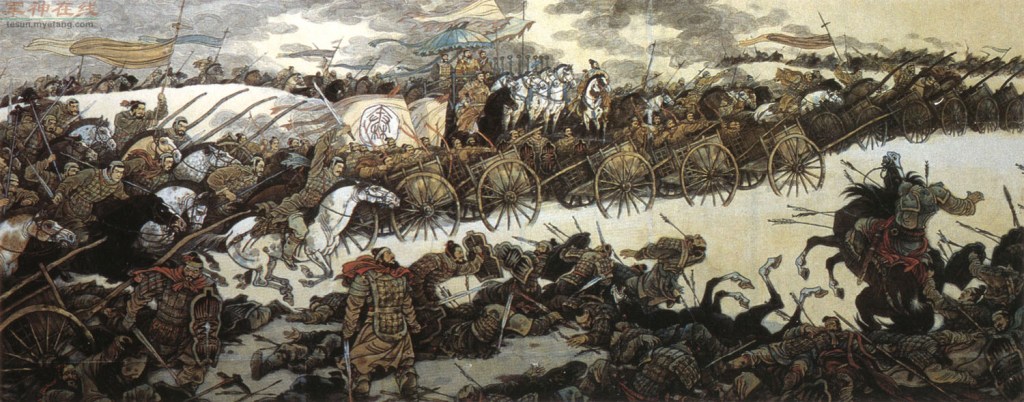
    Battle of Changping

    The 55th year of King Nan(260 B.C.)

    The army of Qin, under the leadership of Deputy Prime Minister Wang He, launched an attack on Shang’dang, successfully capturing it. 

    Fleeing from the turmoil, the people of Shang’dang sought refuge in the kingdom of Zhao. Responding to their plight, the army of Zhao, commanded by General Lian Po, entered the city of Chang’ping to assist the displaced inhabitants, aiding them in resettling within the kingdom of Zhao.

    In the months of April and early summer, Wang He initiated multiple assaults on the kingdom of Zhao. The army of Zhao fought back with limited success, resulting in the loss of one lieutenant general and four middle-level officers. Concerned about the escalating conflict, the king of Zhao consulted with his advisors, Lou Chang and Yu Qing, regarding potential strategies for peace.

    Lou Chang proposed initiating peace talks with a distinguished envoy to the kingdom of Qin. However, Yu Qing disagreed, “The kingdom of Qin holds complete control over the lever of peace. Their relentless determination is to obliterate Your Majesty’s army, and they would not entertain peace negotiations even if one were to seek them. A more strategic approach would be to dispatch distinguished envoys to the kingdoms of Chu and Wei. If these kingdoms respond favorably to our gestures of goodwill, it could sow seeds of suspicion within the kingdom of Qin regarding a potential alliance forming among other kingdoms against them. This strategic maneuver might prompt Qin to reconsider and accept our plea for peace.”

    Despite Yu Qing‘s objections, the king of Zhao ultimately decided to send Zheng Zhu as the envoy to Qin in pursuit of peace. Upon his arrival, Zheng Zhu was warmly received by the kingdom of Qin. The king of Zhao remarked to Yu Qing, “Zheng Zhu seemed to be well received by Qin.” Yu Qing remained skeptical, “It’s unlikely that your majesty will secure a peace treaty, and your army may face defeat. Currently, envoys from all kingdoms are in Qin, extending congratulations for their victory in Shang’dang. Zheng Zhu, being of elite stature, will undoubtedly receive an extravagant welcome from the king of Qin and Marquis Ying, designed to impress and entertain. Consequently, other kingdoms may hesitate to come to Your Majesty’s aid, as they perceive a peace treaty between Qin and Zhao. With no external support forthcoming, the king of Qin may see no need to negotiate a peace treaty with Zhao.”

    As predicted by Yu Qing, despite the grand reception, no peace treaty was established between Zhao and Qin.

    The army of Qin inflicted several defeats upon the army of Zhao, prompting General Lian Po to withdraw his troops behind a fortified barricade, ceasing engagements with Qin. This decision led to frustration and anger from the king of Zhao, who perceived Lian Po‘s actions as cowardice resulting from previous heavy losses. Despite repeated reprimands from the king, Lian Po remained steadfast in his defensive strategy.

    In response to the perceived discord, Marquis Ying dispatched spies bearing thousands of caddies of gold to the kingdom of Zhao, delivering counter-intelligence that suggested the kingdom of Qin harbored fears, particularly regarding the potential ascension of General Zhao Kuo, the son of Lord Ma-Fu, as commander-in-chief of the army of Zhao. The intelligence further insinuated that Lian Po was on the verge of surrender. Prompted by this information, the king of Zhao relieved Lian Po of his duties and appointed Zhao Kuo as the new commander-in-chief of the army.

    Lin Xiangru voiced opposition to this decision, “Your Majesty’s decision to choose Zhao Kuo over Lian Po was based on Zhao Kuo‘s reputation alone. It’s akin to attempting to tune string instruments by tightening the tuning pegs when the strings are already glued in place. Zhao Kuo‘s reliance solely on his father’s military textbooks without the ability to adapt tactics from the books to rapidly changing battlefield conditions makes him ill-prepared for the complexities of warfare.” Despite Lin Xiangru‘s counsel, the king of Zhao remained stubborn in his decision to appoint Zhao Kuo.

    Zhao Kuo had immersed himself in the study of warfare since childhood, believing himself to be unparalleled in the theory of war. He frequently engaged in discussions on the subject with his father, Zhao She. Despite his eloquence in discourse on military strategy, Zhao She remained unimpressed by his son’s understanding of warfare. When questioned about this by Zhao Kuo‘s mother, Zhao She expressed concern, stating that war is a matter of life and death, and Zhao Kuo‘s casual attitude towards it could lead to disastrous consequences if he were to assume a leadership role in the army of Zhao.

    As Zhao Kuo prepared to depart for the frontlines, his mother, troubled by his appointment, wrote to the king opposing it. Summoned by the king, she explained her concerns, “This humble woman served her husband, Zhao She, faithfully in the past. During Zhao She‘s tenure as commander-in-chief, his generosity was renowned—he provided for tens of individuals with his earnings and counted hundreds as his friends. He willingly shared the rewards bestowed upon him by the king and other royalties with his comrades and intellectuals. However, as he prepared for war, he distanced himself from family matters.”

    “In contrast, when Zhao Kuo assumed the role of commander-in-chief, he received homage from his subordinates while sitting facing east. His underlings hesitated to meet his gaze, intimidated by his presence. Unlike his father, Zhao Kuo retained all the gold and silk granted by the king, and in the last few days, he indulged in purchasing houses and land for personal gain.  The king believed that Zhao Kuo would naturally succeed his father’s position, but they are different persons. I wish your majesty would not have chosen him to be the commander!” The king of Zhao declined her plea:”Stop right here, Mom!  I have made up my mind.”

    In her final request, Zhao Kuo‘s mother implored the king to spare her family from any repercussions should Zhao Kuo‘s leadership prove unsuccessful. The king approved of her demand.

    Upon learning that Zhao Kuo had assumed the position of commander-in-chief, the king of Qin took covert action, sending Lord Wu’an as the top general of the Qin army, with Wang He as his lieutenant. Strict orders were given to maintain secrecy, with severe consequences for any leaks of the appointment.

    As Zhao Kuo arrived at the frontline, he implemented new strategies and replaced officers. The Zhao army emerged from their bunkers to confront the Qin troops. Lord Wu’an pretended to be defeated, leading the Qin troops away while leaving detachments behind to ambush the Zhao army.

    Seeing what appeared to be a sign of victory, Zhao Kuo pursued the retreating Qin troops to the camp’s bulwarks, only to find them impenetrable. Simultaneously, Qin detachments of twenty five thousand infantry maneuvered to cut off Zhao Kuo‘s retreat and another five thousand cavalry to slice through between the front and the camp. The Zhao army was severed into two isolated groups and their food supply line was broken.

    Lord Wu’an then unleashed his light infantry to attack the vulnerable Zhao troops, who struggled to fend off the relentless assault. With their situation growing dire, the Zhao forces dug up barriers and erected bastions, awaiting reinforcements.

    Upon learning that the food supply line to the Zhao army had been severed, the king of Qin took decisive action. He traveled to the commandery of Henei in person, and mobilized all men above fifteen years old to march towards Chang’ping, aiming to overwhelm any attempts at rescue or supply for the Zhao army.

    Despite the willingness of the people in the kingdoms of Qi and Chu to aid Zhao, the soldiers of Zhao found themselves lacking in food. When they requested grains from the kingdom of Qi, the king refused. His adviser, Zhou Zi, implored him to reconsider,

    “The kingdom of Zhao serves as a protective barrier for the kingdoms of Qi and Chu. Their relationship is akin to that of lips and teeth: if the lips are lost, the teeth are left vulnerable to the chill. If Zhao falls today, it foreshadows impending disasters for Qi and Chu tomorrow. Therefore, the urgency to rescue Zhao is as crucial as using leftover water in a cracked urn to cool a burned pot. Providing aid to Zhao is not just a moral duty but also a righteous act. Additionally, defeating the Qin troops would bring glory to Qi.”

    “It is our responsibility to assist a country in distress, uphold justice, and confront the formidable Qin forces to earn a heroic reputation. Neglecting this vital issue by prioritizing grains over aiding Zhao would be detrimental to our country and its values.” Despite Zhou Zi’s impassioned plea, the king of Qi refused to listen.

    In the autumn and early September, the soldiers of Zhao endured forty-six days without food. Desperation led to quiet acts of cannibalism within the camp. Despite their efforts to break the barricade, rotating attack squads proved ineffective. As the fifth squad prepared to begin, they remained trapped. Zhao Kuo, the chief commander, leading his elite guards, ventured into a skirmish and tragically met his demise, struck down by arrows, plunging the army into chaos. Without leadership, four hundred thousand Zhao soldiers surrendered.

    Lord Wu’an saw the potential danger posed by these soldiers, “The people of Shang’dang, discontented under Qin‘s rule, allied themselves with Zhao after Qin‘s conquest of Shang’dang. The enormous number of Zhao captives posed a serious threat of mutiny if left alive.” Fearing mutiny, he ordered the execution and burial of all prisoners of war, sparing only two hundred forty youths to return to Zhao. In total, four hundred fifty thousand prisoners were beheaded, shocking the people of Zhao to their core.
  • Comprehensive Reflections to Aid in Governance(Part 40): Casting Skins like Cicadas

    Comprehensive Reflections to Aid in Governance

    By Sima Guang

    Translated By Yiming Yang

    Annals of Zhou Book 5 Scroll 5 (continued)

    Shangdang, Shanxi Province

    The 51st year of King Nan(264 B.C.)

    Lord Wu’an, i.e. Bai Qi, led a campaign against the kingdom of Han.  They took nine cities and beheaded fifty thousand soldiers of Han.

    Tian Dan became the prime minister of the kingdom of Zhao.

    The 52nd year of King Nan(263 B.C.)

    Lord Wu’an launched another attack on the kingdom of Han, capturing the city of Nanyang and securing control over the entire Road Taihang, effectively dividing the kingdom in two.

    Meanwhile, King Qingxiang of Chu fell ill. Huang Xie, who was attending the crown prince of Chu held hostage in the kingdom of Qin, visited Marquis Ying of Qin with a proposition, “The King of Chu may be terminally ill, prompting consideration of strategic moves. It is advisable for the kingdom of Qin to release the crown prince back to Chu. By facilitating the installment of the crown prince as the next king, Chu would likely forge an alliance with Qin. Furthermore, this act would incur a substantial debt of gratitude towards you, the Prime Minister, from the crown prince. Such a move would not only unite the two kingdoms but also secure an alliance with a formidable state boasting ten thousand chariots. Conversely, retaining the crown prince in Xianyang renders him a mere commoner, devoid of his royal stature in Chu. In such a scenario, Chu would inevitably appoint another king, potentially souring relations with Qin. Disrupting a potentially beneficial alliance with a powerful state, without any tangible gain, is an imprudent course of action.”

    Marquis Ying relayed his message to the King of Qin, who responded, “Let the crown prince’s teacher go back first; we will address the matter upon his return.”

    Huang Xie conspired with the crown prince, cautioning, “The Kingdom of Qin detains you to leverage benefits from Chu. Presently, you lack the capacity to bring advantages to Qin. Contrastingly, Lord Yang’wen, the king’s brother, has two sons entrenched in the capital. In the event of the king’s demise and your absence, one of Lord Yang’wen’s sons would ascend to the throne, nullifying your claim to ancestral heritage. It is prudent for you to clandestinely depart Qin, accompanying the envoy back to Chu. I shall remain here to aid in negotiations with the King of Qin, even at the risk of my life.” Subsequently, the crown prince changed his attire and successfully traversed the checkpoints by assuming the role of a driver for the Chu ambassador, on their journey back to Chu.

    Huang Xie resided in the crown prince’s quarters and frequently assumed sick leave on his behalf. He visited the King of Qin only when he was confident that the crown prince had safely departed Qin‘s jurisdiction. Huang Xie boldly declared to the king, “The Crown Prince of Chu has returned to his kingdom and is now beyond your reach. Please, grant me the death sentence for my deceit.” Enraged, the King of Qin was inclined to fulfill his request. However, Marquis Ying interceded, advocating for Huang Xie‘s clemency. He argued, “Huang Xie, as the crown prince’s attendant, displayed unwavering loyalty by offering his life for his lord. Should the crown prince ascend to kingship, Huang Xie would play a significant role. Pardoning him and facilitating his return to Chu would greatly enhance our relations with Chu.” The king heeded this counsel. In the following autumn, King Qingxiang of Chu passed away, three months after Huang Xie‘s return. The crown prince ascended the throne as King Kaolie of Chu and appointed Huang Xie as his prime minister. Additionally, Huang Xie was granted extensive lands north of the Huai River as a fief and bestowed the title of Lord Chun’shen.

    The 53rd year of King Nan(262 B.C.)

    The Kingdom of Chu ceded the city of Xiazhou to the Kingdom of Qin in pursuit of peace. 

    Lord Wu’an of Qin spearheaded a campaign against the Kingdom of Han, successfully capturing the city of Yewang. Consequently, the Shang’dang region, a prefecture of Han, found itself severed from the main kingdom as Qin‘s troops blocked the route to the capital, Zheng.

    Governor Feng Ting of Shang’dang engaged in discussions with his constituents, recognizing the dire situation: “Our passage to Zheng has been obstructed, leaving us vulnerable to Qin‘s advances without aid from Han‘s army. It’s prudent to transfer control of Shang’dang to the Kingdom of Zhao. If Zhao accepts us, Qin will inevitably target them. In response, Zhao will seek an alliance with Han. With our forces combined, we can withstand Qin‘s aggression.” Unanimously, they decided to dispatch a messenger to the King of Zhao, conveying their plea: “Unable to defend Shang’dang, Han has surrendered it to Qin. The people of Shang’dang prefer to be under Zhao‘s rule rather than Qin‘s. We humbly request your Majesty’s acceptance of our submission, offering the seventeen cities and towns of Shang’dang.”

    The King of Zhao sought counsel from Lord Ping’yang, named Bao. Bao responded, “A true leader avoids profiting from unjust gains.” The King of Zhao retorted, “Under my virtuous rule, my people thrive. Why do you suggest there is no merit?” Bao explained further, “Qin methodically annexed Han‘s territory, fragmenting it, waiting for Shang’dang to surrender. By redirecting the harm toward Zhao, Han spared itself. Qin bore the costs and bloodshed, yet Zhao reaps the rewards. Can a weaker state like Zhao snatch what even mighty Qin could not from the feeble? It appears as an undeserved fortune. It’s wiser to decline the offer of Shang’dang.”

    The King then consulted Lord Ping’yuan, who advised acceptance. Consequently, the King dispatched Lord Ping’yuan to Shang’dang to formalize the acquisition. He bestowed three cities, each housing over ten thousand residents, to Governor Feng Ting, granting him the title Lord Hua’yang. Additionally, each county magistrate received three towns with more than a thousand residents. Pay scales were raised by three grades for officials and citizens alike.

    Overwhelmed with emotion, Feng Ting declined to meet Lord Ping’yuan, stating, “I cannot bear to enrich myself by selling my lord’s land.”

  • Comprehensive Reflections to Aid in Governance(Part 39): The Art of Persuasion

    Comprehensive Reflections to Aid in Governance

    By Sima Guang

    Translated By Yiming Yang

    Annals of Zhou Book 5 Scroll 5 (continued)

    Chu Long and Queen Dowager

    The 50th year of King Nan(265 B.C.)

    In the winter of that year, Queen Dowager Xuan of Qin passed away in October, and during the preceding autumn, Marquis Rang went into exile in his fief town of Tao in September.

    Sima Guang’s comment: Marquis Rang played a crucial role in establishing King Zhao of Qin, shielding him from potential challenges. He advocated for Bai Qi as the general, leading campaigns to the south and successfully annexing the cities of Yan and Ying. Marquis Rang also expanded Qin‘s territory eastward, reaching the border of Qi. He compelled all the Lords to submit to Qin‘s authority. The significant rise in the power of the Qin kingdom was attributed to Marquis Rang‘s dedicated efforts. While he exhibited authoritarian, arrogant, and greedy traits that eventually led to his own troubles, his discretion was not as egregious as Fan Ju portrayed. Figures like Fan Ju, whose strategies did not solely prioritize the interests of the kingdom of Qin, coveted Marquis Rang‘s position and actively sought to undermine his power. They influenced the king of Qin to sever familial ties with his mother and uncles, to whom he was indebted. In essence, Fan Ju is a treacherous individual indeed!

    The King of Qin designated Lord An‘guo as the crown prince.

    The troops of Qin conducted a raid on the kingdom of Zhao, successfully capturing three cities. The recently installed king of Zhao was young, so the Queen Dowager of Zhao was in charge. The kingdom of Zhao sought assistance from Qi. In exchange for sending troops to aid Zhao, the kingdom of Qi requested Lord Chang’an, the king’s younger brother, as indemnity. Queen Dowager of Zhao firmly rejected this condition, leading to a standoff.

    Despite Qi holding onto its troops, officials of Zhao implored Queen Dowager forcefully. In a defiant response, Queen Dowager made her stance clear: “Whoever speaks to me about making Lord Chang’an a hostage again, this old lady would spit on his face!” Despite the tension, Vice Chief Strategist Chu Long of Zhao expressed a desire to speak with Queen Dowager. The Queen Dowager granted him an audience, waiting with an unpleasant disposition. 

    Chu Long shuffled towards the Queen Dowager, apologizing for his slow pace, “I apologize, but these old feet of mine are not in the best condition, preventing me from moving quickly. Thus, I haven’t had the chance to see your majesty for quite some time. I hope you can pardon my physical limitations. Additionally, my concern for the well-being of your majesty has grown, and that’s why I humbly request the opportunity for a visit.”

    “I’ve been relying on a hand-cart to get around.”  The queen dowager sympathized.

    “Is your majesty’s appetite still good?”

    “I sustain myself on porridge.” Her hostility diminished somewhat.

    “My humble son, Shuqi, is the youngest and seemingly without much promise. However, in my old age, I still hold great affection for him. I would like to enroll him in the waiting list of the black-jacket guards to ensure the protection of your majesty. I dare to request this despite the potential offense it may cause.”

    “I grant your wish. How old is he?”

    “He is fifteen. Although young, I wish to entrust him to your majesty before I am buried deep in earth.”

    Queen Dowager, surprised by a man’s deep affection for his youngest son, pondered aloud, “Does a man also love his youngest son like that?” Chu Long asserted, “More so than a lady does,” prompting Queen Dowager to laugh and say, “Women love their sons so much more.” 

    “This old man observes that your majesty loves her princess, the Queen of Yan, more than Prince Chang’an.”

    “You are mistaken. I love Lord Chang’an just as much, if not more.”

    “Parents plan for the long-term well-being of their loved ones. When my lady sent off Queen of Yan, the old lady clung to her heels and sobbed. You were saddened because she went far away from home, and the longing persisted even after her departure. However, your prayers have consistently been along the lines of: ‘Please don’t make her come back!’ Is this because you envision her welfare in the long run, ensuring her sons and grandsons become the kings of Yan?”

    “Yes, it is.”  The Queen Dowager admitted.

    “Tracing back three generations, are there any descendants of the king of Zhao who have inherited the title of Marquis from their father and still hold that title?”

    The Queen Dowager replied, “There are none.” Chu Long went further, asking, “Not just counting the descendants of Zhao, are there any rulers who inherited marquis titles in other kingdoms?” Queen Dowager conceded, “This old lady is not aware of.”

    Chu Long concluded, “Inheriting a marquis title brings short-term trouble to the individual and, in the long run, affects the welfare of their descendants. Why is inheriting a marquis title necessarily detrimental for a king’s son? Because they hold esteemed positions without contributing to the state, receive high compensation for little effort, and possess the state’s wealth. Today, my lady bestowed upon Lord Chang’an a royal title, fertile fief land, and state treasures, yet he has made no contributions to the state. When my lady passes away, what justification can Lord Chang’an offer for his position in the kingdom of Zhao? That’s why I believe my lady is primarily concerned about Lord Chang’an current well-being, suggesting that she loves the Queen of Yan more than her son.”

    The Queen Dowager sighed and said, “Fine. You can do to him as you please.”

    Queen Dowager reluctantly consented to send Lord Chang’an to the kingdom of Qi as a hostage, accompanied by a hundred chariots. In adherence to the agreement, the kingdom of Qi sent troops to aid Zhao, and as a result, the kingdom of Qin withdrew its forces.

    Lord Anping of Qi, Tian Dan, assumed the role of a minister in Zhao. He orchestrated an invasion of the kingdom of Yan with the army of Zhao, successfully capturing the city of Zhongyang. Subsequently, he led another raid on the kingdom of Han, seizing the city of Zhuren.

    In the kingdom of Qi, King Xiang passed away, and his son Jian was appointed as the new king. As Jian was underage, the state affairs were overseen by the Queen Dowager of Qi, who had previously eloped with King Xiang and held the title of Lord Queen Dowager.

  • Comprehensive Reflections to Aid in Governance(Part 38): The Gift of Silken Gown

    Comprehensive Reflections to Aid in Governance

    By Sima Guang

    Translated By Yiming Yang

    Annals of Zhou Book 5 Scroll 5 (continued)

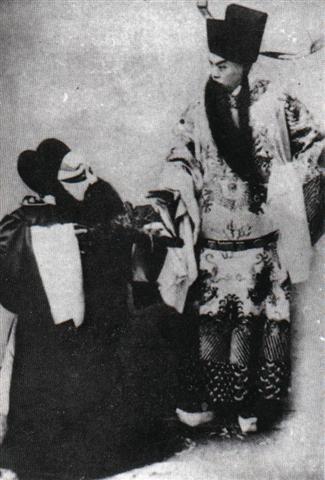
    Gift of Silken Gown, A Peking Opera

    The 46th year of King Nan(269 B.C.)

    General Hu Yang of Qin launched a raid on the city of Yuyu in the kingdom of Zhao but was unsuccessful in capturing it.

    The 47th year of King Nan(268 B.C.)

    Upon the counsel of Fan Ju, the King of Qin directed a prominent official, Wan, to spearhead another campaign against the kingdom of Wei. Subsequently, they successfully seized control of Huai county.

    The 48th year of King Nan(267 B.C.)

    The crown prince of Qin died in the kingdom of Wei while fulfilling his role as a hostage.

    The 49th year of King Nan(266 B.C.)

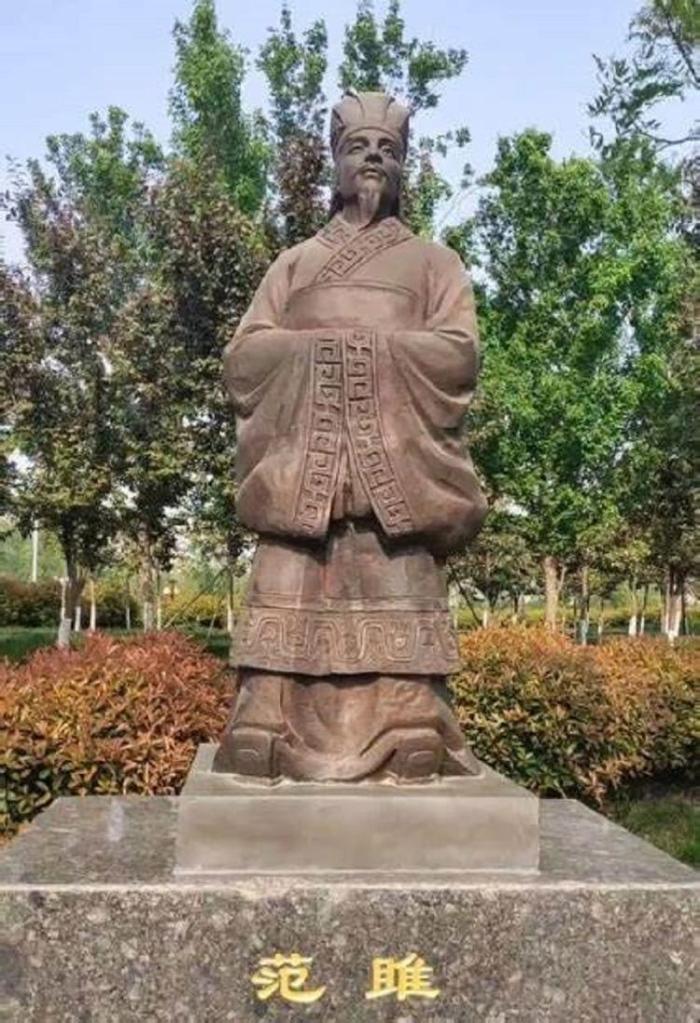
    In the summer, the kingdom of Qin successfully annexed the regions of Xingqiu and Huai from the kingdom of Wei. During this period, Fan Ju earned greater trust from the king and gradually assumed control over the state affairs of Qin. Exploiting the opportunity to sow discord in the king’s mind, Fan Ju remarked, “When I resided east of Xiao Mountains, my awareness did not extend to the king of Qi; my focus was solely on Lord Mengchang. Similarly, my knowledge of the king of Qin was limited, as I recognized only the queen dowager, Marquis Rang, Lord Gaoling, Lord Huayang, and Lord Jingyang within the kingdom of Qin. A true king is one who independently governs a state, weighing the welfare and harm befalling his subjects, and determining their life or death. However, the queen dowager now acts without discretion, Marquis Rang conducts visits to other kingdoms without official reports, while Lord Huayang and Lord Jingyang act unrestrained. Lord Gaoling freely enters the court without approval. With these four types of nobility in power, no state can escape peril. Marquis Rang sends envoys to other states, wielding the authority of a king, signing treaties with fellow lords, and distributing rewards across the world. No one dares to resist his aggressive pursuits, and the spoils of victory enrich Marquis Rang‘s fiefdom, while the losses burden the state, spreading grievances among the people.”

    “I have heard the saying, ‘A tree with too much fruit must be pruned. A tree with too much pruning will harm its core.’ A kingdom is precarious when a minister’s hometown surpasses its capital in size or when a minister is more revered than the king. Nao Chi, in charge of the kingdom of Qi, shot the king on his thigh, removed the king’s hamstring, and hung him in a temple, causing his death overnight. Similarly, Li Tuo, overseeing the kingdom of Zhao, detained the Father Lord in the palace of Shaqiu, leading to his starvation after a hundred days of confinement. In my assessment, the four nobilities today fall into the same category as Nao Chi and Li Tuo. Throughout history, the downfall of three dynasties resulted from lords delegating governance to ministers and indulging in excesses such as drinking and gaming. Jealous ministers manipulated the people, isolating the lord to promote their own interests rather than the lord’s. When the lord remained oblivious, the state eventually crumbled. Presently, officials in the kingdom of Qin, from town mayors to senior ministers and all assistants to the king, are appointed by Marquis Rang. Observing your Majesty’s isolation in the court, I fear that Your Majesty’s descendants may not inherit the kingdom of Qin when your Majesty passes away.” Agreeing with Fan Ju, the king of Qin deposed the queen dowager and ousted Marquise Rang, Lord Gaoling, Lord Huayang, and Lord Jingyang. He appointed Fan Ju as the prime minister of Qin and bestowed upon him the title of Marquis Ying.

    The king of Wei dispatched Xu Jia as an envoy to the kingdom of Qin. Marquis Ying, dressed in humble attire, personally visited Xu Jia. Surprised by Fan Ju‘s appearance, Xu Jia exclaimed using his courtesy name, “How have you been, Fan Shu?” He warmly invited Fan Ju to join him at the table, offering food and drink. As a gesture of hospitality, Xu Jia presented Fan Ju with a thick silken gown. Later, when Fan Ju drove the carriage of Xu Jia to the prime minister’s residence, Fan Ju went in first, stating, “I will notify the prime minister of your arrival.” However, after a prolonged wait, Xu Jia inquired with the doorman, who informed him that there was no one named Fan Ju, and that their prime minister was Mr. Zhang. Realizing he had been deceived, Xu Jia humbly kneel-walked into Marquis Ying‘s mansion, seeking forgiveness.

    Seated in the hall, Fan Ju reproached Xu Jia for his betrayal. He remarked, “Were it not for your compassion towards your old friend and the gift of the silk robe, you might not have escaped with your life.” Fan Ju then organized a grand banquet, inviting envoys from other kingdoms. Xu Jia was relegated to the lower end of the dining hall, where chopped hays and beans were placed in front of him, and he was compelled to eat from the trough without utensils, akin to a horse. Fan Ju directed Xu Jia to convey a stern message to the King of Wei: “Bring the severed head of Wei Qi to me, or we will demolish your capital, Daliang.” Xu Jia hastily returned to Wei and recounted the events to Wei Qi, who sought refuge in the kingdom of Qi, taking shelter in Lord Pingyuan’s house.

    Meanwhile, in the kingdom of Zhao, King Hui’wen passed away, and his son Dan ascended to the throne as King Xiao’cheng of Zhao. The new king appointed Lord Pingyuan as his prime minister.

  • Comprehensive Reflections to Aid in Governance(Part 37): Fan Ju and His Strategy

    Comprehensive Reflections to Aid in Governance

    By Sima Guang

    Translated By Yiming Yang

    Annals of Zhou Book 5 Scroll 5 (continued)

    Fan Ju

    The 45th year of King Nan(270 B.C. continued)

    Marquis Rang of Qin recommended Zao, an immigrant who had risen to the position of minister in Qin, to the king of Qin. In response, the king of Qin instructed Zao to lead a raid on the kingdom of Qi. Under Zao’s leadership, Qin successfully annexed the towns of Gang and Shou, thereby expanding the fiefdom of Marquis Rang in the towns of Tao. 

    Earlier this year, Fan Ju traveled to the kingdom of Qi as the attendant of high official Xu Jia, who was an envoy from the kingdom of Wei. King Xiang of Qi, impressed by Fan Ju‘s reputation for talent in speech and debate, personally gifted him with gold, cattle, and wine. However, suspicions arose when Xu Jia believed that Fan Ju had potentially shared state secrets with the kingdom of Qi. Upon their return, Xu Jia disclosed Fan Ju‘s gifts to Wei Qi, the prime minister of Wei.

    In a fit of rage, Wei Qi severely beat Fan Ju, breaking his ribs and teeth. To escape further punishment, Fan Ju pretended to be dead. He was then wrapped in a bamboo mat and placed in an outhouse. Taking it to an extreme, Wei Qi allowed his intoxicated guests to urinate on Fan‘s body, intending to set an example for those who dared to communicate with foreign leaders.

    Seizing an opportunity, Fan Ju pleaded with a guard, promising a significant payback if he were released. The guard, in turn, persuaded Wei Qi to dispose of the supposedly lifeless body. Wei Qi, in a drunken state, approved, and Fan Ju managed to escape. Upon awakening, Wei Qi regretted his decision and sought to capture Fan Ju once again.

    Learning of the impending danger, Zheng Anping from the kingdom of Wei assisted Fan Ju in going into hiding. Fan Ju adopted the alias Zhang Lu and kept a low profile to avoid further persecution.

    Wang Ji, a court usher of Qin, visited the kingdom of Wei as an envoy. During his visit, Fan Ju approached him at night. Wang Ji concealed Fan Ju in his wagon and smuggled him back to the kingdom of Qin. Recognizing Fan Ju‘s talents, Wang Ji recommended him to the king of Qin.

    In response, the king of Qin decided to meet Fan Ju at a vacation palace. Fan Ju, in a clever ruse, pretended to enter the palace alley accidentally. When the king arrived, palace eunuchs tried to expel the intruder. Fan Ju boldly proclaimed, “There is no king in Qin. There is only the Queen and Marquis Rang!” Hearing the commotion, the king ordered his attendants to stand down and met Fan Ju privately.

    Sitting on his heels in front of Fan Ju, the king earnestly pleaded, “Professor, please give me some advice.” Fan Ju answered, “Yes, Yes, Your Grace.”, and the king repeated his request three times, receiving the same affirmative response each time. Puzzled, the king asked, “Professor, you don’t want to teach me, do you?” Fan Ju explained, “How dare I not! I am a man on the run. I don’t know your grace well. What I want to speak about concerns rectifying state affairs and may involve your grace’s close family members. I want to show my blind loyalty, but I did not know your grace’s intent. That is why I dare not reply when you asked three times. Today, I speak out, and death punishment will follow, yet I dare not evade. A man will die anyway. If my death benefits the kingdom of Qin even a little, that would be my great bequest. My only concern is that people may be silent and hesitant after my death. No one may be willing to come to the kingdom of Qin.”

    Still sitting on his heels, the king reassured Fan Ju, “What are you talking about! I met the professor today because I am dim-witted, and heaven has granted the professor to protect the temple of my ancestors. Please teach me, no matter how significant or trivial the matters are. Extend your guidance as high as the queen dowager, and as low as my subordinates. Please hold nothing back, and do not question my sincerity.”

    Fan Ju bowed down to the king, and the king reciprocated with a bow. Fan Ju began his discourse: “With a large state and as many militant soldiers as the kingdom of Qin has, dealing with other kingdoms would be like driving pitbulls into crippled rabbits. However, the kingdom of Qin has shut down the Hangu Pass and avoided sending soldiers to the east of the Xiao Mountains for the last fifteen years. This is due to Marquis Rang‘s failure to devise strategies beneficial to the kingdom and also a miscalculation on your grace’s part.”

    Intrigued, the king sat down on his heels again, expressing a desire to learn about his miscalculation. Aware of the attendants listening in the shadows, Fan Ju chose to address external affairs first before delving into internal matters. He pointed out, “Marquis Rang‘s decision to bypass the kingdoms of Han and Wei and attack the regions of Gang and Shou in the kingdom of Qi proved to be a detrimental strategy. This move mirrored the past actions of King Min of Qi, who, despite winning battles and claiming vast territories, ultimately gained no lasting benefits. The geographical constraints prevented effective occupation, leading to protracted warfare. As Qi struggled, other neighboring kingdoms took advantage, nearly destroying it.”

    Fan Ju advocated for a more prudent approach, suggesting that the kingdom of Qin focus on capturing neighboring states while fostering alliances with those more distant. Fan Ju elucidated: “Through this strategy, acquiring an inch of land translates into an additional inch for your grace, and seizing a foot of land results in another foot for your grace. Currently, the kingdoms of Han and Wei hold a pivotal position within the realm, serving as the axis of the world. If your grace aspires to achieve hegemony, it is imperative to gain control over this axis. The kingdom of Qin, through its military prowess, exerts dominance over the kingdoms of Chu and Zhao. In our tactical approach, we align ourselves with the kingdom of Zhao when Chu is stronger, and vice versa. When both Chu and Zhao align with us, the kingdom of Qi becomes intimidated. Aligning with the kingdom of Qi, on the other hand, facilitates the capture of the kingdoms of Han and Wei.”

    The King of Qin commended Fan Ju’s insights, lauding it as an excellent discourse. Acknowledging his strategic acumen, the king honored Fan Ju by appointing him as a visiting minister, assigning him the responsibility of providing counsel on all matters pertaining to warfare.

  • Comprehensive Reflections to Aid in Governance(Part 36): Lord Mafu

    Comprehensive Reflections to Aid in Governance

    By Sima Guang

    Translated By Yiming Yang

    Annals of Zhou Book 5 Scroll 5

    Duration of 17 years

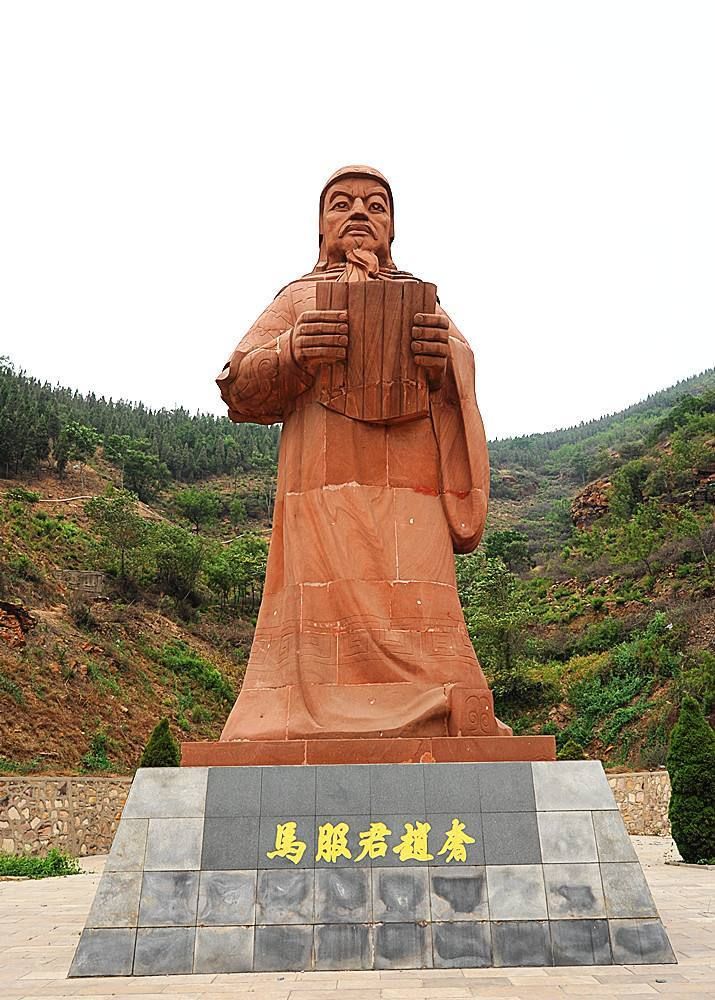
    Zhao She

    The 43rd year of King Nan(272 B.C.)

    The kingdom of Chu dispatched Crown Prince Mi Wan to the kingdom of Qin as a hostage as part of their pledge. Accompanying the crown prince was Huang Xie, serving as the state counselor of Chu and assisting the prince in his diplomatic role.

    Meanwhile, the kingdom of Qin established the office of Nanyang commandery.

    The kingdoms of Han, Qin, Wei, and Chu joined forces in a war against the kingdom of Yan.

    King Hui of Yan passed away. His son ascended to the throne, becoming King Wu’cheng of Yan

    The 44th year of King Nan(271 B.C.)

    Lin Xiangru of the kingdom of Zhao initiated a campaign against the kingdom of Qi, and the invading forces advanced as far as the city of Pingyi.

    Zhao She held the position of minister of the department of agriculture and was responsible for tax collection in the kingdom of Zhao. However, the family of Lord Ping’yuan refused to pay taxes, leading to a confrontation. In response, Zhao She enforced the law and imposed the death penalty on nine attendants of Lord Pingyuan. Enraged, Lord Ping’yuan sought revenge, intending to kill Zhao She.

    In a bold move, Zhao She addressed Lord Pingyuan, “Your excellency holds a position of great honor in the kingdom of Zhao. Yet, you’ve allowed your family members to shirk their responsibilities to the common good. This not only undermines the rule of law but jeopardizes the strength of our entire state. A weakened state becomes a target for external threats, and if Zhao falls, where will your excellency enjoy your wealth?”

    “Consider the respect your excellency commands in our kingdom. If your excellency upholds the law and contributes to public service, both the higher and lower classes will stand behind you without complaint. Fair treatment for all strengthens the state; it ensures that every citizen feels a part of our shared prosperity. The kingdom of Zhao‘s fortitude lies in a unified and just state.”

    “As a person of esteemed royalty, who in the world would dare to disregard your excellency’s influence? Embracing the principles of justice and public service not only secures our kingdom but also cements your excellency’s legacy as a wise and revered leader.”

    Impressed by Zhao She‘s wisdom and integrity, Lord Ping’yuan recommended Zhao She to the king of Zhao, who subsequently appointed him in charge of the kingdom’s treasury. Under Zhao She‘s leadership, taxes were lowered, leading to increased prosperity among the people and a well-stocked state treasury.    

    The 45th year of King Nan(270 B.C.)

    The kingdom of Qin launched an attack on the kingdom of Zhao, putting the city of Yuyu under siege. Seeking counsel, the King of Zhao consulted with military strategists Lian Po and Yue Sheng, asking if they could provide relief for the besieged city. Both responded, “It is far away, and the road there is narrow and treacherous. It is difficult to bring relief to them.”

    Turning to Zhao She with the same question, the king received a different perspective. Zhao She remarked, “It is far away, and the road there is narrow and treacherous. It is like two mice fighting inside their burrow. The side with courage would win.” Impressed by Zhao She‘s insight, the King of Zhao appointed him as the leader of the rescue mission.

    Zhao She halted the march when they were thirty miles away from Handan, the capital of the kingdom. He issued a decisive order: “Death to those petitioning for military strategy.” The Qin army approached the west of Wu’an city, causing vibrations in the roof tiles as they pounded drums and hollered. When a Zhao scout spoke out to rescue Wu’an, Zhao She beheaded him, commanding the troops to fortify the barracks and hold out for twenty-eight days. The Zhao army continued strengthening their barracks, and Qin sent spies to infiltrate the camp. Zhao She treated the spies well and sent them back.

    The Qin general, misinterpreting Zhao She’s slow-walking as timidness, expressed delight, believing Yuyu would soon fall. Zhao She, seizing the opportunity, ordered his troops to expedite their movement. They speed-marched to Yuyu in one day and one night, building barracks fifty miles from the city. Anticipating the Qin army’s response, Zhao She received military advice from a Zhao soldier named Xu Li. Xu Li recommended consolidating troops’ formation and confronting Qin head-on to maintain high morale. Zhao She, acknowledging the wisdom, refused to punish Xu Li when he asked to be sentenced, saying, “Wait!  The order expired after Handan.”

    Xu Li then suggested occupying the high ground of the Northern Mountain first, emphasizing the advantage of those who arrive early. Zhao She approved and deployed ten thousand soldiers to secure the high ground. The Qin troops, arriving late, were repelled from the Northern Mountain. Zhao She seized the opportunity for a full-throttle attack, defeating the Qin army. With this victory, Zhao She and his troops successfully relieved the siege of Yuyu and returned triumphantly.

    In recognition of his outstanding leadership, the king of Zhao bestowed upon Zhao She the title of Lord Mafu, elevating him to the same rank as Lian Po and Lin Xiangru. Xu Li, too, was rewarded with a promotion to the position of a brigade general.

  • Comprehensive Reflections to Aid in Governance(Part 35): Lord Chunshen – The Debater

    Comprehensive Reflections to Aid in Governance

    By Sima Guang

    Translated By Yiming Yang

    Annals of Zhou Book 4 Scroll 4 (continued)

    Lord Chunshen, Huang Xie

    The 42nd year of King Nan(273 B.C.)

    The combined forces from the Kingdoms of Zhao and Wei initiated a siege on Huayang, a city of Han. Faced with this dire situation, the Kingdom of Han dispatched envoys to Qin, seeking assistance. The King of Qin declined their plea for aid. In a desperate attempt, the prime minister of Han implored Chen Shi, an official of Han, stating, “We are in dire need of help. Please make a day trip to the Kingdom of Qin, even if you are unwell.”

    Despite his illness, Chen Shi complied and traveled to the Kingdom of Qin, where he met with Marquis Rang. Enquiring about the urgency, Marquis Rang said, “Did they send you due to a crisis?” Chen Shi calmly responded, “There is no immediate crisis.” Irritated, Marquis Rang questioned, “Why is that?” Chen Shi explained, “The Kingdom of Han would align with the opposing forces if facing a crisis. The fact that I am here again indicates that the situation has not reached a critical point.” Marquis Rang, recognizing the gravity of the situation, pledged, “I will appeal to the king to send troops.” Subsequently, he led Lord Wu’an (Bai Qi) and Hu Yang, another high-ranking official, to come to the aid of the Kingdom of Han.

    The Qin army, taking eight days to reach Huayang, swiftly engaged and defeated the Wei forces outside the city. In the encounter, they forced General Mang Mao to retreat, captured three additional generals, and executed a staggering one hundred thirty thousand soldiers. In a separate confrontation, Lord Wu’an clashed with General Jia Yan from the Kingdom of Zhao. In a strategic move, they managed to drown twenty thousand Zhao soldiers in the Yellow River during the intense battle.

    Duangan Zi, a minister of the Kingdom of Wei, proposed surrendering the city of Nanyang to the Kingdom of Qin as a peace offering. However, Su Dai voiced strong opposition to this suggestion when addressing the King of Wei, stating, “Duangan Zi desires the royal seal of the prime minister, and the Kingdom of Qin covets the land of Wei. By attempting to use one covetous party to counterbalance the other, Wei risks losing both the coveted royal seal and its land. Attempting to appease Qin by relinquishing land is akin to trying to extinguish a fire with brushwood. The fire will persist until all the brushwood is exhausted.”

    Despite Su Dai’s insightful counsel, the King of Wei conceded Su Dai’s point, while accentuating the difficulty of altering the course that had already been set in motion. Su Dai retorted, drawing a strategic analogy, “The chess piece ‘Xiao’ is valuable because it can capture another piece at will and remains stationary when needed. Why not make decisions as wisely as the chess piece ‘Xiao’?”

    The King of Wei did not heed Su Dai’s advice and proceeded to hand over the city of Nanyang to the Kingdom of Qin as indemnity for peace. Nanyang corresponds to the present-day Xiuwu.

    Following the death of King Xi of Han, his son, King Huanhui, ascended to the throne as his successor. 

    At this juncture, both the Kingdoms of Han and Wei found themselves under the dominance of the Kingdom of Qin. The King of Qin was on the brink of dispatching Lord Wu’an, along with the armed forces of Han and Wei, for another campaign against the Kingdom of Chu.

    However, before this plan could be set into motion, Huang Xie, the ambassador from Chu, arrived in the city. Upon learning of the impending campaign, Huang Xie harbored concerns that the Kingdom of Qin, fueled by its consecutive victories, might be poised to annihilate the Kingdom of Chu.

    Huang Xie submitted a letter to the King of Qin, expressing, “I have heard that things tend to reverse when pushed to their extremes. Winter transforms into summer, and reaching the pinnacle can become precarious, akin to stacking chess pieces. At present, the Kingdom of Qin stands as the largest realm, stretching to the boundaries of civilization in the north and the west. Never before in history has a king governed such an extensive territory.”

    Huang Xie continued, “For three generations, the Kings of Qin relentlessly pursued the establishment of a border with the Kingdom of Qi, aiming to disrupt the corridor of alliances formed against Qin by other kingdoms. Your majesty brilliantly deployed Sheng Qiao to serve the Kingdom of Han as an administrator of border towns. Through Sheng Qiao’s efforts, the territories under his jurisdiction were seamlessly integrated with those of the Kingdom of Qin, resulting in the acquisition of hundreds of miles of land without the need for war or even the threat of conflict. Your majesty’s diplomatic finesse and skillful maneuvers were evident in this accomplishment.”

    “Furthermore, Your Majesty raised armies to launch an attack on the Kingdom of Wei, effectively blocked the gates to the capital city of Daliang, seized control of the city of Henei, and captured the towns of Yan, Suanzao, Xu, and Tao. The King’s forces then penetrated the region of Xing, causing the Wei troops to disperse like clouds in the sky, unable to provide mutual support. Your Majesty’s military achievements were so remarkable!”

    “Subsequently, Your Majesty decided to grant respite to both his soldiers and the people of Wei, allowing a period of repose from the rigors of battle. Two years later, Your Majesty resumed hostilities against Wei and successfully annexed the cities of Pu, Yan, Shou, and Yuan. His forces besieged the cities of Ren, Pingqiu, Huang, and Jiyang until the inhabitants capitulated.”

    “Taking strategic measures, Your Majesty carved out the northern territories of Pumo and opened up a direct route from the Kingdom of Qin to the Kingdom of Qi. This action effectively severed the backbone of the alliance between the Kingdoms of Zhao and Chu. The once-formidable anti-Qin coalition, which had united against Qin five times and joined forces six times, now hesitated to come to each other’s aid. The unparalleled glory of Your Majesty shone brightly in these decisive victories.”

    “If Your Majesty can consolidate and uphold the current accomplishments, maintaining a superior posture, and if the desire for conquest is relinquished in favor of governing the annexed lands with benevolence and justice, ensuring tranquility in the hinterlands, then Your Majesty could rightfully stand among the Three Greatest Kings and be mentioned in the same breath as the Five Hegemons in history.”

    “However, should Your Majesty choose to rely solely on the sheer size and superior armed forces, leveraging the momentum of defeating the fighting spirit of the Kingdom of Wei to subjugate all other kings, it is a path fraught with potential troubles in the near future, particularly in the Your Majesty’s own backyard.”

    “There is a saying from the classic The Book of Songs: ‘All start well at first, very few finish so at the end.’ Another saying from The Book of Changes goes: ‘A fox soaks its tail while wading a creek, despite being careful.’ These sayings emphasize the common challenge of initiating endeavors with enthusiasm but encountering difficulties in seeing them through to completion.”

    “An illustrative historical example is the alliance between the kings of Wu and Yue, who joined forces to attack the Kingdom of Qi. Despite their victory at the city of Ailing, the king of Wu was later captured by the king of Yue on the shore of the Three Rivers on their way of return.”

    “Similarly, the Zhi family of the Kingdom of Jin placed trust in the Han and Wei families, forming an alliance to besiege the city of Jinyang belonging to the Zhao family. As victory seemed imminent, the Han and Wei families betrayed the Zhi family, leading to the killing of the Zhi family’s head, Zhi Bo (also known as Zhi Yao), at the foot of Terrace Zao.”

    “Your Majesty, there seems to be a concern that, despite harboring resentment towards the Kingdom of Chu, its existence serves as a strategic advantage for the Kingdoms of Han and Wei, acting as a counter weight. It’s essential to remember that dismantling the Kingdom of Chu might inadvertently strengthen Han and Wei, who are potential adversaries.”

    “I express my worry and respectfully advise against dismantling the Kingdom of Chu. While the Kingdom of Chu may seem like a rival, it can also be a source of support for your kingdom. The true enemies are your neighboring states.  Trusting the kingdoms of Han and Wei solely based on their flattery may echo the historical situation where the king of Wu trusted the kingdom of Yue, leading to adverse consequences.”

    “The ingratiating words from Han and Wei may be a guise to manipulate the larger kingdom while absolving themselves. This suspicion arises because the goodwill towards Qin from Han and Wei may not be enduring, given the longstanding animosity spanning generations. The adversarial history, with fathers and sons of Han and Wei falling to Qin‘s forces for the last ten generations, suggests a deep-seated resentment.  Hence, there will always be apprehension for the well-being of Qin as long as the kingdoms of Han and Wei persist. It appears incongruous to allocate resources for Han and Wei to attack the Kingdom of Chu when there has been a historical backdrop of tensions between Qin and these kingdoms.”

    “Moreover, the choice of the route the Qin army takes to attack the Kingdom of Chu is crucial. If the army traverses the territories of your enemies, such as the Kingdoms of Han and Wei, On the day the army sets forth, it marks the beginning of Your Majesty’s concern that their return might be uncertain.  If Your Majesty’s troops avoid traversing the territory of their adversaries, they must launch their attack from the right side of the Sui River. Considering the challenging terrain with wide rivers, large lakes, mountainous forests, and ravines on the right side of the Sui River, attacking from this direction poses significant challenges. These areas do not yield food, and the cost of damaging the reputation of the Kingdom of Chu might not be offset by any tangible benefits.”

    “Initiating a war with the Kingdom of Chu would likely prompt immediate reactions from the other four kingdoms. Long battles between the armies of Qin and Chu would ensue, providing an opportunity for the Kingdom of Wei to expand into regions like Liu, Fangyu, Zhi, Huling, Dang, Xiao, and Xiang, formerly part of the State of Song. Simultaneously, the Kingdom of Qi would seize the fertile land to the north of the Si River, an area with excellent transportation connections.”

    “In such a scenario, the Kingdoms of Qi and Wei could emerge as the strongest powers in the region. Considering the potential consequences and the geopolitical landscape, fostering friendly relations with the Kingdom of Chu might be a more favorable approach for the overall stability and prosperity of Qin.”

    “Considering the looming alliance between the Kingdoms of Qin and Chu, the Kingdom of Han would likely acquiesce and pay homage to Your Majesty. Leveraging the geographic advantage of the strategic pass of East Mountain and controlling the engirdling of the Yellow River loop, the Kingdom of Han could become a vassal of Qin to the east of Hangu Pass.”

    “Deploying a substantial force of one hundred thousand troops to the State of Zheng would instill fear among the people of the Kingdom of Wei. Cities like Xu and Yanling might retreat to their inner castles, disrupting the connection between the regions of Shangcai and Zhaoling. This move could potentially lead to the Kingdom of Wei becoming another vassal of Qin to the east of Hangu Pass.”

    “Moreover, amending relations with the Kingdom of Chu could lead to the Kingdoms of Han and Wei, which are formidable military states, vying for the land of Qi. The vast area of west Qi could be easily captured, extending Your Majesty’s territory from the west ocean to the east ocean, establishing Qin at the helm of the world. The kingdoms of Yan and Zhao will lose the support of the kingdoms of Qi and Chu, and reciprocally so for Qi and Chu. If the kingdom of Qin advances towards Yan and Zhao, it would destabilize the foundations of the kingdoms of Qi and Chu. This would eventually lead to the subjugation of all four kingdoms to the kingdom of Qin, even without an immediate initiation of war.”

    Recognizing the strategic advantage and potential consequences, the King of Qin agreed with Huang Xie‘s counsel. Consequently, Lord Wu’an was summoned back, and the allied troops from the Kingdoms of Han and Wei were dismissed. Huang Xie was sent back to the Kingdom of Chu, carrying a proposal for a marriage alliance between Qin and Chu.

  • Comprehensive Reflections to Aid in Governance(Part 34): The Prognosis of Lu Zhonglian

    Comprehensive Reflections to Aid in Governance

    By Sima Guang

    Translated By Yiming Yang

    Annals of Zhou Book 4 Scroll 4 (continued)

    Lu Zhonglian

    The 36th year of King Nan(279 B.C.) (continued)

    Tian Dan was on the brink of attacking Di, a small state, when he consulted Lu Zhonglian, a renowned intellectual and lobbyist. Lu Zhonglian cautioned, “General, breaking through the city of Di will prove challenging.” Dismissing the advice, Tian Dan asserted his previous triumph over the larger forces of Yan with a meager army in Jimo. Without bidding farewell, he mounted his chariot and commenced the siege on the city of Di.

    After three months of unsuccessful attempts, He caught wind of the children of Qi singing a taunting rhyme: “A hat as big as a winnow basket, a sword as long as it touches the chops; the city of Di stands impregnable, with carcasses piled up to the hilltop.” Concerned, Tian Dan sought out Lu Zhonglian for guidance. He acknowledged, “Professor, you foresaw my failure in breaking through the city of Di. Please enlighten me on the reasons.”

    Lu Zhonglian explained, “During the siege at Jimo, General, you exhibited an unwavering commitment – weaving brackets upon sitting down, and leaning on a shovel upon standing up. You led the soldiers in songs, urging them to ‘Rush forward when the temple where we worship is gone! Where do we belong when the spirits of our ancestors are homeless?’ At that time, General, you held a resolute determination to fight to the death, with soldiers fully expecting not to return alive. Every one of them fought with utmost intensity, tears in their eyes. This was the spirit that led to the victory over the Yan army.”

    “Nowadays, General, you enjoy the enfeoffments from Ye in the east and entertainment from Zishang in the west. You traverse between the rivers Zi and Sheng, adorned with a gold belt, leading a life filled with happiness and devoid of any immediate threat of death. This stark contrast in circumstances is why the siege of Di has met with failure.”

    Touched by Lu Zhonglian‘s insight, Tian Dan declared, “I still possess the will to succeed; Professor has reignited my motivation.” The next day, he toured the battlefield, standing shoulder to shoulder with his soldiers, invoking their fighting spirit with drumsticks. Finally, the people of Di capitulated, yielding to Tian Dan‘s renewed determination and leadership.

    King Min of Qi sought to eliminate Lord Mengchang following the annexation of the kingdom of Song. Fleeing to the kingdom of Wei, Lord Mengchang was appointed as the prime minister by the Wei king. Lord Mengchang, in turn, orchestrated an alliance among several kingdoms to launch an attack on Qi. With King Min’s death, his son, King Xiang of Qi, restored the kingdom, prompting Lord Mengchang to withdraw to his fief, the state of Xue. There, he maintained a neutral stance, detached from other kingdoms.

    Wary of Lord Mengchang, King Xiang of Qi, upon his inauguration, pursued an alliance with him. Meanwhile, internal strife arose as Lord Mengchang‘s sons vied for the inheritance of their father’s title and land. The kingdoms of Qi and Wei joined forces, ultimately extinguishing the state of Xue. Regrettably, Lord Mengchang passed away without any descendants.

    The Duke Min of Lu passed away, and his son Chou succeeded him, assuming the title of Duke Qing of Lu.

    The 37th year of King Nan(278 B.C.)

    The foremost military commander of the Qin Kingdom, Bai Qi, holding the esteemed title of Daliangzao, spearheaded a military campaign against the Kingdom of Chu. Under his command, the city of Ying, which served as the capital of Chu, fell into Qin‘s control. Additionally, he orchestrated the destruction of the city of Yiling. The armed forces led by King Xiang of Chu crumbled, rendering them incapable of further resistance. Consequently, the King of Chu relocated the capital to the northeastern city of Chen. The Kingdom of Qin subsequently renamed Ying as Nanjun. In recognition of his achievements, Bai Qi was honored with the distinguished title of Lord Wu’an.

    The 38th year of King Nan(277 B.C.)

    Lord Wu’an of Qin successfully captured both the city of Wu and the region of Qianzhong, solidifying Qin‘s control over these territories. As a strategic move, he went on to establish the commandery of Qianzhong to consolidate administrative control.

    Meanwhile, in the Kingdom of Wei, King Zhao passed away. Following his demise, his son Yu ascended to the throne and assumed the title of King Anxi of Wei.

    The 39th year of King Nan(276 B.C.)

    Lord Wu’an of Qin launched an offensive against the Kingdom of Wei, resulting in the conquest of two cities under Qin‘s dominion.

    In the Kingdom of Chu, the king integrated the armed forces of the eastern territory, amassing an additional one hundred thousand soldiers. He strategically directed this potent force westwards, successfully conquering fifteen towns situated to the south of the Yangtze River.

    In the Kingdom of Wei, King Anxi bestowed the title of Lord Xinling upon his brother Wuji.

    The 40th year of King Nan(275 B.C.)

    The Marquis Rang, who held the esteemed position of prime minister in the Qin Kingdom, spearheaded a military campaign against the Kingdom of Wei. In response, General Pu Yuan from the Kingdom of Han intervened in support of Wei. However, Marquis Rang‘s forces triumphed decisively, resulting in the beheading of forty thousand soldiers from the Han army. Pu Yuan, in retreat, sought refuge in the city of Qifeng. To secure peace, the Kingdom of Wei conceded eight cities to the Kingdom of Qin.

    Undeterred, the Marquis Rang initiated another assault on the Kingdom of Wei, this time defeating General Mang Mou. The Qin forces subsequently entered the city of Beizhai and proceeded to lay siege to Daliang, the capital of Wei. Faced with the relentless pressure, the Kingdom of Wei ceded the Wen area in pursuit of a peaceful resolution.

    The 41st year of King Nan(274 B.C.)

    Once again, the Kingdom of Wei forged an alliance with the Kingdom of Qi. In response, Marquis Rang of Qin orchestrated another military campaign against Wei. The Qin forces, displaying formidable prowess, successfully captured four cities and inflicted heavy casualties by beheading forty thousand soldiers from the Wei army.

  • Comprehensive Reflections to Aid in Governance(Part 33): The Over-Achievers

    Comprehensive Reflections to Aid in Governance

    By Sima Guang

    Translated By Yiming Yang

    Annals of Zhou Book 4 Scroll 4 (continued)

    Linzi, the capital of Qi

    The 36th year of King Nan(279 B.C.) (continued)

    The King of Zhao conferred the town of Guanjin upon Yue Yi, expressing veneration and affection for him. This move, however, raised alarms in the kingdoms of Yan and Qi. King Hui of Yan promptly dispatched an envoy to Zhao to reprimand Yue Yi: “General Yue, by embracing misguided opinions and harboring doubts about us, you abandoned the kingdom of Yan and sought refuge in Zhao. While this may benefit you personally, how do you reciprocate the grace my father bestowed upon you for recognizing your talent?”

    In response, Yue Yi composed a letter to the king, drawing a parallel with the historical account of Wu Zixu, a general in the kingdom of Wu. Wu Zixu, having advised King He Lv to engage in a distant battle at the city of Ying, was disregarded by He Lv‘s son, Fu Chai, who went so far as to dispose of Wu Zixu’s body in a river. Fu Chai, doubting Wu Zixu‘s strategic counsel, expressed no remorse upon sinking his body. Wu Zixu, unable to foresee the contrasting character of the two Wu kings, retained his indignation even in death.

    Yue Yi emphasized his commitment: “My primary objective was to accentuate the accomplishments of the late king while deliberately abstaining from claiming any credit for myself. My greatest apprehension was the prospect of being entangled in a smear campaign and facing prosecution that could tarnish the reputation of the deceased king. Confronted with an unspecified indictment, my conscience vehemently opposed exploiting the favor extended by the kingdom of Zhao to the detriment of the kingdom of Yan.”

    “I was mindful of the historical wisdom that distinguished individuals, particularly those of ancient times, refrained from denigrating each other, even in the event of severed friendships. Additionally, a devoted subject refrained from exculpating himself when forced into exile from his homeland.  I may lack intelligence, but I have been a student of gentlemen. I implore Your Majesty to observe my conduct.”

    Upon reading the letter, the King of Yan bestowed upon Yue Yi‘s son, Yue Jian, the title of Lord of Changguo. This gesture marked the restoration of Yue Yi’s relationship with the kingdom of Yan, allowing him to travel between the two kingdoms. Eventually, Yue Yi passed away in the kingdom of Zhao, posthumously honored with the title of Lord of Wangzhu.

    Tian Dan, the prime minister of the Kingdom of Qi, once encountered an old man suffering from hypothermia near the Zi River. The elderly man, unable to move after crossing the river, caught Tian Dan’s attention. Without hesitation, Tian Dan removed his fur coat and draped it over the shivering man. Witnessing this act of kindness, King Xiang of Qi became deeply perturbed, suspecting ulterior motives.

    He vented his agitation, exclaiming, “Tian Dan bestows favors; is he harboring ambitions to seize the kingdom? I fear that if I don’t address this now, he may attempt such a coup later.” After these words, he took a moment to survey his surroundings and noticed no one in close proximity. His gaze then fell upon a pearl jewel craftsman situated beneath a rock. Acting on impulse, he summoned the craftsman and inquired, “Did you overhear my remarks?” The craftsman affirmed, “Indeed, I did.” Curious, the king pressed, “What are your thoughts on the matter?”

    The perl craftsman replied: “It would be more advantageous, Your Grace, to redirect these concerns into a display of your own benevolence. Praise Tian Dan by acknowledging his compassionate actions, stating, ‘We was troubled by the plight of people facing starvation, and Tian Dan graciously opened his home, providing sustenance. We was concerned about an elderly man succumbing to the cold, Tian Dan selflessly removed his fur coat and draped it over him. We worried about the hardships faced by the people, Tian Dan demonstrated genuine empathy. Tian Dan really understands We.’”

    Embracing this advice, King Xiang agreed and rewarded Tian Dan with cattle and wine. Later, the pearl craftsman returned with further advice, recommending that the king publicly acknowledge Tian Dan‘s philanthropy during a court assembly. Additionally, he proposed issuing an executive order to identify individuals lacking food and clothing, promptly providing them with grains. The king, receptive to this counsel, implemented the suggestions.

    As word spread, the people learned of Tian Dan‘s benevolent acts through discussions among officials and intellectuals. The consensus emerged that Tian Dan‘s love for the people was a manifestation of his adherence to the teachings of the king.

    Tian Dan recommended Diao Bo to the king of Qi. However, nine courtiers conspired against Lord Anping, advising the king in a rotating fashion. Their collective suggestion was to express gratitude and goodwill to the kingdom of Chu since their recovery and subsequent peace was aided by Chu‘s general and ten thousand soldiers. The king sought a suitable ambassador, and they unanimously endorsed Diao Bo. Diao Bo embarked on a mission to Chu, where he was graciously received by the king, sharing drinks during an audience. Several months passed without Diao Bo‘s return.

    The nine courtiers seized the opportunity to influence the king, asserting that Diao Bo, a mere courier, received extravagant hospitality from a powerful kingdom due to Lord Anping‘s influence. They implied that Lord Anping‘s status rivaled the king’s, creating confusion between ruler and subject. Moreover, they criticized Lord Anping‘s internal governance of benevolence, accusing him of fostering alliances with northern barbarians, attracting talents from around the world, and harboring limitless ambitions. They urged the king to investigate these matters.

    The following day, the king issued a command: “Fetch Prime Minister Dan!” Unadorned, barefoot, and bare-backed, Tian Dan entered, acknowledging his alleged crimes. After five days of reflection, the king declared Tian Dan innocent, acknowledging no wrongdoing. He instructed Tian Dan to show the appropriate respect as a subject, while reaffirming the king’s duty to treat him as such.

    Diao Bo returned from the kingdom of Chu, and the king of Qi hosted a lavish feast in his honor. As the king became increasingly intoxicated, he suddenly exclaimed, “Summon Prime Minister Dan!” Diao Bo promptly stood up, left the table, and knelt before the king. He inquired, “Is Your Majesty comparable to esteemed figures like King Wen of Zhou?”

    The king admitted, “I am not as accomplished.” Diao Bo pressed on, “Indeed, I knew Your Majesty might not be. How about someone of lower standing, like Duke Huan of Qi?” Reluctantly, the king confessed, “I am not as accomplished.” Diao Bo concurred, “I knew Your Majesty was not. However, King Wen of Zhou addressed Lv Shang as ‘Honorable Father’ when appointing him as prime minister, and Duke Huan of Qi referred to Guan Zhong as ‘Great Uncle.’ Today, with Lord Anping‘s support, Your Majesty addresses him simply as ‘Dan.’ Such language is detrimental to our kingdom.”

    Diao Bo then recounted the achievement of Tian Dan: “Throughout the entirety of the universe’s existence and human history, none have achieved as much as Lord Anping in his ministerial role. When the previous king’s realms were under threat, and the people of Yan launched an attack, Your Majesty, unable to defend, sought refuge in the mountains near Chengyang. In these dire circumstances, Lord Anping led a meager force of seven thousand beleaguered soldiers to defend the small city of Jimo, encompassing three miles of inner city and five miles of outer city.”

    “Lord Anping‘s strategic brilliance reversed the tides of battle, resulting in the capture of Yan’s general and a remarkable comeback that reclaimed thousands of miles of the Land of Qi. During this critical juncture, Lord Anping possessed the opportunity to ascend as king, bypassing the exiled king in Chengyang, with none capable of opposing him. However, Lord Anping, guided by moral principles, rejected the notion of self-anointment.”

    “Demonstrating not only military prowess but also compassion, Lord Anping constructed plank roads and wooden houses connecting Chengyang and ensured the safe return of the king and queen to their people. Presently, with the kingdom in a state of tranquility and order, Your Majesty’s summoning of Lord Anping with a simple ‘Dan’ is deemed infantile behavior.” Diao Bo implores the king to rectify the situation by eliminating the nine conspirators and extending a genuine apology to Lord Anping, emphasizing that failure to do so jeopardizes the stability of the kingdom.The king, swayed by Diao Bo‘s counsel, executed the nine courtiers and exiled their families. Additionally, he granted Lord Anping further fiefs, comprising ten thousand households in the town of Ye.

  • Comprehensive Reflections to Aid in Governance(Part 32): Restoring the Kingdom of Qi

    Comprehensive Reflections to Aid in Governance

    By Sima Guang

    Translated By Yiming Yang

    Annals of Zhou Book 4 Scroll 4 (continued)

    Blazing Bulls

    The 36th year of King Nan(279 B.C.) (continued)

    Tian Dan issued an order for the residents of the city of Jimo to pay homage in the courtyard to their ancestors before every meal. Birds circled and hovered over the city, creating an unusual atmosphere that caught the attention of the Yan soldiers. Tian Dan confidently declared, “A guardian angel from God will guide me.” In response, one of his soldiers playfully teased him, asking if he could be the guardian angel. Unsettled, the soldier attempted to run away after jesting.

    Tian Dan promptly called the soldier back. Seating him facing east, Tian Dan assumed a role similar to that of a student with his teacher. The soldier, in protest, exclaimed, “Lord, I was just joking with you.” Tian Dan, however, silenced him, urging him not to say anything. Instead, Tian Dan continued to show reverence to the soldier. Whenever they were in public, Tian Dan referred to the soldier as “Godsend Master,” and the soldier willingly participated in this charade.

    Tian Dan, in a strategic move, spread rumors claiming, “The people of Qi fear that all prisoners of war from Qi will have their noses chopped off and be placed in the front row of the phalanx. Jimo stands no chance if they resort to such tactics.” The soldiers of Yan, influenced by this misinformation, adopted the mentioned tactic. The people under siege witnessed the cruel act of captives having their noses chopped off, leading to outrage and heightened vigilance within the city, as they feared falling into captivity.

    Employing disinformation once more, Tian Dan stated, “I am deeply concerned that the soldiers of Yan might desecrate the tombs of our ancestors, severely impacting our morale.” In response, the soldiers of Yan indeed dug up the tombs of Qi and burned the corpses. The people of Qi, observing this horrifying act from the ramparts, shed tears and were filled with immense anger. The incident fueled their determination to fight back, and they cried out for a decisive confrontation.

    Sensing the readiness of the soldiers of Qi for battle, Tian Dan took charge by picking up a shovel and leading them to prepare for the battlefield. In a remarkable move, he enlisted his wives and concubines into the army and generously shared the fine food from his household to boost the soldiers’ morale. To strategically manage resources, he ordered his armored soldiers to lie low while deploying the old, weak, and women to guard the rampart.

    Simultaneously, Tian Dan initiated diplomatic efforts by dispatching envoys to the Yan camp to discuss surrender. The soldiers of Yan, interpreting this as a sign of Qi‘s defeat, jubilantly declared victory. Tian Dan raised thousands of ounces of gold from the residents of Qi. He then appealed to the tycoons of Jimo to distribute the gold among the Yan generals, requesting them to spare their families from pillaging upon capitulation. The Yan army generals, pleased with the gesture, approved the requests, leading to a sense of complacency and laxity within the Yan army.

    Tian Dan orchestrated a clever strategy within Jimo city, gathering over a thousand bulls. These bulls were adorned with capes made of crimson silk, featuring painted dragons and characters of various colors. Daggers were fastened to the horns, and the tails were bundled with oil-soaked reed stems. Concurrently, soldiers of Qi dug tens of tunnels around the city walls.

    Under the cover of night, the bulls, their tails set ablaze, were released from the city, accompanied by five thousand elite soldiers. Charging toward the troops of Yan, the bulls, with their fiery tails, inflicted severe casualties and created panic among the soldiers of Yan. The population of Jimo city, in unison, banged drums and copper instruments, generating clamors and roars that reverberated through the air, shaking both the ground and the morale of Yan‘s soldiers. Faced with the terrifying sight of characters on the capes and the onslaught of raging bulls, the soldiers of Yan began to flee.

    In the ensuing chaos, the troops of Qi captured and killed the Yan army general, Qi Jie. Pursuing the retreating Yan soldiers to the north, every town they passed renounced allegiance to Yan and returned to the kingdom of Qi. Tian Dan‘s forces swelled in size, growing more triumphant each day, while the Yan army fled north of the Yellow River. The kingdom of Qi successfully reclaimed over seventy cities it had lost. As King Xiang of Qi moved from Ju to Linzi, the old capital, the people greeted him warmly. In recognition of Tian Dan‘s contributions, the King of Qi bestowed upon him the title of Lord Anping.

    The King of Qi proclaimed the daughter of Taishi Jiao as the queen, and she subsequently gave birth to the crown prince Jian. However, Taishi Jiao disowned his daughter, stating, “She married on her own, without going through a matchmaker. She is not my child, and she tarnished my family’s reputation.” Despite her father’s rejection, the queen continued to show him due respect.