Comprehensive Reflections to Aid in Governance
By Sima Guang
Translated By Yiming Yang
Annals of Qin Book 1 Scroll 6 (continued)

The 4th year of the First Emperor(243 B.C.)
General Meng Ao attacked the Kingdom of Wei in the spring, capturing the cities of Chang and Yougui. The warfare ceased in March.
A prince of Qin, who had been held hostage in the Kingdom of Zhao, returned home. Conversely, the prince of Zhao, who was in Qin, also returned home.
In the fall, widespread locust plagues and epidemics afflicted the Kingdom of Qin. The king decreed that those who contributed more than fifty thousand kilograms of grain would be appointed as local officials.
King Anxi of Wei died, and his son Wei Wu succeeded him as King Jingmin of Wei.
The 5th year of the First Emperor(242 B.C.)
General Meng Ao attacked the Kingdom of Wei and captured about thirty towns, including Suanzao, Yan, Changping, Yongqiu, and Shanyang. He established the East Prefecture for the first time.
In earlier days, Ju Xin had a good friend named Pang Nuan when they lived in the Kingdom of Zhao. Later, Ju Xin became an official in the Kingdom of Yan. The King of Yan wanted to exploit the exhaustion of Zhao, which had been tormented by Qin numerous times. General Pang Nuan was in command after General Lian Po left. The King of Yan consulted Ju Xin on the matter. Ju Xin replied, “Pang Nuan is easy to deal with.” The King of Yan appointed Ju Xin as the commander to attack Zhao. General Pang Nuan led the defense of Zhao, killed Ju Xin, and captured twenty thousand Yan soldiers.
The monarchs were troubled by the relentless assaults from the Kingdom of Qin.
The 6th year of the First Emperor(241 B.C.)
The kingdoms of Chu, Zhao, Wei, Han, Yan, and Wey formed a vertical alliance against the Kingdom of Qin. The King of Chu served as the chief, with Lord Chunshen actually in charge. The allied troops took the city of Shouling and reached the foot of Hangu Pass. The Qin army emerged from the pass and trounced the allied troops. The King of Chu blamed the defeat on Lord Chunshen, causing a distance between them growing.
Zhu Ying, a person from the region of Guanjin, observed to Lord Chunshen, “People think that the Kingdom of Chu was a powerful state and became enfeebled under your watch. I don’t think so. Qin was friendly to Chu under the former king’s rule. Why had Qin not attacked Chu for twenty years? The Qin troops would be encumbered if they had to get through Mengai Pass; they would be prohibited from passing between the states of East and West Zhou, exposing their back to Han and Wei while fighting Chu. Now the situation is different. Wei is on the brink of collapse and cannot take care of their cities of Xu and Yanling. Once Wei yields these two cities to Qin, the Qin troops will be only one hundred sixty miles from the Chu capital, Chen. Then all I foresee is daily grinding struggles between Qin and Chu.”
The Kingdom of Chu moved its capital from Chen to Shouchun, renaming Shouchun to Ying. Lord Chunshen returned to his fief, the city of Wucheng, and continued his duties as the prime minister.
The army of Qin conquered the city of Chaoge in the Kingdom of Wei and the city of Puyang in the state of Wey. Lord Yuan of Wey relocated to the city of Yewang with his entourage and family. They defended the Henei Prefecture of Wei, utilizing the natural barrier of the mountains.
The 7th year of the First Emperor(240 B.C.)
The Kingdom of Qin raided the Kingdom of Wei and captured the city of Ji.
The Queen Dowager Xia passed away.
General Meng Ao died.
The 8th year of the First Emperor(239 B.C.)
The Kingdom of Wei ceded the city of Ye to the Kingdom of Zhao.
King Huanhui of Han died, and his son Han An succeeded him.
The 9th year of the First Emperor(238 B.C.)
The kingdom of Qin invaded Wei and captured the cities of Yuan and Puyang.
In April, during an unusually cold summer, some people of Qin died due to the freezing weather. The king of Qin resided in the city of Yong.
On April 20th, the king of Qin held a coronation ceremony, during which he began to carry a sword, symbolizing his coming of age.
General Yang Duanhe led an attack on the kingdom of Wei and captured the city of Yanshi.
The king was enthroned when he was very young. The queen dowager often had sexual liaisons with Marquis Wenxin. As the king grew older, Marquis Wenxin became fearful of the consequences if the affair was exposed. To protect himself, he introduced one of his attendants, Lao Ai, to the queen dowager, disguised as an eunuch. The queen dowager liked Lao Ai and had two sons with him. She awarded Lao Ai the title of Marquis Changxin and granted him the city of Taiyuan as his fief. She delegated all state affairs of the kingdom to Lao Ai. Many intellectuals sought patronage or employment from Lao Ai.
Attendants of the king who had feuds with Lao Ai disclosed that Lao Ai was not an eunuch. The king ordered officials to investigate Lao Ai. Frightened, Lao Ai stole the king’s tally to issue military commands and plotted a coup d’état by seizing the Qinian Palace, where the king was residing. The king ordered the prime minister Lord Changping, and Lord Changwen to mobilize troops to counter Lao Ai. A fight broke out in the capital city of Xianyang, and hundreds of people were beheaded. Lao Ai’s forces were crushed, and he fled. Eventually, Lao Ai was captured.
In September, Lao Ai and his three associated clans (his father, mother, and wife) were summarily executed. Lao Ai’s confidants were quartered, and their families were all killed. Those followers of Lao Ai with lesser crimes were sentenced to exile in the state of Shu. More than four thousand families had to move. The queen dowager was relocated to the Fuyang Palace in the city of Yong, and her two sons with Lao Ai were killed. The king issued an order: “Whoever pleads on behalf of the queen dowager must be quartered, and their body piled outside the palace door.” Twenty-seven people were killed this way.
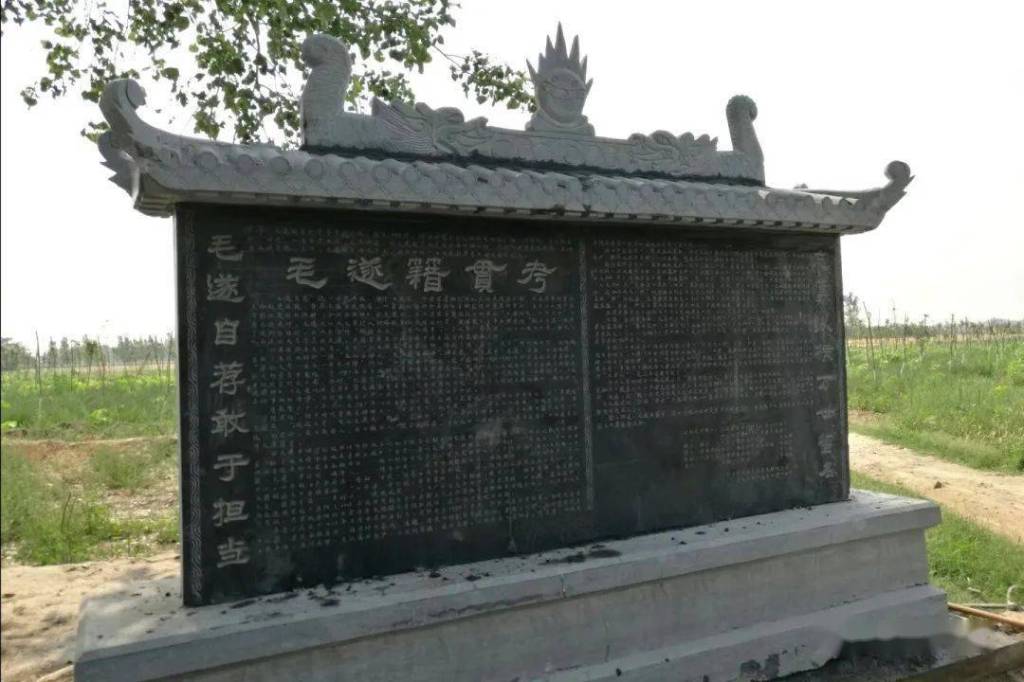
A visitor from Qi named Mao Jiao submitted a note and appealed to the king. The king sent an usher out with a response, “Have you seen the pile of bodies outside the door?” Mao Jiao replied, “I hear there are twenty-eight mansions in the constellation system. There are currently twenty-seven bodies; I came to meet the lucky number. I am not afraid of dying.” The messenger reported what Mao Jiao said. Mao Jiao’s roommates and fellow travelers, seeing this, packed up their belongings and fled from Qin.
The king was furious: “Who is this guy? He upset me on purpose. Go and set up a big pot to boil him alive. I would not pile him outside the door!” The king sat up with sword in hand, with a scowl on his face and spittle flying. An usher went out to let Mao Jiao in. Mao Jiao walked slowly towards the king and paid homage repeatedly. Then he began to speak: “I hear that a living person does not mind talking about death; a monarch of a state does not mind talking about the perishing of a state. Banning the talk of death would not give you extra life. Banning the talk of the perishing of a state would not make a state prevail. A wise monarch is usually eager to hear about the life or death, the survival or perishing of a state. Would Your Majesty like to hear me out?”
The king allowed, “What do you want to say?” Mao Jiao continued, “Your Majesty has committed atrocities, did you realize that? You quartered your stepfather; you put your half-brothers in a bag and beat them to death; you put your mother under house arrest; you butchered loyal advisers. Your cruelty surpasses the tyrants in history such as Jie of Xia and Zhou of Shang. When the news is heard by the world, everyone will be disgusted by it. No one will root for the kingdom of Qin. I am really worried for Your Majesty’s wellbeing. That’s all I want to say.” Mao Jiao took off his clothes and laid down to face his death.
The king got down from his pedestal and helped Mao Jiao to his feet: “Please stand up and put on your clothes, Professor. I will listen to your advice from now on!” The king appointed Mao Jiao as his top adviser. The king then drove his carriage to the city of Yong, with the left seat unoccupied, to welcome back the queen dowager. They mended their relationship as mother and son.








 Reflection by Rio Grande