Comprehensive Reflections to Aid in Governance
By Sima Guang
Translated By Yiming Yang
Annals of Han Book 18 Scroll 26
Duration of 3 years
The 1st year of Emperor Xuan’s Shen’jue Era (61 B.C.)
In January of spring, the Emperor set out for Ganquan Palace and performed the suburban sacrifice to Heaven at the Taizhi Altar. In March, he went to the east bank of the Yellow River and made offerings to the Goddess of Earth. The Emperor was inclined to emulate the customs of Emperor Wu and strictly observed the rites of fasting and sacrifice. He also heeded the advice of occultists to establish additional shrines for various deities. When he heard that in Yizhou there were mountain gods known as the Golden Horse and the Jade Rooster, it was proposed that they, too, should be invoked through sacrificial rites. Thus he dispatched the Grandee of Remonstration, Wang Bao of Shu, on a special mission to seek them out.
Earlier, the Emperor had heard of Wang Bao’s literary talent and summoned him to court. He instructed him to compose the “Ode to the Wise Minister Serving the Holy Lord.” The verse reads:
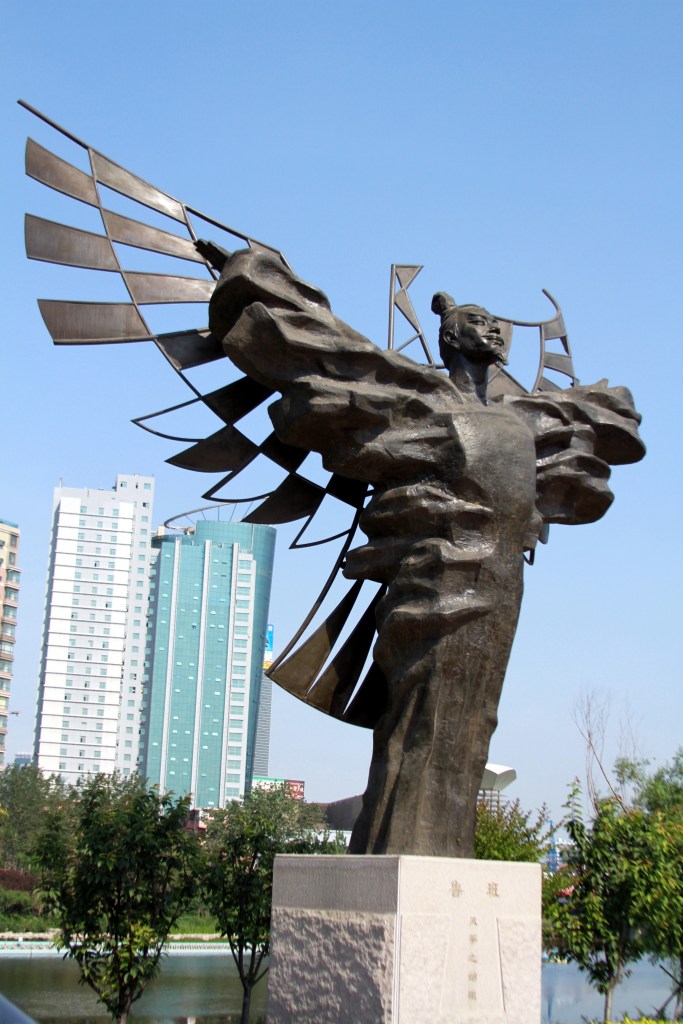
“The wise are the instruments of the state. When capable officials are employed, they enter office, accomplish their tasks swiftly, and earn the esteem of all. When tools are sharp, they require little effort to produce great results. If craftsmen use blunt tools, they toil and sweat the entire day; yet when the master smiths forged the blades of Ganjiang(a legendary sword), when Lílou(a legendary sharp eyes) oversaw the measuring cords, and when Master Gongshu(a.k.a. Lu Ban, a legendary carpenter) carved by the marks of ink, then even if a tower rose five stories high and stretched a hundred zhang(1 zhang ~3 meter) in length, not an inch would be amiss—for the artisans’ skill was in perfect accord with the tools they wielded.
“Ordinary men may drive slow horses, but even if they tear their reins and break their whips, they make no progress. When they ride legendary swift steeds, however—when bridles and saddles are in perfect condition, with Wang Liang(a legendary driver) holding the reins and Han Ai(a legendary chariot inventor) gripping the carriage—they traverse the eight corners of the earth, ten thousand li in a single breath. Why can they go so far? Because of the harmony between man and horse. Likewise, those who wear silk and linen in summer do not suffer from torrid heat; those who wear otter or fox furs in winter do not fear the bitter cold. Why? Because they are well-equipped. So too do wise men and gentlemen make it easy for the Holy Lord to govern the realm.”
“In the past, the Duke of Zhou would pause his meals three times, or bind up his hair three times in the midst of washing, to receive visiting guests; thus, under his great governance, the prisons stood empty. Duke Huan of Qi lit torches in his courtyard to welcome guests at night; thus he convened the monarchs of the nine states and claimed hegemony over the realm. From this it is clear: when lords diligently seek the worthy, they naturally reap the service of the virtuous.
“Ministers’ experiences are much the same. Before the wise encounter their true patrons, they may plan and strategize, yet the lord does not heed their counsel; they may present heartfelt advice, yet the monarch does not trust their sincerity; they may strive to serve, yet their efforts go unrecognized—dismissed or exiled, through no fault of their own. Thus Yi Yin attended the cauldron and sacrificial vessels as a cook, and Grand Lord Jiang Ziya labored with cleavers as a butcher. Baili Xi sold himself into servitude; Ning Qi fed oxen as a herdsman. These were the trials they endured.
“But when they met a discerning ruler or served an enlightened sovereign, their strategies aligned with the ruler’s intentions; their remonstrations were heard and accepted. Advancing or retreating, their loyalty was acknowledged; fulfilling their duties, their abilities were recognized. They received carved seals and were granted fiefs, bringing glory to their ancestral lines. Thus, in the world, sagacious and wise rulers must exist before there can be enlightened and worthy ministers. When the tiger roars, the winds turn chill; when the dragon rises, clouds gather. Crickets sing in anticipation of autumn; mayflies emerge after the rains. As the Book of Changes says: ‘The flying dragon is in the sky; it is auspicious to meet the great man.’ As the Book of Songs says: ‘How magnificent are these many worthy men, by whom this kingdom is established.’ Therefore, when the age is tranquil and the ruler enlightened, men of talent and virtue naturally assemble. Bright and resplendent are those at court, solemn and harmonious in their ranks; they concentrate their minds and spirits, each enhancing the brilliance of the other. Even when Bo Ya(a legendary musician) played the zither Dizhong(a legendary zither in Zhou dynasty) or when Feng Meng(a legendary archer) drew the bow Wuhao(a legendary longbow), their congruency could not match up the accord between the ruler and his ministers.
“Therefore, the Holy King must await wise ministers to accomplish great endeavors, just as men of talent await an enlightened ruler to manifest their virtue. When both desire such accord—taking joy in one another, united in harmony but once in a millennium—communication flows with no trace of doubt or reservation. They soar like goose feathers borne upon a favorable wind, they surge like a great fish leaping in the mighty river. If such joy is attained, what command would not be obeyed? What ordinance would not be carried out? The sacred mandate will overflow beyond the borders, spreading on without end.
“Hence, the Holy King need not scrutinize every detail to understand, for his discernment is already clear. He need not strain his ears to listen, for he is already perceptive. The charge of peace is fulfilled, the expectation of repose attained; rest comes naturally, life extends without bound. There is no need to twist and stretch like Peng Zu(a man who allegedly lived past 400 years old) to pursue longevity, nor to practice the breathing arts of Prince Ziqiao or Chi Songzi(both are wizards) to seek immortality. For they transcend the ordinary and evanesce from this mundane world.”
At that time, the Emperor had great interest in immortals and divinities, and thus Wang Bao’s poetry made reference to them.
The Intendant of Jingzhao, Zhang Chang, also submitted a remonstrance, saying: “May the wise ruler put aside his fondness for chariots and horses, reject the empty words of distant occultists, and devote himself to the arts of imperial governance, that peace may be restored.” As a result, the Emperor dismissed the occultists who had served at court as palace attendants in their entirety.
After the death of Zhao Guanghan, none appointed as Intendants of Jingzhao proved capable, apart from Zhang Chang, who was able to continue his legacy. Though Zhang Chang’s strategies and insight were not as far-reaching as Zhao Guanghan’s, he was well-versed in the Confucian classics and refined in literary accomplishment.
The Emperor placed great importance on outward display, adorning palaces and carriages in splendor surpassing that of Emperor Zhao’s reign. The affinal clans of Xu, Shi, and Wang enjoyed exceptional favor and honor. The Grandee of Remonstration, Wang Ji, submitted a memorial stating:
“Your Majesty, endowed with sagacity and entrusted with myriad affairs, devotes himself wholly to the governance of the realm, seeking to bring enduring peace. Your decrees delight the people as if granting them new life. Your servant has pondered deeply: though this may be praised as boundless grace, the fundamental duty is yet unfulfilled. A ruler with intent to govern is rare; ministers who encounter such a time, whose words are heard and heeded, are fortunate indeed. Yet they have not devised measures for lasting stability nor elevated a wise ruler to the height of the Three Dynasties(Xia, Shang, Zhou). The matters handled each day—convening councils, managing records, adjudicating disputes, hearing appeals—are not the foundation of true tranquility.
“Your servant has heard that, though the people are meek, they cannot be oppressed; though simple, they cannot be deceived. When a sage ruler governs from within the inner palace, success brings the praise of the realm, yet failure brings censure from all quarters. Therefore it is imperative to choose those near Your Majesty with utmost care, discerning whom to employ. Those who stand beside you rectify your conduct; those who serve beyond the hall extend your virtue. This is the essence of good government. Confucius said, ‘Nothing excels rites in governing the people and securing the ruler.’ This is no idle remark. Before later kings established their rites, they modeled themselves upon the rites of former ages and applied them to the present.
“Your servant earnestly hopes that Your Majesty, bearing the mandate of Heaven, will undertake great works, extend favor to officials and scholars, restore ancient ritual and clarify royal commands, and lead the people of this generation toward benevolence and longevity. Then, why should the customs of our age not flourish like those under King Cheng and King Kang of Zhou? Why should life not endure as did that of Gaozong of Shang? What Your servant observes now is a hasty pursuit of worldly concerns, departing from the Great Way. Thus I have offered these words for Your Majesty’s consideration, trusting in Your enlightened judgment.”
Wang Ji reflected: “The lack of restraint in marriage customs and wedding expenses has made it difficult for the poor to marry off their children, and thus they are unwilling to bear many sons and daughters. Moreover, in the Han dynasty, marquises take princesses as wives, and among the feudal lords, even commoners marry daughters of their lords. Thus men serve women, and husbands bow beneath their wives, reversing the proper order of Yin and Yang, from which many disorders arise through women.
“In ancient times, distinctions in dress, carriages, and horses clearly separated noble from base; but now rank and station are confused, and each fashions his appearance according to his own desire. Therefore men clutch at wealth and chase after profit, fearing not even death. In the Zhou age, punishments could be set aside and left unused because wrongdoing was restrained before it appeared, and wickedness was nipped in the bud.”
Wang Ji further said: “Emperor Shun and King Tang of Shang did not rely solely upon hereditary succession for the Three Excellencies and Nine Ministers, but instead raised Gao Yao and Yi Yin, keeping the unrighteous far away. Now, officials of vulgar disposition are permitted to appoint their sons and younger kin; they grow presumptuous and reckless, ignorant of antiquity and the present, offering no benefit to the people. It is fitting to make the selection of the worthy clear and to abolish the ordinance of hereditary appointment. As for the families of consorts and former personal attendants, they may be enriched with wealth but should not hold high office. Abolish the wrestling entertainments, reduce the Music Bureau, and cut back the expense of the Imperial Workshops, so that frugality may be known throughout the realm. In ancient times artisans did not carve elaborate ornaments, and merchants did not trade in luxury goods—not because artisans and merchants alone were virtuous, but because government policy and instruction made them so.”
But the Emperor judged his proposals lofty and impractical, and did not greatly favor him. Wang Ji later resigned, claiming illness.
 Reflection by Rio Grande
Leave a comment