Comprehensive Reflections to Aid in Governance
By Sima Guang
Translated By Yiming Yang
Annals of Zhou Book 5 Scroll 5 (continued)
The 57th year of King Nan(258 B.C.)
In January, Wang Ling initiated an assault on Handan, the capital of the Zhao kingdom. However, his efforts were met with resistance, leading to setbacks. Responding to the situation, the King of Qin dispatched additional troops to reinforce Wang Ling’s campaign. Despite this reinforcement, Wang Ling suffered the loss of an additional five regiments of soldiers.
Meanwhile, Lord Wu’an recovered from his illness, becoming a pivotal figure in the unfolding events. As the situation escalated, the King of Qin contemplated replacing Wang Ling with Lord Wu’an. However, Lord Wu’an, displaying strategic foresight and declined, “The fortress of Handan presents a formidable challenge to breach. Imminent reinforcements from neighboring kingdoms poised to aid Zhao further compound our difficulties. Lingering animosities towards Qin among these kingdoms exacerbate the situation, fueled by the bitter memories of past conflicts, notably the Battle of Changping, where despite our victory, we suffered significant casualties, halving our army’s strength. Consequently, our nation finds itself depleted of both manpower and resources. Attempting to traverse treacherous terrains and river crossings to lay siege to Zhao‘s capital would likely result in our forces being sandwiched between Zhao‘s defenders within and the combined might of other kingdoms attacking from without.”
Recognizing the gravity of Lord Wuan‘s counsel, the King of Qin sought to persuade him through Marquis Ying. However, Lord Wu’an remained steadfast, citing his ongoing illness as an evasion to military engagement. Ultimately, the King of Qin appointed Wang He to assume command, relieving Wang Ling of his duties.
Upon receiving the king of Zhao‘s directive to seek military aid from the kingdom of Chu, Lord Ping’yuan began assembling a retinue for the journey. After gathering his followers, he meticulously selected twenty attendants renowned for their prowess in both scholarly and martial pursuits. Among them, nineteen were chosen, leaving one vacancy yet to be filled.
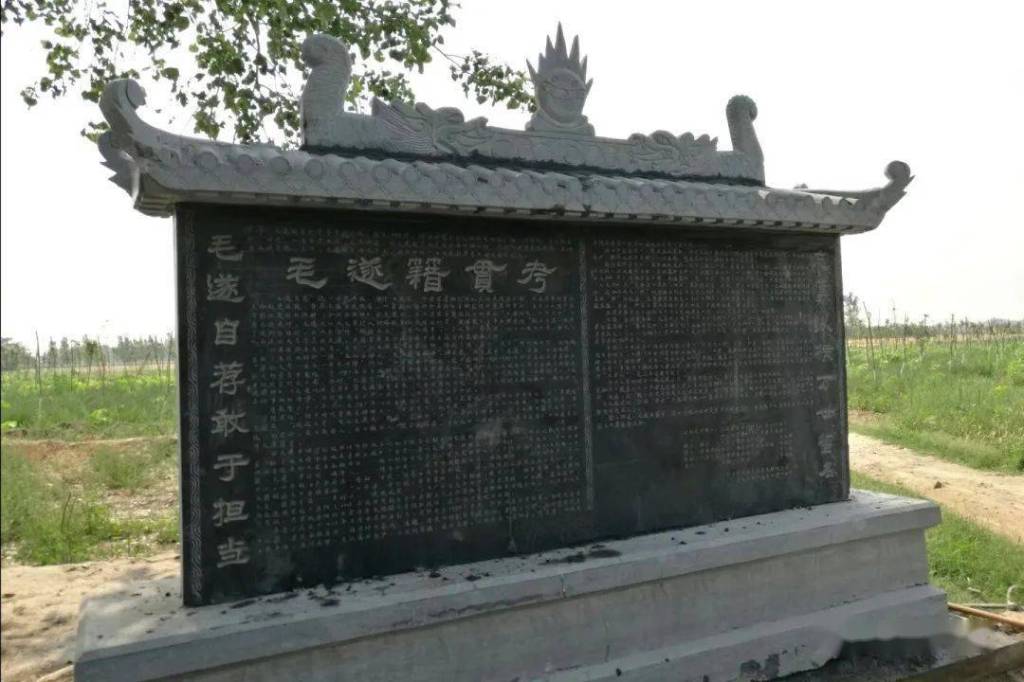
At this juncture, a man named Mao Sui stepped forward, recommending himself for the remaining spot. However, Lord Ping’yuan, unimpressed, rebuffed him,”Those who stand out in society are akin to an awl in a bag—The tip would show in the bottom inevitably. Professor Mao, despite being a member of my dining circle for three years, has failed to garner any praise or recognition from those around me. Your talents have not been acknowledged simply because you lack them, Professor Mao. I’m afraid you don’t possess the requisite qualities for this task. Therefore, you will remain behind.” In response, Mao Sui countered, “I am requesting to be dropped into the bag today. If I had been included earlier, I would have already made my mark, let alone just showing a tip.” Lord Ping’yuan, acknowledging Mao Sui‘s persistence and perhaps intrigued by his confidence, approved his request to join as the twentieth attendant. Meanwhile, the other nineteen attendants exchanged glances and shared a laugh at Mao Sui‘s audacity.
Lord Ping’yuan engaged in lengthy negotiations with the king of Chu regarding the merits and drawbacks of forming a vertical alliance. Despite their efforts, a consensus proved elusive, with discussions stretching from sunrise until noon. Sensing impatience, Mao Sui, laid his hand on his sword and walked up the stairs, interjected by approaching Lord Ping’yuan and remarking, “The advantages and disadvantages of a vertical alliance can be summed up in two sentences. Why did our talks take so long?”
Enraged by this interruption, the king of Chu lashed out at Mao Sui, “Why don’t you leave this place! I am addressing your lord. What business do you have here?”
Mao Sui held his sword and countered, “Your Majesty directs his ire at me due to the kingdom of Chu‘s populous nature. However, within a mere ten steps, Your Majesty cannot rely solely on numerical advantage. Your life hangs in the balance, held by my hand. Moreover, with my lord present, why address me in such a manner? I draw inspiration from historical examples: Shang Tang ascended from a mere seventy-mile base to become a global ruler, and King Wen of Zhou brought all lords under his sway with a mere hundred-mile domain. Did they achieve such feats solely through sheer force? No, they prevailed by seizing advantageous positions and fostering unwavering loyalty among their followers.”
“The kingdom of Chu, boasting a vast territory spanning five thousand miles and an army numbering a million strong, stands as a formidable hegemon. No other kingdom can rival its might. Bai Qi, merely a lackey, led troops in a campaign against Chu, committing egregious acts such as seizing Yan and Ying, burning Yiling. He vandalized your ancestral shrines and dishonored your progenitors in the third battle. These despicable acts echo through generations, casting shame even upon the people of Zhao. Yet, Your Majesty appears unfazed by these atrocities. The vertical alliance serves not the interests of Zhao but those of Chu. Why then, direct your anger towards me in the presence of my lord?”
The king of Chu, taken aback by Mao Sui‘s assertiveness, swiftly agreed, declaring, “Yes! Yes! My country will join the alliance just as the Professor suggested.” Mao Sui, seeking confirmation, inquired once more, receiving a resolute “Affirmative” from the king of Chu. With the decision made, Mao Sui directed the attendants of the king of Chu to fetch chicken, dog, and horse blood.
Presenting a copper plate filled with animal blood, Mao Sui knelt before the king of Chu, proposing a blood oath to solidify the alliance. The king of Chu, as the primary participant, would swear first, followed by Lord Ping’yuan and then Mao Sui himself. With the ritual completed, the alliance was formally established.
Mao Sui then gestured for the nineteen attendants of Lord Ping‘yuan to swear their allegiance using the same blood,”You all will swear the oath using this blood down there. You are nothing but useless free-riders, relying on others to accomplish tasks.” With the pact secured, Lord Ping’yuan departed for the kingdom of Zhao, reflecting on his newfound respect for intellectuals, “Zhao Sheng will never judge an intellectual again in this world.” and elevating Mao Sui to a position of high regard.
In support of the alliance, the king of Chu dispatched troops under the command of Lord Chun’shen to aid Zhao, while the king of Wei contributed a hundred thousand soldiers led by Jin Bi.
The king of Qin dispatched a diplomat with a threatening message to the king of Wei: “I am poised to dismantle the kingdom of Zhao within days. Those who attempt to aid Zhao will face our wrath once Zhao falls.” Fearing Qin‘s might, the king of Wei instructed General Jin Bi to halt the advance and fortify positions near the city of Ye. Despite claiming to support Zhao, Wei’s actions suggested a pragmatic hedging of bets.
Simultaneously, the king of Wei covertly dispatched General Xinyuan Yan to Handan, aiming to persuade the king of Zhao to crown the king of Qin as emperor, facilitated by Lord Ping’yuan. In return, Wei hoped for Qin‘s withdrawal from their territory.
During this time, Lu Zhonglian, a scholar from Qi, encountered Xinyuan Yan in Handan. Expressing his vehement opposition,”The kingdom of Qin is a realm where principles and ethics are forsaken, and soldiers vie to amass the highest tally of severed heads as their ultimate accolade. If the king of Qin were to ascend to the imperial throne, I would sooner cast myself into the eastern ocean than submit as a subject. For people of Liang witnessing the grim repercussions of Qin‘s imperial reign, I would suggest the unthinkable: to have the king of Qin cook the king of Liang into a stew.”
Xinyuan Yan, deeply offended, exclaimed, “How could you suggest such a gruesome act as having the king of Qin cook the king of Liang into stews?”
Undeterred, Lu Zhonglian pressed on, saying, “Of course! Allow me to explain.”Lu Zhonglian elaborated on his analogy, recounting a historical tale, “Marquis Gui, Marquis E, and King Wen of Zhou served under King Zhou of the Shang dynasty. Marquis Gui, seeking favor, offered his beautiful daughter to King Zhou. However, displeased with her appearance, King Zhou callously had Marquis Gui cooked into stews. Marquis E attempted to reason with King Zhou through debate, but in response, King Zhou had Marquis E turned into jerky. Upon hearing of these atrocities, King Wen of Zhou lamented the cruelty. King Zhou, angered by King Wen’s disapproval, imprisoned him in a warehouse in Youli, intending to starve him to death.”
“Now, consider this: Qin stands as a formidable nation, boasting ten thousand chariots. Yet, so does Liang. With both realms wielding equal military might and claiming kingship, why does Liang entertain the idea of elevating Qin‘s king to emperor, especially after Qin‘s recent victory? By doing so, aren’t you essentially putting yourselves at risk of being treated as mere commodities – perhaps even as ingredients for a gruesome meal? Imagine if the king of Qin boldly proclaims himself emperor. He would wield unparalleled power, dictating orders to the entire world. He would meddle in the affairs of his vassals, promoting those he favors and demoting those he despises. He would force his daughters and concubines into marriages solely for political gain, extending his influence over Liang‘s court. How could the king of Liang hope to maintain peace under such tyranny? And how could General Xinyuan retain his position as the king’s favorite?”
Xinyuan Yan stood up and bowed repeatedly to Lu Zhonglian, expressing his newfound respect: “Now I recognize Professor to be a world-class scholar! Let me return, and I promise never to advocate for making the king of Qin emperor again!”
 Reflection by Rio Grande
Leave a comment