Comprehensive Reflections to Aid in Governance
By Sima Guang
Translated By Yiming Yang
Annals of Zhou Book 4 Scroll 4 (continued)
The 36th year of King Nan(279 B.C.) (continued)
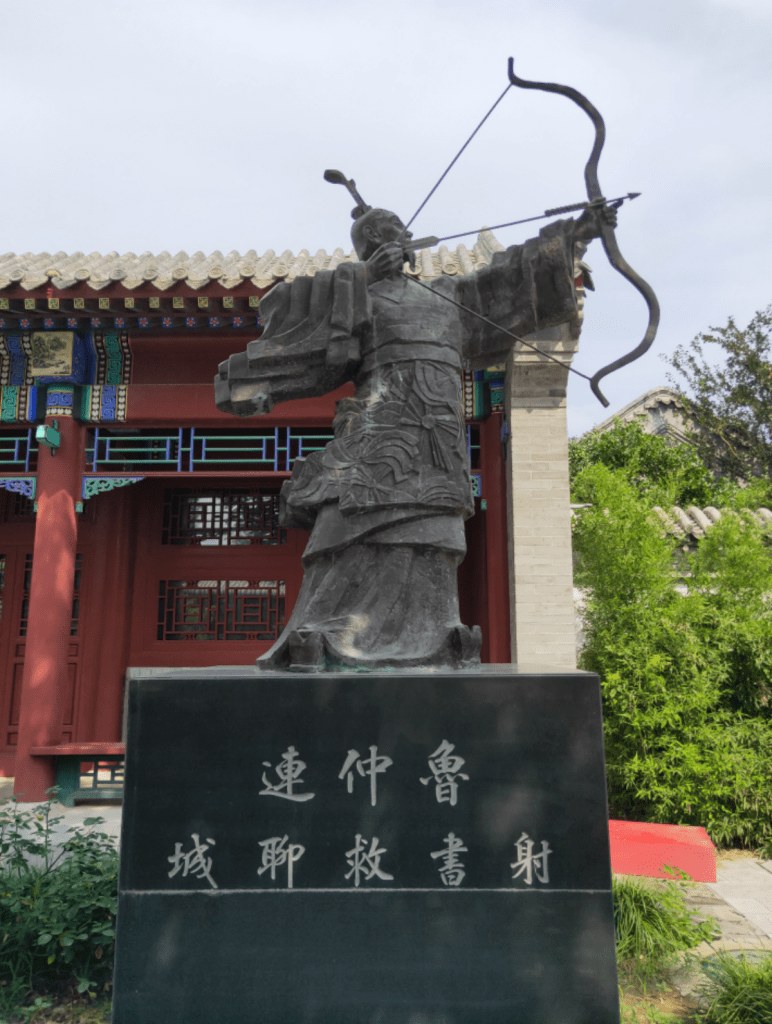
Tian Dan was on the brink of attacking Di, a small state, when he consulted Lu Zhonglian, a renowned intellectual and lobbyist. Lu Zhonglian cautioned, “General, breaking through the city of Di will prove challenging.” Dismissing the advice, Tian Dan asserted his previous triumph over the larger forces of Yan with a meager army in Jimo. Without bidding farewell, he mounted his chariot and commenced the siege on the city of Di.
After three months of unsuccessful attempts, He caught wind of the children of Qi singing a taunting rhyme: “A hat as big as a winnow basket, a sword as long as it touches the chops; the city of Di stands impregnable, with carcasses piled up to the hilltop.” Concerned, Tian Dan sought out Lu Zhonglian for guidance. He acknowledged, “Professor, you foresaw my failure in breaking through the city of Di. Please enlighten me on the reasons.”
Lu Zhonglian explained, “During the siege at Jimo, General, you exhibited an unwavering commitment – weaving brackets upon sitting down, and leaning on a shovel upon standing up. You led the soldiers in songs, urging them to ‘Rush forward when the temple where we worship is gone! Where do we belong when the spirits of our ancestors are homeless?’ At that time, General, you held a resolute determination to fight to the death, with soldiers fully expecting not to return alive. Every one of them fought with utmost intensity, tears in their eyes. This was the spirit that led to the victory over the Yan army.”
“Nowadays, General, you enjoy the enfeoffments from Ye in the east and entertainment from Zishang in the west. You traverse between the rivers Zi and Sheng, adorned with a gold belt, leading a life filled with happiness and devoid of any immediate threat of death. This stark contrast in circumstances is why the siege of Di has met with failure.”
Touched by Lu Zhonglian‘s insight, Tian Dan declared, “I still possess the will to succeed; Professor has reignited my motivation.” The next day, he toured the battlefield, standing shoulder to shoulder with his soldiers, invoking their fighting spirit with drumsticks. Finally, the people of Di capitulated, yielding to Tian Dan‘s renewed determination and leadership.
King Min of Qi sought to eliminate Lord Mengchang following the annexation of the kingdom of Song. Fleeing to the kingdom of Wei, Lord Mengchang was appointed as the prime minister by the Wei king. Lord Mengchang, in turn, orchestrated an alliance among several kingdoms to launch an attack on Qi. With King Min’s death, his son, King Xiang of Qi, restored the kingdom, prompting Lord Mengchang to withdraw to his fief, the state of Xue. There, he maintained a neutral stance, detached from other kingdoms.
Wary of Lord Mengchang, King Xiang of Qi, upon his inauguration, pursued an alliance with him. Meanwhile, internal strife arose as Lord Mengchang‘s sons vied for the inheritance of their father’s title and land. The kingdoms of Qi and Wei joined forces, ultimately extinguishing the state of Xue. Regrettably, Lord Mengchang passed away without any descendants.
The Duke Min of Lu passed away, and his son Chou succeeded him, assuming the title of Duke Qing of Lu.
The 37th year of King Nan(278 B.C.)
The foremost military commander of the Qin Kingdom, Bai Qi, holding the esteemed title of Daliangzao, spearheaded a military campaign against the Kingdom of Chu. Under his command, the city of Ying, which served as the capital of Chu, fell into Qin‘s control. Additionally, he orchestrated the destruction of the city of Yiling. The armed forces led by King Xiang of Chu crumbled, rendering them incapable of further resistance. Consequently, the King of Chu relocated the capital to the northeastern city of Chen. The Kingdom of Qin subsequently renamed Ying as Nanjun. In recognition of his achievements, Bai Qi was honored with the distinguished title of Lord Wu’an.
The 38th year of King Nan(277 B.C.)
Lord Wu’an of Qin successfully captured both the city of Wu and the region of Qianzhong, solidifying Qin‘s control over these territories. As a strategic move, he went on to establish the commandery of Qianzhong to consolidate administrative control.
Meanwhile, in the Kingdom of Wei, King Zhao passed away. Following his demise, his son Yu ascended to the throne and assumed the title of King Anxi of Wei.
The 39th year of King Nan(276 B.C.)
Lord Wu’an of Qin launched an offensive against the Kingdom of Wei, resulting in the conquest of two cities under Qin‘s dominion.
In the Kingdom of Chu, the king integrated the armed forces of the eastern territory, amassing an additional one hundred thousand soldiers. He strategically directed this potent force westwards, successfully conquering fifteen towns situated to the south of the Yangtze River.
In the Kingdom of Wei, King Anxi bestowed the title of Lord Xinling upon his brother Wuji.
The 40th year of King Nan(275 B.C.)
The Marquis Rang, who held the esteemed position of prime minister in the Qin Kingdom, spearheaded a military campaign against the Kingdom of Wei. In response, General Pu Yuan from the Kingdom of Han intervened in support of Wei. However, Marquis Rang‘s forces triumphed decisively, resulting in the beheading of forty thousand soldiers from the Han army. Pu Yuan, in retreat, sought refuge in the city of Qifeng. To secure peace, the Kingdom of Wei conceded eight cities to the Kingdom of Qin.
Undeterred, the Marquis Rang initiated another assault on the Kingdom of Wei, this time defeating General Mang Mou. The Qin forces subsequently entered the city of Beizhai and proceeded to lay siege to Daliang, the capital of Wei. Faced with the relentless pressure, the Kingdom of Wei ceded the Wen area in pursuit of a peaceful resolution.
The 41st year of King Nan(274 B.C.)
Once again, the Kingdom of Wei forged an alliance with the Kingdom of Qi. In response, Marquis Rang of Qin orchestrated another military campaign against Wei. The Qin forces, displaying formidable prowess, successfully captured four cities and inflicted heavy casualties by beheading forty thousand soldiers from the Wei army.
 Reflection by Rio Grande
Leave a comment